Anton Bruckner's Fourth Symphony, the so-called "Romantic", is characterized by a long history of development, stretching from the first drafts in 1874 to the third version in 1888. However, this version, which was common until the 1950s, was rejected in the "version dispute", and instead the second version from 1878/80 became the prevailing version during the second half of the 20th century. The third version was only rediscovered in 1996 by the Bruckner researcher Benjamin Korstvedt and re-edited in 2004. This version, regarded by Bruckner as the final version, which contains a few cuts and mainly tempo adjustments in favor of a slower playing style, was presented by conductor Rémy Ballot and the Altomonte Orchestra at the St. Florian Brucknertage Festival 2021.
SOMM Recordings announces Bruckner from the Archives, a major new, six-double-CD-volume series celebrating the 200th anniversary of Anton Bruckner’s birth in 1824. Conceived and designed by SOMM Executive Producer and acclaimed Audio Restoration Engineer Lani Spahr with support from the Bruckner Society of America, the series features rare archival recordings of Bruckner’s 11 symphonies and selected other important works, many appearing for the first time in any form.
Recordings have been sourced from the more than 11,000 Bruckner performances in the Archive of John F. Berky, Executive Secretary of the Bruckner Society of America, who also acts as Consultant for this important series.
Across the series, authoritative notes by Professor Benjamin M. Korstvedt, Jeppson Professor of Music at Clark University, Worcester, Massachusetts, President of the Bruckner Society of America and member of the Editorial Board of the New Anton Bruckner Complete Edition, trace Bruckner’s life and compositional development from the Symphony in F minor (1862) to the unfinished Ninth Symphony (1894).
Volume 1 (SOMM 5025) will be released on 15 March 2024 and includes two Symphonies: in F minor (Bruckner Orchestra, Linz conducted by Kurt Wöss) and No.1 in C minor, ‘Linz’ (Bavarian Radio Symphony Orchestra, Eugen Jochum); Bruckner’s only String Quartet (Koeckert Quartet); Psalm 112 (Vienna Akademie Kammerchor, Vienna Symphony Orchestra, Henry Swoboda); the Overture in G minor (WDR Symphony Orchestra, Cologne, Dean Dixon); the March in D minor, and Three Pieces for Orchestra (Vienna Symphony Orchestra, Hans Weisbach).
Future volumes include never-before released performances conducted by noted Brucknerians Eugen and Georg Ludwig Jochum, Eduard van Beinum, Volkmar Andreae, Christoph von Dohnányi, Herbert von Karajan, and Joseph Keilberth. Lani Spahr’s previous SOMM releases include the lauded four-volume sets Vaughan Williams Live (ARIADNE 5016, 5018-20) and Elgar Remastered (SOMMCD 261-4), and a Gramophone Editor’s Choice for “superb audio restorations [bringing] performances fully to life” for Elgar from America, Volume 3 (Ariadne 5015-2).
The Bevan Family Consort return with a selection of choral works celebrating the season of lent and passiontide, including a world premiere recording of of the six-voice Lamentations by Alfonso Ferrabosco the Elder. The programme follows the liturgy from the beginning of Lent on Ash Wednesday to the darkness of Holy Saturday. For each day of Tenebrae, they've included a setting of a Lamentation. "Recording an album with the family is always moving, but this one was especially so because of the theme of the music... Like previous albums, this one contains well-worn family favourites beside newly-discovered or un-recorded rarities, thanks to our in-house editor and arch-polyphony enthusiast, Francis... We hope you enjoy our selection and that it can be a prayerful accompaniment to the Lenten season." - Michael Bevan
Anton Bruckner: Symphony No. 8 in C Minor, Version 1890
Profil
CD
$20.99Mar 13, 2026
This symphony is the creation of a giant, and it surpasses all of the master's other symphonies in terms of it's spiritual dimension, it's fearsomeness, and it's grandeur. It's success is almost unprecedented, despite the most ominous warnings of a variety of Cassandras, and that includes several close colleagues. The work was a complete victory of light over darkness, and the storm of enthusiasm which broke out with elemental force when the individual movements had faded away was mighty. In short, it was a triumph that a Roman emperor could not have wished for more beautifully. (Hugo Wolf)
Anton Bruckner: Symphony No. 3 in D Minor - Version 1873 & A
Profil
CD
$32.99Apr 17, 2026
A quest for absolute music Despite a number of setbacks, Bruckner's music has prevailed. His struggle for form and perfection was an expression of his deepest artistic conviction and an inner mission. Like Beethoven, he strove for 'absolute music': a soundscape beyond mere expression that speaks for itself. His Third Symphony in particular, the one 'where the trumpet begins the theme', is an impressive testimony to this aspiration, and it still moves us today: powerful, timeless, and true." Gerd Schaller
Bruckner: Symphony No. 7 / Keller, Concerto Budapest
TACET Musikproduktion
CD
$10.99$21.99Save 50%Mar 01, 2024
Cut or Uncut?
Anton Bruckner would have been 200 years old in 2024. Instead of using flowery but ultimately helpless advertising slogans to promote the 100th release for the Bruckner Year, we are trying to encourage people to think about production processes in classical music with a special release. What is a recording actually about?
Anton Bruckner's 7th Symphony twice in full length, each time on one CD. A live recording (uncut) and a studio production (cut) under identical conditions. Compare them! And don't allow your judgement to be swayed by different recording circumstances!
This comparison would not have been possible without András Keller and Concerto Budapest. András Keller follows an unbroken European tradition that stretches way back into the last century, perhaps even as far back as Anton Bruckner himself. And the monumental arches and climaxes in Anton Bruckner's music are perfect for every listener to ask themselves: What do I want from a recording? What moves me more, live or produced, cut or uncut?
Bruckner, Dvorak, Puccini & Mahler: Ich leb’ allein in meinem Himmel - The Singer Gunther Groissbock
Gramola Records
DVD + Blu-Ray
$38.99May 03, 2024
He makes you feel what it feels like to be alone at the top. Whoever sees and hears him suddenly knows more about the search for the right path that drives every serious person. His stage characters touch the heart. The bass Günther Groissböck embodies kings, scholars, philosophers in the great opera houses of the world; he plays priests, mythical creatures, gods. You could say he specializes in solitary figures.
At first glance, however, Günther Groissböck does not seem like someone who has personal experience with the subject of loneliness. The singer stands, works, acts on and off stage in intensive contact with people. He is married, father of a daughter, in the middle of life or, as conductor Philippe Jordan puts it: “He burns for many things in life, not only for art”. Can you play what you don’t know? How does he shape his stage characters? What are the building blocks for the play? When does the instrument, his voice, touch the audience? How much public spirit, how much individuality does an opera singer need today? And where does Günther Groissböck get the incredible energy he radiates on stage?
For two years we accompanied the artist from Waidhofen an der Ybbs (Lower Austria) with our camera, on night journeys and day trips. At rehearsals, sports, and performances. We filmed him as the black-robed Kaspar, as the powerful King Philip, or as a searcher in the villa of Richard Strauss. The result is a film portrait that tells of a special attitude to life; of loneliness as a source of artistic strength; of a man who can fill his voice with content from within. The film about Günther Groissböck tells of two lines from a Rückert poem, set to music by Gustav Mahler: “I live alone in my heaven, in my loving, in my song.”
ANTON BRUCKNER (1824-1896) - Symphony No. 7 in E major Arrangement for ensemble by Hanns Eisler, Erwin Stein and Karl Rankl During the coronavirus pandemic, when large symphonic performances were almost impossible due to contact restrictions and social distancing rules, the ensemble wanted to enable people to experience the depth and spirituality of Bruckner's music despite the social distancing and isolation restrictions. While there are normally around 80 musicians on stage when Bruckner's 7th Symphony is performed, the Stuttgart-based Ensemble Balance performs the work with just 11 instrumentalists, the result being that this condensed chamber music remains a unique experience, even without the pandemic! And this is because it is precisely in this concentrated, emotionally condensed form that Bruckner's compositional artistry becomes seductively clear and audible! The in-depth exploration into his work during the rehearsals for this recording in August 2020 had the effect of welding the ensemble together in both an artistic and a personal way, and this intimate connection between each and every musician, combined with the spirit of Bruckner's composition, can be clearly felt and heard in this performance by Ensemble Balance.
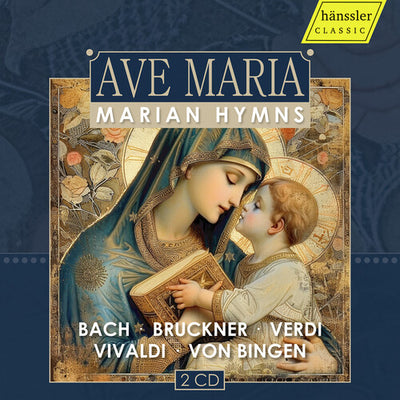
Marien Hymns Masterpieces of musical Marian devotion over the centuries, composed by the greatest composers of the time as well as well-known traditional hymns, interpreted by renowned soloists and ensembles such as the Gachinger Kantorei Stuttgart under Helmuth Rilling, Renata Tebaldi, the Don Cossack Choir Serge Jaroff or the Stuttgart Hymnus Choir Boys' Choir.
Bruckner: Ave Maria - Musik fur Chor und Blaserensemble
Carus
CD
$22.99May 10, 2024
Anton Bruckner 200 (1824-2024)
A wide-ranging selection of Anton Bruckner's sacred works for choir and brass ensemble is presented by the NDR Choir Hamburg under the direction of Hans-Christoph Rademann.The pieces extend almost chronologically over 50 years, allowing the compositional development of this deeply religious composer to be traced.
Despite all the warnings from the prophets of doom, Bruckner's music has thankfully prevailed. Bruckner was always in search of the ideal structure for his symphonies. Dissatisfaction and perfectionism both caused him anguish and served as motivation in his determination to advance on an artistic level. His goal was to compose absolute music in the spirit of Beethoven. It is his Third Symphony above all, "in which the trumpet introduces the theme", that encapsulates this striving for absolute music - music that is timeless and continues to touch people's hearts.
Bruckner: Symphony no. 7 on Vinyl / Haitink, Netherlands Radio Philharmonic
Challenge Classics
Vinyl
$85.99Apr 21, 2023
Bernard Haitink farewell concert to Amsterdam and the Netherlands, dated June 2019. One of his most beloved works, Bruckner’s Seventh Symphony, in a first ever release. An outstanding account in a compelling sound, furtherly enhanced by the 180 grams double-vinyl LP format.
Bruckner: Symphony No. 4 in E-Flat Major "Romantic"
Profil
CD
$9.99$19.99Save 50%Jun 07, 2024
Bruckner requests a favourable reception for his Fourth Symphony, commending the work in these terms: "It is the most accessible and popular of my works and was a huge success when performed in Vienna. As a consequence of a recent letter from Munich, our Emperor has begun to take an interest in me."
Anton Bruckner's Second Symphony is certainly one of the most interesting symphonies in the cycle, even for musical amateurs, due to a number of special features. Inside Bruckner 2024: The complete symphonies in all essential versions.
Organist Lukas Hasler presents Gold, a radiant debut album featuring his own transcriptions and arrangements for organ. What began five years ago with a fascination for Mozart's G major Sonata in Edvard Grieg's two-piano version grew into an artistic journey into the transformative world of transcription. Hasler discovered in the organ an instrument capable not only of recreating orchestral and pianistic textures, but of reshaping them into something entirely new. To capture this vision, he turned to the iconic Golden Hall of the Musikverein in Vienna, whose expressive possibilities and glowing acoustics inspired both the selection of repertoire and the album's title. Gold offers a rich spectrum of colours and styles, from the jubilant brilliance of Bach's Sinfonia (in Dupré's vibrant transcription) to the tender intimacy of Schumann's Romance, recorded here for the first time on organ. Hasler brings theatrical flair to Lemare's arrangement of Carmen Fantasy, profound stillness to Beethoven's "Moonlight" Adagio, and symphonic vitality to Bruckner's Nullte Scherzo, while Mozart's G major Sonata - filtered through Grieg's imagination and Hasler's own artistry - bridges Classical clarity and Romantic warmth. Rachmaninoff's stormy Prelude, Lefébure-Wély's sparkling Boléro, and the playful, genre-bending Vienna Calling complete a programme that celebrates invention, personality, and the golden richness of the Viennese organ sound.
Bruckner: Mass in E minor & Motets - "Bruckner's World", an introduction to the works by Markus Vanhoefer
BR Klassik
CD
$29.99May 03, 2024
In addition to his symphonies, Anton Bruckner is best known for his sacred works: his stirring masses and his deeply moving a cappella motets. On this new BR-KLASSIK CD, to mark the Bruckner Year 2024, the Bavarian Radio Chorus and the Münchner Rundfunkorchester conducted by Peter Dijkstra present his Mass No. 2 together with five well-known motets and the two short Aequali for three trombones from 1847. The new studio recordings were made in connection with the opening concert of the 2023/24 season on October 28, 2023. On a second CD, "Bruckner's World" by Markus Vanhoefer offers not only an introduction to the recorded works but also a detailed description of the life and work of this important Late Romantic composer.
After Bruckner's uncommissioned Mass (No. 1) in D minor had brought him to the attention of a wider public – following its premiere on November 20, 1864 in the Old Cathedral in Linz and a repeat performance in the city’s Redoutensaal – Bishop Franz Joseph Rudigier commissioned a second mass from the composer. Bruckner wrote the work between August and November 1866, and it was to be premiered at the consecration of the Votive Chapel of the New Cathedral; due to delays in the construction work, however, the performance could not take place until September 29, 1869. The premiere of the Mass (No. 2) in E minor for eight-part mixed choir and wind ensemble was also a great success, and Bruckner described it as “the most glorious day” of his life. The unusual instrumentation was due to the occasion and the open-air performance venue on the cathedral building site (the new chapel had proven too small for the choir). The work derives its particular tension from the sharp contrasts between archaic, psalm-like monophony and a strictly polyphonic movement structure modeled on Palestrina, combined with the "modern" wind accompaniment in sweeping, romantic harmony.
Bruckner thoroughly revised the Mass (No. 2) between 1876 and 1882, and the premiere of the second version in the Old Cathedral on October 4, 1885, as part of the Diocesan Jubilee in Linz, was once again an outstanding success. The composer "stood at the organ during the performance and gazed rapturously at the vault of the cathedral, his lips moving in silent prayer."
Bruckner's sacred motets are characterized by Catholic worship and the church spaces that were Bruckner's home from childhood. In 1837, at the age of 13, he was admitted as a choirboy to the Augustinian canons' monastery of Sankt Florian near Linz, where he worked as an organist from 1848 to 1855. His religious devotion and early influence meant that he initially saw himself as a church musician, before broadening his scope to include symphonic music - in whose sound architecture the organ also found an audible echo.
The two pianists, Julius Zeman and Shun Oi, have made an exquisite and historic contribution to the Bruckner Year 2024 – celebrating the 200th birthday of the great symphonist by recording Anton Bruckner's Seventh Symphony in a version for two pianos. Some music lovers may ask in surprise, "For two pianos, not for piano four hands?" However, anyone who, like me, has heard the version for two pianos in a performance – on two Bösendorfer concert grand pianos, performed by the two pianists on this recording – will not find the answer difficult. The volume of sound that a symphony by Anton Bruckner unfolds in its orchestral form has a magnificent, even overwhelming effect, and something of this sonic power must also be conveyed by the piano version if it is not to do without a constitutive feature of this music. I was convinced by the live impression of the performance on two pianos: it truly sounded like "Bruckner," and I could only place the deep and moving impression of this performance alongside the best orchestral performances.
— Dr. Thomas Leibnitz
REVIEW:
Bruckner’s symphonies don’t easily lend themselves to piano reductions. The problem largely lies within the composer’s long stretches of string tremolos. If one literally replicates these effects on the piano, they sound like the worst clichés of silent movie accompaniments and grow instantly tedious. However, in their world premier recording of Hermann Behn’s two-piano Seventh Symphony arrangement, Julius Zeman and Shin Oi successfully circumvent the problem by subjecting the tremolos to altered dynamics, speeds and articulations. This ensures more textural variety, and makes it easier for the pianists to focus on the contrapuntal foreground. Their tempo fluctuations in the first movement have an organic ebb and flow, allowing for assiduous transitions and for themes to take full shape.
Shifts in color and balance beautifully demarcate the Adagio’s harmonic twists and turns. It’s all too easy for even the best pianists to get bogged down while approaching the big C Major climax, yet Zeman and Oi avoid this by minimizing accented downbeats with their eyes and ears on the long lines. They bring more cogent horizontal interplay to the Scherzo than in many orchestral performances, abetted by a moderate basic tempo. And the pianists bring impressive timbral character to the Finale’s themes; note, for instance, the mellifluously voiced chorale against the warmth of the detaché bass lines in octaves. The sonics are a tad dry for music that calls out for a more resonant ambience, but that matters little in light of the pianists’ excellent ensemble values and intelligent music making. Naturally one shouldn’t be without a recording of the orchestral original, but if you want to hear Bruckner’s Seventh Symphony on two pianos, look no further.
BR-KLASSIK is dedicating a second portrait edition to the eminent Dutch conductor Bernard Haitink, containing a total of 9 CDs. Bernard Haitink died in October 2021; he would have turned 95 in March 2024.
These exceptional live recordings document the long-standing and intensive collaboration between Bernard Haitink, the Bavarian Radio Chorus, and the BRSO. Since Haitink conducted a subscription concert for the first time in 1958, he repeatedly led the BRSO for over six decades—sometimes in the Herkulessaal of the Residenz, sometimes in the Philharmonie im Gasteig. The orchestras’ musicians and singers were just as happy to work with him as the Bayerischer Rundfunk’s sound engineers.
The box set includes complete recordings of Beethoven's Symphony No. 9 (CD 1) from 2019, Bruckner‘s Symphonies No. 4 (CD 2) from 2012, No. 7 (CD 3) from 1981, and No. 8 (CD 4 / CD 5) from 1993, as well as his Te Deum (CD 4) from 2010. Also featured are Dvořák‘s Symphony No. 7 from 1981 and his Scherzo Capriccioso (CD 6) from 1981, Mahler‘s Symphony No. 7 (CD 7) from 2011, and Shostakovich's Symphonies No. 8 (CD 8) from 2006 and No. 15 (CD 9) from 2015.
Bruckner’s Fifth is eminently suited to an arrangement for performance on the organ above all because of its musical texture. In no other Bruckner symphony, for example, does counterpoint play such an important part. I am thinking in particular of the great fugue in the final movement. It really does seem as if many passages of this magnificent work were composed as if with the organ in mind, even though the Fifth is not a piece for organ at all, being in the first place a symphonic work. And yet it lends itself admirably to the extraction of a compositional substrate with no loss of essential content. That cannot be said of all Bruckner’s symphonies. Of all his symphonies, in my opinion, the Fifth, Eighth and Ninth are most amenable to an arrangement for organ. Building on the compositional core, it is the orchestral treatment above all that plays a key role. If this is lacking, an arrangement of the work can deprive the work of its grandeur. That is again at risk if one attempts to copy the orchestra or to transpose certain orchestral effects one-to-one onto the organ. Such an approach is generally unsatisfactory, because organ writing is governed by different rules than those applying to orchestral scoring. It would be fatal to make the organ rival the orchestra. My aim from the start was to avoid imitating the orchestra and to create a work specifically for organ in the manner of an organ symphony.