The prizewinning French composer Laurent Petitgirard has earned acclaim for his unusually powerful theatrical imagination. His strikingly creative ballet score for Le Petit Prince (The Little Prince) was first performed at the Avignon Opera in May 2010. Petitgirard centres his score around a chorus, alternating instrumental sonorities to remarkable effect, and evoking the essence of Antoine de Saint-Exupéry's text in it's movement from dream to reality, and from mystery to innocence.
Roussel: Le Festin de l'Araignee, Padmavati / Deneve, Royal Scottish
Naxos
CD · 1 disc
$9.99$19.99Save 50%Jan 31, 2012
One of Roussel’s most performed orchestral works, The Spider’s Web was composed during his earlier impressionistic period, and depicts the beauty and violence of insect life in a garden. Roussel’s experiences as a lieutenant in the French Navy first introduced him to Eastern influences, and the ‘opera-ballet’ Padmâvatî was inspired by his later visit to the ancient city of Chittor in Rajasthan state of western India. It uses aspects of Indian music to evoke this city’s legendary siege by the Mongols. This is the fifth and final volume in Stéphane Denève and the RSNO’s acclaimed survey of Roussel’s orchestral works. “An excellent disc, splendidly and idiomatically performed and a superb advertisement for composer, conductor and orchestra. Highly recommended.” (Gramophone on Vol. 4 / 8.572135)
Great fun! A new full-length ballet, especially one as tuneful as this, with an exciting story, is always a welcome addition to both the ballet repertoire and to recorded music.
José Luis Domínguez, who also conducts on this set, is a significant figure in Chilean music as a conductor. This ballet is his first large-scale symphonic work. It is little surprise that, like many conductor-composers, he has such a sure sense of orchestral balance and capability, something evident throughout this work.
The ballet tells a simple story – with plenty of action, set in California – of Joaquín Murieta, a nineteenth century brigand, perhaps the inspiration for Zorro. His origins are obscure, but he has been adopted as something of a folk hero in Chile from where he might have originated. Pablo Neruda wrote a play about him, later turned into an opera by Sergio Ortega. Those works end with a gruesome finale as Murieta is shot and beheaded.
Domínguez ignores that, instead creating a tale set during the Gold Rush, in which Murieta and his men come to the rescue of a town under threat from the villainous Galgos. There is no decapitation but rather the happy outcome of reunion with the beloved Teresa. Think of this as a blend between Robin Hood and The Magnificent Seven.
The comparison is apposite, as Domínguez is quite specific that his music is inspired by symphonic soundtracks of composers such as Korngold, Herrmann and Williams. That is a clue not only to its style, but also to his idea that it should work as a stand-alone piece. This recording is a must for anyone who enjoys the great film-scores: all the virtues of sweeping themes, varied instrumentation and memorable tunes are here.
Performances are committed and in the best Hollywood tradition, with good recorded quality.
If a great ballet company such as the Royal Ballet were to take this into their repertory, one could imagine it quickly becoming a popular hit, rather in the manner of Khachaturian’s Spartacus. A fine ballet conductor, like Barry Wordsworth, would relish this score.
– MusicWeb International (Michael Wilkinson)
Track Listing
Act I
Prologue [4.26] The town’s people [3.53] Teresa [7.12] The Galgos’ Entrance (The imprisonment of the innocent) [3.17] Joaquín Murieta’s entrance [3.20] Teresa and Joaquín (pas de deux) [4.48] Tresdedos [1.50] Exit of the town’s people [1.30] El Caballero Tramposo (The drunk variation) [2.04] Murieta’s entrance (The freeing of the prisoners – The battle) [6.27] Murieta and Tresdedos [3.25] The leader of the Galgos interrogates the disguised Murieta [2.37] The bustling town [2.04] The women’s entrance (Variation) [4.40] The leader of the Galgos flirts with one of the wives [6.07] Interlude (Teresa’s Song) [3.48] The town’s festivities and the Nobleman’s Spanish Dance [5.07] The toast and the people’s dance [4.26] The disguised Murieta’s intrusion [4.36] Entrance of Murieta’s men and battle [6.15] Teresa and Joaquín’s reunion (Pas de deux) [11.17] Epilogue [2.31]
At first glance Tchaikovsky does not seem easily to fit the "Chill" bill. He is known for pieces such as the 1812 Overture, music which is impassioned and animated in distinctly Russian style, often fiery, even ballistic, and infused with darker moments inspired by the composer's personal turmoil. However he also wrote some of the most beautiful, fragile and ethereal ballet music that has ever been choreographed, as well as lyrical slow symphonic movements and haunting songs. His unique talent lay in his inspired and inventive use of melody, seen at it's best in works such as the Nutcracker with it's myriad infectious tunes. Many of Tchaikovsky's melodies are based on folksongs he collected, predominantly Russian and Ukrainian but also Polish, Italian, Spanish and French (this last seen in the Piano Concerto No. 1, in this collection).
This special ‘241’ set celebrates ten years of Gianandrea Noseda’s Musica Italiana series. Recording with both the BBC Philharmonic and the Orchestra Teatro Regio Torino, Noseda has shown a remarkable commitment to championing long-forgotten scores by well-known Italian composers as well as the finest works by altogether neglected ones. Both discs feature excerpts of more substantial orchestral and operatic works by several Italian late-Romantics and early-mid-20th c. modernists.
Following successes with the Firebird (Naxos 8571221) and Petrushka (Naxos 8571222) Stravinsky's ballet the Rite of Spring was the most ambitious and controversial result of his collaboration with Sergey Dyagilev's Ballet ruses the premiere performance in 1913 leading to a riot in the theatre. The Rite of Spring portrays atmospheric and dramatic pagan rituals which culminate in a sacrificial dance during which the Chosen One dances herself to death. The Dumbarton Oaks concerto represents Stravinsky's later neoclassical style referring to Bach in it's compact scale and transparency of language.
No artist has penetrated the human soul more deeply than Rembrandt van Rijn (1606-1669). Renowned as a young man for his portrayal of individual character and expression, as he withdrew more from the world he made his art a revelation of the inner life of his subjects. On this CD, the world of Rembrandt is given a musical perspective with a carefully chosen selection of pieces by the finest composers of his time. Inside, Hugh Griffith provides explanatory notes on his life and musical environment. 1 CD with full color, illustrated, explanatory booklet.
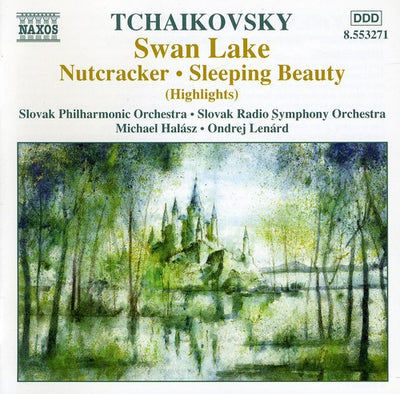
Tchaikovsky: Nutcracker, Swan Lake, Sleeping Beauty Excerpts
Naxos
CD · 1 disc
$9.99$19.99Save 50%Oct 24, 1995
1987 release with highlights from his famous ballets. Tchaikovsky (1840-1893) performed by the Slovak Philharmonic Orchestra recorded at Concert Hall of the Slovak Philahrmonic June 20-25, 1987 & Czecho-Slovak Radio Symphony Orchestra recorded at Concert Hall of the Czecho-Slovak Radio in Bratislava October 13-20, 1987 conducted by Michael Halasz & Ondrej Lenard. The music of Tchaikovsky, in spite of the reservations of contemporaries at home and abroad, must seem to US both essentially Russian and firmly in the West European tradition. In Vienna the critic Eduard Hanslick was able to complain of the "trivial Cossack cheer" of the finale of the Violin Concerto, but in Russia Tchaikovsky never went far enough to please the self-appointed leader of musical nationalists, Balakirev. While by no means a miniaturist, he nevertheless excelled in his mastery of the smaller forms necessary in ballet, writing music that displayed his remarkable gifts of melody and skill in orchestration.