Winner of the coveted 2002 Grawemeyer Award and one of the youngest composers ever to be awarded the Pulitzer Prize, Aaron Jay Kernis is among the most distinguished musical figures of his generation. Conceived as a concerto for toy piano and orchestra, and with touches of Indonesian gamelan, French lyricism and jazz, Three Flavors appears here in it's final version, adapted by soloist and long- term collaborator Andrew Russo. Commissioned for renowned violinist James Ehnes, the introspective Two Movements (with Bells) is a memorial to the composer's father with echoes of blues singing and improvisatory impetuousness, while the virtuoso Superstar Etude No. 3 is his homage to Gershwin and the blues. The Pulitzer Prize-winning composer Aaron Jay Kernis (b. 1960) studied composition with American heavyweights John Adams, Jacob Druckman, Morton Subotnik and Charles Wuorinen. He has developed a truly eclectic musical language over time, initially rigorous but evolving toward a new transparency and emotional eloquence. He incorporates influences of Latin rhythms, jazz and rap into his work as willingly as the harmonic worlds of the Romantic masters, the Renaissance and Hildegard von Bingen.
Daugherty: This Land Sings (Inspired by the Life and Times of Woody Guthrie)
Naxos
CD
$9.99$19.99Save 50%May 08, 2020
In ‘This Land Sings,’ Grammy Award-winning composer Michael Daugherty has created an original musical tribute to the singer-songwriter and political activist Woody Guthrie (1912-1967). Traveling the backroads of America from coast to coast with a guitar and harmonica, Woody Guthrie performed folk songs of love, wandering and social justice during the Great Depression and the Second World War. Daugherty has composed his own original songs and instrumental interludes that give haunting expression, ironic wit and contemporary relevance to political, social and environmental themes from Guthrie’s era. Under the baton of Grammy Award-winning conductor David Alan Miller, the Albany Symphony’s new music ensemble Dogs of Desire, joined by soprano Annika Socolofsky and baritone John Daugherty, give a poignant and rousing performance.
-----
REVIEWS:
For the most part, Daugherty doesn’t set Guthrie’s tunes at all, although This Land Is Your Land turns up in a couple of numbers. Instead, he writes words of his own and draws on texts from elsewhere in the progressive strain of thought, dating back to Mark Twain, that animated Guthrie’s production. It all adds up to something quite unlike anything anybody else has done before. Listeners are going to have their own reactions, but this is original stuff, ideally and flexibly performed.
– AllMusic Guide (James Manheim)
Michael Daugherty traveled around the dust bowl of the United States before commencing the work, savoring the backdrop to Guthrie’s life as a writer and performer. It has resulted in an overture and sixteen vocal and instrumental tracks, the words for the songs written mostly by Daugherty. They are funny; they question life and our existence; suffering and love, all expressed in a mix of classical, folk, and jazzy rhythms. It is certainly a different experience that takes the composer down a new road, particularly so in the early part of the score. The excellent punchy sound is ideal for the work. Do listen to it.
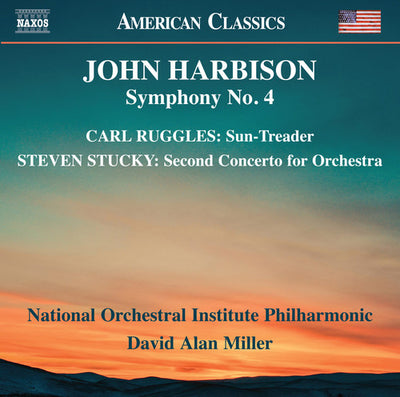
Harbison, Ruggles & Stucky: Orchestral Works / Miller, National Orchestral Institute Philharmonic
Naxos
CD
$9.99$19.99Save 50%Jun 08, 2018
Naxos have come a long way in three decades. Their product is no longer as cheap as chips, but they have few rivals when it comes to yearly volumes or breadth of repertoire. I’m particularly grateful for some of their long-running series, especially those devoted to Americana and music for wind band. I’ve reviewed a fair few albums from both strands, a number of which contain world premieres or works otherwise unknown to me. At the same time, I’ve noticed a general improvement in recording quality, with some newer releases sounding as good as those offered by premium-price labels.
The American Classics project is probably the one I value most, not least for its ability to surprise and stimulate. And just as Naxos’s technical standards have risen, so too has the quality of ensembles and conductors featured. This pleasing state of play is epitomised by a very recent Michael Daugherty album, Trail of Tears: three brand-new concertos, one with the peerless percussionist Dame Evelyn Glennie, music and musicians well served by fine sonics. As it happens, that release introduced me to the conductor David Alan Miller, who also directs this mixed programme of 20th- and 21st-century works by Carl Ruggles, Steven Stucky and John Harbison.
Ruggles’ Sun-Treader, which takes its title from Robert Browning’s poem, Pauline, is a technically rigorous construct that’s also very accessible. Although the piece was premiered in Paris in 1932, it had to wait another 34 years for its first US performance, with Jean Martinon and the Boston Symphony. And while the National Orchestral Institute Philharmonic isn’t exactly a household name – it’s an ad hoc band, drawn from members of the National Orchestral Institute each June – they are highly accomplished players, for whom this music holds no terrors.
Full, firm, and remarkably forensic, Miller’s Sun-Treader is more detailed and, yes, more colourful than Tilson Thomas’s. Producer-engineer Phil Rowlands’ spacious, recording certainly helps to ‘open up’ a work that can seem impenetrable at times. All of which adds up to a thoughtful, exploratory performance that’s very different from MTT’s more urgent, intensely dramatic one. The latter still sounds pretty impressive – the visceral timps a special treat – but I daresay an up-to-date remaster, similar to that provided for the recent BD-A of William Steinberg’s Planets and Zarathustra, would improve things even more. Top-notch accounts of Charles Ives’s Three Places in New England and Walter Piston’s Symphony No. 2 complete this bona-fide classic.
Steven Stucky’s second Concerto for Orchestra, premiered by the LA Philharmonic in 2004, received the Pulitzer Prize for music a year later. In his liner-notes, Robert Lintott says the piece is ‘rife with musical puzzles’, although I doubt most listeners will be aware of the composer’s compositional tricks and tributes. More apparent is Stucky’s homage to the genre – Bartók’s seminal concerto springs to mind – with soloists and various instrumental groups (‘combos’) allowed to strut their stuff. I can well imagine performers relishing both the good writing and the composer’s seemingly boundless good nature.
That’s certainly the case here, with Miller a sure and steady guide; indeed, he takes us on a fascinating trip, pointing out so much of interest along the way. What a tumble of tantalising ideas and sonorities, and how superbly rendered they are in this fine recording. Also, singly and severally, the players respond to this clever and compelling score with a zeal that most composers can only dream of. And as much as I admire Lan Shui, his performance lacks the chutzpah that makes Miller’s seem so rum and rakish. That said, the sound is refined, the playing light and luminous. The all-Stucky programme, which includes Dame Evelyn in Spirit Voices, is attractive, too.
The headline act is the Harbison symphony, commissioned by the Seattle SO for their centennial celebrations in 2004. In five movements – but not composed in that order – the work’s opening Fanfare reminds me of Leonard Bernstein in St Vitus mode. What exhilarating music this is, and how joyfully executed. The gnarly Intermezzo, with its gently shimmering gong in the background, is similarly engaging. The central Scherzo is catchy – goodness, there’s a lot going on here – and the Threnody has something of late Mahler about it. That said, Harbison’s ‘voice’ is very much his own, the Finale gaunt but not emaciated. Pinpoint playing and a strong pulse predominate.
This is a riveting work, delivered with deftness and dynamism, and I commend it to those looking for a way into the composer’s symphonic output. And given the impassioned authority of this performance, I’m tempted to forgo comparisons.
So often in comparative reviews I sign off with comments like: ‘This newcomer is pretty good, but…’. I’m happy to report that, with the possible exception of Miller’s still excellent Sun-Treader, there’s nothing to criticise here. Yes, Naxos really have come a long way since 1987. And that goes for this series, too; it just gets better – and becomes more valuable – with each new instalment.
The British composer Robin Stevens is a great talent waiting to be discovered by the global music community. His varied, stimulating and expressive work is exemplified by this collection of music for wind instruments, ranging from the jolly and accessible (yet very difficult to play) Concert Rondoto the darker, deeper and meaningful Grief’s Portrait. Stevens has a brilliant touch, and also is an excellent pianist, cellist and guitarist and plays all three instruments here, alongside some of the foremost instrumentalists from the musical hotspot of Manchester, England: John Bradbury (principal clarinet, BBC Philharmonic); John Turner (recorderist: Academy of Ancient Music etc.); Richard Simpson (principal oboe, BBC Symphony), Janet Simpson (former principal keyboardist, Hallé Orchestra); and freelance soloists Sarah Miller (flutes);Helen Peller (bassoon) and Lindsey Stoker (horn).
Over the last few years American composer George Tsontakis, winner of the Grawemeyer Award for Music Composition, has crafted three distinctive and exciting additions to the contemporary concerto repertoire. Anasa, for clarinet and orchestra, combines elements of the Klezmer tradition with dance themes inspired by the lyra and lauto, traditional Cretan instruments. In True Colors the trumpet journeys in harmonically vivid, jazz-tinged directions, while Unforgettable balances the meditative with the playful, moving from ballad to phantasmagoria in a double concerto of drama and drive.
These three works represent the first recording for Naxos by the National Orchestral Institute Philharmonic, which is composed of elite conservatory students from across the United States and abroad. The chosen works reflect the richness and variety of the American repertoire. A work of immense poignancy and power, John Corigliano's Symphony No. 1 is a commemoration of friends of the composer who died during the 1980s and '90s. Michael Torke's Bright Blue Music evokes rich lyricism couched in the composer's favorite key of D Major. The suite from Copland's Appalachian Spring is one of the great, quintessential American works.
Review:
Large-limbed, vivid, and intense, John Corigliano’s 1989 Symphony No 1 commemorates the Aids crisis, memorialising some of the composer’s friends who succumbed at a time when diagnosis meant death. It has also stood the test of time simply as good music, here performed superbly.
Migration Series / Mar de Setembro / A Shout, A Whisper, and A Trace
Naxos
CD
$9.99$19.99Save 50%Aug 09, 2019
Migrations provides a generous view of Derek Bermel's superb craftsmanship and eclectic style, in which classical forms, world music, jazz, blues and American folk music create a mix that reaches directly into the body and the heart. Commisioned by Wynton Marsalis, Migration Series has it's roots in African American music, it's impeccable counterpoint and biting rhythms expressed through orchestration that sounds like a city coming to life. Mar de Setembro was inspired by Luciana Souza's bell-toned voice and the intense feelings of Portuguese saudade, while A Shout, A Whisper, and A Trace honors Bartok's last years in New York, referring to the Concerto for Orchestra as well as to jazz and Balkan music.
Tower: Strike Zones / Glennie, McMillen, Miller, Albany Symphony
Naxos
CD
$9.99$19.99Save 50%Jul 23, 2021
Joan Tower is widely regarded as one of today’s most important American composers. The works heard here in their world premiere recordings are part of a growing legacy that one pundit has described as “The Power of Tower.” Strike Zones is tailor-made for percussionist Evelyn Glennie’s dazzling technique and impeccable musicianship. The work’s orchestration is crafted to enhance a stage filled with percussion instruments – while in Small they are contained on a single table, the soloist working like a brilliant chef. The piano concerto Still/Rapids was inspired by the glistening beauty and powerful force of water, and Ivory and Ebony, written as a test piece for an international piano competition, is infused with Tower’s “high-energy” signature.
REVIEW:
Another American Classics release features the music of contemporary composer Joan Tower. These fabulous premiere recordings give a good representation of the range of music Tower has been producing over recent years. It is particularly good to hear performances from Evelyn Glennie as one of a cast of top rate musicians here. The earliest work, Strike Zones, dates from 2001 and the latest, Small from 2016. Both these feature percussion. Still/Rapids combines piano and orchestra with the final piece, Ivory & Ebony being a test piece for an international piano competition.
Winner of a Pulitzer Prize and a Grammy® Award, Christopher Rouse is one of America’s most prominent composers of orchestral music, creating a body of work perhaps unequaled in its emotional intensity. Conceived from the start as differing from a traditional piano concerto, Seeing brings together seemingly disparate elements to explore the notion of ‘sanity’ through the music of Robert Schumann and Skip Spence, swinging between extremes of consonance and dissonance, stability and instability, to create a disorientating and hallucinatory work seen through the lens of mental illness. Kabir Padavali or ‘Kabir Songbook’ presents a range of the great Indian poet’s religious concerns, from extraordinarily beautiful ecstasy to impishly humorous allegories.
-----
Review:
Trevigne is nothing less than sensational. She is assured in her presentation, and possesses a warm and, yes, voluptuous soprano that is perfectly matched to this material. Her performance shows a level of commitment to the composer’s intentions that only the best singers of contemporary music can command.
Daugherty: Dreamachine, Trail of Tears & Reflections on the Mississippi / Miller, Albany Symphony
Naxos
CD
$9.99$19.99Save 50%Mar 01, 2018
Grammy Award-winning composer Michael Daugherty explores the relationships between machines, humanity and nature in three unique concertos. ‘Dreamachine’ for solo percussion and orchestra is a colorful tribute to the imagination of inventors who dreamed of new machines, both real and surreal. The flute concerto ‘Trail of Tears’ dramatizes the tragic governmental forced relocation of Native Americans in 1838 and meditates on how the human spirit discovers ways to deal with adversity. ‘Reflections on the Mississippi’ for tuba and orchestra is a musical voyage down the legendary Mississippi River from Iowa to Louisiana. The Albany Symphony, conducted by David Alan Miller, delivers mesmerizing performances by three outstanding women soloists: Grammy Award-winning percussionist Dame Evelyn Glennie, flutist extraordinaire Amy Porter, and Carol Jantsch, the remarkable principal tubist of The Philadelphia Orchestra.
REVIEW:
Not typically known as a composer of virtuoso music hitherto, Michael Daugherty here writes splendid parts for all three soloists in these concertos, but percussionist Evelyn Glennie’s in Dreamachine is simply breathtaking. And yet, there’s more to this album than Glennie. Daugherty has been expanding his characteristic “Stravinsky plus pop culture” musical language, and although all the music here is typically programmatic, you might not guess that he was the composer. The opening flute concerto, Trail of Tears, applies cinematic techniques to that tragic event with unexpected and convincing results, all the while merging those with virtuoso flute writing. And the evocative tuba concerto, "Reflections on the Mississippi" is a much-needed expansion of the concerto literature for that instrument. With fine engineering from a pair of spaces in the Troy, New York area backing capable performances from the Albany Symphony under David Alan Miller, this is an unusually strong Daugherty release.
-- AllMusic.com (James Manheim)
The latest batch of colorfully orchestrated, imaginatively conceived orchestral works by this GRAMMY Award winning composer are concertante pieces from 2010: Trail of Tears, which is a meditation on the brutal 1838 relocation of Native Americans and the flute a fittingly haunting commentator; 2013's Reflections which goes down the famous river in four movements (“Mist”, “Fury”, “Prayer” and “Steamboat”) and the big, 34-minute Dreamachine of 2014, the most stylistically heterogenous work here from the eerie and impressionistic “Electric Eel” movement which sounds like the aquarium movement from Carnival of the Animals on acid or peyote to the rock-band drum solo in the “Vulcan’s Forge” finale.