

Bru Zane
31 products
-

-

-
 Sale
-

-

-

Les Nuits de Paris - Dance Music from Folies Bergère to Opéra / Roth, Les Siècles
Bru Zane · Jan 2023CD$20.99 -

-

-

Cherubini: Les Abencérages or The Standard of Grenada / Vashegyi, Orfeo Orchestra
Bru Zane · Nov 2022CD$44.99 -

-

-
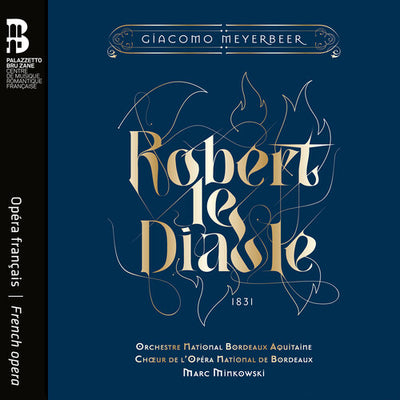
Meyerbeer: Robert le Diable / Minkowski, Bordeaux Aquitaine National Orchestra
Bru Zane · Sep 2022CD$44.99 -

-

-

Offenbach: Le voyage dans la lune / Dumoussaud, National Montpellier Occitan Orchestra
Bru Zane · May 2022CD$42.99 -

-

-

-

-

-

Saint-Saëns: Phryné / Rougier, Valiquette, Dubois, Niquet, Rouen Opera Orchestra
Bru Zane · Feb 2022CD$39.99 -

-

-

- CD 1: Tragédie lyrique
- CD 2: Opéra
- CD 3: Opérette et Café-Concert
- CD 4: Cantate
- CD 5: Musique sacrée
- CD 6: Musique symphonique
- CD 7: Musique concertante
- CD 8: Musique de chambre
- CD 9: Piano
- CD 10: Mélodie
-

-

-

-

-

-

-

Offenbach: La Perichole / Minkowski, Bordeaux National Orchestra, Les Musiciens du Louvre
Bru Zane · Jun 2019CD$42.99


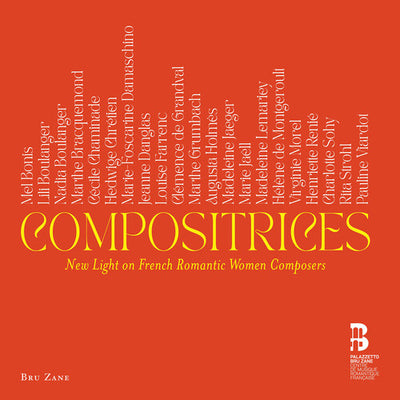
Compositrices - New Light on French Romantic Women Composers
Women composers had great difficulty in making their voices heard and gaining recognition during their lifetimes. Even today, they are all too rarely heard in the concert hall or the opera house. That situation obviously cries out for a change in attitude, but then come the questions: all right, let’s programme women composers, but which ones, and which of their works? In this eight-CD set featuring several hundred performers, the Palazzetto Bru Zane offers its initial answer as far as nineteenth-century France is concerned. The selections range over chamber music, orchestral works, piano pieces and songs. They highlight twenty-one female creators, from already identified personalities like Hélène de Montgeroult, Louise Farrenc, Pauline Viardot, Marie Jaëll and Mel Bonis to such completely unknown figures as Charlotte Sohy, Madeleine Jaeger, Marthe Grumbach, Jeanne Danglas, Hedwige Chrétien and Madeleine Lemariey. From now on, there will be no excuse for ignoring Romantic women composers.


Les Nuits de Paris - Dance Music from Folies Bergère to Opéra / Roth, Les Siècles
The dance permeated every layer of Romantic society. From popular dance halls to courtly salons, people showed their public face, enjoyed themselves and met one another in waltz time or to the rhythms of the quadrille or the polka. At the same time, ballet gained unprecedented fame on the stage of the Paris Opéra. The music that accompanied this frantic round in France has long been neglected, whereas the Viennese have never ceased to celebrate their waltzes. Under the expert baton of François-Xavier Roth, the orchestra Les Siècles has set out to rediscover this French repertory using historical instruments. Their album explores the output of both established composers – Camille Saint-Saëns, Ambroise Thomas, Charles Gounod, Jules Massenet – and their colleagues who specialized in Terpsichorean entertainment, including Philippe Musard, Isaac Strauss, Émile Waldteufel and Hervé.
REVIEWS:
Beautifully recorded and with Bru Zane’s customary excellent booklet notes, this is a disc to delight Francophiles, especially sweet-toothed ones like myself.
-- Gramophone
There is a blowsy joie de vivre in these performances by Roth’s French Orchestra Les Siecles that is hard to resist.
-- The Sunday Times (UK)
It’s all very French, and presented with great flair and warmth by Roth and his orchestra.
-- The Guardian (UK)


Cherubini: Les Abencérages or The Standard of Grenada / Vashegyi, Orfeo Orchestra
Cherubini’s Les Abencérages, premiered in 1813, heralds the spectacle and extravagance of Romantic grand opera. From the Alhambra gardens to the battlefield, the action skillfully intertwines political conspiracies with a love story. Underpinned by the energy and timbres of period instruments, this recording demonstrates the work’s modernity and its musical qualities. Anaïs Constans valiantly tackles the demanding role of Noraïme, while Edgaras Montvidas displays his lyric tenor voice in a series of sublime airs whose beauty was already hinted at by none other than Roberto Alagna in a recital disc released in 2003. Around this couple, a plethoric cast of soloists (Dolié, Sargsyan, Williams, Martin, Lavoie, etc.) achieves the same high standards of French diction and style. The Hungarian conductor György Vashegyi, flanked by the Purcell Choir and Orfeo Orchestra, reveals here another key milestone of French Romantic opera.
REVIEWS:
Unstaged in Paris for over two centuries Les Abencérages, a kind of ‘missing link’ in the history of French opera, has been disinterred by Bru Zane. The overture with its two warring themes – romantic passion versus battlefield chivalry – announce a changed sensibility where the political is properly personal.
György Vashegyi and the Orfeo Orchestra find Beethoven – drums and trumpets and driving rhythms – in Cherubini’s score, and hints at the start of Act III of the Romanticism to come with Mendelssohn. While Étienne de Jouy’s libretto is set in the exotic Alhambra of late-15th century Moorish Grenada, its spectacle and masterly use of the chorus suggests the coming French Grand Opéra. Its story presents two warring factions within the last Spanish caliphate ready to be reconciled through the warrior Almazor’s marriage to Princess Norïme. That is until the villainous Vizier Alémar starts to plot!
Cherubini’s vocal line is free of Italian decorative thrills. Anaïs Constans handles Norïme’s high tessitura with grace, and Edgaras Montvidas’s Almanzor is a worthy heir to Louis Nourrit, the tenor who created the role in 1813. His farewell when exiled from Grenada having ‘lost’ the kingdom’s sacred standard on the battlefield is properly affecting.
Yet it’s the Purcell Choir who steal the vocal honours, with magnificent singing by the women in Act I as they prepare for the wedding, and the men rattling their vocal sabres handsomely as the plot thickens in Act II. For all that, the musical history is perhaps more striking than the opera itself.
-- BBC Music Magazine


Meyerbeer: Robert le Diable / Minkowski, Bordeaux Aquitaine National Orchestra
A New Yorker Notable Recording of 2022!
French grand-opéra specialist Marc Minkowski has at last recorded Robert le Diable, a jewel of the genre. A triumph at its premiere in November 1831, it captivated contemporaries, and its influence stretched as far as Verdi and Wagner. An imposing international cast brings this repertory cornerstone to life: John Osborn portrays a Robert at once valiant and tender, Amina Edris reveals her full resources in the perilous role of Alice, while idiomatic performances by Nicolas Courjal, Erin Morley and Nico Darmanin complete a line-up offering the most vivid contrasts of tessitura. Against the backdrop of a medieval legend, this fantastical work depicts a confrontation between Good and Evil, pitting against each other a group of protagonists torn between desire and duty. A foundational score of musical Romanticism – performed more than 750 times in the nineteenth century at the Paris Opéra alone – is now gradually emerging from oblivion.
REVIEWS:
In these days of cash-strapped opera houses and risk-averse labels, recordings of the grander grand operas are rarities. Flawless ones are even rarer, making this breathtaking and ground-breaking new Palazzetto Bru Zane recording of Meyerbeer’s Robert le Diable a cause for celebration. In Marc Minkowski’s experienced hands, Meyerbeer’s gothic saga fairly flies off the page, every bar fizzing with energy and with set pieces that burst over our heads like fireworks. Add an outstandingly talented cast, headed by John Osborn as Robert and Erin Morley as Isabelle, and you have a set with award-winner written all over it.
-- Limelight


Offenbach: Le voyage dans la lune / Dumoussaud, National Montpellier Occitan Orchestra
Jules Verne was the inspiration for Offenbach’s opéra-féerie, premiered in 1875. The Parisian craze for this type of musical extravaganza stemmed from its impressive stage effects: for Le Voyage dans la Lune, two ballets and some twenty sets took the audience from the Earth to the Moon, successively recreating the Paris Observatory, a working blast furnace and the crater of an erupting volcano. The piece is studded with zany characters and imaginary places: a lunar landscape, a glass palace, mother-of-pearl galleries, etc. The producers even borrowed a dromedary and an ostrich from the zoo at the Jardin d’Acclimatation! To accompany this theatrical display, Offenbach composed a series of colorful, picturesque hit numbers, wittily and energetically performed here by a team of enthusiastic soloists. The Chœur et Orchestre National Montpellier Occitanie are placed under the subtle and precise direction of Pierre Dumoussaud.
REVIEWS:
The Bru Zane Opéra français CD-book series has reached volume 32 with Jacques Offenbach’s music theatre work Le Voyage dans la Lune (A Trip to the Moon). This first complete recording is part of Bru Zane’s contribution to a co-production directed by Olivier Fredj being taken to a number of theatres and opera houses in France. I applaud the entirely sensible decision to abridge the extensive spoken dialogue of this studio recording of Le Voyage (as it is often abbreviated) just enough to keep the narrative coherent.
From the first bar to the last this recording of Le Voyage is very much to my taste, entirely holding my attention. Clearly judiciously chosen, the cast of mainly native French speakers gives an ebullient performance that communicates the sheer infectious joy of music making. This may be a light music work but it doesn’t take long to realise that the cast treats the performance of this opéra féerie with utmost sincerity. What a treat it is to encounter such a motivated cast that communicates such spirit and hilarity.
Both Violette Polchi and Sheva Tehoval are in splendid form, their voices combining so well. They are clearly savouring the charming text as the royal couple express their love for each other. Projecting his large personality, [bass-baritone] Matthieu Lécroart excels in couplets so good-humoured and entertaining the role could have been written for his voice.
Tenor Raphaël Brémard takes the roles of Microscope, the brainy scientist who designed the project to reach the Moon, and Un Acheteur and Un Marchand. He is most effective as Microscope which, although a significant role, consists largely of dialogue; there is some singing but nothing in the way of major solos. As Prince Quipasseparla, tenor Pierre Derhet demonstrates his fine comedy voice in his major solo with chorus known as the Rondo de Quipasseparla. Derhet negotiates the tricky text with witty expression as the prince boasts of how he collects women of all types.
[The] thirty-strong Chœur Opéra national Montpellier Occitanie, prepared by chorusmaster Noëlle Gény, is in splendid voice throughout, adding to the success of the recording. The Orchestre national de Montpellier Occitanie is conducted by Pierre Dumoussaud who keeps the score on the move, bolstered by the enthusiasm and energy of the players.
Released as part of the Bru Zane Opéra français series of CD-books, Le Voyage enjoys the usual high-end presentation that one has come to expect from this label. This 212-page hardback book is a bilingual edition (French and English) with a full cast and track listing, a detailed synopsis and the abridged French libretto with English translation. There are four detailed and informative essays: Alexandre Dratwicki Shooting for the Moon with Offenbach, Jérôme Collomb Offenbach and the ‘féerie’, Alexandre Dratwicki A journey... through the press and Jean-Claude Yon Jacques Offenbach and Jules Verne: abortive encounters. In addition, there are several reproductions of artworks, drawings and posters of the early productions and also current performer photos.
With Offenbach’s opéra féerie - Le Voyage dans la Lune Bru Zane has come up trumps. This unashamedly light music comes across as a fast-moving and immensely entertaining fantasy romp. Surely the number of spectacular scenes makes Le Voyage best appreciated in a full staging; nonetheless, the excellence of the performances on this recording drew me in completely.
-- MusicWeb International


Franck: Complete Songs & Duets / Graziani, Gens, Christoyannis, Cohen
Abundant though it is, César Franck’s vocal music (operas, sacred music, oratorios, mélodies) does not occupy a prominent place in the current repertory. His instrumental compositions – headed by the Violin Sonata in A major and followed by the organ works – represent virtually all that today’s audiences and musicians know of his output. Yet the mélodies and vocal duets, neglected by performers and publishers alike, deserve to be plucked from oblivion, both for their own sake and for their place in the history of French music. The alluring voices of Tassis Christoyannis and Véronique Gens immerse the listener in the atmosphere of the nineteenth-century Parisian salons and the mélodies performed there. The composer and organist César Franck, famed for his instrumental music, proves himself equally skilled in setting poems by Musset, Hugo, Chateaubriand, Daudet and Dumas. This first complete recording of his works for voice and piano ranges over his entire creative life.
REVIEWS:
Of Franck’s overlooked works, probably none are more so than his mélodies (songs). Now, with this new release, Bru Zane provide what is described as the first complete recording of Franck’s works for voice and piano. This collection of 22 mélodies and 6 duos range throughout most of Franck’s compositional life, commencing in 1843 when he was just out of his teens with Robin Gray and Le Sylphe through to 1889 with Les Cloches du soir and La Procession written close to the end of his life. For his melodies, Franck elected to set French texts headed by Victor Hugo with six and also François-René de Chateaubriand, Alphonse Daudet, Alexandre Dumas, Joseph Méry and others.
Bru Zane has entrusted this Franck collection to Greek baritone Tassis Christoyannis and American pianist Jeff Cohen...Christoyannis shines throughout for his reliably warm and appealing tone coupled with the responsive accompaniment from Cohen.
In the set of 6 Duos Christoyannis is partnered by renowned French soprano Véronique Gens who also sings a single mélodie...Her voice remains in outstanding condition and dependably attractive, displaying a special gift for expression. Written in 1888 the 6 Duos, settings of text by five different writers, best evokes the atmosphere of the Parisian salon in the Belle Époque. Christoyannis [has] ease of delivery and Gens[,] engaging charm...
Sound engineer Matteo Costa has achieved splendid clarity and balance between singers and piano. It’s hard to fault the presentation of Bru Zane releases and this album is no exception. In the accompanying booklet there are a pair of essays Another side to César Franck by Alexandre Dratwicki and The Songs and Duets of César Franck by Jean-Philippe Navarre. There is also detailed and helpful information given for each of the twenty-eight songs/duets together with several reproductions of artworks and documents of the period. The French texts provided with English translations alongside are invaluable.
Beautifully performed, recorded and presented, this album of the complete Songs and Duets of César Franck is an appealing addition to the catalogue.
--MusicWeb International (Michael Cookson)


Saint-Saëns: Phryné / Rougier, Valiquette, Dubois, Niquet, Rouen Opera Orchestra
To mark the centenary of the death of Camille Saint-Saëns, the Palazzetto Bru Zane offers a chance to discover one of his most performed and admired operas in his lifetime, presented here in a rare version. Completed in 1893 and premiered the same year at the Opéra-Comique, the piece amusingly recounts the love affair between Nicias and Phryné, who dupes the old archon Dicephilus in order to avenge his cruelty. Its witty melodies and delightful orchestration made the opera an immediate success in Paris and then throughout France. It was enriched with recitatives composed by André Messager in 1896 to promote its career in theatres abroad.
Hervé Niquet’s dashing interpretation brings out to the full the qualities of the Orchestre de l’Opéra de Rouen Normandie and the Chœur du Concert Spirituel, thus providing a sparkling backdrop for the virtuosic soprano voice of Florie Valiquette, the refined lyricism of the tenor Cyrille Dubois and the vocal authority of Thomas Dolié’s baritone.
REVIEWS:
Undoubtedly, Saint-Saëns’ lesser-known operas have featured heavily in Bru Zane’s CD-book series with releases of La princesse jaune, Le Timbre d’argent, Proserpine, Les Barbares and his Cantatas of the Prix de Rome. Bru Zane’s interest in neglected Saint-Saëns opera continues with this new release of Phryné, an hour-long opéra-comique in two acts. This is the world premiere recording of the André Messager version of 1896.
Bru Zane has assembled a talented cast of mainly first-language French speakers. Young soprano Florie Valiquette has had success as Barberine (Le nozze di Figaro), Madeleine/Madame de Latour (Le Postillon de Lonjumeau) and Gabrielle (La Vie Parisienne) this year. She sings the eponymous role here with fresh voice and no shortage of enthusiasm. In Phryné’s Act Two air Un soir, j’errais sur le rivage where she implores Aphrodite the goddess of love to safeguard her love for Nicias, she characterises well and is in splendid voice, light and attractive with a pleasing tenderness and purity.
Hervé Niquet conducts the Orchestre de l'Opéra de Rouen Normandie and the combination is a successful one. I’ve not encountered this Rouen orchestra too often; its playing has commitment, energy and, when required, a pleasing level of sensitivity. The well trained Choeur du Concert Spirituel makes a valuable contribution.
This world premiere recording was satisfyingly recorded in 2021 under studio conditions in the Opéra de Rouen Normandie. A high-end product, Bru Zane’s CD-book series of bilingual editions in French and English maintains its high standards with Phryné and contains a synopsis, five helpful essays and, most importantly the full libretto.
-- MusicWeb International


Leo Delibes: Jean de Nivelle


The French Romantic Experience
To provide an initial account of 10 years of musical rediscovery, the Palazzetto Bru Zane is bringing out a boxed set of 10 albums showcasing extracts from some of the works that have been unearthed: a wide spectrum (1780-1920) of music is presented, spanning tragédie lyrique, opera, operetta and café-concert, cantata, sacred music, orchestral music, concertante music, chamber music, piano music and mélodie. This boxed set also includes recordings made in collaboration with labels working in partnership with the Palazzetto Bru Zane since 2009.
The vocation of the Palazzetto Bru Zane - Centre de musique romantique francaise is to favor the rediscovery of the French musical heritage of the years 1780-1920 and obtain international recognition for that repertory. Housed in Venice in a palazzo dating from 1695 specially restored for the purpose, the Palazzetto Bru Zane - Centre de musique romantique francaise is a creation of the Fondation Bru. Combining artistic ambition with high scientific standards, the Centre reflects the humanist spirit that guides the actions of that foundation. The Palazzetto Bru Zane’s main activities, carried out in close collaboration with numerous partners, are research, the publication of books and scores, the production and international distribution of concerts, support for teaching projects and the production of recordings.
REVIEW:
Well worth anyone’s attention, especially those attracted to the less familiar areas of 19th-century repertoire. In fact, I have rarely encountered a ‘compilation’ that has yielded so much listening pleasure...it helps that the standard of performance (and recording) is first-rate throughout. Treat it as an educational indulgence, I say.
-- Gramophone
CONTENTS:


Olimpie


Offenbach: La Perichole / Minkowski, Bordeaux National Orchestra, Les Musiciens du Louvre
-----
REVIEW:
Bru Zane continues its French Opera series with Offenbach’s La Périchole, an opéra bouffe in three acts.
Offenbach enjoyed great success in 1867; he had productions showing at four Parisian theatres the year before completing La Périchole. Yet in May 1868 the tide was turning. Le château à Toto was unsuccessful, and a revival of Le pont des soupirs failed to inspire. Later in the year came the premières of opéra bouffes L'île de Tulipatan and La Périchole, neither of which kept a hold on the repertory. In 1874, for the revival of La Périchole, Offenbach revised the score considerably: three acts instead the original two acts. It was in this revised form that La Périchole has found favour with audiences.
In La Périchole there are the usual antics so typical of an opéra bouffe, including disguise, mix-ups, mistaken identity and comic twists. La Périchole and her lover Piquillo are a pair of Peruvian street singers who cannot afford a marriage license. Don Andrès de Ribeira, a lecherous Viceroy of Peru, wants La Périchole as his mistress, and makes her his lady-in-waiting. Piquillo, also employed in the Viceroy’s household, marries the veiled La Périchole without knowing it is she. Piquillo gets thrown into prison but the end results in an unexpected pardon from the Viceroy; the lovers are reunited.
Music director Marc Minkowski has conducted both versions of La Périchole. For the Opéra National de Bordeaux production recorded here, he has assembled a mixed version based on the original 1868 score and parts of the 1874 revision. This release was recorded at live performances of stage director Romain Gilbert’s production. Minkowski conducted Les Musiciens du Louvre who are thirty-six strong and use period instruments. Although it surely applies to all audio recordings of live performances to a lesser or greater degree, having seen a brief clip of the show I think the dramatic impact of La Périchole is especially diminished by not seeing the actual performance. Nevertheless, there is still much pleasure to be gained from this recording. The three principal characters – La Périchole, Piquillo and Don Andrès – are very well cast, with French-language singers.
Tenor Stanislas de Barbeyrac throws himself wholeheartedly into the role of Piquillo. A highlight is the brief Rondo de bravoure - Écoute, ô roi, je te présente, where Piquillo presents La Périchole to Don Andrès. This splendid example of Barbeyrac’s theatricalit, demonstrates his vocal clarity and projection, his high notes achieved comfortably. As femme fatale La Périchole, the rich-toned mezzo-soprano of Aude Extrémo projects well, with a first-class level of expression – although her voice does not always have the smoothest delivery. La Périchole’s renowned ‘Tipsy’ arietta - Ah! quel dîner je viens de faire!’ is a success. I wish I could have seen it. Best of all is her ‘Letter’ arioso to Piquillo - Ô mon cher amant, je te jur. The mezzo tenderly reflects how it would be better to separate owing to their poverty and list of misfortunes. It is hard to forget the distinction of Régine Crespin’s rendition of the ‘Letter’ arioso on her 1971 release ‘Prima Donna in Paris’ on Decca.
Alexandre Duhamel as Viceroy Don Andrès gives a creditable performance although it is more of an acting role. Note the ‘Incognito’ song with chorus Sans en rien souffler à personne where Viceroy goes out on the town in disguise. Duhamel is in secure voice, with impressive diction and strong expression. Of the hit numbers, one notes La Périchole and Piquillo’s Le conquérant dit à la jeune Indienne, a foot-tapping ballad with its extremely catchy tune. For the same reasons, I also relish the couple’s rendition of the celebrated Séguedille - Vous a-t-on dit souvent. Minkowski favours swift speeds. He draws a strong and expressive performance from Les Musiciens du Louvre. On occasions, within all the spirited playing there is some slight untidness but nothing too distracting. The Chœur de L’Opéra National de Bordeaux is hard to fault. They give a strong performance throughout under chorus master Alphonse Cemin.
The sound has clarity, and is well balanced. Not surprisingly, there is some miscellaneous stage noise, and applause after some arias and at the end of each act, but it is not a problem. It serves to add to the live atmosphere.
As we have come to expect from this Bru Zane French Opera series, there is a 168-page hardback book with a full French libretto and an English translation. Four informative and well written essays are also included, as is a synopsis and full cast and track listing. My only grumble is wanting the track listing to contain the page number of its place in the libretto.
There are several studio recordings of La Périchole in the catalogue. My first choice remains the 1977 Strasbourg recording on Erato, featuring Régine Crespin, Alain Vanzo and Jules Bastin, conducted by Alain Lombard. Originally, I had the Erato release on vinyl. It is worth knowing that the performance has no spoken dialogue. I find this Minkowski recording of La Périchole tremendously entertaining from start to finish, and I wish I had been in the Bordeaux audience. A fitting tribute in Offenbach’s 200th anniversary year.
– MusicWeb International (Michael Cookson)
