Fall Blowout Sale 2026
Fall into the sounds of the season with 50% off 100+ handpicked titles for a limited time! From the quiet introspection of Satie and the autumnal warmth of Brahms to the lush, romantic beauty of Fauré and more, this collection is made for crisp mornings, golden afternoons, and cozy evenings at home.
Refresh your collection with music that feels right at home this time of year — all at half price! Plus, enjoy FREE SHIPPING on orders of $60 or more, making it the perfect time to stock up on your autumn favorites.
Shop the Fall Blowout now and save 50% while it lasts!
182 products
-
-
-
SaleDebussy: Reveries de Bilitis - Music for Two Harps & Voice / Duo Bilitis
Brilliant Classics · May 2018CD$13.99$6.99 -
SaleBrahms, Rihm & Harbison: Double Concertos / Vogler, Wang
Sony Masterworks · Jun 2018CD$12.98$6.49 -
-
-
-
-
-
-
-
-
SaleGrechaninov: Complete Music for Viola and Piano / Artamonova, Walker
Toccata · Apr 2014CD$20.99$10.49 -
-
-
SaleAll Star Orchestra: Programs 5 & 6 - Schumann, Brahms, Danielpour, Jones / Gerard Schwarz
Naxos AudioVisual · Nov 2013DVD$20.99$10.49 -
-
-
-
-
-
-
SaleThe Best of Tasmin Little - Music of Beethoven, Schubert, Brahms & More
Chandos · Jun 2020CD$21.99$10.99 -
SaleTranscriptions for Two Pianists - Stravinsky, Debussy, Bartok / Bavouzet, Guy
Chandos · Jun 2015CD$21.99$10.99 -
-
-
SaleBrahms: String Sextets / Bailey, Shiffman, Cypress String Quartet
Avie Records · Jan 2017CD$20.99$10.49 -
-
-
-
-
-
-
SaleBrahms: Symphonies No 2 & 3 / Skrowaczewski, German Radio Saarbrucken Kaiserslautern Orchestra
Oehms Classics · Nov 2012CD$25.99$12.99 -
-
-
-
-
SaleBrahms: Serenade No. 1 in D Major Op. 11 - Variations on a T
Challenge Classics · Oct 2016SACD$20.99$10.49
Debussy: Reveries de Bilitis - Music for Two Harps & Voice / Duo Bilitis
Harpists Eva Tebbe and Ekaterina Levental remark that Debussy makes the invisible visible and turns the unspeakable into a musical world full of mysticism, layers of ambiguity and evocative meanings. A century after his death, he is being celebrated across the world in 2018, and this album promises to make a special contribution on record with arrangements of works, most of them relatively unfamiliar, which particularly lend themselves to the ethereal and exquisite combination of voice and harps. Much of the music here was written while Debussy was composing his only opera Pelléas et Mélisande, a Symbolist drama based on the play by Maurice Maeterlinck, who recognized that in many ways Debussy had not only set his play to music but even outstripped and further enriched his original. There is the early and peaceful Ballade from 1890, then the Proses lyriques from 1892-3 and the seductive Trois Chansons de Bilitis (1897), from which this musical partnership takes its name. Bilitis is the fictional poet of Classical antiquity invented by Pierre Louÿs, writing in an erotic, symbolist vein after the fashion of Sappho: and when in 1900 Debussy came to use the texts of Louÿs again for the Musique de Scène pour les chansons de Bilitis, the music accompanied a tableau vivant in pre-Raphaelite style of winsome and scantily clothed young women. The recital is completed by the Danse sacrée et danse profane – originally composed for harp and orchestra in 1904, here with the orchestral parts arranged for a second harp – and the six Epigraphes Antiques from 1914, which return to the musical material of the Bilitis works but in the composer’s more allusive late style which would lead to his final masterpiece written for Serge Diaghilev, Jeux.
Brahms, Rihm & Harbison: Double Concertos / Vogler, Wang
The cellist Jan Vogler, who lives in New York and Dresden, has recorded three Double concertos for violin, cello and orchestra with his wife, the outstanding violinist Mira Wang, with the renowned Royal Scottish National Orchestra under direction of Peter Oundjian. Brahms' famous Double concerto captivates with wonderfully sweeping melodies, romantic sounds, eloquent solos and great orchestral sound. The English press wrote about one of the previous concerts: "Vogler, in particular, treated his solo sections like an operatic recitative, even in the faster Vivace sections of the finale, and Wang, his wife, matched him both in virtuosity and in beauty of tone. The highlight, however, was the opening of the slow movement, which produced sensational legato tone, soloists and orchestra slotting into one another like concentric circles, and creating a sound like molten chocolate.” The American composer John Harbison (born 1938), whose cello concerto premiered by Yo-Yo Ma has already caused a sensation, composed the Double concerto for the Boston Symphony Orchestra commissioned by the Friends of the Dresden Festival. The highly praised world premiere with Jan Vogler and Mira Wang took place on April 8th 2010 in Boston under the direction of Carlos Kalmar. Now this colorful, dynamic work full of glittering virtuosity can be heard for the first time in a recording. The German composer Wolfgang Rihm (born 1953) is considered one of the most important composers of our time. His "Duo Concerto", performed at Carnegie Hall in New York by Jan Vogler and Mira Wang with the Orpheus Chamber Orchestra in 2015, completes this fascinating new recording of three Double concerts with the Royal Scottish National Orchestra.
Music for Brass Septet, Vol. 5 / Septura
-----
REVIEW:
The Fifth in this series from the quite remarkable London-based Septura is a disc full of innovative ideas of re-scoring familiar music made by members of the septet. The most extended section of the disc comes with six of the Preludes Debussy wrote for solo piano arranged by Simon Cox; here Septura embellish the music with the sonorities Debussy would no doubt have used. Indeed the arrangement of La Cathedral engloutie, which ends the disc, emerges as one of the finest pieces the composer never actually wrote. The virtuosity that the group display is quite remarkable, technical challenges never existing in their elevated musical world. The recording quality is equally superb.
– David's Review Corner (David Denton)
Variations / Sarah Beth Briggs
Beethoven wrote in his diary that he wanted “to show the British what a treasure they have in God Save the King”, a reference to his set of variations on the national anthem, composed in 1803. Sarah Beth Briggs recorded the virtuoso set precisely one month before the passing of Queen Elizabeth II in 2022, and the recording heralds the coronation of King Charles III in May 2023. The lesser-known Variations on an Original Theme in F major (1802) represent Beethoven the revolutionary. Uniquely, each variation was written in a different key which would have jarred the ears of the composer’s contemporaries. Sarah Beth Briggs’ collection of Variations underlines a lineage of the genre through the classical and Romantic eras. Opening the program is 9 Variations on a Minuet by Duport by Mozart, whom Beethoven greatly admired. The work takes a theme by cellist Jean-Pierre Duport, chamber music director of the court of the Prussian King, Friedrich Wilhelm II, from whom the composer hoped to gain favor. Mendelssohn’s Variations Serieuses was written as a tribute to Beethoven, and was included in an album of works that raised funds for the now famous bronze statue of Beethoven in Bonn. Mendelssohn’s near contemporary Brahms paid tribute to his troubled friend Robert Schumann, using a melody from Bunte Blätter (“Colorful Leaves”) in his poignant Variations on a Theme by Schumann.
REVIEWS:
Briggs’ execution is fluidly graceful and well-modulated. She approaches this repertoire with a studied care that betrays a love for the period and composers.
-- Wild Mercury Rhythm
All nine of Mozart’s Variations on a Theme by Jean-Pierre Duport, K 573 are quite delicate, sounding here almost as if they were played on a toy piano. Only the finale includes authoritative sounds. Beethoven’s 7 Variations on `God Save the King’ is sturdier; I especially enjoy the lively, witty, chordal IV. Also included is Beethoven’s 6 Variations on an Original Theme. In Variations Serieuses, Mendelssohn managed to write 17 imaginative ones. That number only slightly outdoes Brahms, who came up with 16 Variations on a Theme by Robert Schumann. Lovely music, elegant playing.
-- American Record Guide
Path to the Moon / van der Heijden, Coleman
The performers write: ‘Selecting the repertoire for our album Path to the Moon, we wanted to explore a number of possibilities for binding together a programme. To place different works alongside one another is a wonderful way of bringing out new and unusual qualities in each piece. William T. Horton’s fantastic image The Path to the Moon immediately inspired a flurry of ideas, including works on the subjects of both night and the moon, as well as pieces which invoke the exploratory nature of humankind’s voyage to the moon. Britten wrote his Sonata for Cello and Piano only two years after the first object made by humans had touched the surface of the moon, in 1959. Humans throughout history and from all cultures have been drawn to and taken inspiration from the moon and we have tried to reflect this in our eclectic choice of song repertoire: from Toru Takemitsu to Nina Simone and from Lili Boulanger to Florence Price. As we hope you will hear on this album, Walker’s Cello Sonata rings with echoes of the sound-worlds of blues and jazz and is infused with a beautiful lyricism. We really believe that Walker’s Cello Sonata deserves to become a staple of the chamber music repertoire and are absolutely thrilled to offer you a recording of it in the context of our own exploration of a path to the moon.’
Grechaninov: Complete Music for Viola and Piano / Artamonova, Walker
Alexander Grechaninov (1864–1956), an eventual Russian exile following the Revolution, was a member of the second generation of nationalist composers – he was a student of both Rimsky-Korsakov and Taneyev – he never abandoned an essentially Russian lyricism. These attractive unknown viola works are as good as unknown: several remain unpublished, and two are in Elena Artanomova’s own viola transcriptions. The CD is released to coincide with the 150th anniversary of Grechaninov’s birth this year.
REVIEW:
Primarily known for his orchestral music, Grechaninov also wrote a sheaf of chamber works. That for viola has remained obscure. His Op.161 Sonata for viola (or clarinet) is unpublished which accounts for much of its obscurity and this is its first recording. Its premiere was given by Elena Artamonova and Nicholas Walker in London only in 2013, the same year it was recorded. The premiere was given in December but the recording was made earlier in June. Couched in sonata-form, and written between 1935 and 1940 the work proves amiable, songful and engaging. There is a high quotient of charm in Grechaninov’s chamber music, and that is an element that figures prominently here. His penchant for vocal composition ensures that the melodies are at all times winningly warm, not least in the lyric effusions of the central Canzona movement. I hear hints of Spanish music in the finale though there is certainly a strain of Russian folklore buzzing merrily throughout, and some passages sound almost like Dvo?ák.
The Second Sonata was written in 1943 and is actually a clarinet sonata, whose dedicatee was the great Simeon Bellison. The arrangement for viola is the work of Elena Artamonova, who has taken her cue from the earlier viola sonata and has dealt persuasively with questions of articulation and register. The work sounds convincing in its new form. Once more there’s a fine balance between the instruments, and an uncluttered and jovial quality. Toccata has gone to the trouble of separately tracking each of the variations that mark the theme and variations, with coda, of the second movement of this bipartite work. Here Slavic folk affiliations are to the fore, and a vigorous and engaging variation for solo piano too. I was most taken by the third variation where the piano’s gruff enquiries are met by a pliant viola response. There’s a viola cadenza before the spirited and exciting toccata-like coda.
Early Morning is a cycle of ten pieces written in France in 1930 for cello (or violin) and piano. It has been arranged for viola by Sabine Stegmüller and this is its first recording in this guise. Primarily this is a work of instruction for children, adept and engaging teaching material with nice descriptive titles à la Schumann, two highlights of which are the pensive In the Twilight and the deliciously deft Burlesque. In modo antico is a suite written back in 1918 for violin and orchestra or piano. This arrangement is Artamonova’s. It opens with a somewhat showy cadenza but continues in a romantic vein rather more than anything too self-consciously modo antico, though the movements sport titles such as Sarabande, Gavotte – played with deliciously zesty lift here – and Jig. Finally there are the two Grechaninov transcriptions of songs by Debussy, first published in 1946, which would make excellent recital pieces. Once again these are premiere recordings.
These richly lyrical works, all pretty much unknown, receive highly persuasive and stylistically apt performances from Artamonova – who writes the excellent booklet notes – and Nicholas Walker. Well worth getting to know, in fact.
– MusicWeb International (Jonathan Woolf)
All Star Orchestra: Programs 5 & 6 - Schumann, Brahms, Danielpour, Jones / Gerard Schwarz
Rhapsodie - 20th-Century Clarinet Classics
The Lyrical Clarinet Vol. 2 / Collins, Mchale
This new collection of pieces for Lyrical Clarinet follows Michael Collins’ first volume which included sonatas by Poulenc and Saint-Saens. This varied repertoire ranges from short, cheerful numbers to romantic and enchanting, and brilliantly displays the incredible technical and dynamic range of the instrument. Clarinetist Michael Collins has won multiple awards for his performance, namely the Royal Philharmonic Society’s Instrumentalist of the Year Award in 2007. He has also become increasingly regarded as a conductor, and currently serves as Principal Conductor of the City of London Sinfonia.
The Best of Tasmin Little - Music of Beethoven, Schubert, Brahms & More
Following the announcement by Tasmin Little of her intended retirement from the concert platform, we wanted to create an album that would stand as both a tribute to, and celebration of, her outstanding career as a performer. What better way to do so than ask her to select her own, personal favorites from her recorded career? An exclusive Chandos artist since 2010, Tasmin has made a series of recordings that have proved a cornerstone of the Chandos schedules for a decade, and feature a range of composers and styles of quite breath-taking variety. The first album concentrates on concerti, and features both Walton’s and Britten’s concertos with Edward Gardner, along with the slow movement of her award-winning Elgar recording with Sir Andrew Davis. The second features works from Vivaldi though to Shostakovich via Brahms, and includes (among many other gems) her recording of Vaughan Williams’s iconic The Lark Ascending. It also celebrates Tasmin’s recital partnerships with three outstanding pianists: Piers Lane, Martin Roscoe, and John Lenehan. As she writes in her booklet note: ‘I am very happy that this final, double-album set should reflect so many aspects of me as a musician; and I remain full of gratitude for the tremendous opportunities I have been given to play and record with the greatest musicians of today. I hope you all enjoy this final release.’
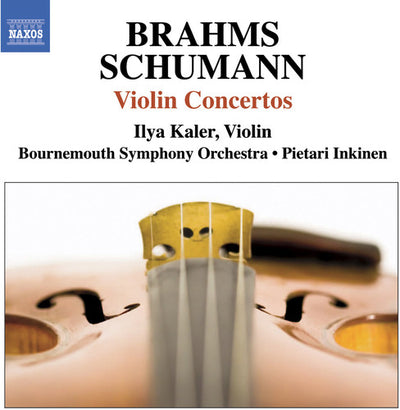
Brahms, Schumann: Violin Concertos / Inkinen, Kaler, Bournemouth
Ilya Kaler’s new recording of the Brahms concerto on Naxos is eminently recommendable. When reviewing his recent recording of the Tchaikovsky violin concerto (see review) I remarked that Kaler’s performance was one “of elegance as well as brilliance” that “wears it war-horse status lightly, impressing itself upon the listener by virtue of its freshness and natural feeling”. Those comments are equally applicable to this recording.
Kaler’s conception of Brahms’ score is one that rejoices in its beauties. Ably supported by the warm sounds exhaled by the Bournemouth Symphony Orchestra, Kaler’s violin sings with a golden tone and sweetly inflected phrasing. He takes his time over the first movement, but maintains his rhythmic control and sense of the music’s overall architecture. In this his performance succeeds where, as Jonathan Woolf points out, Julia Fischer’s similarly conceived account fails. Kaler also lingers lovingly over the gorgeous slow movement – taking over 10 minutes. His pacing is more conventional in the Hungarian finale, which smiles more than it swaggers here.
The coupling of Brahms and Schumann is astute. Firstly it makes programmatic sense. Both concertos share the tonality of D – Brahms in the glowing major, Schumann in the dramatic minor. Both were written for Joachim, and the bond between Schumann and Brahms themselves is as well known as it is complicated.
Secondly, the coupling is an attractive addition to the Naxos catalogue. It complements an earlier disc (Naxos 8.550938), on which Kaler joins cellist Maria Kliegel in Brahms’ double concerto, offered as a coupling for Kliegel’s performance of the Schumann cello concerto. Buy these two discs, and you have the complete Schumann and Brahms string concertos at one fell swoop.
The coupling of the Schumann and Brahms concertos is also fairly unusual in the broader catalogue. While recordings of the Brahms proliferate, there are few recordings of the Schumann concerto and when they do appear they tend to be lumped together with more Schumann. Only Joshua Bell, to my knowledge, has coupled these two concertos on disc before. That disc now forms half of a mid-price twofer in the price bracket above this release (Decca – The Joshua Bell Edition – 4756703). Bell's recording is also available at bargain basement price on Australian Eloquence, but sundered from its Brahms coupling.
Schumann wrote his violin concerto very quickly in the autumn of 1853. Joseph Joachim and Clara Schumann had reservations about the piece. In happier times Schumann would probably have revised the piece, but the rapid decline in his mental health prevented this and the score languished unplayed and unknown until the 1930s. It is an attractive piece, constructed along classical lines, and deserves more attention and respect than it is usually accorded. The first movement has a symphonic seriousness and integrity, contrasting the wild, surging argument of its first subject with a gentle, sensitive second subject. The central movement is quietly beautiful. The finale, in the form of a polonaise and with prominent wind writing, brings the concerto dancing to a close.
Kaler's performance is successful and offers collectors a distinct choice. Bell's recording has a straight forward brilliance and Kremer's EMI recording with Muti, like Menuhin's electric premiere recording of the uncut score, emphasises the drama of the work. Kaler takes a different view. Again favouring spacious tempi – his first movement at 14:28 takes a minute longer than Bell's and two minutes longer than Menuhin's – he presents the concerto very much as the classical conception of a poetic soul. Where the other interpreters listed above play for Florestan, Kaler takes Eusebius' part.
The balance favours the violin in both concertos, but there is air enough around the soloist, and the warm Lighthouse Concert Hall acoustic gives the orchestral sound a lovely glow. Listening through earphones can be disconcerting in the Schumann where either Kaler's or the conductor’s breathing is quite prominent. I did not notice this so much when listening through speakers.
Keith Anderson's liner-notes live up to his usual high standard, but gloss over the circumstances of the Schumann concerto's rediscovery by Joachim's great-niece and avoid entirely discussion of the political wrangling over the concerto's premiere performances.
Another wonderful disc from Ilya Kaler and a bargain of the month.
-- Tim Perry, MusicWeb International
Brahms: String Sextets / Bailey, Shiffman, Cypress String Quartet
The legacy of the Cypress String Quartet, which celebrated its 20th anniversary and valedictory season in 2016, is sealed by the ensemble’s final recording – the two String Sextets by Johannes Brahms in which they are joined by long-time collaborators, violist Barry Shiffman and cellist Zuill Bailey. True to form, the Cypress String Quartet applied innovation to its last recording: live in front of a studio audience at Skywalker Sound Studio. "A tender, deeply expressive interpretation" - The New York Times
Brahms & Carter: Clarinet Quintets / Lieb, Phoenix Ensemble
-----
REVIEW:
The playing in the Carter quintet is assured and confident, as one would expect from contemporary music specialists. This is also a slightly different team from that in the Brahms. I have no complaints about the recording. The disc is housed in a cardboard sleeve rather than a jewel case and the booklet notes, in English only, are printed reversed out (white lettering on a dark ground), which does not make for easy reading. If the programme suits, don’t hesitate.
– MusicWeb International
Karajan Spectacular, Vol. 4
Brahms: Symphonies No 2 & 3 / Skrowaczewski, German Radio Saarbrucken Kaiserslautern Orchestra
In late 1994 Skrowaczewski was appointed Principal Guest Conductor of the Saarbrucken Radio Symphony Orchestra, with which he has enjoyed a close collaboration for many years, both in the concert hall and in the recording studio. In Japan, Skrowaczewski is honored almost like a saint. Oehms Classics is proud of the extent of the recordings and is delighted to be able to continue the Brahms Cycle with the Second and Third Symphonies. - Oehms