Fall Blowout Sale 2026
Fall into the sounds of the season with 50% off 100+ handpicked titles for a limited time! From the quiet introspection of Satie and the autumnal warmth of Brahms to the lush, romantic beauty of Fauré and more, this collection is made for crisp mornings, golden afternoons, and cozy evenings at home.
Refresh your collection with music that feels right at home this time of year — all at half price! Plus, enjoy FREE SHIPPING on orders of $60 or more, making it the perfect time to stock up on your autumn favorites.
Shop the Fall Blowout now and save 50% while it lasts!
186 products
-
-
-
-
-
SaleDebussy: Orchestral Works, Vol. 5 / Markl, Orchestra National De Lyon
Naxos · Feb 2011CD$19.99$9.99 -
-
-
SaleDebussy: Orchestral Works Vol 1 - Prélude À L'Après-Midi D'Un Faune, La Mer / Märkl, Lyon NO
Naxos · May 2008CD$19.99$9.99 -
-
-
-
-
-
-
-
-
-
-
-
-
-
-
-
Piano Nocturnes
The Key Collection: 3 Centuries of Rare Keyboard Gems
The Grand Piano label is dedicated to exploring undiscovered piano repertoire by unfamiliar composers, producing high quality, often world premiere recordings, performed by virtuoso authorities in their chosen field. Marking the label's 5th anniversary, this collection is a comprehensive guide through the history of keyboard music from the invention of the fortepiano to today's living composer's, as well as taking the listener on a musical adventure thorugh a geographically global range of rare musical gems, with all of their new and exciting sounds and fresh perspectives.
Hail To The Chief / United States Marine Band
Selection includes John F. Kennedy Inaugural Excerpt.
Selection includes Dwight Eisenhower Inaugual Excerpt.
Selection includes Harry Truman Inaugural Excerpt.
Selection includes Franklin Roosevelt Inaugural Excerpt.
Debussy: Orchestral Works, Vol. 5 / Markl, Orchestra National De Lyon
Volume 5 of Naxos’s acclaimed series of Debussy’s orchestral music presents a potpourri of works that were either left incomplete by the composer or were orchestrated by others who greatly admired his music. His rarely-heard children’s ballet The Toy Box, dedicated to Debussy’s daughter Emma-Claude but not premièred until after the composer’s death, recalls the innocent world of his popular Children’s Corner suite. Based on Pierre Louÿs’ Chansons de Bilitis, Debussy’s Six épigraphes antiques evoke poetic scenes from the ancient world, as does the sole surviving portion of The Triumph of Bacchus.
Debussy: Orchestral Works Vol 1 - Prélude À L'Après-Midi D'Un Faune, La Mer / Märkl, Lyon NO
The Prélude is very well done. The solo flute is suitably sensuous, and is ably complemented by the solo oboe. Also, I have never heard the two solo violins, at the end, sound quite as winsome as they do here. The big tune in the middle is allowed to expand as it should and the delicate final pages, with slightly too reticent antique cymbals, is well controlled.
La Mer is almost as fine a performance. Starting very mysteriously, Märkl builds up the tension until the music bursts forth with animation. It’s a fine achievement. However, when the second part of the first movement begins, with cellos in eight parts, it’s too reticent and lacks the momentum required to push the music forwards. When Satie first heard this movement, From Dawn to Midday on the Sea, he quipped that he especially enjoyed the bit at a quarter to eleven. Strange as this may seem I think I know the moment he means – at four bars after rehearsal number 13 there is a static section where cor anglais and two solo cellos play a long breathed theme over sustained chords, it’s a magical moment which prepares us for the build up to the climactic final bars. Märkl makes these few bars quite magical and the calm is quite stunning. The coda is well built but the final three chords – which should beat us about the head with their power – fail to completely satisfy. The scherzo, Play of the Waves, is too heavy handed and the important colouristic glockenspiel part all but inaudible. The tension and suspense of the final movement, Dialogue between the Wind and the Sea, is very well done. The climaxes are well developed and the changes of mood and tempo very well handled. There is one strange moment – at rehearsal number 53 the horns play a triplet, followed, in the next bar, by two minim chords. In this recording we are treated to an extra triplet chord! I’ve played this moment several times, thinking my ears were deceiving me, but no, it’s there, an extra triplet beat. As it’s an exact repeat of what they played six bars earlier I’m mystified by what happens. Why is this extra chord there and what is the purpose? I doubt it’s an editing error so the conductor must have heard it as the horns played the passage. Curiouser and curiouser. Better news is that four bars after rehearsal number 59, under the big chords for winds and strings, Märkl plays the brass fanfares which, more often than not, are ignored by conductors as not being in a real Debussy style. Perhaps they are somewhat unsubtle for Debussy, and for this moment, but without them the music suddenly stops dead, it seems empty, something has to be played there and if these fanfares are all we have then we have to have them. It’s a good performance but it lacks that final insight, that ultimate injection of energy which makes the Hallé/Barbirolli recording so memorable and compelling.
Jeux is one of Debussy’s most elusive scores (it was his last orchestral work). It’s a ballet which concerns a lost tennis ball and a boy and two girls who look for it, as they play hide and seek, try to catch one another, quarrel and sulk without cause. Their games are interrupted when another tennis ball is mischievously thrown in by an unknown hand which surprises and alarms them and they disappear into the nocturnal depths of the garden. The story isn’t important. Debussy’s music is. It receives an excellent performance here – Märkl fully understands what is going on in the music and leads his players through the myriad tempo changes, keeps the ever changing orchestral colouring alive and generally makes clear music which so often sounds confused and muddled. You’d be hard pressed to find a finer performance on disk.
André Caplet was a close friend of Debussy and worked on the orchestration of the latter’s incidental music for Gabriele D’Annunzio’s play Le Martyre de Saint-Sébastien and the ballet La Boîte à joujou. He also made two, superb, reductions for two pianos, four hands and six hands, of La Mer, and made orchestral transcriptions of several piano works. Children’s Corner is a delightful six movement suite for solo piano; it’s light hearted, full of fun and several of the movements have become popular independently of the suite – The Little Shepherd and Golliwog’s Cake-walk in particular. Caplet’s orchestration has always struck me as being rather heavy handed – odd for so skilful an orchestrator – but here he has met his match with perfect piano music which does not lend itself to orchestration. Märkl does his best but, ultimately, it’s still too heavy and much of the humour is lost.
Apart from Jeux, which is superb, I would not put these performances of La Mer and the Prélude ahead of other recordings which are currently available - those conductors listed above - but they are very serviceable and if you’re on a tight budget, or just wanting to dip your toes in the Debussian water for the first time, then at the bargain price you’ll get much from these atmospheric readings.
-- Bob Briggs, MusicWeb International
Debussy: Preludes Book I - Images Book I - Nocturne
Fiddler's Blues / Graffin, Désert
Philippe Graffin’s virtuosity combined with his skills as a sleuth have led to the world-premiere recording of a “Posthumous” solo violin sonata by Eugene Ysaye, an astonishing discovery that extends the Belgian composer’s canon of his essential six sonatas for the medium. Philippe unearthed the nearly-completed manuscript in the library of the Brussels Conservatoire, and polished off the final movement in the most Ysaye-esque manner possible. Philippe’s penchant for intuitive programming I brought to bear on Fiddler’s Blues, combining two Ysaye works - including another premiere, with a pair of folksy, Bohemian-flavored works by George Enescu, another virtuoso violinist/composer who emigrated from his native Romania and like Ysaye settled in Paris.
Enescu was a classmate of Maurice Ravel, whose Berceuse sur le nom de Gabriel Faure is an affectionate nod to their teacher at the Paris Conservatoire, whilst his azure-tinged Violin Sonata influences the album’s title. Ravel’s slightly older contemporary Claude Debussy befriended Ysaye. Whereas Ysaye soared writing works for solo violin, Debussy wrote none. Suggesting how such a work may have sounded, Philippe contributes his own arrangement for solo violin of Debussy’s enduring piece Claire de lune.
REVIEWS:
This duo’s rapport comes across in sparky performances. Premieres of pieces by Ysaÿe are a draw, but the Enescu sonata and Hora Unirii are a real treat and leave you feeling anything but blue. ★★★★
-- BBC Music Magazine
The big story here is the first recording of a previously undiscovered seventh unaccompanied violin sonata by Eugène Ysaÿe…Played with flourishing panache and easy command, it makes an electrifying opening to this deceptively titled recital: essentially a survey of the early 20th-century Parisian scene…There’s a real feeling of dialogue.
-- Gramophone
Jeux de Création
This recording is a tribute to the chromatic harp, which, with its rich colors and theatrical effects, was perfectly tuned to the impressionist and art nouveau atmosphere of the turn of the 20th century. Geoffrey Gordon’s Jeux de Creation is inspired by music from the 1920s using both traditional and extended techniques, drawing on themes by Milhaud and Debussy to portray the past and present. Reflecting this aesthetic, the other works in this program include the artistry of Ravel and Faure, the quasi-orchestral effects of Debussy’s Danses, and Caplet’s sensuous and spectacular Divertissements.
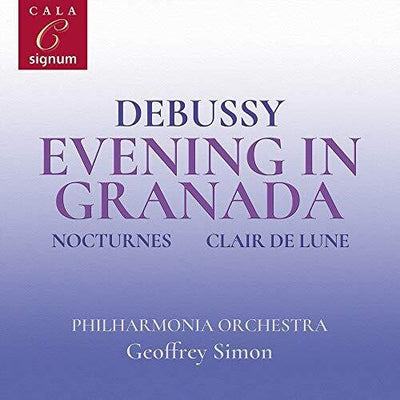
Debussy: Evening in Granada
Voyages / Bevan, Middleton
Soprano Mary Bevan and pianist Jopseph Middleton perform a programme exploring the genius of Baudelaire and Goethe, and how texts by them unlocked very specific musical landscapes in settings by Debussy, Duparc, Chausson, de Breville, Severac, Faure and Schubert. Praised by Opera for her “dramatic wit and vocal control” in stand out performances on opera and concert platforms, Mary Bevan is a winner of the Royal Philharmonic Society’s Young Artist award and UK Critics’ Circle Award for Exceptional Young Talent in music. Pianist Joseph Middleton specialises in the art of song accompaniment and chamber music and has been highly acclaimed within this field. Described in the BBC Music Magazine as “one of the brightest stars in the world of song and Lieder”, he has also been labeled “the cream of the new generation” by The Times and “a perfect accompanist” by Opera Now.
Liebestraum: Romantic Piano Music
V3: COMPLETE DUOS
Impressions / Dervaux
Sophie Dervaux’s debut album on Berlin Classics is very much in the French tradition. Together with her French colleague, pianist Sélim Mazari, the bassoonist presents works on this concept album Impressions that are by composers of various eras, including Debussy, Saint-Saëns, Ravel, Fauré and Koechlin. The bassoon – unusually – takes the stage as a soloist and so fulfils the purpose that the Vienna Phil bassoonist had in mind: to present the unique singing sound of the instrument and enrich the world of the bassoon in the process. “A lot of people think of the bassoon as an amusing instrument. But it can be more than just the jolly clown. I wanted to show that it can sound wonderful and sing wonderfully too.” There is no doubt that Dervaux has proved her point on Impressions. Her repertoire brings together familiar and seldom heard pieces, and at times ushers its audience into a dream world. Among those pieces are Debussy’s Clair de Lune and Beau Soir, illustrating the tonal compass of the bassoon. Sophie Dervaux also presents the Sonata for bassoon and piano in G major, op. 168, written by Camille Saint-Saëns, in his old age. Great phrases and lines flow from Dervaux’s instrument in Fauré’s Après un rêve, and a piece she arranged herself, Pièce en forme d’habanera by Ravel, brings out the almost human voice of the instrument. These Impressionists are joined by theorist and composer Charles Koechlin with his Sonata, op.71. Going a step further, Reynaldo Hahn’s A Cloris and Roger Boutry’s Interferénces bridge the gap between old and new and introduce jazz influences. With her new album Impressions, Sophie Dervaux aims to show her audience what is special about the bassoon: its sound, and its virtuosity too.