Fall Blowout Sale 2026
Fall into the sounds of the season with 50% off 100+ handpicked titles for a limited time! From the quiet introspection of Satie and the autumnal warmth of Brahms to the lush, romantic beauty of Fauré and more, this collection is made for crisp mornings, golden afternoons, and cozy evenings at home.
Refresh your collection with music that feels right at home this time of year — all at half price! Plus, enjoy FREE SHIPPING on orders of $60 or more, making it the perfect time to stock up on your autumn favorites.
Shop the Fall Blowout now and save 50% while it lasts!
186 products
-
-
-
-
-
-
-
-
-
-
-
-
-
SaleBrahms: Piano Concerto No. 2 - Piano Pieces / Tsybuleva, Reinhardt, Deutsches Symphonie-Orchester Berlin
Signum Classics · May 2021CD$19.99$9.99 -
-
-
SaleBrahms: Piano Sonata, Op. 1 & Beethoven: Hammerklavier Sonat
Piano Classics · Jan 2015CD$21.99$10.99 -
-
-
-
-
SaleDebussy: Le Martyre de Saint Sebastien / Cambreling, SWR Symphony Baden-Baden and Freiburg
SWR · May 2024CD$20.99$10.49 -
-
-
-
-
-
-
-
-
-
-
SaleBrahms: The Piano Concertos / Kauten, Wurttembergische Philharmonie Reutlingen
Solo Musica · Nov 2023CD$32.99$16.49 -
-
STRING QUARTETS NOS. 1 & 4
Mariss Jansons - His Last Concert / Bavarian Radio Symphony
For the last seventeen years of his life – from 2003 to 2019 – Mariss Jansons was chief conductor of the Symphonieorchester des Bayerischen Rundfunks and the Bavarian Radio Chorus. Both ensembles and their conductor appreciated each other deeply on an artistic as well as a human level, and this resulted in numerous unforgettable concerts. Jansons’ unrelenting demands on himself and his musicians, his always respectful treatment of his colleagues, and his great devotion to music all played a lead role in their work together. Mariss Jansons occupies a place of honor in the orchestra’s history, and its players will always revere and cherish his memory. With the death of Mariss Jansons one year ago, the music world lost one of its greatest artistic personalities.
Born the son of conductor Arvids Jansons in Riga in 1943, the young Mariss studied at the Leningrad Conservatory before completing his studies with Hans Swarowsky in Vienna and Herbert von Karajan in Salzburg. In 1971 he was a prizewinner at the Karajan Conducting Competition and began his close collaboration with today's St. Petersburg Philharmonic. From 1979 to 2000, Jansons was Music Director of the Oslo Philharmonic; from 1997 to 2004 he conducted the Pittsburgh Symphony Orchestra; and in the 2003/04 season he became Chief Conductor of the Symphonieorchester des Bayerischen Rundfunks and the Bavarian Radio Chorus. The 2004/05 season marked the start of his tenure at the Royal Concertgebouw Orchestra Amsterdam, which ended in 2015. As a guest conductor, he worked with all the leading orchestras of Europe and the USA, and his discography includes many award-winning recordings.
Damase: De nature fidèle
KLAVIERMUSIK
Brahms By Arrangement, Vol. 1
Brahms originally wrote the Piano Quintet, Op. 34, for string quintet before recasting the work as a two-piano sonata. However, the sheet music has not ever been recovered. So, finnish cellist Karttunen set about its reconstruction. The result has all the vigor and power of the music we know but now recast in a different sonority.
REVIEW:
Another triumph for a small independent label. Brilliant thought provoking re-evaluations of ‘standard’ works by Brahms. The double viola version of the clarinet quintet in Brahms’ own arrangement is especially rewarding featuring some of the most beautiful viola playing I have ever heard from Steven Dann. Life-enhancing stuff.
-- MusicWeb International
Brahms: Piano Concerto No. 2 - Piano Pieces / Tsybuleva, Reinhardt, Deutsches Symphonie-Orchester Berlin
Signum Records presents an exciting new collaboration and debut recording with Leeds International Piano Competition Winner (2015), Anna Tsybuleva, of music by Johannes Brahms together with the Deutsches Symphonie-Orchester Berlin, conducted by Ruth Reinhardt. Tsybuleva has been described by as embodying superb pianism and intelligent musicianship (Gramophone Magazine) and A pianist of rare gifts: not since Murray Perahias triumph in 1972 has Leeds had a winner of this musical poise and calibre (International Piano Magazine). Performance highlights have included performances with the Basel Symphony, Mariinsky Orchestra, National Philharmonic Orchestra of Russia, Royal Liverpool Philharmonic Orchestra, Singapore Symphony Orchestra, St. Petersburg Philharmonic Orchestra, and the Tokyo Symphony Orchestra. Alongside this, Tsybuleva has given recitals at such prestigious venues as Het Concertgebouw Amsterdam, Shanghai Oriental Arts Center, Tonhalle Zurich, and the Wigmore Hall, London.
Satie: Complete Piano Works, Vol. 3 / Horvath
This third volume of Erik Satie’s complete solo piano music using Satie scholar Robert Orledge’s new Salabert Edition focuses on music composed between 1892-1897, including theatrical scores such as the revolutionary uspud, and the Danses gothiques and famous Vexations written while the composer was hiding from a tempestuous love affair. The period closes with Satie composing in what he called “a more flexible and accessible way withthe final Gnossienne and the six Pieces froides.” Recognized at once as a great interpreter of Liszt’s music, Nicolas Horvath became in recent years one of the most sought after pianists of his generation. Holder of a number of awards, like the First Prize of the Scriabin and the Luigi Nono International Competitions, he frequently organizes events and concerts of unusual length, sometimes over twelve hours, such as Philip Glass complete piano music or Erik Satie’s Vexations.
Brahms: Piano Sonata, Op. 1 & Beethoven: Hammerklavier Sonat
Brahms: Transcriptions for Piano
Debussy: Le Martyre de Saint Sebastien / Cambreling, SWR Symphony Baden-Baden and Freiburg
In 1910, the Italian poet Gabriele D'Annunzio wrote a play about the martyrdom of St. Sebastian. He enlisted Claude Debussy as the composer and the "Mystère en cinq mansions composé en rhythme français" already premiered in 1911. The text combines and overlaps Christian and pagan traditions, playing with both the flair of antiquity and the fascination of the exotic. The Catholic Church took offense concerning the portrayal of Sebastian, who was played by a female Russian Jew, the dancer Ida Rubinstein, and the audience also reacted hesitantly, so that neither D'Annunzio's play nor Debussy's music to it remained in the repertoire of the concert halls. Debussy himself was very fond of his work and soon put together an orchestral suite, the "Fragments symphoniques", which adapts some of the central numbers of the incidental music for orchestra. Additionally, Désiré-Emile Inghelbrecht created a kind of concert version that radically shortened the text and reduced it to around 15 minutes of recitation in addition to Debussy's music. The same applies to the present recording, which juxtaposes Debussy's original music with texts by the writer Martin Mosebach. These texts do not necessarily reflect the course of D'Annunzio's piece, but rather summarize central aspects of the Sebastian legend, sometimes more directly, sometimes more abstractly.
The present version, a studio recording from 2005, is enriched with (German) text additions by the writer Martin Mosebach, making it thus unique among other recordings of Le Martyre.
Beethoven, Brahms, Messiaen & Schubert: Eternity
Humans’ hope lies in art. The music of Schubert or Beethoven in particular, which gives us some idea of what worlds can still exist. What words can we use to make these works of art tangible? Not explainable, but tangible.
With this album, Turkish-born pianist Gülru Ensari and Romanian-born Herbert Schuch want to provide a space for experience, a place where they can carefully and tentatively approach the subject of eternity. The connection between Messiaen and Schubert, Beethoven and Brahms? Nothing more or less than a perceived truth. An involuntary connection of lines that are already there, but are drawn into infinity and meet somewhere, like the parallel rails of a dead-straight track that stretches right into infinity!
With this new recording “Eternity”, Gülru Ensari and Herbert Schuch entail the music lover to understand the act of listening as a dialogue with oneself (« let us experience it ourselves, recognising the infinitely varied ways in which people perceive things as something enriching instead of something striving for uniformity »).
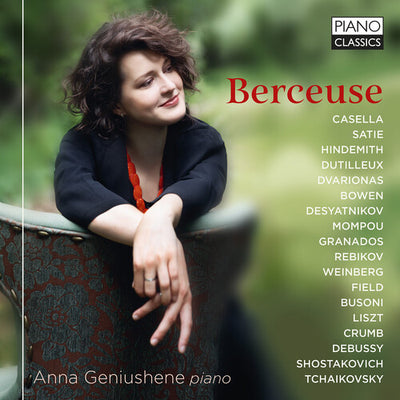
Berceuse / Anna Geniushene
A unique and imaginative collection newly recorded by a recent star of the Van Cliburn Piano Competition. Anna Geniushene’s fresh; layered; and powerful interpretations won her a worldwide following at the 2022 edition of the Van Cliburn International Piano Competition; where she took Silver Medal with a stunning account of Tchaikovsky’s First Piano Concerto which the critic for Gramophone compared in its power and nuance to Van Cliburn himself.
Born in Moscow; Anna Geniushene pursued graduate studies in London and now lives in Lithuania with her husband; the pianist Lukas Geniusas. In her own booklet introduction; she explains the inspiration for this quirky collection of instrumental lullabies. The Berceuse is ‘associated with tenderness; care; purest love; and the most sensitive moments in our lives.’ She dedicates the album to her two young sons. Perhaps the most celebrated Berceuse of all; by Chopin; is missing; because it was Anna Geniushene’s particular wish to find and share neglected examples of the genre; even by well-known composers. Debussy composed the Berceuse heroique during the First World War as a tribute to the soldiers on the Western Front. The Berceuse Elegiaque of Busoni is better known in its orchestral guise. The brief Berceuse by Hindemith; unpublished in his lifetime; ‘draws listeners’ attention by its utterly eloquent and typically sarcastic character; which has nothing in common with traditional lullabies.’ The sheer diversity of composers makes for a continually varied sequence. George Crumb evokes a magical night-time stillness with a minimum of notes. Mompou’s Berceuse is likewise remarkable for its distilled serenity; whereas the examples by Granados; John Field and Liszt bring comfort with more Romantically moulded melodies in the tradition of Chopin. Anna Geniushene closes the album with two Russian Berceuses; by Shostakovich and Tchaikovsky; lyrical; simple and utterly beguiling in her hands.
Chopin & Fauré: Impromptus / Margain
The French pianist Ismaël Margain, newly signed up with naïve, creates a sensitive and meaningful juxtaposition of two major composers of piano repertoire, Frédéric Chopin and Gabriel Fauré. In spite of its title, this first album by the French pianist recorded under the naïve label is anything but improvised: Ismaël Margain cleverly structures the meeting between two piano geniuses, Frédéric Chopin and Gabriel Fauré, highlighting an “obvious kinship between their styles and in their inspiration,” without confusing or misrepresenting their uniqueness. The impromptu form, common to both composers – four for the first, six for the second –, is the starting point for this logical comparison, organising diversity of atmosphere around similar tonalities.
John Damgaard plays Beethoven, Chopin & Brahms
70 - A Life in Music
Brahms: The Piano Concertos / Kauten, Wurttembergische Philharmonie Reutlingen
It has long been my wish to record both of Johannes Brahms’s piano concertos for CD. In doing so, I have been able to build upon many experiences that allow me at this point in time to open myself up even more to the essence of these works, which move me to the depths of my being. Both works offer me something incredibly great, something that in my conception of things can hardly be further enlarged. Each of the two concertos fascinates me with its vast wealth of sound, its intensity, above all with its simply infinite emotional range. Highly dramatic developments open out into playful lightness of being. Time and again there are sincerely thoughtful moments, marked by deep serenity. The slow movements of these two concertos particularly fascinate me on account of those passages, which give us a glimpse into what is above and beyond the world we know. The Magyar in me senses many Hungarian influences. My engagement with the two concertos in the course of making the present recordings together with the Württembergische Philharmonie Reutlingen has enabled me to look at the above aspects with new eyes. These are insights that go ever deeper throughout one’s whole life. The process is never complete. The cathedral is too big for that. Andrea Kauten
Beck, Debussy & Martino: IMAN II / Iman
A musical journey, James W. Iman's latest album, IMAN II, is a stunning blend of Classical and contemporary piano compositions that will leave you spellbound. Four years in the making, this album is the culmination of Iman's passion for Debussy and Donald Martino, as well as his permiere of work from composer and sound designer, Jenny Beck. Iman's masterful interpretations of Martino's Fantasies and Impromptus are nothing short of awe-inspiring, and his renditions of Debussy's works provide the perfect contrast, bringing together the past and present in a way that is both exciting and unique. But it is Beck's electrifying compositions that truly set this album apart.
Iman says, "I have played Stand Still Here more times than any other work in my repertoire. Each of the five pieces that comprise the work are brief–the longest is four minutes–but Jenny Beck achieves a depth of introspection and emotional sweep that is absolutely magnetic.” What makes Beck's work so remarkable is the way she achieves such depth and complexity with seemingly simple motives and harmonies. The pieces on this album hover and linger, creating a hypnotic and immersive listening experience that is nothing short of miraculous. Iman's passion and dedication to this project are evident in every note he plays. He has crafted a captivating album that showcases his skill as a pianist and his ability to bring together the best of the past and present in a way that is fresh, exciting, and deeply moving.