Handel-Hasse: Caio Fabriccio / Cunningham, London Early Opera
Signum Classics
CD
$27.99Jul 15, 2022
The conductor and harpsichordist Bridget Cunningham brings back to life Handel’s pasticcio opera, Caio Fabbricio first performed in London in 1733 and based on an earlier opera by Johann Adolf Hasse (1732).
Caio Fabbricio is London Early Opera’s eighth album in the prestigious Handel Series with Signum Records and is a pasticcio opera, a brilliant and well-considered collection of some of the finest 18th-century Neapolitan arias by different composers, including Leonardo Vinci and Leonardo Leo, selected and arranged by Handel who composed his own dramatic recitatives. London Early Opera (LEO) is a vibrant, baroque group of instrumentalists, singers, music teachers, re- searchers, historians and musicologists on a voyage of rediscovery making glorious baroque music and op- era relevant today.
As Artistic Director of London Early Opera, Bridget Cunningham is a leading exponent of baroque music and continues to create these outstanding recordings with Signum Records exploring Handel’s colorful life, influences and experiences which inspired his magnificent musical legacy.
REVIEW
Bridget Cunningham directs Caio Fabbricio brilliantly, leading from the harpsichord to energise the other players, and to give them space to exploit juicy passages. The singers’ virtuosity and rich characterisations are delightful; particularly good are rising stars sopranos Miriam Allan and Anna Gorbachyova-Ogilvie and mezzo-soprano Fleur Barron. Each of the three has a vocal quality optimally suited to her character: Allan’s luminous core for the heroine Sestia, Gorbachyova-Ogilvie’s velvety textures for the lover Velusio, and Barron’s dark hues for the brutish ruler Pirro.
Yuletide is the mid-winter period from Hannuka, through Christmas, to the celebration of Twelfth Night. From the late 1950s through the 1970s it was seemingly obligatory for all artists from Jazz to Punk to make a Christmas album. With Yuletide Treats, Duo Pleyel joins that spirit and tradition, with some of the greatest classical hits for your festive delight. Comprising keyboardists Alexandra Nepomnyashchaya and Richard Egarr, Duo Pleyel begins with three beautiful, transcendental and intimate movements from Franz Liszt's 'Christmas Tree Suite'. Then follows 'For unto us a child is born' and 'Hallelujah' from Handel's Messiah. No New Year's celebration is complete without the Strauss family's 'Blue Danube' and 'Radetzky March'. Finally, they present Tchaikovsky's 'Nutcracker Suite'. All performed on a Chris Maene Straight Strung Concert Grand, this album is to be listened to at high volume with a large glass of something delicious.
Nina Kotova astounds listeners with this dazzling album for cello alone. “Solo Cello,” her third album for Delos, reveals her spectacular technique, heartfelt passion and profound comprehension of the extraordinary program she has chosen.
Along with a brilliant rendition of J. S. Bach’s C Major Suite for Solo Cello, the Baroque era is represented by Handel and Marin Marais, both with musical fireworks that leave the listener breathless. Works from the 20th century include Hindemith’s Sonata for Solo Cello (four of the five movements were written in one night!); Alfred Schnittke’s haunting tribute to a cellist, Klingende Buchstaben (Sounding Letters); and Gaspar Cassadó’s charming and challenging Suite per Violoncello Solo.
The repertoire for this album is a fascinating combination of well-known and little-known compositions for solo cello. The two transcriptions (of works by Marais and Handel) sound like they were written for solo cello.
REVIEW:
There is an attractive gutsiness to the tone of Nina Kotova’s cello playing...it is a beautiful sound but one with the tinge of a life lived to it. Her manner of playing is similarly unabashed. If anything, her passionate, unbridled playing steps up a gear in Hindemith’s bristling Cello Sonata. I have always downgraded Hindemith as a bit dry, one for the musicologists. Not a chance with Kotova’s feverish advocacy.
...I found the sound a real pleasure. With a lot of cello writing concentrated on the upper strings, it is nice to hear the depths of the instrument’s sound so ripely presented.
I have a suspicion that this recording reflects a regular concert programme of Kotova’s. The way the pieces work together has the feel of practical experience and, unlike many recital discs which hang together on account of a clever idea or theme, this one makes good musical sense and sends the listener home (so to speak) satisfied. This is the sound of a seasoned musical talent in her absolute prime playing with confidence, sensitivity and flair in carefully and imaginatively chosen repertoire that suits her musical personality perfectly. What more could a listener ask for?
Handel's arrival in Rome seems to have had a miraculous influence on his development as a composer. Something about the eternal city ignited the most productive period of his entire career: there Handel worked with some of the greatest musicians of the age and enjoyed the favours of major patrons of the arts. There he also witnessed the clerical aristocracy's sensual enjoyment of those very luxuries, excesses, and trappings of beauty that they professed to deny in their sermons. In Handel in Rome, Dunedin Consort and it's director John Butt set out to convey Handel's response to this stimulating and somewhat paradoxical environment with three Italian cantatas. Winner of the Rising Talent award at the 2022 International Opera Awards, Nardus Williams is the star soprano.
As champion of music from Ireland, Peter Whelan and his Irish Baroque Orchestra give a rare glimpse into a fascinating figure of the eighteenth-century Dublin music scene. Who was Rachel Baptist? Not much is known of the ‘Celebrated Black Syren’, other than she was a soprano of African descent and born in Ireland, sang regularly in Dublin, London, Liverpool, and other cities, and performed alongside famed castrato Giusto Ferdinando Tenducci. The program includes works that Baptist might have performed at the ‘Grand Concert of Vocal and Instrumental Musick’ held in 1752, including arias by Handel, Pasquali (a couple of premiere recordings), Purcell, and some additional instrumental pieces. The ‘resplendent’ Rachel Redmond (The New York Times) is the soprano.
Apollo’s Fire’s founder and director Jeannette Sorrell is “a masterful musical storyteller” (Seen and Heard). The Maestra and her acclaimed baroque orchestra add to their distinguished AVIE discography that includes Handel’s Dixit Dominus and Messiah, with her own adaptation of the composer’s oratorio Israel in Egypt. This colorful orchestral showcase takes the listener on a biblical journey from the Israelites lamentations on the death of Joseph, to the frogs, locusts, disease and darkness that plague the Egyptians, to Moses’ miraculous parting of the Red Sea.
Like gazing into a kaleidoscope, this double-CD album brings a treasure-trove of musical miniatures tracing the sweeping panorama and historic perspective of 10 centuries. A mirage-like journey through 1000 years - from the 11th Century until present day - introduces evanescent encounters with a dizzying array of epochs, genres and styles: from otherworldly chants half-whispered beyond ancient monastery walls, to the traditions of Indian Raga, Bulgarian folk tunes and Mongolian throat-singing, to rustic bagpipes and medieval troubadours, to the Baroque splendor of Bach, Handel and Rameau, to Mozart and Schubert, to Italian and French opera, flamenco and tango, jazz and blues, Stravinsky and Shostakovich, Piazzolla, Duke Ellington, Erroll Garner and David Bowie. This charismatic retrospective is a fascinating collection, brimming with world-premiere recordings (50 out of 51 tracks) and presenting a stunning variety of compositions - some original, some arranged by the performing artists - violinist Elmira Darvarova (first and to date still only ever, woman-concertmaster of the Metropolitan Opera Orchestra) and hornist Howard Wall (a former long-time member of two of the world's greatest orchestras - the New York Philharmonic, and the Philadelphia Orchestra). 17 nations from 5 continents are represented, including by ten women composers (one of whom composed operas in the 17th C. and had her works performed for the likes of Galileo). The meticulous album notes cover the multi-dimensional, serendipitous and cross-pollinating nature of essential events and legacies, which endure and continue to fascinate and transport us.
For his tenth solo recording for Alpha Classics and Outhere Music, Nelson Goerner returns to a composer he particularly cherishes: Schumann, here with the Davidsbündler, his imaginary music society created to combat the Philistines, musicians considered decorative and traditionalist (such as Rossini, Bellini, and Donizetti). Robert began the Davidsbündlertänze a few days after 14 August 1837, the date of his engagement to Clara. Between idyllic dreams and impassioned protests, Goerner is able to develop his full sense of narrative... In addition, he puts his sensitivity to work on Handel's 21 variations on the Chaconne in G major, published in 1735 under the title 'Suite No. 2'. Viennese sweetness and virtuoso intoxication conclude this recital with the Arabesques on 'The Blue Danube' by Johann Strauss Jr., written by the Polish composer Adolf Schulz-Evler (1852/4-1905).
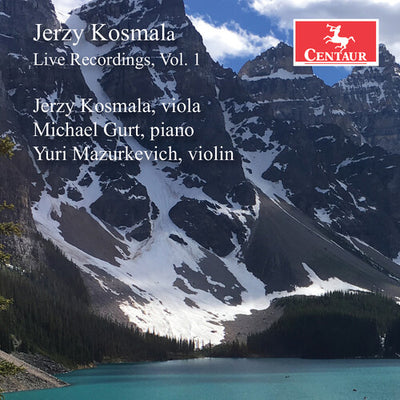
Dr. Jerzy Kosmala, internationally acclaimed as a concert violist and pedagogue, has concertized throughout Europe, the former Soviet Union, Canada, North and South America, Asia, and South Africa, and has recordings on several record labels. He is a frequent guest artist and performer at the world's foremost festivals, International Viola Congresses, universities, and academies, and is a permanent jury member of virtually all of the most prestigious international competitions, including the Lionel Tertis, Geneva, Munich, Markneukirchen, Trapani, Primrose Viola Competition, Brahms Viola Competition, and the Concert Artist Guild International Competition in New York City.
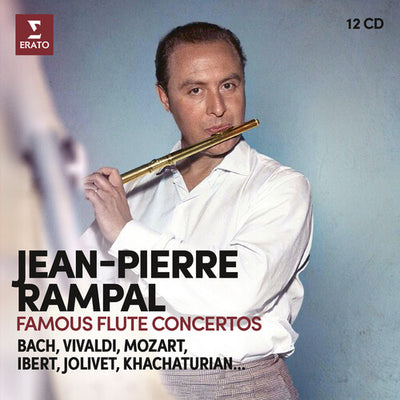
A household word when speaking of repertoire, legendary flutist Jean-Pierre Rampal devoted just as much effort to establishing the masterpieces in their rightful place as to unearthing countless works from the baroque, classical and romantic eras. As far as concertos are concerned, cornerstones by Bach, Mozart and Vivaldi thus gained worldwide fame, and it went the same way for Ibert, Jolivet and Nielsen. Unfailing lyric sense, purity of style, magnificent tone, grace of phrasing, fabulous virtuosity, tremendous commitment... Critics, colleagues and the public were all running out of superlatives. Immediately valued as references, his recordings still fascinate and often leave the listener exhilarated. This 12 CD set tries the challenge of surrounding these marvels with some of the most dazzling rediscoveries, offering famous and less famous music, but equally glorious interpretations.
His exceptional touch and sense of phrasing, his deep and personal understanding of the most varied repertoires, or even the legendary trio he formed together with Jacques Thibaud and Pablo Casals, made Alfred Cortot the greatest pianist of his time. Master of many disciples, notably the brilliant Dinu Lipatti, Samson François and Clara Haskil, Cortot also had a lasting influence on the Russian piano school through Samuil Feinberg and Heinrich Neuhaus, the latter himself being the revered teacher of Sviatoslav Richter.
All of the recordings in this set had undergone careful sound restoration in 2012, in order to respect as closely as possible the original sound. The remastering was carried out under the expert control of Mr. Guthrie Luke, a former disciple of Alfred Cortot who attended many recording sessions by Cortot. These recordings do not represent a "complete" edition: the many rolls engraved by the artist for Duo-Art, Aeolian and Pleyela labels have not been reproduced here, most of them doubling the 78-RPM repertoire. The first recordings are acoustic; and the ones with an electric microphone appeared as early as 1926.
The magnificent Christopher Purves performs a recital of Handel's bass arias. This unique collection demonstrates the range and brilliance of Handel's writing for this voice, featuring a selection from Italian and English operas, English classical drama, Biblical oratorios, literary odes and a masque. Handel's endlessly imaginative gift for characterization is fully explored here, with Purves commanding an extraordinary emotional and technical range from the buffo blustering of Polyphemus in Acis and Gatalea to the loving musings of Abinoam in 'Tears, such as tender fathers shed' from the oratorio Deborah. 'With his acting chops and weighty bass-baritone, Purves in full cry is a splendid and fearful spectacle' (The Times)