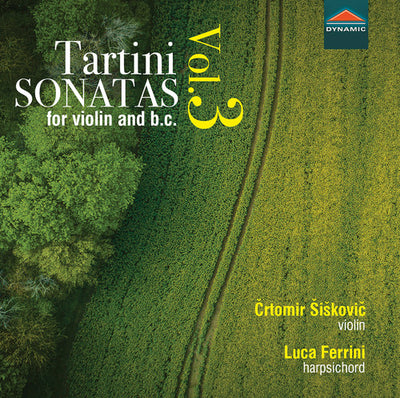
Tartini: Sonatas for Violin and Basso Continuo, Vol. 3
Dynamic
CD
$18.99Apr 12, 2019
This release features Vol. 3 of Tartini's works for violin and harpsichord, adding another significant piece to Dynamic's releases by the baroque composer. The works are performed here by the duo Crtomir Šiškovic (violin) and Luca Ferrini (harpsichord), who were also featured also in Dynamic's Vol.1 and Vol. 2. Both musicians are highly praised specialists for this kind of repertoire. Born in Trieste, Crtomir Šiškovic studied at "Glasbena Matica" and graduated from the G. Tartini" Conservatory of Trieste. He enjoys performing in various chamber groups as well as performing as a soloist with prestigious orchestras. Luca Ferrini studied at the conservatories Tartini in Trieste, and Tomadini in Udine, obtaining full marks for both piano and harpsichord. He is a renowned concert pianist, performing all over Europe as a soloist and member of chamber ensembles.
As the forerunner of the piano and violin concertos, the concerto grosso is all about give and take. Not only one against many but also one, two or three musicians conversing with each other and with a larger ensemble in a genre that celebrates intimacy, diversity and virtuosity. The form inspired collections of instrumental masterpieces by the greatest names of the Baroque era, and it’s an ideal environment for the relaxed mastery of Seldom Sene. Ever since the ensemble’s debut release in 2014 (Taracea, 94871), it has continued to fulfill imaginative recording projects with the same ‘commitment, technical versatility, unanimity of ensemble and near-immaculate tuning on display’ (Gramophone) in that first album. In their booklet notes, Stephanie Brandt of Seldom Sene and Matthias Havinga explain that the challenge of arranging this repertoire was to create a wide variety of sound colors through the intelligent use of different types of recorders and the stops of harpsichord and organ. The Sixth Brandenburg Concerto of Bach is an obvious candidate for Seldom Sene’s performance, having originally been written for a similarly homogeneous ensemble of lower strings. In Handel’s lovely Organ Concerto Op.4 No.1 Havinga retains the solo part while the recorder quintet plays the role of orchestra and basso continuo. The roles are reversed in Vivaldi’s Concerto Grosso Op.3 No.10, where the harpsichord accompanies the recorders’ flights of fancy. There is also an originally scored rarity: the Sonata for five winds and organ by the Italian-born Viennese court composer Antonio Bertali.
J.S. Bach copied out and studied Dieupart’s Six Suittes de Clavessin of 1701, the form of which he then replicated in his ‘English’ Suites. Each suite begins with a substantial movement (called ‘Ouverture’ in Dieupart’s case) which is followed by the traditional allemande, courante, sarabande, ‘galanteries’ and a final gigue. The works are presented here by Sophie Yates.
Felice Giardini was born in Turin in April of 1716. He studied violin with Giovan Battista Somis, former pupil of Arcangelo Corelli and founder of the Turin violin school, and at 20 he joined the Orchestra of the Teatr Regio in Turin; then he undertook a series of trips taht ook him to Germany, France and finally to London, where he lived for 35 years. There, in a very short time he became famous as a skillful and stylish violinist and began attending the cultural and noble atmosphere of the city, obtaining the license by King George II for the release of nine collections of works. As witnessed by Charles Burney in his pioneering music history, Giardini fame spread to Italy and Germany, and its activities as violinist, composer, impresario and choirmaster, flourished until 1790, when he began his downward spiral, which led him, almost eighty years old, in 1792, to undertake one last trip to Russia, where four years later he died, forgotten and in poverty. Within this album the Mirus Quartet accompanied by fine soloists are rediscovering his quartets, perfect examples of Giardini great music that led him to win the English aristocracy of his days.
Nowadays, the work of François Couperin is commonly associated with harpsichord music of the turn of the Baroque and Classicism. His elaborate miniatures and suites, plenty of brilliant ornaments, are now almost inextricably linked to the canonical harpsichord repertoire. The album by Dorota Cybulska-Amsler makes us aware, however, that François was not the only composer in the Couperin family. As the artist points out, names of members of the Couperin family, originating from the Chaumes-en-Brie region, are already in documents from the 16th century. In 1586, Mathurin Couperin (ca. 1569–ca. 1640), is still making a living mainly from farming, but he obtains the right to practice music for remuneration. His son, Charles I (1595–1654) is going to be the founder of a musical dynasty.
Vitali: Varie Sonate alla Francese e all'Itagliana a Sei Str
Tactus
CD
$21.99Jun 05, 2020
The city of Modena, under the rule of the Este family, was the capital of the Dukedom of Modena e Reggio. Thanks to Duke Francesco II's fondness for the violin, music became an essential element in the most important events at the Este court, such as receptions, weddings and official visits of foreign sovereigns. These were the occasions in which the Duke displayed all his magnificence. Modena stands out for the abundance of it's collection of musical documents in the Biblioteca Estense: the library is a real mine, largely unexplored so far. This consideration gave rise to the idea of making this beautiful, extraordinarily modern music available to those who are "pursuing" culture and art. So our goal is to promote a rediscovery of the enormous heritage preserved in the Biblioteca Estense, by carrying out a meticulous study of the sources of the works of the composers who were active at the Este Court in Modena, transcribing them into modern notation and critical editions, and producing monographic recordings of them. The first step consisted in the study and recording of the instrumental works of Giovanni Battista Vitali. In this fifth of 6 releases dedicated to his music preserved at the Estense Library of Modena, the baroque ensemble Italico Splendore performs the Sonatas for six instruments Op. 11, published in Modena in 1684. These are dance movements grouped by tone in the typical manner of a suite, in a sophisticated blend of Italian and French styles.
Friederike Chylek, born in Starnberg, began playing the piano and the recorder at age seven. Whilst still attending secondary school in Stockdorf and Gräfelfing, she began her artistic education in Munich with the harpsichordist Michael Eberth. Starting in the year 2000, she studied harpsichord and figured bass at the world renowned Schola Cantorum Basiliensis with professors including Jesper Christensen, wtih Rudolf Lutz and Edoardo Torbianelli. She performs regularly in numerous concert halls in Germany and abroad and is a welcome guest at such select festivals as the Cadenza Baroque Days in Berlin, the Handel Festival in Göttingen and the Festival Maj z Muzyka Dawna, Wroclas, amongst many others. With the present album, Friederike Chylek puts an end to prejudices against English music - England was long denigrated as the "Land without music" - bringing time to a standstill with works from the Golden Age of Virginal Music, numerous performance and compositional techniques of which provided decisive impulses for the development of European keyboard music.
Handel's Queens: Cuzzoni & Faustina / Cunningham, Crowe, Bevan, London Early Opera
Signum Classics
CD
$27.99Jul 19, 2019
Handel’s Queens features some of the most exquisite pieces of music written by G.F. Handel and his contemporaries for the two finest singers of the eighteenth century, Faustina Bordoni and Francesca Cuzzoni. Often wrongfully framed as rivals, these dazzling new recordings with Mary Bevan and Lucy Crowe reveal the distinctive yet versatile talent of the Italian vocalists. Led by London Early Opera Director, Bridget Cunningham, Handel’s Queens serves an example of the group’s dedication to imaginative programming and outstanding period performance, placing them at the forefront of baroque research.
-----
REVIEW:
The choice of singers in Handel’s Queens seems perfect, for the two excellent and appropriate voices are neatly contrasted while displaying the required virtuosity. Cunningham’s contribution is adroit, with pace and style aplenty and she conducts from the harpsichord.
The complete recording of the Fitzwilliam Virginal Book is a highly prestigious project of unprecedented scope and importance. The high quality of the music and the excellent performances by Pieter-Jan Belder make it a landmark of historical importance. It is the most famous, extensive and important collection of keyboard music from the English Elizabethan and Jacobean Era. Lodged in the Fitzwilliam Museum in Cambridge it contains more than 300 works for the virginal, written by Bull, Byrd, Tomkins and many others. This set contains works by some famous and some less well known composer: Thomas Tallis, Thomas Morley, John Munday, Thomas Tomkins, Ferdinando Richardson and a fine line up of Anonymous composers. The repertoire consists of a wide variety of dance forms such as Pavan, Galliarda, Fantasia, and instrumental arrangements of popular songs or madrigals. Pieter Jan Belder is one of the world’s foremost keyboard players, with an astonishing number of recordings to his name.
Weinberg: Symphonies Nos. 2 & 7 / Duczmal-Mroz, Amadeus Chamber Orchestra of Polish Radio
DUX
CD
$21.99Jun 05, 2020
In recent years, Mieczyslaw Weinberg has become one of the most recognizable Polish composers of the 20th century, which was significantly influenced by the hundredth anniversary of the composer’s birth in December 2019. The project of the Amadeus Chamber Orchestra of Polish Radio devoted exclusively to works by Mieczyslaw Weinberg perfectly reflects the peculiar revival related to the interest in the artist in Poland and in the world. This album is another proposal from the Amadeus Orchestra series, this time dedicated to selected symphonies of the Polish artist.
Vinikour's performances are so buoyant, glistening or noble that you'll likely find yourself glued to your speakers (or headphones). And if you're accustomed to hearing the harpsichord at some distance in a concert hall, be prepared to listen as if you're standing next to the keyboard…” —Gramophone.
Playing with elegance and an innate sense of phrasing that allows lyric inventions to shine through the natural flow of the music, Mr. Vinikour achieves the distinction of offering playing that is genuinely moving.” —Joseph Newsome, Voix des Arts. The six partitas for harpsichord by Johann Sebastian Bach are among the greatest and most inspired works of all keyboard literature. Although they are the first works that Bach decided to publish, they represent the composer's genius at the height of his maturity, matched only by the Goldberg Variations.
Performed on a stunning copy of a North German instrument of Bach's time, rich and expressive, but also clear and incisive, built by Tom and Barbara Wolf, each of the partitas is a microcosm, ranging from the poetic and pastoral (no. 1, in B flat Major), to the epic and tragic (no. 6, in e minor). Bach shows himself to be playful, profound, meditative, theatrical, virtuoso - and always the greatest composer of counterpoint of all time. The six partitas represent the apotheosis not only of Bach's unique keyboard language, and the expressive possibilities of the harpsichord, but in the inherent range of colors and contrasts within the confines of a suite. To a greater extent than in the other sets of suites, each of the six partitas seems to establish its own distinct character, which is developed throughout the suite. As with the English Suites, each of the partitas opens with a prélude. However, these movements are widely varied in form as well as in mood. Although each of the the six partitas contains the standard suite movements (apart from the c minor partita, which foregoes the customary gigue in favor of a Capriccio), these movements show the most striking variety.
REVIEW:
The musical distinction gracing Jory Vinikour’s Bach Partitas should come as no surprise to listeners familiar with this sensitive and cultivated musician. For starters, he gets superb engineering courtesy of Sono Luminus’ home base studios in Boyce, Virginia. The sonics envelop Vinikour’s harpsichord (a 1995 double-manual German model by Thomas and Barbara Wolf, based on a 1738 vintage single-manual instrument by Christian Vater) within a warm, ample, and resonant ambience, with a special ring to sustained bass notes and clarity in all registers. Secondly, Vinikour’s aesthetic evokes that of his late mentor Huguette Dreyfus for its generally conservative tempos and a subtle approach to agogic phrasing that avoids the rhythmic hiccups and lurching mannerisms that we too often hear in the name of “authenticity”.
He never plays faster than one can dance or sing, as the gently ebullient Gigue finales demonstrate, while being quite generous with ornaments and embellishments on the repeats. If the A minor and G major Allemandes tend to sag under their expansive weight, the opposite is true in the D major Allemande’s gorgeously spun legato lines and sustaining power. This Partita’s opening Ouverture, incidentally, receives one of its finest performances on disc; it manages to sound weightily grandiose without sacrificing any forward sweep.
Also worth mentioning are Vinikour’s articulation of the E minor Corrente’s suspended syncopations and his opting to take the Gigue in triple rather than duple meter. Vinikour’s absorption in and commitment to these scores proves further evident in his booklet notes, which are highly informative and vividly expressed. I wouldn’t want to be without Christophe Rousset’s generally brisker pacing, the greater variety of registrations and timbres that Trevor Pinnock serves up in his Hänssler Bach Edition remake, or the late Igor Kipnis’ irrepressible sense of character. Yet Vinikour’s Partitas add up to a serious and major achievement by a serious and major artist.
Bach: Concertos For Two Harpischords / Masaaki & Masato Suzuki, Bach Collegium Japan
BIS
SACD
$21.99May 27, 2014
This is a hybrid Super Audio CD playable on both regular and Super Audio CD players.
That Johann Sebastian Bach as Cantor at St Thomas Church in Leipzig was expected to provide the churchgoers with suitably impressive musical performances each Sunday and Feast day is quite widely known. Fewer will be aware of the fact that the post as director of the city's Collegium Musicum, which he held from 1729, in some ways was just as demanding and time-consuming. Weekly concerts all year round – and twice-weekly during the three busy fair periods (New Year, Easter and Michaelmas) – meant that Bach during his ten years as director spent far more time performing secular instrumental music in Zimmermann's coffee house – the usual concert venue – than cantatas in church. As with his church duties, Bach will also have been expected to provide repertoire for the ensemble, composing as well as arranging music by others and himself for it. Among such works will have been his various harpsichord concertos: with Bach's great reputation as a keyboard virtuoso, it is not difficult to imagine the demand by the Leipzig audiences to see their local hero shine on the stage. Three double concertos for harpsichord by Bach survive, all dating from around 1736, and all arrangements of earlier compositions. BWV 1060 is thought to have originated as a now lost double concerto for oboe and violin, while BWV 1062 is a reworking of the well-loved concerto for two violins. Unlike these two works, BWV 1061 was composed for two harpsichords from the outset, but probably started out as a concerto without orchestral accompaniment – this will have been added later. Performing these works, with a quintet of string players from the Bach Collegium Japan, Masaaki Suzuki is joined by his son Masato. For the present disc Masato Suzuki has also taken a page from Bach’s own book, in arranging the composer’s Orchestral Suite No.1 for two unaccompanied harpsichords.
The Swedish recorder virtuoso Dan Laurin has demonstrated his remarkable versatility on some thirty recordings for BIS, ranging from a nine-disc set with 17th-century composer Jacob van Eyck's complete Der Fluyten Lust-hof to the recent Rock that Flute, with music for recorder and strings written in 2013 by the Dutch composer Chiel Meijering. During a recording career that stretches over almost 30 years, Laurin keeps returning to one particular set of works, however: the concertos by Antonio Vivaldi. Three of the works (the Concertos RV 441, 443 and 444) included on his latest release he has recorded more than once before, with ensembles such as the Drottningholm Baroque Ensemble, Bach Collegium Japan and Arte dei Suonatori. For his latest 'take' on these favourites Laurin has joined forces with the young and vibrant Norwegian string ensemble 1B1 (shorthand for Ensemble Bjergsted 1). As he explains in his own liner notes for the present disc, he was inspired by his work on transcribing and performing Vivaldi’s Four Seasons: ‘A close reading of RV441 and RV443–445 reveals great similarities between these works and The Four Seasons: sudden changes of moods, turbulent emotions, burlesque whims mixed with sublime beauty and elegance… My aim here is to explore the recorder concertos with the same freedom and spontaneity that characterize the modern-day approach to the Seasons.’ Laurin’s recording of the Seasons has been called ‘undoubtedly the best transcription to date’ (Diapason) and ‘never hackneyed, but instead invigoratingly fresh and vibrant’ (Clarino), verdicts which can only fuel the expectations concerning this his latest version of the recorder concertos.
Bach: 6 Trio Sonatas, BWV 525-530 (transcribed for harpsicho
Dynamic
CD
$14.99$18.99Save 20%Apr 12, 2019
This album features a new arrangement for harpsichord and guitar of Bach's six trio Sonatas for organ BWV 525-530. Extravagantia duo, two talented and learned young musicians, takes the challenge to confront themselves with Bach's organ masterpieces with a new and fresh approach which aims to explore from an unusual perspective a piece of traditional repertoire. Luigi Accardo and Francesco Molmenti dig deeply into Bach's historical background and create a musical language of their own. Francesco Molmenti began studying guitar at age 11. He went on to earn his diploma at the Conservatory of Trieste in 2003. He has won several national and international competitions since. Currently, he performs as a soloist, with the Res Intimae guitar trio, and the present ensemble, the Extravagantia Duo. Luigi Accardo was born in Cagliari. He graduated in Piano from the Conservatory of Cagliari and in Harpsichord from the Conservatory of Piacenza.
Ukrainian cellist Natalia Khoma and Russian cellist Suren Bagratuni are the featured performers on these 1998 recordings of works for Cello Duo by Couperin, Telemann, Handel and Bartók. Ms. Khoma, an internationally renowned, Moscow Conservatory trained and prize-winning cellist has distinguished herself as a recitalist and soloist with orchestras thorough the former USSR, the USA, Europe, Canada, South America, Asia South Africa and the Middle East. Mr. Bagratuni, 1986 Tchaikovsky competition Silver Medalist, is Prof. of Cello and String Area co-chair at Mich. St. Univ.
The composers featured on this new release are rarely performed, and much of their music has been lost. All of the pieces featured on this release were found in Johann George Pisendel’s private library collection, and date from 18th century Dresden. Marcin Swiatkiewicz is one of today’s foremost Polish harpsichordists. He specializes in period keyboard instruments, as well as improvisation in both the modern and old styles. Martyna Pastuszka has been the concert master and artistic director of {oh!} Orkiestra Historyczna since 2012. She is an active teacher, and is frequently asked to collaborate with other ensembles.