Johann Sebastian Bach developed a new style, cembalo obbligato, where the right hand of the keyboard plays as a melody instrument and is given the same importance as the violin, flute or other solo instrument. His sonatas for melody instrument and keyboard instrument include works for flute, violin, and viola da gamba. It seems that the obbligato style interested him more than the traditional continuo role for the keyboard. As for the violin, there are two sonatas written with basso continuo and six with harpsichord obbligato. Among these works, the six sonatas in particular were conceived as a set, with a consistent style and a well-considered key distribution. This set is one of the highlights in the catalog of Bach’s chamber music. Bach’s son Carl Philip Emmanuel Bach writes to Bach’s first biographer, Johann Nikolaus Forkel, in 1774: “The 6 clavier [and violin] trios...are amongst the best works of my dearly beloved father. Even now they sound very good and give me many delights, regardless of the fact that they are over fifty years old.” The key distribution is somewhat symmetric and this suggests that Bach intended these as a set of pieces for violin, comparable to his unaccompanied sonatas and partitas for violin. Additionally, with the exception of Sonata No. 6, this set of works all follow the church sonata style.
“JS Bach’s seven concertos for solo harpsichord & strings, occupy a significant place in the history of music, marking as they do the origin of the keyboard concerto genre. Collectively, they encompass the gamut of Baroque rhetorical expression; indeed, leaving aside the six ground-breaking ‘Brandenburg’ Concerts avec plusieurs instruments, it is difficult to think of a more diverse, revolutionary and technically refined set of instrumental concertos from the Baroque period” - Andrew Arthur; Their second recording on Signum Classics, The Hanover Band play-directed by Andrew Arthur present four of these revolutionary concertos, following their successful first album “BMV 1052, 1054, 1055 & 1058 Harpsichord Concertos”. The Hanover Band’s players are amongst the finest in their field and the orchestra has built an international reputation for the excellence of its performances and recordings of eighteenth and nineteenth-century music. Andrew Arthur is best-known for his work in the field of historically informed performance, he is in great demand as a conductor, keyboard soloist and continuo player, working with many of the UK’s leading period-instrument orchestras and professional choirs.
Harpsichordist, fortepianist, and modern pianist Melody Lin enjoys an active musical career in Asia, the United States, and Europe. Lin holds a Doctor of Musical Arts degree in Historical Performance Practices and Keyboard Studies from Claremont Graduate University, where she studied harpsichord with Prof. Robert Zappulla and modern piano and fortepiano with Prof. Jenny Soonjin Kim. Lin has had the pleasure to work with many renowned artists and has participated both domestically and internationally in music festivals. Lin is currently a member of the Music Teachers Association of California.
In November 1973, the music press was ablaze with announcements about the ‘first new major British classical record label to hit the market for many years’ and the ‘hush-hush recording sessions’ that had been in progress to mark its launch. These sessions included bringing harpsichordist Trevor Pinnock to listeners worldwide with his debut album Trevor Pinnock at the Victoria and Albert Museum. Released to critical acclaim, this album cemented the direction of the eagerly awaited new label, CRD Records: to champion new artists and to celebrate the full gamut of listening experiences offered through classical repertoire.
Fifty years on musical tastes have expanded and the harpsichord often gets overlooked, undeservedly so. The harpsichord is an instrument that takes no prisoners; it demands precision and craft, musical sensitivity and more. In Melody Lin’s performances, the rewards are great: as listeners, we are treated to the translation of black dots to bursts of exuberant colour, from elegance to joy to thunderous expressions of foreboding. If the music were to be represented in film, we would move from calm, pastoral scenes to mountainous terrain. This is in fact riveting cinema. We hope you enjoy the views.
In 2023 Brilliant Classics released a 9CD box of the complete keyboard music by William Byrd, marking the tercentenary of the composer's death. The set was welcomed as a monumental achievement, and a worthy sequel to Davitt Moroney's pioneering achievement on Hyperion: 'Those who enjoyed Belder's forthright and imaginatively ornamented Byrd performances in his complete Fitzwilliam Virginal Book survey will know what to expect,' wrote Jed Distler in Classics Today. 'He favors less agogic manipulation and more conservative rhythmic continuity compared to Hyperion's Davitt Moroney. However, a palpable sense of controlled freedom informs Belder's subtle placement of cadences and phrase endings and his flexibly articulated ornaments.' Extracted from that critically acclaimed set, the present album presents all the pieces recorded bv Pieter-Jan Belder on the at the Albert Kiespenning organ of the Grote Kerk in Wijk bij Duurstede. The degree to which any of these pieces was written 'for organ' may remain open to question, when they could be performed, with allowance for some imaginative liberties, on any keyboard instrument, and indeed many contemporary pianists have revived Byrd's music for a new generation of listeners. Whether experienced on a Steinway or a spinet, Byrd is the first great composer for the keyboard, even when producing instrumental versions of choral anthems. Belder includes several such pieces here, which find a natural home 'in church' rather than the domestic setting of the harpsichord. Two versions of Salvator Mundi are effectively forerunners of chorale preludes; likewise three versions of Clarifica me. Several voluntaries lie no less idiomatically on the organ despite their highly florid writing, while the assorted preludes or fantasias and their companion fugues also deserve to be regarded alongside notable pre-Bachian models by Frescobaldi and Buxtehude. According to Early Music Review: 'As for performance, Belder's strength is in allowing Byrd to speak through the music rather than inflicting an interpretative regime upon the music... It remains wholeheartedly to welcome and recommend this fine discographical achievement.'
Johann Joachim Quantz was one of the greatest composers of his time, with a large oeuvre to his name. And while his work for flute has been enjoyed by flautists and audiences alike, it doesn't seem to meet any of the criteria codified at the beginning of the 20th century for what constitutes 'great', 'lasting', 'profound' or 'complex' music. Nor does it meet the requirement set in modern times for the worth of a composer's work to be measured in terms of the influence it has on the next generation. This is because, after having achieved a technical knowledge on par with his contemporaries, Quantz opted for the restrictive life of a court composer in the service of Frederick the Great, King of Prussia, who, though an educated man and amateur musician, had a conservative taste in music. Quantz's music was therefore never 'fashionable', and his compositions failed to leave a mark on posterity. Quantz's oeuvre for the transverse flute includes around 300 concertos, 200 sonatas and dozens of chamber music works, yet until the middle of the 20th century, none of his sonatas and only one of his concertos had been performed in concert. Like the concertos, the sonatas are among the finest examples of the genre, integrating progressive composing techniques and a versatile form and structure. The chronology of the sonatas can only be ascertained to a point. For this first instalment in the recording of Quantz's complete flute sonatas, the selection is linked neither to chronology nor to catalogue number. It features an early composition from Dresden (in B flat major, QV 1:153) and showcases a variety of keys across the seven sonatas chosen. Despite the ad hoc order, by the end of the series all known original sonatas will have been covered. This recording project aims to reconstruct coeval performance conditions as accurately as possible. These efforts include using a replica of an original flute built by Quantz, played at the original pitch (a whole tone lower than standard) and recording in a hall very similar in size, proportions and acoustics to the music hall in Potsdam where so many of Quantz's famous music evenings took place. The microphone set up reproduces without any manipulation what the listener would hear at a performance in such a hall, from a distance of about five metres. In the endeavour we encountered several dilemmas, one being the choice of accompanying forces. It is known that at Frederick's court the use of a keyboard instrument plus a string bass was considered optimal, but we do not know whether this was always realised in practice. In the end it was decided to record most of the sonatas with keyboards only. Another important question, then, was the choice of keyboard: harpsichord or fortepiano. While from the 1740s onwards Frederick had become acquainted with Gottfried Silbermann's fortepianos and indeed purchased a number of them, the harpsichord remained an important accompanying instrument, and there were many of them at the court.
Bach: The Gamba Sonatas with Harpsichord, Piano & Organ / De Carlo, Guglielmi
Fineline
CD
$13.99Oct 20, 2023
I see that we had met in Bach’s profound italianness, in the singing of the melodies that danced in counterpoint, in the rhythmic undulation of his writing. Although in the manuscripts the three Sonatas for Viola da Gamba are accompanied by the harpsichord, we imagined the Viola da Gamba conversing with different keyboard instruments that Bach had at his disposal: a copy of a Mietke harpsichord, a copy of a Silbermann fortepiano and the organ built by Gottfried Silbermann in 1753.
Pachelbel: Hexachordum Apollinis & Chaconne for Harpsichord / Bissolo
Dynamic
CD
$18.99Aug 19, 2022
Johann Pachelbel is remembered today for his Canon in D major, but he was an outstandingly successful organist and composer whose musical legacy is in fact quite broad and varied. Of his keyboard pieces the Hexachordum Apollinis is regarded as the pinnacle of his oeuvre and was a work to which Pachelbel himself attached great importance. Consisting of six arias with variations, the collection brings together the influence of several schools of music, all filtered through the composer’s refined tastes and superlative technical skill. The splendid Chaconne anticipates Bach and is one of Pachelbel’s best-known keyboard pieces.
REVIEW:
The title work on this disc is a fascinating composition. A set of 6 arias with variations written for either harpsichord or organ. Mathematically complex with symbolism relating to numerology and the Kabbalah the booklet notes point out some interesting features and point to a work that should perhaps be more widely known and appreciated. The Chaconne is a more known work.
The Promises of Darkness marks the next chapter in the visionary collaboration between Pulitzer Prize-winning composer Roger Reynolds and conductor/producer Mathias Reumert. Released by Ekkozone, this landmark album showcases world premiere recordings of four major works, tracing four decades of Reynolds's trailblazing contributions to contemporary music. The title work, The Promises of Darkness (1975), pays homage to Reynolds's mentor Roberto Gerhardt. Scored for an ensemble of 11 players, this piece masterfully conjures vivid colors and an almost cinematic sense of dread, revealing Reynolds as a composer unafraid to probe the edges of musical and emotional experience. From 1985 comes Mistral, for strings, brass, and amplified harpsichord. Although inspired by an encounter with the forceful Mediterranean wind, the piece is "neither illustrative nor programmatic," according to the composer. Mistral has previously been released in a lo-fi live recording, but the highly refined score - with it's crystalline articulate harpsichord - is finally brought to life in this new version, which Reynolds himself has hailed as "a triumph." A relentless exploration of the interplay between two harmonic strata, Dionysus (1990) involves "a blend of metaphor and pragmatics" and is captured in a breathtakingly precise performance, with expressive solos from flutist Helene Navasse and trumpeter Laszlo Molnar. Closing the album is the electroacoustic Positings (2013), where the Mathias Reumert Group is joined by computer musician and Reynolds collaborator Paul Hembree. Seamlessly blending live performance with electronic textures, Positings embodies Reynolds's innovative spirit, pushing the boundaries of sound and structure. This release follows the critically acclaimed Wind Concertos, the first in the Reynolds/Reumert series, which earned Album of the Year (The Five Best) from the Danish Broadcasting Corporation in 2024. With The Promises of Darkness, Ekkozone solidifies it's reputation as a home for groundbreaking contemporary music, curated with Reumert's exacting vision.
Please, enjoy one of the most appealing and thought-provoking Baroque discs of the year. It contains a selection of the sonatas drawn from Pisendel's library, the best of Italian and German violin schools. This is the debut album of an outstanding baroque violinist coming from the renowned Schola Cantorum Basiliensis. The recording is the fruit of an in-depth scholar work, of a virtuoso violinist accompanied by a raising star of the harpsichord - to which the expertise of a top sound engineer and producer is added.
Bei Bach zu Hause - Sylvius Leopold Weiss in Leipzig / Cantalupi, Pozzi
MV Cremona
CD
$19.99Feb 09, 2024
Born in Grottkau, a town close to Wroclaw in Lower Silesia (modern day Poland), Sylvius Leopold Weiss (1687-1750) is for the lute what Johann Sebastian Bach represents for harpsichord and organ. Since 1706, in his hometown, he served Count of Palatinate Charles Philippe, brother of Prince Johann Wilhelm, Elector Palatine, patron of the arts and dedicatee of Arcangelo Corelli’s Concerti Grossi, Op VI.
Starting in 1718, he settled permanently in Dresden, refusing the salary offered by the Viennese Court –which was almost twice as much as he was earning in Dresden – and dedicated his efforts to composing more than 600 lute pieces, either solo or with other instruments. In Dresden, he took part in the musical life in court and met numerous musicians; he was particularly friendly with Wilhelm Friedemann Bach, Johann Sebastian’s son and organist at Saint Sophia’s Church. In 1739, the two friends travelled to Leipzig where they were hosted by Johann Sebastian for four weeks. We don’t know for sure for the music played by Bach and Weiss during their meeting, but it seems legitimate to think that they played their music on their instruments composing, arringing or improvising together. This programme is meant to witness this precise type of practise, and in some manner aims at recreating the musical atmosphere of these two musicians’ meeting, during which, as reported by Johann Friedrich Reichardt in the Berlinische Musikalische Zeitung,"being aware of the difficulty in performing controlled and elegant phrases on the lute, eyewitnesses ensure that the great lutenist from Dresden, together with the great organist and harpsichordist Bach improvised many fugues and fantasies together".
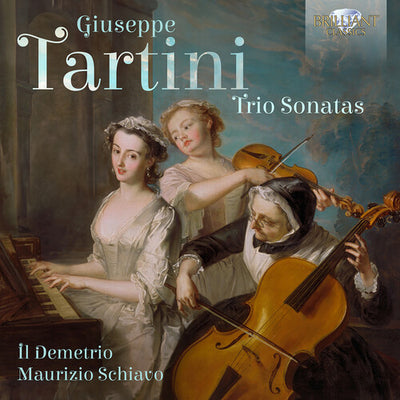
With 37 confirmed trio sonatas to his credit, Giuseppe Tartini is the most important Italian composer of his generation for this type of repertoire. It may seem odd therefore that these works have been so sorely neglected; indeed, as of 2022 only around 20 per cent of the repertoire had been recorded and a critical edition had yet to be published. This state of affairs was largely due to confusion regarding sources, with many divergent interpretations and uncertainties regarding the dates of the handwritten scores. Some order has been brought to this originally chaotic situation by the research carried out by Juan Mariano Porta from 2018 to 2022 as part of his doctoral studies, the result of which was the inclusion of the trio sonatas in the upcoming publications of the Edizione Nazionale delle Opere di Giuseppe Tartini, with advance materials made available to the Il Demetrio ensemble for recording. Giuseppe Tartini dedicated almost all his energy to his chosen instrument, the violin. His established corpus of works currently numbers 200 sonatas for violin and bass, 150 violin concertos, 37 trio sonatas, a handful of concertos for other instruments, and a small number of quartet sonatas and vocal compositions. Production of the trio sonatas began in the composer's late-mature years, and their style would seem to correspond to Tartini's final compositional period, described as a Drang nach absoluter Musik [urge for absolute music], which began around 1750 without a clear line of demarcation from what came before and continued until the composer's death. The trend was towards simplicity, partly deriving from Tartini's desire to put his theoretical speculations into practice. The trio sonatas no longer feature the virtuoso passages of earlier works. They present a binary form with regular phrasing. Their harmonic rhythm is slow, with the violins mainly proceeding in parallel triplets. The function of the bass is relegated one of harmonic support. This recording contains the sonatas G1, D1, d1 A1, A2, A3, A6, and a1, which date to Tartini's final compositional sub-period. They are little-known pieces, most of them hitherto unpublished.
An extraordinary recording based on the famous middle-age manuscript Codex Faenza. Extraordinary for the thrilling interpretation of this often obscure and remote musical language. Extraordinary for it's continuous and seamless capacity of captivating the listener, who never gets tired nor bored. Extraordinary for the quality of the sound of the oldest extant organ (Valere, Switzerland - 1435). This daring project owes it's allure to the musicological knowledge and the musical prowess of the interpreters, of the recording engineer and producer. The well thought-out alternance of colours, instruments and climats (keyboards, flutes and voices) allow an enjoyable listening throughout. L'Amorosa Caccia is led by Fabio Antonio Falcone, already responsible for the Preis der Deutschen Schallplattenkritik recording of Sweelinck's harpsichord music (CC 72926).
Florentine, born Francesco Maria Veracini (1690-1786), was considered one of the greatest violin virtuosos of his day. Periods of residence in London, Dusseldorf, Venice, and Dresden brought the eccentric musician international fame. Amongst his extensive output, his Sonate Accademiche Op. 2 (London/Florence 1744) for violin and basso continuo are the best known today. The character of the Sonate Accademiche is defined by a peculiar combination of the intellectual, the virtuosic, and the highly expressive. Despite the technically demanding writing for the violin, Veracini's masterfully idiomatic approach to his own instrument means the virtuosity flows with a natural ease and playfulness.
Italophilia - Discovering the Italian Style in Handel's Lond
Challenge Classics
CD
$16.99Jan 10, 2025
This CD by The Counterpoints, entitled Italophilia: Discovering the Italian style in Handel's London, investigates the Italian musical influences on English baroque music in the seventeenth and eighteenth century. Already in 1683, Henry Purcell (1659-1695) had written in the foreword of his Sonatas of three Parts that he had 'faithfully endeavour'd a just imitation of the most fam'd Italian Masters'. In later years, the impact of these Italian Masters would only increase, reaching it's apogee in the work of George Frideric Handel (1685-1759). This CD contextualizes Handel's work with composers he influenced and was influenced by, both in England and Italy.
18th-century sonatas by a pair of musical brothers, in stylish historically informed performances from 1994. Very little music by the brothers Groneman is known in modern times beyond the pieces on this album, which have survived simply because of their popularity with flautists of their day. Pleasing both to hear and to play, these sonatas exert an additional fascination today for the insights they give into the taste and technique of the 18th-century flautist. Johannes Albertus Groneman (c.1708-1781) and Johannes Fredericus Groneman (1711-1778) were both probably born in Cologne, where their father was a military-band musician. Albertus developed his skill as a violinist beyond mere proficiency, and left to ply his trade as a jobbing musician in what is now the Netherlands. Having settled in Leiden around 1731, he wrote virtuosic pieces for violin and flute which proved popular enough to be published and republished in London and Paris. He performed throughout Holland, and then moved from Leiden to The Hague, where he was awarded a lucrative and coveted position as church organist. This career of steady accomplishment and gathering renown came to a sudden and tragic end in 1756 when he was committed to an asylum, where he lived out his days in penury. Meanwhile Fredericus is a much more shadowy figure to us: the three books of his flute sonatas listed in contemporary publishers' catalogues have disappeared, as have any details of his life and career. Of his gifts as a musician, there can be no doubt, to judge from the sonatas presented here, showing as they do an up-to-date knowledge of the latest musical trends set by masters such as Tartini and Geminiani, and yet display an expressive style entirely their own. Likewise, the two flute duets by Albertus Groneman demonstrate why his music proved to be so popular during his lifetime: they are in turn gracious, surprising, virtuosic and sweetly-singing, and display the full range of the flute's possibilities. Like Telemann's duets of the same period, they are full of fantasy and.wit and testify not only to the worthiness of their creator, but also to the taste of the 18th century flutist who loved them so well. Originally issued on the Dutch label NM Classics, this reissue restores a valuable window into the vibrant culture of chamber music in 18th-century Holland, performed by specialists in the field. - Johannes Albertus Groneman (baptized 1711-1778) and his brother Johannes Fredericus were born in Hamm (Germany) into a musical family. They enjoyed an education typical of musician's sons in the 18th century, learning from their father the trade, playing several instruments and instructed in composition, harmony and singing. Through his teacher Carl Rosier Albertus was introduced in the Netherlands, where he settled in Utrecht in 1729, later moving to Leiden. It is during this Leiden period that most of Groneman's music which survived, and indeed probably all of the music of this recording, was composed. Upon his arrival in the famous university town, Groneman was able to establish himself with ease in the highest social circles, enjoying the friendship and patronage of patricians and professors, while wealthy merchants and musicians of international repute became godparents to his children. He bought a Stradivarius violin and an especially beautiful harpsichord made by famous Flemish harpsichord maker Ruckers. He published virtuoso music for violin and flute which proved popular enough to be published and republished in London and Paris. - The Flute Sonatas consist of three movements, brilliant allegros framing a melancholy and moving andante full of bold harmonies. The style is gracious and sweetly-singing, displaying the full range of the flute's brilliant possibilities. - Performed by Jed Wentz, a pioneer in the performance practice of notably French Baroque music for his instrument. His many recordings for Brilliant Classics (J.S. Bach and C.P.E. Bach, Blavet, Couperin, Boismortier, Braun, Roman) have established him as one of the foremost interpreters in this field. - Recorded in 1994, a reissue from the NM Classics catalogue, the label for music from the Netherlands.
Bach: Harpsichord Concertos / Arthur, The Hanover Band
Signum Classics
CD
$19.99Jul 15, 2022
“JS Bach’s seven concertos for solo harpsichord & strings, BWV 1052-1058, occupy a significant place in the history of music, marking as they do the origin of the keyboard concerto genre. Collectively, they encompass the gamut of Baroque rhetorical expression; indeed, leaving aside the six ground-breaking ‘Brandenburg’ Concerts avec plusieurs instruments, it is difficult to think of a more diverse, revolutionary and technically refined set of instrumental concertos from the Baroque period.” -Andrew Arthur
For their first recording on Signum Classics, The Hanover Band, directed by Andrew Arthur, present four of these revolutionary concertos, and dedicate this release to their Founder and Artistic Director, Caroline Brown (1953-2018). The Hanover Band’s players are amongst the finest in their field and the orchestra has built an international reputation for the excellence of its performances and recordings of eighteenth and nineteenth-century music. Andrew Arthur is best-known for his work in the field of historically informed performance, he is in great demand as a conductor, keyboard soloist and continuo player, working with many of the UK’s leading period-instrument orchestras and professional choirs.
REVIEW:
Arthur stresses how much these works owe to Bach’s early immersion in Vivaldi’s set of concertos L’estro armonico, several of which he transcribed, and that Italian influence does indeed permeate the performances on this recording. There’s a triumphal warmth in the Hanover Band’s delivery of the D minor work[.]
Arthur’s note on BWV 1054 indicates that he himself is aware of the danger that the harpsichord may be swamped, and in the Adagio e piano sempre of the D major work, the soloist is indeed allowed to breathe. In the joyous A major concerto the sonic balance is nicely resolved.
Austrian Harpsichord Music of the Late 17th Century
DUX
CD
$19.99Jan 16, 2026
Vienna in the second half of the 17th century, under the rule of Emperor Leopold I, was a significant center of musical life-a place where various styles and influences intersected, distinguished by it's own traditions and performance practices. The same was true for harpsichord music: composers working under the auspices of the imperial court supported and inspired each other, which resulted in a large number of surviving works preserved in libraries such as those in Leipzig, Berlin, and New York. The album includes both single-movement and multi-movement compositions that share a virtuosic character, highlighting the exceptional talent of the renowned harpsichordists of the era. Special attention should be given to the artist's own transcription of an unpublished and previously unrecorded suite by Biber, which is the result of Agata Meissner's own research work. The artist is affiliated with the Mozarteum University in Salzburg and divides her attention between performing early music and caring for historical instruments. Three of these instruments were used on this album, specifically chosen to emphasize the characteristics unique to the works of each composer. The album transports listeners to an era of fervent rhetoric and emotions, contained within the bounds of courtly elegance.
'Mahan Esfahani couldn't make a routine recital of Bach's keyboard music if you paid him' was BBC Record Review's verdict on a previous release: prospective listeners to this wonderful new set should rest assured that any hint of the routine remains as distant a threat as ever.