Johann Abraham Schmikerer is only one of the vast number of shadowy figures from the annals of music whose life and activities are hardly known. Among other places, he is also known under the quite unflattering surname Schmierer, in no way deserved in light of his inventive compositions oriented towards the French tastes of the time. His Zodiaci musici of 1698, which is Schmikerer's only undisputed work, is now convincingly joined by the Musico-instrumentalische Gemuths-Lust of 1712 on this recording. It proves not only to be an equally enchanting collection as the "musical constellations", but is also in all likelihood the second part of the suite collection long thought lost, through which the name Schmikerer has been handed down to posterity.
With this recording, volume 42 of the complete music for solo keyboard by Carl Philipp Emanuel Bach, Miklos Spanyi continues his exploration of transcriptions of concertos originally written for keyboard and orchestra, to which he adds some movements from early versions of sonatas (the standard versions of which appear on earlier volumes in this series). Four of the six concertos from the Wq 43 collection are featured here (the remaining two appear on the previous volume, BIS-2397). When Bach published this set of six concertos for keyboard and orchestra in 1772, he also prepared a version for solo keyboard intended for moderately advanced amateurs who could then play them at home, without orchestra, thus opening up a much larger market. A smart move by the shrewd businessman that Bach was. About his decision to record these works on a clavichord rather than a tangent piano as previously, Spanyi says that it allows 'nearly infinite possibilities for fine dynamic shadings' and that 'the required dynamic contrasts can be emphasized even better than on other keyboard instruments of the period'. Spanyi adds that this release is a tribute to the clavichord, and especially to his own instrument, built by Joris Potvlieghe.
This disc features solo keyboard arrangements of works by Carl Philipp Emanuel Bach originally scored for other instruments. In the second half of the eighteenth century the demand for keyboard music increased rapidly, as musical skills became a social requisite for young ladies of the upper classes. Providing compositions for these new keyboard players was financially profitable, but Bach also had another reason for welcoming arrangements: keyboard instruments were his favourite medium. The seven short pieces on this well-filled disc all exist in versions for various small groups of instruments or, in some cases, for mechanical instruments. In his comments, Spanyi suggests that they could in fact be the original versions, perhaps written down in keyboard notation as drafts for further versions, and later arranged by Bach on for various ensembles. Miklos Spanyi has grouped these short pieces around four larger-scale works, of which two are arrangements of symphonies, probably not arranged by or for the composer himself. The solo keyboard arrangements of the two concertos, made by Bach himself and easier to play than the original concertos, were intended for amateurs. On this disc, Spanyi uses an extremely versatile and colourful tangent piano, a very popular instrument in the second half of the 18th century. This particular instrument was built in 1998, after a model from 1799.
When Johann Heinrich Rolle was born, Bach was 31 years old; when he died, Mozart, then in Vienna, was nearing his 30th birthday. In retrospect, it is tempting to count him among the countless "transitional" musicians who distanced themselves from the Baroque, embraced the fashionable galanteries of the time, and thus helped pave the way for the Classical era-as if they had foreseen what was to come. Rolle's career was indeed typical of his era: organist in Magdeburg, student of law, later active in Berlin-first as a legal advisor, then as a violinist and violist in the service of Frederick the Great-before returning to Magdeburg as organist, cantor, and municipal music director. In addition to a wealth of oratorios and cantatas, he produced a substantial body of instrumental music which, as this symphonic-concertante selection shows, places him firmly within the stylistic currents of his time: light-footed, elegant, spirited, and transparent-in short, so galant that the listener is delightfully engaged from start to finish.
Pasquini: The Shadow of Solomon - Cantatas for Bass & Continuo / Abadie, Nigito, Capella Tiberina
Brilliant Classics
CD
$10.99$13.99Save 20%May 27, 2022
Renowned in his day as a virtuoso keyboard player, Bernardo Pasquini (1637-1710) was the most important Italian composer of keyboard music between Frescobaldi and Domenico Scarlatti. In that capacity his output has output has been surveyed by Brilliant Classics with authoritative collections of his sonatas for harpsichord (94286) and for two organs (94347). However, Pasquini also composed more than 70 cantatas of the concise and dramatic kind written by the young Handel after he arrived in Rome in 1706. By that late stage of his life, Pasquini had held one distinguished post after another in Roman musical life and become known as one of its celebrities, as celebrated for his abilities at the harpsichord as his contemporary Corelli was on the violin. Most of his vocal music remains unpublished, which makes the pioneering efforts of Capella Tiberina in this field especially welcome.
This new recording forms a sequel to their 2013 album of two Passion Cantatas (94225) and makes a powerful case for Pasquini as Rome’s leading dramatic composer of his day. Among Pasquini’s surviving cantatas, the six scored for solo bass stand out, for their keen sense of theatre and expressive rhetoric. They take Biblical history, tales of Roman history and pastoral-erotic tropes for their subjects, and they are imaginatively presented here as a cycle, interleaved with pieces for harpsichord, as though recreating a refined evening of music-making at a Roman palazzo around the turn of the 18th century.
Capella Tiberina is led in these stylish accounts by the harpsichordist Alessandra Nigito, who has made a particular study of Pasquini’s vocal music and edited several of his cantatas for modern publication. There is no more authoritative current exponent of this music, and she is joined here by other experienced performers on Italy’s rich early-music scene.
Dandrieu: Premier livre de Pieces d'Orgue / Belder
Brilliant Classics
CD
$16.99Sep 22, 2023
Dandrieu’s Premier Livre de Pièces d’Orgue was printed a year after the composer died in 1738. It contains six suites of pieces in differing church tones; each followed by six versets suitable for performance under the canticle Magnificat. While the Magnificat verses have a logical sequence; the other movements in the suites are somewhat haphazardly planned. Even setting aside the Pascal hymn in the Premier Suite; the remaining pieces have no apparent order; perhaps reflecting a desire to make the publication as generally useful as possible. The first suite’s two fugues are the only cantus firmus pieces in the collection and are based on the hymn Ave Maris Stella and the Pascal proclamation Exultet coelum laudibus (CD 1: 3 and 4). Like the remaining fugues; which are independent; the style is serious: each is marked Majestueusement [sic] and follows the prescriptions of several composers’ prefaces from the late 17th and early 18th centuries. While no fugues from this epoch are as carefully crafted as those of the Rouennais organist Jehan Titelouze (Paris; 1623 and 1626); their placing within organised organ masses and hymns; often as the second verset of a Kyrie; Gloria or hymn; demonstrates an underlying association between genre and rhetoric. We see similar associations with the opening movements of each Magnificat set; but they work on two levels. They are austere and reserved solely for a plein jeu combination of stops: foundation stops from 16 feet to both mixtures but without reeds. According to André Raison they are to be played solemnly with absolute finger legato. A second rhetorical association is the link between registration and text. It has been mentioned that fugues were often used as the second verse of hymns and in mass sections; and a similar association between a plein jeu and the first Kyrie; Gloria or Sanctus; or the first verse of a psalm or canticle exists in nearly every organ composer’s publication until late into the 18th century. This is not by accident since associating sounds and text would help guide congregants – many of whom were neither literate nor conversant with Latin – through the complexities of the ceremony. Indeed; such an association is well within the ceremonials’ inclusive philosophies. Several commentators associate plein jeu pieces with Titelouze; and while the registration provides a link with the north European school of organ playing; particularly of such composers from Flanders and the Spanish Netherlands as Jan Pieterzoon Sweelinck; other genres are decidedly more French. Thus; we have bourrées (e.g.; Duo; Magnificat V; CD2: 15); menuets (e.g.; Basse de Cromorne; Magnificat III; CD1: 33); gavottes (e.g.; Trio; Magnificat V; CD2: 16); gigues (Magnificat IV; CD2: 5); Italianate gigas (Duo; Magnificat III; CD1: 26) and; as mentioned previously; rustic dances in the guise of musettes. It is not only dance forms that permeate French organ music; since we also see the influence of the air de cour in the tender récits (e.g.; Magnificat III; CD1: 33); concerted viol music in the two Tierce en Taille pieces (Suites IV and V) and even Lullyan ouvertures; which form the basis of the offertoires. These are exclusively reserved for grands jeux combinations that juxtapose concertante and ripieno sections using combinations of reeds; cornets and foundation stops that mimic the grand orchestral writing popular with Parisian apparatchiks of the opera.
Johann Jakob Froberger: Suites for Harpsichord, Vol. 4
Athene
CD
$25.99Oct 10, 2025
The fourth and final volume in Gilbert Rowland's acclaimed Froberger series completes the landmark recording project on specialist early music label Athene. This double album is the latest instalment of Rowland's authoritative traversal of the complete Harpsichord Suites by Johann Jakob Froberger - a composer of profound influence whose innovations shaped the very form of the Baroque suite later adopted by Bach and Handel. Praised for it's "glorious sound" and "energy and a good forward drive", the series has garnered widespread critical recognition. Recorded in the sympathetic acoustic of Holy Trinity Church, Weston, in October 2024, the album reunites Rowland with engineer John Taylor, whose audiophile-standard production has underpinned the previous volumes. Rowland's playing combines historical insight with expressive vitality, delivering performances marked by "impeccable clarity, flawless articulation, and period-perfect embellishments". His interpretations illuminate the elegance and inventiveness of Froberger's writing, making this collection an essential reference for enthusiasts and scholars of early keyboard music. This release is a vital addition for fans of Froberger, Bach, Handel, Scarlatti, and historically informed performances, offering both continuity for collectors and a compelling entry point into one of the Baroque's most fascinating keyboard oeuvres.
This disc is devoted to the Dutch music for recorder during the Baroque era. The music is highly original, although we can feel a strong influence by contemporary Italian composers like Corelli. Teun Wisse plays different period instruments, each fitting the single Sonata. The strictly historical approach is accomplished by the recording venue, a Dutch 18th Century church, whose acoustic perfectly fits the music.
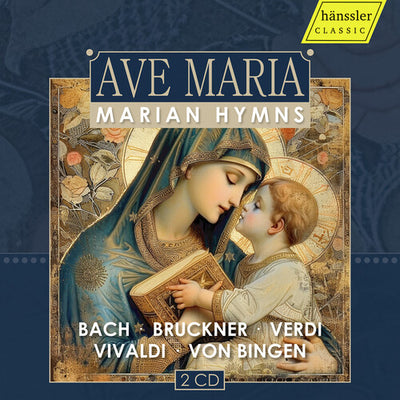
Marien Hymns Masterpieces of musical Marian devotion over the centuries, composed by the greatest composers of the time as well as well-known traditional hymns, interpreted by renowned soloists and ensembles such as the Gachinger Kantorei Stuttgart under Helmuth Rilling, Renata Tebaldi, the Don Cossack Choir Serge Jaroff or the Stuttgart Hymnus Choir Boys' Choir.
Froberger: Suites for Harpsichord, Vol. 3 / Rowland
Athene
CD
$27.99Apr 14, 2023
English harpsichordist Gilbert Rowland has completed the third volume in his ongoing series of the complete Suites for Harpsichord by Johann Jakob Froberger. The album was recorded at Holy Trinity Church, Weston, Hertfordshire on 11-14 July 2022, with engineer John Taylor who produced all of Gilbert’s previous Divine Art and Athene recordings. The first two volumes of the series has attracted much praise from critics for its "glorious sound" and "energy and a good forward drive" of Rowland's playing.
Johann Jakob Froberger was a highly accomplished composer of the middle Baroque period and credited with inventing the ‘baroque suite’ used with variations by Bach, Handel and countless other composers. He was extremely prolific and several of his works, including the Harpsichord Suites, have been discovered recently.
Gilbert Rowland first studied the harpsichord with Millicent Silver. He made his debut at Fenton House in 1970 and first appeared at the Wigmore Hall in 1973. He has made numerous recordings of works by Scarlatti, Soler, Rameau and
Fischer which have received considerable acclaim from the national press. He joined Divine Art in 2010 to record the harpsichord suites by Handel, followed by those of Froberger and Mattheson and was assigned to Divine Art’s specialist
early music label, Athene.
Tenor Haitham Haidar's debut solo album Zaytoun (meaning 'Olive' in Arabic) is a captivating collection of beautiful Baroque and Arabic songs, interlaced with poetry and musical improvisations, an exploration of the intersection between Baroque and Arabic music. Whether it be through instrumentation, ornamentation, or vocal production, Zaytoun highlights the natural connections between what we generally view as separate worlds. Haidar pairs Baroque arias and songs by Monteverdi, Purcell and Bach, with the traditional Arabic songs which were his first introduction to music. He has added arabic instrumentation to some of these Baroque standards, and even translated a Bach aria into Arabic, incorporating Arabic style into the Baroque structure. Alongside the music, are three poetry tracks (from Gibran Khalil Gibran's The Prophet) read over beautifully performed oud improvisation by Abdul-Wahab Kayyali. These tracks (prelude, intermezzo, and postlude) help present the music to follow and shape Haidar's narrative of his own immigrant story in the unique intertwining of Arabic and Baroque music. "As an Arab immigrant, life continues to be a journey of exploration of home, of belonging and this musical project encompasses all parts of my identity, allowing them to live and shine within one sphere rather than compartmentalized sections of myself." Haitham Haidar is a Lebanese-Palestinian Canadian tenor highly sought out for his musicality, "standout presence", and sensitive storytelling. He is a proud graduate of Yale's Institute of Sacred Music, McGill's Schulich School of Music, and the University of British Columbia and currently resides in Montreal, Quebec. Haitham is praised for his 'musical and linguistic versatility' and his 'bright' and 'innately lyrical voice' and enjoys performing oratorio, opera, and chamber music across North America, Europe, and Asia. His recordings as a soloist with the Conspirare and Skylark ensembles have received multiple GRAMMY® nominations.
As is the case with so many 18th-century composers, Giuseppe Sarti (1727-1802) enjoyed fame in his lifetime to rival W. A. Mozart's but is scarcely known today. Some might remember him as the author of the aria "Come un agnello", borrowed by Mozart in Don Giovanni. After all, Sarti's arias were in his lifetime regarded as true models of Italian style. Even after his death, they were regularly performed in the salons of the nobility. But by about 1840 the memory of the man and his works had largely faded. In recent decades, however, there has been a renewed focus on Sarti; not only for his compositions, but also for his merits as a pedagogue and theorist. The 6 Sonate a Flauto Traversiero solo e Basso Continuo were published in Paris by Christophe Le Menu. The date of publication, 1772, can be deduced from an advertisement that appeared in a periodical late that year. It is a collection of sonatas definitely conceived for an audience at a more professional than amateur level, with writing decidedly suited to the instrumental peculiarities of the transverse flute, which, according to the taste of the time, took as it's model the singing qualities of the human voice. This allowed Sarti to take advantage of his skill at composing operas in order to write particularly touching, even dramatic melodies, with typically theatrical affects such as in the Largo and Cantabile of the First Sonata or the Andante of the Fourth Sonata, both in the key of G minor, which on the transverse flute is, with it's veiled timbre, delicately affectionate. In the context of what is one of the main characteristics of flute (and violin) writing by Italian composers, Sarti employs an articulation dominated by legato, clearly diversifying himself, as did the French composers, from the predominantly articulated style that prevailed with German composers. The remarkably flautistic writing, for a composer who did not play the instrument nor wrote much instrumental music in general, suggests he may have been in contact with a flute virtuoso who either advised or inspired him. A credible hypothesis is that a collaboration with the orchestra of the Grand Duchy of Florence led him to work closely with it's principal flautist, the virtuoso Niccolo Dôthel. Other information: - Recorded December 2023 in Florence - Booklet in English contains liner notes by the harpsichordist, Giacomo Benedetti, along with profiles of all three players - Liner notes and biographical information in Italian available at brilliantclassics. Com - Giuseppe Sarti (1729-1802), an Italian composer primarily known for his operatic works, also contributed significantly to instrumental music. His flute sonatas exemplify the elegance and refinement of late Baroque and early Classical styles. - Sarti's flute sonatas are characterized by their lyrical melodies, which reflect the influence of vocal music, a hallmark of his operatic background. The sonatas typically follow the three-movement structure -fast-slow-fast- that was common in the 18th century. The first movements are often lively, with energetic, flowing lines for the flute, while the middle movements tend to be more expressive, allowing the instrument to display it's capacity for emotional nuance. The final movements bring a spirited conclusion, often featuring dance-like rhythms. - These sonatas were likely written for amateur musicians, given the rising popularity of the flute in domestic music-making circles of the time. As a result, they strike a balance between technical accessibility and artistic depth. - Played by Giovanni Miszczyszyn (Traversiere flute, made by Luca Ripanti in Turin/ Italy 2023, after Carlo Alberto Felice Palanca around 1760), Valeria Brunelli and Giacomo Benedetti. Giovanni Miszczyszyn studied with Peter Lucas Graf, and followed Master Classes with Aurele Nicolet and Jean-Pierre Rampal. At the same time he specialized in Baroque flute in seminars and classes with Barthold Kuijken and Pierre Sechet.
On the English musical landscape of the second half of the 18th century, the name Elizabeth Turner stands out as a rare example of a female musician flourishing on British soil. She was successful singer on London's stages between about 1740 and 1756, as well as a composer and harpsichordist. Few of her biographical details have come down to us: her date of birth is unknown, and her year of death (1756) is inferred from reports in English newspapers of the time. The number and dates of printed references to her singing (the earliest is from March 1744) suggests a premature passing that interrupted an acclaimed vocal career. Rivalled only by her fellow singer-composer and contemporary Elisabetta de Gambarini (1731-1765, a Londoner of Italian descent), Elizabeth Turner alternated her activity on the stage with composition, publishing two volumes. The first, Twelve Songs, With Symphonies and a Thorough Bass for the Harpsichord (London, 1750), is a collection of English folk songs; the second, A Collection of Songs With Symphonies and a Thorough Bass. With Six Lessons for the Harpsichord (London, 1756), places 19 songs on texts by British poets alongside 6 lessons for harpsichord. The 'Lessons' genre was one very much in vogue in mid-18th-century England, as evidenced by Purcell's A Choice Collection of Lessons for the Harpsichord or Spinnet (1696), the aforementioned Gambarini's Six Sets of Lessons for the Harpsichord (1748), and Thomas Arne's VIII Sonatas or Lessons for the Harpsichord (1756). Turner's Six Harpsichord Lessons here receive their first complete recording. Each is divided into several movements, in the manner of a sonata. The style is often similar to that of the companion songs in her volume, whose melodies refer distinctly to the models of the tradition (from Purcell down to Boyce, via Thomas Arne and Maurice Greene). This is music intended for refined and cultured amateur performers, whose performances were moments of social conviviality where playing constituted pure pleasure. Yet in a society, such as England's, that relegated the role of women in music to the horizon of amusement, entertainment and domestic pastime, the figure of Elizabeth Turner emerges with disruptive and revolutionary force. Her sort of revolution is not one that demands a paradigm shift, it does not aspire to break the mould, it does not have a vocation for destruction: it is a gentle revolution, made up of elegance and grace, and precisely in it's gentleness it calls out to be heard, an invitation we cannot decline. Other information: - Recorded March 2024 in Silvelle (Italy) - Booklet in English contains liner notes by Maddalena Bonechi, as well as a note from the performer and her biography - Costanza Leuzzi plays a French double-manual harpsichord (anon. , after Pascal Taskin; renovated 2020, Andrea Di Maio) tuned to the Young II temperament at a=415 - Italian liner notes available at brilliantclassics. Com - Elizabeth Turner's (?-1756) Six Lessons for Harpsichord, published in 1756, the year of her death, is a significant contribution to 18th-century keyboard music, reflecting the stylistic characteristics of the time. Little is known about Turner herself, but her work stands as one of the few harpsichord collections by a female composer during that era, making it a valuable historical artifact. The Six Lessons are structured as suites, each consisting of multiple short movements, such as minuets, and gigues, which were popular dance forms in Baroque music. - Turner's compositions exhibit a blend of French and Italian influences, which were prevalent in English harpsichord music of the period. The pieces are characterized by their elegant melodic lines and ornamentation, typical of the French style, alongside rhythmic vitality that hints at Italian practices. The works are accessible for amateur performers, suggesting they were intended for domestic music-making rather than professional concert settings. - The Six Lessons offer insight into the musical tastes and domestic entertainment practices of 18th-century England, particularly for women, who were often encouraged to learn keyboard instruments. Turner's work is a rare example of a published female composer in a male-dominated field. - Costanza Leuzzi, a pupil of Roberto Loreggian, wrote a dissertation on the life and work of Elizabeth Turner. With the purpose of giving new life to Turner's music, Costanza also founded an ensemble of young musicians and gives concerts where she combines the musical performance and the storytelling of the English composer's life. - The interest in unknown authors and forgotten musical literature is the main focus of Costanza's musical career, which aims to share lost masterpieces that deserve to be rediscovered in our time.
Here is the second volume of Bach’s Sonatas for violin and obbligato harpsichord. Terakado and Bonizzoni offer a thoroughly distinctive account of these famous masterpieces. Their approach combines a deep musical and philosophical insight with a conversational vibe.
In 2001, under the umbrella title la Serenissima, Richard Rijnvos started a series of compositions dedicated to the city of Venice. This multi-year 'work-in-progress' currently includes seven compositions, the most recent two of which are the subject of this recording. Jan Hage is particularly known as an advocate and sought-after performer of contemporary organ music. In 2006 he received the silver medal of the Parisian Societe Academique Arts Sciences Lettres for his services to French organ culture. Jane Chapman is one of Britain's most distinguished classical harpsichordists. Her repertoire stretches from early music to contemporary avant-garde. Described in The Independent on Sunday as "Britain's most progressive harpsichordist", and in the Guardian as "a fearless contemporary music performer" she is at the forefront of creating and inspiring new music for harpsichord.
Handel: Five Great Suites for Harpsichord (London, 1720) / Koopman
Challenge Classics
CD
$18.99Feb 03, 2023
George Frideric Handel made a name for himself as a brilliant organist and harpsichordist early on in his career. As a young man, he travelled from Germany to Italy in 1707. We do not know exactly how much or what Handel composed for harpsichord while in Italy, but we know more starting from the time he settled in England. Handel composed all sorts of works for harpsichord in England, In November 1720, he published the Suites de Piecespour le Clavecin, now known as the Eight Great Suites, his most important work for harpsichord. The spectacular Eight Great Suites show Handel the harpsichordist at his best.
The suites are made up not only of newly composed movements, but also of improved versions of pieces he had written before and of harpsichord arrangements of his own compositions for other instruments. One theme central to interpreting Handel’s works for harpsichord (and the rest of his œuvre, for that matter) is what to do with the dotted rhythms. In Handel’s music, we regularly see a theme appearing in different rhythmic variants – sometimes dotted, sometimes not, or only partially, dotted. The question, therefore, is whether to perform these rhythms uniformly throughout the piece or to play them as they were written out in each instance by the composer. I have in large part chosen the latter.
Bach-Centricity - Concertos, Trios & Sonatas arranged for 2
Nimbus
CD
$23.99Jan 03, 2025
The value of such arrangements is that they allow a wider perception into a composer's compositional processes, and which have the potential for presenting new insights and different characteristics to particular pieces of music, which might not be evident in the originals. Hence these arrangements extend a practice that was normal in the early eighteenth century, and in this recording they are played on instruments with which Bach would have been entirely familiar. What revelations they reveal! David Ponsford
Gottfried Grunewald was a successful opera singer in 18th-century Germany, based at the theatre in Hamburg for many years, but a familiar figure in German courts and theatres across Germany. When he died in 1739, the composer Christopher Graupner (his colleague in Darmstadt) destroyed most of Grunewald's music, according to an agreement they had apparently made. Only seven keyboard partitas are known to have survived to modern times, and they receive their first complete recording here in the spirited hands of Fernando de Luca, who has done so much to rescue forgotten names from obscurity with his albums for Brilliant Classics. The loss of Grunewald's output becomes especially regrettable once close attention is paid to these Parititas. They reveal a deep knowledge of the instrument's technique and a refined compositional taste. Stylistically close to German composers of the time such as Kuhnau and Fischer, they also bring to mind the suites composed in Germany by the young Handel (preceding the Eight Great Suites), and the music of the young Graupner. Grunewald shows some skill as a contrapuntalist within the restrictions of the suite genre. The preludes of these partitas are not uniform in form; for example, the Prelude in D minor incorporates broad arpeggiated chords, which begin and end a strict fugue but then dissolves into free motivic play. Another is purely figurative, a third mixes movement with short imitations. Grunewald's allemandes build up like intricate etudes, including one example constructed in an organistically contrapuntal manner. The courantes are interwoven with imitative passages, the sarabandes are melodically appealing, sometimes breathing in the spirit of Handel's nobility of gesture. The doubles and minuets almost give the impression of variations. Some pieces have strongly emphasised French rhythms, others avoid it completely. Potentially incomplete, but certainly striking, is the two-movement Fourth Suite, with it's spacious Allemande followed by an imposing Chaconne, presenting a complete contrast to the nine brief dances of the Fifth Suite, which find Grunewald at his most French-accented. Reviewing the recent set of the harpsichord music by Pierre-Thomas Dufour on Brilliant, Fanfare noted: 'De Luca does a fine job in his performance, with a good sense of phrasing and registration.' - Gottfried Grunewald (1673 -1739) was a German opera singer, harpsichordist and composer. Nothing is known about his youth and training. From 1703 he was a singer and composer at the Oper am Gansemarkt in Hamburg. From the beginning of 1709, he worked as Vice-Kapellmeister at the court of Johann Georg von Sachsen-Weissenfels, where he married Johann Philipp Krieger's daughter. From 1711, he worked as vice-chapelmaster at the court in Darmstadt as Christoph Graupner's deputy. Around 1717, several journeys as a pantaleon virtuoso are documented. He remained active at court until his death. - Of his works, only seven partitas for harpsichord have survived, written in the style customary for the time. The suites consist of the usual order of Prelude-Allemande-Courante-Sarabande-Gavotte-Menuet-Gigue. - "too many performers confine themselves to the standard repertoire. Fortunately, there are artists who look beyond the obvious; Fernando de Luca is one of them and we should be thankful for him. de Luca is a good interpreter; I very much enjoyed his performances, they are as differentiated as possible, also in his treatment of the tempi. He has the advantage of a fine instrument, a copy of a Blanchet of 1754. That is as 'authentic' as one could wish for." Thus wrote Musicweb International about de Luca's recording of harpsichord works by Foucquet.
Uccellini: Sonatas from Opp. 3-5 on an Amati Violin (1572) / Gricmanis, Noxwode
First Hand Records
CD
$21.99Nov 18, 2022
The young violinist Conor Gricmanis and his early music ensemble Noxwode, have recorded rare and beautiful violin sonatas by the early Italian Baroque composer Marco Uccellini for FHR. His sonatas for violin and continuo contributed to the development of an idiomatic style of writing for the violin (including virtuosic runs, leaps, and forays into high positions), expanding the instrument’s technical capabilities and expressive range. This stylus fantasticus genre is evident in this recording, providing ample opportunities for the soloists and ensemble to personalize their interpretations. On this recording, Gricmanis plays what is believed to be the oldest fully playable violin in the world, a 450 year old Andrea Amati made in 1572.