The first Brahms concerto is a touchstone for each and every pianist. Until now nobody had dared to record the concerto on a historical grand piano with an orchestra performing on historical instruments. On his solo recordings Hardy Rittner has already conquered the Brahms Olympus on various occasions. He is joined by the brilliantly arrayed l'arte del mondo orchestra under the conductor Werner Ehrhardt. The result: a great risk - in a live performance - has become a great recording.
Ben van Oosten numbers among today's best-known organ virtuosos. His complete recordings of the organ works of Marcel Dupré, Louis Vierne, and Charles-Marie Widor are nothing short of legendary. It is thus not surprising that his invitation for a portrait of the grand Stahlhuth/Jann organ in Luxembourg's Dude-lange resulted in a "Festival of French Organ Music." This full CD program extending over almost eighty minutes captures a fascinating performance on a his-torical instrument of supreme tonal beauty.
Prinz Louis Ferdinand Von Preussen: Complete Piano Trios Vol 3 / Trio Parnassus
MDG
CD
$23.99Feb 01, 2009
LOUIS FERDINAND Andante with Variations, op. 4. Piano Quartet, op. 5. Larghetto with Variations, op. 11 • Tr Parnassus; Thomas Selditz (va); Stanislau Anishchanka (db) • MDG 303 1549 (71:49)
You might say that the Trio Parnassus owns the music of Prince Louis Ferdinand, at least his chamber music for small ensemble—piano trios, quartets, and one quintet (op. 11, listed above) with the same scoring as Schubert’s “Trout” Quintet. Titled “Complete Piano Trios, Vol. 3,” the present volume, in fact, has no trios at all; the “complete trios” is more accurately a compilation of most of his chamber music. At present, the Trio Parnassus appears to be alone in recording any of the rather small but worthy corpus of music composed by Louis Ferdinand. (The unfortunate Prince, killed in battle in 1805 at the age of 34, completed a total of just 13 opuses, of which 10 are chamber works with piano.)
The Trio Parnassus has made a vital contribution to the discovery and performance of many forgotten musical treasures from the 19th century, including works by Hummel, Bargiel, Scharwenka, and Rheinberger. Prince Louis Ferdinand, a highly talented and accomplished pianist/composer whose teacher was Jan Ladislav Dussek, certainly deserves inclusion in such a group. He was admired by none other than Beethoven, who, after hearing him play, called him a “true musician” and dedicated his Third Piano Concerto to him.
Louis Ferdinand had a gift for writing attractive melodies, and also a fertile imagination when it came to varying them. Variation movements are common in his œuvre, and although he follows the traditional style of variations—increasing rhythmic figuration and tempo, and including a minor key variation, e.g.—there are often surprises, especially since his harmonic writing at times anticipates the music of Schubert and Schumann. His music—especially the piano parts—is technically difficult and brilliant, no doubt intended to demonstrate the virtuosity of the composer.
The dedication of the Trio Parnassus, aided by excellent collaborators, is evident in the high quality of its performance. The ensemble is precise and the intonation of the strings is spot on. I have commented before on the outstanding work of the pianist, Chia Chou, who in addition to handling the demands of the virtuoso piano-writing with seeming ease, also knows when to fade into the background and leave the spotlight to his colleagues. His playing has polish and refinement as well as brilliance.
MDG once again demonstrates the success of its excellent technique in producing a recording using “the natural acoustics of specially chosen concert halls.” The balance among the instruments is perfect, and the sound is warm and vivid. In sum, this is most attractive music, put together with inspiration and skill. Strongly recommended.
Born in 1973, Jörg Widmann has two careers: as a clarinetist, he teaches at the Freiburg College of Music, performs regularly, and has recorded music by Beethoven, Brahms, Harald Genzmer, and Wolfgang Rihm; as a composer who studied under Rihm, Wilfried Hiller, and Hans Werner Henze, his works are piling up European prizes with remarkable frequency. In the latter role, Widmann exhibits an interesting postmodern (if that word still has any relevance) conceptualism. These five compact, one-movement string quartets, for example, though composed over a period of years (1997–2005), when combined suggest the macro-structure of a single quartet—that is, the individual quartets serve the function of an “introduction,” “largo,” “scherzo,” “andante/passacaglia,” and “finale: quasi-fugue,” respectively. Whether or not Widmann had this scheme in mind from the very beginning is hard to say, but there is internal evidence that unifies and enhances their relationship, thematically and dramatically.
One of the conceptual features of Widmann’s music is a fluid blending of historical sounds and styles. The Quartet No. 3, for instance, takes its nickname from the familiar “hunting” rhythm adapted, in this case, from one of Robert Schumann’s Papillons, which gradually unravels into a more contemporary fabric of melodic fragments and disrupted rhythms (Widmann calls it “splinterizing” and “skeletalizing” the form). Quartet No. 2 is a reflection on death influenced by Haydn’s Seven Last Words of Christ; some of the sparse music is recognizable (mournful chords that could be direct quotes) and some indistinct (non-pitched timbral effects), but the effect, while engaging, is more scene painting than movement towards a musical or emotional resolution. The Quartet No. 4 offers a walking bass line and ascending and descending patterns along with chiaroscuro textures; the sounds grow more mysterious as they drift away from the passacaglia’s theme, being somewhat reminiscent of George Rochberg’s interplay of harmonic references in his string quartets. The Quartet No. 5, longest of the sequence and the only one with a vocal component à la Schoenberg’s Second Quartet, deconstructs fugal strategies into episodes of contrasting shapes and tempos, offering close echoes of (if not actual quotes from) the Grosse Fugue and Art of Fugue. As for No. 1, it rises from silence with small Webernesque gestures, turns vigorous and frisky, is interrupted by silences, but builds to a convincing conclusion.
Widmann’s quartets are attractive, thought provoking, and well conceived, and I believe they actually work better when heard together as a connected entity than standing alone, where the occasional missteps, such as the clichéd shouts in No. 3 and the familiarity of material in No. 5, would be isolated and magnified. The benefit of having them on a single disc is the ability to choose which way you’d like to experience them.
Mozart: Piano Concertos Vol 5 / Christian Zacharias, Lausanne Chamber Orchestra
MDG
SACD
$24.99May 01, 2009
This is a hybrid Super Audio CD playable on both regular and Super Audio CD players. Personnel: Christian Zacharias (piano). Recording information: Métropole Lausanne (06/25/2008-06/28/2008).
"We have now reached Volume 5 of MDG’s estimable series of Mozart piano concertos with Christian Zacharias, the first such SACD series to my knowledge and a highly worthy effort... Zacharias’s articulation is spectacular in these pieces, just the right amount of separation between the notes in the faster passages, and an almost organ-like style of playing that allows the melodies to truly soar with a seamless and unobtrusive melisma. The sound is fabulous, the best on any Mozart concerto series so far, and is recommendable without hesitation." -- Steven Ritter, Audiophile Audition
What a debut! The Scherzo in E flat minor is the first exsisiting composition by Johannes Brahms, and its gloom and bizarre character go beyond even the no-joking-matter models set by Chopin.
Hardy Rittner has recorded this rarity on the fourth installment of his historical Brahms series – for the first time on a 240-centimeter Ignaz Bösendorfer grand piano from 1846. The biting tone of this instrument immediately gets under the skin and forms an exciting contrast to the two J. B. Streicher grand pianos.
The two Rhapsodies op. 79 get things going. Brahms would not have been Brahms if he had not composed these pieces with a compelling formal logic. The second rhapsody bears the heading “Molto passionato,” and Hardy Rittner conjures magnificent passion out of the Streicher grand piano from 1868.
In the Piano Pieces op. 76 he spreads out a multicolored kaleidoscope ranging from melancholy to graceful charm and from dancy mirth to eerie gloom - it all is there and can be experienced with special immediacy on this historical instrument.
Brahms composed sixteen waltzes as his ticket to Viennese musical society and dedicated them to the feared critic Eduard Hanslick. This tactic paid off. Hanslick became Brahms’s most glowing admirer.
Rittner shows why this was so: simple on the surface, these exquisitely crafted waltzes create their own special cosmos of expressive colors with a wonderfully catchy tune, a racy Hungarian piece, and other masterful intricacies in three-four time.
Five hundred years ago the Reformation occasioned an upsurge in the production of church music, and even today Luther’s powerful sacred hymns continue to be mainstays in Lutheran religious services. However, Luther’s fruitful juxtaposition of “transmitted” and “modern” music shows that he was also fond of drawing on songs from the “old church.” The Lutheran chorale masses recorded by Hermann Max with his Rheinische Kantorei on vinyl more than thirty years ago represent a special form within these parallel- or shared- relational worlds. Even then the MDG sound engineers used the latest digital technology for the recording. Along with the chorale masses by Christoph Bernhard, Friedrich Wilhelm Zachow, and Johann Caspar Ferdinand Fischer, Hermann Max presents three works that were highly modern during their times. Schein’s composed interpretations of his source texts ventured onto terrain normally reserved for theologians- at least in the old church. But this too is in the spirit of the Reformation: the “priesthood of all believers” can of course not be excluded from the musical sphere! And so this valuable new edition expands our view of Protestant church music, from a much too rarely considered but welcome perspective.
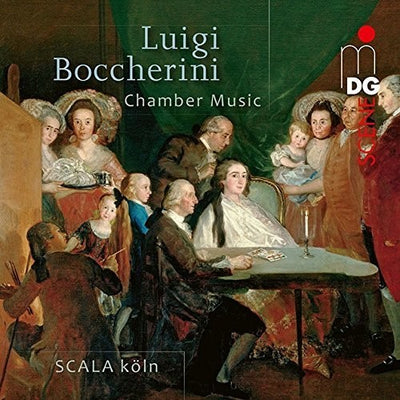
Luigi Boccherini’s contemporaries ranked him with Joseph Haydn, but during later times the high esteem enjoyed by his music faded – when everything of Italian origin that was not an opera was generally dismissed. The young musicians of Scala köln believe that it is high time to reopen Boccherini’s case and are now presenting the results of their new investigation: a delightful program demonstrating that Boccherini’s treasure trove holds more in store than just his famous Minuet. The musicians of Scala koln, led by the violinist Christoph Mayer and the oboist Monika Nielen, bring this music to the stage in fresh new interpretations that are historically informed and feature period instruments. The mixed instrumentation with winds and strings comes with a guarantee of richly varied listening pleasure- boredom is absolutely out of the question!
Schubert: Rosamunde / Malfi, Boyd, Schweizer Kammerchor, Musikkollegium Winterthur
MDG
SACD
$24.99Feb 01, 2011
This is a hybrid Super Audio CD playable on both regular and Super Audio CD players.
Elegant writing beautifully presented.
Douglas Boyd and his Winterthur forces are proving to be a reliable signing for MDG. This disc follows an excellent recording of the Rheinberger organ concertos. In both cases, we are talking about music that has made very few outings on CD, let alone SACD, so to find them presented at this quality is a treat.
Schubert, according to the liner-note, put great energies into improving his reputation as a composer for the stage, but of the ten stage works he completed, only three were preformed in his lifetime. Rosamunde was one of them, and its poor reception was apparently one of the reasons why later stage projects failed to find a home. Problems with the work's dramaturgy have been blamed for its failure, rather than any inadequacies on the part of the music. And the music is good. It falls somewhere between the Schubert the chamber composer and Schubert the symphonist. There is plenty of drama here, but for the most part it retains the civilised formality of the Classical era. Performing the incidental music – and great as it is, the word 'incidental' is definitively appropriate – poses a few challenges. A choir is required, but they only put in a few appearances, as does the alto soloist. Schubert writes trombone parts, but he only uses them to support the choir. So the whole project is a bit impractical, and while you need a range of talented musicians, none is given the opportunity to really show off those talents.
Fortunately, the Musikkollegium Winterthur musicians have what it takes. There is some elegant woodwind writing, all of which is beautifully presented. And those trombone parts, brief as they are, are played with enviable precision and tonal focus. Douglas Boyd achieves a good balance between the composer's aspirations to drama and his innate sense of musical elegance. There are a number of points where the music builds up to a thematic statement through a swell on an upbeat or a short crescendo, and Boyd is able to create just the right sense of anticipation, and without excessive intervention.
It is probably worth noting that this is very much Schubert on modern instruments. There is nothing wrong with that but it seems to be rapidly becoming the exception rather than the rule. The textures are warmer and more homogeneous than you get from period instruments, but - unlike in the later symphonies for example - there is little in the way of contrapuntal or textural detail to lose in the weave. That also limits the potential benefits of the SACD audio. The audio quality is good, and it brings a sense of warmth and intimacy to the quieter textures, especially the woodwind solos, but there is little in this score to bring out in terms of pertinent incident and colour.
The disc opens with a bonus track of sorts. It turns out that Schubert wrote the Rosamunde music to a tight deadline and did not have a chance to write an overture. Instead, the programme opens with the overture to Die Zauberharfe. The liner-note assures us that the overture is very much in the spirit of the Rosamunde music, and so it is. However, the Rosamunde movements are thematically interconnected - though a theme better known from the quartet of the same name. The overture does not share this link and so stands out from what follows. That's not a big grumble, but it does call the logic of the programming into question. Even with this imported overture, the running time is still under an hour. So why not include a few more overtures and incidental movements too? -- Gavin Dixon, MusicWeb International
Späth: Romantic Clarinet Chamber Music / Meier, Kolly, Galatea Quartet
MDG
SACD
$24.99May 31, 2019
Andreas Späth was a clarinetist, a violinist, an organist, and a voice teacher as well as the city music director in Neuchâtel, the concertmaster of the Ducal Court Orchestra in Coburg, and an honorary member of the Swiss Music Society. His death at the ripe old age of eighty-five in 1876 marked the end of an active and richly varied musician’s life – so that it is hardly surprising that he wrote more than 150 compositions for a wide range of genres. Rita Karin Meier has explored Späth’s works for clarinet, his early main instrument, and teams up with the Galatea Quartet and Karl-Andreas Kolly for a long-overdue tribute to this composer who is entirely forgotten today.
The Nocturnes, the three Melodies, and the Elegy also very much reflect the character of romantic composition. The title of the last work in particular might mislead today’s listeners. Anything but melancholy and sorrowful, it tends more to the free form of a fantastic character piece and includes spirited polonaises. There is also more to the Melodies than the title might suggest; they are concertante duets elaborated with fine art. Meier, the principal clarinetist at the Zurich Opera, and Kolly present these works with wit and charm- in what is a highly rewarding discovery!
Faure: Complete Piano Quartets / Mozart Piano Quartet
MDG
SACD
$24.99Jun 21, 2019
Gabriel Faure has frequently been termed “the father of Impressionism.” Why this is so rendered very apparent on this state-of-the-art album featuring interpretations of his two Piano Quartets by the superb Mozart Piano Quartet. With great virtuosity, a fine sense of sound, and an intelligent command of the complex overall structure, the four instrumentalists brighten the performance skies with their musical fireworks. The Parisian music world of Faure’s time was characterized by emancipation from Germany hegemony in chamber music after the traumatic outcome of the Franco-Prussian War in 1871 and by the beginnings of an original French musical language beyond the opera. Faure’s quartets draw formally on the tradition- and yet breathe a new spirit: church modes and whole-tone scales mark so many a motif, and here and there, along with the “classical” development of the themes, we also encounter entirely new harmonic fields and soundscapes. For instance, the beginning of the Adagio in op. 45 already suggests Ravel’s “La vallee des cloches” from the Miroirs: like a memory, distant bells ring in the piano part, over which the very lonely viola gives its all in a pastoral song of lament- enchanting! The two slow movements belong to the absolute highlights on this release.