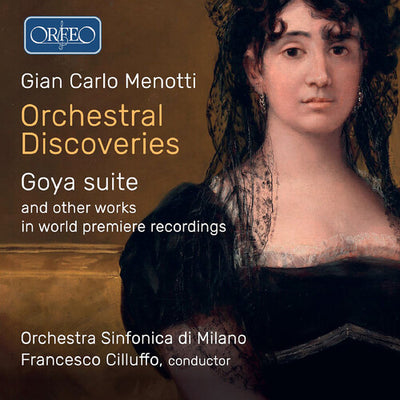
Gian Carlo Menotti was born in Italy in 1911, the sixth of ten children. A child prodigy, he started composing at the age of seven, and was encouraged and supported by his mother, who was a keen and talented amateur musician. Following the unexpected death of his father, Menotti's mother moved the family to Colombia to help with their coffee importing business, and sent Giancarlo to the Curtis Institute of Music, in Philadelphia. The composer made his life in America, although he never gave up his Italian citizenship. Best known for his twenty-seven operas, Menotti also composed a good deal of orchestral music, as featured on this album. The Lewisohn Stadium, the athletic field of the City College of New York, was also used as an outdoor arena for the summer concerts season of the New York Philharmonic, and Menotti's Fanfare was commissioned to open the forty-seventh season, and is recorded here for the first time. Also receiving it's first recording is the original score of Menotti's first (and only) symphony. The programme is completed by suites from the ballet Sebastian and the opera Goya, a third world premiere recording.
Mahler: Das Klagende Lied / Gielen, Vienna Radio Symphony
Orfeo
CD
$20.99Feb 05, 2021
Mahler’s cantata Das klagende Lied today constitutes a veritable rarity in concert programmes – in an age that without contradiction recognizes Mahler as one oft he most eminent milestones in the music history of the late 19th and early 20th century. Based on a horror tale written by Mahler himself, this large-scale, vocal symphonic work forms the beginning of Mahler’s more familiar oeuvre. Mahler, at the age of only 20, submitted the score for the Beethoven Prize at the Society of the Friends of Music in Vienna. He did not receive this prize, however, and subsequently made several revisions. It was finally premiered by the composer in Vienna on 17 February 1901 only. The ‚mixed version‘ (also employed for this recording) consisting of the original first movement and the revised version of the other two parts, became customary in the course of the great Mahler Renaissance in the 1960s. The presented live capture with the 2019 deceased Michael Gielen – like Mahler not only a conductor but also a composer – with the ORF Vienna Radio Symphony Orchestra was taken in June 1990 in the Konzerthaus Vienna.
REVIEW:
This performance of Mahler’s youthful horror story realizes every gruesome detail with positively sadistic relish. There are other fine versions in the catalog, but this live version is the most graphic, exciting, and true to Mahler’s youthful vision. Impactful live sound, great singing, great conducting—this is now the one to get.
Schumann: Piano Concerto; Mozart: Sinfonia Concertante; Rossini / Richter, Muti
Orfeo
CD
$16.99Jan 29, 2013
Of the artists active today, Ricardo Muti has already been a welcome guest at the Festival for more than forty years. His first conducting engagements there did not just provide the basis for his current “telepathic” relationship with the Vienna Philharmonic, but also brought collaborations with important soloists of the older generation. Thus the new CD in the series Festival Documents includes the Piano Concerto by Robert Schumann under Muti's baton, with Sviatoslav Richter once more proving the uniqueness of his pianistic gifts. Over and above all its virtuoso challenges, Richter and Muti together give an account of the work triumphant in its formal cohesion and in which they sculpt it as a large-scale musical arch. Muti's deep understanding of Rossini and Mozart - represented here by the Overture to Semiramide and the Sinfonia Concertante K 364 respectively - is also clearly evident in these early recordings.
Dvořák: Der Jakobiner / Albrecht, WDR Sinfonieorchester Köln
Orfeo
CD
$48.99Dec 08, 2004
REVIEW:
Orfeo's ongoing series of major Dvorák operas and choral works constitutes a genuinely important contribution to the history of recordings, and I hope that it will continue as successfully as it has to this point. There is no other way to get fully acceptable, modern performances of masterworks such as Vanda, or St. Ludmila, and this new recording of The Jacobin, the first in many decades, may be the best of all. There's no other opera quite like it. As a comedy with serious elements, you really would have to go back to Mozart to find anything similar, even though the rustic village setting and plot remain very different from anything that you would have found in an 18th-century setting.
The story is simple, but quite moving. Count Harasov has disowned his only son Bohus as a result of his pro-revolutionary (French) sympathies, which have been exaggerated and distorted by the presciently-named Adolf, the count's nephew and now his presumptive heir. With the death of his wife the count wishes to retire and leave Adolf in charge, along with his pompous henchman, the Burgomaster Filip, who has his sights set on the lively and luscious Terinka, daughter of the village music master Benda. Terinka wanted to marry Jirí, a young hothead and (not incidentally) Benda's prized tenor. Into this situation step Bohus and his French wife Julia, refugees who in fact have a price on their heads arising from their opposition to the atrocities committed in the name of the Revolution.
The ultimate reconciliation between father and son is the primary theme of the opera, but it also has important sub-themes: love of one's country, the love of Benda for his daughter, the conflict between generations, the triumph of egalitarian ideals, and everyone's love of music. It is in fact music, in the form of the dead countess' lullaby sung by Julia to the embittered count, that brings about the happy ending. There's also a brilliant set-piece rehearsal (at the beginning of Act 2) of a homage cantata composed by Benda. It's fabulous. All of the characters, save for the evil Adolph, are fully fleshed out human beings, and the music follows the twists and turns of the plot with the sure hand of a master. The distribution of voices also is very effective: Filip is a bass; the Count, Bohus, and Adolph are baritones; Jirí and Benda are tenors, while Julia and Terinka are sopranos. This makes for some wonderful ensemble writing both with and without the chorus. It is simply impossible to listen to this piece and not conclude that Dvorák was as fine a composer of opera as he was at just about everything else that he touched.
With only a single (but excellent) previous recording available on Supraphon, there's not much competition in this piece, but this newcomer is every bit as fine as its predecessor. Among the women, Andrea Danková's Julia stands out for her beautiful tone and the conviction she brings to her Act 3 confrontation with the count, also very well sung by Christoph Stephinger. Marcin Bronikowski brings virility and intelligence to his portrait of Bohus, and his singing (along with Danková) of the big Act 2 duet "We have wandered in foreign lands" is both moving and impassioned. Michal Lehotsky and Lívia Ághová make a lively pair of young lovers, and Peter Mikulás makes Filip sound aptly bombastic without hamming it up too much.
Gerd Albrecht leads the entire cast, choirs, and orchestra in as vital and persuasive an account of the score as did his counterpart on Supraphon, Jirí Pinkas, and he has much better sonics and the excellent Cologne Radio Orchestra at his disposal. The libretto includes a full English translation and excellent notes. The only problem I can see is that at three CDs, this is an expensive set. Lasting two and a half hours, the work just barely fits on two discs, which is how Supraphon presents it (the timings are virtually identical in comparison), but the quality of the results here justifies the premium price. After all, until the rest of the world wakes up to just how great this work is and starts producing it as often as we see Rusalka, we're not exactly spoiled for choice, and I feel confident that you will fall in love with the music and play it often. So go ahead: treat yourself. This is what recordings are for.
Live Recordings by Lisa della Casa. Composers: Gottfried Von Einem, Richard Strauss, Richard Wagner, Wolfgang Amadeus Mozart. Conductors: Georges Pr tre, Georges Prêtre, Heinz Wallberg, Jaroslav Krombholc, Josef Krips, Joseph Keilberth, Karl B hm, Karl Böhm Orchestras: Vienna State Opera Orchestra
Weber, Beethoven & Brahms: Orchestral Works (Live)
Orfeo
CD
$20.99Jul 07, 2017
Following on from the last Knappertsbusch release of a programme of pure Beethoven featuring Backhaus and the Vienna Philharmonic dating from 1954, Orfeo's new album offers a recording of an entire concert performed in 1962. This recording features Geza Anda and the Cologne Radio Orchestra, one of the few concert orcehstras that Knappertsbusch conducted at the time apart from the Berlin and Vienna Philharmonics, and using the highly professional recording technology of Westdeutscher Rundfunk. The programme of this concert is again a Beethoven piano concerto, the passionate Third in C minor. The pianist Geza Anda, then aged 41, was the diametric opposite as a performer to the 74-year-old Hans knappertsbusch.
This 2CD collection of more than 200 selections taken from various song recitals given 1956-2010 is released in celebration of the 150th birthday of Richard Strauss. + No less than 18 exceptional Strauss singers perform here, listed below in the order they are heard in this edition: Elisabeth Schwarzkopf, Lisa Della Casa, Irmgard Seefried, Nicolai Gedda, Christa Ludwig, Hermann Prey, Leontyne Price, Peter Schreier, Edita Gruberova, Jessye Norman, Edith Mathis, Marjana Lipovšek, Heinz Zednik, Frederica von Stade, Francisco Araiza, Thomas Hampson, Diana Damrau and Michael Volle. + The songs range from famous early songs such as Die Nacht and Zueignung via excerpts from the rarely heard Krämerspiegel to late settings of poems by Friedrich Rückert.
Hungarian composer, pianist, and ethnomusicologist Bela Bartok is considered to be one of the most important composers of the twentieth century. He and Franz Liszt to this day reign as Hungary’s greatest composers who have ever lived. Through his collection and analytical study of folk music, he was one of the founders of comparative musicology, which would go on to become ethnomusicology. Some of Bartók’s best-known works are collected on this album. All of them have written music history and decisively influenced classical Modernism. The composition of these works extends from 1927 (String Quartet No. 3) to 1945 (Piano Concerto No. 3).