Jean-Pierre Rampal – The Complete CBS Masterworks Recordings
Sony Masterworks
CD
$99.94$199.98Save 50%Dec 03, 2021
Before Jean-Pierre Rampal appeared on the music scene in the 1950s, wind players were rarely hired as soloists with orchestras. This legendary French flute virtuoso broke through that barrier with his astonishing talent, flair, and commanding stage presence, attaining the kind of visibility previously enjoyed only by pianists and violinists. He regularly filled the world’s largest concert halls for his recitals and chamber performances. Rampal was the father figure of the flute renaissance in the 20th century which restored the instrument to the exalted position it held during the 18th century.
He also became one the world’s most recorded artists, commanding all the essential repertoire of his instrument but equally embracing previously unknown works, his own discoveries, jazz, pop, folk and contemporary works. Virtually anything written for the flute or plausibly adapted for it was grist for his mill. In his autobiography Rampal referred to the discography that brought him numerous prizes and awards as being so enormous that not even he could keep track of it. In 1969, he began recording for CBS, and in 1979 he signed an exclusive contract with the label.
To mark his 100th birthday, Sony Classical released in a 56-CD box set the first complete edition of Jean-Pierre Rampal’s recordings for CBS, RCA, and Sony Classical.
SET CONTENTS:
DISC 1: Mozart: Flute Quartets DISC 2: Bach Family DISC 3: Bolling: Suite for Flute and Jazz Piano DISC 4/5: Rampal and Lagoya in Concert DISC 6: Vivaldi/Telemann DISC 7: Bolling: "Picnic Suite" DISC 8: Mozart: Flute Quartets K. 285 & K. 298/Divertimento K. 334 DISC 9: Carnaval de Rampal (Showpieces) DISC 10: Schubert: Sonata In A Minor/Moscheles: Sonata concertante DISC 11: Pastorales De Noel DISC 12: Dvořák, Feld, Martinů: From Prague With Love DISC 13: Japanese Melodies, Vol. III DISC 14: Haydn: Divertimentos DISC 15: Sonatas of J.S. Bach and sons DISC 16: Jean-Pierre Rampal plays Scott Joplin DISC 17: Weber: Sonatas for Violin and Piano DISC 18: Bach: Concerto for Flute, Strings and Basso Continuo DISC 19: Vivaldi: Six Concertos for Flute DISC 20: Fascinatin' Rampal: Jean-Pierre Rampal plays Gershwin DISC 21/22: Bach: Sonatas and Partita for Flute DISC 23/24: Haydn: Concertos DISC 25: The Flute at The Court of Frederick The Great DISC 26: Night at The Opera: The Magic Flute DISC 27: Chants de Noel / Children’s Songs DISC 28: Mozart: Sonatas DISC 29: Bolling: Suite No. 2 For Flute and Jazz Piano Trio DISC 30: Mozart: The Flute Quartets DISC 31: Telemann: Overture/Concertos DISC 32: Telemann, Kuhlau, Bach, Mozart, Doppler DISC 33: Kuhlau: Flute Quintets DISC 34: Mozart: Concerto for Flute and Harp/Sinfonia concertante DISC 35: Carulli: Flute Concerto and more DISC 36: Concertos for Two Flutes DISC 37/38: C.P.E. Bach: The Complete Flute Concertos DISC 39: Mozart: Flute Concertos DISC 40: Music for Flute and Harp DISC 41: Mozart,Telemann, J.C. Bach, Reicha DISC 42: Vivaldi: 6 Double Concertos DISC 43: Rameau: Pièces de clavecin en Concerts DISC 44: Italian Flute Concertos DISC 45: Mozart: Divertimento, K.334/Adagio And Rondo, K.617/Andante, K.616/Quintet, K.557 DISC 46: Haydn: London Trios DISC 47: Vivaldi: The Four Seasons DISC 48: Kathleen Battle and Jean-Pierre Rampal in Concert DISC 49: Pla: Catalan Flute Music of the 18th Century DISC 50: Boccherini: Flute Quintets DISC 51: Collaborations DISC 52: Mozart: Symphonies Nos. 36 & 38 – Jean Pierre Rampal, conductor DISC 53: Carulli/Haydn: Guitar Concertos – Jean Pierre Rampal, conductor DISC 54: Bolling: Suite for Chamber Orchestra and Jazz Piano Trio – J.P. Rampal, conductor DISC 55: Romantic Harp Concertos – J.P. Rampal, conductor DISC 56: Mozart: March/Serenade K. 250 “Haffner” – J.P. Rampal, conductor
REVIEW:
Flautist Jean-Pierre Rampal brought the instrument to new prominence, proving its enormous potential in a wide range of repertoire. Sony’s new collection, ‘The Complete CBS Masterworks Recordings’, opens to a benchmark 1969 recording of the Mozart flute quartets where Rampal joins forces with Isaac Stern, Alexander Schneider, and Leonard Rose, and ends with more Mozart – and more Stern – for a keenly played 1994 version of Mozart’s Haffner Serenade. Especially noteworthy are three Kuhlau flute quintets where Rampal joins forces with the Juilliard Quartet: this is superior music, beautifully performed and recorded.
Contemporary repertoire is represented in the first instance by a colorfully inventive and well-performed Penderecki Concerto under the composer’s own direction, surely the best ‘modern’ piece in the set. Rampal enjoyed a fruitful musical relationship with the French jazz pianist, composer and arranger Claude Bolling. Of those pieces included in the set, I’d gravitate first to the Suite for chamber orchestra and jazz piano trio, with its classical resonances; on the other hand, programs devoted to Scott Joplin rags and Gershwin (including a musically pointless abbreviation of An American in Paris) are best left in the box. I’m all for creative crossover but the Gershwin in particular misfires, musically. Still, to be landed with just two ‘duffs’ in a collection of 56 CDs is pretty good going.
As you can imagine, some of the featured repertoire appears more than once but there are sufficient differences in approach between alternative recordings to justify spending time comparing. What’s most interesting is the typically wide range of music on offer, some of it of exceptional quality.
Overall, this is a most enjoyable set, sturdily boxed, with original jacket sleeves that include readable spines, and a hardcover 220-page accompanying book that will give you informative annotations and all the discographical information you need. As diverting collections go, this is certainly one to consider.
50 American Patriotic Military Songs [Limited Edition Vinyl] / US Military Bands
Altissimo
Vinyl
$37.98$75.99Save 50%Jun 28, 2024
50 American Patriotic Military Songs is presented as a four-vinyl LP set of the greatest patriotic music available! This album features over fifteen traditional favorites such as 'This Land is Your Land', 'God Bless America', 'You're a Grand Old Flag', and 'God Bless the USA', along with all the service songs, and Naval and Air Force hymns. This best-selling album also features original compositions by members of the military band including the songs 'The Flag Still Flies High', 'They Died For You, They Died for Me', and 'Honor With Dignity'. This is a great patriotic collection with over two and a half hours of marches, concert band, choral, sing-a-long, and contemporary songs for all to enjoy!
The Brandenburg Project - 12 Concertos / Dausgaard, Swedish Chamber Orchestra
BIS
SACD
$22.48$44.99Save 50%Apr 23, 2021
Along with Vivaldi’s ‘Seasons’ or Beethoven’s ‘Fifth’, Bach’s Brandenburg Concertos belong to those works that are so well-known that we risk taking them for granted. In order to (re-)discover the special qualities that can inspire us today, in 2001 Thomas Dausgaard and the Swedish Chamber Orchestra decided to contact six contemporary composer, asking each of them to compose a companion piece to one of the concertos. Seventeen years later, in 2018, it was time to present the result, with a performance at the BBC Proms of all the works – new and old. Recorded over a period of 18 months leading up to this event, the present boxed set provides a unique opportunity to experience six very different musical minds and idioms entering into conversation with Bach: Mark-Anthony Turnage, Steven Mackey, Anders Hillborg, Olga Neuwirth, Uri Caine and Brett Dean. Bach’s concertos are remarkable in that they are all scored for different instrumental combinations, and part of the brief to the group of composers was to reflect this. In her Aello, Olga Neuwirth has for instance used several ‘instruments’ to stand in for Bach’s harpsichord, including a synthesizer, a milk frother and a typewriter. Brett Dean, on the other hand, has stayed very close to Bach’s instrumentation, but has chosen to write his work as a preparation for Brandenburg Concerto No. 6 – an Approach to Bach’s extremely tight canonic writing. In performing the twelve works the orchestra and Dausgaard are joined by leading soloists including Clare Chase, Mahan Esfahani, Håkan Hardenberger, Pekka Kuusisto and Tabea Zimmermann.
The Original Three Tenors - In Concert, Rome 1990 / Carreras, Domingo, Pavarotti, Mehta [Blu-ray]
C Major Entertainment
Blu-Ray
$17.99$35.99Save 50%Sep 24, 2021
This very special release includes the legendary concert of the Original Three Tenors - José Carreras, Plácido Domingo and Luciano Pavarotti, conducted by Zubin Mehta at the Terme di Caracalla, Rome 1990 on the eve of the Football World Cup in Italy, watched by 1.6 billion spectators worldwide. For the first time available on Blu-ray, digitally remastered! This edition includes the new documentary The Three Tenors - From Caracalla to the World featuring recent interviews with José Carreras, Plácido Domingo, Zubin Mehta, Pavarotti‘s widow Nicoletta Mantovani, Lalo Shifrin, Brian Large, Mario Dradi, Paul Potts, Sir Bryn Terfel, Norman Lebrecht, Didier de Cottignies and many more. Previously unpublished backstage material shows the tenors unadorned and offers a fascinating insight into what takes place beyond the spotlight in Rome, 1990 and the sequel in Los Angeles, 1994. The film takes a completely new look at the concert legends. For the first time, they talk about José Carreras‘ struggles with leukemia, their rivalries and friendships, their spectacular contract poker and life as an opera star.
Bolcom: Piano Music / Finehouse, Olevsky, Oppens, Taylor
Naxos
CD
$17.99$35.99Save 50%Dec 01, 2017
William Bolcom was awarded the 1988 Pulitzer Prize in Music for his 12 New Etudes for piano, and his music has always revolved around works for the instrument on which he still performs as a soloist and accompanist. This collection of mostly premiere recordings reveals student pieces that negotiate twentieth century musical battles between the avant-garde influences of Boulez and Messiaen and Bolcom’s love of Schumann, as well as later work that embraces the 1960s ragtime revival and draws inspiration from friends and colleagues in every phase of his distinguished six-decade career. Elegantly performed by friends of the composer, this wide-ranging program is summed up by Bolcom as ‘cleaning house’ in the Charles Ives tradition.
REVIEW:
Anyone suitably provoked should accordingly investigate this set, each of whose discs is well planned as a standalone sequence. Piano tone is clear but never clinical and Bolcom’s own notes, informative and laconic, complement his music unerringly.
-- Gramophone
This extremely useful set gathers together all of Bolcom’s piano music that you don’t already have in your collection. There are many delights here, and some fascinating revelations about the development of this most versatile pianist-composer who has always resolutely refused to respect musical genre boundaries. …There are two delicious rags, separated by almost forty years, student pieces that show the composer coming to terms with the avant-garde polemics of the 1950s and 60s, and a concert paraphrase of an operatic aria in the popular ‘Neapolitan Song’ style.
-- Records International
What was originally mooted, by Klaus Heymann of Naxos, as a complete retrospective of the piano music of William Bolcom, eventually materialized as this 3-CD collection of works not easily available elsewhere. The compositions span 1956-2012, with music from his teen years to the present day, so you get a good overview of works from all periods of his career. Four pianists were engaged for the task, all with connections to the composer. Most of the recordings were set down in New York in 2014.
The music has been beautifully recorded with an attractively clear piano sound in each case. The excellent accompanying liner notes provide personal reflections and background to the pieces played, by the composer himself. On my first encounter with Bolcom’s music, I would offer a warm recommendation for this most enjoyable release.
Delibes & Minkus: La Source / Kessels, Paris National Opera Ballet & Orchestra
Naxos AudioVisual
Blu-Ray
$17.49$34.99Save 50%Apr 08, 2022
Review:
At last! While we have plenty of filmed productions of Coppélia to watch and enjoy – whether vintage, bang up to date or downright wacky – and a very good one of Sylvia, this new release finally brings the first of Delibes’s three ballets, La source, to a wide audience via Blu-ray and DVD.
The usual explanation for La source’s historical neglect has been that the contribution of Delibes’s co-composer Ludwig Minkus diminished the overall quality of the score. But that suggestion isn’t an adequate one – or even necessarily accurate. In the first place, we need to be clear that “co-composers” doesn’t mean that each of the score’s individual numbers was a sort of high-quality-Delibes-watered-down-by-workmanlike-Minkus hybrid. In fact, the way in which the collaborative process worked was a very practical one – even if we have no idea why it was adopted – with each man allocated responsibility for different parts of the score. Minkus was entrusted with Act 1 and the second scene of Act 3, while Delibes was responsible for Act 2 and Act 3’s first scene. That turned out, in practice, to be a pretty even split, for Minkus ended up providing about 45 minutes worth of music and Delibes penned about 44[.]
It is certainly true that there are differences between the two men’s scores. To some extent, those derive from the mundanely practical point that each composer was writing music for very different sections of the story. Minkus’s focus in Act 1 was on establishing the ballet’s various characters and generally setting the scene, while the finale to Act 3 offered few opportunities as it gave him only six minutes to wrap up the whole drama. Delibes, on the other hand, was tasked with creating the music underpinning the more glamorous jollifications at the khan’s court, which allowed him to concentrate on writing livelier material that was characterised by far more colour, glitter and exotic sensuality.
There is, however, a second and somewhat more fundamental explanation for the perceived contrasts between the two composers’ scores, for Minkus and Delibes had rather different conceptions of what writing music for the ballet actually meant. The former was a composer of the old school who, as Ivor Guest wrote in his booklet essay for the aforementioned Bonynge CD, “specialised in composing music for the ballet, a field not highly regarded in musical circles but which nonetheless demanded a special gift to satisfy the ballet-master’s requirements – to produce melodious numbers for the dances and suitably descriptive passages for the action, and above all to deliver to a deadline”. That has led some critics to perceive Minkus as little more than a hack journeyman who churned out unmemorable material on demand, even though audiences who have come to appreciate the manner in which his skilfully-wrought scores underpin such popular ballets as Don Quixote and La bayadère might beg to differ. In reality, his music was in no way “inferior” to that of the next generation of ballet composers: it simply aimed to achieve a very different - but certainly no less legitimate – musical and dramatic purpose. The first embodiment of that subsequent generation, Delibes himself, was, on the other hand, a composer whose conception of ballet was developing into something rather more ambitious. No less a figure than Tchaikovsky, the originator of the modern “symphonic” style of ballet score, regarded Sylvia as “the first ballet in which the music constitutes not just the main, but the sole interest. What charm, what grace, what melodic, rhythmic and harmonic richness. I was ashamed. If I had known this music earlier, then of course I would not have written Swan Lake”.
It is far too easy, in fact, to assert glibly that any contrasts between the two composers’ contributions are necessarily qualitative in nature. Indeed, when listened to blind and without foreknowledge of who actually composed what, the score of La source – skilfully edited and occasionally augmented here by Marc-Olivier Dupin - actually emerges as a pretty seamless whole.
In reality, there were two other much more significant causes of the ballet’s failure to maintain a long-term place in the repertoire. In the first case, its plot was undeniably involved, and it is notable that the production under consideration omits several of its complicating plotlines. Moreover, the fact that there are no less than three central female figures and that easily confused names were selected for some of the central characters (Naïla/Nouredda, Djémil/Dadjé) does not help. The inconsistency of some of the participants’ on-stage motivations can also be puzzling from time to time – though, in the absence of any other modern production with which to compare it, that may be a feature unique to this particular one.
The second legitimate reason for La source’s relatively rapid descent into obscurity is simply accidental. It successfully maintained its place in the repertoire for a decade and there is no reason to doubt that regular revivals might subsequently have been mounted. However, a disastrous fire in 1873 destroyed the drawings, models and plans on which the original production had been based and, rather than recreate them from scratch, it no doubt seemed easier to ballet impresarios at the time to move on to different projects.
This new Blu-ray/DVD release preserves a new production of the ballet dating from almost 150 years after its premiere. Conservatively choreographed by Jean-Guillaume Bart for the Paris Opera Ballet, it follows the original story’s broad outlines and uses much of the Minkus/Delibes score. Booklet notes author Laure Guilbert is nevertheless at pains to stress that this production is in no way a “reconstruction” of the original but instead has a character and identity of its own. Those last words might be enough to strike fear in the heart of traditionalist ballet fans, but in reality the French choreographer (gushingly described by Ms. Guilbert as a man who “fervently cultivates his attachment to the classical universe… a lover of dance who has transformed [it] into an odyssey throughout the near- and far-flung realms of the art”) is owed a real debt of gratitude for his achievement in returning La source to the stage. There are, it’s true, a few significant problem areas that would have benefited from attention. In the case of the plot, Nouredda’s motivation and reactions as she experiences her character’s trials and tribulations can be somewhat opaque or even downright puzzling. In addition, the stage production itself is visually rather disconcerting. There is, to my own eyes at least, a jarring mismatch between Christian Lacroix’s detailed and often gorgeously elaborate costumes and Éric Ruf’s essentially impressionistic set designs. The latter are highly imaginative and attractive in their own right (especially a set of prominent and exquisitely lit ropes, lowered over the stage from the flies, that represent trees) but they are clearly not intended as any sort of realistic depiction of the settings and that doesn’t gel with the detailed, elaborate and convincingly “realistic” clothing sported by the dancers. Neither element can be described as wrong in itself, but another producer might have chosen to integrate them more effectively.
The quality of the dancing, meanwhile, is generally high, with the women, in particular, demonstrating confident assurance in their own technical skills. Ludmila Pagliero as Naïla performs with delicacy and an appropriate sense of otherworldliness; she presumably impressed not only the theatre audience but the company’s management, too, as within a year of this performance she had been promoted to the top rank of danseuse étoile. Meanwhile, the nature of her role as the princess Nouredda means that the other leading female dancer, Isabelle Ciaravola, tends to spend a disproportionate amount of time on stage looking depressed and generally mopey – although there are also moments, as already noted, when she looks bizarrely happy even though her circumstances are at their worst. If her acting is somewhat questionable, the same cannot be said, however, of Ms. Ciaravola’s dancing which is, invariably, both sensitively and often rather beautifully delivered. Of the men, Karl Paquette combines sheer energy with attention to detail in a winning performance that suffers only from an uncharacteristically drab and featureless costume, little suited, in my opinion, to the hero of a classical ballet. The role of Nouredda’s brother Mozdock, concerned about her only as far as she serves his own political ambitions, is taken by Christophe Duquenne who delivers an effectively villainous turn while leading his energetic and well-drilled soldiers in several lively numbers. Dancing as the elf Zaël, Mathias Heymann is the audience’s favourite as he leaps his way enthusiastically and repeatedly across the stage, creating a genuine character out of his role. The dancer portraying the libidinous khan, Alexis Renaud, makes the most of his opportunities but does not create as much of an impression as the other men. The rest of the company make a very positive contribution, to the extent that I thought that the numbers in which the primary focus was on the corps de ballet were among the most effectively delivered in the whole performance.
On the technical side, I was particularly impressed by the effectively realised stage lighting which has been very well captured on film. The sound, as relayed on this recording, is also more than merely acceptable and allows us to appreciate plenty of felicitous detail from the orchestra, led on this occasion by Koen Kessels who will be known to many as music director of the Royal Ballet. Meanwhile, the experienced François Roussillon’s film direction focuses our attention to everything that we need to see while not distracting us unnecessarily or drawing undue attention to itself.
This is an important release for balletomanes. It is, I think, unlikely that there will be an alternative version of La source any time soon...I repeat, therefore, my original reaction to the release of this new and well-produced Blu-ray disc – at last! Rob Maynard
The award-winning Akademie für Alte Musik Berlin has become one of the world’s leading chamber orchestras on period instruments. These concerts reveal some of the foundations of Beethoven’s genius, and capture vital performances from the 2020 SWR Schwetzingen Festival, the biggest radio festival for classical music in the world. Robert Schumann pointed out similarities between Méhul’s First Symphony and Beethoven’s Fifth, and these third and fourth concerts in the cycle also include a tempest by Holzbauer that precedes Beethoven’s by half a century, plus the little-known Le portrait musical de la nature by Justin Heinrich Knecht, a work that also anticipates Beethoven’s ‘Pastoral’ Symphony. The first and second concerts are also available on Naxos.
Karpman: Ask Your Mama (Poetry by Langston Hughes) / Manahan, SF Ballet Orchestra
Avie Records
CD
$14.99$29.99Save 50%Jul 01, 2015
Epic poetry set to powerful music, brought to life by a cast of legendary performers: Ask Your Mama is an original musical setting by four-time Emmy Award-winning composer Laura Karpman of the 1961 masterpiece by Langston Hughes, delivered with majesty and magnetism by sopranos Janai Brugger and Angela Brown, hip-hop innovators The Roots and Medusa, jazz vocalist Nnenna Freelon and others, conducted by Grammy-nominated George Manahan.
Ask Your Mama: 12 Moods For Jazz is the most modernist, defiant work by Langston Hughes, an icon of the Harlem Renaissance known as the pre-eminent voice of the African-American experience. It gives voice to the outrages and the joys of African-American life through the eyes of a child and the man he becomes, alternating between the fury of indignation and wild comedy, taking us on an odyssey from Africa to the Americas, high art to low art, from south to north, from cities to suburbs, from opera to jazz – and in Hughes’ own words, “from shadows to fire.” Hughes conceived his epic 12-part poem as an interdisciplinary creation, including in the margins suggestions for types of music including hot jazz, German lieder, cha-cha, patriotic songs, post-bop, Arabic and more.
Laura Karpman’s composition is the first musical setting of Hughes’ complete masterpiece. Her score takes its cue from Hughes’ boundary-exploding text and musical notations. Integrating 21st century technology, Hughes’ words are brought to life with orchestral music, live singers, rap artists, and recorded voices of African-American icons from Louis Armstrong to Leontyne Price to Pigmeat Markham. The result: an exhilarating tapestry of jazz, carnivale, tent revival, film, opera and poetry slam.
Ask Your Mama premiered to a sold-out Carnegie Hall in 2009 and has since played from Harlem’s Apollo Theater to the Hollywood Bowl, and has reached millions more through media coverage by National Public Radio, PBS, NBC TV, The New Yorker and the Huffington Post. The release appropriately comes in the wake of Independence Day: as Hughes says in his poem, “your country is your mama.”
Tracklist:
Ask Your Mama Music by Laura Karpman Poetry by Langston Hughes
CD 1 DEDICATION (4:20) CULTURAL EXCHANGE (12:53) RIDE, RED, RIDE (4:16) SHADES OF PIGMEAT (7:42) ODE TO DINAH (10:37) BLUES IN STEREO (5:12) HORN OF PLENTY (7:39) GOSPEL CHA-CHA (11:00) Total time CD 1: 62:15
CD 2 IS IT TRUE? (2:52) ASK YOUR MAMA (6:51) BIRD IN ORBIT (12:12) JAZZTET MUTED – SHOW FARE, PLEASE (17:04)
Total time CD 2: 38:19
Vocal Soloists: Janai Brugger Blackthought, The Roots Nnenna Freelon Angela Brown Medusa Taura Stinson Monet Owens Tesia Kwarteng Erin McGlover Langston Hughes
Instrumental Soloists: Questlove, The Roots drums Ben Wendel tenor saxophone David Loeb piano M.B. Gordy world percussion Bart Samolis bass Firaz Hussein Arabic percussion
Featuringa: Jelly Roll Morton Cab Calloway Lucky Millinder Mahalia Jackson Blind Lemon Jefferson Ella Fitzgerald Bo Didley Shirley Temple Bill Bojangles Jessye Norman Marian Anderson Leontyne Price Charlie Parker Louis Armstrong Pete Seeger Pigmeat Markham
Testament: Bach - Complete Sonatas & Partitas for Solo Violin / Pine
Avie Records
CD
$14.99$29.99Save 50%Apr 01, 2016
Rachel Barton Pine’s ‘Testament’ is one of the best of this set of peerless works to have been released since Isabelle Faust’s definitive volumes of 2010 and 2012.
There is in her interpretation a surprisingly striking contrast between its crystalline voicing, clear articulation, and warm tone that makes the listener feel that it is concerned with the plain and simple beauty of the music as much as with the genius of its counterpoint and relationships between movements. All this is further supported by the sensible combination of Baroque bow and metal strings on a period instrument in modern set-up – the tuning is unfailingly accurate and the strength of the bowing means there is never any interference with the musical line by a squeak or break.
These are thoughtful and generous performances amplified by great maturity and depth.
Breiner: Slovak Dances, Naughty and Sad / Slovak Philharmonic
Naxos
CD
$14.99$29.99Save 50%Sep 25, 2020
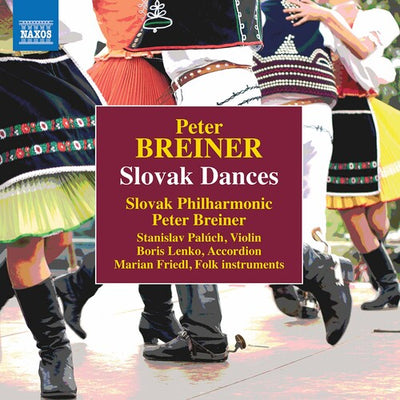
Peter Breiner is one of the world’s most performed composer/arrangers, with a boundless musicality that has led him to create fusions of music from a variety of genres. Drawing on traditions established by Brahms and Dvo?ák and showcasing leading folk music soloists, his Slovak Dances are an exuberant and kaleidoscopic monument rooted in Slovak musical folklore. It comprises 16 symphonic fantasias on songs that evoke varying emotions with an autobiographical element that follows Breiner’s life from his origins in Humenné and Košice to New York. Peter Brenier boasts over 200 albums released and multiple streams and downloads. Known as a conductor, composer, pianist and arranger, he has conducted, often doubling as a pianist, the Royal Philharmonic Orchestra, the Bournemouth, Jerusalem, New Zealand, Moscow and Polish National Radio Symphony Orchestras, the Hong Kong Philharmonic Orchestra, the Slovak Philharmonic and the Orchestre National de France, to mention just a few. His compositions and arrangements have been played in concerts and broadcast worldwide, and some of the most prestigious ballet companies have used his music in numerous performances.
-----
REVIEW:
The basis of Breiner’s suite is native folksong and one might easily suppose, therefore, that its themes might be catchy and easily remembered. Slovak listeners, certainly, will be humming happily along as they recognise such traditional ditties as My father is but one big headache, My mother told me not to sit in the dark, I must have been crazy and Oh, mother dear, it itches (Slovakian peasant life was clearly no bed of roses).
Anyone born west of Bratislava or east of Humenné is, however, unlikely to be familiar with the original melodies and, bereft of that anchor, may well find that the dances come and go without making that much of a memorable impression. Moreover, I’d imagine that the composer’s distinctly contemporary musical palette risks disconcerting or even alienating a few tradionally-minded listeners who prefer their music delivered in an orchestration more characteristic of the late 19th century.
In spite of any such potential issues, the suite certainly offers plenty of pleasurable moments. Many of them occur, as already suggested, during the dances featuring the “domestic ethno-traditional” solo instrumentalists whose contributions deliver frequent titillation to ears unfamiliar with the sound of fujaras or jew’s harps. Thus, no. 3, the jaunty You enchanting girl, you…, is marked by effective and attractive contributions from the violinist, the accordionist and Ms Friedl’s whistles, as too is no. 9 My little whistle – ititi, ititi. Meanwhile, no. 11 I must have been crazy exhibits an engaging and sinuously oriental atmosphere that perhaps reflects the influence of intermittent Mongol and Ottoman invasions of Slovakia over the centuries. The final dance You little gate with bars is the shortest of the whole set but brings the suite to a close with an appropriate burst of vitality.
Everbest Music presents a reissue of two classic Virgil Thomson albums: Portraits and Self-Portraits and Mostly About Love. Performed by pianist and New York Times chief classical critic Anthony Tommasini, these out-of-print gems are now available as Portraits, Self-Portraits and Songs in a 2-CD set, digital download, and streaming formats. Previously released on Northeastern Records, these definitive recordings feature 22 of Thomson’s chamber and vocal works, showcasing his signature wit and shrewd musical style.
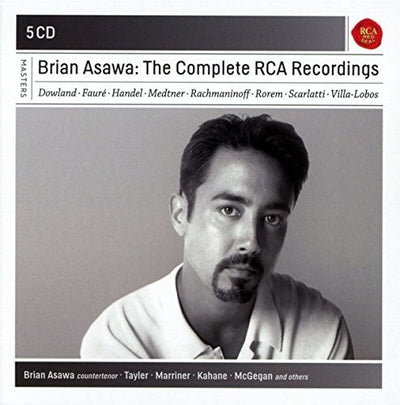
The American Brian Asawa, who died tragically young in 2016, became one of the world’s foremost countertenors before he was 30, acclaimed for the exceptional size, richness, agility and beauty of his voice. In 1991 he was the first countertenor ever to win the Metropolitan Opera Auditions and soon he was singing with opera companies all over the world. He was also a gifted recitalist and made a notable series of recordings for RCA/BMG. All reissued here, they range from Elizabethan Lute Songs to a disc of songs by Ned Rorem and include excerpts from the complete recording of Handel’s opera Serse conducted by Nicholas McGegan, in which BBC Magazine singled out for praise Brian Asawa’s “luscious legato” in the role of Arsamene.
Sony Classical is pleased to announce a new batch of reissues from the CBS/Sony and RCA Victor/BMG back catalogues. This latest instalment of the popular series showcases Mozart and Chopin along with conductor Robert Craft’s pioneering Webern recordings and the global journeys of that irrepressible musical explorer Yo-Yo Ma.
Sir Colin Davis was indisputably one of the greatest Mozart conductors of the last century, both in the opera house and in the recording studio. In Munich in the early 1990s, near the end of his tenure as chief conductor of the Bavarian Radio Symphony Orchestra, he recorded several of the popular serenades and wind concertos (“Davis is completely at home in this music and brings to it grandeur and delicacy in good measure and judicious balance” – Gramophone). And in 1998, as the Dresden Staatskapelle’s first-ever conductor laureate, he recorded twelve opera overtures (“Beautifully turned string playing, wonderful contributions from the wind section, and transparent textures: it all represents splendid ‘big band’ Mozart in the modern tradition” – Classics Today). These superb RCA recordings are now reissued in a 4-album box set.
REVIEW:
Colin Davis’s RCA Mozart CDs from the 1990s, mostly with the Bavarian RSO, tend towards more relaxed tempos than on his earlier analog recordings, a live coupling of the Posthorn Serenade and the Bassoon Concerto recorded at the Mozartfest in Würzburg in June 1992 claiming among its many virtues textural opulence (Eberhard Marschall’s bassoon is among the richest in tone that I’ve ever heard) and, as Christopher Headington noted in these pages (9/94), an unhurried finale ‘despite the Presto marking that tempts less experienced conductors’. You might additionally note Davis’s Toscanini-like vocalizing at the start of the Andantino, a romantic reading that works wonderfully well. Also included are similarly affecting accounts of Eine kleine Nachtmusik, the Wind Serenades Nos 10-12, the Clarinet Concerto (with a mellifluoussounding Karl-Heinz Steffens), and the one CD featuring the Dresden Staatskapelle, an hour’s worth of overtures. I’d never clocked on previous occasions the strong similarity between the very brief Bastien und Bastienne Overture and the opening of Beethoven’s Eroica Symphony. As Mozart orchestral compilations go, this is among the best, one that you should return to with constantly renewed pleasure. The recordings are full-bodied.
Sony Classical is pleased to announce a new batch of reissues from the CBS/Sony and RCA Victor/BMG back catalogues. This latest instalment of the popular series showcases Mozart and Chopin along with conductor Robert Craft’s pioneering Webern recordings and the global journeys of that irrepressible musical explorer Yo-Yo Ma.
Between 1966 and 1974, Glenn Gould paid repeated visits to Columbia’s New York studio to record the piano sonatas of Mozart. Often revelatory, sometimes quirky, but always stimulating, these controversial readings tell us as much about the performer’s own endlessly fascinating musical mind and his conflicting attitudes to Mozart as they do about the composer’s genius at the keyboard. But no other classical sonatas – not even Beethoven’s – were paid the tribute of an integral recording by Glenn Gould. His delight in playing them can be heard throughout this set. Sony Classical is now reissuing the 18 sonatas and two fantasias in a remastered 4-album box.
REVIEW:
Every time I return to Glenn Gould’s set of the Mozart piano sonatas, I’m both aghast and, in some weird way, inspired. Take K310, where the central Andante cantabile rises to an awesome central climax, played staccato, but where the first movement is less Allegro maestoso than Allegro frenetico! Or there’s that strangest of beasts (in Gould’s hands), K331, the opening theme taken so slowly that it sounds as if a (very) young Glenn is tackling it for the first time, head buried in the music, humming away. Yes, things do return to a semblance of normality, though the finale is less ‘alla turca’ than a proud ‘cock o’ the walk’ Turkish trot. Then there are the two Fantasias, K397 in D minor taken at a deathly slow tempo filled with pregnant pauses, a spooky enactment with dark shadows lurking around every corner. Gould’s approach to Mozart in many respects courts extremes but I challenge you to sample any of it and not want to return, if only for a handful of spot checks. It may be outlandish but it’s also utterly fascinating.
Following up its recent box of his 78 and early LP recordings for RCA, Sony Classical is now issuing a 5-album set of Chopin recordings made by the Ukrainian-American pianist Alexander Brailowsky in stereo for American Columbia in the early 1960s. The new reissue contains the complete Preludes, Waltzes, Mazurkas, Polonaises, Andante spianato, B minor Sonata, Fantaisie-Impromptu, Berceuse as well as numerous other works.
REVIEW:
If Brailowsky's Polonaises don’t match Arthur Rubinstein’s finesse and red-blooded ardor, they’re at least idiomatic and shapely, as are the sensitively turned-out Chopin/Liszt song transcriptions and the Berceuse.
A delightfully colorful introduction to classical music, aimed to fire the imagination of young children aged 5-7 years! Readers are asked to think about the different places in which we might hear music, whether it is in a concert hall, or just on television. They are then introduced to a selection of famous composers including Mozart and Beethoven, and learn about each of the musical instrument families, from woodwind to percussion. Throughout the book children are referred to the accompanying CD so that they can hear examples as they read. Music on the CD includes The Magic Flute (Mozart), Harry Potter and the Sorcerer’s Stone (Williams), Carnival of the Animals (Saint-Saëns), The Planets (Holst), Petrushka (Stravinsky) and Peter and the Wolf (Prokofiev).
Mi primer libro de música clasica / Helsby, Chapman
Naxos
Book
$10.99$21.99Save 50%Jan 14, 2022
Una deliciosa introducción a la música clásica, diseñada para despertar la imaginación de los niños desde la edad preescolar hasta la primaria. Se pide a los lectores que piensen en los diferentes lugares en los que podemos escuchar música, como una sala de conciertos o en la televisión.
Se presenta de una manera divertida y totalmente ilustrada una sección dedicada a varios compositores famosos como Mozart y Beethoven, y otra sección sobre las familias de instrumentos musicales, desde instrumentos de viento madera hasta las percusiones. A lo largo del libro, se remite a los niños a la lista de reproducción en línea que lo acompaña, para que puedan escuchar ejemplos musicales mientras leen. En la lista de reproducción se incluyen, entre otras grandes obras La Flauta Mágica de Mozart, Harry Potter y la piedra filosofal de Williams, El carnaval de los animales de Saint-Saëns, Los planetas de Holst, Petrushka de Stravinsky, y Pedro y el lobo de Prokofiev.
-----
A delightfully colorful introduction to classical music, now in the Spanish language, aimed to fire the imagination of young children aged 5-7 years. Readers are asked to think about the different places in which we might hear music, whether it is in a concert hall, or just on television. They are then introduced to a selection of famous composers including Mozart and Beethoven, and learn about each of the musical instrument families, from woodwind to percussion. Throughout the book children are referred to the accompanying online playlist so that they can hear examples as they read. Music on the online playlist includes Mozart’s Magic Flute, Williams’ Harry Potter and the Sorcerer’s Stone, Saint-Saëns’ Carnival of the Animals, Holst’s Planets, Stravinsky’s Petrushka and Prokofiev’s Peter and the Wolf.
"There are people who, when they listen to classical music, think it is boring and turn down the volume or change the station. The appreciation of classical music requires a little bit of education, however, once it is known, it is possible to enjoy it like any other art." – Lilia O'Hara (Los Angeles Times en Español, San Diego Union-Tribune en Español)
Pall Ragnar Palsson writes of his new release: “Composing is a meditative process I embark on in every piece I compose. It doesn’t feel like beginning a new journey with each composition though, rather continuing from where I left off in the last one. This continuity reflects in my music – one sound grows out of the last one, like branches of a tree. Associations and encounters find their way directly to the music, in terms of narrative, atmosphere or structure. It is a conscious process of translation of some kind, and I gratefully allow it to happen, never applying force or excess intellectual argumentation. All the technique I have learned is in service of that unstoppable movement, never dictating the flow.
the DNA of my artistic development, I’d say there are two major factors that have influenced me. One of them is to have been born in Iceland, growing up in a protected environment that leaves one with the feeling (or illusion) that one is free to do anything he wants. Then again moving to Estonia to study composition made me re-evaluate my perceptions on life and art so far. The brisk salty breeze of the ocean got replaced by scent of burning wood rising from the chimneys of old houses near the forest and the playful indie scene of Reykjavik by sophisticated academic concert life in ancient churches and guildhalls of Tallinn. It was the environment where I found my musical language, plunged into East-European art and history, traveled and made friends, connected deeply with the spiritual approach Estonians have to music and their somewhat ancient character. One of those old souls I got to know is my wife Tui who sings on this album. Our singer-composer collaboration started right away and has tied together our professional and personal lives in an especially fulfilling way…”