Alpha Classics Sale 2026
Over 600 titles from Alpha Classics are on sale now at ArkivMusic!
Discover titles from composers such as Giacomelli, Haydn, Godowsky and more!
Sale ends at 9:00am ET, Tuesday, April 14th, 2026.
622 products
-
-
-
-
-
-
-
-
-
-
-
-
-
-
-
-
- anon.: Sometimes I feel like a motherless child
- trad.: Were you there?
- trad.: I Got a Robe
- Trotignon: Why
- Price, Florence: Because
- trad.: Steal away
- trad.: Save Me Lord, Save Me
- trad.: Bright Sparkles in the Churchyard
- trad.: Nobody knows the trouble I seen
- Price, Florence: Resignation
- anon.: A Great Campmeetin'
- Price, Florence: Sunset
- trad.: My Lord, What a Mornin'
- anon.: By an’ by / There is a Balm in Gilead
- Barrett Strong, Norman Whitfield: I Heard It Through the Grapevine
- anon.: Deep river
-
-
-
-
-
-
-
-
- Aprikian: Lamento
- Komitas: Qeler-tsoler
- Komitas: Shogher Jan
- Komitas: Shushiki of Vagharshapat
- Ganatchian: Lullaby
- Komitas: Tsirani tsar
- Komitas: Hoi Nazan Im
- Komitas: Lullaby
- Komitas: Krunk (la grue)
- Komitas: Antuni
- Hakob Aghabab: Jan, ay loosin! (Loosin yelav)
- Komitas: Yerangi
- Aprikian: Lullaby (Arr. for Violin and Piano by David Haroutunian)
- Komitas: Akh Maral Jan
- Komitas: Garoun a (printemps)
- Komitas: Chinar Es
- Komitas: Kaqavik
- Komitas: Yergink Ambel e
- Komitas: Qele, Qele
- Komitas: Dances: No. 5, Het-Araj
- Aprikian: Little Nuptial Suite
- Aprikian: Petite suite nuptial - IV. Scherzo. Réjouissances
-
-
La Comedie-francaise chante Gainsbourg
The troupe of the Comédie-Française pays tribute to Serge Gainsbourg in a musical show that has enjoyed great success. Six actors, singers and musicians from the company perform songs and excerpts from interviews: ‘We have focused on the amorous, sensual side of Gainsbourg. On the one hand, there’s the music, on the other, the man himself, with his repartee, his irreverent, subversive spirit... We have given pride of place to all his emblematic songs, which the younger generation doesn’t necessarily know.’ Stéphane Varupenne and Sébastien Pouderoux (the duo who adapted the words and music), Benjamin Lavernhe, Noam Morgensztern, Rebecca Marder and Yoann Gasiorowski ‘reinvent thirteen classics by the maestro, and it’s quite simply stunning’, wrote Le Figaro, which ranked the show as one of the must-sees of 2022. And here is the original cast album!
L'ame-son - Grénerin: Suites Française / Helstroffer
It was in the second half of the sixteenth century that the guitar became fashionable in France: it was the instrument of the people, whereas the lute was associated with the intellectuals and the nobility. Henry Grenerin became a page (choirboy) in the Musique du Roi in 1641 and went on to invent a new way of playing the instrument and offer it music full of ‘freedom, mystery and ardour’, says Bruno Helstroffer. In the very first recording devoted to Grenerin’s music, Bruno revives this unjustly forgotten composer and makes the most of his long experience as both Baroque musician and exponent of today’s music. He became fascinated by this seventeenth-century composer, and his investigations led him to the Left Bank of the Seine, opposite the Louvre Palace, where Henry’s grandfather was a fisherman, hence the punning title L’âme-son [French hameçon = ‘fish-hook’, âme-son = ‘soul of sound’]. A saga that has also generated a book and a stage show about Grenerin – the first in the line of ‘guitar heroes’ that was to lead to Django Reinhardt and Jimi Hendrix!
Mon amant de Saint-Jean / d'Oustrac, Dumestre, Le Poème Harmonique
Fascinated by the interplay of echoes from one past to another, Vincent Dumestre and Stéphanie d’Oustrac found an affinity in the project Mon Amant de Saint-Jean, their very first collaboration, and aimed to make it a unique musical adventure: a recital in which the atmosphere of the chansons of the Années Folles infuses early music with its sweet madness. In 1904, the great cabaret singer Yvette Guilbert was invited to the home of the Casadesus family, the founders of the Société des Instruments Anciens (Early instrument society): the Baroque fraternised with the café-concert. Around the same time, in the revue Paris qui chante, an aria by Scarlatti rubbed shoulders with the coarse language of Aristide Bruant and Paulin, while Gaston Dumestre, a singer at the cabaret Le Chat Noir (and one of Vincent’s ancestors!), sang chansons réalistes while accompanying himself on the theorbo presented to him by Oscar II of Sweden: ‘It is in language that we must seek the common driving force. These cabaret singers relished a very special flavour, a vigour, a raciness in the words of the Baroque era’, concludes Vincent Dumestre.
Nature romantique - Reinecke, Schubert & Weber
Three leading soloists celebrate Nature in the Romantic era. Flautist Juliette Hurel and pianist Hélène Couvert, currently celebrating thirty years of musical partnership, are joined for this recording by cellist Emmanuelle Bertrand, who was voted ‘Instrumental Soloist of the Year’ at the French Music Awards 2022. They present a recital that enables us to meet the miller’s apprentice imagining his impending death surrounded by the flowers given him by his lost love (in transcriptions of Schubert’s Die schöne Müllerin) and the water nymph Undine, who seeks to gain a human soul (in Reinecke’s Undine Sonata).
REVIEW:
The program consists of the Trio in G minor by Carl Maria von Weber, songs ‘Dried Flowers’ and ‘Shepherd’s Lament’ by Schubert, his Introduction, Theme, and Variations on Dried Flowers, and the Undine Sonata by Carl Reinecke. Aspects of nature play an important role in all the selections.
These are some of the best works in the flute literature in dramatic, effective renditions. The sounds are immediate yet with a rich bass aspect. The intimacy of chamber music at its best is here.
-- American Record Guide
Schubert: Die Schöne Mullerin / Krimmel, Heide
Baritone Konstantin Krimmel, voted ‘Best Newcomer’ of the year at the 2023 Oper! Awards in Germany and a member of the eminent Bavarian State Opera company since 2021, presents his third recording for Alpha. In close partnership with pianist Daniel Heide, he places his artistry and his feeling for words at the service of the lied repertory. This is also an opportunity to discover his vision of the work, an unexpectedly contemporary, socio-psychological analysis: ‘Die schöne Müllerin is a work that romanticises the development of a mental illness, and shows, unfiltered, how a young person can feel without a tempered emotional world. With all its dark sides.’
Forbidden Fruit / Appl, Baillieu
Temptation, prohibition, good, evil... ‘how relevant are these in today's world?’ asks Benjamin Appl. With the complicity of pianist James Baillieu, we are taken on a musical arc from simple folk songs through to the great song composers such as Schubert, Schumann and Wolf, along the way visiting the Impressionists Debussy and Poulenc, exploring ‘new objectivity’ with Weill and Eisler and enjoying compositions by Casucci, Heggie and others. The metaphor of forbidden fruit gives Benjamin and James a wide range of possible interpretations. Whilst some of the song settings centre on sensuality, others focus on socially immoral topics such as incest or sensitive subjects such as abortion. The German baritone embodies each of these stories with a passion and dramatic sense that makes this album a kaleidoscopic and astonishing journey through time and space.
Mozart: Piano Concertos Nos. 11 & 13; Oboe Concerto / Borisov, Pidoux, Griffiths
For the sixth volume of this series devoted to Mozart performances by the young generation of soloists, the pianist Roman Borisov, who won First Prize at the Kissinger KlavierOlymp in 2022 when he was the youngest participant in the competition, has recorded the Concertos K413 and K415 with the ORF Vienna Radio Symphony Orchestra. The French oboist Gabriel Pidoux, winner of the ‘Revelation’ award at the Victoires de la Musique Classique 2020, who recorded his first solo album for Alpha in 2022 (Romance, Alpha789), presents the famous Concerto K314, with the Mozarteumorchester Salzburg, conducted as always by Howard Griffiths. The Orpheum Foundation, which has been supporting young musicians for more than thirty years, has joined forces with Alpha Classics for a series of recordings devoted to Mozart’s concertos for various instruments. The finest soloists of the young generation have been selected under the artistic direction of Howard Griffiths, a renowned Mozart conductor, who considers that playing his music is like ‘looking in a mirror: you can hear if everything is in place, musicality, intonation, rhythm, phrasing’.
Tubin, Bacewicz, & Lutosławski: Works for Orchestra / Järvi, Estonian Festival Orchestra
For their fourth recording on Alpha Classics, Paavo Järvi and the Estonian Festival Orchestra - who bring together the best Estonian talent and leading musicians from around the world each year in Pärnu - celebrate composers from Estonia and Poland, two nations closely connected by their history. Eduard Tubin (1905-1982) is a composer whose ten symphonies tower at the top of Estonian orchestral music. The same may be said about his stage works. World War II forced Tubin to emigrate to Sweden in 1944, where he spent the rest of his life. Suite from the ballet Kratt (Goblin) is based on Tubin’s ballet by the same name, which was also the first ballet in Estonian musical history… Musique funèbre by Polish composer Witold Lutoslawski (1913-1994), was composed in memory of Béla Bartók and its premiere commemorated the 10th anniversary of the Hungarian composer’s death. Bartók’s Orchestral Concerto inspired the Concerto for String Orchestra composed in 1948 by Grazyna Bacewicz (1909-1969). Ignored for many years, she is now one of Poland’s most popular female composers.
REVIEWS:
An imaginative program, played with conviction.
Paavo Järvi has long been a champion of the major Estonian composer Eduard Tubin (1905–1982). He gave us the first recording of Tubin’s last symphony, No. 11, and also recorded Symphony No. 5 with the Cincinnati Orchestra as a coupling for the Sibelius Second. More recently, Jarvi and his conductor-brother Kristian established the Estonian Festival, and with the Festival Orchestra Paavo has made exciting recordings of other Estonian composers, as well as Shostakovich.
This program consists of two works by Tubin: the suite from the ballet Kratt (The Goblin) and the Music for Strings (1962), along with the increasingly familiar Concerto for String Orchestra by Polish composer Grażyna Bacewicz, and Witold Lutosławski’s early masterpiece, Musique funèbre, written in memory of Bartók.
Kratt, which has been recorded complete elsewhere, is a vibrant, colourful score with a hint of Petrushka about it. There is not a dull moment in the 25-minute suite Tubin assembled in 1961, nor in his Music for Strings, where Jarvi relishes the mysterious textures of the first movement.
He conducts a full-blooded, vigorous performance of Bacewicz’s piece, especially in the finale where the composer combines neat counterpoint with rhythmic punch. Finally, we get a searing rendition of Musique funèbre, where the parallels to Bartók’s Music for Strings, Percussion and Celesta are underlined as a basis for exploration. Sound quality in this imaginative program is excellent.
-- Limelight
Paavo Järvi and the Estonian Festival Orchestra present music by Estonian composer Eduard Tubin (1905–1982), opening the program with a colorful and entertaining suite from the ballet Kratt (Goblin). The suite from the ballet Kratt (1961) is based on Tubin’s ballet of the same name. The idea for this work was born in 1938 after his return from Budapest, where he had presented his compositions to Zoltan Kodaly. Kodaly recommended that he pay greater attention to the use of folk tunes.
Tubin obtained material from the Estonian folklore archive and selected thirty folk songs and instrumental pieces as the basis for the ballet. In Estonian mythology, a kratt (goblin) is created by humans but brought to life by the devil. Influenced by evil forces, the Kratt flies through the air, leaving behind a glowing trail of fire as he accumulates treasures for his master. But in return, the master sells his soul to the devil.
The first performance of Kratt took place in Tallinn on February 24, 1944, on the founding day of the Estonian Republic. The ballet was performed only six times before the National Opera Estonia was destroyed on March 9 in a in a bombing raid by the Russian Soviet Army when Russia annexed Estonia.
The score fell victim to the fire, but the instrumental parts and piano reduction were safe. Tubin took them with him when he fled to Sweden in 1944, and made a new score. In 1961, he was commissioned by the Swedish Radio Symphony Orchestra to compose the suite from the ballet. Tubin’s music for strings, which is no less tonally appealing, can also be heard, and Paavo Järvi lets it be played expressively.
Musique funèbre by Polish composer Witold Lutoslawski (1913–1994) was composed in memory of Bela Bartok. It is more of an homage than a lament or an elegy, and Järvi is wary of any sentimentality. Very exciting is the neoclassical Concerto for String Orchestra by Polish composer Grazyna Bacewicz, played with bouncy momentum in the outer movements and sublime delicacy in the Andante.
-- Pizzicato
Ravel & B. Mantovani: Poétiques de l’Instant Vol. II / Hurel, Dalangle, Ceysson, Voce Quartet
This second instalment of our long-term project Poétiques de l’Instant (Poetry of the Moment) combines two masterly string quartets with a range of other instrumental colours, unpublished transcriptions and first performances. Alongside the famous Quartet by Ravel, the Voce Quartet have commissioned a new quartet from Bruno Mantovani – his fifth - which develops around a crucial note in Ravel’s Quartet. They have also drawn on the multiple talents of harpist Emmanuel Ceysson, who enhances the programme with a magical chamber transcription of Ravel’s famous Mother Goose suite. For this arrangement, as well as for Ravel’s equally superb Introduction and Allegro for septet, the Quatuor Voce are joined by three outstanding artists: flautist Juliette Hurel, clarinettist Rémi Delangle and harpist Emmanuel Ceysson.
Legrenzi: La morte del cor penitente
A highly prolific composer, Giovanni Legrenzi practised his art in oratorios and other works for the church, as well as in opera and chamber music. In fact he explored all the musical genres of his period, taking over the baton handed on by Gabrieli and Monteverdi, and enjoying an enviable reputation among his contemporaries. Better known during his lifetime (1626-1690) for his operas rather than for his religious music, Legrenzi was widely admired and copied all over Europe.
Of his eight known oratorios, only three have survived, including this gem: La morte del cor penitente (The Death of the Repentant Heart), a chamber oratorio probably composed in 1671. The theme is the spiritual development of the Sinner, the central figure of the work, who must pay his debt to God to save his immortal soul. The oratorio’s text provides a whole vivid universe of ‘affects’ (emotions) relating to spiritual torments and temptations. In his pilgrimage from the Cross to the heavenly light, beset by the competing voices of Sin and Hope, the Sinner duly makes his repentance, and finally achieves redemption.
Debussy: C'est l'extase, La mer / Franck, Radio France Philharmonic
Debussy’s song cycle Ariettes oubliées of 1888 set six poems from Paul Verlaine’s collection Romances sans paroles, beginning with C’est l’extase and Il pleure dans mon cœur – penetratingly poetic images of love’s ecstasy and rainlike tears of despair. The six Ariettes are the departure point for the arrangement realized in 2012 by British composer Robin Holloway in response to a request from the San Francisco Symphony. Holloway has altered their order while adding a further four Debussy songs, binding the whole work together with brief orchestral links and a feverish epilogue, ‘con moto agitato’. This world first recording is given by French soprano Vannina Santoni, with the Orchestre Philharmonique de Radio France under the baton of Mikko Franck. The Finnish conductor, a great admirer of Debussy, here also presents the master’s bewitching masterpiece La mer, first heard in Paris in 1905.
Duello d’archi a Venezia / Siranossian, Marcon, Venice Baroque
“For this recording we have created an imaginary ‘battle of the bows’ between Vivaldi, Veracini, Tartini and Locatelli, the ‘four musketeers’ of the violin in Venice during the first half of the 18th century”, said Chouchane Siranossian and Andrea Marcon. “Corelli died in 1713 and passed the torch on to his heirs… Venice then became the setting for merciless rivalries. The violin became an instrument of confrontation, an ideal weapon for demonstrating virtuosity and technical prowess. The player’s ultimate goal was to astonish the listener and to demonstrate his own bravura, to the point that certain narcissistic tendencies of the player were often exaggerated.” Chouchane Siranossian, whose virtuosity was described as "diabolical" by the Sunday Times and who “hit the nail on the head” according to Classica on her Tartini recording (Alpha596, Choc), is the ideal interpreter of these high-risk concertos, with the fresh and knowledgeable support of Andrea Marcon and his Venetian ensemble.
Dutilleux: Tout un monde lointain; Dusapin: Outscape / Julien-Laferrière, Robertson, ONF
Victor Julien-Laferrière, winner in 2017 of the first Queen Elisabeth International Music Competition of Belgium dedicated to the cello, presents here two French works for cello and orchestra: Outscape by Pascal Dusapin: "The title itself carries the musical project (...) a word rich in meaning that indicates a variety of meanings from the most common to the most philosophical. “Outscape” is the way or opportunity to escape, to invent a path of one's own. I liked this word because it is basically like a summary of the history of my work." Alongside this work composed in 2015 and here recorded in its world premiere (conducted by Kristiina Poska), the French cellist, the Orchestre National de France, this time conducted by David Robertson, celebrate Henri Dutilleux (who died just 10 years ago, on 22 May 2013), with his famous concerto, whose title is taken from a poem in Baudelaire's Les Fleurs du mal, La Chevelure: " A whole far-away world, absent, almost defunct"...
REVIEW:
Tout un monde lointain… finds Dutilleux at his stealthiest – not least in the first of its five continuous movements, ‘Énigme’, to whose refractory changes of mood JulienLaferrière is as attentive as he is to the probing inwardness of ‘Regard’ and the plangent dialogue of ‘Houles’. Nor is he afraid of mining a deeper vein of expression than many in the shimmering vistas of ‘Miroirs’, before ‘Hymne’ brings this Baudelaire-inspired sequence to an energetic if ultimately equivocal conclusion.
The numerous possible meanings of Dusapin's Outscape (2015), are reflected in the timbral and textural interplay of music where a corresponding emotional intensity gradually takes precedence. Even in the dramatic final stage, an interiorized quality remains foremost yet, as JulienLaferrière renders it, there is never an absence of immediacy.
With vibrant orchestral playing and sound of real vividness, this disc can be warmly recommended.
-- Gramophone
Among the many composers he commissioned new works from, including Britten and Lutosławski, the cello concerto that Rostropovich commissioned from Henri Dutilleux holds a special place. Rostropovich commissioned new works at the drop of a hat, and it took only a backstage introduction by Igor Markevitch in 1961 (reminiscent of Rostropovich’s first meeting with Britten, the introducer being Shostakovich) for him to prompt Dutilleux to write something for him. Rostropovich added that the famously slow and meticulous composer take his time, which Dutilleux did, producing Tout un monde lointain… , the concerto’s given title, in 1968. This led to the premiere in 1970 and later a famous recording by Rostropovich for EMI, transferred to CD in 1988.
The title, which translates as “An entire world far away,” was a considered choice, taken from the poetry of Baudelaire – in the early 1950s Dutilleux was inspired to write a ballet based on Les fleurs du mal, but it came to nothing. Baudelaire is the source of the one-word titles of the concerto’s five movements, but it is reasonable simply to consider them as indicators of the music’s atmospheric moods. As varied as the score is, Dutilleux focuses on the cello’s lyrical voice.
Dutilleux ascribed much of the work’s immediate success to Rostropovich’s performance, which is likely enough. That poses a formidable challenge for subsequent soloists, in the present case Victor Julien-Laferrière, an admired French cellist born in Paris in 1990. I’ve appreciated him as a member of the outstanding Trio Les Esprits[.]
Therefore, I listened to the present release with faith in Julien-Laferrière’s abilities. He is in every way exemplary, and the absence of Rostropovich’s strong presence isn’t felt unless you do a bar-by-bar comparison. Dutilleux lived long enough – he died at 97 in 2013 – to journey through many stylistic phases, and I’d say that Tout un monde lointain… , despite its modernist harmonies, is richly Romantic. A flair for theatricality infuses the score, which aids in directly communicating with the listener.
David Robertson, a specialist in modern and contemporary music, provides ideal accompaniment, and although Serge Baudo is excellent on the Rostropovich recording, this new version features more precise and colorful orchestral execution from the Orchestre National de France, along with improved, up-to-date recorded sound.
The notion of a distant imagined world is a shared theme with Pascal Dusapin’s Outscape from 2016 – in a free-form composer’s note he rhapsodizes about the connotations of this English word, which frankly I’d never run across before (it’s a synonym for “an escape”).
Outscape is engrossing, underscored by Julien-Laferrière’s intense and highly accomplished performance of the solo part. I often couldn’t follow the argument by ear, but there was no trouble remaining involved with a work that exemplifies the current eclecticism so vividly. The mood is often deliberate, at times mournful, and it helps that the music’s emotional tone is so clear and direct, even as its gestures widely divagate.
It’s frustrating, no doubt, to compete with a classic recording, all the more because the Dusapin must stand up to Rostropovich’s pairing, the esteemed Lutosławski Cello Concerto, another of his most notable commissions. But Julien-Laferrière has a great deal going for him, and there’s no obstacle to giving this release a strong recommendation.
-- Fanfare
Schumann: Kreisleriana & Ghost Variations; Widmann: 11 Humoresken / Pilsan
Schumann composed Kreisleriana in April 1838, at the age of 27, exactly the same age as Aaron Pilsan today : “The youthful thing that I can identify with in Kreisleriana is its spontaneity. If I had to describe the piece, I would use the German word for crazy, ‘verrückt’, which doesn’t just mean crazy, but also to be disconnected from reality. So, crazy, imaginative and intimate… There is a huge connection between these two German composers, as Jörg Widmann was inspired by Schumann’s music a lot and even his musical language is very similar, even though their styles are obviously very different. The starting point for Widmann’s music is from feelings, from the emotions and sentiments and that is where there is a similarity, but not only there. He even quotes Robert Schumann in his tenth Humoreske, taking a bar directly from Schumann’s Geistervariationen."
REVIEW:
Pilsan expresses the inner turmoil of the Kreisleriana with a keen sense of the enigmatism that is one of the secrets of Schumann’s art. He also finds the right approach in the Geistervariationen, interiorized, cantabile and supple. The melodic tenderness is never obscured by melancholy. It is in such a clear and restrained interpretation that the loss becomes clear, for this is, after all, Schumann’s last work before he was committed to a mental hospital.
Between the two Schumann works Aaron Pilsan has inserted Jörg Widmann’s Elf Humoresken, whose title refers to Robert Schumann. He succeeds very well in showing what the composer wanted: "May the interpreter discover in each of the pieces its very own tone and make it sound, sometimes mocking, then again dry, here melancholically clouded, but always with humor and subtlety."
-- Pizzicato
[Pilsan’s] artistry has evolved considerably. You have to turn to the most esteemed recordings of Kreisleriana, by Horowitz, Pollini, and Argerich, for example, to outstrip Pilsan’s performance. He seeks more balance and moderation at times than those pianists...he’s clearly to the manner born.
Reading the informative liner notes to this new release, which also includes a brief interview with Widmann conducted by Pilsan, you pick up some obvious reference points. Schumann wrote his own set of humoresques, and he freely used the expression marking mit Humor or mit guten Humor, which a postmodern composer like Widmann doesn’t take to be as simple as it looks. He takes full advantage of an emotional spectrum extended even farther than Schumann’s.
The mood is often freely tonal and Romantic, easily accessible if you appreciate contemporary eclecticism and Widmann in particular, as I very much do. Fragmentary references to Schumann abound, and in the final piece a bar of music from Schumann’s last work, the “Ghost” Variations, is directly quoted, serving as a link to Pilsan’s performance of the whole piece. The other major work on the program, Kreisleriana, was based on the fantastical Kapellmeister Johannes Kreisler created by E. T. A. Hoffman. The fact that Schumann borrows the title of one of the three Kreisler novels (the last of which is narrated by his cat) implies that the music describes Kreisler’s peculiar temperament as much as Schumann’s – in the medieval sense, temperament is rooted in the four humors.
I haven’t heard other recordings of the Widmann, but Pilsan’s account seems nearly ideal in the way he merges Schumann into the contemporary texture of the music.
-- Fanfare
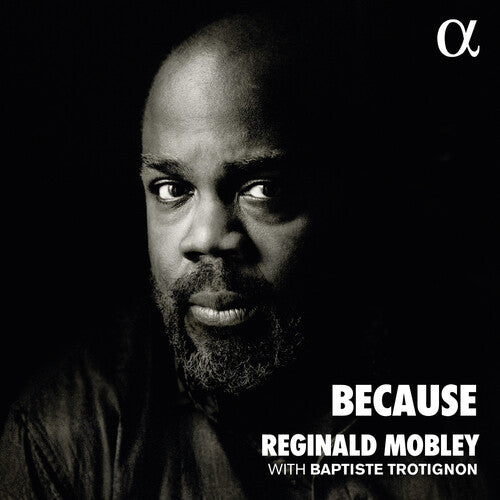
Because - Songs & Spirituals / Mobley, Trotignon
During the long era when Bach, Mozart and Beethoven were creating the musical canon of Western Europe, the songs of enslaved Africans resounded in the colonies on the other side of the Atlantic, expressing pain and longing, but also joy and the desire for freedom. The American countertenor Reginald Mobley - a rising figure in baroque music, notably under the direction of John Eliot Gardiner with whom he sings very regularly - and the French pianist Baptiste Trotignon, winner of numerous awards (Victoires du Jazz, Django d'Or) have combined their talents and sensibilities to celebrate these spirituals and the music of Black composers including Harry T. Burleigh (1866-1949) and Florence Price (1887-1953), whose beautiful transcriptions and melodies blend with Baptiste Trotignon's subtle arrangements of the famous Sometimes I feel like a motherless child or I got a robe... The melody "Because", composed by Florence Price on a poem by Paul Laurence Dunbar, inspired the title of the album: Because I had loved so hard (...) Because I had loved so vainly... Why this album? Because...
CONTENTS:
REVIEWS:
On their new album Because, American countertenor and early-music specialist Reginald Mobley and French pianist Baptiste Trotignon offer a collection of music from the Renaissance.
No, not that Renaissance.
The album is an updated compendium of Negro spirituals...and art songs published, collected, or written in and around the Harlem Renaissance — a period of revival in Black art, literature, culture, and music that spread from the Manhattan neighborhood throughout the United States and the Western world in the early 20th century...this movement and these songs have impacted American music on a scale that is unsurpassed, from jazz to pop to hip-hop, as well as a significant body of classical repertoire.
With Because, his first solo album, [Mobley] offers a powerful portrait addressing the musical legacy of Black spirituals and the complicated paradoxes contained within them: themes of bondage and salvation, power and tenderness, pain and beauty, spirituality and temporality.
We rarely hear a countertenor wade into this repertoire, and Mobley’s voice, which seems to get better by the year, is wonderfully pristine. Like good champagne, his tone is both effervescent and rich. In 20th-century art songs such as Florence Price’s “Because I Had Loved So Deeply” or Harry Burleigh’s “Jean,” or traditional spirituals like “Were You There When They Crucified My Lord?” and “Nobody Knows the Trouble I’ve Seen,” he does not produce sound so much as spin it in long, sumptuous phrases.
As an accompanist and arranger, Trotignon is both resourceful and inventive, and it’s clear that he also lives and breathes this music.
-- Early Music America
Britten & Bruch: Violin Concertos / Kerson Leong, Hahn, Philharmonia Orchestra
On his second album for Alpha Classics, rising star violinist Kerson Leong juxtaposes the Violin Concertos of Bruch and Benjamin Britten. This unusual pairing is a reflection on the journey from one extreme of expression to another. Bruch’s In Memoriam is the perfect bridge between them. “The Britten expresses a raw and exposed experience, while the Bruch is comforting and uplifting. After the last few years in which the world has experienced much difficulty and uncertainty due to pandemic, war, and crisis, recording this album in London in January 2021 with the Philharmonia Orchestra and Patrick Hahn was a profoundly cathartic moment. It is in the spirit of catharsis that I offer this album.” - Kerson Leong
REVIEW:
The clincher for me was the lead work on the disc, Britten’s Violin Concerto, which actually has enjoyed a rash of recent recordings by “name” players, but none that has managed to make sense of the piece for me – or even particularly to like it. Leong changed that for me, and when an artist can overcome my resistance and make me hear a work in a different perspective, one that illuminates its beauty and elucidates its soul, that is worthy of a Want List entry.
-- Fanfare
Kerson Leong’s splendid account of the Bruch comes hot on the heels of [other recordings, but] Leong’s take on the piece is more outgoing in expression. Leong’s generosity of phrase and tone, for instance, comes unashamedly from the chest in the songful reaches of the slow movement, and in the finale where the big tune bears down on the G string he really tugs at our emotions.
The bonus addition here is Bruch’s littleheard but substantial tribute to Joseph Joachim, In memoriam, which is as turbulent as it is reflective, as befitting the legendary violinist’s fighting spirit, and gives Leong further opportunity to sing from the heart. My thoughts occasionally turned to Elgar and the more than a hint of nobilmente that it proffers.
But it is the coupling of the Britten Violin Concerto (gratifyingly becoming more and more core repertoire these days) which...sets this disc apart. The inspiration here was another violinist, Antonio Brosa, but more self-evidently, through the Spanish inflections in its material, it’s a meditation on that most divisive of civil wars – something which clearly distressed and exercised Britten, the pacifist. This is the composer at his most elegiac and unsettled (is it major or minor?) and Leong is clearly at one with its inner tussles – but also with all the extraordinary sparks of originality which make it unmistakably Britten: like the powerful coda of the first movement which pits the soloist’s abrasive pizzicato against deeply meditative strings only to have him grow more and more prayerful with the music’s ascendancy.
The kinship with Shostakovich is startling in the trenchant Scherzo, which Leong digs into with great resilience, but again the entry of the tuba with violin and piccolo in extremis high above the stave is pure Britten, as is the emotive orchestral climax.
But Leong really makes his mark with the concluding Passacaglia, a form so beloved of both Britten and Shostakovich as a metaphorical anchor in times of great stress. Suddenly psychological ambiguities are set aside and in the wake of one war Britten becomes contentious objector of all. The tragedy catches in his throat and the music of those closing pages – movingly projected by Leong – chokes on the soloist’s final utterances. With outstanding collaboration from Patrick Hahn and the Philharmonia Orchestra I can’t recall a better account of the piece than this.
-- Gramophone
Mozart: Piano Concertos Nos. 15, 16, 17 (KV 450, 451, 453)
The Orpheum Foundation, which has been supporting young musicians for more than thirty years, has joined forces with Alpha Classics for a series of recordings devoted to Mozart’s concertos for various instruments. The finest soloists of the young generation have been selected under the artistic direction of Howard Griffiths, a renowned Mozart conductor, who considers that playing his music is like ‘looking in a mirror: you can hear if everything is in place, musicality, intonation, rhythm, phrasing’. For this fifth volume, the American pianist Claire Huangci joins the Mozarteum-Orchester Salzburg and Howard Griffiths, her mentor for the past ten years. For her, she says, these concertos are ‘true musical revelations, works full of virtuosity and imagination’.
Schubert, Loewe, Schumann & Wolf: Echo
The baritone Georg Nigl is fascinated by ballads, which unfold in him "dream images". Schubert's long and little-known lied Viola, based on a poem by Franz von Schober, or the great ballads based on texts by Goethe "opened up a world that has always accompanied me, that of the storyteller (...) stories of frightening beauty, with as many colours as possible...". The magnificent pianos on this recording - a Christoph Kern fortepiano after Conrad Graf (Vienna, 1826) and a Steinway & Sons concert grand piano (New York, 1875) - beautifully played by Olga Pashchenko, with whom Georg now forms an intimate and inspired duo, allow us to hear "unknown sounds and sometimes unheard-of colours"...
Nuit a Venise
Venice was surely the capital of music and the arts in the sixteenth and seventeenth centuries, and one of the most coveted positions in the city was that of maestro di cappella at St. Mark’s Basilica. A few lucky chosen candidates succeeded one another in bringing to life the musical splendour of the basilica, all of them fabulous musicians and composers prolonging the legacy of the great Claudio Monteverdi. For its third recording on Alpha, the ensemble Les Surprises has chosen to sail towards Venetian waters and mix with these geniuses of affect, word-setting and theatre, exploring music that ranges from grandiose double choruses to intimate duets or trios combining sacred and profane.
Mayrig - To Armenian Mothers / Zaïcik, Haroutunian, Maliarevitch
In 1906, Komitas gave a concert and lecture in Paris. Debussy came on stage after the concert and knelt before the Armenian composer (who was also a priest, a singer and a pioneer of ethnomusicology), exclaiming: ‘I bow before your genius, Reverend Father.’
'Komitas is the voice of the land of Armenia, of its churches and its stones which remained silent for many centuries', the violinist David Haroutunian tells us. Along with the mezzo-soprano Eva Zaïcik, who is passionate about these songs, and the pianist Xénia Maliarevitch, he pays tribute to this great musician and to the French-Armenian composer Garbis Aprikian, now ninety-six years old. This heir to Komitas, a student of Olivier Messiaen, has made a major contribution to the dissemination of Armenian music, both classical and popular, in France and beyond. The album opens with his Lamento, a beautiful evocation of and touching homage to Komitas.
CONTENTS:
REVIEW:
The album opens with Aprikian’s ‘Lamento’, a solemn and moving homage to Komitas, and continues with 5 other pieces by Aprikian and one each by Ganatchian and Achabab. The other 16 pieces are by Komitas. Songs of grief and sadness, separation from loved ones and rejoicing over times of reunion, lullabies, hardship, and homelessness alternate with instrumental pieces. Many reflect the Armenian folk tradition. A lullaby by Aprikian is especially lovely.
The performances are superb. Eva Zaicik, who impressed me greatly in her recent Nisi Dominus album for Alpha, is once again outstanding in a different style. She adapts easily to the vocal demands of this music, with silky singing in a quiet low register and smooth warmth in her higher brighter voice. In a similar way, David Haroutunian draws viola tones from his lower register and high-pitched almost ghostly effects, perhaps from playing sul ponticello (bowing near the bridge). Xenia Maliarevitch is a wonderfully attentive pianist.
When this arrived I didn’t know what to expect. It turned out to be a most welcome arrival that has appreciably broadened my musical horizon. Each time I listen I find something new to appreciate.
Notes, texts and translations incuded.
-- American Record Guide
Beethoven, Brahms, Messiaen, Scarlatti & Scriabin: Meeting My Shadow / Gigashvili
Giorgi Gigashvili is only twenty-two, but he is already hitting the headlines: now a pupil of Nelson Goerner, he is a protégé of Martha Argerich, who gave him the urge to play the piano alongside his first love, pop singing: at the age of thirteen, he was a contestant in The Voice in his homeland, Georgia, and won the prize! A few years later, Argerich discovered him at a piano competition, and he went on to win prizes at several more, including the Hortense Anda-Bührle Prize at the Géza Anda Competition in Zurich in 2021. Another high-flying mentor, the violinist Lisa Batiashvili, asked him to play him the piano on her recording of the Franck Violin Sonata. His free and spectacular playing impresses, his creativity and personality astonish. Here he presents his first recital, revealing his palette of colours: Scarlatti, Beethoven, Scriabin and Messiaen. But never far away is his shadow, the singer of the electro band Tsduneba (‘temptation’ in Georgian) which he founded with his friends.
Vivaldi, Chelleri & Ristori: Teatro Sant'Angelo / Charvet, Le Consort
During the Carnival of Venice in 1637, a play ‘rappresentata in musica’ was opened to the public for the first time – a success. Opera was born and spread like wildfire. Venice had the largest number of theaters in the world. In 1677, the Teatro Sant’Angelo opened its doors on the campo of the same name. Tiny, chaotic, cheap and extremely productive, it was renowned for its musicians and its sets. This effervescence owes much to the figure of Vivaldi who, from 1705 onwards, regularly premiered his operas there and acted (with his father) as impresario. His own Arsilda, L’incoronazione di Dario and La verità in cimento triumphed there, but he also invited composers such as the young Fortunato Chelleri and Giovanni Alberto Ristori. The mezzo-soprano Adèle Charvet and her partners in Le Consort pay tribute to all these composers with a flamboyant program that mixes famous arias and world premieres – no fewer than twelve of them!
REVIEW:
Venice’s Sant’Angelo Theatre opened its doors to the public in 1677. Though never the grandest of the Serenissima’s opera houses, it nonetheless attracted important names, including Antonio Vivaldi. Alongside a selection of Vivaldi arias, this album includes a dozen first recordings unveiling other composers who trod the theater’s boards. Spanning the gamut of Baroque affects, the program contrasts frothy arias with tragic outpourings and displays of vocal fireworks.
Adèle Charvet dispatches the showpieces with agility and bravura, but her velvety voice is particularly well suited to the pathos arias which are eloquently articulated; just occasionally her vibrato wavers a little intrusively. She’s superbly supported by Ensemble Le Consort who, under the brilliant young violinist Théotime Langlois de Swarte, perform with fire, passion and breathtaking virtuosity.
-- BBC Music Magazine
Maria Mater Meretrix / Prohaska, Kopatchinskaja, Camerata Bern
Soprano Anna Prohaska and violinist Patricia Kopatchinskaja are both well known for their taste for eclecticism, experimentation and adventure. As they are also are friends, it was only to be expected that one day they would devise and record a programme together, and here it is: Maria Mater Meretrix … What is the relationship between Hildegard von Bingen and Gustav Holst, Antonio Caldara and Lili Boulanger? The two musicians and their partners in Camerata Bern explore the image of woman through ten centuries of music: the figure of the Virgin Mary – among other works, the triptych Magnificat - Ave Maria - Stabat Mater (1967/68) by Frank Martin, an unclassifiable composer whom both artists venerate – but also Mary Magdalene, in pieces by Caldara and Kurtág. The Saint, the Mother, the Whore … The expression of two women musicians of today, a journey full of meaning and a sensory exploration featuring solos, duets, quartets and works for large orchestra.
REVIEWS:
Here’s a fun proposition. A program comprising works depicting either the Virgin Mary or Mary Magdalene through time, conceived of and executed with flair by the soprano Anna Prohaska and violinist Patricia Kopatchinskaja. Both are thoughtful, entirely game musicians, and their passion for the concept and material is evident.
Taking as their theme the archetypes of saint, mother, and whore, Prohaska and Kopatchinskaja traverse many periods and styles in their exploration of the two Marys: Holst, Eisler, von Bingen, Kurtág, and Haydn are just some of the composers jostling for your attention. Undoubtedly the risk for some listeners will be an experience that verges on the musical patchwork, and for some Maria Mater Meretrix is easily dismissed as just another concept album. For this reviewer, the particular alchemy of Prohaska and Kopatchinskaja override any such reservations, and some of the works gathered here are given truly revelatory readings.
Take Kurtág’s Kafka Fragments for one, selections of which are threaded through the track list. They pack a punch despite – or is it because of? – their lengths (the Berceuse lasts all of 59 seconds) and leave you wanting more: more of the composer’s spectral, exquisitely simple settings of Kafka’s diaries and letters, and more of the musicians’ seemingly inherent way with the music.
The spine of the recording is Frank Martin’s Maria-Triptychon, which is similarly taken apart and studded throughout the album. This is another move that won’t agree with some listeners, and the contrast between a selection and its preceding or succeeding piece is sometimes a little too jarring to be entirely fruitful. However, there’s no faulting the commitment of the performers – Prohaska bends and wields her darkly-coloured, rich soprano with feline ease, and Kopatchinskaja matches her with her own glowing, sinuous phrasing. Together they bring to life an emotional world alternating between moments of extreme desperation and rapture, reaching such a pitch of intensity that the more tranquil offerings on the album actually serve as much needed and effective moments of respite.
Hildegard von Bingen’s O Rubor Sanguinis is one such example, drawing the listener into a richly imagistic world of great beauty. The closing “Per il mar del pianto mio” is another such example, taken from a Caldara oratorio that deals directly with Mary Magdalene – Maddalena ai piedi di Cristo. Prohaska is simply gorgeous here, unfurling seemingly endless long lines of deeply felt sorrow and hard-won faith. Her unstinting dramatic instincts have never seemed so in tune with her musical gifts, and she brings something like Eisler’s sly, cabaret-tinged “Lied der Kupplerin” to bold, brilliant life.
Directing the sensitive and dramatically attuned Camerata Bern, Kopatchinskaja thrills in electrifying selections from Haydn’s Seven Last Words and the God-Music movement of George Crumb’s spine-tingling Black Angels string quartet. The violinist’s own improvisatory Felino is a playful nod to the prominent role of cats in Marian imagery.
This recording comes highly recommended.
-- Limelight
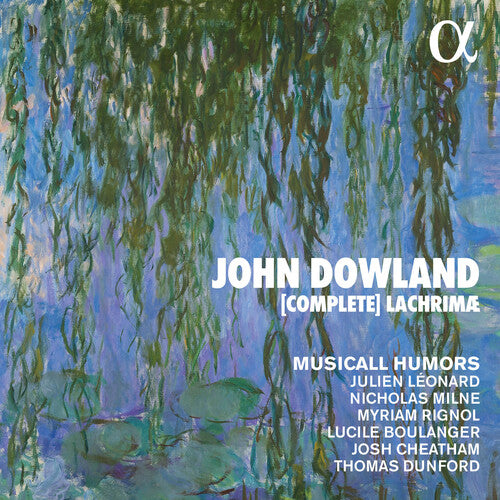
Dowland: Complete Lachrimae / Musicall Humors Viol Consort
‘London, April 1604. With the freshly printed partbooks of his Lachrimae under his arm, John Dowland walks from the printing house to his home in Fetter Lane. He should have been back in Denmark long ago, but for the moment all his thoughts are on the new publication he is carrying, his latest and most ambitious work to date: a complete cycle of instrumental music, twenty-one dances, honourably dedicated to Anne of Denmark, Queen of England.’ For Dowland has just completed one of the greatest masterpieces of Renaissance music. He had left England to enter the service of the Danish court, disappointed at not being appointed court composer to Elizabeth I, but he seems to have made the best of all his setbacks to compose this magnificent collection of purely instrumental works, much of it bathed in the melancholy typical of late sixteenth-century England.
Musicall Humors – a collective of the finest gambists of their generation – performs the complete set of pavans, galliards and ‘almands’, grouped into suites, each with its own character. A character inspired by the music, but reinforced here by the changing composition of the consort and the players taking turns to perform the ‘top line’, so that each musician’s personal playing style gives each piece a specific colour.
REVIEWS:
Dunford immerses the five-person gamba ensemble led by Julien Léonard and Lucile Boulanger in a rich and often extremely fragile-seeming web of voices and moods with a composure and sovereignty that moves and inspires. Everything breathes in the most wonderfully sonorous interplay, nothing groaning excessively. And when they dance, they maintain their posture and dignity like a dream.
-- ConcertoNet
We are faced with an absolutely referential recording, of intense and unprecedented beauty. Musicall Humors offers us the complete collection, but in a sequence of pavans followed by galliards, which refreshes our ears with the contrast, compared to the usual arrangement.
-- Scherzo
Trinitatis - Bach Cantatas / Gratton, Guillon, Le Banquet Céleste
Ever since the foundation of his ensemble in 2009, Damien Guillon has been forging ahead in the (re)discovery of J. S. Bach’s cantatas. ‘Trinitatis’ is devoted to three cantatas for the season after Trinity, for which Le Banquet Celeste has assembled its most seasoned members. Three very different works in which Bach expresses in various ways the emotion that the subject of the prescribed Gospel for the day stirred in him.