Two-time GRAMMY® Award-winning Turtle Island Quartet returns with Island Prayers, a deeply expressive new album to be released February 20 on Azica Records. The recording marks a renewed artistic statement for the quartet, bringing together world-premiere commissioned works by founder and artistic director David Balakrishnan, Terence Blanchard, Rhiannon Giddens, and Jerod Impichchaachaaha' Tate-four voices that together reflect the evolving landscape of American music.
Terra Infirma was directly inspired by the experiences of it's creative team. Reena Esmail, who resides in the Los Angeles neighborhood of Altadena, was forced to evacuate her home during the catastrophic fires of January 2025. Kondonassis, a committed advocate for the environment, is founder and director of the non-profit organization Earth at Heart; her initiatives include the widely-praised commissioning project FIVE MINUTES for Earth. Terra Infirma reflects not only the environmental passion and advocacy of both artists, but also their inspiration to innovate and expand the concerto form. In this bold new work, with a title taken from a poem by Robert Walters, the harp symbolizes the protagonist Earth, both fragile and powerful. The towering instrument is moved choreographically by Kondonassis across the stage as she journeys through various arrays of suspended percussion. In the composer's words, the work is "part virtuoso concerto, part performance art, and part theater." Esmail, who is Indian-American, has drawn on her extensive studies of Hindustani music in composing Terra Infirma. Her compositional voice is at once arresting, lyrical, haunting, and fierce. The work, which includes a defining movement titled "Immolation," incorporates elements of Raag Deepak, an ancient collection of pitches believed to invoke fire. Kondonassis, known for "a range of colour that's breathtaking," (Gramophone), brings the work to life with colorful authenticity. Says Esmail, "Terra Infirma sits somewhere between a harp/percussion concerto and a monodrama - Yolanda leads us through the trajectory of a wildfire, starting with the eerie moments before the first spark, and ending with the hope of new growth. The work explores our human relationship to fire - a force that can be at once devastating and illuminating. It has been a dream to work so closely with Yolanda, who has reinvented the role of the harp over and over again throughout her career. We have built the DNA of this piece together over so many years - experimenting in percussion studios, mapping stage plots, pushing our imaginations to the limit. I am so excited to share this work with the world." States Kondonassis, "The personal and musical resonance that I feel with Reena has resulted in a work that's deeply personal, uniquely colorful, and ground-breaking in so many ways. The harp is a highly visual instrument, and Terra Infirma utilizes that element to the fullest. In this work, the harp is actually a character in the musical drama onstage, and that gives me the chance to portray an enormous range of artistic emotion." The new concerto forms the heart of The Terra Infirma Project, a multi-year initiative of the Interlochen Center for the Arts, which boasts Kondonassis as an alumna (class of '82). The Interlochen Orchestra is featured along with Kondonassis and conductor Andrew Grams on the world-premiere recording, released in April 2026 on the Grammy-winning Azica label. The entire process, from initial workshops to the world-premiere and recording, has been captured by the award-winning film crew, Fulvew Productions, for an upcoming documentary to be released for airing on PBS Television in August 2026. The Terra Infirma Project is generously supported by the Allen B. Cutting Foundation.
No wonder the stellar team of pianists Eric Zuber and Boris Slutsky found Rachmaninoff's works for two pianos irresistible. The two had a shared history: Mr. Slutsky was Mr. Zuber's piano teacher beginning when the latter was a mere 11. Here, instructor and student have now become equal partners with a shared aesthetic. "Like many pianists (and listeners), I've always felt deeply connected to Rachmaninoff's music," says Eric Zuber. "Precisely identifying what makes it resonate so profoundly with so many people is challenging, but for me, it's his sincerity of expression, emotional honesty, and exceptional craftsmanship in writing for the piano. Through his distinctive musical language, Rachmaninoff captures the complexities of human emotion-our joys, loves, and sorrows-in ways words alone cannot fully express.
In the discussion on women and classical music, perhaps no other instrument draws such a strong association with feminine stereotypes as the harp. Once the instrument of choice for respectable young ladies, it was considered suitable for the domestic sphere and the world of private salons. And yet, as the harp made it's way out of the home and into the concert hall, it's publicity was championed by male performers, playing the music of male composers. Often overlooked are the women-performers and composers alike-who revolutionized the instrument and gave it a solo voice. Birds of Paradise celebrates the artistic voices of women as both performers and creators. This album showcases living composers Reena Esmail and Angelica Negron and legendary harpist and composer Henriette Renie. Featured works include Renie's Trio, the first major work written for this combination of instruments, alongside the world premiere recording of Negron's Ave del paraiso and the first recording of Esmail's Saans as arranged for harp, violin, and cello. Listeners are invited to experience this dynamic sound world, full of color and warmth, created and performed by women.
BAN: Stories of Censorship is Apollo Chamber Players' bold musical response to rising global threats against freedom of expression. Featuring new commissions by composers from politically embattled regions-including Afghanistan, Turkey, and the U.S.-the album amplifies voices often silenced. Narrated by cultural icon George Takei, The Book of Names recalls the Japanese-American internment through music and memory. DJ Spooky's Quantopia / The Thought Police confronts disinformation and the erosion of truth in the digital age. In Revise? composer Jasmine Barnes and Houston Poet Laureate Emeritus Deborah D.E.E.P. Mouton explore the distortion of Black identity in American culture. Arman (Hope) by Afghan composer Homayoun Sakhi is a lyrical reflection on artistic survival under Taliban rule, with the idea of hope at the forefront, while Turkish composer Erberk Eryilmaz's Fog Bell becomes a powerful metaphor for the role of artists as warning beacons-standing like a fog bell boldy cutting through the mist against authoritarianism and censorship. Together, these works form a musical call to conscience, reminding us that in dark times, art is both resistance and refuge.
This album portrait of Carlos Simon grew out of a commission, The Best Cuisine, which was funded by a grant from Chamber Music America and composed during the COVID-19 pandemic. The artists on this album presented the work's premiere in Washington, DC in 2022. At it's core is a spirit of collaboration - a coming together of art song and culinary flair, musical styles, and friendships - during a time that was otherwise quite solitary. It's text, written by baritone Carl DuPont, celebrates the craft of cooking that both he and Simon honed during the pandemic. With newfound inspiration drawn from the multifacetedness of Simon's compositional voice, DuPont and violinist Domenic Salerni, cellist Carrie Bean Stute, and pianist Efi Hackmey returned to Chiarina's longtime venue, the historic St. Mark's Church in Capitol Hill, to record The Best Cuisine and additional works for combinations of violin, cello, piano, and baritone. While Simon has more recently become known for his large-scale works, Chiarina seeks to highlight Simon's versatility and poignancy in works for more intimate performing forces.
Yuliya - Forgotten Songs of Julia Weissberg Rimsky-Korsakov
Azica Records
CD · 1 disc
$15.99Aug 22, 2025
This recording with AZICA Records marks the first modern-day capture of the music of Julia Lazarevna Weissberg Rimsky-Korsakov (1878-1942). During her lifetime, Weissberg ascended the heights of cultural life in Russia's "Silver Age", only to be relegated to obscurity in the subsequent era of socialist realism. A prominent composer, critic, and public figure, she was particularly celebrated for her art songs, symphonic poems, and children's operas. Her works, known for their harmonic ingenuity, were widely published and performed during her lifetime in both Russia and Germany. Born to a prominent Jewish family in Orenburg, Weissberg was a composition student of Nikolai Rimsky-Korsakov at the St. Petersburg Conservatory and continued her studies in Berlin with Max Reger and Englebert Humperdink. While in Germany, she saw the premieres of many of her songs for voice and orchestra, which received reviews across Germany, France, England, and Russia. By the time of her return to St. Petersburg in 1912, she was a widely-published composer, publishing under the name Julie Weissberg. She subsequently married musicologist Andrey Rimsky-Korsakov, Nikolai's son. The couple founded the first Russian music magazine Muzïkal'nïy sovremennik (Contemporary Music) for which Weissberg served on the editorial board and was one of the main reviewers. In her lifetime, Weissberg published more than 75 works, including art songs, symphonic poems, symphonies, chamber works, folk songs, and operas for children. Contemporary Russian composer Mikhail Gnesin referred to her as "the first professional female composer in the history of Russian musical art of the 20th century," and contemporary critic Leonid Sabanayeff claimed that she was "a master in the full sense of the word" for her extraordinary musical and text setting abilities. Many of her art songs feature texts by prominent contemporary women creatives from across the globe, including Indian activist Sarajini Naidu (1879-1949), Polish author and activist Maria Knopnicka (1842-1910), German children's author Paula Dehmel (1862-1918), and her close collaborator Sophia Parnok (1885-1933), later known as the 'Russian Sappho'. Weissberg was a leader in the contemporary music community, championing the creation of new works. She died in 1942 with her son Vsevolod Rimsky-Korsakov in the Nazi siege of Leningrad. Soprano Sarah Moulton Faux, an Opera America and America Prize winner, first saw mention of Julie Weissberg's work while researching the art songs of Nikolai Rimsky-Korsakov. Intrigued, Sarah began a two year research project into Weissberg's catalogue with the assistance of musicologist Dr. Olga Panteleeva. Together, they found a treasure trove of Weissberg's published manuscripts in the Russian State Library in Moscow. Panteleeva also discovered a doctoral dissertation by Mazur Marina Moiseeva from the St. Petersburg Conservatory, Composer Julie Weissberg: Personality and Creative Heritage (According to the Materials of the Archives of St. Petersburg), which proved to be an invaluable resource. Fifteen songs for voice and piano handpicked from that treasure trove comprise this album, featuring Sarah Moulton Faux and internationally acclaimed pianist and composer Konstantin Soukhovetski. Seven-time Grammy-winner for Classical Music Producer of the Year Judith Sherman is the lead producer and sound engineer.
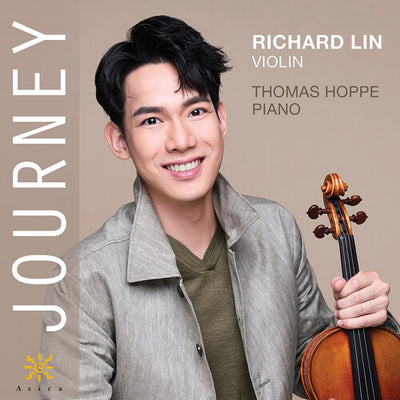
Richard Lin, the 2018 winner of the International Violin Competition of Indianapolis releases his debut recording. Performed with passion and flare, Lin is joined by renowned pianist Thomas Hoppe in music of Richard Strauss, John Corigliano, Gershwin/Frolov, Vitali, and Debussy.
Beyond The Years - Unpublished Songs of Florence Price
Azica Records
CD · 1 disc
$15.99Jul 26, 2024
With an ever-increasing awareness of the excellence that defined her career, Florence Price is finally receiving the recognition that she deserves. Price won the Wanamaker Prize in 1932, and she was the first Black woman to have a symphony premiered by a major American orchestra. Price was a gifted student, pianist, and organist. She graduated from high school in Little Rock, AR, at age 14. At age 16, she graduated from the New England Conservatory (as the only double major in her class) with degrees in organ performance and piano pedagogy. Price wrote music for everyone– across a range of styles and abilities, and for a variety of forces. Beyond the Years hones in on Florence Price the composer of songs. ONEcomposer has cataloged nearly 150 of her songs (to date), only about half of which have been published.
Beyond the Years highlights Price’s affinity for themes of faith, nature, love, and loss. Amongst Price’s treasures in the archives at the University of Arkansas, Fayetteville, is her well worn copy of Vaccai: Practical Method of Italian Singing, a symbol of her fastidious commitment to writing idiomatically for the voice.
As performed by Karen Slack and Michelle Cann, these songs are receiving new life in the hands of two of the greatest artists of our generation.
Over the past several years, I've become interested in stepping away from the common recital-with-piano-accompaniment format and have been exploring more unusual sounds and colors. For instance, I played a recital of music for bassoon and percussion, and I'm interested in the idea of bassoon and organ, or guitar, or harp. I chose harp for this album since I have the pleasure of working with one of the finest harpists in the world every week, Emily Levin. In researching repertoire, I found more music written for bassoon and harp than I expected. Unfortunately, most of the music written for this combination is not always the peak of musical quality. What I did find, however, was the great music composed for bassoon and harp was mostly written by French composers. The Andres and Jolivet were absolute musts since they were written for the instruments and are both fantastic pieces. With the Jolivet involving a flute, I went right to my friend and colleague, David Buck, who was more than happy to join us. A fan of vocal music, I had to include something on the album written for the voice, have it be French, and also be topical. I have always adored the Bizet and Delibes duets and knew we could easily arrange them for two bassoons and harp. Another friend and colleague, Tom Fleming, joins us for those. I first heard the Charpentier sung by Maria Callas and I immediately fell in love with it's lushness. There are two charming short pieces that really fit in beautifully; the Sauguet and Tournier. Though the Tournier was originally written for cello, it works perfectly on the bassoon. The Sauguet was written for the bassoon and it showcases the instrument's expressiveness. To close the album I chose one of my favorite things written by Gabriel Faure. "In paradisum" is the final movement of his Requiem.
Following the success of WindSync’s recording of Miguel del Aguila’s Wind Quintet No. 2, released on the quintet’s album All Worlds All Times, the pair returned to the studio—this time, the legendary Studio Two at Abbey Road Studios in London—to record the present monograph of del Aguila’s works for winds.
This milieu connects rather poetically to WindSync’s founding principles. Although Abbey Road is now associated with the likes of Pink Floyd, Eric Clapton and, of course, The Beatles, or with the famous soundtracks to the Star Wars and Harry Potter movies also captured there, the first musician to record in the studio was British classical composer Edward Elgar, with the London Symphony Orchestra. By playing del Aguila’s music into the studio’s arsenal of historic microphones—the same ones used by The Beatles—WindSync reaches into Abbey Road’s storied past to acknowledge its classical roots, while marrying that tradition with the dressed-down, boyband accessibility that inspired the quintet’s cheeky name.
The Telegraph Quartet makes their Azica Records debut, In this first installment we have two works that, as far as can be determined, have never been recorded together. They are equally unlikely to have appeared together on the same mainstream live concert program. Ravel’s only string quartet is often paired with Debussy’s only string quartet particularly to showcase their shared lineage of French Impressionism, and that Ravel’s design was strongly influenced by Debussy’s. Schoenberg’s first numbered quartet is most often programmed within the cycle of his own radically evolving quartets, or with the work of the larger “Second Viennese School”, perhaps even the quartets of his only teacher Anton Zemlinsky. Here, in a striking setting, two of the greatest 20th century composers share the program with two distinctively different masterworks that have a nearly identical chronology. Born one year apart (Schoenberg in 1874, Ravel in 1875), these contemporaries composed, premiered and published their quartets between 1902 and 1907 (Ravel first, then Schoenberg). 1904 saw the premiere of Ravel’s quartet just as Schoenberg began to compose his. This synchronicity in the first decade of the 20th century makes this pairing an extraordinary snapshot of the avant- garde: A time capsule.
The juxtaposition is a marvelous invitation for comparison and contrast. It presents two significantly divergent “schools” that nonetheless share some interesting traits. The history, temperament, life story and lasting influence of each composer portray them as wildly different, like two different musical species. But together, their quartets paint a vivid portrait of a shared moment within the long history of the string quartet genre
Hildegard, Sibelius et al: Earthdrawn Skies / Aizuri Quartet
Azica Records
CD · 1 disc
$8.99$17.99Save 50%Jun 23, 2023
Earthdrawn Skies explores deep connections between humankind and the natural world through the distinct lenses of four composers forging personal relationships with the soil and the stars. These works by Hildegard von Bingen, Eleanor Alberga, Komitas Vardepet and Jean Sibelius are rooted in a sense of tradition and connection to the land, even as the composers seek something beyond their reach: an understanding of God, the physics of the cosmos, homeland, happiness. The music on this album draws from the earth as it reaches upward and outward. these composers share an impulse to understand the sky, the heavens, the larger things in life. This is music we have kept returning to as a quartet, as it speaks to us in deeply personal ways. We cherish playing this music together, and we hope it resonates as much with you as it does with us.
Chopin: The Young Chopin / Zuber, Lin, Indianapolis Chamber Orchestra
Azica Records
CD · 1 disc
$18.99Nov 18, 2022
Hailed as an “irresistibly fluid” by The New York Times and “illuminating” by the Cleveland Plain Dealer, pianist Eric Zuber releases his debut album, The Young Chopin, with the Indianapolis Chamber Orchestra and conductor Wilbur Lin. The release celebrates the early piano repertoire of Frédéric Chopin (1810 – 1849), including his Variations on ‘Là ci darem la mano’ from Mozart’s Don Giovanni, Op. 2; Andante spianato & Grande polonaise brillante, Op. 22; and his Piano Concerto No. 1 in E Minor, Op. 11.
Zuber writes, “The ingenuity of [Chopin’s early] piano writing shows a complete technical understanding of the craft of the instrument, and the seductive beauty of his melodic and harmonic writing is second to none. And to think he was only 17 when he wrote the variations as a school assignment! These early compositions are tremendously difficult from a technical perspective, and Chopin was clearly seeking to showcase his abilities as a pianist. Yet, there is little of the empty displays of virtuosity that appear in the works of some of his contemporaries. Everything serves a purpose to create a clear emotional effect.”
Higdon, Jalbert & Tate: Moonstrike / Apollo Chamber Players
Azica Records
CD · 1 disc
$18.99Sep 02, 2022
Apollo Chamber Players’ sixth commercial album, MoonStrike, is a universal celebration of storytelling, space and folk song, realized through new works by Jennifer Higdon, Jerod Tate, and Pierre Jalbert. Higdon’s In the Shadow of the Mountain (2020) is inspired by her upbringing in the Great Smoky Mountains and incorporates the sounds and colors of the area. Next is the title work, Emmy-winning Chickasaw composer Jerod Impichchaachaaha’ Tate’s multidisciplinary MoonStrike (2019), which honors the Apollo space program through American Indian moon legends as narrated by astronaut John Herrington, the first Native American to fly in space. French-Canadian composer Pierre Jalbert’s L’esprit du Nord (“Spirit of the North”) (2019) is a three-movement work that fuses three of his culture’s folk songs with his unique, contemporary musical language.
Yolanda Kondonassis writes: FIVE MINUTES for Earth is a project that both celebrates our planet and illuminates our challenge to preserve it. In 2020, I asked each of the composers featured in this collection if they would consider contributing a work for solo harp of approximately five minutes in length that expresses a powerful experience inspired by Earth in one of its many conditions or atmospheres. I was overwhelmed by the generosity of immediate responses and set about assembling this labor-of-love project. The endeavor quickly expanded to include a live, multi-media concert, fifteen unique videos for each track, a separate published collection of Earth-inspired solos for younger harpists, and most importantly, the opportunity for harpists all over the world to perform these innovative, Earth-inspired works for solo harp by some of today’s most lauded composers; in doing so, every verified performance of any of the works from the FIVE MINUTES for Earth collection, anywhere in the world, will result in a monetary contribution to a recognized earth conservation organization, sponsored by my non-profit organization, Earth at Heart. FIVE MINUTES for Earth is also a metaphor for the urgent and compressed timeframe that remains for our global community to embrace and implement solutions to our fast-growing environmental crisis.”
REVIEW:
In 2020 harpist Yolanda Kondonassis asked each of the composers featured in this collection to consider writing a short solo harp piece that expresses “a powerful experience inspired by Earth in one of its many conditions or atmospheres.” Needless to say, the musical results prove as diverse as the planet’s ecosystems.
Takuma Itoh’s new-agey Kohola Sings shows how one can imitate a humpback whale song on a harp. For Hear the Dust Blow, Michael Daugherty checks his customary dazzle at the door and channels Roy Harris in slow motion. On Hearing Nightbirds at Dusk showcases Aaron Jay Kernis’ textural sensitivity and harmonic refinement at their best.
Chen Yi’s Dark Mountains offers wild contrasts in texture and touch. Reena Esmail’s Inconvenient Wounds utilizes a wide array of evocative scraping effects, while the subtle microtonal writing throughout Keith Fitch’s “as Earth dreams” mesmerizes. Sparsely deployed melodies and murmuring repeated notes hold attention throughout Zhou Long’s Green.
Perhaps Stephen Hartke’s Fault Line is the collection’s most probing, dramatic, discreetly resourceful, and least formulaic work: a substantial conclusion to a beautifully engineered contemporary harp collection that offers something for every musical taste. Well worth hearing.
Grammy-winner Jason Vieaux, “among the elite of today’s classical guitarists” (Gramophone), is described by NPR as “perhaps the most precise and soulful classical guitarist of his generation”. Among his extensive discography is the 2015 Grammy-winning album for Best Classical Instrumental Solo, Play. Vieaux’s multiple appearances over the years with Chamber Music Society of Lincoln Center, Music@Menlo, Strings Music Festival, Eastern Music Festival, Caramoor Festival, etc., have forged his reputation as a top-drawer chamber musician. Regular collaborators include the Escher String Quartet, Grammy-winning mezzo-soprano Sasha Cooke, violinist Anne Akiko Meyers, harpist Yolanda Kondonassis, and accordion/bandoneon virtuoso Julien Labro. Now, Vieaux releases "Bach Volume 2", a follow-up to highly acclaimed Volume 1. This is Jason's first release since the 2015 release of Grammy Award winning "Play."
Pamela Z: With Malice Toward None / Apollo Chamber Players
Azica Records
CD · 1 disc
$9.49$18.99Save 50%Sep 03, 2021
Anchored in an optimistic synthesis of classical, folk, rock and electronic music, With Malice Toward None elevates the idea of what it means to be human in the 21st century. Pamela Z artfully deconstructs her folk rock heroes while paying homage to youthful nostalgia and childhood songcraft, while Christopher Theofanidis and Mark Wingate partner to craft a jaggedly ethereal adaptation of poet Samuel Beckett’s haunting final masterpiece. Eve Beglarian’s epic Armenian fantasia (We Will Sing One Song) taps into the elemental desire to connect - its yearning, duduk-inspired glissandi and enchanting melismas diverge and reunite as they crisscross digital soundscapes; virtuosic percussion improvisations lead to a place of sonic enlightenment. With tradition beckoning, newly arranged Armenian folk songs find their voice, over a century removed from ethnomusicological discovery. The album’s titular track personifies the life of its creator, weaving storytelling and social contradictions with Enlightenment calls to action and good old-fashioned rock ’n’ roll. Communing with artists across the globe, Apollo Chamber Players expands its bold take on our collective contemporary experience, innovating beyond the boundaries of time, place and pandemic.
“It cannot be easy to write for solo piano: so many magnificent sounds of the 18th and 19th centuries abide in the ears of today’s pianists and concertgoers. By including some of my favorite Chopin miniatures alongside three major piano pieces from the 1990’s, I could well stand accused of an all-too-common reluctance to break from the past. I prefer to treat with this vexed situation pragmatically, acknowledging the reality that most of my listeners will perceive the new refracted through the lens of the old, and that some will simply be more inclined to keep listening when given a dose of the familiar together with the strange. All three recent works recorded here bear some imprint of the pianistic past—each in a different way—and yet all three successfully outrun it.” (Thomas Saur)
Barber, Copland: Many-Sided Music, Vol. 2, Ariel and Other Poems / Aeolus Quartet
Azica Records
CD · 1 disc
$9.49$18.99Save 50%Jul 09, 2021
The award winning Aeolus Quartet offers the second installment in their Many-Sided Music Project, Ariel and Other Poems. This ongoing project collects distinctive voices of American composers, combining the classic with the modern. Ariel and Other Poems takes its name from the original title of Sylvia Plath's last manuscript. The poems contained therein include the work that inspired Christopher Theofanidis' Ariel Ascending, and joined by the rich expansive tones of the Copland, the buzzing electricity of the Mazzoli, and the deep catharsis of the Barber, the album Ariel and Other Poems seeks to offer a small sampling of the multi-faceted collection of American chamber music.
Assad, Dunne, Goss: Cantigas de Santiago / Russell
Azica Records
CD · 1 disc
$18.99Jul 09, 2021
Grammy winning guitarist David Russell joins Azica Records as releases his latest album of contemporary works written just for him. Classical guitarist David Russell is world renowned for his superb musicianship and inspired artistry, having earned the highest praise from audiences and critics alike. In recognition of his great talent and his international career, he was named a Fellow of The Royal Academy of Music in London in 1997. In May 2003 he was bestowed the great honor of being made "adopted son" of Es Migjorn, the town in Minorca where he grew up. Later the town named a street after him, "Avinguda David Russell". David Russell spends his time touring the world, appearing regularly at prestigious halls in main cities, such as New York, London, Tokyo, Los Angeles, Madrid, Toronto or Rome. Concert-goers everywhere are in awe of his musical genius and inspired by his captivating stage presence. His love of his craft resonates through his flawless and seemingly effortless performance. The attention to detail and provocative lyrical phrasing suggest an innate understanding of what each individual composer was working to achieve, bringing to each piece a sense of adventure.
Lowak Shoppala' (Fire and Light) is a work that expresses Chickasaw identity through the medium of modern classical music and theatre. The work is in eight scenes and features orchestra, narration, children's chorus, traditional Chickasaw and modern dancers, traditional Chickasaw and classical vocal soloists and American Indian storytellers. Each scene depicts a part of Chickasaw culture and history. Lowak Shoppala' was conceived, designed and composed by Jerod Impichchaachaaha' Tate and premiered Saturday, November 21, 2009 at the Te Ata Theatre, East Central University, Ada, Oklahoma with Mr. Tate conducting the Oklahoma Youth Orchestra.
Last Silence / Martha Aarons, Lev Polyakin, Frances Renzi
Azica Records
CD · 1 disc
$9.49$18.99Save 50%Feb 05, 2021
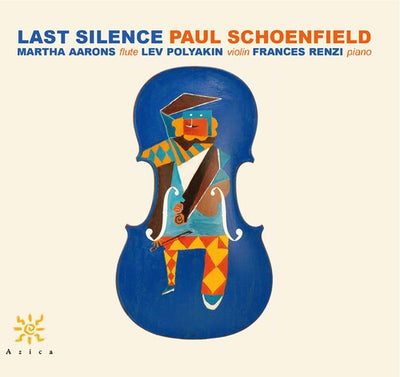
Performed by the trio for whom it was written, Paul Schoenfield's new composition "Last Silence" picks up where "Cafe Music" left off. A show stopping tour de force of excitement and emotion. Schoenfield's "Four Souvenirs" is finally released here by violinist Lev Polyakin and pianist Frances Renzi, who commissioned the work. Beautiful trios by Rota and Cui round out the album. Paul Schoenfeld‘s music is widely performed and continues to draw an ever-expanding group of fans. According to Juilliard’s Joel Sachs, “he is among those all-too-rare composers whose work combines exuberance and seriousness, familiarity and originality, lightness and depth. His work is inspired by the whole range of musical experience, popular styles both American and foreign, vernacular and folk traditions, and the ‘normal’ historical traditions of cultivated music making, often treated with sly twists. Above all, he has achieved the rare fusion of an extremely complex and rigorous compositional mind with an instinct for accessibility and a reveling in sound that sometimes borders on the manic.”
The traditional songs of the Christmas holiday are offered here by the Salzedo Harp Duo, their third release on Azica Records. The Salzedo Harp Duo, named after groundbreaking composer Carlos Salzedo, is Jody Guinn and Nancy Lendrim. Jody Guinn has been the principal harpist of the Akron Symphony Orchestra and the Cleveland Opera since 1984. She has been substituting or playing extra harp with the Cleveland Orchestra since 1986. Guinn shares her love of the instrument with several private students and is on the harp faculty of colleges across the region. Jody Guinn has been the principal harpist of the Akron Symphony Orchestra and the Cleveland Opera since 1984. She played for the Cleveland Ballet and the Ohio Chamber Orchestra for 16 years while both organizations were in existence in Cleveland. She has been substituting or playing extra harp with the Cleveland Orchestra since 1986 including multiple tours to Europe, New York City’s Carnegie Hall and Washington D.C.’s Kennedy Center.
'Twas the Night Before Christmas / Burning River Brass
Azica Records
CD · 1 disc
$18.99Nov 29, 2019
Classical meets Christmas in this latest offering from the Burning River Brass. Beautifully arranged Christmas favorites from this tremendous group of brass and percussion! Since 1996, Burning River Brass has been dazzling audiences from Alaska to Taiwan with "power and virtuosity," "harmonious blend," and "consistently stirring performances." Composed of twelve of the finest brass and percussion players in the country, Burning River Brass is an ensemble on fire! The original inspiration behind Burning River Brass was to give great players who were also good friends a chance to play together on a consistent basis. Soon after the first rehearsal in May 1996, BRB began to grow rapidly. The ensemble made its debut in September of 1996 in Tremont, Ohio under the auspices of Arts Renaissance Tremont and by 1998 was touring nationally.
-----
REVIEW:
The centerpiece is Burning River Nutcracker, swinging arrangements of six selections from the ballet. I admit to curmudgeonly skepticism when it comes to this sort of thing, but these readings won me over with lively, skillful, and tasteful playing.
The Brentano Quartet, in their second release for Azica Records, present the Mozart String Quartets No. 19 in C Major, K. 465, "Dissonance", and No. 16 in E Flat Major, K. 428. Since it's inception in 1992, the Brentano String Quartet has appeared throughout the world to popular and critical acclaim. "Passionate, uninhibited and spellbinding," raves the London Independent; the New York Times extols it's "luxuriously warm sound [and] yearning lyricism"; the Philadelphia Inquirer praises it's "seemingly infallible instincts for finding the center of gravity in every phrase and musical gesture"; and the Times (London) opines, "the Brentanos are a magnificent string quartet... This was wonderful, selfless music-making." Within a few years of it's formation, the Quartet garnered the first Cleveland Quartet Award and the Naumburg Chamber Music Award; and in 1996 the Chamber Music Society of Lincoln Center invited them to be the inaugural members of Chamber Music Society Two, a program which was to become a coveted distinction for chamber groups and individuals. The Quartet had it's first European tour in 1997, and was honored in the U.K. with the Royal Philharmonic Award for Most Outstanding Debut. That debut recital was at London's Wigmore Hall, and the Quartet has continued it's warm relationship with Wigmore, appearing there regularly and serving as the hall's Quartet-in-residence in the 2000-01 season.
Internationally renowned flutist Carol Winsenc joins forces with the Escher String Quartet, Tanya Dusevic Witek also on flute, and pianists Stephen Gosling and Emile Naoumoff to present this dynamic recording of the compositions of Yuko Uébayashi. The opening piece, Misericordia pour flûte et quatuor à cordes was composed for Carol Wincenc. Hailed "Queen of the Flute" (New York Magazine) at the outset of her, now, brilliant 48 year career, flutist Carol Wincenc was First Prize Winner of the (sole) Walter W. Naumburg Solo Flute Competition, as well as the Lifetime Achievement Award recipient from the National Flute Association, the National Society of Arts and Letters Gold Medal for Lifetime Achievement in Music, and Distinguished Alumni Awards from Manhattan School of Music and the Brevard Music Center. During the past two seasons she performed, recorded and gave masterclasses as an exclusive Burkart Flutes Artist in Beijing, Shenyang, Seoul, Warsaw, Prague, Venice, Nice, and Thessoloniki.
Grammy Award winner Jason Vieaux joins forces with the esteemed Escher Quartet to produce a recording with some new and old works with dance themes in common. These three works may share elements of dance-inspired music, and contain actual allusions to specific dances in the titles (or expressive markings) of certain movements, but that is where the similarities end. These guitar quintets, all from very different periods, couldn’t be any more different from each other in style, timbre, texture and dynamics. They show the musical range and flexibility of the guitar within a more traditional chamber music group setting.