Challenge Classics
263 products
Bach: Sonatas for Violin & Cembalo obbligato, Vol. 2 / Terakado, Bonizzoni
Here is the second volume of Bach’s Sonatas for violin and obbligato harpsichord. Terakado and Bonizzoni offer a thoroughly distinctive account of these famous masterpieces. Their approach combines a deep musical and philosophical insight with a conversational vibe.
Liszt: La Leggierezza / Yang Yang Cai
A stunning debut by 24 years old Chinese pianist Yang Yang Cai. For her first disc she carefully selected six very diversified works by Liszt, in order to convey all her pianistic qualities: prowess and virtuosity, but also philosophical insight and colouristic finesse. Her craftsmanship, musicality and fine taste are perfectly in balance.
Bononcini: Cantate per Contralto con Violini / Ars Antiqua Austria
Fourteenth disc by Ars Antiqua Austria and Gunar Lezbor for Challenge Classics. World Premiere Recordings of three Cantatas for countertenor and violins. Alois Muhlbacher is one of most sought-after countertenors today: in 2023 has engagement with Minkowski (Alcina), Haselboeck (Bach) and tours with a Farinelli arias recital… Bononcini’s Cantatas look like a Trilogy on the theme of longing for a distant love. They were perceived in their time as innovative and progressive, directed towards the future.
Schreker: Der Schatzgräber (Reissue) / Faveyts, Uhl, Albrecht, Netherlands PO
Schreker is well known for his operas and wrote the libretto and composed his opera "Der Schatzgräber" after the great success of "Der ferne Klang" (1912) and "Die Gezeichneten" (1918). "Der Schatzgräber", questioning the value of materialism versus love, was to prove particularly powerful in post-War Europe. Musicweb International raves: “... this is one of those operas and recordings which ‘has it all’, from the drama and sublime beauty of the music to the glorious performance and sumptuous recording. If you are a fan of opera on record from any period this is a treat, but if you love your music-dramas exciting, moving and Romantic with a big-boned ‘R’ then this is one you will want to keep close to your media player for a long time to come.”
Handel: Five Great Suites for Harpsichord (London, 1720) / Koopman
George Frideric Handel made a name for himself as a brilliant organist and harpsichordist early on in his career. As a young man, he travelled from Germany to Italy in 1707. We do not know exactly how much or what Handel composed for harpsichord while in Italy, but we know more starting from the time he settled in England. Handel composed all sorts of works for harpsichord in England, In November 1720, he published the Suites de Piecespour le Clavecin, now known as the Eight Great Suites, his most important work for harpsichord. The spectacular Eight Great Suites show Handel the harpsichordist at his best.
The suites are made up not only of newly composed movements, but also of improved versions of pieces he had written before and of harpsichord arrangements of his own compositions for other instruments. One theme central to interpreting Handel’s works for harpsichord (and the rest of his œuvre, for that matter) is what to do with the dotted rhythms. In Handel’s music, we regularly see a theme appearing in different rhythmic variants – sometimes dotted, sometimes not, or only partially, dotted. The question, therefore, is whether to perform these rhythms uniformly throughout the piece or to play them as they were written out in each instance by the composer. I have in large part chosen the latter.
Porpora: L'aureo serto – Arias / Foresti, Buccarella, Abchordis Ensemble
The present release by baritone Sergio Foresti on Challenge Classics. The second where he is accompanied by the remarkable Abchordis Ensemble, conducted by Andrrea Buccarella. This recording is devoted to the arias composed by Nicola Porpora, probably the greatest of the Neapolitan composers as much as the voice is concerned. A selection of arias of different moods and characters that ceaselessly tantalize and intrigue the listener. A disc you can listen to with constant pleasure and commitment from start to end, thanks also to the orchestral accompaniment (and overtures) and the impeccable recording and production.
Fauré: Nocturnes, Barcarolles, Préludes & Variations / Minaar
Thirteen Nocturnes and as many Barcarolles form the core of the collected output of Gabriel Urbain Fauré for the piano. Night-time meditations, then, along with inspiration drawn from rippling water (the origins of the barcarolle lie in the songs sung by Venetian gondoliers and the word itself comes from the Italian ‘barca’, a boat.) Along with some impromptus, préludes and other works, one might rapidly gain the impression of a delightful collection of salon music, whose titles may actually display the influence of Chopin. But this music is so very much more than pretty salon music. In the intimacy of these genres, Faure succeeded time and again in nothing short of exposing his very soul. And the French composer’s style is entirely his own-original and personal - from the first note to the last.
Hannes Minnaar received international acclaim after winning several international competitions and being awarded a Borletti-Buitoni Trust Fellowship. This re-release of his 2016 deluxe album package omits the original companion DVD.
Reviews:
‘Minnaar’s identification with this unique realm of music is complete and his deeply felt interpretations shine with clarity and infinite nuance.’ -Gramophone
‘One very exhilarating recording. Hannes Minnaar’s playing is not only sensitive but also lyrical und sometimes dreamy. With a wide spectrum in sound shades, much refinement and a continuous flow the Dutch pianist’s performances are absolutely fascinating.’ -Pizzicato
‘Minnaar consistently avoids the kitsch trap. He takes this music seriously and immerses it in different moods: a darkly flowing river, then a pointillistic sequence of small effects, then again a radiant melody over a moving underground. -Deutschlandfunk
-‘The delicate poetic qualities of Fauré’s piano pieces requires the most sensitive of touches from the pianist tackling them, and it’s clear that Hannes Minnaar is comfortably a master of the idiom.’ -CD Choice UK
‘The crystal-clear, free-flowing performance fits Fauré’s reserved luminous notes perfectly. It’s amazing how he transforms the nocturnes into musing monologues, or how he consecrates the preludes with mild severity.’ -De Standaard
Bruckner: Symphony no. 7 on Vinyl / Haitink, Netherlands Radio Philharmonic
Ravel: A Moune – Chamber Music with Violin / Tur Bonet, Testori, Goy
This is a ‘concept-album’ around Maurice Ravel and his special relation with Hélène Jourdan Mourhange, a dear friend and violinist nicknamed "Moune." The program is set-up in order to take the listener by the hand into Ravel’s musical world through a series of pieces which are gradually more deep and complex. The music is played on a 1935 Hautrive piano, while violin and cello are played on gut strings. The Tzigane is in the rare version for Luthéal (Pleyel, 1910), a period prepared piano with a distinct character. About Lina Tur Bonet, Diapason writes: “Impressive: Lina Tur Bonet’s discography aligns beautiful achievements’. Indeed her previous releases have already collected all European awards.
Ivanschiz: Chamber Music at Lambach Abbey / Letzbor, Ars Antiqua Austria
Amandus Ivanschiz was baptized Matthias Leopold Ivanschiz on 24 December 1727 in the Austrian city of Wiener Neustadt. As early as 1742, at the age of fifteen, Matthias decided to join the Pauline Order and took the name Amandus. On 25 December 1743 Amandus took his vows and was then sent to Maria Trost and Wiener Neustadt to study for the priesthood. The extensive oeuvre of this master, who only lived to the age of 31, is astonishing. In total, more than 300 copies of his works can be found in Central and Eastern Europe. His modern style and great compositional mastery probably explain the wide dissemination of his music. Ivanschiz might therefore also have served as a model in the development of the young Mozart. Amadeus’ first visit to the monastery is documented on 12 September 1767, after which we know he returned at least another three times.
Bach: Sonatas for viola da gamba, BWV 1027-1029 / Sofronitsky
Shostakovich: 24 Preludes & Fugues, Op. 87 / Minnaar
After Bach's Goldberg Variations, which won him worldwide honors (including a Diapason d'Or from France's Diapason Magazine), Hannes Minnaar challenges and confronts what has become a 'classic' of the 20th century repertoire: Shostakovich's Preludes and Fugues, composed in 1951. Here again, the qualities of his pianism, for which he is recognized as one of the leading musicians of our time, come under the spotlight: the diversity of touch and the suppleness between tension and tranquility to characterize every Prelude and Fugue, the precision of tone, the lack of any affectation, a natural finesse in phrasing and articulation, and a familiarity with the score going hand in hand with a freshness that conjures a sense of improvisation. Here we encounter a new landmark in the crowded field of interpretations of this wonderful music.
Rameau: Pieces de clavecin en concerts / Accademia Strumentale Italiana
Forster, Graun, & Quantz: Horn Concertos
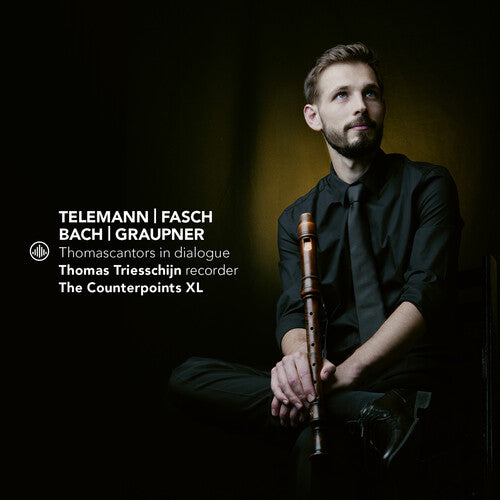
Thomascantors in Dialogue
Mozart en famille: Music for Violin, Viola & Piano / Sigiswald, Sara & Marie Kuijken
This recording of Mozart chamber music can be listened to as a pleasant private concert "en famille". The choice of the works is dictated solely by the specific instruments played by the three family members: violin, viola and keyboard. This is not a usual instrumentation in the chamber music repertoire, yet it is this combination that has given rise to a pleasantly varied program - thanks to Mozart's inexhaustible genius! This cleverly thought out program features four pieces with different instrumentations and moods in order to elicit a constant interest and pleasure from the listener. The Kuijkens Trio plays with their unmistakable understanding, tenderness, and tone color; a constant delight throughout the album.
Wagenseil: Six Sonatas for Violin, Cello, & Violone
The path traced on this album, with music by Georg Christoph Wagenseil (1715-1777), and on following ones has the undoubted merit of introducing us to some composers considered “minor” compared to Haydn and Mozart. They were not only very active and influential on the musical life of that time; they also created a considerable amount of quality music, which deserves to be rediscovered and appreciated. In a historical-musical perspective, the music of these less famous authors helps to reconstruct the passage between the decline of the Baroque, towards the middle of the eighteenth century, and the noon of the classical style. A period that we often classify as ‘pre-classical’ or ‘galant’ or ‘early Viennese school’. This praiseworthy cultural operation, aimed at rediscovering not only “minor” composers but also certain genres considered “domestic” music allows us to better understand how the “musical landscape” looked like, especially in Vienna.
Domestic music responded to the desire for cultured entertainment not only for the aristocracy but also for the rising bourgeois class; and as such, it constituted an indubitable status symbol. The six sonatas in trio on this album, dating from around the 1750s can be ascribed to the genre of ‘divertimento’: before 1780 the term was all-encompassing, and included all non-orchestral instrumental music, including sonatas and quartets. Above all, the idea of “musical conversation”, or dialogue or discourse between the different instruments, is very present in this type of composition, in which a pleasant and well-regulated lounge conversation is simulated and sublimated with just the notes. The collection of Six Sonatas, presented on this CD, from the early fifties of the eighteenth century should be placed among the first chamber documents for three independent strings, without the support of a keyboard instrument for the realization of the continuo.
Schubert: Sonata in B flat Major D 960; Drei Klavierstucke D 946 / Ayako Ito
Ayako Ito: “Nowadays, in concert halls, we generally see a single type of piano that normally has 88 keys and is normally black. Things were quite different in the Vienna of the 19th century: the piano had fewer keys, was decorated with wooden inlay and had no steel subframe. All this made them sound quite different. Conrad Graf was one of the finest builders of pianofortes in Vienna in the period from 1820-40. And Franz Schubert was living in the same city.We can revive a rich, warm, singing, powerful and even orchestral sound on Graf's pianofortes. His pianos feature the Viennese action or “Prellzungenmechanik”, with their hammers built up from many layers of leather. These hammers allow the performer to impart subtle nuances and dynamic contrasts. Of course, the pianos are straight-strung. The player can alter the tonal color using four pedals, with one of the pedals specific to the pianoforte being the moderator. When the moderator pedal is depressed, a strip of cashmere slips between the hammers and the strings. Christopher Clarke (1947) built the instrument used for this recording in 2000, as a facsimile of Conrad Graf's pianoforte no. 995. Clarke's pianoforte always inspires me. I find it a miraculous instrument. The utter precision of the mechanism lets us explore the finest gradations and introduce the most subtle nuances – singing, speaking or whispering. It is a mechanism that demands a high technical mastery from the player.”
Review
Ayako Ito approaches the masterpiece D960 with romantic fervour, trusting the less powerful, more refined, tone of the fortepiano will provide authentic period sound compensation. Her opening theme isn’t as soft as pp, but smoother and more swinging than the Molto moderato marking suggests. The deep bass disturbance at the end of its first full statement (tr. 1, 0:24) is more threatening than the pp marking. The clarity of Ito’s running quavers in the ‘tenor’ part enhances the tense atmosphere, yet the third part of the first theme (0:58), more pleading, moves through quiet insistence. The second theme (2:06), is in the tenor part against the ‘soprano’ descant, with Ito’s sensitive balance the latter’s creaminess like a loving companion. The dancing three-quaver groups in triplets which eventually result skip buoyantly. The phrase of resolution terminating these (4:04) deserves more breadth, but the extraordinary exposition ‘first time’ codetta (4:55), like hobgoblins arriving, Ito makes boldly gawky.
In the development (10:19) Ito prefers cool examination rather than shock, its ff climax of the dancing triplets underplayed (11:27). But she builds the tension and dynamic well to the fruition of the third theme (12:18), the most tender and memorable. Ito makes the second theme recap (16:08) more delicate and sensitive. Her coda (19:22) is tranquil yet flowing.
The opening of the slow movement juxtaposes a left-hand four note rising figure and melancholic right-hand melody. Ito makes the first and final notes of the left-hand figure very clear as bell peals three octaves apart. In this C sharp minor funeral Ito is sorrowful yet smoothly dignified, her equipoise between the hands arguably overmuch easing the pain of bereavement. The central section in A major (tr. 2, 2:59) remembers the loved one and clarifies a relationship, its theme beginning in rich ‘baritone’ register, the soprano repeat (3:26) adding varied semiquaver runs. From Ito it feels like both parties confirm shared sadness. At the return to the opening (5:36) the left-hand has an additional four-note motif, three semiquavers and a quaver, for me like funeral carriage wheels biting into the road. Ito makes it a clear, inescapable presence. The decrescendo after the melody’s climax finds the left-hand unheeding the pathos of the melody briefly in C major (6:30); yet after the next melodic climax comes a blessing, the coda (7:55) easing calmly into C sharp major.
Ito’s finale’s rondo theme begins a bit stiff in marking out the rhythm; her second strain (tr. 4, 0:21) is catchier and first episode (1:24) blends calm tone with confident movement, the relationship between melody and accompaniment grippingly maintained, until a sudden silence and ff shock (2:36) of catastrophe, especially when the melodic outburst goes into descant register.
Best of D946, Three piano pieces, is for me the first. It’s in E flat minor with urgent first strain to its right-hand cyclical theme. The second (tr. 5, 0:15) adds more rhythm, then a melody picked out from the first notes of the three-quaver groupings (0:19). The return of the first strain is in E flat major (0:50), the touch more rhythm a vehicle for Ito screaming a scrunched appoggiatura at the fz climax. The central section second theme (2:54) is in B major, festooned with turns and phrase-ending arpeggios, Ito revealing it as leisurely and affectionate. Its second strain (4:13) adds glissando-like up-and-down [32nd notes], the return of the first more luxurious in chording and close more rhetorical. To this vibrant, varied piece Ito brings considerable gusto.
--MusicWeb International (Michael Greenhalgh)
Hello Darkness: Songs on Death from Monteverdi to Eilish / Vermeulen, Schulze
EXTASIS
Champion: Apostola Apostolorum [The Den Bosch Choirbooks vol. 3] / Bull, Capella Pratensis
Aumann: Chamber Music in the Abbey of St. Florian / Letzbor, Ars Antiqua Austria
Feast of the Swan - Den Bosch Choirbook, Vol. 4
The present program presents the kind of music that might have been heard at the Feast of the Swan, an annual banquet held by the Confraternity of Our Illustrious Lady in ’s-Hertogenbosch, sometime in the middle of the sixteenth century. The combination of “sacred” and “secular” pieces might come as a surprise. However, the border between what we in the twenty-first century might imagine as two different musical realms was actually quite porous in the sixteenth.
One of the Confraternity’s regular banquets, held each year on the first Monday after Holy Innocents’ Day (28 December), was the Feast of the Swan. The Swan was the Confraternity’s heraldic beast, a symbol of grace and purity, attributes of the Blessed Virgin. In the medieval imagination, the swan had musical associations. The anonymous bestiary Physiologus states that the Latin name for the swan (cygnus) comes from the verb “to sing” (canere), because it produces such a beautiful song from its long and flexible neck. It was thus fitting that the Feast of the Swan should include a rich musical component. Some of the singers also played instruments at the banquets.