Hasse, C.P.E. Bach, Hertel: Cello Concertos / Rudin, Musica Viva
Chandos
CD
$21.99Jun 24, 2016
Three lovely but rarely performed cello concertos are featured on this new release. These works are among the earliest in the genre by German composers. Cellist Alexander Rubin is not only a multi-prize winning soloist, but also a respected conductor. He fills both roles on this recording. Musica Viva is one of the best-loved chamber orchestras in Russia. The musicians are known for their refined but unconventional programmes, where they frequently perform rare works.
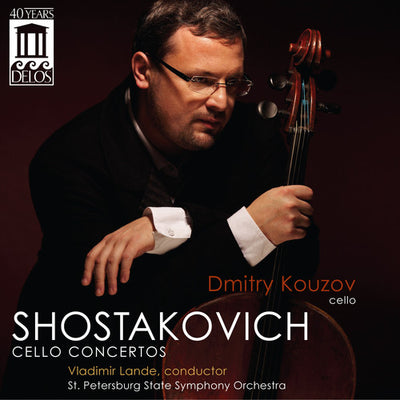
Dmitry Kouzov is one of his generation's leading cello virtuosos. From his earliest years Kouzov was surrounded by musicians with direct personal connections to Shostakovich, making the master's music an inseparable part of his musical being. That immersion, along with the partnership with the St. Petersburg State Symphony and Lande, make for an insightful and moving reading.
Bitter the Laughter, Sweet the Tears / Richter Uzur Duo
Centaur Records
CD
$17.99Jan 06, 2023
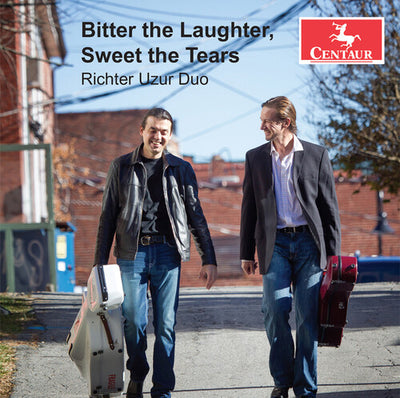
The Richter Uzur Duo approaches the concert stage with effortless virtuosity, soulful musicality and self-effacing humor. Trained in two of the world's most lauded musical institutions — The Royal College of Music and The Moscow Conservatory, respectively — guitarist Brad Richter and cellist Viktor Uzur are consummate performers and accomplished composers, each having played around the globe to critical acclaim and international awards. Together, the Richter Uzur Duo combines elements of classical music, rock, indigenous American music and Eastern European folk, all played with a native sense of vernacular, integrity and charm, producing a sound that is all their own.
LEGENDS: Rebellion is the next installment in a series of recordings celebrating women as storytellers and bearers of cultural memory. Featuring world-premiere recordings, Grammy-nominated, long-time collaborative duo soprano Laura Strickling and pianist Joy Schreier return to add to the evolving legend of modern art song in an album exploring rebellion in many forms: political, emotional, erotic, maternal, and spiritual. From Afghan women's landay poetry composed in defiance of oppression, to mythic heroines reclaiming their own narratives, to an unflinching portrayal of new motherhood and a powerful meditation on love as resistance. Pushing against conventional expectations of what art song 'should' be, this album offers a kaleidoscopic array of harmonic and rhythmic languages alongside compelling, deeply human texts; a program that fascinates, challenges, informs, and delights - inviting both devoted listeners of art song and those less familiar with the genre into a richly expressive sonic world celebrating contemporary song as a space for courage, vulnerability, witness, and transformation.
Mikis Theodorakis is a composer whose life and work are more closely connected with the vicissitudes of twentieth-century European political history than any other musician alive today. In calling his new album East Of The Aegean, Theodorakis harks back to his own origins – he was born on the island of Chios in the eastern Aegean Sea. In Jens Naumilkat and Henning Schmiedt, Theodorakis has found two musicians who are ideally suited for a sensitive interpretation of this work.
Concertos of Josef Guretzky / Richter, Gaborjani, The Harmonious Society of Tickle-Fiddle Gentlemen
Chandos
CD
$21.99Jan 20, 2017
The Harmonious Society of Tickle-Fiddle Gentlemen takes its name from the original ensemble that gave London’s first public concerts, from 1678, and which continued to meet well into the middle of the eighteenth century. The members of the group are leading figures on the period instrument scene in the UK and Europe, offering programmes that draw on recent and original research. They have been described on BBC Radio 3 as ‘purveyors of exhilarating and uplifting music.’ The baroque ensemble here commits to record unjustly neglected concertos by Josef Guretzky, rich in Italian-influenced virtuosity and dynamism, yet highly innovative in the contrast of rhythms and forms. The album features the premiere recording of four of Guretzky’s nine cello concertos as well as Guretzky’s only surviving Violin Concerto. They are complemented by a contemporaneous keyboard fugue by another Czech master of the baroque era, Bohuslav Matej Cernohorsky.
Jose Serebrier is a conducting legend, and one of the most recorded classical artists of all time. He has received forty-five Grammy Award nominations, and eight Grammy wins. Along with the Royal Scottish National Orchestra, Serebrier presents works by Samuel Adler. The compositions chosen include Adler’s Symphony No. 6, Concerto for Cello and Orchestra, and Drifting on Winds and Currents. Cellist Maximilian Hornung, who has already been recognized for his recordings, joins the orchestra for the cello concerto. “Jose Serebrier is a top rate conductor/composer with a sense of choice and judgement second to none. He gets the very best from a youthful RSNO.” (MusicWeb International)
As a tribute to Alexander Baillie on his 60th birthday, he and John Thwaites join together to create an outstanding release of cello and piano music by Brahms. The Brhams Sonatas have formed part of many a recital by Baillie and Thwaites over the years but what makes these so special are the pianos. The pianos for this release were chosen specifically for each sonata and are authentic to the time of the composition.
Joseph-Marie-Clement Dall'Abaco (1710 - 1805) was an Italian/Flemish composer and cellist. Little is known about his life, but we do know that he travelled and performed as a cellist. He also wrote for cello, and these works clearly show his great mastery. Performing these pieces is Charles Rasmussen. Charlie Rasmussen enjoys an active career as both a modern and Baroque cellist and as a teacher at the Wisconsin Conservatory of Music. Mr. Rasmussen was previously on faculty at the Talent Education Suzuki School in Norwalk, CT where he taught private and group cello lessons, musicianship classes, and coached chamber ensembles. Mr. Rasmussen strives to help his students develop a lifelong passion for music and cello playing. Mr. Rasmussen holds a Masters of Music in Cello Performance from the University of North Carolina, Greensboro (UNCG), where he was a graduate assistant and studied with Dr. Alexander Ezerman. He also received a Post-Baccalaureate Certificate in Music Theory from UNCG. Before his studies at UNCG, Mr. Rasmussen graduated magna cum laude with a Bachelor of the Arts degree in music from Luther College where he studied with Dr. Eric Kutz. Mr. Rasmussen studied the Suzuki Method with Carol Tarr at the University of Denver, and he is trained to teach Books 1-10 through the Suzuki Association of the Americas.
The idea of the 'Jeux de Couleurs' recording came to us when we thought of combining Frits Celis' trio with one of the greatest works of the chamber music repertoire, Ravel’s Piano Trio, and an arrangement of Debussy's 'La mer' by Sally Beamish. Combining well - and lesser- known pieces, performing vast orchestral works in the smaller context of the piano trio, and searching for nuance and colours are recurrent themes in our musical choices. The painting that we have chosen for the cover of the CD, Paul Klee’s ‘Architektur der ebene’, expresses how we feel about the music and what we would like to communicate with it. As is the case with all of Klee’s paintings, it is very musically structured and features the use of motifs and an explosion of colour.
Gabriel Prokofiev: Concerto for Turntables and Orchestra No.
Signum Classics
CD
$9.99$19.99Save 50%May 22, 2020
Gabriel Prokofiev's famous first Concerto for Turntables reached a global audience when performed by Mr. Switch at the 2011 BBC Proms, under the baton of Vladimir Jurowski. It has since been performed 55 times worldwide, with the 5th movement being performed 20 times as part of the BBC's Ten Piece's project. The aim of the piece is to demonstrate the main DJing techniques, with each movement showing off a specific one. Prokofiev's Cello Concerto was composed in 2012 and is the third concerto he composed. It was the most conventional of his concertos, with the other two (at that point) being for Bass Drum and Turntables. Despite this, Prokofiev still manages to explore influences of electronic and dance music in the concerto, whilst also exploring the traditional lyrical side of the cello.
“Elegance and poetry... silvery tone, beautifully controlled… phrases flowing and immaculate.” (Okinawa News) Italian virtuoso flutist Raffaele Trevisani continues to exemplify such praise in this, his ninth Delos recording. His graceful elegance and interpretive warmth are evident in this all-Mozart program containing some of his loveliest music despite his rather low regard for the flute. A rare bonus is the faithful transcription for flute of the masterly Quartet for Oboe, K370. Mr. Trevisani’s three collaborators are members of the renowned Suk Chamber Orchestra.
Korean Women's Voices / Kyoung Cho, Won Cho, Se Ryung Woo
Centaur Records
CD
$18.99Apr 19, 2019
This album features a group of contemporary art songs by Korean women composers, all commissioned by The Korean Society of Women Composers. These songs are brought to life by Korean soprano Kyoung Cho, and Korean-Canadian bass Won Cho. Internationally acclaimed Korean soprano Kyoung Cho has established a reputation in diverse regions of Asia, Europe, The Mid-East, and North America. Critics praised her performances as “Sublimely beautiful, transcendent, serene, dazzling, and heavenly” and “Refined tone color and dignified sound, which effectively expressed an appeal that penetrated the heart.” Korean-Canadian Bass Won Cho is in demand in both concert and operatic repertoire worldwide thanks to the unique range and beauty of his voice as well as his outstanding acting ability and strong stage presence, appearing with many of the opera houses and orchestras of the US, Canada, Europe, Mid East, Asia, and his native Korea. Critics hailed Cho’s performances as “expertly played whose deep tones vibrate the seats,” “one wished the score let him sing his overcoat aria twice,” “Won Cho steal(s) the show,” “deep resonant mellifluous sound," "he sang with a grave, classic beauty," “a particularly dark, melodic yet rafter-ringing bass that is worth the price of admission all by itself.”
Pete Jacobson & Paul Livingstone: Taos Mountain Meditations for Sitar & Cello
Yarlung Records
CD
$21.99Jun 16, 2023
Paul Livingstone and Peter Jacobson offer soulful musical meditations on beauty and tranquility; helping the listener or yoga practitioner balance his or her inner world. Pete and Paul take inspiration from the Hindustani musical tradition and from Paul’s teacher and mentor Ravi Shankar who collaborated so eloquently with Yehudi Menuhin on violin and helped to popularize Hindustani music in the West. Pete and Paul also draw inspiration from American jazz improvisation. You may have heard Paul before on his several classical Hindustani or “ragajazz” crossover recordings, and Yarlung’s Sangam release in 2022.
Pete is a cello rock star, whom you may know from his tours and recordings with Rhye, Dr. Dre, Kamasi Washington and the West Coast Get Down, The Talking Strings, Quartetto Fantastico and Aux Cerna. You may also know him from film and television, including in The Walking Dead, Motherland and The Twighlight Zone. Paul and Pete have performed on GRAMMY-winning records by Ricky Kej, Ozomatli and Quetzal. Taos evokes magic, mystery, art, multiculturalism and majesty.
Home to the Tiwa-speaking Red Willow people of Taos Pueblo for more than a thousand years, Taos is also home to Spanish settlers from 1600, who founded the Spanish village of Taos in 1795. Taos offers breathtaking scenery, refreshing air and light and the magnificent smells of adobe earth, pinion and sagebrush. The area inspired some of the 20th Century’s most creative artists, including Georgia O’Keeffe, Ansel Adams and D.H. Lawrence. The native Red Willow people, the Tiwa Indians in Taos, practice a hybrid religion today, incorporating the conflicting tenants of their native religion with Roman Catholicism superimposed by the Spanish padres over hundreds of years. If one asks a devout Tiwa friend about the conflicts, he or she may shrug and may comment that one can follow both truths.
This ability for people in Taos to incorporate disparate theologies and world views will help us understand the multiple spiritual inspirations for the music on this recording. –Bob Attiyeh, producer
Settecento - Baroque Instrumental Music / La Serenissima
Signum Classics
CD
$19.99Feb 12, 2021
‘Settecento’ is the style of art, music and architecture that emerged in Italy in the early 18th century, celebrated here by La Serenissima and Adrian Chandler with a collection of works from that era. The works are grouped by the areas of Italy where each composer worked, including the Kingdom of Naples (Scarlatti, Mancini), Republic of Venice (Dall’Abaco, Vandini, Tartini & Vivaldi) and the Papal States / Bologna (Brescianello). The ensemble La Serenissima is recognized as the UK’s leading exponent of the music of 18th-century Venice and connected composers. Uniquely, the group’s entire repertoire is edited from manuscript or contemporary sources. It has become synonymous with virtuosity, dynamism and accessibility, uncovering new repertoire and making it available to all through live performance, recordings and educational initiatives.
American Classics - Barber: Orchestral Works Vol 2 / Alsop
Naxos
CD
$19.99Mar 01, 2001
Lyricism and obsessive patterns are finely realised by the RSNO, while conductor Marin Alsop shows a keen sensitivity to both scores and balances their rhetoric with the clean-edged clarity of their textures. In addition, her performance of the now-ubiquitous Adagio for Strings is a model of restraint, proving the saying that less equals more. Attractive sound, with a wide range and plenty of definition. - BBC Music Magazine
Max Reger’s oeuvre occupies a unique position between the centuries. His advanced compositional techniques made him one of the most frequently performed composers at the Verein für musikalische Privataufführungen in Vienna and meant that he was held in great esteem by Arnold Schönberg. His affinity for Bach in his settings as well as in his choice of forms, architectonic techniques, and specific instrumentations was just as obvious as his grounding in Romanticism and his veneration for Beethoven and Brahms. Reger’s ties to the tradition – in this case to Mozart and Brahms – were the point of departure for his Clarinet Quintet in A major op. 146, a work radiating an ease that hardly seems to have been disturbed by the circumstances of a world war. The major tonality of the work is unusual in the chamber music from Reger’s late period and something it shares with the String Sextet op. 118. Apart from the sextet, after 1909 it is found only in the Flute Serenade in G major op. 141a and in the clarinet quintet. In contrast to these two other works, however, the sextet is of much greater complexity in formal design and material elaboration, which happens to be assigned to a very obvious thematic presentation. Even though Reger did not live to experience the publication and premiere of the clarinet quintet, the string sextet received a posthumous tribute inasmuch as the study score was immured in the base of Reger’s funerary monument in the Waldfriedhof in Munich on 11 May 1930.
Ernest Bloch: Schelomo - Hebraic Rhapsody, Suite for Viola a
Signum Classics
CD
$20.99Jul 11, 2025
Schelomo: Rhapsodie Hebraïque is the most celebrated part of Ernest Bloch's Jewish Cycle, and although originally conceived for voice, Bloch determined that only the cello could adequately embody the character of Solomon. The Suite for Viola and Piano was composed between February and May 1919, and the cello version is the work of the pianist and composer Adolph Baller and cellist Gabor Rejto, who recorded their version in 1969. This album sees the World Premiere Recording of the cello version for orchestra, with cellist Parry Karp, who studied with Rejto "getting to record these two masterpieces with conductor Kenneth Woods and the BBC National Orchestra of Wales is a dream come true" - Parry Karp.
Exiles in Paradise - Émigré Composers in Hollywood
Naxos
CD
$9.99$19.99Save 50%Mar 13, 2020
Political crises and rising anti-Semitism in Europe during the first half of the 20th century prompted many leading musicians to immigrate to America. An influx of refugees formed a flourishing artistic community centered within a few square miles near Hollywood and this exceptional gathering of composers transformed America's musical landscape. This survey explores their diverse output through music for cello and piano, including arrangements by the composers and their fellow expatriate performers never before heard on the cello.
Arctic Dreams is critically celebrated composer John Luther Adams's uniquely beautiful and magical seven-movement work for a quartet of voices and a quartet of strings, with layers of digital delay that create 32-part canonic textures. It is dedicated to the composers friend the late writer Barry Lopez, and titled after one of Lopez's greatest books. The work, like most of Adamss works, reflects the composers passion for natures elemental forces. Adams writes about the piece: As in several of my later string quartets, all the string sounds are produced by natural harmonics and open strings. The sung text is composed of the names of Arctic places, plants, birds, weather, and the seasons, in the languages of the Iñupiat and Gwichin peoples of Alaska. John Luther Adams's music has won both a Pulitzer Prize and a Grammy Award and has been performed by such prominent ensembles as the Chicago Symphony Orchestra, the Los Angeles Philharmonic, and the Seattle Symphony, JACK Quartet, and the International Contemporary Ensemble. Cold Blue Music has released eight recordings devoted to his work, including Lines Made by Walking, Everything That Rises, and The Wind in High Places. The performers: Synergy Vocals is a critically acclaimed vocal ensemble that has recorded music by Steve Reich, Louis Andriessen, David Lang, Luciano Berio, John Adams, Arvo Pärt, and many others and performed with the Boston, Chicago, and San Francisco Symphonies and the Los Angeles and New York Philharmonics. Their performances and recordings have been deemed amazing (New York Times); beautiful, haunting (Gramophone); and dazzling (The Observer). With Synergy is a quartet of notable string players: violinist Robin Lorentz, violist Ron Lawrence, cellist Michael Finckel, and bassist Robert Black.
Boccherini: Cello Concertos Vol 1 / Hugh, Halstead, Et Al
Naxos
CD
$19.99Apr 29, 1999
This is a winner of a disc, the first of a projected series covering all 12 of Boccherini’s cello concertos, beautifully performed on modern instruments but with concern for period practice and superbly recorded. One minor snag is a confusion over numbering. Naxos calls its first selection of works Nos. 1-4, whereas in Gramophone and on the Gramophone Database the new numbering above is used. What many collectors will be concerned about is the Boccherini Cello Concerto beloved of generations in Grutzmacher’s corrupt edition.
When many years ago I questioned Jacqueline du Pre about choosing it for her recording, she promptly justified herself, saying, ‘But the slow movement is so lovely.’ She was quite right, as her classic recording makes clear (EMI, 10/67), but that movement was transferred from another work, in fact No. 7 in G, one of the four works here. Tim Hugh’s dedicated account of this lovely G minor movement is a high spot of this issue, with rapt, hushed playing not just from the soloist but also from the excellent Scottish Chamber Orchestra under Anthony Halstead. It develops into a long cadenza, a sustained meditation lasting almost two minutes out of the six-and-a-half, and I should have liked to have it identified in the notes.
As it is, Hugh offers substantial cadenzas not just in the first movements of each work, but in slow movements and finales too, though none is as extended as the one in the G minor slow movement. Halstead, as a period specialist and a horn virtuoso as well as a conductor, matches his soloist in the dedication of these performances, clarifying textures (not least in the ripe horn parts, presumably played on natural instruments) and encouraging Hugh to choose speeds on the fast side, with easily flowing slow movements and outer movements which test the soloist’s virtuosity to the very limit, without sounding breathless.
The formula in all four works is similar, even though each has its individual delights, with strong, foursquare first movements, slow movements that sound rather Handelian and galloping finales in triple time. Not just for those who know only the old Grutzmacher concerto, all this will be a delightful discovery. And remember, there are two more issues to come.
Following the huge success of their recent album release 'Timelapse' (Jan 2021), Orchestra of the Swan presents Vivaldi Sleep, a project that was initiated by the orchestra during the first national lockdown of 2020. Eleven artists from a broad range of genres - including klezmer, folk, electronica and jazz - were invited to add a solo part in response to the orchestra's recording of the second movement of Autumn from Vivaldi's Four Seasons. Guest artists recorded their solo parts at home and were given free rein to start prior to the orchestra's recording and continue after it had finished if they wished. Manipulation of the source material was also allowed. Formed in 1995, Orchestra of the Swan is a British chamber orchestra which, under the artistic direction of David Le Page, is passionate about audience inclusivity and blurring the lines between genres through it's adventurous and accessible programming. This album demonstrates this ethos exactly.
There is an Icelandic saying, “mergur málsins”, which directly translates to “the marrow of the matter,” and these Suites, to me, speak directly to the essence of being human. As for many cellists, these Suites have been my steady companion throughout my life with the cello, first as a vehicle to learn counterpoint, style, and harmony, then as material with which to explore personal expression and interpretation, and today they are a mirror, reflecting the deeper truth of the human experience, revealing more layers of meaning each time I come back to them.
As far as we know, these Suites were not written for the church, and by 1720, they were not written for people to actually dance to, but rather as forms with familiar rhythms and style. In contrast to the Violin Sonatas and Partitas which were written around the same time, the Cello Suites each have the same movement structure, which includes a Prelude and two pairs of dances (Allemande and Courante, Sarabande and Gigue) with an added “wildcard” of pairs of Menuets, Gavottes, or Bourées. Rather than hindering expression, this structure seems to enable more creativity to flow, as Bach pushes the boundaries of the expressive and technical possibilities of the instrument with each succeeding Suite.
During the heart of the pandemic of 2020, I found comfort and refuge in these Suites. As I began to play them not just individually but as a set, an arch started to emerge, a true Hero’s journey: starting with the innocent 1st Suite in G major, the first taste of bitter disappointment in the d minor 2nd Suite, a renewed optimism in the 3rd Suite in C major, the bold and brash 4th Suite in Eb Major, the dark tragedy of the 5th Suite in C minor, and finally the glorious redemption of the 6th Suite in D Major. My hope in presenting these Suites without repeats is to more clearly illuminate this arch of their presented order so that we may more closely follow this universal storyline. - Sæunn Thorsteinsdóttir
REVIEW:
Recordings of Bach’s six Cello Suites aren’t in short supply, so what does this latest new one have going for it? Icelandic-American cellist Sæunn Thorsteinsdóttir is known as a contemporary music specialist, returning here to what she describes as “mergur málsins” (“the marrow of the matter” in Icelandic), a constant companion throughout her musical life. Thorsteinsdóttir found solace in the suites during the pandemic and celebrated the 2020 summer solstice by playing each suite in a different church in Iceland’s remote Westfjords region. Thorsteinsdóttir views each work as part of a sequence, “a true hero’s journey” which takes the listener from innocence to redemption, tasting disappointment, optimism and tragedy along the way.
Knowing this isn’t a prerequisite for enjoying the performances, and Thorsteinsdóttir’s poised, lyrical playing makes this set a front runner among recent recordings.
J.S. Bach: Sonatas for Violoncello Piccolo & Fortepiano
Evil Penguin
CD
$12.99$16.99Save 25%Nov 08, 2024
This recording emerged from a quest to explore new rhetorical and poetic spaces, timbres, and dynamics, aiming to reveal the soul of J.S. Bach's splendid sonatas for viola da gamba and harpsichord. The cello piccolo, an instrument similar in size and texture to the viola da gamba, proves ideal for capturing the lyrical quality of some movements and the virtuosity of the more intricate and faster passages. The fortepiano, an English instrument beautifully restored, was chosen to emphasize the contrapuntal nature of the three trio sonatas, particularly in the continuous duetting of the right hand with the cello.