Geminiani: La Forêt enchantée / Nannini, Elisa Baciocchi Ensemble
Tactus
CD
$21.99Mar 04, 2022
The musical production of Francesco Saverio Geminiani is totally focused on instrumental music, and includes two collections of violin sonatas, one of cello sonatas, three of concerti grossi, two of Pièces de Clavecin, and a series of transcriptions and revisions of works by other important Italian composers such as Arcangelo Corelli and Francesco Mancini. Geminiani was very active as a treatise writer: he published no less than six works, among which the one that stands out is The art of playing on the violin, published in 1751 and still regarded as the most important violin treatise of that period, together with that of Leopold Mozart from 1756. The treatise became quite famous at once, and was much used by the composer’s contemporaries; several versions of it were published up to 1790, with English and French editions, reaching the New World. The composer’s only digression from his customary work consisted of La Forêt enchantée, a theatrical pantomime meant to be performed by mimes and dancers on expressly-composed music; it had been inspired by Canti xiii and xviii of Gerusalemme liberata, by Torquato Tasso (1544-1595). The version drawn up by Claudio Valenti – who devised the dramatic part together with the actor Piero Nannini – seeks out and re-creates the prosodic relationship between the text and the music that constitutes the core of the composer’s inspiration in his reading of Tasso’s text. For this reason, the work is presented not only in its version for string instruments alone, with the addition of a single flute, but has also been stripped of its orchestral repetitions (all of them), so as to outline an instrumental structure that is transparent, but able to catch and amplify the expressive peculiarities of the score in relation to the text, achieving a novel sort of representative madrigal.
Dvořák: The Complete Piano Trios / Jarušková, Jarušek, Giltburg
Supraphon
CD
$47.99Sep 22, 2023
Piano Trio No. 4, “Dumky”, ranking among Antonín Dvořák’s most celebrated works, is one of the most frequently recorded chamber pieces in existence. After attending a performance, with the composer on the piano, Leoš Janáček summed up his impressions succinctly: “A new source of light has flashed.” When it comes to Piano Trio No. 3, the renowned Vienna-based critic Eduard Hanslick called it a gem, demonstrating that Dvořák was “one of the best modern masters”. Piano Trios No. 1 and 2, however, have been scarcely performed. In this light, the complete recording of Dvořák’s piano trios is a project richly deserving attention. All the more so due to the artists who have made it: Boris Giltburg, winner of the Queen Elisabeth Competition and one of the world’s most distinguished contemporary pianists, alongside Veronika Jarušková and Peter Jarušek, members of the globally celebrated Pavel Haas Quartet, who have earned great recognition for performing Dvořák’s music – Gramophone Recording of the Year (quartets) and Gramophone Chamber Award (quintets, together with Giltburg).
The three musicians featured on the album manifest an incredible chime. Possessing the uttermost technical brilliance, they breathe as one. The album was made at the studios in the picturesque Wye Valley, straddling the border between England and Wales, under the supervision of the legendary producer Andrew Keener while London was celebrating the coronation of Charles III. Exceptional moments for Dvořák’s exceptional music... Giltburg – Jarušková – Jarušek: A truly one-of-a-kind Dvořák festivity.
REVIEWS:
Make no mistake, this is Dvořák playing of the highest order and – even against some strong competition – these performances as a whole set a new benchmark in this marvellous quartet of works. Urgently recommended!
-- Europadisc
Happily, the present ensemble is equal to the demands of these fine works. The string players have a wealth of experience in the Czech repertoire as long-standing members of the celebrated Pavel Haas Quartet. Indeed, one of the most immediately striking aspects in these performances is the sheer beauty of the string sound. They are ably matched by pianist Boris Giltburg whose care over articulation and unfussy, nuanced playing is a constant delight. Among highlights, the conclusion of the development of the first movement of the B flat trio is quite magical and the entire F minor trio is powerfully focussed while resisting the hectoring tendency that mars even some committed renditions.”
-- BBC Music Magazine, November 2023
These performers bring out the rustic elements in this music; they connect with the childlike stargazers that we all are at heart, and that is a good part of Dvořák’s appeal. I suppose you could call it the ultimate in authentic performance, and that’s fine by me. Great sound, too (Wyastone Concert Hall, 2022 23, producer Andrew Keener). Strongly recommended.
-- Gramophone, Awards Issue 2023
The ‘Dumky’ trio is a delight here, as it should be; but I found myself drawn more to the others, enjoying the way they bring the folk rhythms and Dvorak’s lyrical gifts together, and the sense of effortless virtuosity and power Giltburg brings, even though a lot of the time he isn’t unleashing it.
-- BBC Radio 3, 30th September 2023
What a marvellous disc. Jaruskova and Jarusek of the Pavel Haas Quartet and the renowned pianist Giltburg are so at home in the four piano trios they might almost be tearing the freshly finished pages from Dvorak’s hands. Superbly recorded by Andrew Kenner, this is a total delight.
-- The Sunday Times, 8th October 2023
I found this disc an example of chamber musicianship at its best: the excellent sound engineering balances and blends parts, which underscores the ensemble’s successful delivery of Dvořák’s most sensitive nuances and extroverted peaks. Listening to all the selections in succession, we are treated to a vibrant experience indeed—but one in which the distinctive essence of each trio is aptly captured.
Erling Bloch – The Pioneering Danish Chamber Musician
Danacord
CD
$54.99Apr 17, 2026
Erling Bloch He was born into a home where artistic matters held pride of place. His father was a painter and at the same time extremely interested in music; therefore, a musical education was a wholly natural thing for the young Erling. Already at the age of seven he received violin tuition and was made familiar with chamber music through the cellist Emil Robert Hansen, the brother of the pianist Agnes Adler, whose piano trio was to be of great significance for him. He entered the conservatoire at the age of fifteen, where already in 1922 he gave his début concert, and only one year later became a member of The Royal Danish Orchestra. Here he was active until 1954, when teaching steadily began to take up more of his time. He had taught at the conservatoire since 1946 and became a professor there in 1949. Here he was held in affection and admired by his pupils, and was musically a central force at the conservatoire until he had to retire at the age of seventy. After his retirement, he continued as an examiner. I met him repeatedly for many years at The Royal Academy of Music, where I was a member of the staff. He was always friendly, attentive, and witty-in short, a person whom we always looked forward to meeting.
This unique box set explores the deep bond between Ludwig van Beethoven's music and literature-from Schiller and Goethe's poetic inspiration to Beethoven's theatrical scores like The Ruins of Athens, Egmont, and Fidelio. New text versions and insightful interpretations breathe fresh life into rarely heard works, highlighting Beethoven's belief in music as a moral force. A powerful journey through music shaped by words, and words inspired by music.
Earth, Sea, Air - British Music for Cello & Orchestra
Chandos
SACD
$10.99$21.99Save 50%Jun 07, 2024
Laura van der Heijden joins the BBC Scottish Symphony Orchestra and conductor Ryan Wigglesworth for this album of British cello concertos. Frank Bridge's Oration, composed in 1929 - 30 was intended as an outcry against the inhumanity of warfare, and a tribute to the victims of the First World War. It's arch form single continuous movement exhibits the intense chromaticism typical of Bridge's output from this era. Commissioned by the Ukrainian-born cellist Gregor Piatigorsky, Walton's Cello Concerto suffered a number of difficulties with regard to first performances (Piatigorsky suffered a mental breakdown; Walton missed the UK premiere because of a nasty road accident) but it has nevertheless become a staple of the repertoire. It was with this concerto that Laura van der Heijden won the BBC Young Musician of the Year competition, in 2012. The young British composer Cheryl Frances-Hoad studied at the Yehudi Menuhin School and then the University of Cambridge and King's College London, and rapidly established herself as one of the most talented and prolific composers of her generation. Earth, Sea, Air was written for van der Heijden, who gave the work's premiere in Glasgow in 2023, a week before making this recording with the same forces.
Geminiani: Good Taste in the Art of Musick, Music for Violin
Brilliant Classics
CD
$9.99$12.99Save 25%Oct 10, 2025
Francesco Geminiani (1687-1762), son of the violinist Giuliano Geminiani. After a season at the Teatro dei Fiorentini in Naples and a two-year spell at the Cappella Palatina in Lucca, Francesco left his homeland for good in 1714 to pursue a career in London, Dublin and Paris. The flourishing public concert life and optimal publishing conditions in London were attracting a great many Italian musicians, who were adored by the English public, achieving cult-like status - Arcangelo Corelli most of all. As a pupil of Corelli's, Geminiani inherited that legacy, while at the same time promoting an independent development in violin playing. Geminiani not only skilfully used the cult of Corelli and his own privileged position as an Italian musician to market himself; he also cultivated close contacts with powerful patrons, made a name for himself as an event organiser and painting dealer, and published several treatises. Among those, his The Art of Playing on the Violin, which he published at his own expense in 1751, was pioneering. He was responding to a pronounced culture of violin enthusiasts, whose great demand caused a proliferation of amateur schools and rudimentary music compendiums in England. Geminiani's treatise, however, was one of the first in Europe meeting professional standards. It differs significantly in scope and conception from other treatises of the mid-18th century from German-speaking countries, focusing intently on seeking the true nature of musical expression as the highest purpose of music. This is also reflected in the term 'Ornaments of Expression' coined by Geminiani to describe ornaments. He lists a rich selection of ornaments in another method, Treatise of good taste in the Art of Musick, published in 1749, designed to help the musician practise the art of ornamentation and variation. This treatise, along with his Rules for Playing in a true Taste published in 1746, include arrangements and variations based on well-known Scots tunes. The fashion of choosing simple folk songs as the basis for compositions was also utilised by other Italian composers in order to meet the needs and preferences of the English public. Geminiani's variations uniquely combine the Italian art of variation, inspired by the example of Arcangelo Corelli, with the simple grace of Scottish folk songs and ornamentation techniques developed under the influence of many years spent in Paris. The compositions contained in Geminiani's treatises go far beyond mere didactic use. His skilful, idiosyncratic use of harmony, rhythm and ornamentation tells the story of a highly trained, experimental and unconventional artist moving between nations and compositional styles. Other information: - Recorded April 2021 in Gartensaal, Germany - Bilingual booklet in English and German contains liner notes and profiles of the musicians - Francesco Saverio Geminiani was born in Lucca. He began his study at an early age with his father, but his most important lessons followed in his years with the great Roman Master, Arcangelo Corelli. Composition lessons with Alessandro Scarlatti helped inspire and solidify his craft. In 1714 Geminiani settled in London, where he quickly gained fame as an ensemble player, concert violinist, and teacher. Here he became friends with Handel and led the orchestra during many performances together. Geminiani enjoyed great success not only in London, but also in Ireland where he spent a considerable amount of time, settling in Dublin in 1760. - Geminiani's playing was distinguished by it's great expressiveness, richness of dynamic coloring, extraordinary liveliness, and a strong temperament. Tartini called Geminiani "il furibondo" - the furious one! - One of Geminiani's most enduring legacies is his treatise The Art of Playing on the Violin, published in 1751. This influential work is one of the earliest comprehensive guides on violin technique and interpretation. Unlike previous violin tutors, which often focused on basic fingering and bowing, Geminiani's treatise provided detailed insights into expressive playing, ornamentation, and the subtleties of articulation. It reflects the evolving style of violin playing in the 18th century, emphasizing musicality over mere technical proficiency. It covers topics such as bowing techniques, left-hand positioning, and vibrato, offering exercises to develop precision and expressiveness. He also stresses the importance of dynamic contrast and phrasing, essential elements in Baroque performance practice. - Played on period instruments by Anna Kaiser (violin), Johannes Berger (cello) and Solrun Franzdottir Wechner (harpsichord).
Moeran: Chamber Music / Sweeney, Morgan, Gill, Dullea, Fidelio Trio
Resonus Classics
CD
$9.49$18.99Save 50%Mar 18, 2022
Ernest Moeran’s love for Ireland and absorption of its music and musicians led to the composer living on the island of Valentia for two years. He later made Kenmare his second home from around 1934 until his death there in 1950. Moeran’s experiences in Ireland appear to have influenced him melodically in the traditional folk dance-like textures he embraces, particularly throughout his early Piano Trio and Violin Sonata featured on this album alongside his Prelude for Cello and Piano and Sonata for Two Violins. With their own strong links to Ireland, the album is performed by the Fidelio Trio with violinist Nicky Sweeney. In the four chamber works on this album Moeran’s use of melodic and harmonic turns, his approach to instrumentation and command of the strings and piano writing, has gifted us a treasure trove of focus in repertoire, utterly connected, through him, with music of places and peoples.
REVIEW:
Especially valuable here is the superbly articulate and memorably affectionate advocacy lent to the disarming Piano Trio...this enterprising anthology yields copious rewards and can be welcomed without reservation.
The First Symphony was largely inspired by the composer's tempestuous love affair with the widowed Baroness Imma von Doernberg, whom Walton met in 1929 and with whom he was living on the Continent in the early 1930s. Although the work was long in gestation, with a particular delay in the composition of the finale, the result was universally acclaimed as an outstanding success, with John Ireland commenting "unlike any other English symphony, this is in the real line of symphonic tradition. It is simply colossal, grand, original, and moving to the emotions to the most extreme degree... It has established you as the most vital and original genius in Europe". Walton's star was in the descendent through the 1950's, with a poor reception to his opera Troilus & Cressida, and equally negative comments for his Cello Concerto, which was widely considered to be embarrassingly old-fashioned in it's essentially neo-romantic idiom. Commissioned by Gregor Piatigorsky (at the suggestion of Heifetz), the work was first performed in Boston under Charles Munch in January 1957, with the UK premiere under Sir Malcolm Sargent following a month later. Walton was unable to attend that concert as he was hospitalised following a car accident on the journey to London from his home in Italy. Now widely perceived as one of Walton's most important late scores, the work is performed here by Sinfonia of London's principal cellist Jonathan Aasgaard.
The Beecham Collection - Saint-Saens: Samson et Dalila, Op.
SOMM Recordings
CD
$20.99Apr 17, 2026
At the Festival Hall, on 24 April, 1960, an 80-year-old Sir Thomas Beecham gave what would turn out to be the final concert he conducted with the Royal Philharmonic Orchestra in London. SOMM Recordings is releasing the last work on that historic programme as part of it's continuing Beecham Collection of live recordings-the Bacchanale from the opera Samson et Dalila by Camille Saint-Saens. Unbeknownst to them, the audience's tumultuous reception of this performance proved to be a farewell to Beecham on the London concert platform. In June 1960, he suffered a cerebral thrombosis and never conducted again; he died on 8 March 1961. Jon Tolansky, a former musician at the Royal Opera House who has since specialised in making documentary features on composers and performers, recalls hearing this programme as an 11-year-old. "I had never heard anything remotely like it," he says, "as Sir Thomas, now standing fully upright on the podium, became a generator of electric lightning and as the Royal Festival Hall seemed to be shaking, most especially in the last two minutes or so, in a catastrophic earthquake." This historic release also includes live recordings of Saint-Saens's First Cello Concerto and Nikolai Rimsky-Korsakov's Scheherazade. Once again, audio restoration is by the renowned audio recording engineer Lani Spahr, whose work has recently been honoured with four Gramophone Magazine Editor's Choice Awards-for Bruckner from the Archives Vols I and IV and, more recently, Bliss, the Composer Conducts and E.J. Moeran's music conducted by Sir Adrian Boult. Beecham was always what The Times called "a quietly persistent advocate for Saint-Saens," and he offers attentive support to the 1958 reading of Saint-Saens's First Cello Concerto by Ukrainian-born soloist Mischel Cherniavsky. The concerto is in one continuous movement with three tightly structured sections sharing interrelated ideas. Cherniavsky came from a family of nine musically gifted children, and he played in the Cherniavsky Trio with two of his brothers from 1901 until 1934, after which he was mostly based in London and France. The live performance of Rimsky-Korsakov's Scheherazade on this release was given at the Royal Festival Hall on 21 March, 1957. This fell right in the middle of recording sessions when the orchestra was immersed in the piece for three days, which goes some way to explaining the glorious quality of the playing in the concert. What Rimsky-Korsakov described as the "various fairy-tale wonders" he had in mind when composing the work come across in Beecham's live performance with a freshness and brilliance that make for an unforgettable experience. A 24-year-old Steven Staryk became leader of the RPO shortly before these recordings, earning the title "king of concertmasters" from The Strad magazine. About his performance on this concert The Times wrote "the solo playing of the new leader, Mr Steven Staryk, must have due acknowledgment."
Prior to the turn of the 20th century, Camille Saint-Saëns enriched the cello repertoire with two important compositions: his Cello Concerto No.1 in A minor (Op.33 ) and his Cello Sonata No.1 in C minor (Op.32). The first Cello Sonata was composed in the autumn of 1872, and its first public performance – with J. Reuschel on cello and the composer at the piano – was given on 26 March 1873 at the Salle Érard in Paris. The work is divided into three movements: the first and third have a tragic character, while the second offers an oasis of quiet serenity. The work opens with a dramatic Allegro in sonata form. The second movement stems from an organ improvisation performed by Saint-Saëns at Saint-Augustin. The final movement takes up the tumultuous and agitated character of the first and ends in an unrelenting race. Some 30 years separate the Cello Sonata No.2 in F (Op.123) from its predecessor. The fruit of laborious work, it was completed in early 1905. The Sonata is structured in four movements, the first in sonata form with contrasting heroic and lyrical characters throughout. The second movement is a Scherzo with eight variations, each with its own identity while maintaining a link to the theme, one of them in the form of a fugue. The third movement is, in Saint-Saëns’ words, ‘a romance that will delight cellists’, and he wrote of its concluding section, ‘the Adagio will bring tears to sensitive souls’. The sonata ends with a playful, light Rondo in which both piano and cello engage in technical virtuosity and imitative games.
Rheinberger's chamber music work bears witness to his deep roots in the classical tradition, particularly in composers such as Mendelssohn and Brahms. His compositions are characterised by clear formal structures, melodic elegance and harmonic richness.
Scintilla - Early Italian String Quartets / Butter Quartet
Brilliant Classics
CD
$7.49$14.99Save 50%Jul 19, 2024
An exciting young Dutch-based ensemble, performing on gut strings, brings flair and historically informed style to four little-known examples of repertoire from the dawn of the string quartet. Founded while it's members were students of the Royal Conservatoire in The Hague, the Butter Quartet gives vibrant historically-informed performance focusing on Classical-era repertoire. Within it's short history, the Quartet has appeared at several important early-music festivals. At the 2019 York Early Music International Young Artists Competition, they were awarded a place in the prestigious EEEMERGING+ professional development scheme for young European ensembles. With this collection of rarely heard 18thcentury quartets from Italy, the Butter Quartet makes a thrilling debut on record. The individuality of each composer is accentuated by their mutual juxtaposition. In their booklet essay for the album, the Quartet members recount combing libraries for early quartets which have been overshadowed by Haydn's mastery of the genre. All of the composers featured in Scintilla were famous violin virtuosi, with the exception of Boccherini who was a cellist. Their work as performers was inseparable from the music they composed. Italian galant music and performers were characterized by gorgeous tone, operatic sensibilities, and elegant ornamentation. An E flat major Quartet by Gaetano Pugnani (1731-1798) retains traces of Baroque grammar to it's phrasing, while a C minor Quartet by Boccherini (1743-1805) is marked by the surges of pathos that belong to the key signature as reinterpreted by Haydn, Mozart and Beethoven. Maddalena Sirmen (1745-1818) wrote six quartets of which No.5 in F major is a remarkably close-woven and reflective work, hardly a display piece in the tradition of her teacher Tartini but touched throughout with the spirit of subtle innovation we associate with Haydn. Finally, the C major Quartet of Felice Giardini (1716- 1796) is distinguished by an unusually rich viola part which may arise from the circumstances of it's composition in London, where the composer played his violin with both the painter Thomas Gainsborough and the Prince of Wales, who became King George IV
It took a move from his native Seville to Paris for Joaquin Turina (1882-1949) to discover an authentically Spanish voice for himself, principally encouraged there by his countryman Isaac Albeniz. The Piano Trio in F now numbers among the first works of Turina's maturity, though it was lost for many years and only rediscovered in 1999. The distance of over two decades between this early work and Turina's first numbered Trio is mirrored in stark terms by the contrast in idioms. An essentially outgoing, Romantic temperament has been refined by the passing of time and life into a more angular melodic style, supported by more chromatic and allusive harmony - no less 'Spanish' in it's way, perhaps even more so. This is the piece that for many years was Turina's best-known chamber piece, beyond the Danzas fantasticas which delighted many listeners to Alicia de Larrocha and (in their orchestrated form) Ernest Ansermet. Now the First Piano Trio may be appreciated in a broader context of Turina's writing for a notoriously challenging genre, and we hear how in each work the three instruments gain a greater degree of independence. From 1933, the Trio No.2 continues this process of refinement and distillation, notwithstanding the Brahmsian hemiolas which destabilise it's opening theme. Turina's masterpiece in the piano-trio genre is probably Circulo, a concise three-movement essay which he composed on the eve of the First World War. It charts the passing of a single day, from the slow stirrings of dawn to a dance in the middle of an Andalucian day through to the gradual falling of dusk, which begins in wild exuberance and ends in peace under a starry sky. The Orphelion Ensemble was founded in Vienna by the Spanish violinist Deborah Gonsalves Deborah Gonsalves and the Austro-German cellist Berthold Hamburger. For this new recording of Turina's trios, they are joined by the Spanish pianist An Eva Browning Artist-in-residence Associate Professor of piano at Texas Tech University, Daniel del Pino. Based in Spain, Orphelion gives concerts across the world with a flexible line-up of artists in order to pursue an artistically ambitious programme which sees them work with leading visual artists, writers and actors. - Joaquin Turina was born in Sevilla, Spain, where he received his first music lessons. Later he went to Madrid and subsequently settled in Paris, where he took composition lessons from Vincent d'Indy at his Schola Cantorum de Paris, while studying the piano with Moritz Moszkowski. Inevitably he came into contact with Debussy and Ravel, and his early compositions were clearly influenced by the Impressionists. However he returned to his native Spain and developed his own style in which the rich folklore, folk music and atmosphere of Spain is predominant. Together with Albeniz, Granados and de Falla he established the Spanish Nationalist School. - This new recording presents Turina's complete works for piano trio, clearly showing the development of his compositional style. It is music of great imagination, colouring and instrumental brilliance, in which the sounds and perfumes of Spain are nearly palpable. - Excellent performances by the Orphelion Ensemble, consisting of Daniel del Pino (piano), Deborah Gonsalves (violin) and Berthold Hamburger (cello).
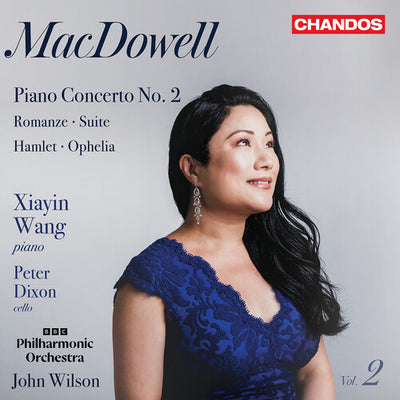
In July 1884, MacDowell and his wife, Marian, spent their honeymoon in England, and were both captivated by performances of Shakespeare plays at London's Lyceum Theatre. The young composer started immediately on sketches based on six characters, but completed only two, Hamlet and Ophelia, which were published the following year. MacDowell recycled some of the music from his sketch for Benedick, from Much Ado about Nothing, as the second movement of his Second Piano Concerto. Having lived in Germany from 1885 to 1888, the couple returned to America and Edward reactivated his career as a concert pianist. The Second Concerto was the perfect vehicle to display his virtuosity, and he gave the first performance in New York in 1889. Composed during the same period as the Second Concerto, the Romanze for Cello and Orchestra was written at Wiesbaden in 1887, and MacDowell dedicated it to the virtuoso Bohemian cellist and composer David Popper. The Suite in A minor was the first work MacDowell composed after the couple's move to Boston, and reflects his lifelong love of nature. Set in five movements, it received it's first performance in 1895 by the Boston Symphony Orchestra under the direction of Emil Paur.
By the time of the ‘Ottocento’ (19th century), opera was the dominant force in Italian musical culture, with bel canto composers such as Rossini and Donizetti creating a public appetite for opera that eclipsed achievements by Italy’s musical sons in other genres. Some of these composers who focused their energies instead on instrumental music, swimming against the operatic tide, remained in their native land, while others found a home (or were forced to find one) abroad.
Giuseppe Martucci (1856-1909) is one who stayed. A gifted pianist, he bypassed the operatic path and wrote music with a kind of fluent synthesis of Italian lyricism and German, dialectic approach to form that reached an early peak in his Cello Sonata of 1880. Yet Martucci, as a teacher of composition in Bologna and then Naples, urged the teenaged Alfredo Casella (1883-1947) to study abroad.
Ildebrando Pizzetti (1880-1968) is among the few composers in this set whose entire career centered in Italy, and he wrote a substantial body of instrumental music.
Before the war and eventual exile, Mario Castelnuovo-Tedesco (1895-1968) succeeded in reinventing an essentially Romantic model (of both form and harmony) for his own time with his Cello Sonata Op. 50 of 1928.
From seven years earlier, Ildebrando Pizzetti’s Sonata of 1921 is a more gloomy, even tortured affair. The Cello Sonata of Francesco Cilea (1866-1950), while unmistakably cast as an ‘operatic’ work from its opening solo, features a protagonist scarcely burdened by the existential angst to be found in comparable works from northern Europe.
Like Cilea, Ermanno Wolf-Ferrari (1876–1948) is known for his operas but unlike Cilea’s cello sonata, Wolf-Ferrari’s Op. 30 dates from the final three years of his life and belongs to a mature output of instrumental music.
Virtuoso cellists Alfredo Piatti (1822-1901) produced many trifles and showpieces to display his artistry to his adoring public in London. He was most proud of the set of six sonatas included in this set. In 1844 he made his first appearance in the English capital and soon settled there, playing both as a soloist and in one of the first celebrity string quartets.
The Cello Sonata by Mario Pilati (1903-1938) is another product of the fast-moving 1920s, formed in a Romantic tradition but inflected – like the music of Casella, Pizzetti, and Castelnuovo-Tedesco – by contemporary trends in impressionism and futurism.
From the next generation of composers, the Cello Sonata composed in 1948 by Eliodoro Sollim (1926-2000) fluently incorporates the kind of modal harmonies and cross-rhythms adopted by the likes of Bartók and Janáček from the folk traditions of their own cultures.
From the song cycle Die schone Mullerin, Op. 25, D. 795 ("The Fair Maid of the Mill"), the eighteenth lied titled Trockne Blumen ("Withered Flowers") served as inspiration for Schubert to compose Introduction and Variations, D. 802 for flute and piano. This piece was written in 1824 for Ferdinand Bogner, a flute professor at the Vienna Conservatory and one of Schubert's friends. Eventually, Bogner became head of the Gesellschaft der osterreichischen Musikfreunde (Austrian Philharmonic Society) and helped organize the premiere of several of Schubert's works. Deeply expressive and lyrical, the version for flute and string quintet in this recording was arranged by Rainer Schottstadt and is a technical tour de force for every flutist.
A Profound Tribute to Reflection and Resilience In the Mirror is an exquisite collection of works by contemporary women composers, masterfully interpreted by cellist Heather Tuach and pianist Yoko Misumi, both members of the celebrated Greenwich Trio. This album is not just a recording-it is an emotional journey born of reflection, healing, and hope. The title piece, composed by Liz Dilnot Johnson, was commissioned specifically for this project, setting the tone for an album steeped in introspection and serenity. The repertoire features original works and new arrangements by renowned composers including Dobrinka Tabakova and Jessie Montgomery, whose contributions enhance the album's contemplative spirit. Each piece carries it's own story, from Jocelyn Morlock's bird-inspired Halcyon to Jennifer Higdon's nocturnal reverie Nocturne. These works are tied together by a shared exploration of human resilience and the quiet strength found in moments of introspection. The project began during the upheaval of the COVID-19 pandemic and became deeply personal for pianist Yoko Misumi, who underwent successful cancer treatment during it's recording. Returning to the piano after her recovery, Misumi found solace and renewal in these compositions, describing the experience as "an emotional and musical healing." Highlights include: · Liz Dilnot Johnson's In the Mirror, a poignant four-movement work dedicated to personal loss and renewal. · Jessie Montgomery's Peace, composed during the pandemic and adapted for cello and piano with the composer's blessing. · Dobrinka Tabakova's Whispered Lullaby, an evocative piece inspired by Goethe's Faust. · Margaret Hubicki's lyrical Lonely Mere, a tribute to the serene landscapes of the Malvern Hills. The album is both a celebration of female creativity and a testament to music's power to comfort and inspire. Listening to In the Mirror is an opportunity to pause, reflect and take in moments of profound calm amidst life's turbulence. This is a must for admirers of contemporary chamber music, fans of women composers, and anyone seeking solace and beauty in music
David Conte's Intimate Voices presents a deeply personal journey through a decade of his chamber music, with works recorded between 2014 and 2024. Celebrating the composer's 70th birthday, this album reflects his belief in the continuity of musical culture, shaped by his studies with the legendary pedagogue Nadia Boulanger. As one of her last students, Conte embraces her wisdom that "true personality in music is only revealed through the deep knowledge of the personalities of others." His compositions resonate with this philosophy, drawing inspiration from past masters while forging his own expressive voice. Highlights include the quietly intense Elegy for Violin and Piano and the dynamic Piano Trio No. 2, whose four movements pay tribute to Erich Korngold, Stephen Sondheim, Frank Martin, and Beethoven. Also featured are the Sonata for Clarinet and Piano, Sonata for French Horn and Piano, and Aria and Fugue for Cello and Piano, each showcasing Conte's mastery of instrumental color and structural clarity. His works seek to engage listeners beyond chronological time, instead creating musical narratives that feel eternal in their emotional depth and artistic intent. Marking his debut on PENTATONE, Intimate Voices is a testament to Conte's evolution as a composer and his deep reverence for the past. Performed by an ensemble of distinguished musicians including Samuel Vargas, Kevin Korth, Emil Miland, Miles Graber, Kevin Rivard, Jerome Simas, Eric Zivian, and Matthew Linaman, this album offers an essential listening experience for lovers of contemporary chamber music.
Brahms, Kahn & Frühling: Trios for Clarinet, Cello & Piano / Quantum Clarinet Trio
Haenssler Classic
CD
$10.49$20.99Save 50%Sep 29, 2023
The human factor determines the path. The Clarinet Trio op. 114 by Johannes Brahms more or less represents the DNA of the Quantum Clarinet Trio, and the piece was one of the driving forces behind the founding of this young chamber ensemble, whose members first met at the Mozarteum University in Salzburg in 2014. At that time, Italian clarinettist Elena Veronesi had been searching for fellow musicians to collaborate in a late work trio, and she found them in the German cellist Johannes Przygodda and Korean pianist Bokyung Kim. What started as a project has now evolved into a permanent ensemble. This great Brahms trio has continued to be a enterprise in which life converges with art.
Cellists, pianists and clarinettists usually come together when a work requires such a constellation, the line-up going their own separate ways once the project is completed. Compared to piano trios or string quartets, these particular instruments unfortunately rarely come together as a fixed ensemble. The Quantum Clarinet Trio is a welcome exception to the rule, making this encounter with one of Brahms' most important works much more than just a "fleeting liaison".
The Greco Brothers & Friends - Works for basse de violon, vi
Challenge Classics
CD
$16.99Feb 06, 2026
This recording takes the listener deep into the heart of late-seventeenth-century Naples, where brothers Rocco and Gaetano Greco were central figures in the city's thriving musical life. Their works, grounded in the practice of partimento - an improvisational method built around a given bass line - showcase the cello's emancipation from a purely accompanying role into a fully expressive solo voice. Through vivid dialogues between lower string instruments and harpsichord, I Mastricelli revives a forgotten musical language in which virtuosity, counterpoint, and improvisation converge. The result is a rare glimpse into the creative processes that shaped the Neapolitan cello school and it's lasting influence across Europe. The second part of the programme focuses on Gaetano Greco's pedagogical legacy, presenting short dances, toccatas, and improvisations drawn from early-eighteenth-century student notebooks, alongside music by Francesco Mancini. I Mastricelli highlights the diversity of Neapolitan musical culture - from the earthy energy of the tarantella to the refined contrapuntal art of the keyboard. The ensemble's instrumentation - including cellos, bass viols, bass violins, theorbo, lute, guitar, and harpsichord - evokes the rich timbral world of Baroque Naples. Combining scholarly research with living performance, this debut album offers both an artistic rediscovery and a celebration of the improvisatory freedom at the core of the partimento tradition.
Edward Hart: Under an Indigo Sky / Charleston Symphony
Navona
CD
$8.49$16.99Save 50%Mar 03, 2023
Edward Hart’s UNDER AN INDIGO SKY features A Charleston Concerto and Under an Indigo Sky, two concertos that celebrate and reflect the history and culture of the Southeastern United States. A native of Charleston SC, Hart finds inspiration in the natural beauty and multicultural heritage of his homeland. A Charleston Concerto was written to commemorate the 350th Anniversary of the City of Charleston; it features a collaboration with the Charleston Symphony and the world-renowned Harlem Quartet. It takes an unflinching yet ultimately hopeful view of the city’s complex history over those three and a half centuries. Under an Indigo Sky for violin and orchestra is a musical love letter written to Hart’s geographical home. It explores both the physical splendor of the mountains and coast, but also the feel and “soul” of these breathtaking places.
On 6 November 2026, Divine Art is thrilled to announce Window to the Stars, it's second release devoted to the highly appealing chamber music of Scottish composer Helen Leach. Window to the Stars follows her hugely successful 2024 debut album Diary of the Bee, and features an acclaimed lineup of artists, including pianist Simon Leach, cellist Adrian Bradbury, clarinettist John Bradbury, and violinist Benedict Holland. A cornucopia of new, imaginative works, Window to the Stars overflows with finely crafted and deeply redolent, sensitive music, with titles set to become classic repertoire. Leach writes: 'Often inspired by the abundance and timeless beauty of the natural world here in Scotland' Window to the Stars combines lush 'romantic lyricism, bursts of harmonic colour with evocative textures. At times majestic and dramatic, elsewhere infused with deep peace and moments of lightheartedness, the music reflects my own inner world'. 'Out of the Depths', the tender and poignant opening work for solo cello, is followed by two pieces transporting us to the wild and beautiful Scottish landscape: 'As the Feet of a Deer', a rich, expressive, earthen combination of clarinet, cello, and piano, conveying the stag's nobility and physicality, and 'Wherever I Wander', which is inspired by Robert Burns' poetry, begins with a simple folk melody, rhapsodic in it's nostalgia for a treasured homeland, and ends softly with a sense of sublime peace. 'When the Seasons Danced' also reflects the natural world, taking the listener through the seasons and landscapes and ending with the dreamy movement that gives the album it's title, 'Winter: Window to the Stars', which leaves a sense of wonder with distant echoes of Christmas bells. 'The Dove of Peace', for clarinet, violin, cello, and piano, is a tribute to the beautiful, spiritual musical language of Messiaen's 'Quatuor pour la fin du temps', articulating our need for peace. 'Hommage a Edgar Degas' celebrates an artist beloved among musicians and dancers alike through melodic lines, musical gestures, and vivid colours reflecting the forms and movements of Degas' works. The uplifting and deeply spiritual 'Butterfly Garden draws on the inherent ethereal nature of the clarinet, while the expansive melody and undulating accompaniment of 'Prelude for a Royal Swan' for cello and piano seek to portray the beauty, dignity, and unwavering commitment of England's late Queen. Hallmarked with vivid storytelling and melodic strength, the distinctive compositional voice of Helen Leach is becoming increasingly regarded internationally, with the music of her Divine Art 2024 debut album Diary of the Bee being regularly broadcast on the airwaves around the world. Helen has a background as a clarinettist and church musician and was Principal Clarinet with the National Youth Orchestra of Scotland, going on to study at the Royal Northern College of Music. She was a Director of Worship in Manchester and there directed the music for live BBC Radio 4 broadcasts. In 2022, she became Composer-in-Residence at Marchmont House, Berwickshire, and the historic Lorimer Music Room. Helen works with the BBC Songs of Praise team, and since 2024 has conducted and arranged the ensemble music for the annual BBC Young Chorister of the Year event with Aled Jones.
With Improvised Bach, cellist Víctor García García invites listeners into the living, breathing world of Johann Sebastian Bach, where composition, performance and improvisation were once inseparable arts. Centred around Bach's Partita No. 1 for Solo Violin-performed here in a rare historical cello transcription-the album reimagines the composer's music through newly improvised preludes, doubles and ornamented repeats, all rooted in Bach's original harmonic language while revealing fresh expressive possibilities. In 2024 Victor was awarded First Prize at the Bach International Competition in Leipzig. He is a Professor of Historical Cello at the HKU Utrecht Conservatorium and also in Scotland's St. Andrews University. Research is an important part of his work besides his musicianship. Rather than treating Bach's masterpieces as untouchable monuments, Victor García García approaches them as a vibrant musical language that continues to evolve in performance.. Drawing inspiration from eighteenth-century improvisational practice, each improvised piece becomes a musical dialogue across three centuries, capturing the spontaneity of the moment while remaining deeply faithful to Bach's style. The result is a compelling recording gives listeners the opportunity to hear familiar works with renewed curiosity, imagination and wonder.