After his latest recording, devoted to Bach's Sonatas and Partitas in his own arrangement, Franz Halasz returns to Spanish music with this recital devoted to Federico Moreno Torroba. The composer of many of the best-known zarzuelas, Moreno Torroba did not initially seem destined to specialise in guitar music. It was his symphonic poems that caught the attention of the legendary guitarist Andres Segovia, who commissioned Moreno Torroba's first compositions for guitar despite the composer's unfamiliarity with the instrument. The compositions gathered here showcase a composer who, although deeply rooted in the Spanish musical tradition, was attuned to what was being done elsewhere, including the music of Claude Debussy and Igor Stravinsky, and who created a personal language marked by impressionism that would later influence guitar music throughout the twentieth century, from Heitor Villa-Lobos to Leo Brouwer. The winner of a Latin Grammy, Franz Halasz is a highly acclaimed guitarist who has himself contributed to the repertoire of his instrument by making arrangements of Manuel de Falla and Isaac Albeniz. On a guitar built in 1936 by the legendary luthier Hermann Hauser, Halasz turns the instrument into a multi-faceted prism through which the musician can 'break the light of music' into orchestral sound, in the words of Segovia.
Daniel Rieppel, a native of Minnesota of Austro-Hungarian descent, performs Mozart’s Fantasy and Sonata in C minor, the Piano Variations of Aaron Copland and Symphonic Etudes by Robert Schumann. Dr. Rieppel performs widely in North and South America and Europe (most recently in Iceland) and has been Professor of Music at Southwest Minnesota State University for over a quarter century. He has international recognition for his research into Schubert’s incomplete sonatas, finishing several that will be the subject of his next recording.
Morricone: Cinema Rarities / Serino, Orchestra di Padova e del Veneto
Arcana
CD
$20.99Oct 06, 2023
The idea for this album came about during the recording of its predecessor Cinema Suites (BBC Music Magazine’s “Screen Choice”, Album of the Week on WDR3 etc.), when the Morricone family sent Marco Serino a number of rarities that they hoped could also be recorded, particularly “Dedicated to Maria” (from the film The Sleeping Wife) that the composer had dedicated to his wife. These works, along with others that Serino rediscovered in his own archives, make up the backbone of Cinema Rarities, an ideal sequel to the previous recording.
After twenty years as Ennio Morricone’s chosen violinist, Serino continues his exploration of the compositions for violin and orchestra, but this time with a particular focus on pieces that, besides being less well known to the wider public, all share a degree of “Italianness”.
The main nucleus of the program consists of three suites named after three Italian film directors (Silvano Agosti, Mauro Bolognini and the Taviani brothers), with whom Morricone worked closely. Although the respective films did not achieve the international acclaim of those directed by Sergio Leone or Giuseppe Tornatore, which featured in the previous recording, they inspired the composer to come up with new and distinctive solutions, such as “Love Remembered” from The Inheritance, considered by Marco Serino to be one of the most beautiful.
Equally quintessentially Italian are the two extracts from the scores for The Lady Caliph directed by Alberto Bevilacqua, including the lovely “Nocturne” and the brief “Quasi un Vivaldi” (from Sergio Sollima’s film Revolver), which herald by almost a decade remakes like Gian Piero Reverberi’s Rondò Veneziano. A unique place is occupied by Four Adagios, a collection of four pieces chosen by the composer himself (including the iconic “Whoever” and “Deborah’s Theme”), which in this arrangement for violin cites the main theme of the first movement of the Beethoven Concerto. Dedicated to Serino and performed worldwide under the baton of Morricone, Four Adagios speaks to the artistic partnership between composer and violinist, their mutual professional respect and deep friendship.
What does it mean for Schumann's Kreisleriana to be Romantic? Is it the violent contrasts, the mercurial shifts in mood, the fragmentary architecture, the raw and unfiltered expression? Is it the breathtaking lyricism? Or is it the spectre of the tormented kapellmeister Kreisler haunting this work that dissolves the boundaries between music, literature, and psychological portraiture? Acclaimed virtuoso Paolo Giacometti brings both poetry and psychoanalysis to Kreisleriana and Kinderszenen, performing them on a resplendent 1838 E´rard born in the very year these works first saw the light.
In this new recording of contemporary works for saxophone and piano, Max Goldberg and Annabel Thwaite present a programme of contemporary works by European, American and Australian composers, including the world premiere recording of Welsh composer Edward-Rhys Harry's The Ballad of Lady Barham, the philanthropist who established schools and churches in the Gower peninsula through her own funding. Max Goldberg demonstrates the lyrical and expressive qualities of the saxophone as a solo instrument throughout this recording.
The city of Petersburg has a complex history, merging diverse cultural influences into a distinct profile. The forces generated amid the constant interplay of repression and the yearning for freedom find expression in experimentation. This led the Günter-Kim duo to explore the cosmopolitan city in search of traces. In the process, the cello-piano duo has discovered various compositions related to Dmitri Shostakovich: Boris Goltz, Galina Ustvolskaya, Boris Arapov… and, as a world premiere recording, Leonid Gorokhov. The duo's arrangements of Shostakovich's Spanish and Jewish songs symbolize a thoughtful approach to foreign cultures. This stands in stark contrast to the current somber reality: Petersburg, once the gateway to Europe, is on the brink of closing itself off.
Gian Francesco Malipiero (1882-1973) approached the piano with a sense of expressive freedom, avoiding the conventions of pure virtuosity and preferring a more intimate and reflective language. His piano pieces range from lyrical miniatures to more complex works, in which influences can be recognized from Italian early music to the modernity of Debussy, Casella, Stravinsky and Scriabin. Alessandro Riccardi has programmed a sequence of pieces written during the 1900s and 1910s. They evoke a creative laboratory, where harmonic experimentation and the search for new expressive forms intertwine with a deep respect for the past. From 1905, the 6 Morceaux represent the first expression of Malipiero's compositional personality, where modal influences intersect with late 19th-century trends. Published in 1910, the Tre danze antiche represent Malipiero the assiduous antiquarian, the reviver and transcriber of his 17th-century forebears such as Monteverdi and Gabrieli. The quartet of Preludi autunnali were composed in Venice in September 1914 and foreshadow a period of 'perpetual tragedy' in the composer's music caused by the outbreak of World War I. As Malipiero wrote in 1952: "Their melancholy is perhaps the effect of the war just begun and not yet felt." Those effects are further amplified in Maschere che passano from 1918, a 10-minute quintet of oblique sketches, presenting high contrasts: mysterious, violent, distant, Malipiero at his most late-Debussyan. In 1920 he then wrote a heartfelt homage to Debussy, followed by 'Three Homages', which undercut the solemnity of their title by being dedicated successively to a parrot, an elephant and 'an idiot'. Throughout the album, marking Alessandro Riccardi's debut on Piano Classics, the piano becomes an instrument for personal introspection and sonic exploration, while maintaining a strong connection to Italian tradition and, at the same time, looking into the future. - Gian Francesco Malipiero was an Italian composer whose piano works reflect his unique approach to musical expression, blending tradition and modernity. Known for rejecting the rigid structures of classical forms, Malipiero sought to evoke pure emotion and a sense of mystery in his music, often drawing on Italian folk traditions and Renaissance polyphony. His piano compositions are characterized by their lyrical qualities, rich textures, and distinctive harmonic language. - Malipiero's piano output includes several collections, each showing his innovative yet deeply Italian aesthetic. Among his notable works are the Preludi autunnali (Autumnal Preludes), a series of poetic and introspective pieces imbued with melancholic beauty. These works often feature modal harmonies and unexpected shifts in tonality, reflecting his quest to free music from the constraints of conventional Romanticism. - Other works on this new recording are the Maschere que passano, Omaggi, Six Morceaux, and 3 Danze Antiche. These pieces are deeply atmospheric, blending delicate, impressionistic passages with moments of stark drama. Malipiero's piano music often eschews virtuosic display in favor of expressive depth, demanding a nuanced and sensitive touch from the performer. - Alessandro Riccardi is one of the most remarkable young pianists of his generation. His CDs with works by Scriabin and Liszt received several 5-star reviews in the international press.
Mezzo-soprano Hermine May and pianist Manuel Lange invite you into Wagner's world of Tristan and Isolde where insatiable yearnings are awakened, passions heightened and where the fervent desire to transcend reality finds supreme love beyond death in Liebestod.
To mark the 120th anniversary of Estonia's national composer Eduard Tubin, this exuberant chamber music programme, including two world premiere recordings, traces Tubin's life, which is clearly marked by the dramatic upheavals of the 20th century. Early works side by side with late compositions show deep insights into the artist's soul - we hear his inner struggles, his development and his joys in top-class interpretations by pianist Kart Ruubel and her twin sister Triin, violin, as well as Xandi van Dijk, viola and Theodor Sink, cello.
Part of the British Music Society series, this work presents Grace Williams’ songs and folk-song arrangements in world premiere recordings. The acclaimed Welsh baritone Jeremy Huw Williams is accompanied by the Australian pianist and composer Wendy Hiscocks.
Although he had famous students (i.e. Szymanowski) and teachers (Moniuszko), few listeners know much, if anything, about Zygmunt Noskowski. And yet, for most of the 19th century, he was the primary exponent of modern symphonic music in Poland. His Third Symphony and his symphonic poem Steppe, Op. 66 blend sweeping Romanticism with Polish folk spirit. The symphony's seasonal journey is lush and lyrical, starting with spring and ending with the optimistic outlook to the next. Steppe evokes Poland's vast landscapes with Borodinesque colors. Under Antoni Wit, these overlooked gems shine anew and make for intriguing listening for lovers of melodic symphonic music.
Engelbert Humperdinck's music for the pantomime of Karl Gustav Vollmoeller's arguably most important stage work impresses with it's deeply Romantic sound and large-scale choral scenes and had so far led an unforgivable shadowy existence in the composer's oeuvre. Premiered in London in 1911, none other than Max Reinhardt adapted this work for film (1912) and staged numerous performances with hundreds of actors, singers, and dancers - finally also at the Salzburg Festival in 1925. This recording represents the first complete recording of this deeply Romantic masterpiece.
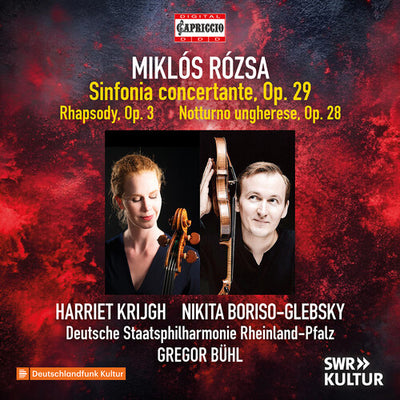
This release further explores the rarely performed or recorded concert music of Miklos Rozsa (of Ben Hur fame), coupling his Rhapsody for Cello in which the young composer truly found his style, his Notturno Ungherese ("a nostalgic night piece, harking back to the memories of my childhood in Hungary"), and the late Sinfonia concertante for violin and cello, a fiendishly difficult violin-cello double concerto that is among Rozsa's finest, least film-music-like concert works - and one of his most underrated. Gregor Piatigorsky and Jascha Heifetz, who instigated it's composition, never ended up playing it, but Harriet Krijgh and Nikita Boriso-Glebsky certainly do.
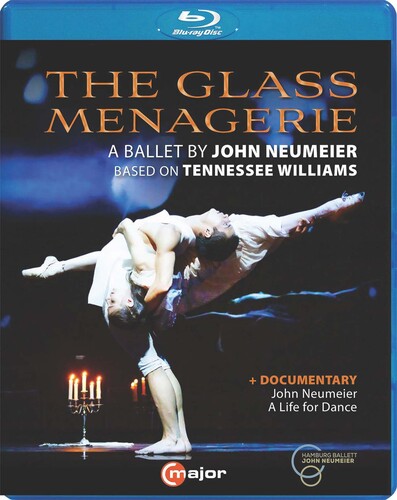
Discover the brilliance of the iconic John Neumeier in this captivating double feature. The Glass Menagerie, inspired by Tennessee Williams' poignant drama, showcases Neumeier's extraordinary talent for storytelling through movement. At the center of this production is renowned ballet dancer Alina Cojocaru, who inspired John Neumeier to create the piece. Together with the acclaimed Hamburg Ballet, she delivers a performance that dances on the heartstrings and lingers in the soul. Complementing this masterpiece is John Neumeier - A Life for Dance, Andreas Morell's intimate documentary that offers a glimpse into the passion and vision of one of the greatest choreographers of our time. This edition is a must-have for dance enthusiasts and lovers of profound artistic expression.
Discover the brilliance of the iconic John Neumeier in this captivating double feature. The Glass Menagerie, inspired by Tennessee Williams' poignant drama, showcases Neumeier's extraordinary talent for storytelling through movement. At the center of this production is renowned ballet dancer Alina Cojocaru, who inspired John Neumeier to create the piece. Together with the acclaimed Hamburg Ballet, she delivers a performance that dances on the heartstrings and lingers in the soul. Complementing this masterpiece is John Neumeier - A Life for Dance, Andreas Morell's intimate documentary that offers a glimpse into the passion and vision of one of the greatest choreographers of our time. This edition is a must-have for dance enthusiasts and lovers of profound artistic expression.
Acclaimed concert violinist Rachel Barton Pine, sought-after pianist Orion Weiss, and the multiple Grammy Award-winning Pacifica Quartet join forces for their new album French Impressions: Chamber Music by Chausson & Tailleferre, celebrating transformational works by French composers Ernest Chausson and Germaine Tailleferre, whose chamber music deserves greater attention on recordings. Chausson's Op. 21 sextet, titled Concert, known for it's unusual orchestration of solo violin, string quartet, and piano, takes advantage of the quasi-orchestral capabilities of a chamber ensemble. The only work on the album featuring Rachel Barton Pine, Pacifica Quartet, and Orion Weiss as a collective, Concert is regarded as one of the most important French chamber music works of the late-19th-century fin-de-siecle era. Germaine Tailleferre was a prolific composer and the only female member of the group of celebrated 20th-century French composers known as Les Six. Tailleferre was a piano prodigy who enrolled at the Paris Conservatoire at age 12, defying her father's objections. Her compositions span symphonic, chamber, and film music. A winner of numerous premiere prix, she studied with revered composers including Maurice Ravel, whose work significantly influenced her versatile style. Violinist Rachel Barton Pine showcases her "astonishing and joyful" (Washington Post) artistry, alongside the "powerful technique and exceptional insight" (Washington Post) of pianist Orion Weiss for Tailleferre's Violin Sonata No. 2, Pastorale, and Berceuse for Violin and Piano - works that often express a nostalgic longing for home and display dynamic and adventurous interplay between the violin and piano. The Pacifica Quartet, known for it's "remarkable expressive range and tonal beauty" (New York Times), is featured on Tailleferre's String Quartet, a piece acclaimed for it's playful themes, fluid accompanimental figuration, and bold harmonies.
This further edition to Steffen Schleiermacher's Eisler anthology once again provides insights into an exciting composer's life that still receives far too little attention today. With his differentiated palette of expression and affinity for nuance, Schleiermacher is a master interpreter of Eisler's original, often surprising aesthetics encompassing an extremely wide variety of musical styles.
The development of an original classical repertoire for the accordion began with Mogens Ellegaard in his native Denmark and his student, the Scot Owen Murray, in the UK. In 1976 Ellegaard gave the first broadcast performance of Gordon Jacob's pastoral, elegant concerto, which treats the accordion almost as a chamber organ. A generation and more later, two concertos written for Owen Murray open out the possibilities of the accordion much more adventurously, exploiting it's extraordinary range of colour, it's striking range of expression and it's mercurial ability to weave through orchestral textures.
Rózsa: Orchestral Works / Bühl, Deutsche Staatsphilharmonie Rheinland-Pfalz
Capriccio
CD
$21.99Jan 05, 2024
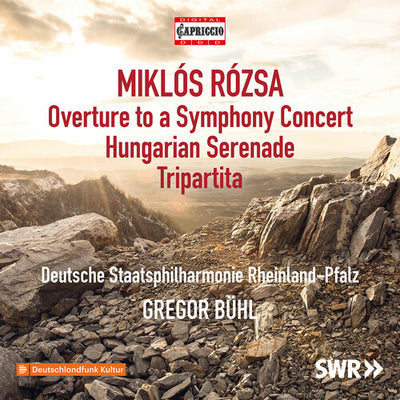
Miklós Rózsa feared that success as a film composer might overshadow his reputation as a composer of classical concert fare. He was right. Three Oscars and 17 Academy Award nominations tends to do that. The two worlds were strangely incompatible and forced Rózsa into what he called his “Double Life” – the title of both a film for which he won an Oscar and that of his autobiography. The three orchestral works presented here, from his early, middle and late phases, provide a charming introduction to his alternative side.
REVIEW:
Works like the ones on this album ought to appeal to lovers of any of Rosza’s many film scores; the musical language is not that far off. The orchestra, an underrated regional group, gives crisp performances under conductor Gregor Bühl on a release that should appeal to both film buffs and fans of 20th century music generally.
Alinde Quintet - a new star in the chamber music heavens At the prestigious ARD Competition in Munich in 2024, the Alinde Quintet emerged as a dazzling new star on the chamber music scene. By that time, they had already earned several notable prizes in London, Copenhagen, and beyond. The players are closely associated with leading Czech and international orchestras, including the Czech Philharmonic, the Gustav Mahler Jugendorchester, the BBC Symphony Orchestra, and the Royal Philharmonic Orchestra. On their debut album, the quintet presents the intimate "inscapes" of four composers. In the works of Haas and Shostakovich, the shadow of war and Nazi ideology casts a profound, even fatal shadow on their inscapes, while Shostakovich and Jan Novak also ran into conflict with Communist dictatorships. Yet all of the compositions reflect distinct personal inscapes, offering glimpses into the lives of their creators. Haas's imaginative quintet bears the unmistakable imprint of his teacher Leos Janacek, who had died just months before the work's completion. Shostakovich's Eighth String Quartet (arranged by Mark A. Popkin) serves as both autobiography and elegy - a dark, haunting inscape tinged with drama. In Peteris Vasks's composition, an ancient Latvian funeral song intertwines with virtuosic passages and aleatoric sections, evoking the heartrending loss of a kindred spirit. Like a contrasting colour on a canvas, the Concertino by Jan Novak brings the album infectious joy, playfulness, and jazzy rhythms, lending radiant colouring to the composer's inscape, which could not be obscured even by the dark clouds of Czechoslovakia's totalitarian regime of the 1950s. Throughout the album, the Alinde Quintet draws on the full spectrum of colours their instruments can offer, vividly painting each composer's inscape.
Casella, Mule, Respighi & Pizzetti: Music for Cello & Piano / Trainini, Pontoriero
Tactus
CD
$21.99May 03, 2024
A cross-section of the Italian production for cello and piano, conceived during the hazy beginning of the twentieth century, shows us how the most varied influences – coming from all sorts of styles: Gregorian, Monteverdi, operatic, German and French late-romantic, avant-gardist, Franco-Russian impressionist, French symbolist, veristic – are absorbed and remoulded, accepted and rejected, by various personalities of the world of composition. In this cultural ambience, a crucial role was played by the so-called Generation of Eighteen-Eighty, whose components, Casella, Malipiero, Pizzetti, Respighi, friends and collaborators, stood out for their pursuit of innovation and their aim to create a character peculiar to Italian music; this quest was accompanied, at least in their artistic choices, by a certain lack of political commitment. Within this recording, cellist Roberto Trainini and pianist Stella Ala Luce Pontoriero are delivering an anthology of precious musical gems as necessary testimony to the great value of some obscured and forgotten Italian early twentieth century repertoire.
The virtuosic Supraphon debut of Jan Schulmeister So far, the career of the Czech pianist Jan Schulmeister has been distinguished by victories at dozens of international competitions (including the 2019 Cesar Franck Piano Competition in Belgium, the 2021 North International Music Competition in Sweden, and the 2022 Manhattan International Competition in the USA), to which he added Third Prize at the prestigious Cliburn Junior Competition (Dallas, USA) in 2023 at 17 years of age. For his Supraphon debut, he has chosen works of the late 19th century by Russian composers, music that is firmly grounded in the national tradition but that often seeks out and remains open to stimuli from the surrounding world. The oldest of them, Mussorgsky, was a loner without any depth of academic training, but he greatly advanced the boundaries of musical expression. In Pictures at an Exhibition, he accompanies listeners at an imaginary exhibition of paintings by his late friend, the painter and architect Viktor Hartmann. Rachmaninoff wrote his lovely cycle of piano pieces Moments musicaux under time pressure while facing a profound existential and creative crisis. His classmate Scriabin, no less brilliant a pianist, chose the path of a visionary and an experimenter as a composer, as we can hear from an early opus he wrote for piano (at age 16), the Etude in C sharp minor, Op. 2, No. 1. His later Five Preludes, Op. 16 (1895) reflect the omnipresent Impressionism of Paris at the end of the century. In this repertoire, Jan Schulmeister can demonstrate all of his qualities - virtuosic technique and depth of musical feeling.
John Ireland is widely regarded as one of the greatest British composers of the twentieth century. His contribution to the piano solo repertoire is of great significance. This album, performed by award-winning pianist Rebeca Omordia, is an exploration of John Ireland's piano music composed over a period of almost forty years. His distinctly English yet individualistic musical style is reflected in works bearing evocative titles that reveal Ireland's deep connection to landscapes and literature, creating a unique sound world. The release includes Decorations, published in 1915, as the earliest pieces; the substantial Piano Sonata in E minor (1920), described by Lisa Hardy in her book as "the outstanding example of all British piano sonatas"; the large-scale Sarnia: An Island Sequence (1940-41); and Columbine, the last piano piece he wrote, from 1951.
A unique and imaginative collection newly recorded by a recent star of the Van Cliburn Piano Competition. Anna Geniushene’s fresh; layered; and powerful interpretations won her a worldwide following at the 2022 edition of the Van Cliburn International Piano Competition; where she took Silver Medal with a stunning account of Tchaikovsky’s First Piano Concerto which the critic for Gramophone compared in its power and nuance to Van Cliburn himself.
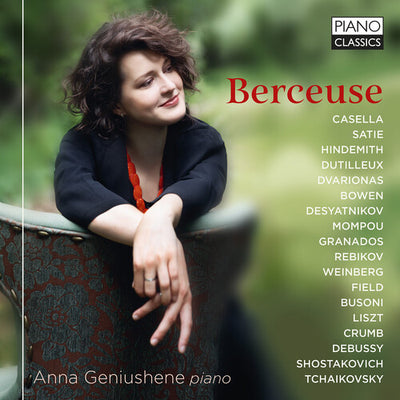
Born in Moscow; Anna Geniushene pursued graduate studies in London and now lives in Lithuania with her husband; the pianist Lukas Geniusas. In her own booklet introduction; she explains the inspiration for this quirky collection of instrumental lullabies. The Berceuse is ‘associated with tenderness; care; purest love; and the most sensitive moments in our lives.’ She dedicates the album to her two young sons. Perhaps the most celebrated Berceuse of all; by Chopin; is missing; because it was Anna Geniushene’s particular wish to find and share neglected examples of the genre; even by well-known composers. Debussy composed the Berceuse heroique during the First World War as a tribute to the soldiers on the Western Front. The Berceuse Elegiaque of Busoni is better known in its orchestral guise. The brief Berceuse by Hindemith; unpublished in his lifetime; ‘draws listeners’ attention by its utterly eloquent and typically sarcastic character; which has nothing in common with traditional lullabies.’ The sheer diversity of composers makes for a continually varied sequence. George Crumb evokes a magical night-time stillness with a minimum of notes. Mompou’s Berceuse is likewise remarkable for its distilled serenity; whereas the examples by Granados; John Field and Liszt bring comfort with more Romantically moulded melodies in the tradition of Chopin. Anna Geniushene closes the album with two Russian Berceuses; by Shostakovich and Tchaikovsky; lyrical; simple and utterly beguiling in her hands.
A wide-ranging introduction to the distinctive compositional voice of Amy Beach through her solo piano music, featuring both well-known and unfamiliar pieces. While Amy Beach is now among the best-known female composers of classical music history, her story becomes more remarkable as details of it are disseminated. The pianist Mark Viner introduces her life and music in a detailed but approachable essay to accompany this new recording of her piano music on Piano Classics. She was essentially self-taught, and a prodigy to match any previous celebrated male examples, at least in technica l terms. She translated Berlioz's treatise on orchestration in order to use it herself. She became a formidably accomplished pianist in her own right, but was then prevented from giving more than two recitals a year by her husband. Beach continued to compose, however, and steadly so through the last decade of the 19th century and well into the 20th. The earliest piece on Martina Frezzotti's recital is also one of her most familiar, the nocturne Dreaming from 1892, in which she emulates a Chopin model with piano writing that's deceptively simple on the page but uniquely haunting on the ear. The album's most substantial work is the 25-minute Variations on Balkan Themes, from 1904. The four themes in question were passed on to her by a missionary to the region, and the piece amounts to a proud cry for Serbian nationalism in the post-Lisztian style. Through it's course, Beach writes in the style of a barcarolle, a parlour waltz, a funeral march, a Hungarian dance and much more, weaving together her material with a sure hand. Beach's own skill as a pianist surely contributes to the soft tonal shades she conjures in her transcription of Richard Strauss's song Ständchen. She also explored the possibilities of making accurate musical transcriptions of birdsong decades before Olivier Messiaen did so, and her most celebrated work in this vein is the achingly beautiful Hermit-Thrush at Eve from 1922. Martina Frezzotti's album of Fanny Mendelssohn for Piano Classics (PCL10238) won enthusiastic praise from David Hurwitz on a video review for Classics Today. According to pianodao. Com (Andrew Eales), 'Frezzotti proves a brilliant advocate for these pieces in this recording, combining a poetic sensibility with the necessary weight and flair to showcase the more dazzling elements of Mendelssohn's piano writing. The recording is bright, reverberant and luminous.
There was no more unprejudiced or enthusiastic promoter of Danish music than Thomas Jensen. Twelve composers are featured here, in styles ranging from Romantic ballet to modernist oratorio. Nearly all the recordings are issued for the first time ever since they were originally broadcast. Taken together, they present a panoramic picture of Danish music in the 19th and 20th centuries.
The two works recorded on this disc both come from a creative period at the beginning of the 1930s. In terms of style, with his works linked to basic tonalities, Weigl drew on the sound realm of late Romanticism, from whose aesthetics he never departed in favour of more progressive contemporary trends. Weigl’s knack for orchestration shows both in the hymnic climaxes as well as the chamber music-like passages. Weigl never lived to hear any performances of either his Third Symphony or the Symphonic Prelude. Like so many of his larger works, these scores were not (re-)discovered until interest in Weigl’s music resurged decades later. This release allows audiences to hear both works for the first time on record.
REVIEW:
Stylistically, the pieces clearly show Weigl’s own voice, even as they remain close to the late-Romantic symphonic style.
The symphony's rich palette of development and treatment leads from intimate moments of chamber music to grand climaxes. The large orchestration of the Symphonic Prelude indicates that it was intended for the concert hall rather than as incidental music. Overall, the works remain rooted in traditional sounds.
Weigl was unable to experience performances of these works. The new interest in his music is also reflected in these premiere recordings. The Deutsche Staatsphilharmonie Rheinland-Pfalz and conductor Jürgen Bruns illuminate these works with successful commitment.
The latest instalment in this popular series focuses on the life and music of Russian composer Modest Mussorgsky. Illustrated with some of Mussorgsky’s finest works the biographical narrative includes excerpts from Songs and Dances of Death; Boris Godunov; Night on Bald Mountain and Pictures at an Exhibition.
The piano duos presented here, all drawn from the mid-20th century, have their inspiration in dance or ballet: but thankfully, that red flag for program music - is it a hopeless prisoner of a storyline or visual narrative? - shows no sign of rising. All three works stand majestically on their own: Rachmaninoff's autumnal self-eulogy, The Symphonic Dances, Barber's Souvenirs, a whimsical collage of the Gilded Era ballroom, and Piazzolla's Tango for Two Pianos (arr. P. Ziegler). And, in the case of Piazzolla, we witness the tango, as it moves from the cafe to the concert hall, shedding the strictures of dance itself.