This is pianist Nelson Goerner’s twelfth recording for the Alpha Classics label. He devotes his new album to the solo piano works of Franz Liszt, with the famous Sonata in B minor as the centrepiece, nearly twenty years after his first CD of the sonata, he felt the urge to re-record it, following a series of critically acclaimed concerts. His talents as a storyteller and as a virtuoso with an eye for nuance are heard to marvellous effect in this monumental work, a veritable ‘musical action’ that undoubtedly belongs in the pantheon of the finest literature for piano. The programme is completed by excerpts from Liszt’s major cycles, including the Petrarch Sonnets from the Années de pèlerinage and the Hungarian Rhapsody No. 6, along with the spectacular concert étude La leggierezza.
REVIEWS:
Nelson Goerner made an excellent studio recording of Liszt’s Sonata in B minor that the Cascavelle label first released in 2007. This live all-Liszt recital from 2023 also features the Sonata. Although it benefits from fuller-bodied engineering, the interpretation offers surprisingly little change in regard to overall design, substance, and execution. Goerner’s tempo relationships remain judicious and unified, while themes are characterized with subtle yet telling contrast.
Forced to choose, I’d favor Goerner’s diversified voicings and greater dynamic projection in the remake’s Andante sostenuto. On the other hand, the earlier Allegro Energico fughetta gathers greater spontaneous momentum, followed by a more incisive yet less grand recapitulation. One could argue that there are fewer distinctly individual touches here in comparison with recent reference-worthy interpretations by Marc-André Hamelin, Benjamin Grosvenor, Joseph Moog, or Giovanni Bertolazzi. Yet that hardly matters, given Goerner’s intelligent mastery and total identification with the score.
If anything, Goerner’s readings of Liszt’s three Petrarca Sonetti offer even more fervent and poetic melodic projection, together with mellifluous legato chord voicings and prominent bass lines. If no one alive plays La Leggierzza with the feathery aplomb of Benno Moiseiwitsch’s unrivaled 1941 HMV recording, Goerner’s impassioned mobility comes pretty darn close to that paradigm, although he never plays softly enough when required.
Lightness and insouciance, however abound in the Valse oubliée No. 2. Goerner takes his sweet time over the Hungarian Rhapsody No. 6’s introduction, milking the music’s bardic implications without lapsing into vulgarity. Most pianists understandably treat the friska section as a high-wire right hand octave etude: think Horowitz, Cziffra, and Argerich. Goerner nails the notes, of course, yet presents both hands as equal partners, letting you hear a piano composition instead of a piano competition. I have no hesitation recommending such a satisfying and well-rounded Liszt program.
A new album on GENUIN from the internationally performing pianist Sophia Weidemann! A prizewinner at numerous international competitions, she thrilled both critics and audiences with her album of works by Fanny Hensel. Now she follows up with a recording devoted to Bach: the program features the world-famous Goldberg Variations, which show off the phrasing and tonal artistry of this young pianist from Swabia to brilliant effect. She takes her listeners on an exciting and moving journey through the 30 variations - a work in which, for Bach, an entire world is contained. To quote the composer himself: "A most joyful delight for the soul!"
J.S. Bach's first Clavier-ubung - the Partitas - is an important work which holds a particular status: it is the first major publication by a great musician at the height of his maturity - he was 46 - and already a living legend. A large part of the challenge it poses can be found in this contradiction; that a hurdle must give the impression of ease. Art must conceal art itself. My intention was to play them as I would wish to hear them, such as I thought they might be heard: here then is a proposal. And if this proposal incites a desire to delve further, my goal will have been achieved.
Aaron Pilsan completes his recording of the Well-Tempered Clavier, five years after the first volume was praised by critics for it's ardent, accurate and fluid interpretation. Twenty years lie between the two volumes; whilst the first is better known, 'the second book is more playful, but also more accomplished. It goes further harmonically and also demonstrates extraordinary harmonic invention with original and often exotic harmonies. The best example of what differentiates the two books is the fugue in D sharp minor in the second book, a piece whose boldness and harmonic originality never ceases to enthral and astonish me,' says the Austrian pianist, who again demonstrates his fascination for the composer: 'What I love most about Bach's music is that he expresses everything that goes to make up our lives, but in perfect order.'
Vox Luminis has teamed up with the Freiburger Barockorchester again, and together they celebrate music for Ascension Day. This topic inspired great composers such as Johann Sebastian Bach, four of whose Ascension cantatas have been preserved. The festive and colourful Cantata BWV 128 was composed towards the end of Bach’s second year in Leipzig. The Ascension Oratorio BWV 11 was written for larger forces and ends with a triumphant chorus. In the case of Georg Philipp Telemann, more than thirty cantatas for Ascension Day alone have survived. The cantata Ich fahre auf zu meinem Vater (I ascend unto my Father) was composed in 1721. Lionel Meunier’s ensemble and the FBO give a fervent rendering of this captivating music with its texts focusing on the afterlife.
Chopin, Scriabin & Yashiro: 72 Preludes / Mao Fujita
Sony Masterworks
CD
$23.98Oct 18, 2024
Mao Fujita follows up his 'acclaimed' debut album on Sony Classical, the complete Mozart Piano Sonatas, with a similarly ambitious recording project, 'Preludes'; three complete sets of 24 preludes by Chopin, Scriabin, and 20th century Japanese composer Akio Yashiro. This album represents a fascinating exploration of three different but intricately connected worlds, each full of poetic diversity, volcanic energy and atmospheric stillness. Each of these three sets are in perfect symmetry with each other, each containing 24 short preludes, one for each major and minor key. But it is Chopin's preludes that form the axis around which these other two sets of preludes orbit. Chopin's Preludes, Op. 28 (1839) broke all expectations of the term 'prelude', elevating the form from small, often-improvised, introductory pieces to singular works in their own right, and in this Op. 28 set, presented as a spinning constellation of self-contained ideas and emotions, and some of the most enduring and loved piano pieces in the repertoire. Scriabin's Preludes, Op. 11 (1888-96) echo Chopin's set in so many ways - the number of preludes, the ordering of the keys, the concept of the prelude as a short, but significant work - but is certainly no copy, rather more a descendant, an extension, hyper expressive, each prelude an intricate miniature world of it's own. The third set of preludes is perhaps the most intriguing. A world premier recording of the 24 Preludes (1945) by Japanese composer Akio Yashiro. Taking Chopin's model even further, Yashiro creates a highly idiomatic and original work, written when only 15 years old. This is the most personal work on the album for Mao Fujita, with a relationship to the composer's widow, and presenting the work for the first time as a commercial studio recording. Or as Mao puts it, "the Chopin and the Scriabin are the fish and the rice, the base, but the Yashiro is the wasabi, just as vital, and that special kick to create something delicious."
Hardly any other event during Mozart Week has remained so vividly in visitors' memories as the 1994 production of Ombra felice. Mozart's creative excess in the field of opera is evident not only in fragments of stage works such as Zaide KV 344, L'oca del Cairo KV 422 and Lo sposo deluso KV 430, but also in the more than seventy arias and ensembles he composed as individual works. Some of these are abandoned or unfinished drafts, as Mozart's singers (or sometimes Mozart himself) were not entirely satisfied with them, while others were contributions to foreign opera productions, which were often performed in the form of pasticcios at that time. This broad compilation thus provides a good overview of Mozart's aria compositions.
The large-scale Bach Organ Landscapes project featuring J.S. Bach's entire organ oeuvre recorded on a range of instruments aims to provide an overview of organ-playing and organ-building traditions that were key to Bach's composing. With a keen eye to the unique cultural organ legacy of the places associated with Bach, Halubek has placed Bach's original sound at the heart of his project. The recordings are accompanied by digital material that offer an almost tactile access to the great composer's sound universe.
Whereas Prokofiev was captivated by Romeo and Juliet, Ravel had shut himself away a quarter of a century earlier in Levallois Perret to compose Gaspard de la nuit, inspired by Aloysius Bertrand's collection of poems subtitled Fantaisies à la manière de Rembrandt et de Callot. In 1973, the Uzbek composer Dilorom Saidaminova paid tribute to Mussorgsky's Pictures at an Exhibition and composed The Walls of Ancient Bukhara, which offers a sonic view of the historic centre of the Central Asian city founded four or five centuries before the common era. Her compatriot Behzod Abduraimov was keen to pay tribute to this little-known composer and record her music, which, like the other two works on this album, is evocative and colourful.
Liszt: Transcendental Etudes & B Minor Sonata / Piemontesi
PENTATONE
CD
$29.99Sep 01, 2023
Pianist Francesco Piemontesi presents Franz Liszt’s Transcendental Etudes and Sonata in B Minor, two of the highest mountains to climb within the piano repertoire. The metaphor of climbing a mountain not only applies to the technical demands placed on the player, but also to the sublime nature of these works: colourful, poetic, lyrical, and bold in their construction. Piemontesi has taken his time before embarking on this epic journey, and the recording documents how his interpretation of these legendary works has matured over time.
Unique to this album are the liner notes, written by Nike Wagner, the great-great-granddaughter of Liszt. Francesco Piemontesi is among the most-cherished pianists of our age, and presents the fourth fruit of his exclusive collaboration with Pentatone, having released the acclaimed Schubert – Last Piano Sonatas (2019), Bach Nostalghia (2021) and Schoenberg, Messiaen & Ravel with the Orchestre de la Suisse Romande and Jonathan Nott (2022).
REVIEW:
It’s been worth the wait. Each piece reflects absolute clarity of intention, even in the case of the longest and most episodic one, ‘Ricordanza’. Piemontesi has a rare ability to let us hear the individual notes in a rapid fortissimo wash of sound, and his variations of touch give free rein to the poetry. ‘Harmonies du soir’ opens with a silky touch, and builds to a majestic climax before dying back to a faint echo of itself. The lyrical ‘Paysage’, too, opens sotto voce, but as the sound palette becomes richer, one has the feeling of watching a series of receding landscapes, as in a Chinese scroll painting. ‘Wilde Jagd’ hurtles headlong, ‘Feux follets’ is gorgeously shaded and the virtuosity of ‘Allegro agitato molto’ is magnificent.
Andras Schiff plays Scarlatti & Kurtag - Lucerne Festival Hi
Audite Musikproduktion
CD
$20.99Oct 17, 2025
Andras Schiff has been closely associated with Lucerne Festival for 35 years. These live recordings from 1998/99, now released for the first time, present him interpreting two masters of the miniature: Schiff performs the short pieces with a love of risk, a great art of characterisation and a tremendous sense of sound.
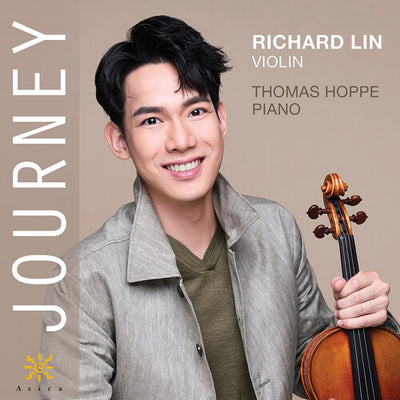
Richard Lin, the 2018 winner of the International Violin Competition of Indianapolis releases his debut recording. Performed with passion and flare, Lin is joined by renowned pianist Thomas Hoppe in music of Richard Strauss, John Corigliano, Gershwin/Frolov, Vitali, and Debussy.
J. S. Bach: Sonatas for Viola da Gamba and Harpsichord
Arcana
CD
$20.99Nov 28, 2025
Johann Sebastian Bach, though largely unaffected by the trends of his time, reimagined many older forms with striking originality, shaping the course of Western music. Among his innovations is the sonata for a melodic instrument (such as the viola da gamba) and obbligato harpsichord, where both parts engage in equal dialogue-a model later expanded by his sons and composers like Haydn, Mozart and Beethoven. Following their acclaimed first album dedicated to Corelli's Sonatas Op. 5, Teodoro Bau and Andrea Buccarella now present their second duo recording: the Sonatas for viola da gamba and harpsichord by J.S. Bach, each revealing a unique stylistic approach within a unified form.
Motschmann: AION For Large Ensemble, Artificial Intelligence
Berlin Classics
CD
$19.99Oct 11, 2024
Johannes Motschmann's latest album is a revolutionary fusion of human creativity and artificial intelligence. This groundbreaking project showcases a unique AI, custom-built and meticulously trained on Motschmann's extensive work to replicate his distinctive style seamlessly. Unlike generic AI music tools, this AI collaborates intimately with Motschmann, pushing the boundaries of modern composition. This album promises an unparalleled auditory journey. It was performed by the illustrious Ensemble Modern at the SWR Experimental Studio and conducted by the renowned Peter Tilling. Immerse yourself in the future of music, where technology meets artistry.
Step into a world of musical elegance with this release featuring solo piano interpretations of the most famous compositions by J.S. Bach. This album is a celebration of Bach's genius, showcasing the intricate beauty and emotional power of his work through the expressive medium of solo piano. Performed by Tim Allhoff who has collaborated with an impressive array of musicians and ensembles, including Larry Grenadier, Jeff Ballard, Robbie Williams, Jules Buckley, Vision String Quartet, and many more, this collection promises to deliver a rich listening experience that bridges tradition and innovation. Each piece is thoughtfully crafted to highlight the depth and complexity of Bach's compositions, making them accessible and captivating for both seasoned listeners and newcomers alike.
Jean-Baptiste Dupont performs transcriptions of works by Johann Sebastian Bach on the organ of Saint-Sernin. The layering of composition, transcription, instrument, and interpretation emphasizes the polyphonic depth and dynamic colouring of the pieces. Timeless masterpieces merge with the expressive potential of the Cavaille-Coll organ, itself a masterpiece of the 19th century.
Debut album by a young talented Russian guitarist. Well constructed programme based on Leo Brouwer and Agustin Barrios. An engaging listening from start to end, thanks to the Kurenchakova's prowess and eloquence and to the warmly resonant recording. "Lux Amoris Aeterni" ("The Radiance of Eternal Love") is an album about divine love in the language of music, expressed through the gentle timbre of the classical guitar.
The Czech Philharmonic and Music Director, Semyon Bychkov, continue their acclaimed Mahler cycle with the composer’s First Symphony, one of the most evocative and colourful symphonic debuts in the history of the genre. Mahler once famously said that “a symphony should be like the world, it should encompass everything.” In his First Symphony, he creates just such a world, filled with animal sounds, hunting horns, rural dances, klezmer bands and allusions to his own songs and folk song melodies such as Frère Jacques. These elements all function within a highly subjective, immersive symphonic drama, providing a blueprint for most of his symphonies to come. Semyon Bychkov and the Czech Philharmonic approach the composer’s firstling with their esteemed eye for detail and pacing, matched by their unmistakably Bohemian sound. The Czech Philharmonic is one of the world’s orchestral gems, recognised for its rich tradition with the Czech masters as well as European repertoire. Semyon Bychkov who is internationally renowned for his interpretations of the core repertoire, began his tenure with the Orchestra at the start of the 2018/19 season. Their recording of Mahler’s First Symphony follows Mahler’s Fourth and Fifth Symphonies (both 2022) and the Second Symphony (2023), part of the complete Mahler cycle to be released by Pentatone.
REVIEW:
The orchestra’s magical combination of richness, precision, and nuance is instantly in evidence, with brass and wind pinpoint and the strings characteristically shimmering and sinuous in the opening movement before making merry in Kraftig bewegt, doch nicht zu schnell. The control and perfection of Bychkov’s pacing in the third movement, and the way his forces combine in Sturmisch Bewegt with such attack one minute and astonishing fluidity the next, epitomizes a reading of beauty and depth.
Anton Bruckner: Symphony No. 9 in D Minor, WAB 109 - Live fr
Profil
CD
$20.99Apr 17, 2026
PH16063 Bruckner 9, Vol. 54 Edition Staatskapelle Dresden. Christian Thielemann, Staatskapelle Dresden, Live Aufnahme der Saison 2014/2015 aus der Semperoper »Ich mag die Neunte gar nicht anfangen, ich traue mich nicht, denn auch Beethoven machte mit der Neunten den Abschluss seines Lebens!« Anton Bruckner
Bernhard Lang's Monadology XXXVI is a radical "meta-composition". It deconstructs Chopin's Op. 10 Études through granular analysis, loops, and virtual remixing-destroying and reassembling the score into new sonic textures. The cycle consists of 12 Etüden. The last three are dedicated to Daan Vandewalle, the internationally acclaimed pianist renowned for his mastery of 20th- and 21st-century repertoire, who now brings them to this album.
On one side, Francesco Corti, one of the most internationally acclaimed harpsichordists and protagonist of five acclaimed albums released by the Arcana label. On the other, Ilya Gringolts, making his debut for the same label: a violinist of extraordinary versatility, committed to contemporary music but also animated by a deep passion for the Baroque repertoire and historically informed performance. Proof of this is his recording of Locatelli's Il labirinto armonico (2021), which was awarded the Diapason d'Or and selected as Editor's Choice by Gramophone. Two artistically different but complementary personalities, united for years in a successful partnership, tackle a milestone of chamber music: the first great example of concertante sonatas for keyboard and melodic instrument. Completing the programme is Tertia deficiens, a piece by contemporary composer and Baroque violinist Andrew McIntosh (Grammy nominee), commissioned specifically for this project with the aim of creating an evocative bridge between past and present.
Pianist Nicolas Stavy, who has already made recordings devoted to works by Boris Tishchenko (BIS-2189) and Dmitri Shostakovich (BIS-2550), now presents the first instalment of a complete survey of Alfred Schnittke's compositions for solo piano. This recording presents works from various periods of the Russian-German composer's career - from the 1950s, which the composer described as the 'years of obscurity', to the 1990s, a time shaped both by world fame and serious illness. While Schnittke wrote relatively little music for the piano, each work reflects - or sometimes anticipates - the phases of the composer's creative development. The Five Preludes and Fugue and the Prelude and Fugue belong to Schnittke's first creative phase, when he was still under the influence of Shostakovich. The Little Piano Pieces, composed for the composer's six-year-old son, are an example of his 'polystylism', juxtaposing and combining music of various styles from the past and present. The Sonata No. 2 and the Five Aphorisms, both from 1990, return to a more ascetic and abstract language, with a bleaker tone, no doubt echoing his serious health problems.
The three Suites recorded on this CD (BWV 1007, BWV 1008 and BWV 1010) were transcribed for guitar by the performers themselves, following a practice customary for Bach and absolutely familiar to him (the Fifth Suite for cello has come down to us in two versions, one for cello and one for lute: we are not sure which came first). One should therefore recognise the full aesthetic legitimacy of the guitar transcription of these compositions, a practice, moreover, that has now been established for decades. This procedure is ultimately legitimised by the primacy, in Bach’s language, of the harmonic and contrapuntal dimension over their sonic realisation, a primacy that led Ferruccio Busoni, for whom the concept of “transcription” occupies a position of absolute centrality in his aesthetic thought, to transcribe for piano not only numerous compositions for organ by Thomaskantor, but also the Chaconne from the Second Partita in D minor for solo violin. With specific regard to the guitar, one cannot fail to mention the name of Andrés Segovia, who transcribed for his instrument and recorded in 1946 the highly famous Chaconne.
Guarneri Quartet - The Complete RCA Victor Album Collection
Sony Masterworks
CD
$199.98Mar 28, 2025
In the early 1960s, four young musicians who had been playing chamber music at Rudolf Serkin’s Marlboro School and Festival in Vermont were encouraged to form a string quartet. In July 1964, the Guarneri Quartet gave its first concert and less than a year later made its first recordings under contract to RCA Victor. For the next 45 years, with only one change of personnel, the Guarneris performed all over the world and amassed a large, wide-ranging, prize-winning discography. Sony Classical now presents, for the first time in a single collection, all the recordings made by the Guarneri Quartet for RCA between 1965 and 2005.
When the announcement came of its retirement at the end of the 2008–09 season, the eminent British critic Rob Cowan wrote a perceptive, affectionate tribute to the Guarneri Quartet in Gramophone, comparing it to the Juilliard Quartet, the other superb ensemble that had dominated the American quartet catalogue for so many years. Using their respective Bartók recordings as an example, he contrasted the “cut-glass precision” of the Juilliard’s early-60s set to the Guarneri’s “volatile, free-spirited, generously expressive and tonally rich” performing style in its RCA cycle from the mid-70s.
That characterization of the Guarneri Quartet’s playing runs through virtually all the reviews garnered in their long recording career, a story that began with the 1966 release of two of Mozart’s late “Prussian” Quartets and an album coupling Dvořák and Smetana. HiFi Stereo Review wrote that “not since the Juilliard String Quartet set the New York music world on its collective ear some 25 years ago has a new chamber group created such a furor as the Guarneri Quartet on the occasion of its New York début in February, 1965. This pair of discs demonstrates eloquently what all the shouting was about, for these players – Arnold Steinhardt, John Dalley, Michael Tree, and David Soyer – blend precision with flexibility of phrasing and rhythm in a way not often encountered in contemporary American string groups. Here, indeed, is the influence of the seed bed from which the quartet stems – the Marlboro of Rudolf Serkin, Alexander Schneider, and Pablo Casals … To the Smetana [‘From My Life’] the Guarneri Quartet brings blazing intensity and fierce rhythmic verve, while the wonderful slow movement of the Dvořák [Op. 105] comes forth from the stereo speakers with an almost orchestral lushness, yet with inner voices flawlessly balanced.”
Other critics concurred in their reviews of these two LPs: “The foursome produces an unfailingly luscious tone, plays with letter-perfect intonation, and displays all sorts of felicitous pinpoint balances and coloristic effects. And how these gentlemen stay together … even in the most wayward of tempo changes. In short, this is ensemble work of a transcendental variety … The Guarneri Quartet is the most gifted group of its kind I have heard in years” (High Fidelity). “This is distinguished Mozart playing indeed. Its technical excellence needs little comment: as with the Dvořák/Smetana record … last month, with this team you take technical mastery for granted as soon as you hear the first phrase, and straightaway it's the intensely musical quality of the playing which strikes you. Theirs is Mozart played with the classical virtues, above all with firm line, poise and sensibility. The surface of the music is polished, but how much the Guarneri Quartet find beneath” (Gramophone).
Arthur Rubinstein was the quartet’s longtime keyboard partner. In 1966, they recorded the Piano Quintets of Schumann and Brahms: “Rubinstein and the Guarneris search out to equally convincing effect the flowingly lyrical aspects of the music, and this yields special rewards in a ravishing slow movement [the Brahms]” (HiFi Stereo Review). Dvořák’s followed in 1971: “The performance is beautifully balanced between the gentleman at the keyboard and the gentlemen with strings, and the sense of give and take comes from the experience of many collaborations” (High Fidelity).
They also recorded the piano quartet literature, beginning in 1967 with “beautiful performances” (High Fidelity) of Brahms. Their reading of Fauré’s Op. 25 in C minor was judged (also by High Fidelity) to be “beautifully played and exquisitely well reproduced. The instrumental lines are wonderfully clear in this highly directional recording … Rubinstein displays his regal style.” And in a disc containing both of Mozart’s piano quartets, “the playing throughout both sides is extremely beautiful … and superbly integrated – at once expressive and elegant, making all of Mozart’s points with clarity, straightforwardness, and the exalted give-and-take that is the life’s breath of real chamber music. The recorded sound, too, is exceptional for its richness, balance, and clarity” (HiFi Stereo Review).
One of many other composers who feature prominently in Sony’s Guarneri collection is Haydn. About the ensemble’s 1977 recording of the two Op.77 quartets, HiFi Stereo Review wrote that “these spirited, attractive performances of Haydn's two greatest string quartets are marked by a sense of real involvement. Articulation is crisp, ensemble is impeccable, and there is an organic flow from the first phrase to the last in each work”, while Gramophone praised their “deeply thoughtful, powerfully paced” 1986 reading of Haydn’s Seven Last Words.
With reinforcement from the Budapest Quartet in 1965, the Guarneris produced an “absolutely stunning performance (HiFi Stereo Review) of Tchaikovsky’s Souvenir de Florence sextet. In 1966, they recorded quartets by Mendelssohn and Grieg (the latter receiving its CD première in this set): “The Guarneri ensemble does itself proud throughout this disc – most notably in the Mendelssohn, in which they display a tonal homogeneity and a warmth of phrasing that are truly striking. It is as though one instrument, not four, were producing the lovely sound that emerges from the speakers. Happily, the RCA recording staff has come up here with a string quartet sonority of the utmost intimacy, yet endowed with just enough room tone to enhance the naturally warm tone of the Guarneris” (HiFi Stereo Review).
But the heart of any string quartet’s repertoire is inevitably the Beethoven cycle, and it is with these works that the Guarneris were most closely associated. They made their complete recording for RCA between 1966 and 1969. Gramophone described the Early Quartets as “elegant and buoyant, with well-chosen tempos, subtle bowing, crisp articulation, telling contrasts between staccato and legato, and a consistent sense of style.” HiFi Stereo Review enumerated the virtues of their Middle Quartets: “(1) excellent intonation; (2) glowing tone; (3) ensemble that is balanced and accurate but always flexible and natural; (4) superb phrasing and line-building; (5) good feeling for a high Beethoven style. These are strong and expressive readings that often achieve great poetic insight and a powerful dynamic impulse.” The HiFi Stereo Review’s critic rhapsodized over their Late Quartets: “If I had to make the choice of a very few records to take with me to a desert island, I’d choose recordings of the last five Beethoven string quartets. Now, with the arrival of this new album (complete with the Grosse Fuge) by the Guarneri Quartet, I’ve got my island package. All I need is the island. The Guarneri is, without a doubt, one of the most extraordinary string quartets before the public these days: the group has an absolutely stunning sense of both soloistic and ensemble color. Indeed, I can’t think of another string quartet that can match them for sheer sensuous appeal.”
SUMMARY:
• With the first release of the Guarneri Quartet’ recording of Mendelssohn’s Quartet No. 3, transferred and edited from the session reels using 24 bit / 192 kHz technology
• 9 quartet recordings for the first time on CD, transferred and mastered from the original analog tapes, 3 quartets remastered, using 24 bit / 192 kHz technology
• Includes collaborations with Arthur Rubinstein, Leonard Rose, Mischa Schneider, Pinchas Zukerman, Walter Trampler, Ida Kavafian, and more
• Original LP sleeves and labels, booklet with full discographical notes
Second instalment in the ongoing complete Ferdinand Ries (1784-1838) symphony cycle by Tapiola Sinfonietta and conductor Janne Nisonen includes the composer's Symphonies Nos. 4 and 5. Often remembered in music history as Beethoven's 'right hand', these new recordings by the Tapiola Sinfonietta reveal a major symphonist. The first volume in the series has received oustanding reviews in the German music press.
With the energy of a jet engine, violinist Oscar Bohorquez and pianist Frank Braley dive into a whirlwind exploration of unknown and thrilling American repertoire. Duos by Paul Schoenfield, William Bolcom, Aaron Copland, Mike Mower, and Brazilian composer Mozart Camargo Guarnieri - blessed with a name as remarkable as his music - bring the rhythmic vitality of the Americas into your living room. From jungle and desert-infused melodies to the spirit of tango, samba, rumba, square dance, and New York jazz clubs, this album offers a wonderfully vibrant and captivating musical experience.
Méditation: Keyboard Works by Bach, Couperin & Others / Andreas Staier
Alpha
CD
$15.99$20.99Save 25%Feb 16, 2024
Andreas Staier’s informed and inspired interpretations have left their mark on the discography of both the harpsichord and the fortepiano and have enabled us to see Bach, Mozart and Schubert in a completely new light. This is Staier’s first solo album of a projected series for Alpha Classics, in which he also presents his own compositions for the first time. “Two motifs connect the works in this recording: the first is a ancient cantus firmus, a melody in long notes […] the second is the interval sequence of octave, fifth, sixth, and third. […] Anklange, my six pieces for harpsichord, grew out of several conversations I had with the composer Brice Pauset about what it means to compose in our time, and in particular what it implies to compose for historical instruments. This led me to ask myself how I could express and capture my own conception of music in notes, marked as it is not only by Byrd, Bach and Schubert, but also by the music of the 20th and 21st centuries."
REVIEW:
This release is a good example of Andreas Staier’s intelligent program building, both intellectually and musically speaking. Two motifs form a thread that runs through most of the works assembled here. One is the note sequence E–F-sharp–A–G-sharp–F-sharp–E that appears in Johann Caspar Ferdinand Fischer’s E major Prelude and Fugue from Ariadne Musica, Bach’s E major Prelude and Fugue from The Well-Tempered Clavier Book II, plus Froberger’s Fantasia II and Ricercar IV (the latter transposed to begin with G). The other motif is based on a sequence of intervals: octave, fifth, sixth, and third. Other pre-Bach composers include Louis Couperin and Johann Joseph Fux
At the recital’s midpoint, Staier features his own six pieces for harpsichord composed in 2020 that comprise a suite entitled Anklänge. His style forgoes tonality for the most part, yet his boundless palette of sonorities, his dramatic registral deployment, and his instincts for when and how to leave space all generate palpable tension and release. The fourth piece, for example, makes arresting use of thick spread chords that resonate for a long time under the fingers, while No. 6 features aphoristic lines that unfold like skywriting, with plenty of air between each utterance.
Indeed, resonance and breathing room characterize Staier’s performing style, which revels in the colorful variety of stops offered on his harpsichord modeled after a 1734 Hieronymus Albrecht Hass model. You’ll notice this in how Staier times and differentiates his arpeggiations of chords throughout the Couperin Pavane, as well as in the melting impact of his masterful finger legato in the Froberger Meditation. Surprisingly, Staier takes a forthright tempo for the aforementioned Bach Fugue, where his octave couplings have a rather upholstered effect that, for my taste, works against the music’s reflective and vocally oriented nature. Still, Staier remains the masterful instrumentalist and thinking musician that has long enamored me to his extensive and wide-ranging discography.
Ronald Stevenson, still unknown to many outside the British Isles, is considered by several pianists as among one of the most important pianist-composers of the 20th Century. Following the tradition of many great pianists, Stevenson created piano transcriptions from the works of other composers and also wrote music in a variety of styles. This piano album by Peter Jablonski offers a compelling portrait of the Scottish piano master. The album includes four world premiere recordings.