This sixth instalment of Masaaki Suzuki's critically acclaimed complete organ works by Johann Sebastian Bach presents the first eleven pieces from a manuscript since referred to as the Leipzig Chorales. Conceived around 1739, this collection is unusual in that it contains no new compositions, but rather 'reworkings' of organ chorales dating from the years 1708-17, when Bach was in Weimar. The chorale arrangements are based on established Lutheran melodies that particularly appealed to Bach. They were not intended as preludes for congregational singing, but rather as music to accompany the communion service or as concert music. Bach took great care with this project, selecting the best of his organ music from earlier in his career, and saw it as his legacy for the future. Together with the Orgel-Buchlein, the Schubler Chorales and the third book of the Clavier-ubung, the Leipzig Chorales represent the pinnacle of Bach's sacred organ music. On this recording, Masaaki Suzuki plays the Arp Schnitger organ of the Martinikerk in Groningen, the Netherlands, one of the largest and most famous baroque organs in Northern Europe. Arp Schnitger was the most famous organ builder in northern Germany in the seventeenth century, and his admirers included Buxtehude, Handel and Bach himself.
The Russian Revolution of 1917 and the subsequent Cultural Revolution did everything in their power to destroy the influence of religion in the Russian Empire. Sacred music was publicly forgotten in the process. Although Schnittke, whose German-born father emigrated to the Soviet Union in 1926, was atheistically influenced by the state education system, he believed spiritually in "something greater". In 1982, he was baptized a Catholic, and shortly before his death he was accepted into the Orthodox Church. The search for a religious identity can also be traced in his works. Vedel and Berezovsky are among the most important composers of Ukrainian classical music of the 18th century. Little is known about Vedel's life. The works attributed to him, including 31 choral concertos, are all set to liturgical texts or Bible verses. In these works, the traditions of the Orthodox church music of his homeland, Ukrainian baroque tradition and folk songs merge with a new Western European operatic and instrumental style. Bortniansky is highly credited with bringing the genre of the sacred concerto to fruition. Consisting of psalm verses set to music, which were sung during the Eucharist in church services, it's purpose at the time was far-reaching: as a universal genre, it was the highlight of the Orthodox liturgy, an adornment of the state ceremony and also intended for a kind of domestic music-making. In the Western repertoire, it comes closest to the instrumental concerto grosso, with the difference that no instruments are permitted in the Orthodox service.
J.S. Bach: The Well-Tempered Clavier Book 1 - No. 22 Bb mino
Nimbus
Sheet Music
$7.99Oct 06, 2023
The main purpose of this edition is to assist those "desirous of learning" with some suggestions and information that might be helpful in the process of learning, understanding and performing the works of Bach. These suggestions should not be taken as a "must" to follow, but are simply meant to assist in the comprehension and practical execution of The Well-Tempered Clavier (WTC) and to encourage further exploration. This Edition is available in 2 Books, or as 48 separate 'Preludes and Fugues' scores.
Goldberg Variations (Arr. for String Trio by Dmitry Sitkovet
Evil Penguin
CD
$16.99Feb 06, 2026
In Dmitry Sitkovetsky's transcription, Bach's Goldberg Variations are revealed in a new light: a refined dialogue between violin, viola and cello, where each voice breathes and listens to the others. TrioFenix delivers a strikingly clear interpretation, combining architectural rigour, expressive freedom, and sonic poetry. Backed by nearly twenty years of musical complicity, these three chamber musicians breathe new life into one of the masterpieces of the Baroque repertoire, in a version that is as vibrant as it is intimate.
Five significant 20th-century compositions for violin and cello. Works by Xenakis, Ravel and Honegger reflect the composers' French roots, while a diverse, forward-looking harmonic language contrasts with such traditional forms as the sonata and passacaglia, the latter in Norwegian Johan Halvorsen's Passacaglia for Violin and Cello after Georg Friedrich Handel; Austro-Czech composer Erwin Schulhoff's Duo for Violin and Cello completes the programme. Manuel Lipstein has already released his first solo album, Roots, on OehmsClassics.
Yasmin Rowe Plays J.S. Bach, Prokofiev, Schumann & Granados
Willowhayne Records - Label
CD
$21.99Aug 02, 2024
Following her highly praised debut album, Yasmin Rowe returns to Willowhayne Records for an engaging and delightful programme, in which she returned to Holy Trinity Church, Hereford for this recording. Now resident in Melbourne, Australia, Yasmin has gained critical acclaim as a soloist, collaborator and recording artist in Europe, Asia and Australia. As well as her concert hall recitals, she has given many free-to-air concerts As well as her concert hall recitals, she gives many live-to-air performances, appearing as a frequent guest on Melbourne-based 3MBS Radio since 2019.
Chameleon - Chamber Music from Bloch to Rock / Signum Saxophone Quartet
Berlin Classics
CD
$21.99Apr 12, 2024
• SIGNUM saxophone quartet will release their first album on Berlin Classics • Feat. Alexej Gerassimez (Percussion) and Eckart Runge (Cello) • The quartet has made a name for themselves in various exciting projects (e.g. working with Alexej Gerassimez for his solo album on Berlin Classics) • With Chameleon they show how colorful the sound of the saxophone is with a diverse selection of music from classical (Glazunov, Bloch, Haydn, and more) as well as pop and rock
Embark on a captivating journey bridging time and soundscapes with Lithuanian pianist Guoda Gedvilaite's latest GENUIN album. Featuring works by Johann Sebastian Bach at it's core, this recording interlaces Bach's original compositions, his arrangements of other Baroque pieces, and romantic piano works by famous pianists such as Wilhelm Kempff and Egon Petri. The meticulously curated album is elevated by the ethereal works of Domenico Scarlatti, a contemporary of Bach, played with brilliance and profound depth, culminating in a masterful blend of artistry.
After his latest recording, devoted to Bach's Sonatas and Partitas in his own arrangement, Franz Halasz returns to Spanish music with this recital devoted to Federico Moreno Torroba. The composer of many of the best-known zarzuelas, Moreno Torroba did not initially seem destined to specialise in guitar music. It was his symphonic poems that caught the attention of the legendary guitarist Andres Segovia, who commissioned Moreno Torroba's first compositions for guitar despite the composer's unfamiliarity with the instrument. The compositions gathered here showcase a composer who, although deeply rooted in the Spanish musical tradition, was attuned to what was being done elsewhere, including the music of Claude Debussy and Igor Stravinsky, and who created a personal language marked by impressionism that would later influence guitar music throughout the twentieth century, from Heitor Villa-Lobos to Leo Brouwer. The winner of a Latin Grammy, Franz Halasz is a highly acclaimed guitarist who has himself contributed to the repertoire of his instrument by making arrangements of Manuel de Falla and Isaac Albeniz. On a guitar built in 1936 by the legendary luthier Hermann Hauser, Halasz turns the instrument into a multi-faceted prism through which the musician can 'break the light of music' into orchestral sound, in the words of Segovia.
Babadjanian, Krenek & Smetana: Epochs & Cultures in Dialogue
Oehms Classics
CD
$19.99Jan 17, 2025
The debut album by the young Trio Contrasti takes us on a journey through time with a mosaic of sounds in which epochs and cultures enter into dialogue. Romanticism gave the art world a new paradigm of thought. Music took the leading position among the arts; the freedom of formal design, initiated by the content, unfolded. The quest for national self-identification and the rapid development of national styles in art began. Romanticism opened the way for a dialogue between epochs and cultures that continued into the 20th century. Three works that have no direct connection to each other are nevertheless in a common context. When viewed through the prism of a romantic paradigm, they can be seen as milestones on the path through epochs and cultures.
Skillfully crafted, meticulously executed and utterly enjoyable, Giulia Nuti's solo recordings include three anthologies of keyboard music, the last two released with Arcana. These albums feature historically significant instruments carefully chosen by the artist to enhance the repertoire with which they are associated: Le Cœur et l’Oreille (2017), recorded on the 1658 Louis Denis harpsichord and, more recently, The Fall of the Leaf (2022), featuring the splendid Italian “Rucellai” virginal built around 1575.
Her albums have been met with critical acclaim and awards, such as the “Preis der Deutschen Schallplattenkritik” (German Record Critics’ Award) and the “Diapason d’or”.
For her fourth solo recital album, Giulia Nuti explores a different path, performing one of the pinnacles of keyboard literature, Johann Sebastian Bach’s Six Partitas. In this recording, she uses a splendid harpsichord by Christian Kuhlmann (2016), a copy of the magnificent Henri Hemsch of 1751.
Bach's six suites for cello (BWV 1007 to 1012) are considered the must-haves of the instrument's repertoire. In this recording, Valérie Aimard offers a generous version that radiates without ever seeking effect for its own sake. With finesse and subtlety, the performer honors Bach's greatness.
Bach: The Brandenburg Concertos & Ouvertures / Bernardini, Zefiro
Arcana
CD
$39.99Oct 20, 2023
While pursuing its constant search for music to study and rediscover, Zefiro undertook another important challenge by recording, in 2017 and 2015 respectively, the Brandenburg Concertos and Overtures, two pinnacles of the 18th-century instrumental literature. For this project Alfredo Bernardini waited until he could count on a select band of musicians who were not only in a perfect symbiosis of spirit and intent, but also equipped with the indispensable virtuosity and long-standing familiarity with the works. Thanks to the historical insight and human energy displayed by the ensemble, the interpretative results are both vivid and profoundly moving.
The recordings acquired not only prestigious awards such as Gramophone’s Editor’s Choice, Diapason d’or, Choc de Classica and Toccata’s CD of the month, but also specific acknowledgements for Overtures nos. 3 (France Musique) and 4 (SRF 2 Kultur), judged to be the best-ever versions. After being out of the catalogue for some time, they are now gathered together for the first time in an elegant box set.
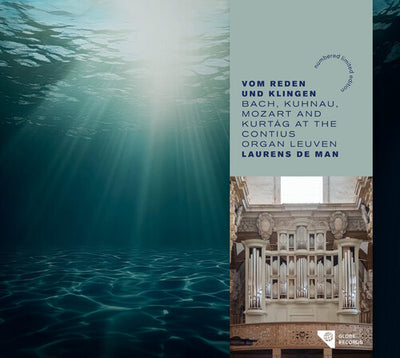
Vom Reden und Klingen - Bach, Kuhnau, Mozart & Kurtag at the
Globe Records
CD
$16.99Nov 15, 2024
Vom Reden und Klingen showcases the artistry of Laurens de Man, the first organist to be awarded the prestigious Nederlandse Muziekprijs. The album is a highly original recital consisting entirely of program music (music that depicts a story). These organ pieces by Bach, Mozart, Kuhnau, and Kurtag are therefore rare specimens of program music outside the 19th century. Laurens de Man plays the newly reconstructed Contius organ at the St.-Michielskerk in Leuven, Belgium
With this LP, IBA is beginning to release a new series of live concert recordings from the immense sound/video archive of Idil Biret from the 1950s to 2020. On the first LP, Schumann's Fantasie Op. 17 from the New York concert at Alice Tully Hall in 1972 and Liszt's Sonata in B minor from the Paris concert at Salle Gaveau in 1978 are included. These two performances of the works were significant milestones in Biret's concert career, opening up to her the stages of the Soviet Union and East Germany.
The large-scale Bach Organ Landscapes project featuring J.S. Bach's entire organ oeuvre recorded on a range of instruments aims to provide an overview of organ-playing and organ-building traditions that were key to Bach's composing. With a keen eye to the unique cultural organ legacy of the places associated with Bach, Halubek has placed Bach's original sound at the heart of his project. The recordings are accompanied by digital material that offer an almost tactile access to the great composer's sound universe.
Bruckner’s Second Symphony is a rare enough encounter in its 1877 version, but it’s virtually unperformed in the 1872 original version. This is not owing to some deficiency of the earlier ideas compared to the later alterations. It’s mainly habit and convenience because to get new parts and re-learn something ostensibly known, that differs in a great many details, means an extra expense of effort and resources. That’s a shame, really, because it is decidedly worth discovering the original, not-yet-ironed-out rawness of Bruckner’s early masterpiece, which was something unheard of at the time – but needn’t remain unheard now.
What does it mean for Schumann's Kreisleriana to be Romantic? Is it the violent contrasts, the mercurial shifts in mood, the fragmentary architecture, the raw and unfiltered expression? Is it the breathtaking lyricism? Or is it the spectre of the tormented kapellmeister Kreisler haunting this work that dissolves the boundaries between music, literature, and psychological portraiture? Acclaimed virtuoso Paolo Giacometti brings both poetry and psychoanalysis to Kreisleriana and Kinderszenen, performing them on a resplendent 1838 E´rard born in the very year these works first saw the light.
Un Air d’italie - The Mandolin in Paris in the 18th Century / Schivazappa
Arcana
CD
$20.99Oct 20, 2023
As an instrument from Italy, one that was exotic and evocative of Mediterranean atmospheres, the mandolin was very much in fashion in France until the end of the Century of Enlightenment: a fact also confirmed by many iconographic and musical sources. Pizzicar Galante, an ensemble that stands today as a benchmark for the interpretation of the galant literature for mandolin and continuo, has been acclaimed for the “finesse, creativity and spirit” (Olivier Fourés, Diapason) and “communicative energy” of its performances (Sébastien Llinares, France Musique).
For its second recording with Arcana, it offers a compilation of the finest music played during the veritable “golden age” enjoyed by the mandolin in Paris from the 1760s to the Revolution. It is a rare and unexplored repertoire in which the dazzling virtuosity of Anna Schivazappa, a specialist in historical mandolins, dialogues with the beguiling and charismatic voice of Marc Mauillon.
“Since Beethoven, nothing has been written that even comes close!”
The great conductor Arthur Nikisch made this remark to Bruckner’s former student, Joseph Schalk and also his fellow conductor, Hermann Levi, described the piece as “the most significant symphonic work since Beethoven’s death.”
Arthur Nikisch conducted the first performance in the Stadttheater, Leipzig, on 30 December 1884, with Bruckner in the audience. While the performance was not a total triumph, it brought the sixty-year-old composer significant international recognition for the first time. During the composer’s lifetime, the Seventh, especially its Adagio, was his most popular symphony, and it remains among his most beloved and frequently performed works.
With Pierre Boulez's 2nd Piano Sonata Idil Biret not only makes her American recording debut, but also presents the first U.S. recording of this important contemporary work. Composed in 1948, this sonata occupies a position that exerted a causative influence upon Boulez's subsequent music. It's experimental and ground-breaking nature may be better understood if one regards it as having grown out of a response to Webern's Variations (1936), the companion piece on this album. The rigid, geometric patterns of Webern's work, the classical purity of it's encompassing organization, seems to have served as a base of departure for Boulez's broadened structures that are equally rigid but incomparably more complex. It is this very complexity that conceals the strict framework of the entire composition and projects it as the product of an ardent improvisatory impetus. It demands from it's interpreter a similar approach, along with technical prowess and intellectual control of the highest order. It was only a matter of course that this work, together with influences emanating from other sources (chiefly John Cage), should lead the path not only to open-form and aleatory compositions, including Boulez's own 3rd Piano Sonata, but also, through it's new pianistic language, urge the development of a whole new generation of virtuoso pianists. (Ilhan Mimaroglu, 1973)
J.S. Bach: Sonatas for Violoncello Piccolo & Fortepiano
Evil Penguin
CD
$12.99$16.99Save 25%Nov 08, 2024
This recording emerged from a quest to explore new rhetorical and poetic spaces, timbres, and dynamics, aiming to reveal the soul of J.S. Bach's splendid sonatas for viola da gamba and harpsichord. The cello piccolo, an instrument similar in size and texture to the viola da gamba, proves ideal for capturing the lyrical quality of some movements and the virtuosity of the more intricate and faster passages. The fortepiano, an English instrument beautifully restored, was chosen to emphasize the contrapuntal nature of the three trio sonatas, particularly in the continuous duetting of the right hand with the cello.
After listening for a while (to orchestral music on the radio) Idil would detect the main melody and then play it on the piano with one finger. Afterwards, when she reached the age of four, she would play these with two hands and with the correct harmony. Bach preludes and fugues from the Well Tempered Clavier, for example, which even the talented musicians took considerable time to study and memorise, were mastered by Idil in only a few days after listening once or twice, after which she would play these without a single wrong note. (Leman Biret, 1988)
For the fourth instalment of his Schubert+ series, Can cakmur focuses on the genre of the impromptu, aiming to identify historical predecessors for Schubert's piano writing as well as gain an insight into the evolution of free-standing poetic keyboard compositions. Placing Franz Schubert's famous set of 4 Impromptus, D 899, at the heart of this recording, cakmur also presents two Impromptus by Jan Vaclav Vorisek, a composer who was praised by Beethoven and seems to herald Schubert. Four works by Chopin and two by Scriabin complete the programme and bear witness to composers' fondness for this free form, capable of expressing romantically a moment, a feeling or a mood. Designed to place Schubert's major piano works alongside works by other composers, Can cakmur's Schubert+ series has so far earned the highest praise: 'With Can cakmur you are returned to your first sense of wonder and revelation at discovering Schubert's genius' (International Piano), 'cakmur [is] remarkable from start to finish, with irresistible colours, refined nuances and a clear tone' (Crescendo), 'cakmur's phrasing and his use of dynamics and colours are overwhelming' (Pizzicato).
Bach published during his lifetime four volumes of keyboard pieces under the title Clavierubung which began with a set of six Partitas, published between 1726 and 1731. The first of the set was the Partita No. 1 in B flat major. The Chromatic Fantasia and Fugue in D minor, was apparently written during Bach's time at Cothen, probably about 1720, and revised in Leipzig about 1730. The six English Suites, the 3rd being included here, have nothing particularly English about them, except their title. They were written perhaps in Weimar in about 1715 or possibly during Bach's period at Cothen. Bach brought together a set of five French Suites, of which the 5th is Biret's favourite, later augmented to six and forming part of the Clavierbuchlein for Anna Magdalena, his second wife. The Italian Concerto in F major was published in 1735 in the second volume of the Clavierubungen, with the original title Concerto nach Italienischen Gusto. It reflects the style of the Venetian solo concertos by Vivaldi.
Fux: La corona d’arianna / Bernardino, Zefiro, Arnold Schoenberg Choir
Arcana
CD
$20.99Sep 22, 2023
In 2018, the Styriarte Festival in Graz launched, in collaboration with Zefiro, a project to rediscover the operatic output of the Styrian composer Johann Joseph Fux (1660-1741), Kapellmeister at the imperial court in Vienna for forty years, with the aim of restaging six of his nineteen operas, one per year. With a cast of Baroque vocal specialists, led by Monica Piccinini and Carlotta Colombo, this set of La corona d’Arianna represents the second instalment of the Arcana series which documents the recordings made in the course of this six-year cycle, following the success of Dafne in lauro (A488, 2021 – awarded Gramophone Editor’s Choice and rated Eccezionale by Musica), La corona d’Arianna was described as a "festa teatrale" and indeed it breathes a festive atmosphere throughout. It was written and performed in Vienna in 1726, as a birthday present from emperor Karl VI to his wife Elisabeth Christine. The choir,representing the guests at this big party, has a predominant role. On a closer look, Venus (Monica Piccinini) is busy combining couples of characters so far unlucky in love: Arianna (Carlotta Colombo) with Bacco (Rafal Tomkiewicz), Teti (Marianne Beate Kielland) with Peleo (Meli-li). This recording was made following the stage performances in Graz in June 2022 in which the work was shortened in relation to post Covid requirements. Yet the music by Fux flows happily, with plenty of dramatic tension and variety of colours.
Gregor Meyer, director of the GewandhausChor, fulfills a dream by returning to "his" instrument, the organ, and recording an album at GENUIN that gathers sounds from Saxon organs of an organ-building dynasty: the Kreutzbach family from Borna. Meyer plays organs from three eras, taking us through Saxony from Johanngeorgenstadt to Wiederau and Zwickau-Marienthal. Meyer's organ playing utilizes the full range of the highly characteristic and historically valuable organs to faithfully and differentially portray music by Johann Sebastian Bach, Georg Böhm, and Max Reger. A must for lovers of historical, regionally anchored organ craftsmanship!
A mystic realm tinged with the scent of foreign spices, bewitching music, vivid color and sensual delights... Orientalism sparked a new wave of romanticism in Western art in the 19th century, which had a profound influence on artists. At the time, The Arabian Nights had long been popular in Russia, in a French translation by Antoine Galland that indulged the Francophile passion for all things Arabic. For Rimsky-Korsakov who had a life-long fascination with fairytales especially those from the exotic setting of the mythical Orient,"Scheherazade"was an ideal theme. Born into a family of Russian naval officers, music and the sea became his passion since childhood and he graduated from the Naval Academy of St. Petersburg to become a naval officer himself. While pursuing his musical studies, he embarked on numerous ocean voyages, visiting Brazil, America, Europe etc The Oriental Ballet Suite "Thousand and One Nights" was originally conceived as an orchestral work, first published for piano solo in 1927, and then arranged for orchestra by the composer himself. It gained popularity immediately after it's release and was broadcast on several radio stations.
Bruckner: Symphony No. 4 / Poschner, ORF Vienna Radio Symphony
Capriccio
CD
$21.99May 05, 2023
Bruckner’s frantic revisions of his symphonies Nos. 3, 4, and 8 were borne out of his disappointment with Hermann Levi rejecting the original version of the 8th symphony. Helping in this large-scale revamping effort were former Bruckner-students Franz and Joseph Schalk, Ferdinand Löwe, Max von Oberleithner, and Cyrill Hynai, which resulted in these versions’ reputation – and especially that of the last version of the 4th – being varnished as something not quite Echt-Bruckner.
It wasn’t until the discovery of photographs of the 1888 version’s manuscript score and the subsequent publication of Benjamin Korstvedt’s edition thereof that it became clear: This late edition really did reflect Bruckner’s intentions. To ears familiar with the still better-known 1881 version, the result might sound mystifying, even troubling, but it also surprises with many particularly exquisite passages!
This album contains the symphonic suite "Scheherazade" by Nikolai Rimsky-Korsakov and the short composition "The Enchanted Lake" by his student Anatoly Lyadov.
In 1887-88, after the sudden death of his brilliant friend Borodin, Rimsky-Korsakov composed those three orchestral works which crowned his Russian national period and has made his name a permanent part of the worldwide concert repertoire: the "Capriccio espagno"l, the symphonic suite "Scheherazade", and the concert overture "La Grande Pâque Russe". With Scheherazade Rimsky-Korsakov did not tell a story, he rather set individual, unconnected episodes and images to music.
Anatoly Lyadov has a reputation of being lazy – based solely on Rimsky-Korsakov’s opinion of him – yet his ambition was for every piece of music he created to be flawless. One consequence of this was that his entire œuvre consists entirely of miniatures. The "Enchanted Lake" does not tell a story but is purely impressionistic music about a Russian forest lake, on a level with Ravel and Debussy. Conductor Dmitri Kitayenko conducted various orchestras in Moscow, became chief conductor of the Moscow Philharmonic in 1976, and took over the Symphony Orchestra of the Hessischer Rundfunk in Frankfurt am Main in 1990-96. He went on to hold principal positions with the Bergen Philharmonic Orchestra, the Bern Symphony Orchestra, the KBS Symphony Orchestra in Seoul and finally, in addition to his worldwide activities as a guest conductor, was appointed Honorary Conductor of the Gürzenich Orchestra in Cologne.