We're worried by it, stressed out from it, frightened of it - and yet we're fascinated by it. Chaos has always been perceived as a threat, but also as the foundation of life. Various creation stories explain how the world arose out of disorder, out of "mayhem". In like manner, it is anarchic spirits in particular that are credited with the ability to create masterpieces of creative art. This conception was perhaps most neatly expressed by Friedrich Nietzsche: "You must have chaos within you, if you are to give birth to a dancing star." The present album is made up of works which, if you like, harbour the sound of chaos. Originally written for a wide variety of instruments, these pieces are arranged here for string quartet and are connected by improvised interludes - linking passages for which the Hungarian composer Samu Gryllus has provided the basis. The Chaos String Quartet emerged from the iconic violist joke: "Well-established, world-famous string quartet looking for a new first violin, second violin... and cellist." That's exactly how it happened. On Cornwall's rugged coast, during a Prussia Cove masterclass, after an illuminating lesson, a sight-reading session, and a candlelit dinner, Sara invited Susanne to form a quartet. After that first conversation, it took some time to find two other brave musicians, both beyond their mid-twenties, who were willing to embark on the exciting, sometimes complex, and risky adventure that is a string quartet. Fortunately, Eszter and Bas joined soon after, with great enthusiasm. As usual, naming proved a challenge. Some suggested using the first violinist's surname; others, a Greek god. A few warned, "Don't start with A - there are too many." Then came a provocative idea: why not call it Chaos? Furthermore, the quartet enjoys inspiring the next generation, sharing it's experience as Young Artists in Residence at Vienna's University of Music and Performing Arts, cheekily sparking a little chaos among the artists of tomorrow. Their recognition as BBC New Generation Artists (2023-2025) and regular appearances at venues like Wigmore Hall, Musikverein, and Concertgebouw illuminate a journey where unpredictability becomes inspiration-reminding us that from the origins of chaos can emerge music of unique order and profound beauty.
Métier presents a landmark 4-disc box set from pianist Ian Pace in commanding performances of music by composer Michael Finnissy (b. 1946). Finnissy is widely regarded as one of Britain's most important living composers. Pace, one of the leading interpreters of Finnissy's work, presents an album focused around Finnissy's epic cycle for piano, The Verdi Transcriptions, alongside the second complete recording (after the composer's own) of the iconic English Country-Tunes, and works inspired by music of the late-18th and 19th centuries. The result is a broad view of Finnissy's extensive output of piano music in relation to Romantic aesthetics. The album is released in anticipation of the Métier label's upcoming celebrations of Michael Finnissy's 80th birthday in 2026. Finnissy's four-book cycle of Verdi Transcriptions reimagines Verdi's operas through a modern lens. As Finnissy states in his liner notes: "Transcribing sound into a written form (notation) involves making significant choices. The choices can color the ongoing exploration of that sound as 'composition.'" The result of those choices is a monumental, late-Romantic epic. Finnissy's English Country-Tunes has long been considered one of his signature and most technically demanding cycles. There is a similar line of composition through transcription as The Verdi Transcriptions, only in these works the source material is English folk music. Written in celebration of Queen Elizabeth II's Silver Jubilee, the work can also be seen as a commentary on the spirit of British patriotism at the time. Ian Pace's readings reflect decades of study: he first performed English Country-Tunes in the 1990s and has played Finnissy's complete piano oeuvre in cycles (1996 and 2016). The set includes extensive liner notes by both Pace and Finnissy, offering rare insight into the compositional ideas and performance choices behind these demanding works. In Pace's recording of Michael Finnissy's other epic piano cycle, The History of Photography in Sound (MSV 77501), BBC Music raved: "Pace's intimate acquaintance with the totality of History is apparent in his commanding performance... this is a magnificent achievement for both composer and performer," and Gramophone hailed Pace as "Finnissy's David Bailey, each note shaded to perfection, structures translucently and sharply lit, defining sonic images of our time." Incomparable virtuoso, called the Paganini of the harp, Félix Godefroid was also a composer and teacher. This recording, performed by Sophie Hallynck, highlights the composer's studies in high virtuosity. Designed for his own use and that of professionals, they partake of both "absolute music" - as with the deservedly famous Étude in B-Flat Minor, Op. 193 - and the character piece, picturesque or sentimental. These musical miniatures are pieces overflowing with musicality in a refined style, but they express a pedagogical program first and foremost. Godefroid conceived of his études as a true school for harpists. Each technical problem becomes the medium for a musical expression - an approach that gives these études exceptional richness and relevance. Often based on one of those melodies for which Godefroid had such a knack, each one is set apart by a strongly marked expressive character, ranging from laughter to tears, as well as by it's structure, rhythm, novel sonorities, and harmonic surprises not lacking in audacity. Sophie Hallynck has risen to the technical challenges specific to each étude while staying faithful to the spirit of the era, with the aspiration to achieve a subtle balance between virtuosity and expression. Her essential objective has always been to make technique live through music, without ever obscuring that emotion that emanates from it. Shostakovich composed music for film throughout his life, from his teenage years as a pianist accompanying silent films in Leningrad until the early 1970s. New Babylon provoked a political and artistic storm upon it's release in 1929 but remains one of Shostakovich's finest film scores, performed here complete and uncut. Popular favorites The Gadfly and Hamlet are heard in premiere recordings of the complete scores. Also included is the music for Alone, The Girlfriends, Love and Hate, and The Fall of Berlin in premiere recordings that have garnered international critical acclaim. "This composer of the New Complexity movement admires avant-jazz. He also digs 19th-century classics. So, when adapting Verdi, he does it via the spirit of Cecil Taylor. Near the midpoint of Finnissy's "La Traviata" potpourri, you'll find dense fireworks as well as tenderness deriving from a motif Verdi once assigned to Violetta." - Seth Colter Walls, NYT
Boulez: Chef d’orchestre; Stravinsky, Schoenberg, & Boulez:
Frémeaux
CD
$32.99Oct 18, 2024
En reaction aux resonnances neo-classiques qui dominaient le paysage musical francais de l'apres Seconde Guerre mondiale, quelques compositeurs - emboitant le pas au groupe Jeune France (Messiaen, Jolivet...) - ambitionnerent de mettre en lumiere les grandes figures de la tradition moderne, Webern, Schoenberg, Stravinsky, Berio et quelques autres. Pierre Boulez fut sans aucun doute le plus celebre representant de cette nouvelle orientation. Compositeur mondialement reconnu, pedagogue, initiateur et directeur de nombreuses institutions (Ircam), il fut egalement l'un des plus respectes meneurs d'orchestre, mettant sa baguette au service du repertoire de son temps. Christophe LOINTIER & Patrick FReMEAUX. In reaction to the neoclassical resonances that dominated the French musical landscape post-World War II, a few composers - following in the footsteps of the 'Jeune France' movement that included Messiaen and Jolivet - made efforts to throw light on the great figures of the modern tradition, namely Webern, Schoenberg, Stravinsky, Berio and a few others. Pierre Boulez was no doubt the most famous of this new orientation's representatives, a world-renowned composer and teacher who initiated and directed numerous institutions such as the Ircam for example. He was also one of the most respected conductors to wield a baton over the repertoire of his day. Christophe LOINTIER & Patrick FReMEAUX
Louise Farrenc has emerged in the last decade as a major figure among French composers of the early-Romantic era, whose neglect in previous eras can only be understood in the context of her gender, revealed in both live performances and studio recordings.
Robert Schumann lavished praise on Farrenc’s early published work, and it is easy to hear why from these two piano trios and Cello Sonata, all of which belong to the mainstream of lyrical Romanticism in its early flowering.
The pianist Linda di Carlo has already been the constant presence in two previous albums of Farrenc’s chamber music on Brilliant Classics, and she brings a deep understanding and experience of the idiom to these new recordings.
Vale - A pastoral symphony, Tristan - still, Pluen (feather)
Signum Classics
CD
$20.99Apr 24, 2026
This new album presents three major orchestral works by British composer William Mival, performed by the Philharmonia Orchestra under Martyn Brabbins. Spanning two decades, the album features the expansive new symphony Vale, the contemplative Tristan - still, and the Welsh-themed Pluen (feather). Together, they trace Mival's engagement with tradition and landscape. From the concentrated focus of Tristan - still to the folk-song variations of Pluen and the broad, five-movement design of Vale, the recording offers a clear overview of Mival's approach to writing for large forces.
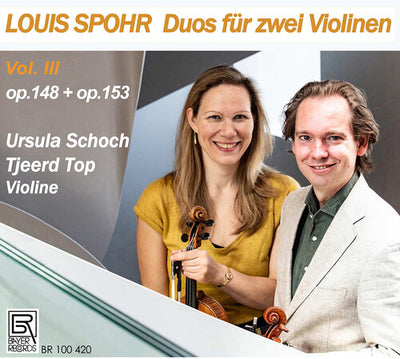
Together with Op. 150, the Violin Duos Op. 148 and 153 form Spohr's last cycle in this genre. It is as if Spohr, whose last published compositions included the new duos, once again wanted to show all his ability to write large-scale music with the limited instrumentation. Ursula Schoch and Tjeerd Toch are both members of the famous Concertgebouw Orchestra.
Walton: Violin Concerto; Portsmouth Point; Suite from Troilu
Chandos
SACD
$21.99Apr 04, 2025
Sinfonia of London and John Wilson start a new series of recordings of works by Sir William Walton with this album featuring Charlie Lovell-Jones as soloist in the Violin Concerto. Lovell-Jones has soloed with major orchestras internationally, broadcasting on radio and television. As leader of the multi-award-winning Sinfonia of London, he has performed at the BBC Proms and recorded numerous albums, and is the winner of a number of significant international competitions. Commissioned by Jascha Heifetz, the Concerto was premiered in 1939, in America, and was enthusiastically received. Inspired by Walton's friend and lover Alice Wimborne, the work is extremely lyrical and passionate in nature, sporting a wild, virtuosic Tarantella as the second movement. Alice was also a driving force behind the inception of Walton's first grand opera, Troilus and Cressida, composed over almost a decade, largely after her untimely death. Here we hear the four-movement orchestral suite compiled in 1987 by Christopher Palmer, at the instigation of Lady Walton and his lifelong publisher OUP. Walton's overture Portsmouth Point is the earliest work on the album, premiered in 1926.
Music of Johann Sebastian Bach was always fundamental for Aliya Turetayeva. From the first listening of his Mass in B minor in her childhood, his music has accompanied her through her life. Almost every day she starts with the music of Bach in order to be "well-tuned" throughout the day. She always felt connected with eternity through his music and shared many happy and tragic moments during the years listening to his output. Bach's music was always a symbol of faith for the artist - many times in life his music gave Aliya Turetayeva strength to live further and not to give up; it will remain to be a symbol of faith for her, to be her Credo. Aliya Turetayeva was born in 1986 in Almaty, Kazakhstan and received her first piano lesson at the age of five. Aliya moved to Cologne, Germany to continue her studies at the Hochschule fur Musik und Tanz Koln as a student of Professor Pavel Gililov. She was awarded her Masters degree in 2010. As well as her work as a soloist, Aliya Turetayeva is a dedicated chamber musician. She recorded chamber music works by G. Crumb and A. Schnittke for WDR Radio Cologne. She also completed 2013 her postgraduate studies at the Mozarteum University in Salzburg under the tutelage of Professor Gililov with the highest mark.
Arthur Honegger's song output falls into two distinct periods. The first spans his apprentice years from 1914 - the date of the first of the 4 Poemes H.7 - to 1924. He returned to art song on the eve of the Second World War, and Eleni-Lydia Stamellou sings two further sets of songs originally conceived as film accompaniments. In the 4 Poems there is a Debussyan turn to the harmony which mirrors the symbolist flavour of the text. More distinct from the model of Debussy is the album's title track, 'Petite Chapelle', with it's avowedly spiritual character. Honegger conceived his 3 Poemes de Paul Fort in the autumn of 1916. Here the relationship between music and text is more directly illustrative, as in the distant hunting horns to accompany the hunter lost in the forest. From February 1917, Nature morte stands alone as a musical still-life, a brief sketch of a bowl of peaches and white grapes. No less epigrammatic, but more musically adventurous as befitting the text, are Honegger's settings of the 6 Poemes d'Apollinaire which he composed between August 1915 and March 1917. But, for all Apollinaire's influence over the composers of 'Les Six' - Honegger included - Jean Cocteau was far more instrumental in determining their aesthetic aims. And though it was Apollinaire who had coined sur-realisme in response to seeing the premiere of Satie's ballet Parade in 1917, this new, mischievous spirit courses through Honegger's deft settings of Cocteau. Honegger makes a sincere tribute to one of France's most celebrated Renaissance-era poets in the Chanson de Ronsard from February 1924. From 1926, the 3 Chansons de La Petite Sirene feature whole-tone rising harmonies in the opening song, and the even briefer companions uphold a Satie-like inscrutability. At this point, Honegger continued in vocal music (operas, operettas and oratorio) but left song alone. However, in 1937, his soundtrack to Jean Choux 'talkie' remake of Louis Mercanton's 1920 silent film Miarka, la fille à l'ourse afforded an opportunity to write two brief songs. Eleni Lydia Stamellou's recital closes with another pair of songs written for the cinema, the Romances sentimentales for Un seul amour, a story by Balzac very loosely adapted for the screen by Pierre Blanchar. In a genre all their own are the settings of 3 Psaumes, which Honegger composed in occupied Paris over the winter of 1940/1. The sound of the organ underpins the Bachian flow accompanying Psalm 34 and the misty F minor chords beneath Psalm 140, even if the vocal line itself harks back to Honegger's song-writing of the 1920s. Other information: - Recorded April-December 2024 in St Petersburg, Russia - Booklet in English contains liner notes by Peter Quantrill and profiles of the musicians - Arthur Honegger (1892-1955) was a Swiss composer associated with the French musical movement Les Six. Known for his eclectic style, he blended elements of French impressionism, German romanticism, and modernist techniques. While Honegger is best known for his orchestral works, such as Pacific 231 and Jeanne d'Arc au bûcher, his vocal compositions show a more intimate and lyrical side of his artistry. - Honegger's songs reflect his deep sensitivity to poetry and text, setting works by prominent French poets like Paul Fort and Jean Cocteau. His melodies for voice and piano exhibit rich harmonic textures and expressive phrasing, demonstrating both refinement and emotional depth. Unlike his orchestral pieces, which can be complex and rhythmically driven, his songs favor clarity and directness, allowing the poetry to shine through. - Greek soprano Eleni Lydia Stamellou was Prize Winner at the Ferruccio Tagliavini Competition in Austria, with Dame Joan Sutherland as the president of the jury. She subsequently attended masterclasses given by Teresa Berganza, Edda Moser and Christa Ludwig. She sang in opera productions with MusicAeterna conducted by Teodor Currentzis. Her specialization is Renaissance/Baroque and Contemporary Music. She sang in productions of Berio and Hersant.
Argentine violinist Tomás Cotik now resides in the U.S. He is a professor of violin at Portland State University. Here, he performs his own arrangements for violin of the J.S. Bach Six Cello Suites. This is, of course, some of the greatest of all of the solo cello literature, beautifully arranged for and performed on violin.
Violin and piano duo Tamsin Waley-Cohen and Huw Watkins explore a violin and piano programme spanning four generations of musical imagination. Prokofiev's F minor Sonata captivates with it's dramatic intensity and baroque-inspired clarity. Stravinsky's Duo Concertant enchants through five lyrical musical poems, blending wit, elegance, and classical poise. Knussen's 'Reflection', written for Waley-Cohen and Watkins, immerses listeners in a jewel-like world of colour and introspection, where every note is deliberately placed. Watkins's Violin Sonata fuses modern lyricism with bursts of earthy vitality, creating a dialogue of subtle contrasts.
Nineteen years after his first recital devoted to the music of Alexander Scriabin [BIS-1568], Yevgeny Sudbin returns to the works of this eccentric Russian composer with a new recital that brings together pieces composed at various points in his career. Of his special relationship with this composer, Sudbin writes: 'I simply cannot think of any other composer who consistently brings out such a primordially raw and physical reaction in me and, with time, his grip has only intensified on me.' Arthur Rubinstein once said that 'Scriabin's music is like a narcotic. It is so intoxicating that it can become dangerous', to which Sudbin adds by way of precaution, 'enjoy responsibly at your own peril.' Carefully prepared by Sudbin, the programme reveals Scriabin's stylistic evolution, from his beginnings when he was still influenced by Chopin and devoted to small forms, through his middle period where the rich, late-romantic idiom is just beginning to cross into darker, more complex realms, on to his late period in which, in Sudbin's words, 'one sometimes feels too close to the edge of insanity'. In his latter works, Scriabin indeed seems to push music to the expressive limits in order to create a climate of spiritual ecstasy.
The Art of Fugue emerges as the central instrumental project of the last decade of Bach’s life, after a gradual development over several years: the exploration in depth and with an overflowing musical imagination of the contrapuntal possibilities inherent in a single musical subject. In this work, the theoretical component of Bach’s thinking is at its clearest: theory and practice merge, old and new stylistic elements and compositional techniques are integrated and demonstrate in an incomparable way his individual approach to composition.
Since Bach gave no indication of the instrument, nor does his writing shed any further light on the subject, one might even wonder whether this work is a purely theoretical work, intended solely for musical analysis. However, since the composer’s rediscovery in the nineteenth century, musicians have appropriated the work, whatever their instrument. It is now generally accepted that the work was composed for the keyboard. A second harpsichord part is added for three fugues, played here by Masato Suzuki.
After several acclaimed recordings of Bach’s works for keyboard instruments, Masaaki Suzuki finally takes on this immense work, the pinnacle of the cantor’s art and one of the absolute peaks of Western music.
REVIEW:
Although Masaaki Suzuki’s solo harpsichord Bach recordings span several decades, his technical and musical consistency seems to defy time, as borne out in The Art of Fugue. He continues to use a Willem Kroesbergen harpsichord modeled after a Flemish Baroque-style instrument, whose transparent timbres befit the vocal orientation governing his phrasing. For example, his tempos never move faster nor slower than one can comfortably sing. As a result, the contrapuntal lines accommodate Suzuki’s breath pauses, arpeggiations, agogic adjustments, and ritards at cadences.
In lieu of Bach’s completion, Suzuki follows the tradition of placing Bach’s valedictory chorale prelude Wenn wir in höchstein Nöten sein at the end. All in all, a fine Art of Fugue that complements my harpsichord reference versions. BIS’s superb sonics and Bach scholar Christoph Wolff’s in-depth annotations also deserve kudos.
Bliss: Music for Brass Band / Wilson, Black Dyke Band
Chandos
SACD
$21.99Aug 09, 2024
Sir Arthur Bliss contributed two staples of the brass band repertoire - Kenilworth and The Belmont Variations, whose enduring success inspired arrangers to turn to his other compositions, for example Eric Ball and Four Dances from the ballet Checkmate or Phillip Littlemore's suite from the film score for Things to Come. Three new arrangements have been made especially for this album: Robert Childs' suite from the ballet Adam Zero, and Michael Halstenson's arrangements of Music from the Royal Palaces and Welcome the Queen. Collectively this program reflects the essence of Bliss's compositional style: the inherent drama of his scores for film, ballet, and television and his flair for the ceremonial, especially in the context of his position as Master of the Queen's Music.
Black Dyke Band, tracing it's continuous history back to 1855, is the most recorded band in the world, having produced a discography of more than 350 recordings to date. It is also the most successful contesting band in the world, having won the European Championships thirteen times, the British Open thirty times and the National Championships of Great Britain twenty-four times. In 2023, they appointed conductor John Wilson as their Honorary President.
REVIEW:
The ensemble balance is superb, the internal voicing clear and detailed, the execution punchy, delicate, breezily confident and heartfelt by turn. This is a wonderful album in every way, highly recommended.
— Gramophone
The program is well put together and demonstrates the essence of Bliss’s style.
This live recording immortalizes Christophe Rousset's performance at the Fundacion Juan March in Madrid on January 8, 2025, a featured event in the Earning a Living concert series. Francois Couperin's keyboard compositions illuminate the role of royal patronage as the modus vivendi for musicians of the Early Modern period. Couperin's treatise, L'Art de Toucher le Clavecin, is here interwoven with a selection of his Pieces de clavecin, giving rise to a portrait gallery in music, each inspired by anonymous figures who inhabited the French court. This set of pieces de caractere, whose allusive and encoded meanings remain largely enigmatic today, is presented in groupings by tonality, each offering a window into the refined world of Baroque palace life and it's intricate web of connections.
There are several sets of pieces that Bach collated (also) with his lessons in mind, amongst them the 'Orgelbuchlein', the 'Little Organ Book', which he started whilst working in Weimar in 1708, and the so-called 'Inventions and Sinfonias', composed in the 1720s in Cothen for his son Wilhelm Friedemann and for "lovers of the clavier, and particularly those who desire to learn". He worked on the 'Orgelbuchlein' over many years, adding to it and making changes, presumably adapting to his student's needs. His inscription on the title page proclaims in a rhyming couplet that his compositions were "in praise for the Almighty's will, and for my neighbour's greater skill". In the context of this programme two choral preludes and two 'Sinfonias' are used as "warm-ups", or preludes for five imagined lessons, functioning as the binding of the student's portfolio.
The Piatti Quartet and Emmanuel Despax join forces to present an album of works by Farrenc, Schumann and Durosoir. Louise Farrenc arranged her own brilliantly dramatic Wind Sextet and Piano, for Piano Quintet and this arrangement is a World Premiere Recording on this release. They've chosen to include three of Lucien Durosoir's most touching and beautiful pieces, one for violin and piano, and two for cello and piano. "We are very proud to present this album which has been a dream of ours to record for some time" - The Piatti Quartet.
L'Orfeo Barockorchester and it's director Michi Gaigg have created an impressive discography through their close collaboration with cpo. Their repertoire spans from Baroque and Classical instrumental works to Schubert's symphonies and includes rarely performed compositions by Telemann and Haydn's delightful Incontro improvviso. New to the cpo catalog is their exploration of Johann Sebastian Bach by this refined, spirited ensemble. Seven sacred solo cantatas form the program, featuring two proven specialists in early music who sing the vocal part: Dutch bass-baritone Peter Kooij, awarded the Leipzig Bach Medal in 2016, and Austrian alto Margot Oitzinger compellingly demonstrate how people in the time of the great Thomaskantor strove to guide Christians on the right path.
Campo: String Quartets Nos. 8 & 9 (Live at the Fundacion Jua
Marchvivo
CD
$29.99Jun 21, 2024
This album features mastered versions of works performed live by the Quatuor Diotima at the Fundacion Juan March on 27 April 2022 and 14 February 2024. It presents the world premiere recordings of String Quartets Nos. 8 and 9 and of the Intermezzo Scherzo on the surname Mi-la-nes by Conrado del Campo (1878-1953), one of the most original but least well-known Spanish composers of the first half of the twentieth century. The concert was part of the Proyecto Conrado, launched in 2021, which involves programming the first complete cycle of his thirteen string quartets. This will go hand in hand with the production of a complete edition of the scores, most of which have never been published, and the release of recordings of the quartets. The aim of this ambitious initiative is to rescue a significant body of works from the undeserved neglect into which they have fallen.
Enno Poppe has 'tailor-made' concise ensemble works for two of the most important ensembles of contemporary music: "Gold" - a purely vocal work for the SWR Vokalensemble - and "Korper" - for the Ensemble Modern. In the three-part a cappella work "Gold" (one of only two choral compositions to date), Poppe indulges for the first time in his love of the lustfully excessive texts by Arno Holz (1863-1929), one of the most important representatives of German Naturalism and literary Modernism. The poems are parodistically related to less humorous high literature. The SWR Vokalensemble's supple miracle sound appears confidently in various combinations, sometimes fanned out in 24 voices as in old vocal polyphony. "Korper" takes us to another end of the scale of possible sounds. Here, the 21 soloists of the Ensemble Modern form a formidable big band, augmented by appropriate woodwind and brass instruments (including saxophones, of course). Here, however, Poppe is more concerned with exploring and expanding what the big band provides as a 'sound body', i.e. The colors, dynamic and rhythmic possibilities, with the means of New Music, an art that the Ensemble Modern has truly perfected. As so often with Poppe, the piece "Korper" goes through multiple processes of intensification and collapse. In the climaxes, the physicality of the music is almost overwhelming. Nevertheless, the nuclei of the piece are the intimate, thinly scored moments when the electric strings ever so gradually rise up with the percussion, or when a saxophone, a keyboard, or a trombone steps out of the thicket of sound and is allowed a few moments of self-discovery.
Rachmaninoff: Morceaux de Fantaisie; Morceaux de Salon; 3 No
Naxos
CD
$19.99Feb 13, 2026
Composed at the age of 19, Rachmaninov's earliest published cycle of piano pieces, the Morceaux de Fantaisie, contains the Prélude in C-sharp minor, destined to become his signature work, and the Mélodie in E major, much loved by Tchaikovsky. The expressive Morceaux de Salon show Tchaikovsky's influence and some of the grief felt by Rachmaninov after his mentor's death. With the inclusion of the melodically rich Nocturnes and the Four Pieces, the earliest to survive in his hand, this collection shows both the young composer finding his voice and the timeless Rachmaninov we recognise today.
The world-renowned violinist Ida Haendel CBE (1928-2020) was born in Poland, a child prodigy whose career spanned seven decades. She studied with the greatest teachers of the time, Carl Flesch and George Enescu. Haendel made her London debut playing the Brahms Concerto at the Royal Albert Hall Promenade concerts in 1937, to great acclaim. The association with the Proms was lifelong and resulted in 68 appearances there. At the outset of war she moved to the UK, before finally settling in the US. Her close affinity with the Sibelius Violin Concerto drew praise from the composer, while her performances of the Brahms, Elgar and Britten concertos were of the very highest quality. She toured widely under such great conductors as Sir Thomas Beecham, Sir Adrian Boult, Sergiu Celibidache, Bernard Haitink, Otto Klemperer, Raphael Kubelik, Charles Munch, Sir Georg Solti, Lorin Maazel and Zubin Mehta. She died at her home in Miami aged 92.
The album "Inner Spaces" is the third album of the Istanbul-born pianist Serra Tavsanli. With great certainty one can claim that it is her most personal album. With the works by Johann Sebastian Bach recorded here, she not only presents a masterful interpretation on a modern grand piano, but also connects the music with her own history and origins. In doing so, she reveals her innermost self and provides insight into very personal spaces of thought.
Based on the initials B A C H, Serra Tavsanli has selected the pieces that match the key. Even more, because in the album's booklet she writes: "Pieces that for me stand for different concepts that make up being human and play a role in all traditions and religions. B (Partita in B flat major) symbolizes faith; A (Partita in A minor) stands for hope. C (Toccata in C minor) represents love. B (French Overture in B minor) symbolizes our present. With this selection, the pianist takes her audience directly into her emotional worlds, into her "Inner Spaces".
Serra Tavsanli has ventured deeply into the world of Bach and is completely absorbed in it while playing. In a certain way, she also intentionally makes herself vulnerable. Her playing is narrative, it opens up associative spaces and is at the same time effortless, yet completely uncompromising. In the booklet she writes: "I was suddenly there, where everything succeeds, where it is safe and free. A place that is accessible to everyone, and where origin, religion, skin color or gender no longer play a role. A place where we are not alone." Serra Tavsanli decided to share her insights and experiences, which made her become an exceptional pianist, with her audience. At concerts, she likes to recite texts that she wrote in collaboration with cultural manager and Bach specialist Folkert Uhde to give the works even more context, but also to bring them into our time.
"As an artist, I want to open this place to everyone, to share with anyone and everyone the experience that fear becomes strength, that paralysis becomes strength. A place of hope, of freedom, of doing well. A place where no one is excluded," Serra Tavsanli describes her concern. With this recording, she will certainly succeed in this.
I have devoted this most recent recording to dance. The pieces that I perform here are all linked to the art of dance from different eras and different cultures. Throughout history and in most people's perception, dance has always been a source of entertainment and joy, but it can also represent more sombre occasions, with pomp and grandeur. The Chaconne, for example, has become both tragic and sublime over time and today it's rhythm has mellowed! Chopin's Mazurkas can be rustic and folkloric, haunting or lyrical, even dramatic. In short, dance can express diametric opposites and unite those opposites at the same time. That's why I also want to pay homage to Shiva's dance, for this god, the symbol of destruction, illusion and ignorance, destroys in order to awaken human beings and lead them to create a new world. Shiva's divine dance, Tandava Nritya, is regarded by Hinduism as the origin of the cycle of creation, preservation and devastation. Vagharshapat Dance is based upon a melody from 'Yerangi' found in "Six Dances for Piano" (1906) by the legendary Armenian composer Komitas (1869?935). Vagharshapat is the location of Etchmiadzin Cathedral and the fourth largest city in Armenia located 11 miles west of Yerevan. My recording ends with Khachaturian's "Sabre Dance", in an arrangement of my own. The duality of this piece's character is obvious, as while the sabers suggest the idea of death, the dance becomes a 'living dance? one that enchants us or, a dance that comes alive. I hope that the current times of wars, destruction and social upheaval will soon be replaced by peace and the joy that comes with it, and I hope that this recording brings a form of respite and quietude and with it lightness, joy and happiness. Vardan Mamikonian "Vardan Mamikonian demonstrates a technique that combines power and poetry... and flashes of interpretive genius." New York Times Vardan Mamikonian has come to the attention of the international press and public thanks to his prestigious technique and extraordinary musicality. He has performed in the United States with such renowned orchestras as the Atlanta, San Francisco, Detroit, Pacific, Houston and National Symphonies, as well as with the Los Angeles Philharmonic at the Hollywood Bowl. He is a guest at major international festivals such as Verbier and St. Moritz in Switzerland, Ravinia in the USA, La Roque d'Antheron in France, the Schleswig Holstein Musikfestival in Germany, and the Hong Kong Arts Festival. He gives recitals in some of the world's most prestigious music venues: Musikverein Vienna, Carnegie Hall New York, Theatre des Champs-elysees Paris, Herkulessaal Munich, Wigmore Hall London, Tonhalle Zurich, Davies Symphony Hall San Francisco and Kennedy Center Washington, to name but a few. Born in Yerevan, Armenia, into a family of musicians, Vardan Mamikonian began studying piano at the Spendiarian School of Music in his hometown, under Arkui Haroutunian. He continued his studies at the Moscow Central Music School and the prestigious Tchaikovsky Conservatory in Moscow with Valery Kastelsky, one of the last proteges of the legendary Heinrich Neuhaus. He then went on to perfect his skills at the Piano Academy in Imola, Italy, under the guidance of Lazar Berman. In 1991, Vardan moved to Paris, and in 1992, he won the World Music Masters Competition in Monte Carlo, reserved exclusively for winners of international competitions. Vardan Mamikonian has taken part in numerous recordings for radio and television, as well as for the German label Orfeo. Several of his recordings have been praised by the international press.
Busoni: Doktor Faust / Meister, Orchestra del Maggio Musicale Fiorentino
Naxos
CD
$25.99$35.99Save 25%Nov 08, 2024
Busoni's operatic masterpiece, Doktor Faust, was left unfinished on his death in 1924. A DVD (37998) and Blu-ray (57998) of this performance was released on Dynamic in March of this year, receiving much critical acclaim. Cornelius Meister conducts the orchestra and chorus of Maggio Musicale Fiorentino with Dietrich Henschel in the title role. This release marks the 100th anniversary of the composer's death. May 2025 will be the 100th anniversary of the opera's premiere performance.
Deutscher Schallplattenpreis - The jury's statement: "Comprehensive and highly "Comprehensive and interpretatively high-ranking insight into the central creative field of an unjustly forgotten composer of the Schonberg generation, who stood in the Reger tradition and continued it not without a pronounced will to experiment. The edition of a young label enriches the record repertoire in an exemplary way and has a high information value." (Orgelwerke); "Excellent performance." (American Record Guide)
We at Challenge Classics are proud to present the complete edition of Schubert's symphonies in the interpretation offered by Jan Willem de Vriend conducting the Residentie Orkest Den Haag. - Even among experts, these symphonies were regarded as second-rate copies of the great Viennese classics. de Vriend's exceptionally fresh and pulsating interpretation, however, decisively corrects the old prejudices and points to Schubert's own emerging symphonic concept (Crescendo - DE - on CC 72739, vol.1 I soon became accustomed to the sheer brio of de Vriend's approach, which included striking variations in volume, decisive accents and many lickety-split finales... combination of delicacy, decisiveness and drive (Fanfare - USA - on CC 72802, vol.2) ... The feeling is of musical values leading at every point. (BBC Music Magazine - UK - on CC 72863, vol.3) The enchanting opening theme of Symphony No. 5 sets what will be the preponderant tone, vigorous and elegant, and that agreeably bracing idiom is maintained throughout both symphonies. (BBC Music Magazine - UK - on CC 72803, vol.4)