The Joannes Daniel Dulcken Harpsichord; Johann Sebastian Bac
Gramola Records
CD
$44.99May 16, 2025
The harpsichord from 1745 by Joannes Daniel Dulcken bearing the inventory number SAM 726 not only is an instrument with a beautiful and most distinctive sound: it also commands admiration as a visually magnificent exhibition piece. Nothing is known about the original owners, but over the course of a century and a half it found it's way from the production site in Antwerp to Vienna, where it was added to the collection of Historic Musical Instruments at the Kunsthistorisches Museum in 1921. In the following decades, it's playability was restored in several stages, with it's sound now documented for the first time on this CD. The internationally acclaimed Austrian organist and harpsichordist Stefan Donner presents the Goldberg Variations by J.S. Bach, one of the most famous variation cycles in music history, which is also an ideal choice of program due to the immediate proximity of it's publication in 1741 to the time of the instrument's creation
Once again, cellist Christian-Pierre La Marca renews artistic perspectives in relation to his instrument. With "Legacy" (V7259) released in early 2023, he questioned the notion of heritage in music, through a mirroring between the concerti by Haydn and the works of his master Porpora, not forgetting to highlight fruitful interactions with Mozart. "Wonderful World", the fruit of a collaboration with Yann Arthus-Bertrand, awakened our consciences to environmental issues (V7362, 2021).
Serendipia Ensemble, Rita Rógar, and Moisés Maroto, together with their ensemble of musicians—Darío Tamayo on the harpsichord, Calia Álvarez on the viola da gamba, José Arsenio Rueda on the baroque bassoon, and Jon Wasserman exchanging his plucked string instruments (theorbo and baroque guitar)—have recorded the complete sonatas. Premiering worldwide with the record label IBS Classical.
With this large continuo group, Serendipia Ensemble seeks a unique musical approach to the concept of the triosonata, finding the common ground between the concerto form conceived by Corelli and the sonata form arranged by Schickhardt. We are now able to hear, with layering of different instruments, the triosonatas approach the concerti in sections such as the tutti-soli that we appreciate in the Corellian originals.
J.S. Bach, Decker, Horton & Mendelssohn: On Impulse
Pro Organo
CD
$19.99Sep 15, 2023
Robert Horton; the 2022 First Prize Winner in the American Guild of Organists' National Competition in Organ Improvisation (NCOI); presents a program of organ improvisations modeled after a variety of musical forms; in addition to his adaptations of music of Bach and Mendelssohn for solo pipe organ; on the new Pasi Opus 28 pipe organ at St. George's Episcopal Church; Arlington; Virginia USA.
The ensemble Pandolfis Consort, the countertenor Nicholas Spanos and the Czech Ensemble Baroque Choir present works by the Neapolitan composer Nicola Antonio Porpora on this album entitled "SALVE". The music on this album forms an imaginary concert program: In the first part, there are three Marian antiphons framed with introductory and connecting individual sonata movements composed a few years earlier in London. The second part features Psalm 127 "Nisi Dominus". Together, this is the music composed by Porpora for the feast of the Assumption for the Ospedaletto in Venice in 1744. Common to all the vocal pieces is the concentration on the sonorous, uplifting voice with infinite coloratura, the virtuoso part of the first violin and, in one case, the counterpart of the choir, which is scored here as soloist voices. This reduction to the essentials, to solo instruments, to the core of the music, has for many years been the focus of the Pandolfis Consort, founded by violist Elzbieta Sajka-Bachler, performing on period instruments
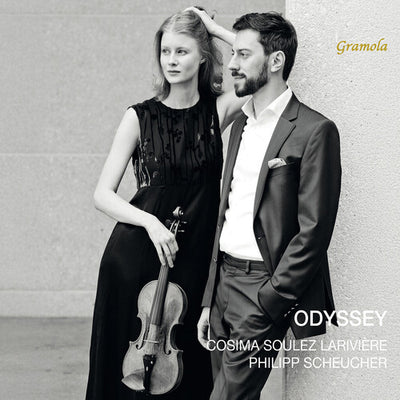
Under the title ODYSSEY, the French-Dutch violinist Cosima Soulez Lariviere and the Austrian pianist Philipp Scheucher lead us through a legendary world, as it were, beginning with Karol Szymanowski's "Myths" op. 30. The three movements "Arethusa", "Narcissus", "Dryads and Pan", which are strongly influenced by Impressionism, refer to motifs from Greek mythology and are considered a milestone in the duo repertoire for violin and piano due to their various innovative playing techniques. The following two-movement Sonata in E-flat major op. 11 No. 1 by Paul Hindemith is also influenced by Impressionism, although Hindemith's very specific, simple and "classical" musical language clearly shines through at all times. The Sonata for Violin and Piano by the American composer John Corigliano from 1962/63 captivates with it's diverse moods, which are underlined by impressively virtuoso as well as lyrical or complex rhythmic elements. The final piece is the breathtaking "Aria" by his compatriot Kevin Puts, described as a "master of polystyle", who has enjoyed great success in recent years with his latest opera "The Hours".
La contemplazione offers a glimpse into “Viennese Classicism” through two authors who, while almost antagonistic, were also complementary and contemporary: Hummel and Schubert. In the late 1820s, European music was at a fascinating crossroads: the musical style that had dominated the old continent since 1780 (commonly known as “Viennese Classicism”) was in crisis and entering its final phase. At a time when tradition and innovation coexisted, emerging expressive needs pushed composers to seek alternatives to classical canons. La contemplazione offers a glimpse into this period through two authors who, while almost antagonistic, were also complementary and contemporary: Johann Nepomuk Hummel (1778-1837) and Franz Schubert (1797-1828). About the Instrument: Fortepiano Graf 1826/1827 (Edwin Beunk collection)
In an environment of fierce competition among various piano manufacturing houses, Conrad Graf emerged as the reference brand in Vienna, even being named the official constructor of the empire. Graf built the piano used in this recording in 1826 or 1827 with a range of six and a half octaves.
In this recording, you will find a dialogue between two of the most essential funerary musical works of the German Baroque.
In 2022, we celebrated Heinrich Schütz, a central figure of the album, on the 350th anniversary of his death. As a culmination of a series of projects around his person and work, this recording wants to serve as a tribute to an extraordinary musical legacy that found in Johann Sebastian Bach, its greatest supporter. The manifest bond between both composers here is seen in the way in which death is shaken and beaten for later, collected from within our soul, be restored and sublimated by two artistic personalities capable of transcending a rich amalgamation of religious, cultural, and musical aspects around the ars moriendi of his time. Schütz’s Musikalische Exequien and Bach’s Actus Tragicus stem from a creative attitude toward death that is very close to home one from the other. Thus, it is not by chance that with their listening, both works fill us with peace and the deep sense of rest with which they do it.
In 1907, Florent Schmitt composed music to accompany a ‘mimodrame’ danced by Loïe Fuller, La Tragédie de Salomé. His score is bursting with colour, energy, and voluptuousness – and also with oriental influences stemming from his travels to Morocco and Constantinople, where he discovered the howling dervishes. The final scene features the heart-rending ‘Chant d’Aïça’, an oriental melody sung by a soprano. This music, though bold and modern for the listeners of 1907, nonetheless aroused the admiration of another composer, Igor Stravinsky, to whom Schmitt dedicated the Symphonic Suite he subsequently derived from the work. However, Alain Altinoglu, at the helm of the Frankfurt Radio Symphony Orchestra of which he has been Music Director since 2021, has chosen to record the original version of this landmark of early twentieth-century French music. The beautiful Chant élégiaque, in its 1911 version for cello and large orchestra, completes this programme.
The LSQ celebrates Haydn's ideas with wit and charm as well as brilliance in the expansive solo passages which revive the hype of 1790s Vienna and London. This is Haydn at the height of his creative powers and a quartet to the highest performance standards. The natural, unobtrusive recording technique elevates these Classical masterpieces to their rightful pedestal.
Italian Baroque Trumpet Concertos / Reiner, Interpreti Veneziani
Naxos
CD
$19.99Oct 11, 2024
The brilliant dynamism of Italian Baroque music is at it's most virtuosic and thrilling in works featuring the solo trumpet, whether in original compositions or transcriptions. Albinoni's astonishing ornamentations and the luminous dexterity of Vivaldi's concerto both represent each composer's distinctive character, heard alongside works by Corelli, Zipoli, Baldassare and Torelli. Domenico Sarri's Sinfonia a 5 is heard here in it's world premiere recording. Thomas Reiner is an acknowledged exponent of this repertoire with his performance of German Baroque Trumpet Concertos (Naxos 8.551419) described as 'first rate and spirited... an excellent protagonist' by Fanfare magazine.
J. S. Bach The English Suites BWV 806-811 Zhu Xiao-Mei piano After a six-year hiatus, acclaimed pianist Zhu Xiao-Mei returns with a deeply personal and masterful recording of J.S. Bach's English Suites. This release completes her heartfelt journey through Bach's piano compositions, marking another significant milestone in her extraordinary career. This project is the culmination of years of meticulous preparation and an intimate relationship with the music. Zhu Xiao-Mei's approach is characterized by a profound connection to each piece, allowing her to bring out the subtleties and nuances that make Bach's work so timeless. Her dedication to living with the music day-by-day ensures a performance that is both authentic and deeply resonant. J. S. Bach The English Suites BWV 806-811 CD 1 1-7 8-17 18-24 CD 2 1-7 8-14 15-22 Available worldwide English Suite No. 3 in G minor, BWV 808 English Suite No. 1 in A major, BWV 806 English Suite No. 2 in A minor, BWV 807 English Suite No. 5 in E minor, BWV 810 English Suite No. 4 in F major, BWV 809 English Suite No. 6 in D minor, BWV 811 The English Suites, with their blend of lively orchestral and delicate intimate moments, have a special place in Zhu XiaoMei's heart. She describes them as "a music of intimacy," making this recording particularly unique. Despite the challenges, including pandemic-related delays and finding the perfect piano, her dedication to authenticity shines through in every note. Zhu Xiao-Mei's insightful and sensitive performance invites you into a world of subtlety and depth, offering a refreshing contrast to today's fast-paced musical landscape. This album is not just a completion of her Bach recordings but a milestone that underscores her exceptional artistry and unwavering devotion to Bach's timeless music.
On this recording, the piano quintet led by violinist and conductor Remy Ballot juxtaposes Franz Schubert's famous Trout Quintet with Johann Nepomuk Hummel's much less frequently heard Piano Quintet, composed almost 20 years earlier. What both quintets have in common (apart from the fact that they remained unpublished for several years after completion) is the fact that they were - according to the contemporary convention - still scored for double bass, which would usually become replaced by a second violin in the later course of music history. Yoko Urata-Fog, piano, Remy Ballot, violin, Iris Ballot, viola, Jorgen Fog, cello and Manfred Hecking, double bass, impress with their uncompromising musicality and unpretentious playing, which brings out the diverse layers of sound in a unique, almost analytical way, and prove the point that after many dozens of recordings of "The Trout" (yet far less of the Hummel quintet), there still remains something genuine to be expressed with these "Classics".
Haydn: Syphonies Nos. 6, 7 & 8 (Le matin, Le midi, Le soir)
Coro
CD
$19.99Nov 28, 2025
Recorded live at Boston's magnificent Symphony Hall, CORO brings together on one album the Handel and Haydn Society's recordings of Haydn's early Symphonies Nos. 6, 7 & 8. Known as Le matin, Le midi and Le soir, the three works, written shortly after Haydn joined the court of Prince Paul Anton Esterhazy, are amongst the most striking of the composer's early symphonies. Characterised by unusual virtuoso writing across the orchestral ensemble, all three works feature extensive solo passages for the wind, horn and strings, including rare solo writing for the double bass and bassoon, and demonstrate Haydn's emerging skill as a master of symphonic writing.
On this 2012 recording, previously available on Decca, Robert Hollingworth leads his celebrated ensemble, I Fagiolini, on a journey unearthing incredible lost works from the late Renaissance and early Baroque, adding to their acclaimed 'Colossal Baroque' series on CORO. 1612 - the death of Giovanni Gabrieli, master of the 'Massive Baroque' and most brilliant of Venetian multi-choir composers but also the publication of Lodovico Grossi da Viadana's very modern four-choir Vespers collection. I Fagiolini's recording remains the only version of these spectacular Vespers as well as of Giovanni Gabrieli's unparalleled military-evoking Magnificat for seven choirs (meticulously researched and reconstructed by Hugh Keyte) and replete with fanfares and canon blasts.
Bittersweet - Sophie Pacini's own collection of encouraging masterpieces that feels like a gentle embrace in the midst of crises and challenges. In a world often dominated by uncertainty and stress, the music on this album offers a powerful solace - a reminder that beauty, pain and hope are mysteriously intertwined. Inspired by an intimate, moving concert in a women's shelter in Munich, the ECHOKlassik Award winner was passionate about giving hope and light to many otherpeople in dark hours with a compilation of her personal heartfelt pieces. It is probably the most personal album project to date by the Munich-born artist, who -unintentionally dubbed a "wunderkind" - had to fight against discrimination, exclusion and resentment from an early age and always drew all her strength from her music. Each piece on "bittersweet" is a little encouragement, a reminder that even in themost bittersweet moments of life, the beauty of music can lead to new strength. Sophie Pacini's interpretation, between virtuosity and sensitivity, opens doors to aworld that provides encouragement in difficult times - and shows that true strengthlies especially in fragility.
Music without remembrance is not possible, affirms pianist Sophie Pacini, and "Rimembranza" is the title she has chosen for her 6th solo album. Here, the music deals with hope and doubt, pain and deliverance, bitter loss and - most of all - memory. At the album's core she has placed two works she finds strongly connected with pain, transience, and death: Mozart's Sonata in A minor K.310 and Schubert's Sonata in A minor D 784. Mozart's mother died in Paris shortly before he wrote his sonata. His twelve variations on the French folk song "Ah, vous dirai-je, Maman!" thus already bear the seed of the Sonata in A minor in themselves. "They are Mozart's rimembranza addressed to himself", she suggests. With their plaintive title harking back to the past, these variations open the curtain on Sophie Pacini's album. Before it falls again, we hear Schubert's two Impromptus Op. 90: sounding like excerpts from his sonatas, they "brush against our memory like two bittersweet rimembranzas from the past", she muses. The last act is introduced by Schubert's "Standchen" on a love poem by Ludwig Rellstab. The subject of love likewise closes the album; from the film "Cinema Paradiso", we hear the love theme composed by the recently departed Ennio Morricone and his son Andrea - a tribute track to Sophie Pacini's second homeland, Italy.
This compilation of the greatest sacred compositions for bass and organ finds it's ideal performers in singer Gunther Groissbock and Matthias Giesen on the Bruckner Organ in St. Florian. The repertoire spans from J. S. Bach through Haydn and Mozart to Bruckner and Brahms and ends with the conclusion of the oratorio "The Book with Seven Seals". Here, two of the most powerful instruments meet, not in conflict, but complementing each other to create a sound experience of exceptional quality. Three centuries come to life in the great Basilica of St. Florian, radiating their brilliance within the unique acoustics of this exalted church. Clemens Horak, Manuel Huber and Wolfgang Vladar, all members of the Vienna Philharmonic Orchestra, complement the outstanding duo Groissbock/Giesen as instrumentalists.
The Festival Organ of the Klosterneuburg Abbey Basilica
Gramola Records
CD
$24.99Oct 18, 2024
Festival organ, grand organ, monumental organ - when it comes to talk in Klosterneuburg about Johann Freundt's masterpiece from 1642, people almost exclusively use these superlatives. As the musical jewel of the Augustinian Canons' monastery Klosterneuburg, it radiates far beyond the borders of Austria and is an important tourist attraction for organ enthusiasts in Central Europe. If intending to portray such a magnificent instrument as the festival organ in the context of a CD, one soon has to deal with the phenomenon of being "spoilt for choice". If you look at the European repertoire for organ from around 1642, you quickly realize that much of it can be performed very well on Johann Freundt's Great Organ. Even if you look a few decades or centuries further back, you will still discover pieces in the organ literature that harmonize wonderfully with the festival organ. This portrait CD is intended to give a small insight into the great variety and possibilities of the organ and also demonstrate it's modernity. After all, it is up to us whether an instrument is considered modern or not. In the opinion of the author of these lines, this organ can be played much more authentically than many a new organ, on which, in today's opinion, "anything can be played". Johannes Zeinler
Sensual - that's undoubtedly the word that best describes the music on this album dedicated to the early works of Josquin des Prez. In his early thirties, the composer was already developing a unique sense of sound and language. He knew how to make rhythms resonate, rendering them sometimes enveloping, sometimes liberating. His melodies are full of life - sometimes gentle, sometimes sinuous - and his duets seem to be made of glances exchanged between voices. Josquin composes with great finesse, playing on the contrasts between the intimate and the radiant. As in the art of his time, even when he addresses religious subjects, his music retains a sensual beauty, full of emotion and humanity.
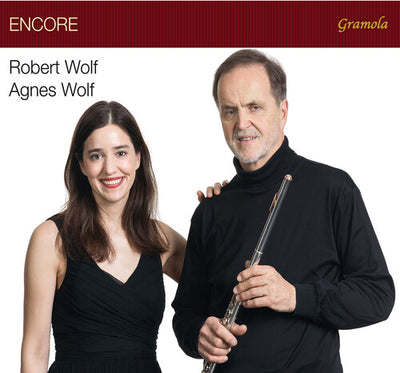
The applause continues, even some cheers can be heard: definitely get out again, take a grateful bow! And present some more? Something full of verve and vigor to increase the enthusiasm even more? Or would you prefer something calm and soothing for the soul? - Although encores have certainly not been at the heart of musical performances, they are most often an integral part during the conception stage of a concert evening's program. As sort of an encore to his lifetime's achievements, Robert Wolf, who was principal flute player of the Vienna Symphony Orchestra for almost 40 years, and his daughter Agnes Wolf, piano, pay tribute to the wide range of encore pieces from his many years of concert activity on the present CD "ENCORE". In addition to original works by W.A. Mozart, M. Blavet, C. Debussy, M. Ravel and J.S. Bach, there are also arrangements of well-known pieces by C.W. Gluck, F. Schubert, D. Shostakovich, G. Faure and J. Lanner, among others.
Harry Christophers has been at the forefront of choral music for the last 45 years and this album, in celebration of his 70th birthday, demonstrates the breadth of his musical passions and the wealth of repertoire he has recorded over the years. Featuring 39 tracks hand-picked by the conductor, the works on this collection document Harry Christophers' life in music-from his early years as a chorister at Canterbury Cathedral, through his time at Magdalen College, Oxford, and subsequent founding of The Sixteen, to more recent years as Artistic Director of America's renowned Handel and Haydn Society. This collection charts his discovery as a boy of Purcell and Poulenc to his enduring love for the music of Victoria and Handel and his celebrated partnership with James MacMillan. Each track holds special significance and the stories behind the choices are documented in notes especially written by Harry Christophers for this album.
Hardly any combination of instruments is more appealing than a string quartet and a clarinet; together they make a magical melange. The Hagen Quartet and Jörg Widmann have recorded Mozart's Clarinet Quintet, a 'work among friends', in this irresistible blend. Jörg Widmann, clarinettist and composer in equal measure, picks up on the omnipresent themes of 'floating, love, and chant' in Mozart's notes and creates a weighty counterpart to Mozart's popular work with his own clarinet quintet, which is available here in a world premiere recording.
Bach, Cassadó, Fabregas, Marais & Migo: The Voice of Casals / Morelló Ros
IBS Classical
CD
$13.99$17.99Save 20%May 19, 2023
The cellist Roger Morelló has intercalated three sarabands from the Suites for Cello Solo by Johann Sebastian Bach. The first is the one included in the Suite No. 1, whose prelude served as primary material for the work by Marc Migó. The second saraband that appears is the one from the Suite No. 2, which is in the key of D minor, and the third is the E flat major saraband. Along with these pieces, we encounter the Suite for Cello Solo by Gaspar Cassadó – a renowned Casals pupil and one of the most legendary violoncellists of the twentieth century as well as a composer. Along with this piece, Morelló has added his cello arrangement of an original work for viola da gamba from Les voix humaines by Marin Marais, which is the piece that lends this album its title. Side by side with these historical references that have become timeless, Roger Morelló includes two contemporary works. One of them is formed by the Variations on the name of Casals by Marc Migó, a work commissioned by Morelló himself, to whom it is also dedicated. The other contemporary composition that Morelló wanted to include on this album is a work that he commissioned from Elisenda Fábregas, who in turn dedicated it to him. It has Catalan dances as its title and consists of four dances.