Composer: Jean-Marie Leclair
29 products
Itzhak Perlman - Concertos, Sonatas & more...
R E V I E W S of some of the recordings that make up this set:
It's always fascinating to go back to the early recordings of artists who are firmly ensconced in the classical music pantheon. Such is the case with this recording of the Tchaikovsky and Sibelius concertos made by Itzhak Perlman in the late 1960s.
The Tchaikovsky concerto was written for virtuoso violinist Leopold Auer who actually thought the work unplayable. The young Perlman brings passion and flash to the concerto; his playing is suitably poetic in its sentimental moments and fiery in its finale. Sibelius's concerto was written about the same time that he wrote his second symphony. Perlman grasps the concerto's romantic soul while standing up to its demanding modernist technical challenges. As an added bonus the recording includes Dvorák's Romance, a gentle idyll that displays Perlman's lovely legato playing. -- MUZE [review of RCA 63591]
This album continues the tribute to classic film music from John Williams and Itzhak Perlman's CINEMA SERENADE disc. It is an undeniably old-fashioned and romantic album, befitting the era the music is drawn from. On "As Time Goes By" from CASABLANCA, Perlman proves that he's still one of the world's premier concert violinists, playing the theme with palpable ache. Most of these compositions are by the classic film composers--Alfred Newman, Miklós Rózsa, Max Steiner--with one notable exception. William Walton's theme for HENRY V gets a suitably regal, yet restrained, treatment. Perlman sounds as if he's having a good time with the sprightly Irish motifs of "The Quiet Man." The orchestrations are rich and dramatic, and the recording quality is superb. This album is highly recommended to anyone who remembers when a soundtrack was more than just a bunch of flavor-of-the-month pop tunes. -- MUZE [review of SONY 60773]
Prokofiev's F minor Sonata—surely his greatest chamber work—opens bleakly, then flowers to harmonic richness before switching to a sharp-edged Allegro brusco, a deeply introspective Andante and a closing Allegrissimo that recalls (or anticipates, depending on its precise chronology in Prokofiev's thinking) the finale of the great Eighth Piano Sonata... Perlman's is an immensely assured, sweet-centred reading, delicate where needs be (the ''wind in a graveyard'' passages of the first movement, for example) and yet with a Heifetzian resilience that both sonatas willingly respond to... When it comes to the delightful Second Sonata—of rather less import, and a second-hand utterance (the original was for flute and piano)—Perlman and Ashkenazy play with astonishing virtuosity and here their visceral virtues win hands down, especially in the Scherzo... the playing has real class, the recording is clean and there's a substantial bonus in Perlman's accomplished 1966 version of the Second Violin Concerto, where Leinsdorf and the Boston Symphony trace and characterize the score's every subtle detail—especially among the woodwind. That, for me, is the disc's most indelible interpretative feature. -- Gramophone [review of RCA 61454]
L'Opera des Operas / Niquet, Le Concert Spirituel
To celebrate 30 years of the Concert Spirituel, Hervé Niquet pays homage to the French musical patrimony of the 17th and 18th centuries, to whose exploration he remains passionately devoted. In close collaboration with Benoit Dratwicki and the Centre de Musique Baroque de Versailles – which also celebrated its 30th anniversary in 2018 –they have devised an intriguingly unconventional programme idea. Following the example of Louis XIV, who in 1671 asked Lully to create a Ballet of ballets consisting of extracts from the thirty or so ballets that the composer had put on at court, they have conceived ‘An Imaginary Opera,’ a veritable ‘Opera of Operas’: around thirty extracts, with well-known repertoire alongside rarities – some completely unknown and unpublished – have been put together to create a plot centered around three dramatic archetypes of the period: a princess in love, a witch queen (her rival) and a courageous prince. All the themes of French baroque opera are illustrated in turn, according to the rules of the genre: battle, tempest, sorcery, love duets, religious invocations, and sleep. The virtuoso arias, dazzling ballets and imposing ceremonial choruses are by Lully and Rameau, naturally – but also by Campra, Marais, Bertin de La Doué, Destouches, Stück, Gervais, Colin de Blamont, Rebel, Francœur, Montéclair, Leclair and Dauvergne. Brilliantly brought to life by the very finest of today’s baroque lyric artists, this recording was made at the Opéra Royal de Versailles.
Sol & Pat: Gabetta & Kopatchinskaja Play Music from Leclair to Ligeti
This album celebrates a musical rapport that has lasted for twenty years and, above all, a true friendship: ‘We’re like two sisters, on stage and in life’, as Patricia Kopatchinskaja and Sol Gabetta like to say. In parallel with their dazzling solo careers, they have frequently got together for concerts in trio or double concerto formation (like the one written for them by Francisco Coll, recently released on ALPHA580). But they have conceived their new recording for a rather rare combination, the violin- cello duo – with the aim of choosing pieces they found interesting either stylistically or for the way they use the instruments. The programme includes the Duo written by Zoltán Kodály in 1914, which was not premiered until 1924, two years after Maurice Ravel’s Sonata for violin and cello, along with a few forays into the Baroque period (Leclair, Scarlatti, Bach) and, of course, works by twenty-first- century composers to whom the two soloists are very close: Jörg Widmann, Francisco Coll and Julien-François Zbinden are on the itinerary of this introspective journey into the generous world of two total artists.
The Golden Hour - French Baroque Violin & Viol Music / Boulanger, Pierre, Fortin
We are around the time of the Regency, at the political crossroads between Louis XIV and Louis XV. The viola da gamba was enjoying its last hours of glory in France, while the violin was beginning to take centre stage. The Golden Hour, which generally refers to the periods after sunrise and before sunset when the light changes, evokes here those years of convergence, even confrontation, between a viola da gamba in the twilight of its life and a violin at the dawn of its soloist destiny.
Comedie et tragedie, Vol. 2 / Tempesta di Mare
The comédie-ballet was the brainchild of the French comedic actor, singer, dancer, and playwright Molière. After ten years of collaborating with Lully, a Suite from whose Le Bourgeois Gentilhomme features in Volume 1, he turned to Charpentier. The outcome was Le Malade imaginaire whose fourth performance would prove Molière’s last, as he died on stage.
Scylla et Glaucus is the only stage work by Jean-Marie Leclair, the foremost violinist of his generation and a composer whose late opera shows the clarity of his orchestration and places its focal point on the strings, as one would expect.
Les Fêtes de Polymnie is contemporary with Leclair’s opera but more forward looking in its approach, and famous for the ingenuity of Rameau’s colorful orchestration, particularly obvious in the overture.- Chandos
Review:
I particularly liked Tempesta di Mare's vigorous, spiky strings in Leclair's 'Air des silvains' and the 'Premier air de demons'…delightful music, delightfully played.
– Gramophone
Unico Wilhelm van Wassenaer & the Recorder in the Low Countries / Bosgraaf, Corti
Sybrandus van Noordt and Unico Wilhelm van Wassenaer are the only native Dutch composers represented on Erik Bosgraaf’s latest album, but his selection nonetheless illustrates both the high quality of musical culture in a nation without aristocratic courts, and also the central place of the recorder within that culture. Andreas Parcham, Johann Christian Schickhardt and Jean-Marie Leclair are known to have lived and worked in the Republic; Jean-Baptiste Loeillet was born in Ghent and worked in Lyon, but his recorder sonatas were all published in Amsterdam. History has been a little unkind to Unico Wilhelm van Wassenaer, remembering him latterly above all as the composer of the attractive Concerti Armonici which were previously attributed to Pergolesi. That such a confusion could have arisen in the first place is testament to the originality and craftsmanship of a musician-composer who was evidently in touch with the latest Italian developments in Italian style from his home in The Hague.
The three sonatas on this album expand our understanding of van Wassanaer, and they are complemented by little-known composers with a similarly internationalist outlook such as the Danzig-born Andreas Parcham and the well-travelled Jean-Marie Leclair. The four-movement suite of lively character pieces by Fiocco is extracted from a collection originally written for harpsichord, and opens with an Allegro made famous through a violin-and-piano arrangement recorded by the likes of Menuhin and Perlman; Bosgraaf restores its original character. In the second half of the 17th century, the recorder underwent a revolutionary development which turned it into a sophisticated instrument. Erik Bosgraaf plays seven different instruments here, ranging from sopranino to bass, all of them built with a particular range of pitch but also distinct palette of timbres.
REVIEWS:
Bosgraaf is a virtuosic player, whose performances are always energetic. Sometimes he tends to go overboard, for instance in his choice of tempi and the addition of ornamentation. Here he behaves almost impeccably. Some movements in Schickhardt's sonata are played very fast, but that seems justified. Bosgraaf makes a nice difference between the two ensuing allegros in the middle of this sonata. There is just one issue: in the opening movement of Van Noordt's sonata it was decided to add some chirping. I don't like this kind of gimmick, and the music doesn't need it. In a time when the use of a string bass seems the rule, and the participation of a plucked instrument almost inevitable, it is nice that the performers have confined themselves to the harpsichord for the basso continuo. The two artists often collaborate, and Corti is again an excellent partner, who also delivers a fine performance of the pieces by Fiocco.
In short, this is a delightful disc which will appeal not only to recorder aficionados.
-- Musica Dei Donum
Most of us haven’t heard of Unico Wilhelm van Wassenaer (1692-1766), but that’s who wrote more of the music on this program than anyone else. Some of his contemporaries—Fiocco, Leclair, Loeillet, Van Noordt, Parcham, and Schickhardt—will be more or even less familiar. They were all in some way related to the Dutch Republic. 7 members of the recorder family are used with a modern copy of a 1732 harpsichord tuned at A=392, generally considered the French standard. Erik Bosgraaf sings, whatever the size and pitch of the instrument he’s playing. Francesco Corti employs the buff stop now and then but accompanies ably all the way through. He gets the Fiocco to himself: four movements that conclude the First Suite of Harpsichord Pieces, Op. 1. Balance between the two players and through the range of the harpsichord is excellent. Ornamentation keeps things lively, so your attention never flags. Since there are 38 tracks, all of them are relatively short, making for plenty of variety. They may go by even faster than you wish, because everything is worth hearing again! Music like this—often with a strong influence of Italians like Vivaldi—is how 18th Century Dutch passed the time when they had leisure, and when you have leisure you’ll enjoy it too. Also consider hearing from Jeremias Schwarzer and Ralf Waldner on Genuin 19646 (S/O 2019, p 177). A 28-page booklet gives notes by musicologist Thiemo Wind in English and German along with many illustrations. This recording was made in a church apparently next to a field with cows, so the range of pictures extends from the sacred to the profane or mundane, but that’s the only mundane thing about this collection!
-- American Record Guide
Leclair: Scylla & Glaucus / Plewniak, Il Giardino d'Amore
What if the tour de force of French opera in the Age of Enlightenment was Scylla et Glaucus? At the age of 50, the famous violinist Leclair decided to write his first operatic piece, investing irrepressible energy in it. The drama is unrelenting: the nymph Scylla spurns the advances of the Demigod Glaucus, who seeks out the sorceress Circe to cast a spell on her; Circe is in love with Glaucus, drives Scylla to madness and turns her into a deadly rock… An infernal scene, an ocean storm and final cataclysm are employed to give striking relief to this trio of unappeased love, the effusions of irresistible beauty. The conductor and violinist Stefan Plewniak conducts a glorious stage of soloists in the eddies of vengeance!
Jean-marie Leclair: Violin Sonatas, Book 2 Nos. 6-7 And 9-12
Five years after the publication of his first book of sonatas, Jean-Marie Leclair, the great exponent of the emerging French violin school, released his second book. He had continued to be influenced by the lyricism and virtuosity of Italian models but, concerned that the technical demands of his writing might prove excessive, ensured that a handful could be played either on the flute or the violin. Yet he continued to make considerable advances and the level of melodic invention and expressive intensity remained untouched, the result of a fusion of Italianate fire and French elegance. Together with Naxos 8.572866 this is the first complete recording of Leclair’s Op 2 Sonatas.
Jean-marie Leclair: Violin Sonatas, Book 2 Nos. 1-5 And 8
LECLAIR Violin Sonatas, op. 2, Nos. 1–5, 8 • Adrian Butterfield (vn); Jonathan Manson (vdg); Laurence Cummings (hpd) (period instruments) • NAXOS 8.572866 (77:50)
Several years ago, the three Naxos discs comprising Adrian Butterfield’s performances of Jean-Marie Leclair’s first book of violin sonatas (Naxos 8.570888, 8.570889, and 8.570890) appeared, and I highly recommended them in Fanfare 35:3. Butterfield and harpsichordist Laurence Cummings have now returned, with Jonathan Manson rather than Alison McGillivray playing the viola da gamba, with an installment of six sonatas from the composer’s second book. Butterfield’s own notes relate that this set includes five sonatas for violin or flute (two occurred in the first book); and Butterfield emphasizes that Leclair intended these works for a wider group of performers.
The program, in order, opens with one of the sonatas in which Leclair offered the choice of violin or flute. Its four movements begin with an arch Adagio in which Manson displays the richness of the seven-string gamba made in 1978 by Curtis Bryant (Butterfield plays a violin made by David Rubio in 1996 after the 1734 Rode Guarneri del Gesù, while Cummings plays a 2000 harpsichord by Andrew Garlick based on a 1748 model). The book of sonatas appeared in 1728, after, according to Butterfield, Leclair had studied for a time in Turin with Corelli’s student, Giovanni Battista Somis. William S. Newman suggests that, through Somis, Leclair made the acquaintance of the music of both Corelli and Vivaldi; and later he would come under the spell of Corelli’s student Pietro Locatelli, whose devilish virtuosity appears, though restricted mainly to the lower positions, in Leclair’s later books of sonatas. Butterfield draws comparisons between Leclair’s allegro s and Corelli’s, but Somis’s sonatas, at least the later ones of op. 4 (written in 1726, about the year Leclair visited him), fall into three rather than four movements, as all these do. Somis’s works also don’t push the technical envelope far beyond Corelli’s—they’re very tame, as these by Leclair, for the most part, prove to be. Nevertheless, the Second Sonata in Leclair’s set employs double stops freely, and represents generally a more advanced technique. But Butterfield and his ensemble find the commonalties in these works, whatever their instrumentation or technical demands, in the starchy French style in which they present what Leclair had absorbed of the Italian style from his travels. And in the Finale of that Second Sonata, they abandon themselves to an Italian energy that recalls Vivaldi’s, featuring cadenza-like passagework.
The Third Sonata returns to the instrumental choice offered by the First Sonata—violin or flute—and therefore to the more moderate technical demands such a choice implies. Butterfield points out in the notes the melodic affinities of the opening movement of the Fourth Sonata to Corelli’s style, a parallel he and the ensemble exuberantly draw in the performance itself. But those familiar with Somis’s sonatas may find that these works resemble his as closely as they do Corelli’s. In any case, the ensemble brings sonorous virtuosity to the third movement, a double-stopped “Aria: Gratioso .” The Finale combines Corelli’s melodic manner with technically more demanding swirling double stops.
The Fifth Sonata again suggests the simplicity of an arrangement for violin or flute, but its first movement offers Manson, again, an opportunity to display the richness of both his tone and his musical imagination. After a Corellian (or Somisian) Allegro of considerable melodic and rhythmic verve—at least in this performance—the Sonata proceeds through an elegant Gavotte to a piquant Finale, in which Butterfield’s tart ornamentation lends a brisk energy. Butterfield points out that Leclair conceived the Eighth Sonata as a sort of duet for violin and gamba, and his interaction with Manson in the first movement bears out this observation. Its imitative second movement takes advantage of the same manner of writing, even if it isn’t so thorough-goingly polyphonic as similar passages in Corelli’s church sonatas. But Corelli’s personality shines through this movement’s melodic contours as well as through its counterpoint. The Sarabanda offers particularly rich opportunities for conversation between the violin and gamba; the Finale contains chains of trills that enliven its melodic discourse.
Butterfield remarks that violinists have not taken up Leclair’s first two books of sonatas, perhaps because of their modest demands; perhaps his insightful and cleanly-recorded performances (along with those of the first book) will revive some interest in them. Strongly recommended—and not just for the violinistic moments.
FANFARE: Robert Maxham
Jacques Thibaud plays Franck, Debussy, Fauré, Ravel, Saint-Saens & Mozart / Thibaud
| Jacques Thibaud is considered to be one of the early 20th century’s leading violinists and chamber musicians. Such composers as Eugène Ysaÿe and George Enescu dedicated works to him. His memory lives on in such bodies as the Jacques Thibaud String Trio, founded in 1994, who pay homage to his lifelong love of ambitious and eloquent music-making in ensemble. The violinist was born in Bordeaux in the ancient lands of Aquitaine in south-west France, in Département Gironde, on September 27, 1880. His father had recognized his son’s musical talents and was still giving him violin lessons when Jacques gave his first public performance in Bordeaux at the age of eight. In 1893, when he was 13, he began studying at the Paris Conservatoire with the eminent Belgian violinist Martin Pierre Joseph Marsick (1847-1924), winning the conservatory’s Premier Prix in 1896. He also took instruction from Marsick’s compatriot Eugène-Auguste Ysaÿe (1858-1931). From 1940 Jacques Thibaud taught at the Paris school of music directed by the French pianist, piano teacher and writer on music Marguerite Long (1874-1966), with whom he gave many concerts. The two artists initiated the Long-Thibaud competition for pianists and violinists (Concours international Marguerite Long–Jacques Thibaud) in 1943. The violinist later taught at the École normale de musique de Paris, founded in 1919 by Alfred Cortot , and in the 1950s directed summer courses at the Accademia Musicale Chigiana in Siena, Italy. The 73-year-old violinist’s life was tragically cut short on September 1, 1953 – 10 days after his last concert in France – when the plane taking him to Tokyo crashed into Mont Cimet near Barcennolette in the French Alps. |
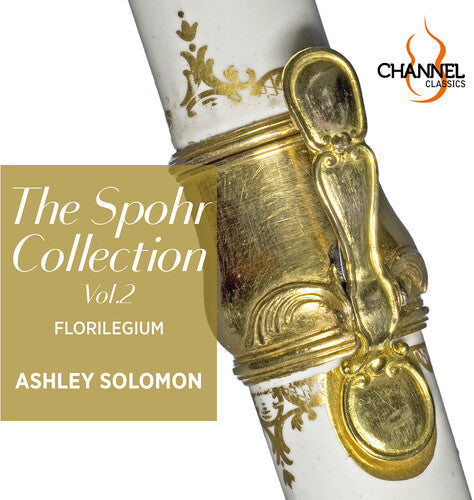
The Spohr Collection, Vol. 2 / Solomon, Florilegium
Internationally acclaimed flutist Ashley Solomon and period ensemble Florilegium present “Spohr Collection, Vol. 2”. Ashley Solomon: “The opportunity of playing original flutes from the 18th century is a rare occurrence. Whenever the chance presents itself, it must be seized immediately!”. On Solomon’s remarkable Spohr Collection, Vol. 1 (CCS43020), he set himself a challenge to record on 9 original flutes, mostly domestic chamber music, together with his colleagues from Florilegium. This new release, Spohr Collection, Vol. 2, features six flute concertos from the 18th century on six unique flutes; some made of ivory, various woods (boxwood and ebony), and one of porcelain and gold. Each instrument is matched with repertoire from the same period it was initially made and played in. This offers a unique insight into the world of the flute virtuoso in the 18th century. These concertos by Vivaldi, C.P.E. Bach, Quantz, Leclair, Blavet and Woodcock invite the listener to experience and enjoy the rich sound world that each of these original flutes conveys.
Sarasate: Transcriptions for Violin & Piano / Tianwa Yang
The finale to this critically acclaimed four-disc series contains some of Sarasate’s greatest—and also some of his rarest—transcriptions and arrangements, some of which have been in the repertoire of violinists since they were published. They include a delectable Chopin sequence, arrangements inspired by the music of French Baroque violinists, an early and beautifully constructed Souvenirs de Faust based on Gounod, and Sarasate’s own favourite concert piece, Raff’s La fée d’amour. “Yang throws off merciless chains of double stops and finger-crippling arabesques with scintillating aplomb…simply inimitable…Bravo!” (BBC Music Magazine on Volume 3, 8.570893)
Leclair: Violin Sonatas Book 1 No 9-12 / Butterfield
LECLAIR Violin Sonatas, op. 1, Nos. 5–8 • Adrian Butterfield (vn); Alison McGillivray (vdg); Laurence Cummings (hpd) • NAXOS 8.570889 (55:14)
LECLAIR Violin Sonatas, op. 1, Nos. 9–12 • Adrian Butterfield (vn); Alison McGillivray (vdg); Laurence Cummings (hpd) • NAXOS 8.570890 (57:37)
In an age that spawned the likes of Bach and Handel, Couperin and Rameau, Jean-Marie Leclair (1697–1764) has been relegated unnecessarily to the back of the bus. He was the most cosmopolitan of musicians, yet unlike the flamboyant Handel, he seems to have had no interest in political self-promotion. Leclair’s music and violin playing were his focus; the violin sonatas recorded here are the first true reconciliation by a Frenchman of the two most disparate musical styles of the era, the French and Italian. He achieved this by careful study and unselfish interaction with many musical luminaries of the period—Quantz, Locatelli, Forqueray, Chéron. The fact that Leclair could not abide the political machinations at court—he quarreled with Pierre Guignon over the choice of repertoire—should not surprise us. The dispute escalated, and in 1737 Leclair was forced into exile in the Netherlands. He returned several years later and entered into semiretirement, which consisted of composing, teaching, and a failed attempt at the theater. The final episode of Leclair’s life was not so pleasant; after Leclair and his wife had separated, he was found late one night murdered in his apartment. A disenfranchised nephew was suspected, but for some reason never brought to trial.
Perhaps all this is secondary to the music, which is sui generis . Each of the sonatas recorded here—the complete Book 1—is cast in the sonata da chiesa format, with predominantly Italian titles: Adagio, Allegro, Grazioso. Yet there are a few characteristic French dances thrown in for flavor: gavotte, sarabande, minuet, gigue. Above all, the music owes its genesis to Corelli, but it is more than mere imitation. Think of Italian chamber music with a French accent—the copious, written-out ornaments are especially indicative of the French pedigree. The technical demands are quite novel for French music of the period; not surprisingly, Leclair is regarded as the father of the French violin school. Above all, this is lively, tuneful, engaging music that has been woefully neglected by period instrumentalists.
Enter Adrian Butterfield, who sets matters right with his skillful and sensitively played renditions of the sonatas of Book 1. Unless you’re the most die-hard opponent of period violin, the sheer beauty of Butterfield’s tone, enhanced by minimal, tasteful vibrato and expressive phrasing, should not fail to please. He is supported admirably by harpsichordist Laurence Cummings and gambist Alison McGillivray—although wouldn’t it have been wonderful if a theorbo had been added to the mix? The recorded sound is smooth and realistic—important virtues in a violin recording. Highest recommendation.
FANFARE: Christopher Brodersen
Leclair: Violin Sonatas, Book 1 No 5-8 / Butterfield
Recording information: St Mary's Church, Walthamstow, London, UK (01/03/2008-01/05/2008); St Mary's Church, Walthamstow, London, UK (01/08/2008-01/10/2008).
Leclair: Complete Flute Chamber Music
Includes work(s) by Jean Marie Leclair. Soloists: Fenwick Smith, John Gibbons (classical), Laura Blustein, Laura Jeppesen, Christopher Krueger.
Fiery And Sublime: The Sources Of Quantz's Inspiration
The booklet note to this CD, by Brian Berryman, leader of La Ricordanza, tells us that one of Quantz’s obituarists (unnamed), described his flute-playing as “learned, fiery and sublime”. When Charles Burney met the elderly Quantz in Berlin, an encounter he reported in The Present State of Music in Germany, the Netherlands, and United Provinces (1773), he liked the man, describing him as “an intelligent man”, who “talks well concerning music”. He added, however, that “talking and composing are different things” and confessed to finding his music “frequently common and insipid”. “Fiery and sublime” or “common and insipid”?
There certainly isn’t anything here that seems worthy of the epithet “sublime”; perhaps the German “erhaben” has other overtones of which I am ignorant? Nor would I want to dismiss any of Quantz’s work on this disc as “common” or “insipid”. “Fiery”, however, wouldn’t be too bad a description of some of the writing - and here, some of the playing - in the fast outer movements of the two pieces by Quantz which are played with great vitality by La Ricordanza. Those two pieces are coupled with one each by four other composers: Leclair, C.P.E. Bach, Johann Gottlieb Graun and Michel Blavet. Samples of their work are here because one of the aims of the disc is to illustrate what its subtitle describes as “the sources of Quantz’s inspiration”.
Quantz was one those composers who achieved something more-or-less individual through synthesis rather than through startling originality. The point is implicit in something else that Burney says about Quantz, in comments based both on his conversations with the composer and on Quantz’s own Memoirs. Burney records how Quantz had benefited from his friendship with Johann Georg Pisendel. “Pisendel”, writes Burney, “had in his youth been taught to sing by the famous Pistocchi [one of the great castrati], and had received instructions on the violin, from Torelli; however, having travelled through France and Italy, where he had acquired the peculiarities in the taste of both countries, he so blended them together as to form a third genus, or mixed style of writing and playing, which was half French and half Italian. Influenced by his example, Quantz declares, that he always preferred the compound style, to the national one, or that of his own country”. Quantz himself made a kind of musical Grand Tour between 1724 and 1727, visiting Italy, France, England and the Netherlands, learning acquisitively along the way – he certainly encountered Blavet in Paris in 1726 and Leclair in Turin in the same year; Graun and C.P.E. Bach he knew, naturally, in Berlin.
The concerto by Quantz which opens the disc - and of which this is the first ever recording - has some fair Italianate fire in its opening allegro di molto and its closing vivace di molto, both movements played with appropriate panache by Brian Berryman, very well supported by the remaining members of La Ricordanza. The intervening movement, marked ‘Grave ma con affetto’ makes one feel sure that Quantz had listened to some of the strikingly expressive music of the younger C.P.E. Bach. Quantz’s Sonata in C major - if it is by Quantz, there being some doubt about the attribution - is unusual in its use of both transverse flute and recorder as solo instruments. It is an attractive and engaging piece, in which the brilliant articulation of the recorder contrasts effectively with the softer, broader tone of the flute. At times it sounds like a version of the frequently claimed antithesis between the vivacity of the Italian manner and the more sentimental idiom of the French!
Graun’s Concerto for recorder is amiable enough without making any very striking or, I suspect, memorable impression on the listener. Burney, evidently in a grumpy mood, dismissed Graun’s compositions as “languid” – and this isn’t, it has to be said, one of the compositions one would call as evidence in rebuttal of the charge. There’s no danger of sublimity here or, indeed, of very much fire. I suspect that Annette Berryman makes about as much as can reasonably be made of the piece. The Sonata by Leclair is altogether more interesting, not least for the beautiful Sarabande which forms its brief third movement and for the inventive allegro assai which follows it. Blavet’s Concerto is an interesting piece, its outer movements thoroughly Italianate and each involving a technically demanding cadenza both of which Brian Berryman negotiates admirably. The central slow movement is made up of two gavottes, in which the musical inflections are just as thoroughly French.
The Trio Sonata by C.P.E. Bach effectively steals the show. Report has it that it was first written when the composer was seventeen, before being revised around 1747 when Bach was in his early thirties, in Berlin alongside Quantz and Graun. The music takes more risks than Quantz or Graun were ever willing to take and, both melodically and harmonically it speaks with a greater individuality than either of the senior Berlin composers could regularly achieve. This isn’t just a matter of Bach being more stylistically advanced - historically speaking - than Quantz and Graun; he is simply possessed of a greater originality of musical mind. Where Quantz was a very effective synthesiser of musical idioms, Bach was something like the creator of a new one.
For anyone interested in the chamber repertoire for flute in the eighteenth century this should be informative and enjoyable listening. Since the playing is exemplary and the recording quality outstanding it can, however, be warmly commended to more than just those with a specialist interest.
-- Glyn Pursglove, MusicWeb International
Mozart, Leclair, Prokofiev: Isaac Stern & Pinchas Zukerman Live / Stern, Zukerman
| Isaac Stern's career as a solo artist, chamber musician, and much else was remarkable. These CDs, of his live performances is an eloquent testament to his musical insights, technical command and He was born in 1920, in Krzemieniec, now in Ukraine. A year later his parents came to San Francisco. Violin lessons began at eight, with Naoum Blinder. His Town Hall debut in 1937 was followed by a Carnegie Hall debut in 1943. He was the first American artist to tour the former Soviet Union. His campaign to save Carnegie Hall began in 1960. The Six-Day War of 1967 saw his iconic performance with Leonard Bernstein on Mount Scopus. His involvement with Hollywood, which began in 1948 in Humoresque, and in 1971, in Fiddler on the Roof. He recorded prolifically and received countless honors and tributes. Isaac Stern passed away at the age of 81. Born in 1948 in Tel Aviv, Pinchas Zukerman's earliest musical influence was his father. At 8 he began studies with Ilona Feher. When Stern and Casals heard the prodigy in 1961, they recommended he study in New York with Galamian. In 1967 he shared first prize at the Leventritt Competition, and debuted at Lincoln Center two years later. Since then, he has had a remarkable career as a solo violinist, violist, conductor, and chamber musician. From 1980 to 1987 he was the music director of the Saint Paul Chamber Orchestra. In 1998 he became music director of the National Arts Centre Orchestra in Ottawa. Zukerman has recorded over a hundred albums, earning 2 Grammy awards and 21 nominations. Among his honours is the Isaac Stern Award for Artistic Excellence in Classical Music. |
Leclair: Quatrieme Livre, Vol. 1
The Fourth Book of Violin Sonatas by Jean-Marie Leclair is considered the pinnacle of French Baroque violin artistry. Leclair pushed the development of violin playing further and further until hardly anyone could follow him. Accordingly; these sonatas are played by only a few and are unfortunately rarely heard. Hélène Schmitt; herself celebrated as an exceptional violinist; has for many years intensively studied the life and work of the great musician; whose career repeatedly took unexpected turns and whose life ended abruptly with a murder that is still unsolved today. On this CD she shows not only the virtuosity but also the many amazingly different colours of the sonatas. She is supported by her top-class continuo group in various instrumentations. The album is the first part of a complete recording of the twelve sonatas of the Fourth Book. The booklet contains an extensive text penned by the artist; who thus shares her personal insights into Leclair's life.
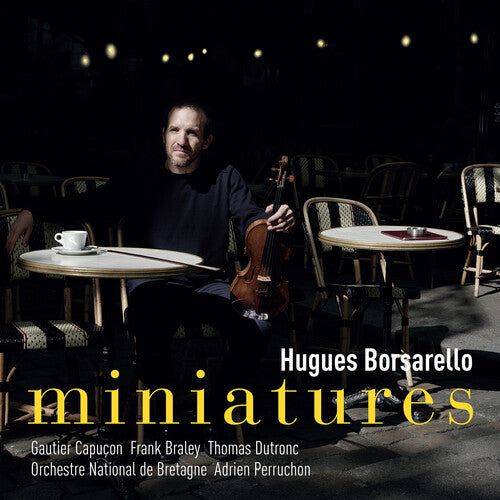
Miniatures - French Music for Violin & Orchestra / Borsarello, Perruchon, Breton National Orchestra
The French violinist Hugues Borsarello draws this programme of miniatures from the repertory of his instrument and from the great operatic arias, transcribed for violin and orchestra: ‘My idea was to relate a French history of music over the course of three centuries, in the form of short pieces.’ Lully’s Marche pour la cérémonie des Turcs rubs shoulders with arias by Bizet, Saint-Saëns and Offenbach, Satie’s Gymnopédie no.3 and Gounod’s Ave Maria. All these universally known pieces ‘are perfectly suited to the soul of the violin’, says Borsarello, who is joined by prestigious guests: cellist Gautier Capuçon for Vieuxtemps’s Duo Brillant, guitarist Thomas Dutronc for Django Reinhardt’s celebrated Nuages, pianist Frank Braley.
And this programme doesn’t neglect the classics of the violin, including Ysaÿe’s magnificent Berceuse de l'enfant pauvre. Vieuxtemps’s famous set of variations on Yankee Doodle is here performed for the first time in its version with orchestra.
The Art Of Gioconda De Vito
Les Grandes Eaux Musicales De Versailles
Leclair: Sonatas for Two Violins, Op. 3 / Hoebig, Stobbe
-----
REVIEW:
The duo have technical mastery to spare, with a bright, clear sound and beautifully clean playing. The first and second violin parts are equally important here, with constant interplay and textural depth, and it’s virtually impossible to tell them apart. The hope that these performances go beyond the technical challenges to give a sense of the man who created them is more than fulfilled in an outstanding CD.
– The Whole Note (Canada)
Leclair: Scylla & Glaucus

Jean-Marie Leclair, a pure product of the 18th century, was at the crossroads of styles, cultivating a virtuosic art combining melodies à la française and Italian virtuosity stemming from Corelli and Vivaldi. He was 49 when he undertook his first (and only) lyric tragedy: Scylla et Glaucus. A veritable masterpiece, revealing the obvious influence of Rameau, Scylla et Glaucus left a strong mark on French opera. First performed at the Académie Royale de Musique in 1746, this opera, which had a run of 17 performances and enjoyed great success, was only rediscovered in the 1980s (by John Eliot Gardiner in Lyon).
Leclair: Premier Livre De Sonates
What is most remarkable in his work is precisely the perfect equilibrium that is found between different tendencies within each work: audacity and boldness, but profoundly reflected thought, presented without haste and with a sure grasp. A perfect correctness of style, without coldness, on the other hand a certain lyricis, particularly in the slow movements, whose pace is grave and almost majestic. Sometimes there is tenderness but always it is contained: sometimes there is also ardour, ma non troppo. And so there is always a balance which also affects the way in which he combines the Italian tradition of writing and the manipulation of the violin with the French tradition. Philippe Beaussant, from the liner notes A shadowy, unstable and misanthropic character, died mysteriously from a knife wound inflicted by an unknown assailant, Jean-Marie Leclair is the real creator of the French violin school and one of the greatest violinists of the Eighteenth Century. His prolific output, almost exclusively devoted to the violin, consists of a series of collections of sonatas published throughout his lifetime, in which stand out 48 sonatas for violin and bass (four volumes). The First Book of Sonatas for Solo Violin with Basso Continuo dates from 1723 and represents Leclair's first publication. Four sonatas are performed here by Fabio Biondi, one of the most authoritative Baroque performers, joined by an all-star continuo group featuring Rinaldo Alessandrini, Pascal Monteilhet and Maurizio Naddeo.
Leclair: Le Tombeau / Cohën-akenine, Les Folies Françoises
During his lifetime Leclair was renowned for the accuracy, clarity and brilliance of his playing. His sonatas show both the boldness and the technical ease of their composer. Leclair never indulged in excessive virtuosity: in his works we find not only impressive technical brilliance but also precision, nobility and charm in their composition. This recording is devoted to the sonatas and concertos of Jean-Marie Leclair - works that deserve much greater recognition.
L'ange & Le Diable / Siranossian, van Immerseel
Jos Van Immerseel returns to chamber music and the accompaniment of young talents, two absolute priorities for him. In Chouchane Siranossian he has found a worthy partner, as gifted on the modern violin as she is on the Baroque instrument, a pupil of Tibor Varga, then of Zakhar Bron, as well as a disciple of Reinhard Goebel, whose first recording, on the Oehms label, attracted great attention (winning a ‘Diapason Découverte’). Here it is the Baroque violinist who engages in dialogue with the harpsichord of Jos Van Immerseel in a Franco-Italian program juxtaposing the music of the ‘Angel’ Leclair and the ‘Devil’ Locatelli, not forgetting Tartini’s famous ‘Devil’s Trill’ Sonata . . . Indeed, all this music is ‘devilishly’ difficult to play, but the Franco-Armenian violinist shows perfect mastery of it, combined with great inventiveness.
A French Soiree / Trio Settecento
The album also contains additional tracks by Francois Couperin that are identified by generic Baroque era dance titles without specific details: Allemande, Sarabande, Sicilenne, Gavotte.
Rameau: Jéliote, haute-contre de Rameau / Mechelen, A Nocte Temporis
| Reinoud Van Mechelen and his ensemble A Nocte Temporis continue their ‘Haute-Contre Trilogy’ with Rameau’s favourite singer, Pierre de Jéliote, probably the finest haute-contre in history. (Reminder: this is a high tenor voice, not to be confused with the countertenor!) Rameau wrote an enormous amount of music for Jéliote, who was not only a singer but also a guitarist, a cellist and even a composer. The album pays tribute to this native of the Béarn region, who was born in 1713 and died at the ripe old age of eighty-four, with a selection of airs by Rameau (from Hippolyte et Aricie, Les Fêtes d’Hébé, Platée, Castor et Pollux, Les Boréades) but also by Dauvergne, Colin de Blamont, Mondonville, Rebel and Francoeur. Though some are well known, others are much more rarely performed today. |
Chaconne for the Princess / Semeradova, Traxler
During the Baroque era, taking music and art lessons was an integral part of education of children in royal families. Anne, Princess of Orange (1709-1759), the eldest daughter of King George II of Great Britain, was fortunate in having excellent teachers. At the age of five, she moved from her native city of Hanover to London, where for eleven years her musical talent was cultivated by G. F. Handel, a celebrated composer and keyboard virtuoso. Handel dedicated a number of his works to the Princess (among them the wedding serenade Parnasso in festa), while other, highly popular, pieces of his were arranged, including by the virtuoso flautist Michel Blavet. Following her wedding and departure from London, Anne no longer took harpsichord lessons, yet at the court in The Hague, her new home, she remained faithful to the Muses and surrounded herself with excellent artists. For a few years, the court employed the superb violinist and Kapellmeister Jean-Marie Leclair, who dedicated to Anne his fourth book of solo sonatas. In the case of some of them, he mentioned – to the delight of all flautists – the possibility of their being performed by “flûte allemande” as an alternative instrument. As a soloist, the flautist Jana Semeradova has worked with distinguished early music specialists (S. Azzolini, A. Bernardini, E. Onofri, etc.) and has performed at major festivals (Utrecht, Leipzig, Halle, Versailles, Sable, Regensburg, etc.). Erich Traxler is an outstanding soloist and chamber player, who has appeared at the most renowned concert venues worldwide. Princess Anne’s remarkable musical story is the intersection of the stories of the two exceptional musicians.