Composer: Steven Edward Stucky
5 products
Beethoven: Symphony No. 6 - Stucky: Silent Spring / Honeck, Pittsburgh Symphony Orchestra
Reference Recordings proudly presents the beloved Symphony No. 6 "Pastoral" of Ludwig van Beethoven, with Steven Stucky’s "Silent Spring," in exceptional performances from Manfred Honeck and the Pittsburgh Symphony Orchestra. "Silent Spring" was commissioned by the Pittsburgh Symphony Orchestra in honor of the 50th anniversary of the publication of the book "Silent Spring", the seminal work by Pittsburgh native Rachel Carson. The music, like the book, can be heard as a call to action to love and to save nature and the earth. The Pittsburgh Symphony Orchestra, known for its artistic excellence for more than 125 years, is credited with a rich history of the world’s finest conductors and musicians, and is deeply committed to Pittsburgh and its region. This release is the thirteenth in the highly acclaimed Pittsburgh Live! series of multichannel hybrid SACD releases on the FRESH! imprint from Reference Recordings. This series has received GRAMMY® Nominations in 2015, 2016, 2018, 2019, 2020 and 2022.
Please note: this Hybrid SACD will play on any CD player.
REVIEW:
This is yet more fine Beethoven from Honeck and his orchestra. The coupling with the Stucky is fitting. Taken with the album’s bracingly clean engineering and insightful liner notes (including the conductor’s in-depth discussion of his approach to Beethoven interpretation), and we’ve got ourselves another winner in this ongoing Pittsburgh/Beethoven series. Warmly recommended.
-- The Arts Fuse
Silent Spring is not a novel, but more a treatise on how mankind’s pursuit of profit, particularly with the use of certain pesticides in intensive farming methods, is slowly destroying the planet. Unsurprisingly condemned and dismissed by the agricultural industry, as well as, more surprisingly, the media at the time, Ms. Carson’s work has proven to be chillingly prophetic with as much relevance to the planet today as it was some sixty years ago when it was first published.
-- Lee Denham (MusicWeb International)
If you’ve followed Manfred Honeck’s Beethoven symphonies with the Pittsburgh Symphony Orchestra on Reference Recordings, presumably a complete cycle in the making, the first from an audiophile label (the third, fifth, seventh, and ninth have already appeared), you’ll know what to expect from this “Pastoral”—swift tempi, lean, even sec sonorities (vibrato held in considerable check), great clarity of line and texture, the live recording impressively wide in dynamic range if a tad short on atmosphere and bloom. The arrival in the countryside is brisk and bracing, the brook never dawdles along its merry way, the peasants’ dance is bumptious and high-spirited, the thunderstorm rages with hair-raising ferocity, and the plangent, beautifully phrased “Shepherd’s Song” rises to a strong climax. The late Stephen Stucky’s Silent Spring fills out the program, a powerfully expressive suite of four meditations on Rachel Carson’s environmental classic of the same title. The Pittsburgh Symphony play like gods and angels in both works. If a richer, more relaxed and expansive “Pastoral” is desired, try Bernstein/Vienna (DG) or Walter/Columbia (Sony), while Szell/Cleveland (Sony) ideally mediate classical rigor and early romantic ardor. Still, those who’ve liked Honeck’s previous Beethoven needn’t hesitate.
-- The Absolute Sound
Harbison, Ruggles & Stucky: Orchestral Works / Miller, National Orchestral Institute Philharmonic
The American Classics project is probably the one I value most, not least for its ability to surprise and stimulate. And just as Naxos’s technical standards have risen, so too has the quality of ensembles and conductors featured. This pleasing state of play is epitomised by a very recent Michael Daugherty album, Trail of Tears: three brand-new concertos, one with the peerless percussionist Dame Evelyn Glennie, music and musicians well served by fine sonics. As it happens, that release introduced me to the conductor David Alan Miller, who also directs this mixed programme of 20th- and 21st-century works by Carl Ruggles, Steven Stucky and John Harbison.
Ruggles’ Sun-Treader, which takes its title from Robert Browning’s poem, Pauline, is a technically rigorous construct that’s also very accessible. Although the piece was premiered in Paris in 1932, it had to wait another 34 years for its first US performance, with Jean Martinon and the Boston Symphony. And while the National Orchestral Institute Philharmonic isn’t exactly a household name – it’s an ad hoc band, drawn from members of the National Orchestral Institute each June – they are highly accomplished players, for whom this music holds no terrors.
Full, firm, and remarkably forensic, Miller’s Sun-Treader is more detailed and, yes, more colourful than Tilson Thomas’s. Producer-engineer Phil Rowlands’ spacious, recording certainly helps to ‘open up’ a work that can seem impenetrable at times. All of which adds up to a thoughtful, exploratory performance that’s very different from MTT’s more urgent, intensely dramatic one. The latter still sounds pretty impressive – the visceral timps a special treat – but I daresay an up-to-date remaster, similar to that provided for the recent BD-A of William Steinberg’s Planets and Zarathustra, would improve things even more. Top-notch accounts of Charles Ives’s Three Places in New England and Walter Piston’s Symphony No. 2 complete this bona-fide classic.
Steven Stucky’s second Concerto for Orchestra, premiered by the LA Philharmonic in 2004, received the Pulitzer Prize for music a year later. In his liner-notes, Robert Lintott says the piece is ‘rife with musical puzzles’, although I doubt most listeners will be aware of the composer’s compositional tricks and tributes. More apparent is Stucky’s homage to the genre – Bartók’s seminal concerto springs to mind – with soloists and various instrumental groups (‘combos’) allowed to strut their stuff. I can well imagine performers relishing both the good writing and the composer’s seemingly boundless good nature.
That’s certainly the case here, with Miller a sure and steady guide; indeed, he takes us on a fascinating trip, pointing out so much of interest along the way. What a tumble of tantalising ideas and sonorities, and how superbly rendered they are in this fine recording. Also, singly and severally, the players respond to this clever and compelling score with a zeal that most composers can only dream of. And as much as I admire Lan Shui, his performance lacks the chutzpah that makes Miller’s seem so rum and rakish. That said, the sound is refined, the playing light and luminous. The all-Stucky programme, which includes Dame Evelyn in Spirit Voices, is attractive, too.
The headline act is the Harbison symphony, commissioned by the Seattle SO for their centennial celebrations in 2004. In five movements – but not composed in that order – the work’s opening Fanfare reminds me of Leonard Bernstein in St Vitus mode. What exhilarating music this is, and how joyfully executed. The gnarly Intermezzo, with its gently shimmering gong in the background, is similarly engaging. The central Scherzo is catchy – goodness, there’s a lot going on here – and the Threnody has something of late Mahler about it. That said, Harbison’s ‘voice’ is very much his own, the Finale gaunt but not emaciated. Pinpoint playing and a strong pulse predominate.
This is a riveting work, delivered with deftness and dynamism, and I commend it to those looking for a way into the composer’s symphonic output. And given the impassioned authority of this performance, I’m tempted to forgo comparisons.
So often in comparative reviews I sign off with comments like: ‘This newcomer is pretty good, but…’. I’m happy to report that, with the possible exception of Miller’s still excellent Sun-Treader, there’s nothing to criticise here. Yes, Naxos really have come a long way since 1987. And that goes for this series, too; it just gets better – and becomes more valuable – with each new instalment.
Thoroughly modern Miller; plenty more, please.
– MusicWeb International (Dan Morgan )
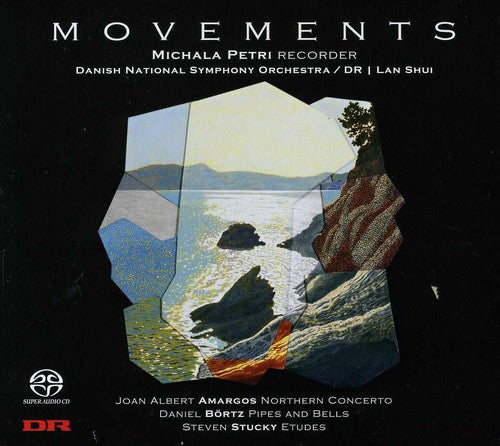
Movements - Amargós, Börtz, Stucky / Michala Petri, Et Al
This is a hybrid Super Audio CD playable on both regular and Super Audio CD players.
Martin Chalifour And The Los Angeles Philharmonic In The Walt Disney Concert Hall
Martin Chalifour is Principal Concertmaster of the Los Angeles Philharmonic and is a professor at the University of Southern California’s Thornton School of Music. Chalifour is a frequent guest at several summer music festivals. Maintaining close ties with his native Quebec, he has returned there often to teach and perform as soloist with various Canadian orchestras.