Gian Francesco Malipiero
27 products
-
Malipiero: Piano Works
$19.99CDPiano Classics
Apr 18, 2025PCL10323 -
-
-
-
-
-
-
-
-
-
-
-
-
-
-
-
-
-
-
-
-
-
-
-
-
-
-
-
-
-
-
-
-
-
Malipiero: Piano Works
Malipiero: Il canto della lontananza
Malipiero: Cordiali saluti
Malipiero: String Quartets Nos. 1 & 8 and Sinfonia No. 6
Malipiero: Integrale delle Composizioni per Cello e Piano e
Malipiero: Piano Concertos 1-6 / Bartoli, Carulli, Et Al
This is a hybrid Super Audio CD playable on both regular and Super Audio CD players.
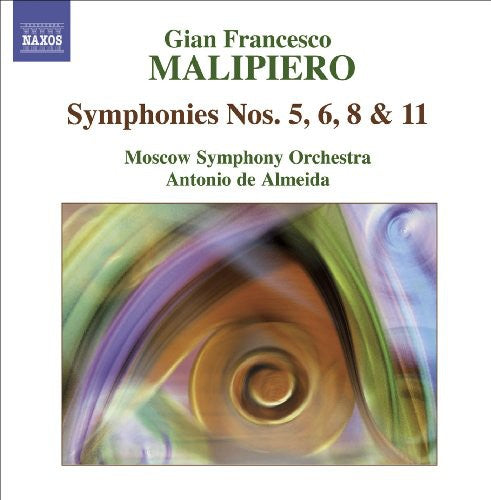
Malipiero: Symphonies, Vol. 3 - Nos. 5, 6, 8, 11
Malipiero: Piano Works
Malipiero: Fantasie di ogni giorno, Passacaglie & Concerti
Malipiero: Gabrieliana etc. / Pinti, Carlini, Camerata Strumentale "Citta Di Prato"
Malipiero & Monteverdi-Malipiero: Music for String Quartet / Quartetto Sincronie
In the dark years of the Nazi-Fascist period, when the light of the end was still far off, Malipiero completed a long-awaited undertaking: an edition of the complete works of Claudio Monteverdi. Its last volume, the sixteenth, came out in 1942 at the height of the war. The edition contained the sacred production that the publisher Vincenti had assembled in the collection Messa a 4 voci et salmi (1650).
Quartetto Sincronie’s choice to include an arrangement of Monteverdi’s Mass, alternating the parts with Malipiero’s work, is yet another example of reinvention-creation that Malipiero would likely have appreciated. In the composers’ poetics, instruments are asked to sing as voices, and so the opposite—voices translated to instruments—is fitting. Philological rigor was, after all, foreign to Malipiero’s worldview. Instead, the composer spoke of his relationship with Monteverdi as a kind of psychic channeling: finding synchronicity within the synchrony of listening, which dissolves the distance of centuries. The Mass for Four Voices is thus split into parts throughout the record, but it remains possible to orient oneself. The cohesion is melodic: there’s a descending tetrachord G-F-E-D at the beginning of the Kyrie that returns in various guises (inverted, diminished, augmented), articulating the contrapuntal fabric of the different movements. The listener can thus follow this pathway, from the Gloria to the Agnus Dei, in a zigzag that turns Monteverdi the sacred “refrain” to Malipiero’s profane cycle of quartets.
Malipiero: Complete Piano Music, Vol. 3 / Orvieto
The piano works on this CD date from different periods in Gian Francesco Malipiero’s creative life. From his unpublished juvenilia to the late Ricercar toccando, from the evocative Poemi asolani of 1916 to the disillusionment of the pieces written in the years following the First World War: a range of works that bear witness to the development of the composer’s conception of the piano miniature as a kind of intimate diary, between nostalgic impressions and aphoristic humour.
Malipiero: Complete Music For Solo Piano / Lopez
Italian composer Riccardo Malipiero (1914–2003) was the nephew of Gian Francesco Malipiero. He was a pioneer of twelve-tone technique in Italy. His 6 published piano works encapsulate half-a-century of development, from the post-Respighian 14 variazioni (1938), to the classicism of Diario second (1985). This is the first-ever recording of this music.
REVIEW:
The present six works, tracing this Milanese composer’s piano music from 1938 to 1989, are made up of short, separately-tracked musical episodes—the perfect answer to a challenged attention span. There are 49 tracks so Toccata’s attention to detail is nothing short of lavish. In addition the pianist’s essay on the composer and his solo piano music encompasses nine closely packed but perfectly eye-friendly pages. The booklet is in English only. The works recorded here make up Malipiero’s published corpus for piano solo. They here receive their recording premieres.
The 14 Variazioni di un tema musicale are already fully formed in dodecaphonic terms and angular style. Costellazioni finds this composer at close to the peak of the avant-garde’s popularity. We hear awkward figures rumble, ripple and skitter, deep bass chords resound. The hypnotic writing evokes thoughts of distant galaxies. The work ends in a stutter that gutters and then finally peters out. He is the master of Stravinskian scurrying figuration; cool, cold with flourishing rhythmic thunder and grunt.
This is tough music presented with factual and technical diligence as well as artistic qualities. Credit to the pianist for carrying through this distinctive project from concept to execution. There’s no want of valour in choosing this music to champion.
-- MusicWeb International
Malipiero: The String Quartets Complete Edition / Quartetto di Venezia
The eight string quartets that Malipiero wrote between 1920 and 1964 constitute a major body of Italian chamber music and reflect his successive musical affiliations. The first two form a linked unit and espouse his radical anti-Romanticism in the early 1920s. Nos. 3 and 4 share structural similarities and act as a kind of laboratory for his symphonies of the time. Quartet No. 5 was inspired by Malipiero’s theatrical work, whilst No. 6 explores a new-found narrative dimension. With the two late quartets Malipiero moves into a world of chromaticism, where tone-color freedom reaches the apex of imagination and achievement.
REVIEW:
Malipiero’s eight string quartets were composed over a period of 44 years and show a remarkably consonant stylistic development.
The First Quartet, composed in 1920 and showing the impressionist influence of Debussy and folk textures alike, is his most extended quartet at (here) 22 minutes. Its partition points are clear as are the ritornello figures. Malipiero’s way is not development, more successive panels of light, color or contrast but he ensures that the work ends with a reflection on the Italian baroque so close to his musical heart, cadences of almost ecclesiastical beauty and refinement. The Second Quartet is related to the First in several structurally important ways but is more compressed and in some ways even more lyrical. It generates real propulsion and sonority and this malleable movement alternates with light textures.
The athleticism of Malipiero’s conception is a distinguishing feature of the quartets; tightly constructed single-movement works that bring a heavy quotient of Venetian energy, myriad in effect, constantly referencing, briefly but adroitly, Italian Baroque and his rich folkloric storehouse. That’s certainly the procedure in String Quartet No.3 ‘Cantàri alla madrigalesca’ (1931) by which time impressionism has been lightly dispersed. A greater sense of fluidity and metrical flexibility enters with the Fourth Quartet of 1934. The occasional eruptive material seems more organic than in previous quartets where paragraphical points could impede and threaten to destabilize the music.
The wartime Fifth Quartet was written concurrently with an operatic project and here a greater sense of textural clarity infiltrates itself into the music. In part lyrically effusive this is an effective work that reflects cross-pollination of influence but also an increasing tightening of procedure, so that incidental elements are more clearly subsumed into the musical argument. No.6, though once again in a single movement, is in three ‘parts’, two Allegros surrounding a central quasi-improvised section which has catchy, playful elements.
The last two quartets show an increasing enthusiasm for chromaticism, and this means a moving away from the mid-period clarity established earlier in the cycle. If you welcome clotted textures and thickening of the quartet sonority, you’ll enjoy No.7 where livelier music includes a clarifying lyricism alongside that sense of effortful skirling dynamism. In 1964 he wrote his final quartet, the tautest yet, in which the material is foregrounded and saturated in chromaticism. The fugal elements that also motor the music are eloquent tribute to his command of the quartet medium and his skill in introducing disparate material without ever becoming academic.
Suitably, these recordings are played by the Quartetto di Venezia, city of Malipiero’s birth. They play with fulsome commitment and the booklet notes, reprised from that earlier appearance, will tell you all you need to know.
-- MusicWeb International
Malipiero: Tre Commedie Goldoniane, Stradivario / Benda, Major
The Naxos Italian Classics series has produced some fine discs. These include top-notch versions of Alfredo Casella’s >First and Second symphonies with the Orchestra Sinfonica di Roma under Francesco La Vecchia. That revival of interest will surely extend to the works of Malipiero, a contemporary of Casella’s and also a founder member of the Corporazione delle Nuove Musiche. The disc under review is not new - it was issued on the now defunct Marco Polo label in the late-1990s - and the music is hardly core repertoire. All the more surprising, as the pieces recorded here are really rather good. Not only that, the playing of the Orchestra della Svizzera Italiana is very idiomatic, too.
The three fragments from Malipiero’s opera Tre commedie goldoniane have an open-faced, genial air; La bottega da caffè is a perky little number, underpinned by some delightful, burbling rhythms, the out-of-sorts Sior Todero characterised by low, rather comical brass. As vignettes go, these are lightly drawn, and all credit to conductor Christian Benda for bringing out the many subtleties of colour and rhythm. The latter is a key element here, the molto perpetuo of La baruffe chiozzotte discreetly done. It’s an odd blend of chamber-like scoring and gaudy effects - the bells for instance - but it hangs together well and never outstays its welcome. Most entertaining.
The short, post-war ballet Stradivario, centred on a stolen Strad that comes to life and dances with a variety of other instruments, is surprisingly light on its feet. Violinist Tamas Major is a little thin-sounding as the protagonist, but it’s the boisterous bass drum - well caught - that threatens to steal the show. There’s plenty of dynamic range here; the orchestra is convincingly balanced, woodwind solos rise naturally from the mix and the brass are thrilling in their brisk, repeated figures. There’s an abiding sense of fun in this music, epitomised by the smile-inducing march for flutes and drums. A real tonic, this.
Malipiero’s interest in Italian composers of the 16 th, 17 th and 18 th centuries dates back to his youth, where he spent hours copying the music of Monteverdi and other early masters. This fascination, shared by his compatriots Casella and Respighi, is most evident in La Cimarosiana, inspired by the music of Domenico Cimarosa (1749-1801). But it’s not just a fastidious, dry little exercise in retro-writing; for instance, sandwiched between the elegant Andante grazioso and Non troppo mosso is an uncouth, streetwise Allegro moderato that’s both bizarre and entirely in keeping with Malipero’s well-developed sense of mischief and whimsy. Make no mistake though, the period features are skilfully done and the music is very well played; the limpid Larghetto is especially attractive.
As a Venetian himself, Malipiero would have had a special affection for the music of Giovanni Gabrieli ( c. 1554/57-1612), whose distinctive style is joyfully conveyed in the bracing Gabrieliana. The up-front OSI brass are very bright indeed - brazen, even - which seems entirely appropriate in this context. That said, it’s all a tad fatiguing at times. Not as relaxed and congenial as the other items, perhaps, but it does reveal a more studied, serious aspect of the composer’s musical persona.
This is a most rewarding reissue, and a tantalising glimpse into Malipiero’s endearing sound-world. There are several discs in this series - some of the symphonies have already been reviewed on these pages - so if this collection piques your interest don’t hesitate to give them a try.
-- Dan Morgan, MusicWeb International
Malipiero was a very odd composer. He wrote tons of music, some of it very unpretentious and appealing (as here), turning later in his life to a gnarly, chromatic idiom. If you want to sample some of his better work, this reissue (originally released on Marco Polo) makes an ideal place to start. The largest work is the ballet Stradivario, one of those “musical instruments come to life” stories with creepily tragic results. The music from three Goldoni comedies is frothy and full of fun, while the other two works fall into the same genre as Respighi’s Ancient Airs and Dances or Casella’s Scarlattiana. The performances are perfectly enjoyable, and well recorded to boot. A nice disc for collectors of the unusual.
-- David Hurwitz, ClassicsToday.com
Malipiero: Symphony No 7 / Almeida, Moscow Symphony
Malipiero: Symphonies Vol 2 / Almeida, Moscow SO
MALIPIERO Symphonies: No. 1, “In quattro tempi, come le quattro stagioni;” No. 2, “Elegiaca.” Sinfonie del silenzio e della morte • Antonio de Almeida, cond; Moscow SO • NAXOS 8.570879 (77:40)
CDs containing the works of Gian Francesco Malipiero (1883–1973) occupy less than two inches of shelf space in my collection, so by no means can I claim more than passing familiarity with his music. My first encounter with this composer, however, was on a 1950s Nonesuch LP with the Stuyvesant String Quartet playing one of Malipiero’s string quartets. That recording, if anyone is interested, has been transferred to CD by Bridge.
Malipiero was one of the so-called “generazione dell’ottanta” (generation of the 1880s) composers that included Wolf-Ferrari (1876–1948), Respighi (1879–1936), Ildebrando Pizzetti (1880–1968), Riccardo Zandonai (1883–1944), Alfredo Casella (1883–1947), and Castelnuovo Tedesco (1895–1968). If permitted to engage in a bit of chronological stretching, I’d also include in this group Nino Rota (1911–1979) and Gian Carlo Menotti (1911–2007). In a 31:5 Rota review, I substituted for “generazione dell’ottanta” the “identity crisis generation.” Here were several Italian composers working independently of each other, but each in similar circumstances. Instrumental music in 19th-century Italy was all but dead, having been displaced by opera. And while all of the above-named composers made contributions to the operatic literature, one aspect of their shared dilemma was that Italian opera had by this time already achieved its apogee in Verdi and Puccini. At the same time, they also shared a desire to create a new legacy of Italian instrumental music, which led to their second dilemma. They retained strong roots in 19th-century Romantic traditions, yet their lives intersected those of other roughly contemporaneous 20th-century Italians—Dallapiccola, Nono, and Berio—who were committed to keeping abreast of the more modernistic and avant-garde trends elsewhere on the Continent. As a result, the “generazione dell’ottanta” came to be seen largely as a throwback to an earlier period.
Malipiero was enormously prolific, and much of his output is mostly of a serious nature, weighted towards Classical-form symphonies, concertos, and chamber works. His music never gained the traction of Respighi’s more easily digested style, but Malipiero’s smaller following of intellectual elites was significant and influential. Among his admirers was the aforementioned Dallapiccola, and Bruno Maderna was one of his students. It seems that Malipiero played a bit loose with musical terminology. No fewer than 17 of his works include in their titles the word “sinfonia,” and in the case of one of them on this disc, “sinfonie,” though not all of them necessarily fit the description of what is commonly thought of as a symphony. This also leads to some confusion, for the two numbered symphonies heard here are nowhere near being among the composer’s earliest efforts in the form. Three symphonies preceded the No. 1, and by quite a few years: the Sinfonia degli eroi (1905), the Sinfonia del mare (1906), and the Sinfonie del silenzio e della morte (1910) listed in the headnote. The Symphony No. 1, subtitled “In quattro tempi, come le quattro stagioni,” was not written until 1933, and its successor, the Symphony No. 2, subtitled “Elegiaca,” followed three years later in 1936.
The Sinfonie del silenzio e della morte (“Symphonies of Silence and Death”) is more like three interconnected tone poems than it is a three-movement symphony. Inspired by Poe’s The Masque of the Red Death , the first movement, “Danza tragica,” is a lot less macabre sounding than its description might suggest. The music has a distinctly Russian flavor to it, echoes of Mussorgsky’s Night on Bare Mountain being inescapable. But the specter of evil conjured by Malipiero is neither as vivid nor as visceral as that of Mussorgsky’s shrieking fiends. The second movement bears the heading that gives the work its name, while the third movement bears the heading, “Il molino della morte” (The Mill of Death). Whatever Malipiero’s morbid, ghoulish, and grisly intent may have been, his score too often belies it with interruptions by arching lyrical themes and infusions of lush orchestral writing. The work is simply too fetching to be anything other than a less-than-hair-raising ride on the lighter side of the dark side.
Malipiero’s Symphony No. 1 (“In four movements, like the four seasons”) was inspired by the Venetian poet Anton Maria Lamberti’s Le stagioni . The Symphony is programmatic only superficially and not representational in content. The music is abstract, and its formal structure laid out in four movements that proceed in a slow-fast-slow-fast order. The piece is fragrant with scents of the Orient, of the exotic, of early Debussy, and indeed of Respighi. In fact, if you like Respighi’s Roman trilogy, you are bound to find a close relative to it in Malipiero’s Symphony. It’s an exquisitely beautiful score, easily and immediately accessible, luxuriantly orchestrated, and filled with many memorable mood-evoking passages. I was so spellbound by the Lento, ma non troppo that I had to listen to it a second time before continuing on to the last movement. As the saying goes, “You can take the Romantic out of the 19th century, but . . .”.
Eschewing even the superficial program of the Symphony No. 1, the Symphony No. 2, “Elegiaca,” is also in four movements, but orders them in a fast-slow-fast-slow sequence. Three years in Malipiero’s life made no difference in his style. He was at this juncture still a dyed-in-the-wool Romantic, and this work dating from 1936 is as resplendent and gorgeous as the previous one. Again, it’s in the slow movements that Malipiero pours out his heart and soul in music that is never cloying but that nonetheless can make you weep. Considering the modernist trends of the time—Schoenberg’s Fourth String Quartet was written in the same year—it’s little wonder that history has marginalized Malipiero, along with many of the composers mentioned at the outset, as regressive and even reactionary. But unless one is an academic elitist of the worst kind, that should not be an argument against music written by any composer in any period that is beautiful and moving; and I can tell you that Malipiero’s music is both. I know that I, for one, having heard this disc, will be expanding my heretofore very limited Malipiero collection.
There do not appear to be any competing recordings of these works currently listed, so it’s providential that Antonio de Almeida and the Moscow Symphony Orchestra give exceptionally fine performances. I did not realize, however, until reading the fine print, that this Naxos disc is actually a re-release of a 1993 recording that originally appeared on the marco polo label. So make sure you don’t already have it before you run out and buy this one. If you don’t, this is a must-have purchase.
FANFARE: Jerry Dubins
Malipiero: Symphonies No 9 & 10, Sinfonia Dello Zodiaco / De Almeida, Moscow Symphony
Malipiero wrote 11 numbered symphonies, recordings of all of which, originally on the Marco Polo label, have now been re-issued by Naxos in five volumes … wherever there is an adequate performing version. In each case, the Moscow Symphony Orchestra under the French conductor and musicologist, Antonio de Almeida, play persuasively. They bring verve and enthusiasm to the music, which was written across Malipiero's long career, though not at every stage in it: he wrote no fewer than seven sinfonie between 1944 and 1951. It's a worthwhile set to own; that's just as well, because it's the only effectively complete set. It omits the early Sinfonia degli eroi. But includes half a dozen unnumbered works to which Malipiero gave the title, sinfonia and is one of very few other recordings of Malipiero's symphonies anyway.
The three works on this final re-issue - from almost 20 years ago - in the series are three: by far the longest at almost three quarters of an hour in four distinct parts, Spring, Summer, Autumn and Winter, is the Sinfonia dello zodiaco ('Zodiac Symphony') which was published in 1951. It's not to be confused with the composer's first symphony, subtitled 'In quattro tempi, come le quattro stagioni', or 'In four movements, like the four seasons'. Each part of Sinfonia dello zodiaco is further divided into three movements corresponding to the months of which the seasons are made up, although they are not named other than with tempo markings. Malipiero was evasive about the origins of the symphony in particular and any relationships with astrology or the seasonal year in general. It's hard to see anything like the same programmatic correspondence as is clearly the case with Vivaldi - even though the latter had texts.
The excellent liner-notes that come with this CD indicate that the first movements of each part (movements 1, 4, 7 and 10) suggest seasonal characteristics. Certainly the thin, frozen tentative nature of the beginning of winter (10) is remarkably apposite. The Moscow Symphony Orchestra lives very well with the dichotomy that comes from such a diffuse structure (or at least inexplicit and more impressionistic than purely descriptive) on the one hand; and much colour, motivic variety and quiet purpose as opposed to extra-musical wandering, on the other.
Like many other composers, Malipiero was superstitious about his symphonies' numbering, making efforts to avoid writing a ninth which to this day still confuse. When he eventually felt it safe to do so, he was in his 80s and had written at least two others which could have been so called. The official Ninth "dell’ahimè" (the '"alas" (symphony)' perhaps) dates from 1966. It's much more pointed and punchy than the earlier work. It's shorter, too; at just a quarter of an hour, which is, in fact, more typical of the composer. For as much as Malipiero seems interested in developing thematic progression, he proportionally eschews wholly consistent tonal bases; or, more accurately, he encourages tonal clashes.
The Tenth also has a subtitle. It implies winding down or disability due to age, 'atrophy' is implicit, although Atropo is Atropos, one of the Greek goddesses of fate. In fact it's dedicated to the memory of conductor Hermann Scherchen, a great friend of Malipiero's: the former collapsed and died immediately after a performance of the latter's operatic triptych L’Orfeide at the Maggio Musicale Fiorentino of 1966. The Tenth Symphony is rich in relevant quotations. If the Ninth is bleak, the Tenth is bleaker. Again the orchestra is totally in tune with the spirit and musical construction which Malipiero embraced in order to breathe life into these admittedly somewhat enigmatic works. The qualities of sincerity, unobtrusive yet barely assimilated distress, and a vestige of hope (the serene second movement [tr.17]) make this a fitting ending to this symphonic portrait of an under-appreciated composer. More and more Malipiero is beginning to be offered as the most significant Italian symphonist of his generation.
There is nothing of regimentation, bombast, driven hectoring or short cuts to orchestral (particularly string) colour in the playing of the Moscow Symphony. De Almeida has a light but firm and unambiguous touch at all times. One might just perhaps level the criticism of somewhat staid tempi on occasions. Maybe a touch more pep in the third, marked mosso, movement of the Tenth, for example.
On the whole, though, this is a recording to be returned to, learnt from and from which new depths can be derived at each revisit. No one section of the orchestra stands out as particularly worthy of merit. Indeed, the sense of ensemble between woodwind and strings, say, is highly satisfactory. The difficult, because slightly self-conscious, diminuendo bell effect two and a half minutes into the Tenth's last movement (again, marked molto vivace and perhaps lacking just a touch of drive) is well handled too.
If you've been collecting the series you'll want to add this concluding CD. If you're just joining, the interpretations are of sufficiently high standard to make you want to work your way backwards and explore more widely.
-- Mark Sealey, MusicWeb International
Malipiero: Sinfonia degli Eroi… / du Closel
Five vividly contrasting works, four of them in world première recordings, make up this latest issue in the Naxos series of orchestral music by the Italian composer Gian Francesco Malipiero. Visions of heroism and death form the cornerstone of the release, in the Ditirambo tragico (Tragic Dithyramb) composed during the First World War, and in Malipiero’s two earliest surviving pieces, Dai sepolcri (From ‘Tombs’) and the Sinfonia degli eroi (Symphony of Heroes). They are heard alongside the deceptively relaxed charm of Armenia, based on traditional Armenian melodies, and the varied, pungently Stravinskian moods of the aptly titled Grottesco (Grotesque).
Malipiero: Opere per Pianoforte / Alberti
Gian Francesco Malipiero (1882-1973), one of the most creative Italian composers within the so called ‘Generation of the Eighties’, began self-taught, studying the Italian masters of the 17th – 18th c. before moving on to the Hochschule in Berlin and devoting his long life to teaching and composition. The piano pieces presented here give an idea of his great spirit of creative innovation that, with the basics well anchored, he was able to give new life to the writing of chamber and symphonic music that in those days was painfully resuming his way after the dominance of the rampant Italian melodrama.
Malipiero: Impressioni Dal Vero; Pause Del Silenzio / La Vecchia, Rome SO

It's always difficult to speak authoritatively about performances of unfamiliar music, but these works are so strange, so beautiful, and so remarkable that criticism is disarmed. Impressioni del vero ("Impressions from life") consists of three, three-movement suites of strikingly colored, harmonically arresting, melodious music. The titles give some impression of these atmospheric pieces: Dialogue of Bells, The Cypresses and the Wind, The Woodpecker, and Festival in the Valley of Hell. "Haunting" is perhaps the best term to describe the music--it gets under your skin, and doesn't sound like anyone else.
Pause del silenzio ("Breaks in silence") consists of two suites, one of five movements and one consisting of seven brief episodes played continuously. There's an improvisatory quality to these pieces that makes them completely unpredictable, and yet somehow they work well together. Okay, let's forget about describing the impossible and turn instead to performances that sound remarkably confident and assured. The orchestra plays very well, conductor Francesco La Vecchia (as in his Casella series) leads with a masterly sense of pacing, and the sonics are excellent. This is just wonderful.
--David Hurwitz, ClassicsToday.com
Malipiero: Il Finto Arlecchino, Etc / Peter Maag, Veneto Po
The Four Inventions, though slightly more tuneful, follow the same melodic principle as the Seven, which can lead to an impression of sameness if played in succession. Malipiero's 1925 opera Il finto Arlecchino evoked the world of 18th-century Venice, and the music ranges from neo-classical to near parody of the period. For some of today's "authenic performance"-trained ears this will seem quite anachronistic, as will Malipiero's Vivaldiana (1952), a loving tribute that is true to the text of Vivaldi's concerto movements while imbuing them with newly vivid and vibrant orchestral colors. Peter Maag's insightful and committed conducting makes the most of these elements, which are wonderfully realized in brilliant performances by the Veneto Philharmonic Orchestra, recorded in clear, full sound by Naxos. Do give this a try.
--Victor Carr Jr, ClassicsToday.com
Malipiero: Violin Concertos & Per una favola cavalleresca / Symphonic Orchestra of Rome
This release couples Gian Francesco Malipiero’s two contrasting violin concertos with the world premiere recording of his kaleidoscopic orchestral work Per una favola cavalleresca, evoking legendary scenes of love, tournaments, battles, moonbeams and heroes. Malipiero’s First Violin Concerto is one of his most beautiful and joyful works, a remarkable achievement for a composer who is said to have played the violin badly in his youth. His Second Violin Concerto, written 30 years later, sounds astonishingly different on a first hearing, but reveals itself to be inspired by the same lyrical impulse as the earlier concerto.
Review
Naxos/Marco Polo have been staunch allies of Malipiero of yore. Their example has been all the more admirable since their advocacy dates from a decade or more after the composer’s death. First, they recorded all the symphonies - and there are lots of them - in Russia on Marco Polo. These were done largely with the far too easily overlooked Antonio de Almeida (1928-1997). That multiple-CD series has been reissued on Naxos.
His First Violin Concerto (1932) is in the accustomed furiously confident three movements. There’s no hint of neo-classicism or museum-rigid “Alte Stil”. This is fast-flowing music where the orchestra keep pace with the ardent solo, here played with unblinking skill by Paolo Chiavacci. The writing is juicy and its probing ardour continues into the central Lento and the nicely rounded finale. This is a work and performance that, for me, never descends into tedium.
Per una favola cavalleresca (For a chivalric tale) is in four movements and is the earliest piece here. It is claimed to be inspired by legendary scenes of love, tournaments, battles, moon-beams and burials of heroes, possibly with links to a Malipero opera Lancelotto del Lago. It’s the longest work here, in four unnamed movements, across half an hour. It’s masterfully orchestrated with no strata of the orchestra wasted. Romantic to the hilt and occasionally voluptuous in the familiar manner of Respighi, as in his Ballad of the Gnomes. Even within these bounds it is a full-lipped piece yet with plenty of nocturnal facets as in parts of the third movement. Written at about the same time as Sibelius’s Suite mignonne which, at least in its titles, has its chivalric overtones, it is a very different. The Malipiero is more head-on and drips with juice as you can hear with the no-holds-barred brass fanfaring of the highly coloured finale. One can easily read into this the betrayal of Arthur and his anger, even if the work and the movement does end in a romantic glow.
Malipero wastes nothing - no time beating of useless filler material - both this and the second concerto are over and done with in about twenty minutes. The second - quite a short piece at 19:35 - is cooler. It was written a decade before the composer’s death and confronts a very different world order from the First. It is by no means devoid of passion. Even so, darker emotions are in play. The soloist has to make speedy headway. Disillusion inflects the central non troppo lento which is lichen-hung. The finale is another work of testing virtuosity, but brusque.
Another point to make is that these works, especially the First concerto and the Cavalleresca at times seem wrung from the same harmonic material as Vaughan Williams’ The Lark Ascending but always stand in their own right.
A Malipiero genre admirably tackled by the familiar La Vecchia and his orchestra. They have been most agreeably performed and recorded.
--MusicWeb International (Rob Barnett)
Malipiero: Complete Piano Music, Vol. 2
Within the context of the wide and multifaceted creative activity of Gian Francesco Malipiero (Venice, 1882 – Treviso, 1973), piano production represents a marginal branch, or at least one that was developed less systematically. However, there are about thirty titles – spread over more than sixty years – in which the most typical forms of Malipiero’s language find perfect expression: from the melancholy restlessness of the first works to the clear expressive intensity of the last ones.
Malipiero: Chamber Music / Rest Ensemble
The Milanese composer Riccardo Malipiero was born in Milan in 1914 and took lessons with his uncle, Gian Francesco Malipiero in the late 30s. Malipiero disowned all that he wrote up until 1938 and saved only a small amount of that written before 1945: the surviving early pieces show the influence of his uncle’s teaching and the neo-classicism of Casella and Stravinsky. However, influenced by Luigi Dallapiccola, he came to embrace a personal, lyrical language of 12-tone composition which ultimately traces its roots back to the music of Berg. The four-movement Violin Sonata from 1956 makes an ideal introduction to Riccardo Malipiero’s music, with a nervous, waltz-like Scherzo and a frozen slow movement leading into the finale’s extensive violin cadenza, beautifully written for the instrument and played here by Rebecca Raimondi with burning conviction as well as ferocious accuracy (she included the sonata within her Master’s recital at the Guildhall School of Music and Drama, from which she graduated in 2017). At her graduation recital she was accompanied by Alessandro Viale, and together with the other members of the Rest Ensemble they have given concerts of Malipiero’s music in both the UK and Italy, lending to these studio recordings the ring of intimacy and impassioned authenticity that is rare in recordings of unfamiliar modernist music. The Piano Trio of 1969 sets a tougher challenge to both performers and listeners, more angular and explosive, yet still imbued with a strain of wit and grace that runs through his output.