Classical
55 products
-
Antonio Salieri, Complete Works for Harpsichord & Piano
$16.99CDDynamic
Jun 20, 2025DYN-CDS8060 -
-
-
Early Romantic Piano Quartets by Hummel, Ries & Schubert
$12.99CDBrilliant Classics
Jan 30, 2026BRI97705 -
-
-
-
-
The Mendelssohn Legacy
$19.99CDNaïve
Dec 19, 2025V8972 -
-
-
Poesia
$16.99CDAntarctica
Nov 07, 2025AR 061 -
Clementi: Piano duets
$25.99CDTactus
Oct 03, 2025TC750390 -
Hummel: Quintet, Op. 87 & Bertini: Grand Sextuor, Op. 90
$23.99CDMDG
Nov 14, 20251022371-2 -
-
-
Dussek: Violin Sonatas, Vol. 4
$12.99CDBrilliant Classics
Jan 09, 2026BRI96594 -
-
-
-
-
-
-
-
-
-
-
-
-
-
-
-
Viotti: Complete Violin Concertos
Antonio Salieri, Complete Works for Harpsichord & Piano
The Romantic Room – Chamber Works by Spohr
Marschner: Piano Trios, Vol. 1 / Gould Piano Trio
Early Romantic Piano Quartets by Hummel, Ries & Schubert
Viotti: Duos for 2 Violins
Ariette e divertimenti da camera
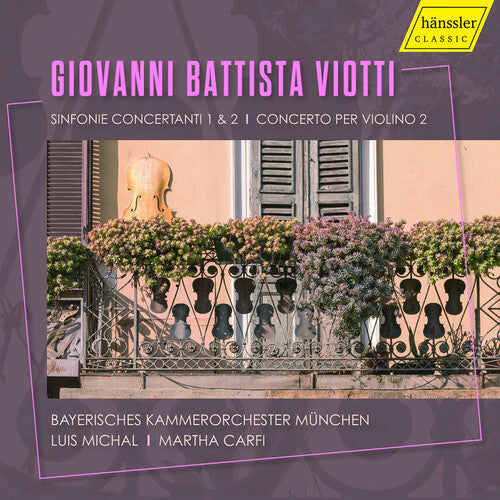
Viotti: Sinfonie concertanti 1 & 2; Violin Concerto no. 2 / Carfi, Michal, Bayerisches Kammerorchester Munchen
In June 1878 Johannes Brahms wrote to Clara Schumann: "The A minor Concerto by Viotti is my very special passion. It is a splendid piece with a remarkable freedom of invention: it sounds as if he were fantasizing, and everything has been designed and executed with such mastery …" Already during his lifetime Viotti was regarded as one of the most brilliant violin virtuosos, and his violin concertos also enjoyed special renown. As a composer Viotti brings in the schemes of the Italian School but also weaves in romantic motifs far ahaead of their times.
Uncommon Valor / "President's Own" United States Marine Band
Loewe: Complete Piano Music, Vol. 3 / Nicholson
Known in his lifetime as ‘the north German Schubert’, Carl Loewe (1796–1869) is remembered today chiefly as a composer of songs and ballads. Yet there is a considerable body of piano music that is strikingly innovative in content, expression and harmony, containing the germs of ideas later taken up by composers such as Wagner and Liszt. Loewe was unquestionably a brilliantly original talent, a major figure in ushering in the Romantic era – with the remarkable Four Fantasies of 1854 heard here ‘documenting’ in music the contemporary emigration of German families to the United States. This third volume of Linda Nicholson’s survey of his piano music on historical instruments concludes its first-ever complete recording on any kind of piano.
The Last Castrato - Arias for Velluti
Mythos - Schubert & Loewe / Krimmel, Bushakevitz
The Mendelssohn Legacy
Charpentier, Cherubini & Lefebure-Wely: Noel sous l’empire / Guerillot
French organ music under Napoleon and the Restoration is an overlooked period in musical history, inheriting the glories of classical organ and heralding the great romantic organ music. This pivotal time, teeming with great performers – most of them improvisers – counted Isaac-François Lefèbure-Wély among its masters, who presided over the prestigious Eglise Saint-Roch from 1805. In 1823 he published a collection of 34 Noëls, inspired by those of his predecessors yet deeply rooted in their time, imbued with the memory of the Incroyables and the Merveilleuses. These extremely popular works for nativity ring out in true splendour from the organ of the Chapelle Royale, shimmering with the mysteries of Christmas through Quentin Guérillot’s generous, familiar style.
Poesia
Clementi: Piano duets
Cherubini: Sei Sonate per cimbalo
Hummel: Quintet, Op. 87 & Bertini: Grand Sextuor, Op. 90
Frohe Weihnachten (1 LP)
Viotti: Violin Concerto No. 22; Cherubini: Symphony In D
Dussek: Violin Sonatas, Vol. 4
Fanny Mendelssohn, Vol. 2 / Gaia Sokoli
Dussek: Violin Sonatas, Vol. 3 / Huber, Altmann
Over the course of his long and eventful career, Dussek composed 38 violin sonatas – or rather sonatas for the keyboard, accompanied by the violin – and the partnership of Julia Huber and Miriam Altmann is acquiring impressive credentials and critical praise as they gradually uncover them for the first time.
‘This is one excellent disc,’ noted the Fanfare reviewer of Volume 1 (96385). ‘Julia Huber and fortepianist Miriam Altmann give wonderful renditions. Each plays off of each other, with clarity, technical acumen, and a good sense of phrasing… You ought to have this as an integral part of any collection of chamber music of the period.’
Volume 2 (96588) was received with equal enthusiasm: ‘This is an outstanding continuation of the series… done with style and verve by Julia Huber and Mariam Altmann… Well worth getting.’ Volume 3 presents a contrast of sonatas from the beginning and near the end of Dussek’s life. Even the early Op. 4, No. 3 Sonata, however, shares the qualities of the mature Dussek noted by one contemporary reviewer: ‘Dussek's strength in composition lies in the idiosyncrasy, the novelty, the striking, brilliant quality of his rich invention, and, as far as the development is concerned, in the fire and the intimacy which his works seldom lack.’
Fire and intimacy: what else would we expect from a wide-ranging opening movement subtitled ‘L’amante disperato’ (The forlorn lover), with playing indications such as Amoroso and Lamentabile and dynamic indications from triple piano to triple forte?The sonata’s argument is concentrated in the piano part, with the violin marked as ‘ad libitum’, whereas the two Sonatas Op.69 show more of a partnership, albeit still led from the keyboard in the manner of works in the same genre bv Mozart and (until the ‘Kreutzer’) Beethoven.
Both Op. 69 Sonatas take the listener on a gripping narrative through typically bravura piano writing and unexpected turns of incident. No.2 is unusually structured in two expansive halves, while the quick outer movements of No.1 are separated by a songful Adagio subtitled ‘Les soupirs’ (The Sighs’) no doubt for the appreciation of Dussek’s French audience.
Field: 18 Nocturnes / Tyler Hay
As the pre-eminent forerunners to Chopin’s works in the same genres, the Nocturnes of John Field have few rivals for music well known by history but so seldom heard. They were largely inspired by the slow movements of Classical concertos, Mozart above all, as well as opera arias. From them, Field evolved his own firm concept of a form with rich harmonies and gentle dynamics to suggest the night and dreaming, though in fact he began by giving these pieces traditional names such as Pastorale, Serenade and "Romance. He wrote the 18 works not as a set, but over the course of 15 years, rarely completing more than one and never more than three in a single year. Liszt observed in them ‘The total absence of everything that looks to effect'.
Even when he settled upon Nocturne, Field bestowed upon some of them a qualifying subtitle: ‘Cradle Song’ (No.6), ‘Reverie’ (No.7), ‘Song Without Words’ (No.13), ’Nocturne Pastorale’ (No.17), and ‘Nocturne characteristique Midi’ (No.18). This last Nocturne stands apart from its companions as a tribute to midday, cast as an Allegro, with a coda in which a chiming clock strikes twelve as quicker notes laugh and dance around the repeated note.
As a window on the salons of 19th century Europe, the Nocturnes are taxing neither to play nor to listen to, but they are polished with painstaking finesse, and they demand from the performer all the subtle pianistic guile of Chopin’s works: notably a command of rubato to shape the melodies, and the imaginative and technical capacities of a coloristic palette to bring variety without eccentricity to the sequence.
Tyler Hay can call upon such talents and skills as critics have recognized in his previous recordings for Piano Classics such as an album devoted to the music of John Ogdon (PCL10132) ‘Tyler Hay is a formidable pianist… I believe John Ogdon would be very pleased by these performances of his music’ (Fanfare). ‘The young pianist Tyler Hay has brilliantly mastered and assimilated these often elusive scores, even to the point where I heretically prefer his interpretations to Ogdon’s’ (Gramophone).
Clementi: Sonatas Op. 1 & Op. 1a / Bacchi
While Clementi’s sparkling music has been recorded by many celebrated pianists such as Arturo Benedetti MIchelangeli, few of them have paid much attention to the composer’s first published collection. This new recording by Carlo Alberto Bacchi is all the more welcome for being informed by his study of the composer’s complete oeuvre as part of the ‘Clementi Project’ which sees him performing many of the sonatas in concert as well as recording them for Piano Classics.
The inscription on Clementi’s tomb in Westminster Abbey commemorates him as ‘the father of the piano’. Clementi above all was responsible for devising a modern technique, of the kind still recognisable today, which would serve pianists on the larger instruments being manufactured in the early years of the 19th century. This technique is differentiated from harpsichord technique, and trained not just through lessons but through pianistic ‘methods’ and publications such as these sets of sonatas, which are arranged in order of progressive difficulty in order to introduced students to technical challenges step by step. Like Mozart, Clementi also manifested his musical talents at a very early age: at the age of 7, he was already studying organ, singing and counterpoint; he wrote a mass at the age of 11 and an oratorio at the age of 12.
The English nobleman and eccentric Sir Peter Beckford effectively bought the young Clementi on a seven-year contract and kept him at his West Country pile. When the contract with Beckford expired in 1774, Clementi moved to London and took off on a career that brought him fame across Europe – as a touring virtuoso, a teacher, publisher – and even sometimes composer. The six Op.1 sonatas were published in 1771, during Clementi’s period in service to Beckford. Although he was not yet 20 and almost completely self-taught, they show his mastery of material and his irrepressible invention. All the sonatas have a simple, playful and light-hearted character, and a two-movement form. The five Sonatas of Opus 1a, on the other hand, date from a decade later, even after the Op.6 Sonatas. They were published in Paris around 1781, and here we sense the stirrings of Clementi as ‘father of the piano’ in the cascades and doublings and expanded imagination.
Thomas Jensen Legacy, Vol. 20
Thomas Jensen Legacy now at Vol. 20
There was no more unprejudiced or enthusiastic promoter of Danish music than Thomas Jensen. Twelve composers are featured here, in styles ranging from Romantic ballet to modernist oratorio. Nearly all the recordings are issued for the first time ever since they were originally broadcast. Taken together, they present a panoramic picture of Danish music in the 19th and 20th centuries.
Giuiani & Paganini: Violin & Guitar Duos
Hummel: Complete Piano Trios / Trio Parnassus
As a composer Hummel stood between different eras. His compositions span all the contemporary forms of music except for the symphony. He was foremost among the composers who sought to preserve the classical style and refused to tread the new paths opened by Beethoven.
For the present-day listener the various musical currents prevalent in Beethoven‘s day need no longer exclude each other. Unhampered by strong emotions or the obligation to take sides, we can – depending on expertise or mood – savor his music either in a totally unprejudiced way or with the detachment with which one views events long past. And to let oneself be captivated by Hummel‘s chamber music can be a singularly agreeable and rewarding experience no matter whether one is motivated by a desire to gain a deeper understanding of historical connections or by the wish to simply enjoy good music.
Hummel left us eight works written for the piano trio group. A first work has not been included in this selection, as only the works which the composer himself described as “piano trios” were chosen for this recording. With the exception of one piece we do not know when these works were composed. For chronological information we must therefore rely on the dates of the first editions or of reviews.
Hummel & Schubert: La Contemplazione / Orzaiz
La contemplazione offers a glimpse into “Viennese Classicism” through two authors who, while almost antagonistic, were also complementary and contemporary: Hummel and Schubert. In the late 1820s, European music was at a fascinating crossroads: the musical style that had dominated the old continent since 1780 (commonly known as “Viennese Classicism”) was in crisis and entering its final phase. At a time when tradition and innovation coexisted, emerging expressive needs pushed composers to seek alternatives to classical canons. La contemplazione offers a glimpse into this period through two authors who, while almost antagonistic, were also complementary and contemporary: Johann Nepomuk Hummel (1778-1837) and Franz Schubert (1797-1828). About the Instrument: Fortepiano Graf 1826/1827 (Edwin Beunk collection)
In an environment of fierce competition among various piano manufacturing houses, Conrad Graf emerged as the reference brand in Vienna, even being named the official constructor of the empire. Graf built the piano used in this recording in 1826 or 1827 with a range of six and a half octaves.
Classical Accordion Revealed - Masterpieces by Mozart, Clementi, & Haydn
This album features major works by Mozart, Clementi, and Haydn, arranged for and played by virtuoso accordionist William Popp.