Fall Blowout Sale 2026
Fall into the sounds of the season with 50% off 100+ handpicked titles for a limited time! From the quiet introspection of Satie and the autumnal warmth of Brahms to the lush, romantic beauty of Fauré and more, this collection is made for crisp mornings, golden afternoons, and cozy evenings at home.
Refresh your collection with music that feels right at home this time of year — all at half price! Plus, enjoy FREE SHIPPING on orders of $60 or more, making it the perfect time to stock up on your autumn favorites.
Shop the Fall Blowout now and save 50% while it lasts!
186 products
-
-
-
-
-
-
-
-
-
-
-
-
-
-
-
-
-
-
-
SaleAprès un rêve - Belle epoque: Nights at the Piano / Emmanuel Despax
Signum Classics · Aug 2023CD$19.99$9.99 -
-
-
-
-
SaleBrahms, Kahn & Frühling: Trios for Clarinet, Cello & Piano / Quantum Clarinet Trio
Haenssler Classic · Sep 2023CD$20.99$10.49 -
-
-
-
-
-
-
SaleDebussy: Orchestral Works Vol 1 - Prélude À L'Après-Midi D'Un Faune, La Mer / Märkl, Lyon NO
Naxos · May 2008CD$19.99$9.99
The Etudes Project, Vol. 1: Iceberg / Jenny Lin
The term étude first started to turn up in musical literature in the late 1700s, and came into common usage in the first half of the 19th century. The notion of a piece of music exactingly engineered to promote some specific aspect of technique was nothing new; in her public presentations of “The Étude Project,” pianist Jenny Lin traces the concept back to Johann Sebastian Bach’s Clavier-Übung, four volumes of keyboard exercises published between 1726 and 1741 — the final volume known more widely as the “Goldberg” Variations.
Countless composers have risen to the challenge of the étude. This album, the first documentation of a sweeping project conceived by Lin, includes some of the most famous examples – Debussy, Scriabin, Rachmaninoff, Messiaen, Ligeti, and Glass – alongside equally noteworthy contributions to the format by such mavericks as Ruth Crawford Seeger, Toshio Hosokawa, and Unsuk Chin. Lin further pairs each of her canonical selections with an entirely new work by a member of ICEBERG New Music, a determinedly heterodox collaborative of 10 gifted young composers who represent a broad range of stylistic inclinations, but who are united by their enduring faith in substance and craft.
Bucking a current fad, the new études were not proposed as sequels or responses to existing works. Lin simply asked the ICEBERG composers to challenge her, and then used her own keen ear and sure instincts to find sympathetic pairings. Driving rhythms and rich harmonies link pieces by Alex Burtzos and Chopin. Rangy scatterings of notes present a frolicsome affinity between Victor Baez and Unsuk Chin. Stephanie Ann Boyd and Debussy both deploy dreamy arpeggios in rippling waves; and so on. In each case, hearing the new piece enhances your understanding of the older one—and vice versa. Identifying affinities among old and new music, and among familiar and unknown pieces, is a knack Lin has demonstrated again and again throughout her career—and it’s part of what makes her not only a persuasive interpreter, but also an invaluable guide and companion. Stated simply: you are in extraordinarily sure hands, here.
REVIEW:
Aligning with composers of ICEBERG New Music, pianist Jenny Lin gave its ten members absolute freedom of style and pianistic approach when crafting new etudes for her. In addition to her Herculean playing, the fearless pianist brings curatorial prowess to bear in pairing each new etude with an existing work from the canon. Have a listen to this disc and then have another. The Etudes Project will repay you manifestly.
– The Whole Note (CA)
Brahms: The Cello Sonatas / Muller-Schott, Piemontesi
The two cello sonatas by Johannes Brahms are in very stark contrast to each other. This is not solely due to the more than twenty years separating the works. Brahms had a preference for pairs of works with the same instrumentation, which he frequently composed according to the principle of contrast. In the case of the cello concertos, it is above all the character and mood of the respective pieces that describe the contrasts. In the version for cello, the Violin Sonata op. 78, one of Brahms’ finest chamber works, supplements the two original cello sonatas in a charming way. Daniel Müller-Schott and Francesco Piemontesi team up once more for this all Brahms program after the great success of their release of cello sonatas of the 20th century (C872151).
REVIEW:
Poetry, power, and passion are all here, to an unquestionable degree. There were more times when I was struck by the piano’s beautiful tone than the cello’s, but at 44 Müller-Schott has grown into the kind of maturity that still expresses the joy of music in the face of temptations to become a much-in-demand professional repeating the same handful of popular pieces. I haven’t previously associated him with passionate playing, but he’s struck a bond with Piemontesi, whose Liszt can be quite ardent. Every desirable quality is present here.
– Fanfare
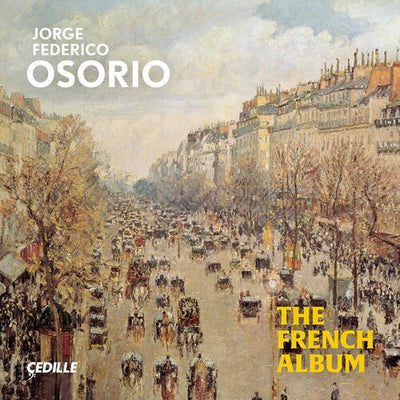
French Album / Jose Federico Osorio
Distinguished international pianist Jorge Federico Osorio brings his flair for French music to works of the Baroque, Romantic, and early 20th century eras by Jean-Philippe Rameau, Emmanuel Chabrier, Gabriel Fauré, Claude Debussy, and Maurice Ravel. Fittingly, Osorio opens The French Album with Fauré’s exquisite Pavane and concludes with the ever-popular Pavane pour une enfante défunte by Fauré’s student, Ravel. The Mexican-born, European-trained pianist offers eight of Debussy’s pictorial Préludes, each with its unique sound world, including the mystical La Cathédrale engloutie, one of the most stunning pieces ever composed for piano. Another audience favorite is Debussy’s evocative Claire de lune from his Suite bergamasque. Providing contrast, Rameau’s whimsical Les Tricotets conjures the back-and-forth motion of knitting needles. A set of Spanish-flavored works include Chabrier’s Cuban-inspired Habanera; Debussy’s lively La Puerta del Vino, depicting sailors carousing and enjoying their wine, and La soirée dans Grenade, where the piano imitates the sound of a guitar; and Ravel’s Alborado del gracioso, brimming with Iberian rhythms.
REVIEW:
What appears to be a hodgepodge of French pieces actually emerges as a carefully crafted program. Pianist Jorge Federico Osorio begins with Fauré’s famous Pavane, where his elegant phrasing and fluid “walking” tempo assiduously segue into a well-contrasted Debussy group. He brings a strong rhythmic profile and dry-point clarity to works dominated by rapid passagework such as Les collines d’Anacapri, Ce qu’a vu le vent d’Ouest, and Feux d’artifice, as well as Ravel’s Alborada del gracioso.
While Osorio certainly embraces the sensual undercurrents in Clair de lune, Voiles, Feuilles mortes, and La cathédrale engloutie, the climaxes have plenty of backbone. The pianist similarly integrates curvaceous lilt and unsentimental grit in Chabrier’s Habanera and Debussy’s habanera-like La Puerta del Vino and La soirée dans Grenade. Three selections from Rameau’s G major Suite stand out for Osorio’s care over ornaments, although his slightly heavy way with the final selection, Ravel’s Pavane, misses the animation and flexibility of the old Gieseking and Casadesus recordings. All told, an enjoyable and well-put-together recital.
– ClassicsToday.com (Jed Distler)
Heroic Horn - Best Loved Classical Horn Music / Various Artists
For those who are new to an instrument, the first question is often: where to start? The ‘Best Loved’ series offers an easy answer to that question and a perfect introduction to the wonderful, varied world of classical music. Spotlighting individual instruments in some of the best-loved pieces ever written, and with a mix of solo, chamber and orchestral works, the series provides a convenient introduction to classical music’s infinite variety of instrumental sounds and styles. The focus in these releases is a light and relaxed approach, rather than academic and theoretical: a joyful exploration and celebration of individual instrumental sounds. The present release is a showcase of the horn.
Alexander Brailowsky plays Chopin
Following up its recent box of his 78 and early LP recordings for RCA, Sony Classical is now issuing a 5-album set of Chopin recordings made by the Ukrainian-American pianist Alexander Brailowsky in stereo for American Columbia in the early 1960s. The new reissue contains the complete Preludes, Waltzes, Mazurkas, Polonaises, Andante spianato, B minor Sonata, Fantaisie-Impromptu, Berceuse as well as numerous other works.
REVIEW:
If Brailowsky's Polonaises don’t match Arthur Rubinstein’s finesse and red-blooded ardor, they’re at least idiomatic and shapely, as are the sensitively turned-out Chopin/Liszt song transcriptions and the Berceuse.
– ClassicsToday.com (Jed Distler)
Best Of Chamber Music / Idil Biret
Idil Biret’s chamber music performances are relatively rare. Most importantly, she played Beethoven’s violin Sonatas Nos. 5, 7 and 9 with Yehudi Menuhin at the Istanbul Festival in July 1973. In 1975, she played all the five Beethoven cello sonatas with Maurice Gendron. With the London String Quartet, in 1980, Biret played the Schumann and Brahms Piano Quintets at the Queen Elisabeth Hall in London, later at the Istanbul Festival and then recorded the Brahms Quintet as well as the Mahler Piano Quartet with the LSQ. In 2011, she played in concerts and recorded Berlioz’s Harold in Italy in Liszt’s piano transcription and Brahms’ 2nd Viola Sonata with Rusen Gu¨nes. In 2014, she played in concerts and recorded the Schumann Piano Quintet with the Borusan Quartet of Turkey. The same year, she recorded the two cello sonatas of Brahms with Roderic von Bennigsen. Finally, in 2019, Biret played and recorded Mendelssohn’s 1st Piano Trio and the Tchaikovsky Piano Trio with Irina Nikotina and Julya Krepak. These are some of the memorable chamber music performances of her career.
Brahms: Complete Songs, Vol. 1 / Prégardien, Eisenlohr
| This first volume of Brahms’ complete songs spans a period of nearly 25 years. A prolific composer of Lieder, Brahms’ adherence to traditional form was accompanied by a modern approach to compositional style. Thematically, most songs explore ideas of love, loneliness and solitude, perfectly exemplified by the Vier Gesänge, Op.43. In a similar way the Sechs Lieder, Op.86 share a common theme of a farewell to life. This volume contains some of his greatest songs, including Die Mainacht, as well as little-known jewels such as Versunken. |
Chopin: Works for Cello and Piano / Désert, Gastinel
Brahms: Cello Sonatas & Songs / Meneses, Wyss
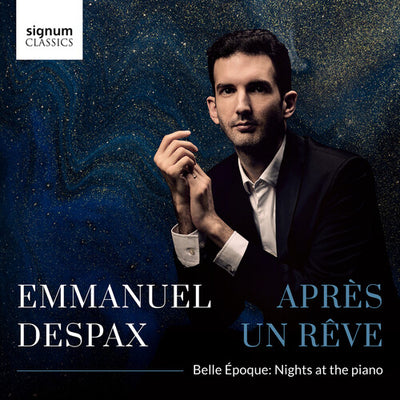
Après un rêve - Belle epoque: Nights at the Piano / Emmanuel Despax
“Après un rêve” is an ode to the French Belle Époque repertoire, depicting the beauty of dreams and the night. The album is an opportunity to hear and perhaps discover rarely played / rarely recorded wonderful works (Chaminade Nocturne, Duparc Aux étoiles, Poulenc Les soirées de Nazelles), alongside central pillars of the repertoire, and includes a world premiere of Despax’s arrangement of Après un rêve. The album is attributed to his grandfather, Jacques Charpentreau, a French poet who adored this repertoire and frequently drew inspiration from the night in his works. Despax has curated some of his poetry, as well as works by other poets he admired to complement this music, taking the listener on an immersive poetic and musical journey through this noctur- nal landscape.
REVIEW:
Despax has recorded Bach, Brahms, Chopin, but the works here particularly suit his sensibility. In Maurice Ravel’s haunting masterpiece Gaspard de la Nuit, he masters the ferocious challenges with ease, delicacy, strength.
-- The Guardian (UK)
Apollo & Dionysus / Danae & Kiveli Dorken
After the successful release of "Odyssey," pianist Danae Dörken presents her second album on Berlin Classics. Together with her sister - Kiveli Dörken - she invites the listener to embark on an emotional and psychological journey through a very personal selection of music that characterizes the Greek gods Apollo and Dionysus. This unique journey aims to become aware of the characteristics represented in each of us and create a balance between them. The technical brilliance present in their playing and the insightful, sensitive interpretations already make this album a highlight. Their deep personal connection and the decades of playing together at the piano are audible in every moment of these recordings and set this album apart.
Brahms, Kahn & Frühling: Trios for Clarinet, Cello & Piano / Quantum Clarinet Trio
The human factor determines the path. The Clarinet Trio op. 114 by Johannes Brahms more or less represents the DNA of the Quantum Clarinet Trio, and the piece was one of the driving forces behind the founding of this young chamber ensemble, whose members first met at the Mozarteum University in Salzburg in 2014. At that time, Italian clarinettist Elena Veronesi had been searching for fellow musicians to collaborate in a late work trio, and she found them in the German cellist Johannes Przygodda and Korean pianist Bokyung Kim. What started as a project has now evolved into a permanent ensemble. This great Brahms trio has continued to be a enterprise in which life converges with art.
Cellists, pianists and clarinettists usually come together when a work requires such a constellation, the line-up going their own separate ways once the project is completed. Compared to piano trios or string quartets, these particular instruments unfortunately rarely come together as a fixed ensemble. The Quantum Clarinet Trio is a welcome exception to the rule, making this encounter with one of Brahms' most important works much more than just a "fleeting liaison".
but I like to sing... / Carolyn Sampson & Joseph Middleton
After many acclaimed releases on BIS, most recently ‘Sounds and Sweet Airs – A Shakespeare Songbook’ (BIS-2653), Carolyn Sampson’s latest recital with Joseph Middleton lives up to its name: it is an eloquent testimony to the English soprano’s love of her art. This programme artfully blends well-known and lesser-known lieder by German and Austrian masters such as Schubert, Mendelssohn, Brahms, Richard Strauss and Hugo Wolf with French songs by Gounod, Poulenc and Franck, as well as works by Anglo-Saxon composers such as Hubert Parry, Samuel Barber and Ivor Gurney. Female composers are not forgotten, with rarely-performed songs by Rita Strohl based on slightly risqué poems by Pierre Louÿs, music by Cheryl Frances-Hoad, Kaija Saariaho – who has recently passed away – and Deborah Pritchard, whose song presented here was composed especially for Sampson. And while Leonard Bernstein’s comically cheeky song ‘I hate music’, appears to be a call not to let music take itself too seriously, Errollyn Wallen’s ‘Peace on Earth’, which concludes the album, invokes calm and encourages us to find peace, a message that seems more relevant today than ever.
(b)romance
Debussy & Ravel for Two / Bax & Chung Piano Duo
Their third duo album on Signum Classics, husband and wife Alessio Bax and Lucille Chung unite to bring an album of French works by Debussy and Ravel in versions for piano duo and four hands. With arrangements by Dutilleux and Ravel himself key works include ‘Prélude à l’après-midi d’un faune’ for four hands and La valse for two pianos.
Walking The Dog
A surprising and refreshing journey which explores the confines of the repertoire for saxophone and piano, Walking the Dog unites two formidable virtuosos of the contemporary classical scene, the Austrian Andreas Mader and the German Joseph Moog.
Walking the Dog is a multifaceted work, an authentic melting-pot, a surprising witness to the richness of the international musical scene at the beginning of the 20th century. One would then encounter styles as diverse as the mambo, the merengue, the habanera, or the samba, or even fusions of these seemingly separate genres.
Andreas Mader and Joseph Moog open their recital with Gershwin's Rhapsody in Blue in the inspiring version of the Japanese Jun Nagao. Under their sensitive and incisive fingers, it becomes the spirit of Jazz itself, sparkling and fresh. The Suite of seven pieces adapted from Prokofiev's Romeo and Juliet pursues it in a trenchant and caustic way: the saxophone, part soprano part tenor, displays all its colours.
This programme also pays tribute to France – a well-deserved homage to the country where Adolf Sax fathered such a great family of instruments. Some works are iconic, such as Debussy's Rhapsody (in a new and impressive version by the saxophonist), Milhaud's Scaramouche, some less known, like the Two Pieces by Lili Boulanger, and we have a genuine rarity, the Five Exotic Dances, a brilliant and exciting suite of miniature compositions from 1961 by Jean Francaix. Andreas Mader and Joseph Moog conclude their journey by a return to the origins – New York – by giving us the little Promenade, under the title "Walking the Dog", that Gershwin composed for the film Shall We Dance with Fred Astaire and Ginger Rogers.
This is an absolutely thrilling album which arouses both curiosity and senses, a true revelation from this surprising duo. It is impossible to resist Andreas Mader's voluptuous saxophone interlocked into the golden piano playing of Joseph Moog.
Hail To The Chief / United States Marine Band
Selection includes John F. Kennedy Inaugural Excerpt.
Selection includes Dwight Eisenhower Inaugual Excerpt.
Selection includes Harry Truman Inaugural Excerpt.
Selection includes Franklin Roosevelt Inaugural Excerpt.
Debussy: Orchestral Works Vol 1 - Prélude À L'Après-Midi D'Un Faune, La Mer / Märkl, Lyon NO
The Prélude is very well done. The solo flute is suitably sensuous, and is ably complemented by the solo oboe. Also, I have never heard the two solo violins, at the end, sound quite as winsome as they do here. The big tune in the middle is allowed to expand as it should and the delicate final pages, with slightly too reticent antique cymbals, is well controlled.
La Mer is almost as fine a performance. Starting very mysteriously, Märkl builds up the tension until the music bursts forth with animation. It’s a fine achievement. However, when the second part of the first movement begins, with cellos in eight parts, it’s too reticent and lacks the momentum required to push the music forwards. When Satie first heard this movement, From Dawn to Midday on the Sea, he quipped that he especially enjoyed the bit at a quarter to eleven. Strange as this may seem I think I know the moment he means – at four bars after rehearsal number 13 there is a static section where cor anglais and two solo cellos play a long breathed theme over sustained chords, it’s a magical moment which prepares us for the build up to the climactic final bars. Märkl makes these few bars quite magical and the calm is quite stunning. The coda is well built but the final three chords – which should beat us about the head with their power – fail to completely satisfy. The scherzo, Play of the Waves, is too heavy handed and the important colouristic glockenspiel part all but inaudible. The tension and suspense of the final movement, Dialogue between the Wind and the Sea, is very well done. The climaxes are well developed and the changes of mood and tempo very well handled. There is one strange moment – at rehearsal number 53 the horns play a triplet, followed, in the next bar, by two minim chords. In this recording we are treated to an extra triplet chord! I’ve played this moment several times, thinking my ears were deceiving me, but no, it’s there, an extra triplet beat. As it’s an exact repeat of what they played six bars earlier I’m mystified by what happens. Why is this extra chord there and what is the purpose? I doubt it’s an editing error so the conductor must have heard it as the horns played the passage. Curiouser and curiouser. Better news is that four bars after rehearsal number 59, under the big chords for winds and strings, Märkl plays the brass fanfares which, more often than not, are ignored by conductors as not being in a real Debussy style. Perhaps they are somewhat unsubtle for Debussy, and for this moment, but without them the music suddenly stops dead, it seems empty, something has to be played there and if these fanfares are all we have then we have to have them. It’s a good performance but it lacks that final insight, that ultimate injection of energy which makes the Hallé/Barbirolli recording so memorable and compelling.
Jeux is one of Debussy’s most elusive scores (it was his last orchestral work). It’s a ballet which concerns a lost tennis ball and a boy and two girls who look for it, as they play hide and seek, try to catch one another, quarrel and sulk without cause. Their games are interrupted when another tennis ball is mischievously thrown in by an unknown hand which surprises and alarms them and they disappear into the nocturnal depths of the garden. The story isn’t important. Debussy’s music is. It receives an excellent performance here – Märkl fully understands what is going on in the music and leads his players through the myriad tempo changes, keeps the ever changing orchestral colouring alive and generally makes clear music which so often sounds confused and muddled. You’d be hard pressed to find a finer performance on disk.
André Caplet was a close friend of Debussy and worked on the orchestration of the latter’s incidental music for Gabriele D’Annunzio’s play Le Martyre de Saint-Sébastien and the ballet La Boîte à joujou. He also made two, superb, reductions for two pianos, four hands and six hands, of La Mer, and made orchestral transcriptions of several piano works. Children’s Corner is a delightful six movement suite for solo piano; it’s light hearted, full of fun and several of the movements have become popular independently of the suite – The Little Shepherd and Golliwog’s Cake-walk in particular. Caplet’s orchestration has always struck me as being rather heavy handed – odd for so skilful an orchestrator – but here he has met his match with perfect piano music which does not lend itself to orchestration. Märkl does his best but, ultimately, it’s still too heavy and much of the humour is lost.
Apart from Jeux, which is superb, I would not put these performances of La Mer and the Prélude ahead of other recordings which are currently available - those conductors listed above - but they are very serviceable and if you’re on a tight budget, or just wanting to dip your toes in the Debussian water for the first time, then at the bargain price you’ll get much from these atmospheric readings.
-- Bob Briggs, MusicWeb International