Keyboardist Steven Devine continues this complete survey of Johann Ludwig Krebs’ significant contribution to the keyboard genre with the third volume in this series dedicated to the composer’s keyboard works. Featuring one of the three surviving Partitas from a presumed set of six, this album also includes the world premiere recording of Krebs’ Six Keyboard Sonatas (Krebs-WV 832-837), that only came to light during the historic restoration of the archive of the Sing-Akademie to Berlin following its removal to Ukraine during the war in 1943. With a compositional style that points to a period later in Krebs’s life, these charming, witty and sometimes quirky works clearly demonstrate the composer’s confident yet straightforward charm.
Besseghi: Sonate Da Camera, Op. 1 / Opera Qvinta [2 CDs]
Tactus
CD
$29.99Sep 04, 2020
The instrumental ensemble Opera Quinta, directed by Fabrizio Longo, violin soloist of the team, adds an important element to the inexhaustible rediscovery of the eighteenth- century Italian heritage. The sonatas op. 1 by Angelo Michele Besseghi - composer of which, unfortunately, only few biographical information has reached us - were published in 1710, openly paying homage to the edition of his much more famous countryman who ten years earlier would have marked the course of European violin history: the Opera 5 by Arcangelo Corelli. Period ensemble Opera Quinta is violinist Fabrizio Longo, gambist Rosita Ippolito, lutenist Fabiano Merlante, and keyboardist Valeria Montanari.
There is only a small number of orchestral pieces in Johann Sebastian Bach's oeuvre- which is surprising considering that the composer worked with excellent ensembles in both of his positions- as "Konzermeister" and Kapellmeister" - in Kothen and Weimar during the period between 1708 and 1723. This is particularly true of concertos where there is a high number of transcriptions, rearranged predominantly for harpsichord. Capella Savaria, Hungary's oldest period instrument ensemble, presents four of these on this album. The Capella Savaria (Szombathely) was founded in 1981 by Pál Németh. Their aim is to play 17th and 18th century music using the documents of the period. The play on authentic instruments with copies of bows of the epoch, studying the instrumental tutors of the Baroque era, referring to articulation, embellishment and, in wider sense, the characteristic sound of the whole period. The basis of the ensemble is strings, which are joined by other instruments as required.
Friederike Chylek, born in Starnberg, began playing the piano and the recorder at age seven. Whilst still attending secondary school in Stockdorf and Gräfelfing, she began her artistic education in Munich with the harpsichordist Michael Eberth. Starting in the year 2000, she studied harpsichord and figured bass at the world renowned Schola Cantorum Basiliensis with professors including Jesper Christensen, wtih Rudolf Lutz and Edoardo Torbianelli. She performs regularly in numerous concert halls in Germany and abroad and is a welcome guest at such select festivals as the Cadenza Baroque Days in Berlin, the Handel Festival in Göttingen and the Festival Maj z Muzyka Dawna, Wroclas, amongst many others. With the present album, Friederike Chylek puts an end to prejudices against English music - England was long denigrated as the "Land without music" - bringing time to a standstill with works from the Golden Age of Virginal Music, numerous performance and compositional techniques of which provided decisive impulses for the development of European keyboard music.
Bach: Harpsichord Concertos II / Corti, Il Pomo d'Oro
PENTATONE
CD
$19.99Feb 12, 2021
Francesco Corti and il pomo d’oro continue their acclaimed series of Bach harpsichord concertos with a recording of the concertos BWV 1044, 1054, 1056 and 1057. This completes the cycle of seven “official” harpsichord concertos that Bach composed. Many of them are masterful reworkings of existing material, either own compositions or works by contemporaries, showing Bach’s exceptional skill to present musical ideas in a different light. For their second Bach recording, Corti and il pomo d’oro have chosen to work with a relatively small ensemble, in order to bring out the individuality of each melodic line. Corti shares the centre stage with recorder players Andres Locatelli and Alessandro Nasello in BWV 1057, while joining forces with violinist Evgenii Sviridov and traverso player Marcello Gatti in the concluding “triple” concerto BWV 1044. Francesco Corti belongs to the most established harpsichordists of his generation, and releases his second PENTATONE Bach harpsichord concertos album, after his debut on the label in 2020. He works together with the multi-award-winning ensemble il pomo d’oro, who also recorded two vocal recital albums with PENTATONE: Carnevale 1729 with Ann Hallenberg (2017), as well as Prologue with Francesca Aspromonte (2018).
Weinberg: Symphonies Nos. 2 & 7 / Duczmal-Mroz, Amadeus Chamber Orchestra of Polish Radio
DUX
CD
$21.99Jun 05, 2020
In recent years, Mieczyslaw Weinberg has become one of the most recognizable Polish composers of the 20th century, which was significantly influenced by the hundredth anniversary of the composer’s birth in December 2019. The project of the Amadeus Chamber Orchestra of Polish Radio devoted exclusively to works by Mieczyslaw Weinberg perfectly reflects the peculiar revival related to the interest in the artist in Poland and in the world. This album is another proposal from the Amadeus Orchestra series, this time dedicated to selected symphonies of the Polish artist.
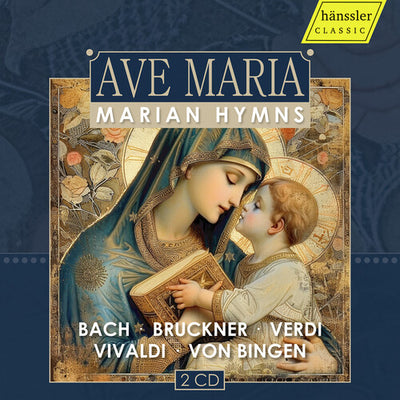
Marien Hymns Masterpieces of musical Marian devotion over the centuries, composed by the greatest composers of the time as well as well-known traditional hymns, interpreted by renowned soloists and ensembles such as the Gachinger Kantorei Stuttgart under Helmuth Rilling, Renata Tebaldi, the Don Cossack Choir Serge Jaroff or the Stuttgart Hymnus Choir Boys' Choir.
Foreign Masters, an album that celebrates the profound influence of immigrant composers on 18th-century London, transforming it into the cultural capital of the world, is set to release this September. This collection features exquisite music for recorder and harpsichord, showcasing the brilliance of composers who brought their European heritage to London. Performed by Max Volbers, a prizewinner of the Deutscher Musikwettbewerb and one of the most versatile young musicians in early music today, the album promises to captivate listeners with it's artistry and historical depth. Immerse yourself in the works of legendary composers such as Georg Friedrich Handel, Arcangelo Corelli, Giuseppe Sammartini, James Paisible, Giovanni Carbonelli, Giuseppe Alberti, Johann Pepusch, and more. Each piece is a testament to the rich, multicultural tapestry that shaped London's musical landscape.
Fux & Biber: Music for Trumpets & Strings / Clemencic Consort
Oehms Classics
CD
$19.99Apr 29, 2022
These 2004 recordings,, reissued by Oehms Classics, with the renowned Clemencic Consort conducted by René Clemencic include works by the important composers Johann Joseph Fux and Heinrich Ignaz Franz Biber. In the selection of Fux's works, cosmopolitan skill meets French and Italian styles with southern German tradition. Graceful in the graceful pieces by Biber, magnificently representative in the solemn ones, this recording with a varied program offers an authentic portrait of one of the most important masters of baroque music. The Clemencic Consort under the direction of René Clemencic is one of the most renowned ensembles for music from the Middle Ages to the Baroque period with a focus on authentic interpretations. Numerous award-winning recordings bear witness to the work of the ensemble.
REVIEW:
The first CD contains ballets and sonatas for trumpet and strings by Heinrich Ignaz Franz Biber. The highly virtuosic music is heard in opulent and magnificent ensemble playing. Baroque opulence also abounds in the works of Johann Joseph Fux. The works assembled here impressively demonstrate the composer's versatility. The Clemencic Consort emphasizes this with a variety of tonal color and dynamic contrasts, fully exploiting the dance-like element of Fux’s music.
Barre: Premier Livre de Pieces pour la Flûte Traversiere avec la Basse Continue
Navona
CD
$16.99Jun 24, 2022
When four musicians of high caliber join forces, one can generally expect favorable results; but only the truly splendid manage to create a musical experience greater than the sum of its parts. Such is the nature of The Opus Project, founded in 2020 and already rated as one of Canada’s most eminent Early Music quartets. On MICHEL DE LA BARRE, the four musicians masterfully perform rarely-heard, unsung suites by the eponymous French flute virtuoso and composer, who broke new ground in Baroque music by merit of being the first to publish solo pieces for his instrument. Zesty yet courtly, refined yet effervescent, these works please at once, not least owing to the lucid and charming interpretation by The Opus Project. A match made in heaven.
The present album constitutes a juxtaposition of works of two musical families: the greatest one, without which it would be hard to imagine the history of modern music - the Bach family - and the Podbielski family, of Polish origin, who have almost been completely forgotten and pushed to the margin of consciousness. Four unique personalities emerge from this compilation - each immersed in their own time and operating with their individual expression style. The common denominator of the works presented on the album is a unique instrument, considered to be perfect in the times of Johann Sebastian Bach - the viola da gamba. The listener will hear it together with the harpsichord in the interpretation of a marriage of musicians specializing in Early Music performance - Krzysztof and Anna Firlus.
Scarlatti: Sonatas / Paweł Łosakiewicz, Lilianna Stawarz
DUX
CD
$21.99Apr 16, 2021
The year 1685 bestowed mankind with three geniuses with supernatural talents in composition and improvisation, i.e. Johann Sebastian Bach, Georg Friedrich Händel and Domenico Scarlatti. Only the last two had the opportunity to confront themselves in a direct duel for the title of the winner in the category of the fastest fingers implementing unbridled improvisational ideas. Interestingly, Scarlatti’s sonatas, although deeply rooted in the tradition of the turn of the Baroque and Classicism, are ahead of works of both eras in many respects, while the numerous textural solutions suggested by the composer are a harbinger of harmonically advanced Romantic miniatures. The interpretations featured on this album result from the collaboration of two different, seemingly incompatible worlds. The world of interpretation rooted in early music and that represented by contemporary instruments in relation to the Baroque era. The need for making music together, for dialogue and mutual inspiration as well as for the diversity of perception of performance issues are undoubtedly a great asset of this album.
Igor Ruhadze’s Brilliant Classics recording of sonatas by Locatelli (94736) won warm praise from Gramophone. ‘The playing is elegantly supple, the string tone warm, and the architecture of individual movements thoughtfully worked out. All this makes for a pleasant mood and enjoyable listening. The more exuberant pieces are brilliantly and at times breathtakingly performed.’ With his latest Brilliant Classics album, the Russian Baroque-specialist violinist and director turns to another pivotal figure in Baroque-era violin culture, Francesco Geminiani.
Taught first by his violinist father and then by both Corelli and Alessandro Scarlatti in Rome, Geminiani was already a leading figure in north Italian courts in his 20s, before he undertook the move to London that made his name and fortune. Geminiani dedicated the Op.1 Sonatas (1716) to Baron Johann Adolf Kielmansegge, his first London patron. According to Hawkins, Kielmansegge favored the composer by arranging a performance before the king in which Geminiani was accompanied on the harpsichord by Handel. With these sonatas, which clearly stem from Corelli, Geminiani presented himself to the public as Corelli's pupil. Many imitation editions followed the first printing, but the commentator Charles Burney maintained that only the composer himself could do them full justice. Apparently designed as a calling card for Geminiani’s talents as a violinist-composer, the Op.1 Sonatas still make strenuous technical but also expressive demands on any interpreter. Their genteel surface and polished dialogue between parts conceals an array of sophisticated contrasts between moods and demonstration of a violinist’s credentials as an artist as well as a technician.
For this new recording, Igor Ruhadze is joined not by his colleagues in the Violini Capricciosi ensemble but the Russian-born harpsichordist Alexandra Nepomnyashchaya. Having pursued graduate studies with early-music luminaries such as Richard Egarr and Menno van Delft, she too evinces intense sympathy with Geminiani’s idiom.
Couperin, Dornel, Forqueray, Rebel: Portraits: Les caractères français / {oh!}
DUX
CD
$21.99Feb 04, 2022
Artistic salons had begun thriving in Paris at the beginning of the eighteenth century. Their history started in the early seventeenth century with Madame de Rambouillet’s Chambre bleue, which offered its regulars a lively exchange of views on current events in politics, the arts and science, while also serving as a venue for conversations on “love, friendship, a sense of duty, reputation, virtue and taste.” Music was an inseparable element of salon life. It was performed by both high-caliber artists and amateurs, and was the subject of heated debates, controversies and polemics. A gradual return of life to Paris, and the fresh breath of freedom that characterized the final years of the reign of Louis XIV and the ensuing period of regency in particular had created an environment, in which French composers opened themselves up to the music of various nations. The present release features chamber works by Jean-Fery Rebel, Antoine Forqueray, Louis-Antoine Dornel, and Francois Couperin, performed by the {oh!} trio.
• Mostly premiere recordings of Baroque Recorder Sonatas from the collection of Viceroy of Naples
• The greatest discovery of the collection is certainly the sonata by Adolf Hasse, then Europe's leading opera composer
• These works are among the highlights of late Baroque music
This third double CD set completes Gilbert Rowland's survey of these Handel's groundbreaking solo keyboard music, works that began to free the form from the formal constraints of Allemande, Courante, Sarabande, Gigue. Forty-plus years of recitals, appearances at major festivals in several countries, together with regular broadcasts, have helped to establish Gilbert Rowland's reputation as one of Britain's leading harpsichordists. The standard of playing is very high indeed... a most enjoyable recording. (The Consort on Vol.1)
Francesco Corti and il pomo d’oro continue their acclaimed series of Bach harpsichord concertos, now moving to the works for two harpsichords, BWV 1060-1062, together with Andrea Buccarella. Compared to the previous two instalments, the accompanying ensemble is small, allowing for maximal transparency and focus on the soloists. The greatest discographic asset of this album is Corti’s arrangement of Bach’s unfinished concerto for harpsichord, oboe and strings in D Minor, BWV 1059. In his extensive contribution to the booklet, Corti explains why and how he used parts of Cantata BWV 35 to complete the score. Emmanuel Laporte performs the solo oboe. Francesco Corti belongs to the most established harpsichordists of his generation, and releases his third PENTATONE Bach harpsichord concertos album, after releases in 2020 and 2021. He works together with the multi-award-winning ensemble il pomo d’oro, who also recorded three vocal recital albums with PENTATONE: Carnevale 1729 with Ann Hallenberg (2017), Prologue with Francesca Aspromonte (2018) and Handel – Apollo e Dafne & Armida abbandonata (2021). Andrea Buccarella and Emmanuel Laporte both make their PENTATONE debut.
Diogenio Bigaglia, a composer who at present is unknown to most people, was active in Venice in the first half of the eighteenth century, so he was a contemporary of the much better known Tomaso Albinoni, Alessandro and Benedetto Marcello, and, above all, Antonio Vivaldi, whose work shows several evident – and more or less explicit – references to Bigaglia’s production. So he turns out to be a composer who is worthy of interest not only for the intrinsic musical worth of his works, but also for the influence his activity may have had on musicians with whom we are more familiar; this is why musicologists have recently started showing an increasing interest in him. This recording presents the complete "12 Sonate a Violino Solo o Sia Flauto e Violoncello o Basso Continuo Opera prima del Signor Bigaglia Padre Benedettino", as this work is called in the title page of the edition published in Amsterdam by Michel Charles Le Cène around 1722 . Davide Belosio solo violin interprets this world premiere recording accompanied by I Solisti Ambrosiani, already protagonists of a previous release dedicated to the rediscovery of the Venetian composer (v. Diogenio Bigaglia, Cantate per soprano e continuo, Tactus, TC670203).
Bononcini: Cantate e Sonate / Montanari, Aurata Fonte
Tactus
CD
$10.99$21.99Save 50%Aug 06, 2021
Giovanni Bononcini was born in Modena on 18 July 1670, the eldest and best-known son of the composer, violinist and theoretician Giovanni Maria (1642-1678), one of the main exponents of the musical school of Modena in the second half of the seventeenth century. His talent was extremely precocious: in 1685 he published Trattenimenti da camera op. 1, Concerti da camera op. 2 and Sinfonie op. 3. Giovanni Bononcini is known above all for his dramatic and vocal chamber music, whose simple, refined intensity of expression was acknowledged by his contemporaries. The cantatas are formed of the prescribed succession of arias (or duets) and recitativos, and show Bononcini’s outstanding expressive skill and his ability in finely crafting the close relationship between words and music that was required by this genre of chamber music because of the need to “further the feeling of that divine poetry by means of the expression of the harmonious melodies” (as he wrote in a letter to Benedetto Marcello from London on 6 April 1725). This ability of his made it possible for him, through his perfect knowledge of counterpoint, to tastefully adjust “the exact observation of the different moods produced in the soul by the different modulations of the sound, so as to be able to adapt them suitably to the needs of the words”. Within this world premiere recording the Aurata Fonte ensemble is performing the manuscripts of a composer whose talent was recognized and affirmed by a great career throughout Europe.
Richard Jones (1680?-1744) was an English composer and violinist of whom lamentably little is known. Jones' first publication appeared in 1720, a solo cantata While in a Lovely Rurall Seat. In 1732 he was associated with the Drury Lane Theater Orchestra in London, succeeding Stefano Carbonelli as the orchestra's leader. He was a stage composer at a time when George Frideric Handel's music dominated the British stage, and much of his music, or what of it survives, shows clear Italianate influence. Like the details of his life, little of Jones's music survives. His pantomime stage works and ballad operas are all lost. His keyboard and violin suites however did survive and are noted for their wide, angular leaps and unconventional structure.
The 6 Harpsichord Suites (or Lessons), possible inspired by the great keyboard suites by Handel, are of a very high quality, beautifully written, original and enormously appealing, with inventive handling of sweeping melodies, unexpected cadenzas and frequent changes of direction. They are also rich in harmony, with some bold inventions and plenty of vigorous rhythm that can be quite challenging from a technical point of view. In other words, they are compositions that on occasion rival those of Purcell and Handel.
Francesco Fornasaro followed master classes with Luigi Ferdinando Tagliavini, Giulia Nuti, Bob van Asperen, Pierre Hantaï, Christophe Rousset, Skip Sempé, Menno van Delft, Francesco, while he further improved his skills in baroque ensemble music and baroque instrumental techniques and practices at the Maggio Fiorentino Formazione under the guidance of Alan Curtis, Federico Maria Sardelli and Federico Bardazzi.
Celebrated harpsichordist Steven Devine completes his monumental survey for Resonus Classics of the complete solo keyboard works by Jean-Philippe Rameau (1683-1764) with this new collection. These seminal works of the French Baroque era are brought to life vividly by Devine, mainly marking the earlier part of Rameau’s career and charting the development of the future prolific opera and ballet composer. The three books of Pieces de Clavecin are joined by the Cinq Pieces (derived from the Pieces de Clavecin en Concert), and the individual work La Dauphine. Also included is the substantial compendium Les Indes Galantes- keyboard transcriptions that Rameau himself made from his own opera-ballet of the same name composed in 1735/36. “[Devine] is authoritative, suave, technically dazzling and delivers immaculately manicured ornaments that lend brilliance and expressive introspection when required.” (BBC Music Magazine)
Luca Guglielmi: “Bach himself did not see the autograph manuscript as a 'definitive' version. He kept it as an 'open manuscript' on the rack of his harpsichord up to his death, using it as a 'textbook' for the lessons he gave to his students, never ceasing to insert a series of corrections, reworkings, improvements, small variants and even performance instructions. Bach's hands-on approach to his work in progress proves just how modern he actually was and remains. Through a truly 'holistic vision' we can embrace artistic parameters inherited from our 18th-century forebears: a profound, venerable legacy that remains unknown to the ones who approach the musical art on 'scientific' methods based on calculation and measurement. For this recording we have had the fortune to use an original Christian Zell 1737 harpsichord, a favorite of Gustav Leonhardt to whose memory this volume 1 is dedicated.”
Marais: Les Folies d'Espagne / Rasi, Marisaldi, Pornon
Stradivarius
CD
$11.99Jun 24, 2016
This release views “French style” from a strictly historic point of view, exploring the musical language of absolutism which reigned in Paris from the time of Louis XIV (1643-1715) and part of the time of Louis XV (1715-1774). Marin Marais was one of the most famous composers of “French-style,” excelling in chamber music. Performing on period instruments are Alberto Rasi on viola da gamba, Patrizia Marisaldi on harpsichord, and Beatrice Pornon on theorbo.
Gervasio, Barbella & Cocchi: The Manuscripts for Mandolin of Gimo Collection
Tactus
CD
$29.99Mar 03, 2023
The CDs contained in this box set were conceived and produced as part of the project "Il mandolino a Napoli nel Settecento”, coordinated by the University of Bologna in collaboration with the University of Uppsala and the Neapolitan Mandolin Academy (www.mandolinonapoli700.com). The objective of the project was the recording on period instruments of the 19 compositions for mandolin by Neapolitan composers of the eighteenth century, whose manuscripts are collected in the Gimo collection and preserved in the "Carolina Rediviva" Library of the University of Uppsala. The two CDs include the works by Giovanni Battista Gervasio (CD1), and Emanuele Barbella, Gioacchino Còcchi and an anonymous (CD2). The production aims to offer the listener a new interpretation of this repertoire based on an interpretative concept sensitive to the quality of sound, phrasing and aesthetic and compositional concepts of the time, contributing to a more extensive rediscovery of the Neapolitan and southern Italian instrumental repertoire of the eighteenth century. This CD box was born thanks to the fruitful collaboration between the University of Bologna and the Museum of San Colombano – Tagliavini Collection, that hosted most of the recordings and made available the precious instruments of its collection.
Following much critical acclaim for his debut solo album Ciaccona, harpsichordist Guillermo Brachetta returns to the Resonous label with Concerto, a thrilling programme of works for one and two harpsichords composed seza ripieno. This stunning album features J.S. Bach's Italian Concerto, the second part of his Clavier-Übung and solo concerti from Wilhelm Friedemann Bacha nd Carl Heinrich Graun. Bachetta is joined by Menno van Delft for the original two-harpsichord version of J.S. Bach's Concerto a due cembali in C major, BWV 1061a. ''Superb performances by Brachetta'' (Financial Times)