Johann Sebastian Bach
1685–1750. German composer. in the Baroque Counterpoint tradition.
Supreme master of Baroque counterpoint; sacred and secular output of unparalleled breadth and influence.
Signature works: The Well-Tempered Clavier, Mass in B minor, St Matthew Passion, Goldberg Variations, Brandenburg Concertos.
442 products
-
-
-
-
-
-
-
-
-
J.S. Bach: The English Suites
$29.99CDFirst Hand Records
Jul 25, 2025FHR166 -
J.S. Bach: The Art of Fugue
$21.99CDFirst Hand Records
Jan 16, 2026FHR191 -
-
-
-
-
-
- trad.: She moved through the fair
- Satie: Gymnopédie No. 1
- Delius: On Hearing the First Cuckoo in Spring
- Ravel: Pavane pour une infante défunte
- Rutter: Lord, make me an instrument of thy peace
- Grieg: Symphonic Dance, Op. 64 No. 2
- Bach: Bist du bei mir [When you are with me]
- Ravel: Sonatine: Mouvement de Menuet
- Debussy: Suite bergamasque: Clair de lune
- Handel: Semele: Where’er you walk
- Rutter: Sheep may safely graze
-
-
-
-
-
-
-
-
-
-
-
-
-
-
-
-
-
-
-
-
-
-
-
-
-
-
-
For Piano … or not?
$22.99CDArs Produktion
Dec 19, 2025ARS38686 -
-
Bach: Concertos for Recorder / Bosgraaf, Ensemble Cordevento
A high-grade LP transfer for a superbly engineered album of Bach at his most life-enhancing. JS Bach may not have composed any concertos specifically for recorder – none have survived, at any rate – but he scored for the instrument elsewhere in his output, most unforgettably so in his earliest surviving cantata, the ‘Actus tragicus’. In any case the uniquely adaptable nature of his inspiration lends itself to the kind of sympathetic adaptation undertaken here by Erik Bosgraaf in partnership with the musicologist and art historian Thiemo Wind. Three of the concertos here have beenadapted from pieces which survive in a scoring for solo harpsichord and string orchestra: BWV 1053, 1055 and 1059. A fourth concerto has been constructed by Wind from transcriptions of cantata arias, adapted from the secular cantata Preise dein Glücke, gesegnetes Sachsen BWV215 and Liebster Jesu, mein Verlangen BWV32. The idea is humble but ingenious, answering the question: what might Bach have done, or could he have done, if he had written concertos for the recorder? In doing so, Bosgraaf and his colleagues are following good precedents: after all, Bach himself created and performed many such transcriptions. His oeuvre demonstrates that a composition wasnot regarded as an unchanging work of art, and during his lifetime it was standard procedure to make quite radical adaptations according to the relevant circumstances. In any case, Bosgraaf and the one-per-part musicians of Cordevento perform these concertos with an unfailing sensitivity to the momentum and poetry of Bach’s originals. Now, on 180-gram vinyl, these recordings gain a special warmth and depth while losing none of their pin-point clarity. ‘Erik Bosgraaf’s recorder-playing is fluent and lively in fast music, and his five colleagues provide accompaniments that are lean, stylish and precise.’ (Gramophone)
J.S. Bach: Cantatas
J.S. Bach: Cello Suites, Vol. 1 (arr. for theorbo)
Bach: Sonatas for Violin & Cembalo obbligato, Vol. 2 / Terakado, Bonizzoni
Here is the second volume of Bach’s Sonatas for violin and obbligato harpsichord. Terakado and Bonizzoni offer a thoroughly distinctive account of these famous masterpieces. Their approach combines a deep musical and philosophical insight with a conversational vibe.
Wilhelm Backhaus - The Complete Acoustic & Selected Early Electric Recordings
As one of the great pianists of the 20th century, WILHELM BACKHAUS (1884–1969) needs no introduction. He recorded almost continuously from 1908 until his death, but this set, focusing on his earliest recordings, completes APR’s coverage (see also APR 6026, APR 6027 and APR 5637) of all his solo and concerto output for The Gramophone Company/HMV, except the electrically recorded Brahms titles, which are available elsewhere. These early discs reveal Backhaus as an exciting young virtuoso, rather than the sober purveyor of German classics he was to become.
J.S. Bach: The Well-Tempered Clavier I
We are now in the year 2022: as chance would have it, this album’s release coincides with the 300th anniversary of the first volume of the Well-Tempered Clavier. Our lifestyle has changed in many ways over the past three centuries. We travel at much greater speed; we develop an increasing number of technologies and digital means of communication. Trained specialists are responsible for every area of our lives. But have we truly made progress? Excessive global travel, as we know, has an alarming impact on climate. While many areas of our life become digital, communication is made simpler but ultimately only leads to mental lethargy, social isolation, and emotional impoverishment. Specialists turn out to be one-track minds who accumulate isolated bits of knowledge – indeed, as ancient Greek philosopher Heraclitus remarked, “knowing many things doesn’t teach insight.” Insight thus not only requires for us to have knowledge, but also for us to broaden our horizons. And that is exactly what is so fascinating about the Well-Tempered Clavier.
Trance & Rhythm
J.S. Bach: The English Suites
J.S. Bach: The Art of Fugue
Olga Samaroff & Frank La Forge - Complete solo recordings
The Decca Solo Recordings, 1941-1945 / Kathleen Long
An unobtrusive figure in the British music scene and despite her self-stated lack of ambition, KATHLEEN LONG (1896–1968) was a musician of the highest order. She taught for 44 years at the Royal College of Music and was a major Decca artist for two decades, having recorded for several other labels before that. Her first recording was made in 1928, and her first Decca recordings (of Mozart’s Piano Concertos K449 and K450) were made in 1935. Her first Decca solo recordings are those on this release. On disc, she made premiere recordings of several Mozart concertos and sonatas and was renowned for her Scarlatti and Fauré. For her service to French music, she was made Honorary Member of the Académie de France.
J.S. Bach, Buxtehude & Bruhns
J.S. Bach: 6 Suites for Solo Cello / Marina Tarasova
The Six Suites for Solo Cello by J.S. Bach, composed around 1720, are generally regarded as the first and greatest masterpieces ever written for the instrument. Their scope is vast and ingenious. Although most of the time, only one note is played, occasional chords and masterful melodies imply harmony and counterpoint. The Suites have been performed and recorded countless times over the last 100 years, with a variety of interpretative approaches. These approaches, until recently, could often be rather academic and formal, as it used to be thought that baroque music was mostly about form. The present cellist takes a radically opposing approach, one which is inspirational and which infuses the works with vitality and spirit.
Marina Tarasova is a world-renowned cellist with many recordings to her name for Musical Concepts and Northern Flowers among other labels, and this is her first recording for Divine Art. She has won international competitions in Prague, Florence and Paris and has a wide repertoire covering works of composers from the 17th century to the 20th century.
Classical Tranquillity / Rutter, Manchester Camerata
John Rutter writes: Tranquillity is a state of mind. You might be more likely to describe a favorite countryside scene rather than a person as ‘tranquil’, but you are really describing the effect it has on you. You feel calm, serene, still, at peace, relaxed, untroubled, chilled-out . . . perhaps we have so many different words for this state of mind because it is so important, and yet so elusive in an often noisy, frantic world.
Music has an extraordinary power to evoke tranquillity – as is revealed in the eleven pieces I have chosen to make up this collection. Ten of them happen to be among my personal favorites, drawn from the music of seven composers, plus the treasure trove of anonymous folk music, and I have added an orchestral version of my choral setting of Lord, make me an instrument of thy peace, a text formerly believed to be by St Francis of Assisi.
CONTENTS:
A Cathedral of Sound - The Bach-Busoni Transcriptions / Madge
violin and his choral preludes by Ferruccio Busoni. Liszt is basically urtext-true in his Bach and Beethoven transcriptions, while Busoni incorporated in his transcriptions not only the text of the work but also the total acoustical end result.
Salvation - Bach & Shostakovich: Vocal & Instrumental Music / Mields, G.A.P. Ensemble
‘I play Bach every day,’ said Shostakovich in 1950, at an event to mark the bicentenary of Bach’s death. ‘For us, Bach's legacy is an embodiment of flaming emotion, soulful humanity and true humanism, which stands in contrast to the dark world of raw evil and contempt for humanity.’
Taking their inspiration from these words, and from the palpable influence of Bach on the solid forms and fluent counterpoint of Shostakovich’s own music, this quartet of musicians presents an entirely original pairing of the two composers, in which cantata arias and a major song-cycle are linked and interspersed by instrumental interludes.
The German soprano Dorothee Mields is renowned for her piercing musicianship and luminous tone in the music of Bach, working with such illustrious conductors as Rene Jacobs and Philippe Herreweghe. Her contributions to recent recordings in this field have been called ‘sensational’ and ‘ravishing’ by Gramophone.
Here she sings recitatives and arias from seven cantatas, including the meditative opening movement of ‘Ich bin in mir vergnügt BWV204’. The trio-sonata accompaniment brings her expressive handling of the text to the fore, and prefaces the arias with the G major Sonata BWV1021 for violin and continuo, while Luca Quintavalle contributes the sixth Prelude and Fugue from Book 2 of ‘The Well-Tempered Clavier’. Switching to piano for Shostakovich, Quintavalle plays the D major Prelude and Fugue from the Russian composer’s counterpart to the WTC. The early Piano Trio No.1 makes a Romantically yearning preface to the late settings of Alexander Blok which Shostakovich composed alongside the song-cycle Fourteenth Symphony. These songs find the composer at his most introspective, unsparing and yet rewarding of the subtlety which Mields brings to them. The idioms of Bach and Shostakovich complement as much as they contrast, and they are drawn together here by performances of powerful eloquence.
J.S. Bach: a la francaise
Johann Wilhelm Hertel is one of the
lesser-known composers of the late
baroque and early classical era. Born in
Eisenach in 1727, as a young man he
travelled to the north of Germany with
his father, who was a viola da gamba
virtuoso engaged as a Kapellmeister at
the court of Mecklenburg-Strelitz. Already
as a young man Johann Wilhelm showed
a remarkable talent for music. He
excelled on the harpsichord and violin,
but his father wanted him to additionally
study law. However, a trip to Berlin and
contact with Berlin court musicians Carl
Philipp Emanuel Bach and Franz Benda
pushed the young Johann Wilhelm to
devote his life primarily to music. In
particular he studied the harpsichord with
Carl Philipp Emanuel Bach, the violin with
Franz Benda and composition with Karl
Heinrich Graun. He spent his life in the
service of the Mecklenburg-Strelitz and
-Schwerin courts, and he was also music
director in Stralsund. It was during this time
that he had many opportunities to meet
authorities from both the musical and
scientific worlds.
His oboes concertos are exemplary
compositions of these times. The autographs,
which are preserved in the Library of the
Royal Conservatoire of Brussels (Sig. No. B-Bc5562 and B-Bc-5563), together contain 10
oboe concertos in various keys. Nine of them
are collected (and numbered by librarians) in
Sig. No. B-Bc-5562 ,and one is separately
placed as B-Bc-5563. As there is no catalogue
of Hertel’s works, the numbers given for the
concertos are taken from the manuscript Sig.
No. B-Bc-5562. Some of the pieces are dated
1749 (Concertos Nos. 3 and 9) and others
1756 (Concerto No.2). All the concertos were
prepared for this recording by Katarzyna
Pilipiuk, copying with a focus on accuracy;
only minor mistakes were corrected so as to
give the most faithful transmission of the
composer’s ideas. The material is very clear,
with all the pieces noted by the composer in
score form. All of them have signs of stylistic
inspiration from the works of Carl Philipp
Emanuel Bach, in particular Concerto No.5,
which is an excellent work in the
Empfindsamer Stil.
Other information:
● Recorded March 2023 in Kraków, Poland
● Pilipiuk plays a Baroque oboe by Randall
Cook (2019), after Jonathan Bradbury (c.1720)
● Booklet in English contains liner notes by the
artist, and biographies of her and of the
ensemble
Bach: Sonatas & Partitas for Violin Solo / Timpe
Few works by Johann Sebastian Bach have given rise to more research and speculation than the 'Sei Solo', the sonatas and partitas for solo violin. From the search for models to dating based on stylistic features, from the identification of the paper used for the autograph from 1720 to the mysticism of numbers, no stone has been left unturned to solve the numerous riddles posed by this exorbitant work. The pieces in this collection are exorbitant in several respects. Not only does Bach go beyond what was customary at the time in terms of length, but the musical content and technical demands are also unprecedented, both in the context of contemporary violin music by other composers and within Bach's own oeuvre. As so often in Bach's oeuvre, an entire musical cosmos is explored in a single work.
Alfred Brendel plays Busoni & Liszt
Bach: Sonatas for viola da gamba, BWV 1027-1029 / Sofronitsky
Bach & Chick Corea / Luiza Borac
Pianist Luiza Borac plays Bach's Goldberg Variations and Canons, transcriptions of Bach works by Lipatti, Busoni, Kempff, and Siloti, concluding with Chick Corea's Children's Songs.
REVIEW:
There is no attempt on Borac’s part (unlike some other famous pianists) to suggest the sonority of the harpsichord. But her playing has a clarity and deftness of touch entirely appropriate for this repertoire. Borac’s superb technique, crystalline tone, and seamless legato provide the utmost pleasure.
The remaining Bach items embody a comparable level of artistry, both unaffected and highly expressive. Jazz pianist and composer Chick Corea’s Children’s Songs were inspired in part by Bartók’s Mikrokosmos. Borac, who participated in some of Corea’s workshops, and found them “unforgettable and matchless,” plays the songs with masterful technique, captivating energy, and pervasive joy. She dedicates this recital “to the memory of my father George Borac.” What a beautiful musical tribute, and gift to us all. Highest recommendation.
— Fanfare (Ken Meltzer)
The Complete Polydor Recordings (1927-1936) / Kempff
Wilhelm Walter Friedrich Kempff was a German pianist and composer. Although his repertoire included Bach, Mozart, Chopin, Schumann, Liszt and Brahms, Kempff was particularly well known for his interpretations of the music of Ludwig van Beethoven and Franz Schubert, recording the complete sonatas of both composers. Wilhelm Kempff’s 78-rpm recordings were very much focused on Beethoven, as can be heard on seven previously issued APR discs, but this release presents everything by other composers he set down from the start of electrical recording until the war. Notable among the titles are four of his own Bach transcriptions and, revealing the pianist in an unexpected light, his own virtuosic elaboration of the Schubert/Liszt ‘Hark, Hark! The Lark’ transcription.
REVIEW:
There's something special about these recordings, something quite miraculous. In spite of the relatively primitive technology involved in these early electrical recordings, I had no trouble at all forgetting sonic imperfections, and zeroing in on a great master channeling great composers. The French Suite no. 5 of Bach, recorded in 1935, is the highlight of the disc; it's a masterful interpretation. I was in awe of this from the first time I heard it, since I had the strong feeling that Kempff was communicating his own awe.
-- Music for Several Instruments
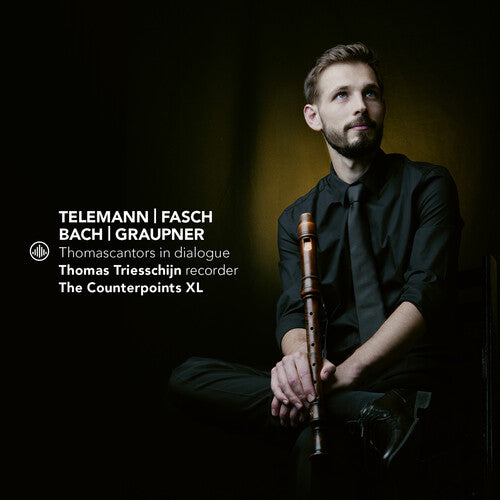
Thomascantors in Dialogue
Bach: The Well-Tempered Clavier / Francesco Cera
Bach’s The Well-Tempered Clavier was written at a time when composers had begun to expand the limited tonal compass of keyboard instruments through far wider use of keys and; ultimately; equal temperament. The 48 preludes and fugues that constitute The Well-Tempered Claver are composed in a wide range of styles; and the work remains one of the most important and influential in Western classical music. Francesco Cera is a prominent Italian early music specialists and he plays on a copy of a Hemsch harpsichord of 1736; using his own personal tuning. For Book II he employs the Altnickol edition of the score which includes numerous variants.
Mozart, Bach & Beethoven: Violin Concertos / Frank Peter Zimmermann
Bach & MacMillan: Motets & Sacred Songs / Short, Tenebrae
Tenebrae bring their trademark passion and precision to this live performance of music by J. S. Bach and Sir James MacMillan, to be recorded live at Snape Maltings in May 2023. Renowned for their technical difficulty,
Bach’s motets are pillars of the choral repertoire, requiring minute attention to detail as well as a full emotional range. Here, Tenebrae performs the three most well-known of the set, culminating in the joyful Singet dem Herrn. Like Bach, Sir James MacMillan has written much of his music for the church, and his settings of the Tenebrae responsories paint a vivid picture of the events of Holy Week. This album also features the premiere recording of I saw Eternity the other night, which MacMillan composed for Tenebrae in 2021 to celebrate the 75th anniversary of the London Bach Society.
Speaking on Bach and MacMillan, Nigel Short says“I am sure James will be as revered in 400 years’ time as Bach is today. On so many different levels, the contrast between the music of these two great composers could not be more dramatic. What both composers have in abundance, though, is an utter devotion to their religious faiths. This total conviction displays itself in their music, leaving the listener in no doubt as to their commitment to creating music imbued with every ounce of passion and precision. I hope listeners will enjoy and feel the sense of excitement and energy we as performers always feed off in concert, and that this performance in the beautiful venue of Snape Maltings will stand the test of time and be heard by music-lovers for centuries to come.”
Bach: Suites for Cello Nos. 1-6 / Skeen
The six suites for solo cello are frequently considered to be Bach’s greatest masterpieces and are a pinnacle of the Baroque cello repertory. This new album of Bach’s complete Cello Suites has the unique feature of being performed using two different historic cellos, one of them being a rare five-string instrument from the 17th century, which is used on Suite 6.
Cellist William Skeen is one of the world’s premiere Baroque cellists. He serves as Principal Cellist with Philharmonia Baroque Orchestra, Voices of Music, and was Principal Cellist of the American Bach Soloists for nearly two decades. Mr. Skeen taught Baroque cello and viola da gamba at the University of Southern California for two decades. Mr. Skeen has received two GRAMMY® nominations for previous albums. He continues to perform regularly with major orchestras and Baroque groups around the world.
This new release of the Six Cello Suites was beautifully recorded by famed multi-GRAMMY®-winning engineer Leslie Ann Jones at Skywalker Sound in Marin County, California. It was mastered by RR's own multi-GRAMMY®-nominated engineer, Sean Royce Martin. The album was produced by the outstanding San Francisco-based Lolly Lewis, who in recent years has been particularly focused on period instrument performance and has produced six albums with the New Esterházy Quartet.
For Piano … or not?
Bach: Sonatas for Violin & Cembalo obbligato, Vol. 1 / Terakado, Bonizzoni