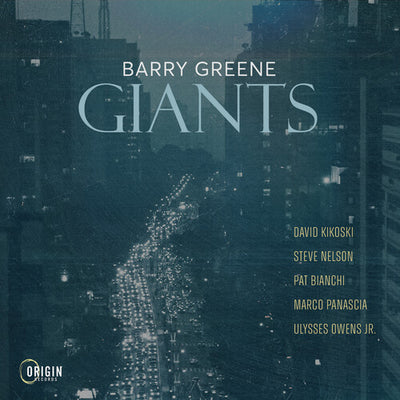
GIANTS is jazz guitarist Barry Greene's most fully realized recording to date-a powerful tribute to the players who shaped his musical voice, including Pat Martino, Grant Green, Wes Montgomery, and Russell Malone. Spanning organ trio, modern ensemble, and solo guitar settings, the album reflects a lifetime of deep immersion in the jazz tradition, delivered with authority, swing, and an unmistakable personal voice. With Pat Bianchi on B3 organ and drummer Ulysses Owens Jr., Greene captures the raw energy and soulful drive of the classic organ trio. The broader sound palette of his quintet setting with David Kikoski on piano, Steve Nelson on vibraphone, bassist Marco Panascia, and Owens, yields richly textured performances that balance fire, lyricism, and harmonic depth. More than a tribute, Giants is a statement-an artist at the peak of his powers honoring the lineage while speaking unmistakably in his own voice. "Monster chops, soulful feel, full/rich classic jazz tone, and virtuosic harmonic techniques establish him as a top-tier guitarist." - Benedetto Guitars. Barry Greene is just about one of the best; not only as a player, but also as a writer and a teacher & a world-class musician. Pat Martino
Jordina Milla/Barry Guy - "Live In Munich" / Verve Label Group; ECM; Jazz This concert recording from Munich's Schwere Reiter performance space features improvisation with an expanded palette of possibilities. "To work with these colors is a great challenge and joy!" says bassist Barry Guy of the glowing and ever-changing tints, timbres and tones radiating from Jordina Milla's freely associative piano. Like Guy, Milla is both a player of prodigious technical capacity and a fearless improvisational explorer, and her highly creative use of the piano interior opens up new sonic territory, to fascinating result.
A Classic Christmas featuring Michael Barry and Friends, remixed and remastered, to be released on November 6, 2020. 12 tracks of Christmas favorites in classical arrangements for guitar, recorder, cello, violin and flute. Also a bonus track, Nat King Coles Christmas Song, performed by the Nat King Cole Generation Hope Summer Strings. 10% of proceeds to be donated to Nat King Cole Generation Hope to support its mission to provide music education to children with the greatest need and fewest resources. Michael Barry is a Grammy award-winning guitarist, composer and producer living, working and making music in New York City. He has performed extensively in the United States, as well as Canada, South America and Europe. A former music instructor and Executive Director of the American Institute of Guitar, he continues to explore music as a universal language and a means of bridging the gap between people of different cultures and backgrounds.
The one-act opera Djamileh by Georges Bizet set to the libretto by Louis Gallet tells an oriental love story between the slave named Djamileh and Cairo sultan Haroun. The plot, bringing to mind the atmosphere of One Thousand and One Nights, is a quite typical example of Romantic fascinations with the Far East. Bizet's had his doubts about the work- many considered it to be too difficult for a stage adaptation. However, the artistic craft of the creator of the balanced libretto surrounding the story of oriental lovers with a suggestive sound, and the craftsmanship of Jennifer Feinstein, performing the title, allows the listener to enjoy all the values of this little known opera. Mezzo-soprano Jennifer Feinstein has been likened by the Los Angeles Times to "a young Horne, so rich is her mezzo and so full of spark was she on stage." She is becoming increasingly coveted for her portrayals of the dramatic mezzo repertoire.
Vaughan Williams: Riders to the Sea, Op. 1 - Holst: At the B
DUX
CD · 2 discs
$32.99Mar 03, 2017
The opera- or rather and properly the musical interlude- At the Boar’s Head was written in 1924. Gustav Holst composed it at his home in Thaxted, where he was resting after collapsing, probably due to being overladen with work. By the time his health deteriorated, the composer had taught in a number of schools and played as an orchestra trombonist, devoting all his free time to composing. The libretto, which Holst also composed, is based on Shakespeare’s Henry IV parts 1 and 2. Also included in this release is Ralph Vaughan Williams’ Riders to the Sea, a short one-act opera based on the play of the same name by John Millington Synge. The opera has remained largely in the realm of students and amateurs until Sadler Wells added it to their repertoire in 1953.
The original London production of Kander and Ebb's Cabaret, with Harold Prince reprising his Broadway role as director, opened in 1968 and ran for 336 performances. Cabaret starred Judi Dench (long before she was a "Dame") in her first musical role as the heroine, Sally Bowles. Lila Kedrova, known to movie-goers for her roles in Zorba the Greek and Torn Curtain, is Fraulein Schneider, her first musical role. Also featured is American actor Barry Dennen in his British stage debut as the Kit Kat Klub's gregarious and outrageous Master of Ceremonies. Dennen received the Evening Standard Award for his performance, which led to his role as Pontius Pilate on the original concept recording of Jesus Christ Superstar and its subsequent 1973 film version.
Personnel includes: Jerry Hadley (vocals); Jay Berliner (guitar, mandolin); John Moses (clarinet); Dominic Cortese (accordion); John Beal (bass); Barry Mitterhoff (mandolin).
Recording information: Clinton Recording Studios, Studio A, New York, NY (05/24/1995-09/27/1995); Soundtrack Recording Studios, Studio A, New York, NY (05/24/1995-09/27/1995).
Performers include: Gil Evans, George Russell, Johnny Carisi and Rod Levitt.
A lot of unusual music appears on this Bluebird CD. Altoist Hal McKusick (with arrangmeents contributed by George Russell and Gil Evans) performs five numbers (including a version of "Blues for Pablo" that was cut a year before Miles Davis's recording) with a variety of musicians including trumpeter Art Farmer and trombonist Jimmy Cleveland. Arranger John Carisi (heard here on trumpet) interprets seven previously unreleased numbers with an octet and trombonist Rod Levitt performs five of his arrangements with his own advanced octet. Although these performances would have little influence on future developments in jazz (the free jazz movement of the 1960s overshadowed the trend toward using elements of modern classical music in charts), the music still sound quite fresh and unpredictable today.
Mussorgsky: Pictures At An Exhibition / Barry Douglas
RCA
CD · 1 disc
$17.99Sep 04, 2008
An impressive performance, spacious, full-bodied, and last but not least, never forgetful of the warm human feeling prompting Mussorgsky's tribute to a recently and prematurely deceased friend.
After Barry Douglas's recent RCA concerto debut in the Tchaikovsky, now a solo recital—with Pictures at an Exhibition, long a cornerstone of his repertory, the principal work. It's an impressive performance, spacious, full-bodied, and last but not least, never forgetful of the warm human feeling prompting Mussorgsky's tribute to a recently and prematurely deceased friend. In view of Ashkenazy's own orchestration of the work, it is perhaps not surprising that he himself draws a wider range of colour from the keyboard, particularly its upper register glints; his characterization is just a shade more vivid, underpinned by a stronger sense of direction (Decca). But Douglas's tone is warmer—and full marks to the RCA engineers for reproduction so faithful.
Both artists use the Urtext edition, notably giving us an ff start to ''Bydlo''. Here I think douglas's slower tempo is a distinct advantage in evoking the ox-wagon's lumbering motion, just as his marginally brisker tempo for the finale is truer to the composer's allegro alla breve marking. But neither his quarrelling children in the Tuileries garden nor his gossiping market-women at Limoges have as much temperament as Ashkenazy's, nor is his witch as ferocious—or sinister in flight. Both players, in their different ways, rightly make the recurrent promenade episode very personal. But on its first reflective return I questioned Douglas's subdivision of each phrase into two, just as I wondered if the ensuing sad song of the troubador (here very much an unrequited lover at the castle gate) really needs his occasional yieldings of pulse. His exceptionally full, rich fortissimo, free of all edginess or clang, is of course a tremendous asset in the majestic finale—as it also is in the big climaxes of the Dante Sonata. Comparison with Brendel (Philips) in this work revealed Douglas less dramatically menacing, less intense. But in its less urgent way (and, incidentally, he allows himself all the time in the world for the middle section's bittersweet reflection), the reading is warmly romantic and expansive—with some ravishing softer sonority en route. You're certainly left in no doubt as to why Liszt included the word 'fantasia' in the title. If yielding phrasing in the Liebestod sometimes relaxes tension in pianissimo, textural strands are clearly defined and the climax itself is sumptuous.
Britten: Piano Concerto; Debussy: Fantaisie / Barry Douglas
RCA
CD · 1 disc
$17.99Dec 21, 2007
This coupling offers two youthful concerto works and a solo interlude. The most substantial work is the Britten Piano Concerto (placed last on the disc), written in 1938 when the composer was 25. It is a boisterous piece, unstintingly virtuosic and with clear overtones of Prokofiev. It suits Douglas well, and he tackles the relentless passagework with spirited enthusiasm. His tone is rather hard, particularly in the fortes, but this is not entirely unsuitable given the steely, driven quality of the music. The first-movement cadenza is genuinely exciting, and the point when the orchestra re-enters in a moment of calm retreat (track 7 at 9'21''), with Douglas providing a rare beauty of tone and colour in the following lyrical passage, is beguiling... The Debussy Fantaisie (1890), which despite the composer’s efforts remained unperformed during his lifetime, receives a strong performance with crystalline clarity in the passagework... His playing breathes with natural phrasing and articulation, and has a sure-footed integrity...
Recorded in London in 1965 with a line-up featuring George "Kid Sheik" Cola (trumpet & vocal), John Handy (alto & vocal), Cuff Billett (trumpet & vocal), Pete Dyer (trombone), Richard Simmons (piano), Brian Turnock (string bass) and Barry Martyn. Track listing: Rebecca, Last Night on the Back Porch, Ice Cream, Black and Blue, Eh La Bas, in the Groove, Little Richard's Blues, Put on Your Old Grey Bonnet, Panama, in the Gutter, Bye Bye Blackbird.
The first half of this album features Barry's late 60s band, with Teddy Fullick (trumpet), Sammy Rimington (clarinet/alto/tenor), Pete Dyer (trombone), Graham Paterson (piano), Brian Turnock (string bass) and Martyn (drums) recorded in London 1967. The second half features the classic Martyn band, with Cuff Billett (trumpet), Bill Greenow (clarinet), Pete Dyer (trombone), Graham Paterson (piano), John Coles (banjo), Terry Knight (string bass) and Martyn (drums) recorded in London 1962. Track listing: All I Do Is Dream of You, I'm Glad for Your Sake, Object of My Affection, Love Is Made for You & Me, Shine on Harvest Moon, June Night, Honky Tonk Town, Saturday Night Function, Swingy Little Thingy, Last Mile of the Way and more.
The Sinfonietta is entitled 'Symphonic Phantasy' on the unpublished manuscript (echoes of the original title of Sibelius's Seventh Symphony) and it remained unperformed during the composer's lifetime. He was unsure of it and told the conductor Christopher Whelen, to whom he gave the manuscript in 1950, that he didn't want it played. Whelen faithfully obeyed this injunction until 1983, when he was very reluctantly persuaded to let it be performed during Bax's centenary year. (He had previously refused a request from Robert Ponsonby to allow it to be premièred at a Prom in 1980, where it would have shared the program with the first performance of Rubbra's Eleventh Symphony under Nicholas Cleobury.) Vernon Handley and the BBC Welsh Orchestra eventually gave the first performance at a recording session in Llandaff on 25 June 1983 for broadcasting later that year. (Odd to think that it has only ever been played in Wales and Czechoslovakia.)
This limited edition reissue features the brilliant trombone work of Ray Anderson, the bass of Mark Helias & the percussion skills of Barry Altschul. The trio had worked together extensively by the time they recorded this album. The cohesion between the instruments & the fluid interaction with which they develop & expand their ideas is remarkable. This recording captures the high level of creativity flowing from the music. It was recorded more than 20 years ago, but it has retained it's freshness, vigour & wit.