Outlet CDs
3357 products
Classics For The People, Vol. 2
Boccherini: Stabat Mater - String Quartet, Op. 41, No. 1
Salvatore: Organ-alternatim Masses
Françaix - Nielsen: Clarinet Concertos
Burgmüller: Lieder - Piano Sonata, Op. 8
Kabalevsky: Piano Sonata No. 3 & 24 Preludes / Kabalevsky
During his lifetime Dmitri Kabalevsky was considered by the authorities to be one of the top 5 composers of Russia, on a par with Prokofiev and Shostakovich. He was praised for his formalism, general popular style and patriotism. He was not a revolutionary, and this caused his fame to decline after the collapse of the Soviet Union. His music however has a strong identity, vigorous, alternating power with lyricism, and rooted in the rich folklore of Russia. This new recording contains his effervescent 3rd Piano Sonata and the complete 24 Preludes, Op. 38, written during World War II, each based on a Russian folk song, presenting a wide variety of moods, from the pensive melancholy to fiery passion. Played by the highly talented young Italian pianist Pietro Bonfilio, who expresses his love for the Russian culture with this beautiful recording.
Guitar Vibes: Music For Guitar And Strings / Elias, Netherlands Chamber Ensemble, Matangi Quartet
Izhar Elias has produced several successful and imaginative albums for Brilliant Classics. None of them have confirmed to a ‘Spanish guitar’ stereotype but all have engaged in various original ways with the developing heritage of the instrument during the 19th century, from ‘Paisiello in Vienna’ (BC95301) to ‘Beethoven and the Guitar’ (BC94631) to Giuliani’s astonishing transcription of Rossini’s grand tragedy Semiramide (BC93902). His latest recording brings the classical guitar up to date with works by composers from four different countries; within them may be heard influences from classical music, avant-garde, Caribbean music, Spanish folklore, flamenco, Arabic music, blues, Argentinean tango and even trip-hop and heavy metal: provocative testament to the world’s most versatile instrument. The Guernica Suite by Pujol (b.1959) focuses on different aspects of Picasso’s painting in six movements, with a tentatively positive conclusion. The Triptych of Roberto Sierra (b.1953) evokes some nocturnal sounds from his native Puerto Rico, including the tropical tree frog as well as a night on the tiles. The three Danzas Concertantes pulse and glide with the rhythms of Leo Brouwer’s native Cuba, offset by some astringent harmonies that place the guitar’s usual role as purveyor of folkloristic colour under threat. Finally there is the Schattenspiel Suite by Florian Magnus Maier (b.1973), who also plays electric Moog guitar on this recording. Maier pursues a diverse career as a composer, guitarist and vocalist with bands including Alkaloid, Dark Fortress and Noneuclid; this tripartite suite inspired by shadows is his best-known work in the classical tradition, and for this recording he has made a new arrangement for two guitars and string quartet. There is something for everyone on this album: it’s essential listening for guitar-music enthusiasts who want to broaden their horizons.
STRING QUARTETS NOS. 1 & 4
Wagner: Lieder
Tosti: The Song of a Life, Vol. 2
With this second volume of Tosti’s songs, Brilliant Classics takes listeners just half-way through a prodigious, career-long output, in which the key-notes are unfailingly memorable melody, lively charm and a gift for story-telling that rivals the very greatest song-writers past and present, from Schubert to Dylan. Many of his songs have never been recorded, so this set makes a unique contribution to the catalogue. There are a few French songs on Vol 2, reflecting Tosti’s great popularity in Paris, but most of the texts here are by Italian poets, mostly contemporaries such as D’Annunzio and Panzacchi. The album works chronologically through the decade 1886-1895, during which time he was singing teacher to the English royal family. Perhaps in deference to his pupils, there are songs by the likes of Longfellow and Weatherly: the release concludes with his delicately wistful setting of In the Hush of the Night. The first volume of this extraordinary project on Brilliant Classics won wide critical praise. ‘All the singers are careful over nuances,’ remarked MusicWeb International. ’Tosti’s songs have, through the years, been bawled out of recognition by leather-lunged tenors, and it is a blessing to hear so many beautiful pianissimos and diminuendos in this repertoire. The accompaniments are discreet and the recording is well-balanced and natural-sounding.’ This release will be an essential acquisition for all lovers of art-song.
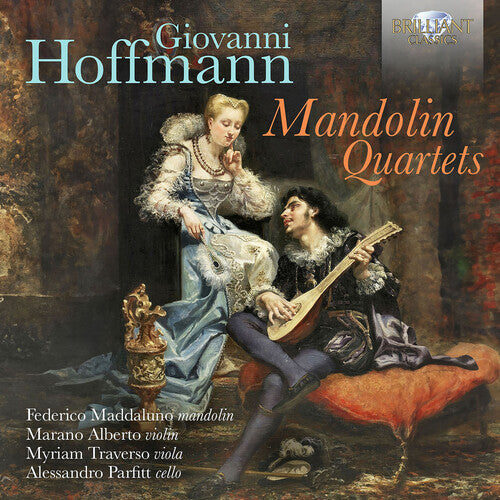
Hoffmann: Mandolin Quartets
There is still much we do not know about the veritable mandolin-mania of late 18th-century Europe, particularly Vienna, which in that period was home to the three greatest musicians of the Classical period: Haydn, Mozart and Beethoven. The instrument certainly enjoyed dazzling success in Viennese musical circles, embraced by the cultured aristocrats who resided in the Habsburg capital, and its meteoric rise was supported by some extraordinary virtuosos who helped promote its high-quality and fast-growing repertoire.
Giovanni Hoffmann’s refined chamber music featuring the mandolin was warmly received among the Viennese elite, making him one of the foremost figures behind the burgeoning mandolin repertoire of late 18th-century Vienna. Very little is known about his life; the Italianate first name alongside a clearly central-European surname adds to the mystery shrouding his birthplace and sphere of education.
Hoffmann was both a mandolin virtuoso and an esteemed composer. In 1799, the music merchant Johann Traeg advertised a list of the mandolin scores available to purchase from his shop on Vienna’s Singerstraße. It included a Trio for mandolin & bass by Hoffmann, and that same year, the composer released a further number of manuscript works through Traeg including his Quartets for mandolin, violin, viola & cello and
Serenatas for mandolin & viola. Hoffmann’s work is recorded again in Austria in the early decades of the 19th century, but – like his birth – the place and date of his death have not yet come to light. His music, however, lives on, a testament to his talent for composing delightful music in a Classical style evoking the fascinating gatherings of the Viennese literati.
Shostakovich: Jazz Suites / Kuchar, Ukraine National Symphony
Be Baroque / Spark
Spark plays Baroque music. That sounds simple, but is in fact highly complex. That's because when an ensemble like Spark approaches a past era, that can only come about with a fresh new perspective, bold reorientation and lots of delight in experimentation. It is not for nothing that the ECHO Klassik prizewinning formation enjoys a reputation for blending the old and the new, tradition and innovation, the familiar and the unheard-of in a unique manner. Consequently, on their upcoming release "BE BAROQUE" the five exceptional musicians are not interested in simply arranging Baroque works for their formation. On the contrary: in their new arrangements they aim to highlight new aspects, intensify moods and awaken unforeseen associations. Baroque manners are assimilated, spun and transformed into the musical language of the 21st century. Based on a number of masterworks by Bach, Vivaldi, Handel and others, Spark creates its very own Baroque tableau whose color spectrum ranges from almost true-to-the-original reproduction through to a completely new composition.
Complete Orchestral Works / Shpiller, Krasnoyarsk Symphony
Telemann: Cantatas And Chamber Music With Recorder
Fumagalli: Organ Music / Ruggeri
Polibio Fumagalli (1830-1900) was one of the most important exponents of nineteenth century Italian music. He held important posts in Milan, and as organ teacher at the Conservatory and organist of the S. Celso he was in close contact and collaboration with the famous organ builder Giuseppe Bernasconi, with whom he helped to develop the “symphonic” or “orchestra” organ, with its registers imitating orchestral instruments. This new recording presents two of Fumagalli’s organ sonatas, in classical/romantic style, as well as the complete cycle “Ascetica Musicale,” character pieces of great charm and lyricism, using the full potential of the “orchestra” organ. These works are played with great imagination by Italian organist Marco Ruggeri on two historical Bernasconi organs, built in 1885 and 1892.
Moving On
THE CELEBRATED PIANIST JACKY TERRASSON, HAILED BY THE NEW YORK TIMES AS "ONE OF THE THIRTY ARTISTS POISED TO SHAPE THE TRAJECTORY OF AMERICAN CULTURE," UNVEILS "MOVING ON". BACK IN FRANCE AFTER THREE DECADES IN NEW YORK, HE ORGANIZES A DOUBLE NATIONALITY TREASURE HUNT, MIXING CHOPIN AND JAZZ, WITH GUEST ARTISTS SUCH AS KAREEN GUIOCK-THURAM, CAMILLE BERTAULT AND GRÉGOIRE MARET. WITH A NEW-FOUND JOIE DE VIVRE, EACH PIECE TELLS AN ADVENTURE, A STORY, A DELICATE CELEBRATION OF HAPPINESS.
Introduced in The New York Times in 1994 as "one of the thirty artists poised to shape the trajectory of American culture in the following three decades," pianist Jacky Terrasson has lived up to this acclaim by becoming the most widely heard French jazz musician on digital platforms. Born in Berlin in 1965 to an American mother and a French father, he pursued studies in classical piano in France before enrolling at the Berklee College of Music. In 1993, he clinched the prestigious Thelonious Monk Institute of Jazz International Piano Competition.
He began his career alongside luminaries such as Betty Carter, Dee Dee Bridgewater, Cassandra Wilson, Charles Aznavour, Guy Lafitte, Barney Wilen, and Ray Brown. Terrasson made his mark. Signing with the legendary Blue Note label under the stewardship of its iconic president, Bruce Lundvall, he embarked on a remarkable 25-year journey of success. An indefatigable globetrotter, he graces the stages of the most illustrious jazz and piano festivals across Europe, the United States, South America, and Asia.
"Moving On," the title of Jacky Terrasson’s new album perfectly sums up the new aspirations "of the most traveling of jazz pianists, a pianist of happiness" (Telerama). After being the muse of the majors (Blue Note & Universal), it is a new adventure as an artist producer and a new path that Jacky Terrasson decided to begin by creating his own label (Earth Sounds). It is also, after 30 years spent in New York, his choice to live again in France, the country where he grew up. But also continue to play regularly on the American continent, a subtle treasure hunt between leaving and returning to the two countries of his dual nationality. It also means offering two trio recording sessions (in France and New York) for the same record with numerous guests: the singers Kareen Guiock-Thuram and Camille Bertault, the harmonica player Grégoire Maret, and the drummers Billy Hart and Eric Harland. And finally, fully embrace his thirst to bring together a Chopin prelude with a jazz standard (Besame Mucho), to invite a bird recorded in Borneo which becomes a piece (Edit Piaf), to write and compose music for his friends (Are you following me, put into words by Camille Bertault), for his desires (Love Light), his travels (AF 006), and to be happy (Happy by Pharell Williams like a fireworks display almost bringing together all the musicians on the album). Behind each title hides an adventure, a story, depth, and the desire to always want to enjoy life with delicacy.
15 titles, including 8 exclusive to the CD edition.
Rhetorique du Silence / David Bergmüller
Introducing the enchanting sounds of lutenist David Bergmüller. Immerse yourself in a musical journey with his captivating solo recital. With a repertoire carefully handpicked, David's music unveils a realm of intricate melodies and serene tones that resonate close to silence. Each note carries a meditative character that transcends time. This album's music acts as a soothing antidote in a world constantly bombarded with stimulation. It effortlessly captivates our senses, offering a peaceful sanctuary amidst the chaos. Drawing from the rich tradition of French lute music, David Bergmüller adds his unique touch with skillful arrangements that breathe new life into the compositions. Experience the magic of this exceptional collaboration, where centuries-old melodies blend seamlessly with David's artistic vision. Prepare to be spellbound by the beauty of this repertoire that continues to fascinate and provide a much-needed counterpoint to our overstimulated lives.
Impressions / Dervaux
Sophie Dervaux’s debut album on Berlin Classics is very much in the French tradition. Together with her French colleague, pianist Sélim Mazari, the bassoonist presents works on this concept album Impressions that are by composers of various eras, including Debussy, Saint-Saëns, Ravel, Fauré and Koechlin. The bassoon – unusually – takes the stage as a soloist and so fulfils the purpose that the Vienna Phil bassoonist had in mind: to present the unique singing sound of the instrument and enrich the world of the bassoon in the process. “A lot of people think of the bassoon as an amusing instrument. But it can be more than just the jolly clown. I wanted to show that it can sound wonderful and sing wonderfully too.” There is no doubt that Dervaux has proved her point on Impressions. Her repertoire brings together familiar and seldom heard pieces, and at times ushers its audience into a dream world. Among those pieces are Debussy’s Clair de Lune and Beau Soir, illustrating the tonal compass of the bassoon. Sophie Dervaux also presents the Sonata for bassoon and piano in G major, op. 168, written by Camille Saint-Saëns, in his old age. Great phrases and lines flow from Dervaux’s instrument in Fauré’s Après un rêve, and a piece she arranged herself, Pièce en forme d’habanera by Ravel, brings out the almost human voice of the instrument. These Impressionists are joined by theorist and composer Charles Koechlin with his Sonata, op.71. Going a step further, Reynaldo Hahn’s A Cloris and Roger Boutry’s Interferénces bridge the gap between old and new and introduce jazz influences. With her new album Impressions, Sophie Dervaux aims to show her audience what is special about the bassoon: its sound, and its virtuosity too.
Towards Verklärte Nacht
Easy Studies for Guitar, Vol. 2/ Porqueddu
Muffat: Componimenti Musicali per il cembalo (1739) / Loreggian
Gottlieb Muffat’s oeuvre, dedicated almost in its entirety to keyboard instruments and skilfully straddling the stile antico and stile moderno, deserves more detailed attention than it has ever been afforded. The majority of sources containing music by Muffat are unpublished, with only two collections published at the composer’s own behest during his years in the Emperor’s service in Vienna. One of these is the Componimenti Musicali per il Cembalo (Augsburg, 1739).
This collection contains 6 Suites and a Ciacona with 38 variations for solo harpsichord. The composer describes these seven works as capricci or galanterie to be performed in the stile moderno and to suit modern tastes. Although arranged in the conventional order of Allemande–Courante–Sarabande–Gigue, Muffat also added various optional dances, displaying no shortage of innovation. The first movements are introductory in nature, often fugal in form and varying in style and pace: Ouverture (Suites 1 and 5), Prelude (Suite 2) and Fantaisie (Suites 3, 4 and 6). The seventh piece in the collection, the Ciacona con 38 Variazioni, is a special case. As Christopher Hogwood suggests in his introduction to the modern edition (Orpheus, 2009), the Ciacona could be another tribute to the imperial family, as the number of variations matches the age Charles VI’s niece, Maria Amalia, would have been on 22 October 1739.
Muffat’s interest in contemporary harpsichord composition is most clearly evident in his transcription and reinterpretation of works by George Frideric Handel, based on a manuscript copy of the Suites des pièces pour le clavecin he held in his library. Muffat reworked the suites in Handel’s collection, suggesting new ornamentation, distributing the notes differently between the hands, changing the clefs and sometimes note values, and adding slurs and cadenzas. He then applied everything he had observed while rewriting Handel’s suites to his own Componimenti musicali: including a table of ornaments, which the composer asks be played with ‘art and discretion’; he considers the positioning of the player’s hands on the keyboard in his writing and avoids using multiple clefs on one line to prevent confusion; he describes the optimum way to use the thumb for accidentals; and he provides the correct technical interpretation of trills and slurs.
Study of the Componimenti reveals what could be defined as a pedagogical intent, as well as a clear desire to make the score unambiguous and accessible by means of his introductory instructions. The collection contributed greatly to setting a new benchmark for keyboard writing in the lands of the Viennese Empire.
Viotti: Violin Concerto No. 22; Cherubini: Symphony In D
Duarte: Orchestral & Concertante Works for Guitar
John W. Duarte was born in Sheffield, England on 2 October 1919. He started playing the ukulele, but soon moved to the guitar at the age of 15. The advent of guitar phenomenon John Williams, whom Duarte taught for 18 months before the young musician’s entry into the Royal College of Music, London, gave the composer an opportunity to expand his chamber music oeuvre.
The Concertante Quartet Op.22, a substantial work in four movements. In 2021 the composer’s son, Christopher Duarte, discovered some folk songs arranged for guitar and small orchestra among his father’s manuscripts. There is no mention of these arrangements in his list of works and no correspondence relating to their creation, but from the composer’s handwriting these probably date from the mid-late 1950s and may have been written for John Williams to play with fellow RCM students.
Next Market Day, scored for piccolo, snare drum and strings, is an energetic rendering of an Irish love song which Duarte revisited several times. The Coolin of Rùm (or, The Rùm Cuillin), scored for flute, oboe and strings, is a tune from the Isle of Rùm, one of the small islands near the Isle of Skye in the Hebrides. Cuillin is the name for a range of mountains in this area and Duarte may have been alluding to the name of a previous owner of Rùm, Maclean of Duart.
Duarte began work on what became A Tudor Fancy in early 1967. Following A Tudor Fancy, a concerto in all but name. The Concierto alegre Op.101 (1986) is deliberately light in woodwind (2 flutes, one each of the rest), a trumpet, strings, but with a battery of percussion, including two vibraphones. As with A Tudor Fancy, the music proceeds in a variety of ‘conversations’, with the orchestration kept deliberately light when the guitars are playing.
Tippett: A Child of Our Time / Davis, BBC Symphony
Michael Tippett’s oratorio A Child of Our Time was composed between 1939 and 1942 as a direct response to the events leading up to (and including) the notorious Kristallnacht, in November 1938, in National Socialist Germany. Tippet first intended to write an opera, but quickly determined that this would inevitably be too literal, and that the (rather neglected) oratorio form lent greater scope for reflective and meditative interjections to the narrative.
Hoping to persuade his friend and mentor T.S. Elliot to write the libretto, he sent the poet such an intricately detailed plan that Elliot responded by suggesting that Tippett, having thought so carefully about it, prepare the text himself – which he duly did. (He then went on to write his own libretti for all his future large vocal works). Set for choir, orchestra, and four soloists, the work adopts a structure that owes a debt to Handel’s Messiah, which Tippett had studied intensively in the 1930s. In addition, Tippett wanted to incorporate choral interludes much as Bach had done in his passions. Rejecting Lutheran chorals and Jewish hymns, he finally settled on African-American spirituals of which he placed five within the work.
Sir Andrew Davis conducts the BBC Symphony Orchestra and Chorus, with an exceptional quartet of soloists. The album was recorded in Surround Sound in Croydon’s Fairfield Halls following live performances in London’s Royal Festival Hall.
REVIEW:
Bass Ashley Riches shines particularly as the narrator, bringing a terrific clarity and command to the role. The BBC Symphony Orchestra give a fine performance, but the real star of the show is the BBC Symphony Chorus.
— BBC Music Magazine