The Mozart Sale - Spring 2026
Over 1,300 titles featuring works by Mozart are on sale now at ArkivMusic!
Discover the music of Wolfgang Amadeus Mozart — one of the greatest composers in the western canon — with releases from the Orchestre de l'Opera Royal, Jennifer Lim, SWR Symphonieorchester and more.
Shop The Mozart Sale now before it ends at 9:00am ET, Tuesday, May 12, 2026.
1326 products
Mozart: Flute Quartets
Three of these marvellous quartets for flute and string trio were composed in 1777/78 during Mozart’s first extended tour without his father. The three quartets K. 285; 285a; 285b are undoubtedly among the most outstanding works in the genre. They share a lightsome; carefree quality with the typical shades of melancholy in the slow movements. The sparkling Quartet in D K.285 is a virtuoso outing for all four instruments. Although the flute has the upper part in the lightning-fast opening concertante movement and the spirited concluding Rondeau; the string trio are also given strikingly brilliant; soloistic parts; creating a dense web of spirited; dazzling sallies and engagements. The central movement is a Romance with a melting flute melody against string pizzicatos – a sort of serenade with guitar accompaniment for his then love (future sister-in-law) Aloysia Weber; Constanze’s sister. The elegant second Quartet in G K.285a is indebted to Johann Sebastian Bach’s youngest son; Johann Christian; who wrote quartets that were very similar in concept and idiom. At the age of eight Mozart had taken lessons with J.C. Bach while in London; and as late as 1778 he wrote: ‘I love him… with all my heart and feel deep respect for him’. Following the ‘London’ Bach’s example; the quartet comprises a substantial opening Andante in sonata form and a lively minuet. The third Quartet in C K.285b is also in two movements. An effervescent movement in sonata form is followed by an elegant set of variations providing a solo variation for each of the four instruments. There follows a dreamy slow variation; before the music snaps back out of its metaphysical mood and into the here-and-now with a clownish minuet-cum-scherzo. The Quartet in G K.370; though originally an oboe quartet in F; was first published in 1801 by the Bureau de Musique; Leipzig; in the G major arrangement for flute and strings. Transposing an oboe piece up a full tone was then common practice in flute adaptations; but in this instance; we are dealing with a genuine arrangement involving substantial modifications. The Quartet in A K.298 is very different. It is of the Quatuor d’airs dialogués type; a popular Parisian form where each movement quotes an aria by a fellow composer or a tune that is widely known. The theme of the first movement is Franz Anton Hoffmeister’s song ‘An die Natur’. The central section of the ensuing minuet quotes the old French song ‘Il a des bottes; des bottes Bastien’. Finally; in the last movement; the theme is taken from Giovanni Paisiello’s opera Gli schiavi per amore. He used the aria ‘Chi mi mostra dolce amore’ (Who will show me sweet love) as the theme for the final movement. This piece completes our cycle of five Mozart chamber works; taking us from Mannheim to Vienna via Munich. Their five different conceptions and characters represent the quartet for flute; violin; viola and cello in its noblest form and set the benchmark for all subsequent quartets composed for these forces.
Mozart The Progressive - Piano Sonatas & Dance Movements / Wessel
Mozart brought to life anew! Pianist Michael Wessel records all 18 of Mozart's piano sonatas: a unique cosmos bursting with unbridled ideas! Some special features are close to the pianist's heart and distinguish this release from others. Michael Wessel refreshingly combines the insights of historically informed performance practice with the sustaining; richly coloured tone of the modern Bösendorfer concert grand. The result is a lively and contrasting mixture of speaking and singing characters. In the detailed booklet; Wessel excitingly relates the respective time and life circumstances to the sonatas. On each CD, three sonatas are grouped together under a thematic focus. The series begins with "Mozart the Poet": K. 330; 331 and 332 as narration, poem and play - followed by "Mozart - Two Faces": Fantasy K. 475 and Sonatas Nos. 13; 14; 16. "Mozart the Progressive" includes Gigue K. 574; Minuet K. 355 and Sonatas Nos. 15; 17; 18.
Mozart: Symphonies Nos. 39 & 40 / Popelka, Norwegian Radio Orchestra
The Norwegian Radio orchestra; under the baton of Chief Conductor Petr Popelka; performs Mozart's Symphonies Nos. 39 and 40.
Mozart: Bastien et Bastienne; Pergolesi: La Serva Padrona [In French] / Jarry
In 1733, Pergolesi created La Serva padrona in Naples, which won over Paris in 1752, becoming the symbol of Italian music. Quickly played in French as La Servante Maîtresse, it inspired Rousseau for his opera Devin du Village, a parody of which was created under the title Les Amours de Bastien et Bastienne. Mozart discovered it in 1768 and composed his Bastien und Bastienne in German for the private theatre of the magician Mesmer.
These two masterpieces bound through style and history come to life with colourful plots: lightness, falsehoods and what is comic create delightfully bubbly situations for the tyrannical servant and naive shepherds, from which Pergolesi and Mozart derived the best musical effects. Adèle Carlier, David Tricou and Marc Scoffoni, with the Opéra Royal Orchestra and Gaétan Jarry, carry this torch of emotion and comedy, so emblematic of the 18th century.
La Bella Cubana - Mozart y Mambo / Willis, Padrón, Havana Lyceum Orchestra
My dream of recording all four of the Mozart horn concertos has been fulfilled at last. Little did I know that this long-held dream would come true in Cuba of all places and with a Cuban orchestra! I have learned so much about Cuban music and how to dance Mozart along the way and, as a result, feel changed as a person and as a musician", says Sarah Willis. With this album - subtitled La Bella Cubana - the Mozart y Mambo trilogy is complete. After two critically acclaimed albums, three documentary films, two international tours and fundraising to help support classical musicians in Cuba, Sarah concludes this adventure of a lifetime with the Havana Lyceum Orchestra and their conductor, José Antonio Méndez Padrón by recording Mozart's Concerto No. 4 with its famous final Rondo. Also on the album, three of her colleagues from the Berlin Philharmonic Orchestra, Jonathan Kelly, Wenzel Fuchs and Stefan Schweigert, join her for more Mozart, performing the Sinfonia Concertante for four solo wind instruments and orchestra. Of course, no Mozart y Mambo album would be complete without the Sarahbanda ensemble, who once again fuse Mozart with Cuban dance rhythms in Rondo alla Rumba. And what better way to say goodbye than with the most famous Cuban song of all time, Guantanamera! Let the magic of Mozart y Mambo - this music, these musicians, their interpretation, their love for the project and for each other - get you up and dancing one more time!
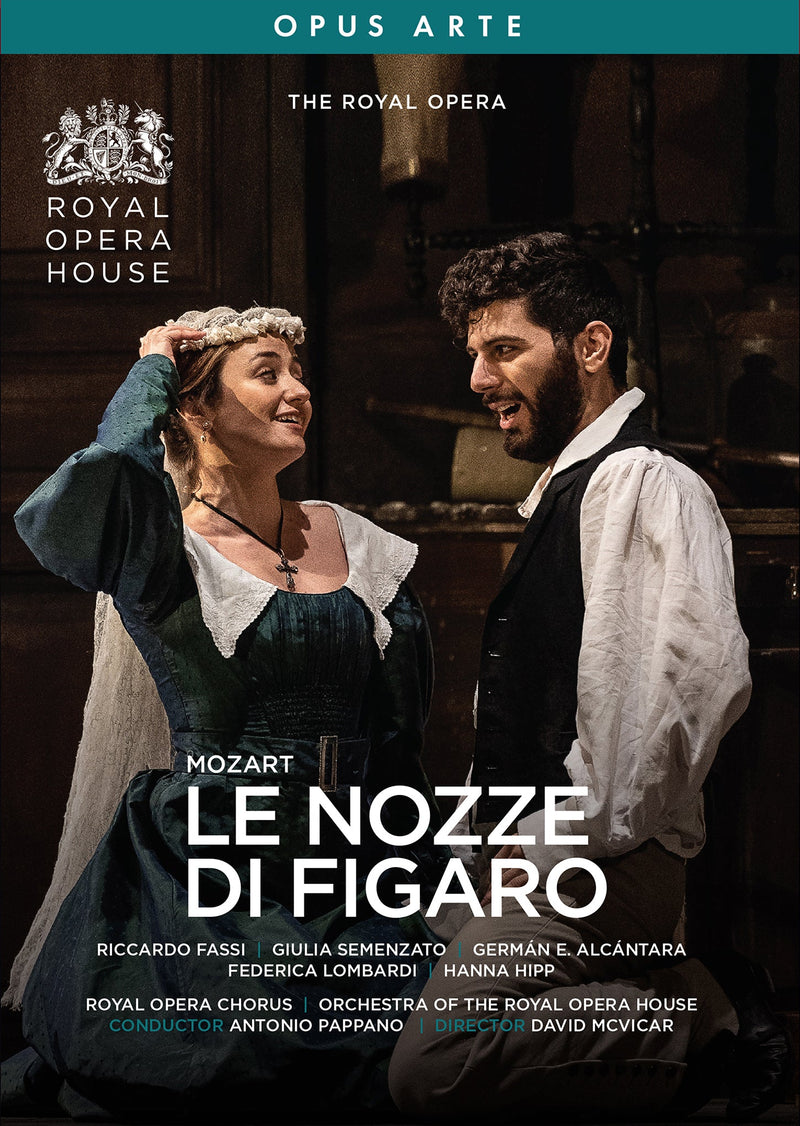
Mozart: Le Nozze di Figaro / Fassi, Semenzato, Alcantara, Pappano, Royal Opera House
From the headlong rush of the overture, Mozart’s timeless comedy is a breathless journey through one very eventful day in the life of an 1830s château. Figaro and his bride Susanna conspire to foil the unwanted advances of Count Almaviva, while the Countess has her heart stolen by a cross-dressing pageboy. Mozart’s music unfolds with beautiful solos and ensembles to amplify the deep emotions behind the seemingly farcical surface. Music Director of The Royal Opera Antonio Pappano brings his specialist perspective to Mozart’s effervescent score. A young and predominantly Italian cast, including Ricardo Fassi, Giulia Semenzato and Germán E. Alcántara, perform this revival of David McVicar’s sumptuous and hugely popular period staging.
Mozart & the Organ / Engegård, Sponberg, Snerte, Dahl
Mozart’s original music for organ consists of 17 one-movement “Epistle sonatas” — chamber music written between 1772 and 1780 for masses in Salzburg. The instrumentation for 14 of these is two violins and basso continuo, while the remaining three are written for more instruments. The pieces are short — this is music written to be played between the reading of texts. In 1790 Mozart was commissioned to write music for what was known as a “Flötenuhr” — a large grandfather clock containing a self-playing organ. The works are compositions of exceptionally high musical quality. Here the mature Mozart reveals his gifts as a contrapuntalist and his ability to create singable melodies and forward-looking harmonies.
Mozart: Piano Concertos Nos. 15 & 20 / Michelangeli, Bavier, SWR Symphony
Arturo Benedetti Michelangeli’s piano playing is highly praised for its tremendous reflectiveness. He could spend decades immersing himself in a piece in order to get to know it inside out. His art of touch, his wealth of overtones and his highly refined sense of sound are just as praiseworthy – qualities that came in especially useful for playing Chopin and Debussy. Michelangeli is, however, less known as a Mozart interpreter which makes these 1956 recordings with the orchestra of Süddeutscher Rundfunk conducted by Anton von Bavier so fascinating. Here, Michelangeli presents a life-affirming, even vigorous Mozart with almost Olympian pride. His manner of playing is always forward-pushing, at times boisterously passionate. In his interpretation there is no exaggerated sensitivity, no fiddling with sound, no over-reflectiveness and, in particular, no sentimentality in the slow movements.
REVIEW:
SWR has brought out Arturo Benedetti Michelangeli’s 1956 Ludwigsburg Festival Mozart K. 450 and 466 performances that ICA originally released back in 2013. Reviewing Michelangeli’s EMI 1950 studio recording of K. 450, I wrote how the pianist “subjects each phrase to finely-tuned gradations of touch and dynamic scaling, leaving not one note unscrutinized and unaccounted for.” That’s equally true here, albeit with faster tempos in the outer movements, plus additional vigor and continuity on the soloist’s part, and a better (if not particularly distinctive) orchestra.
Michelangeli’s astonishing command of the D minor concerto’s decorous figurations and strenuous left-hand broken octaves will keep most mortal pianists humble. If Michelangeli’s slow-movement dynamic taperings are decidedly “old-school” in the context of today’s leading Mozart practitioners, at least they’re not so caricatured as in his 1989 DG recording.
The slightly dry and drab-sounding SWR source tape seems to have been reproduced with relatively little intervention, in contrast to ICA’s boosted midrange and hint of added reverberation. Notwithstanding this release’s sonic and stylistic limitations, pianophiles will want to hear Michelangeli on prime form.
-- ClassicsToday.com (Jed Distler)
Mozart: Serenades / González-Monjas, Mozarteum Orchestra
Founded in 1841 under the participation of Constanze Mozart, the Mozarteumorchester Salzburg today enjoys the highest reputation worldwide for its lively and style-conscious Mozart interpretations. In numerous ways, it connects the Viennese Classical period to the music of the 19th/20th, and 21st centuries. The orchestras' constant preoccupation with his core repertoire also shapes its approach to the music of later periods. Thus chamber-musical transparency, articulatory clarity, and nuanced sonority are a trademark that makes the Mozarteum Orchestra special and recognizable, also when playing the music of other composers. This CD is the first release of a series, which begins at the orchestras' programmatical core: Mozart, and ventures onto Richard Strauss, Anton Bruckner and Hans Werner Henze.
Mozart: The Piano Quartets
Following a highly successful series of concerts in the summer of 2022, Francesca Dego, Timothy Ridout, Laura van der Heijden, and Federico Colli headed into the studio to record Mozart’s Piano Quartets. Whilst he may not have been the first composer to add a viola to the popular piano trio, Mozart was certainly the first to do so with such outstanding success.
In his piano quartets, the strings become an equal partner to the piano, rather than mere accompaniment – much as in his piano concertos. This link is reinforced by his choice of form – unlike his string quartets, the piano quartets have three movements rather than four: a full-bodied movement in sonata form, a lighter central slow movement in a related key, and a rondo finale. Both works were composed during the three-year period, from February 1784 to December 1786, in which Mozart wrote twelve piano concertos. The first quartet is written in the key of G minor – rarely used by Mozart – and the overall mood is quite dark, almost disturbing. The second quartet, in E flat major, is by contrast much sunnier in atmosphere. Consequently, the two works together make for a very satisfying program.
REVIEW:
There’s no real star: this is real chamber music. And yet, first among equals, Colli’s piano is the center of gravity, setting the tone with quiet grace when he’s foregrounded, and sounding characterful and eloquent even when he’s in the background; he never has to push his way through...this is chamber-music playing that really has something to say, and it’s never complacent.
— The Guardian (UK)
Doktor Lichtenthals Mozart
The second volume of the series by the title “Doktor Lichtenthals MOZART” by Pandolfis Consort playing on period instruments presents symphonies by W. A. Mozart in chamber music arrangements. Peter Lichtenthal, born Wolfgang Mayer in 1779 in Bratislava, was not only a physician, but also a composer and author, including of two Mozart biographies, to which high authenticity can be attributed due to his acquaintance with Constanze Mozart and his two sons Carl and Franz. As a great admirer of the genius Mozart, he created numerous transcriptions of Mozart’s works to make them performable in a small private setting. In this case, the symphonies No. 40 in G minor, K. 550, and “Jupiter” No. 41 in C major, K. 551, are set for string quintet.
Children's Corner - Music for Guitar / Smith
This selection of transcriptions celebrates childhood in a variety of ways, featuring popular works – Schubert’s Erlkönig, Granados’s atmospheric Tales of Youth, Mozart’s elegant Sonata facile, Schumann’s Scenes of Childhood and Debussy’s Children’s Corner – presented in a totally natural and idiomatic manner within the guitar’s distinctly expressive soundworld.
Mozart & his Europe
In a fascinating musical interplay, the young, highly acclaimed pianist Anna Khomichko presents works from the 18th century on her debut CD in cooperation with SWR (Southwest Broadcasting). Mozart meets Bach's sons Carl Philipp Emanuel and Johann Christian, as well as the supposed rival and contemporary piano star Muzio Clementi. In the supple and clear piano playing of this critically acclaimed artist, the differences and similarities between the works, the personalities of the composers, and the tastes of the time emerge clearly. Khomichko, who is also a successful classical music blogger, thus takes up the cause for a wide-ranging, sensuous repertoire that is absolutely worth discovering.
Music for Solo Piano / Zhu Xiao-Mei
Zhu Xiao-Mei has taken an important place in the classical music world, not least in view of her valuable interpretations of Bach's music. This CD box set combines other key works by the pianist from Scarlatti, Haydn and Mozart to Beethoven, Schubert and Schumann, testifying to her ability to express a wide range of styles and epochs through her unique artistic vision and tonal sensitivity. These recordings, recorded between 1995 and 2011, are the result of an intense exploration of the different characters of the six composers and are indicative of their interpreter's Œuvre.
Horowitz in Moscow - The Legendary 1986 Concert
In 1986, the legendary pianist Vladimir Horowitz, who left his homeland 61 years ago, announced that he would return to the Soviet Union for the first time since 1925 to give recitals in Moscow and Leningrad. This sensational historic recital from Moscow includes works by Sergei Rachmaninoff and Alexander Scriabin, whom Horowitz knew both, Domenico Scarlatti, W.A. Mozart, Franz Liszt, Frédéric Chopin, Robert Schumann and Moritz Moszkowski. The disc too contains additional documentary footage with Horowitz. “Horowitz, playing with a clarity and dynamic range that friends said he had not matched in many years“ (New York Times) made an outstanding performance of musical, as well as political, significance.
Mozart: Piano Concertos Nos. 11 & 13; Oboe Concerto / Borisov, Pidoux, Griffiths
For the sixth volume of this series devoted to Mozart performances by the young generation of soloists, the pianist Roman Borisov, who won First Prize at the Kissinger KlavierOlymp in 2022 when he was the youngest participant in the competition, has recorded the Concertos K413 and K415 with the ORF Vienna Radio Symphony Orchestra. The French oboist Gabriel Pidoux, winner of the ‘Revelation’ award at the Victoires de la Musique Classique 2020, who recorded his first solo album for Alpha in 2022 (Romance, Alpha789), presents the famous Concerto K314, with the Mozarteumorchester Salzburg, conducted as always by Howard Griffiths. The Orpheum Foundation, which has been supporting young musicians for more than thirty years, has joined forces with Alpha Classics for a series of recordings devoted to Mozart’s concertos for various instruments. The finest soloists of the young generation have been selected under the artistic direction of Howard Griffiths, a renowned Mozart conductor, who considers that playing his music is like ‘looking in a mirror: you can hear if everything is in place, musicality, intonation, rhythm, phrasing’.
Mozart: Early Piano Concertos / Levin, Cummings, Academy of Ancient Music
Academy of Ancient Music (AAM) continues a celebrated project to record Mozart’s complete works for keyboard and orchestra, with this tenth volume of the series. Together with renowned scholar-pianist Robert Levin, and directed by Laurence Cummings and Bojan Cicic, AAM presents the Church Sonata No. 17 alongside the Piano Concerto No. 5 – Mozart’s first original keyboard concerto – both for orchestra and organ. The three K107 concertos are joined
by a concerto movement from the music book of Mozart’s sister, Nannerl, believed to have been drafted by Mozart as a young child, and completed here by Robert Levin. The hardback CD package is accompanied by comprehensive notes commissioned specially for the album.
Music for Piano Trio and Solo Piano / Ballý, Ars Trio
Some legends remain concealed … The name Martin Ballý may be new to many, yet it is definitely worth remembering. Proof in this respect is given by the renowned pianists Jan Bartoš and Miroslav Sekera, his pupils, whose extraordinary art bears witness to Ballý’s outstanding qualities as a teacher. Yet the main testimony is Ballý’s own recordings, hitherto untouched and patiently waiting in the radio archives.
His repertoire as a solo pianist centers on 20th-century Czech music: unrivaled interpretations of Janáček and Martinů works, mesmerizing renditions of Kabeláč pieces. In his straightforward expressiveness, Ballý is not afraid to venture to the very limit of his instrument’s potential, but his tone remains radiant and colorful. Besides solo piano (his teachers included Josef Páleníček), Ballý devoted to chamber music (studying with the no less famous Josef Vlach). As a member of Ars Trio, his partners were children of the mentioned teachers, the violinist Dana Vlachová (today a member of the Czech Trio) and the cellist Jan Páleníček (now a member of the Smetana Trio). Their recordings feature gems of Czech trio music (Dvořák, Novák, Martinů) and two remarkable global repertoire creations (Shostakovich, Mozart). The majority of the recordings, dating from between 1980 and 1992, are from the Czech Radio archives and are now being released for the very first time. legends are well worth waiting for.
Doktor Lichtenthals Mozart / Pandolfis Consort
Peter Lichtenthal, born Wolfgang Mayer in 1779 in Bratislava, was not only a physician, but also a composer and author, including of two Mozart biographies, to which high authenticity can be attributed due to his acquaintance with Constanze Mozart and his two sons Carl and Franz. As a great admirer of the genius Mozart, he created numerous transcriptions of Mozart’s works. On its first CD of a two-part series by the title “Doktor Lichtenthals MOZART”, which is now released, the Pandolfis Consort presents piano works by W. A. Mozart in arrangements by Lichtenthal. On period instruments, the Consort takes over the function of the entire orchestra as a string quartet in the Concerto for Piano and Orchestra No. 20 in D minor, K. 466, featuring the Romanian pianist Aurelia Visovan on the likewise historic fortepiano. The Fantasy for Piano No. 4 in C minor, K. 475, and the Piano Sonata No. 14 in C minor, K. 457, also included on the CD, were extended by Peter Lichtenthal with a cello part, which is interpreted by Günter Schagerl.
Luftveranderung / quintttonic
The brass quintet quinTTTonic came together in Vienna in 2017 and prepares its audience a cocktail of fine brass sounds, enriched by vocals and a touch of poetry. The five brass players’ debut album “Luftveränderung” (Change of Air) is presenting a colorful selection of pieces ranging from Viennese classical music, contemporary works and jazzy chaos to traditional local music and original compositions. The tailor-made repertoire is mainly characterized by the collaboration with composers – such as Leonhard Paul, Ursula Reicher and Kurt Schwertsik. Five female brass players from Upper Austria, Lower Austria and Carinthia – five individual characters, five creative minds, four different instruments. Their different roots are clearly noticeable, as is their love of musical experimentation – Crossover at its best!
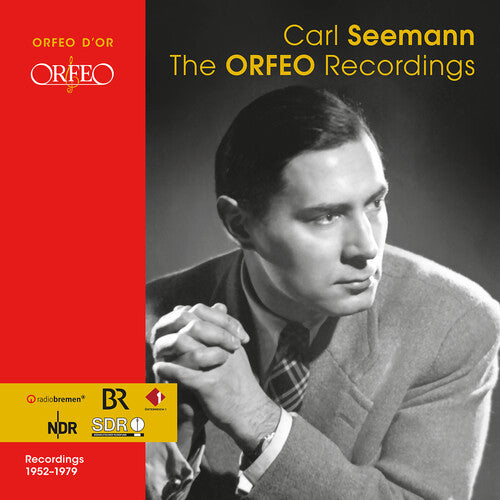
Carl Seemann: The Orfeo Recordings
Carl Seemann – The ORFEO recordings – Carl Seemann was the kind of pianist who didn’t try to impress audiences with brilliant virtuosity. Instead, he understood the piano as his ideal medium for revealing a polyphonic structure on a single instrument. After his death on November 26th, 1983, at the age of 73, in Freiburg, it took some 25 years before the recordings of his studio and concert performances began to be re(dis)covered and today he is once again regarded as one of the leading German pianists of the post-war era. On the occasion of his 40th year of death, ORFEO releases this 7 CD anniversary box with all his recordings on the label and an additional booklet that highlights Carl Seemann’s artistic background and his pianistic environment.
REVIEW:
Pianist Carl Seemann (1910-1983) largely specialized in the Viennese classics, and tended to shine more in collaborations than when under the solo spotlight.
His 1965 Bach Partitas, for example, range from workaday (Nos. 2 and 6) to sensitive and cultivated (No. 3 and No. 5’s outer movements). By contrast, his 1964 recital with frequent partner violinist Wolfgang Schneiderhan features congenial and inspired readings of the Bach E major, Beethoven E-flat Op. 12 No. 3, Mozart B-flat K. 454, and Schubert A major D. 574 sonatas.
The 1979 Mozart C major concerto K. 503 with the NDR Symphony Orchestra under Wilfried Boettcher is sluggish and heavy in the outer movements compared alongside Seemann’s 1950 DG studio recording, which wasn’t all that great to begin with. However, the 1972 E-flat K. 449 captures Seemann on fine form in a work he otherwise did not record. Here his energized and poetic solo work is complemented by Leopold Hager’s shapely orchestral framework.
Seemann’s boring and heavy-handed Beethoven Piano Concerto No. 2 precedes a stylishly flexible 1962 performance of that composer’s Sonata No. 9 in E major Op. 14 No. 1. The 1952 broadcast of Beethoven’s Bagatelles Op. 126 is basically a sonically drab replica of Seemann’s engaging, vibrant, and better engineered 1951 DG studio version. As I listened to cellist Enrico Mainardi’s 1956 Bach Viola da gamba Sonata in D major BWV 1028, I was struck by how the pianist’s tone seemed unusually mellifluous and nuanced. Then I looked at the booklet, and it turned out that the pianist was Carlo Zecchi, not Seemann! No wonder! Yet the real Carl Seemann holds more interest throughout a 1973 Reger Sonata No. 4 than Mainardi, who was way past his prime by that date.
The collection’s final disc focuses on Paul Hindemith conducting the Bavarian Radio Symphony Orchestra. They are not so polished as The Philharmonia Orchestra in Hindemith’s EMI recording of the Symphony for Concert Band, yet they bring more urgency and surface excitement to the fugal finale. The Bavarian musicians rise to the occasion in The Four Temperaments, where I prefer Clara Haskil’s limpid and sparkling fingerwork to pianist Hans Otte in Hindemith’s DG Berlin Philharmonic recording.
Considering that Berg’s Chamber Concerto was hardly a repertoire staple in 1955, Hindemith obtains impressive ensemble cohesion and discipline. Seemann handles the difficult piano part cleanly and securely, capably complementing violinist Wolfgang Marschner’s expressive agility. That said, Marschner comes more alive partnered alongside Paul Jacobs’ fleeter, more incisive pianism in a 1959 Köln Radio broadcast featuring Hermann Scherchen’s volatile podium presence.
At the very least I’m happy to have Seemann’s recital with Schneiderhan, his Mozart K. 449, and his more successful Bach Partita movements in my permanent collection, together with the Zecchi and Haskil selections. Christoph Schlüren’s annotations provide useful biographical information about Seemann and his career.
-- ClassicsToday.com (Jed Distler)
Mozart: Piano Concertos Nos. 15, 16, 17 (KV 450, 451, 453)
The Orpheum Foundation, which has been supporting young musicians for more than thirty years, has joined forces with Alpha Classics for a series of recordings devoted to Mozart’s concertos for various instruments. The finest soloists of the young generation have been selected under the artistic direction of Howard Griffiths, a renowned Mozart conductor, who considers that playing his music is like ‘looking in a mirror: you can hear if everything is in place, musicality, intonation, rhythm, phrasing’. For this fifth volume, the American pianist Claire Huangci joins the Mozarteum-Orchester Salzburg and Howard Griffiths, her mentor for the past ten years. For her, she says, these concertos are ‘true musical revelations, works full of virtuosity and imagination’.
Mozart: Piano Concertos Nos. 24 & 25
In his second disc of Mozart Concertos for Challenge Classics, Ben Kim confronts two great concertos like Nos. 24 and 25, both composed in Vienna in 1786. Both works are numbered among the masterpieces of the genre. The album reflects Mozart's artistic development and how it alienated his listeners, but also of the artist's own journey of finding confidence in vulnerability. His previous CC 72816 (Concertos Nos. 17 & 23) was welcomed by Gramophone: “his debut with Challenge reveals a sensitive touch … [his] performances give pleasure in their delivery of Mozart’s indelible melodic writing” and by BBC Music Magazine: “ … a recording that offers considerable rewards.”
Mozart: Symphonies Nos. 34, 35 & 36 / Manasi, Slovak Sinfonietta
Matthias Manasi is rated as one of the most sought-after and most outstanding conductors of his generation, earning himself a distinguished name both on the opera and concert podiums. With a diverse repertoire range he is recognized for his knowledgeable and insightful interpretations, encompassing the great symphonic and operatic repertoire, contemporary scores, and historically informed performances. He is celebrated for the extraordinary combination of precision and temperament of his conducting and the convincing depth of his musical understanding, The Austrian newspaper ‘Heute’ wrote after a concert: “Matthias Manasi delivered an outstanding performance in the legendary, heavenly acoustics of the Golden Hall of the Musikverein Vienna”. The ‘Factanet Rome’ wrote after a concert: “It was a great interpretation that added value to Manasi’s work and that proclaims him as one of the most important conductors of our time”.
Mozart: Anime Immortali - Countertenor Arias / Fagioli
Countertenor Franco Fagioli makes his Pentatone debut with Anime Immortali, together with the Kammerorchester Basel, exploring the music that Mozart composed for castratos. Ranging from opera to sacred music and culminating in Exsultate, jubilate, the recorded works share a sublime and profound character, demonstrating Mozart’s strong connection to the castrato voice. With this album, Fagioli finally returns to the composer that inflamed his desire to become a musician during his youth. Franco Fagioli is one of today’s most esteemed countertenors, and makes his Pentatone debut. The Kammerorchester Basel returns to the label after a recording of Haydn’s Stabat Mater (2022) with René Jacobs.
¡Escucha una entrevista con Fagioli en el podcast Naxos en español!