

naxos
4414 products
-

-

American Classics - Barber: Knoxville - Summer Of 1915, Essays For Orchestra
Naxos · May 20041 discCD$19.99 -

-

American Classics - Barber: Violin Concerto, Souvenirs, Etc / Buswell
Naxos · Jan 20021 discCD$19.99 -

-

-

-

-

-

-

-

-
 Sale
American Classics - Brubeck: Chromatic Fantasy Sonata, Etc / John Salmon
Naxos · Mar 20041 discCD$19.99$9.99 -

-

-

-

-

-

-

American Classics - Carter: String Quartets 2, 3 And 4 / Pacifica Quartet
Naxos · Feb 20091 discCD$19.99 -

-

-

-
 Sale
American Classics - Carter: Symphony No 1, Etc / Wait, Et Al
Naxos · Mar 20041 discCD$19.99$9.99 -

-
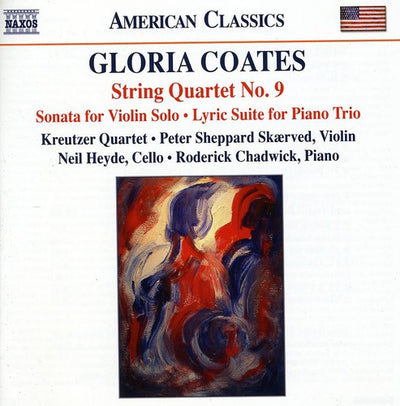
American Classics - Coates: String Quartet No. 9, Sonata For Violin Solo; Lyric Suite
Naxos · Sep 20101 discCD$19.99 -

-

-

American Classics - Copland: The Tender Land Suite, Piano Concerto, Etc / Pasternack, Hanson
Naxos · May 20081 discCD$19.99 -

-

American Classics - Corigliano: Mr. Tambourine Man, Three Hallucinations
Naxos · Sep 20081 discCD$19.99 -

-

-
 Sale
American Classics - Corigliano: Music For Violin And Piano / Bieler, Tichman
Naxos · Dec 20081 discCD$19.99$9.99 -

-

-

American Classics - Corigliano: The Red Violin Caprices / Quint, Wolfram
Naxos · May 20081 discCD$19.99 -

-

-

-

-

-

-
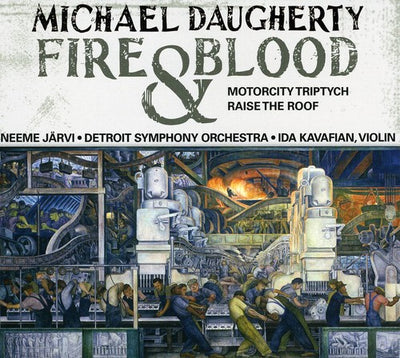
American Classics - Daugherty: Fire & Blood, Raise The Roof / Kavafian, N. Jarvi, Detroit SO
Naxos · Aug 20091 discCD$19.99 -
 Sale
American Classics - Daugherty: Philadelphia Stories, Ufo / Glennie, Alsop, Et Al
Naxos · Oct 20041 discCD$19.99$9.99


American Classics - Barber: Choral Music
Naxos
CD · 1 disc
$19.99
Aug 29, 2006
Setting texts for chorus or solo songs occupied Samuel Barber throughout his creative life. In particular he sought out English and Irish writers, many of whose melancholic and nostalgic texts aptly matched his own musically romantic persuasion.


American Classics - Barber: Knoxville - Summer Of 1915, Essays For Orchestra
Naxos
CD · 1 disc
$19.99
May 01, 2004
"None of the performances on this new release is less than superb; moreover, no one who has been using the Naxos series to build his library of Barber works risks being disappointed by this or any of the other releases...this new Naxos release is especially notable for its extremely rich yet transparent sound quality and for painstakingly shaped phrasing by the Scottish National Orchestra."
-- Walter Simmons, Fanfare
-- Walter Simmons, Fanfare


American Classics - Barber: Orchestral Works Vol 2 / Alsop
Naxos
CD · 1 disc
$19.99
Mar 01, 2001
Lyricism and obsessive patterns are finely realised by the RSNO, while conductor Marin Alsop shows a keen sensitivity to both scores and balances their rhetoric with the clean-edged clarity of their textures. In addition, her performance of the now-ubiquitous Adagio for Strings is a model of restraint, proving the saying that less equals more. Attractive sound, with a wide range and plenty of definition. - BBC Music Magazine


American Classics - Beach: Gaelic Symphony, Piano Concerto
Naxos
CD · 1 disc
$19.99
Jun 01, 2003
If you're having only one Amy Beach CD (and you should have at least one), let this be your choice. It's a mystery why the Piano Concerto still awaits the attention it surely deserves, for it's a terrific piece, full of good tunes, flashy keyboard writing, and colorful orchestration. It's also very well constructed, with the long (17-plus minutes) first movement effectively balanced by the three ensuing ones. The "perpetuum mobile" scherzo is delightful; the Largo, with its quasi-Wagnerian opening, is surprisingly expressive for all its brevity; and the finale has irresistible verve. The only previous recording of note was an unsatisfactory version on Vox, which this newcomer blows away. Alan Feinberg certainly has the chops for the piece, and tosses off the trickier moments with uninhibited abandon. However, for some inexplicable reason he's given a very wiry, brittle sounding instrument (excellently balanced, though) with a real "twang" in its middle register (happily the top of the keyboard sounds much better). That strange caveat aside, this is now the version of choice.
The "Gaelic" Symphony comes off equally well. As always with this orchestra, the strings are especially rich-toned and a joy to hear. In the final analysis, there's not much difference between this performance and Järvi's on Chandos, save for the fact that conductor Kenneth Schermerhorn takes a little more time over the slow movement and finale, which is all to the good. Again, we can only admire Beach's command of the orchestra, her free and easy use of the brass, and the way she keeps the music moving along smartly. This may not be a "great" work in the manner of Dvorák's "New World" Symphony, which inspired it, but it's certainly a very enjoyable one, and like the Piano Concerto it deserves to be heard more often. All in all, a very highly recommendable disc, finely recorded.
--David Hurwitz, ClassicsToday.com


American Classics - Beach: Songs / Kelton, Bringerud
Naxos
CD · 1 disc
$19.99
Oct 19, 2004
Amy Beach's songs are pleasant enough, and certainly well-crafted, with smartly chosen texts--Burns, Longfellow, Browning, Shelley, and some lesser-known poets, including Beach herself. But most of their appeal lies with the composer's deftness in borrowing from and incorporating the styles of major artists such as Schubert, Brahms, Wolf, Richard Strauss, and Debussy into her writing. She even takes directly from Beethoven in her quite lovely song "The Rainy Day". In other words, there's nothing really original here, but melodically and in terms of overall accessibility and singability, Beach understood the genre and knew how to create music that nearly everyone--singers as well as listeners--could enjoy. There are lullabies, German lied, and French chansons, as well as a nod or two to English and American parlor-song. And we're fortunate to have as our interpreter a singer who is one of the world's experts in this repertoire: mezzo-soprano Katherine Kelton did her doctoral dissertation on Beach's songs. She exhibits a voice of rich color and easy, inviting expressiveness, and her technique effortlessly conveys the varied moods and cleverly imitative styles so that we can just sit back and appreciate each one of these charming if not particularly profound works. Beach's piano accompaniments are carefully thought-out and add essential, characterful aspects of tone, color, and texture that are often very technically challenging. Catherine Bringerud is completely at home with this music and at one with Kelton's vocal interpretations. The sound is complementary to vocal and instrumental timbres and presents the performances in realistic perspective. Fans of American song--and especially of Amy Beach (who did much of her writing just down the road from where I'm writing this review, at the MacDowell Colony in Peterborough, NH)--shouldn't miss this interpretively considerate, solidly performed recital.
--David Vernier, ClassicsToday.com
--David Vernier, ClassicsToday.com


American Classics - Bernstein: Chichester Psalms, Etc
Naxos
CD · 1 disc
$19.99
Sep 01, 2003
"Marin Alsop follows up her excellent Samuel Barber series for Naxos with works by her one-time mentor, Leonard Bernstein. For the most part, she and the Bournemouth Symphony deliver the goods. The suite Bernstein fashioned from his lone film score, On the Waterfront, contains some of this composer's most vibrant and involving music, where no section of the orchestra goes under-utilized. Everything in the score clearly stands out under Alsop's eagle eyes and ears, with syncopated rhythms and canonic passages securely aligned and the Bournemouth brass at their assertive best (especially in the final Allegro non troppo section)...The Bournemouth strings come into their own in Chichester Psalms, notably in the third-movement prelude. Alsop's brisk tempos serve the first movement's insouciant asymmetry well, and she makes the third movement's lyrical points through strict dynamic gradations and steady tempos (it's so tempting to milk this music to death!). The chorus is expertly prepared, and the small solo parts are handled as well as they can be. Boy soprano Thomas Kelly's centered pitch and clear diction deserves more than honorable mention. My only complaint about Naxos' wide-ranging sonics is that you can barely understand the words at loud moments--but listeners will find texts and translations are provided. Yes, no one conducts Bernstein like Lenny, but Marin Alsop manages to make this music her own. And that's no small feat."
--Jed Distler, ClassicsToday.com
-----
Bernstein the composer has a champion in Marin Alsop, who decided to become a conductor after hearing him lead the New York Philharmonic when she was 9. On a Naxos disc, she conducts an uplifting performance of his colorful "Chichester Psalms" with the Bournemouth Symphony Chorus and Orchestra (of which she was principal conductor from 2002 to 2008). Bernstein described the "Psalms," for which he set Hebrew texts, as the "most B flat majorish tonal piece I’ve ever written." The recording also includes lively renditions of his Three Dance Episodes from "On the Town" (a musical theater piece) and the Symphonic Suite from "On the Waterfront," which uses material (including some that was cut) from his 1954 film score.
--Vivien Schweitzer, New York Times


American Classics - Bernstein: Serenade, Etc / Alsop, Et Al
Naxos
CD · 1 disc
$19.99
Nov 15, 2005
Bernstein?s Serenade for solo violin, strings, harp, and percussion was inspired by Plato?s Symposium and the composer described it as a ?series of related statements in praise of love.? This is the only performance I know which treats it that way, rather than as a snazzy solo concerto. It?s partly to do with conductor Marin Alsop?s measured approach to tempo: the work bounces along, but the syncopated rhythms never race out of control, and moments of excitement are never whipped up in order to generate a buzz. It?s also partly to do with the soloist. Philippe Quint?s smooth-toned violin persuades and cajoles: there are flights of fancy, but there is also reasoned argument. In short, this really does sound like a group of articulate protagonists in intellectual parlay (a situation Bernstein himself loved to be in). Marin Alsop was a protegee of the composer, and here she salutes his memory by taking the program of the Serenade seriously. The aforementioned sections of the Bournemouth orchestra are disciplined and tight.
The ballet score, Facsimile , perhaps needs to be drawn out of its shell a little more; it is the least flashy of Bernstein?s early concert works. Alsop and the orchestra do it justice, but this is one of those rare cases where only the composer (on Sony and Deutsche Grammophon) can bring it to shining life. Jerome Robbins?s ballet was set to a nihilistic scenario of ?post war malaise and the spiritual vacuum of modern man,? to quote the notes. (I thought the post-war era was optimistic! Robbins should have been around now.) The music is, likewise, a little gray, though Bernstein?s natural ebullience peeps through whenever it can. In any case, the playful moments need to be more playful, the dramatic fortes a little more dramatic than they are allowed to be here. The prominent piano part is nicely integrated into the orchestral fabric in this spacious recording.
Facsimile is an exception to my theory (which I?m sticking to) that, generally, Bernstein?s music speaks for itself and it?s musicality suffers when points are over-emphasized or climaxes inflated. The late Divertimento (written for the centenary of the Boston SO) provides a good example. Once more, Alsop reins in the highjinks and as a result, the piece seems more substantial and less ?occasional? than usual. These works are available in the composer?s recordings and many other fine interpretations exist (such as Hilary Hahn?s dazzling Serenade, with David Zinman conducting the Baltimore SO on Sony?if it?s still around) but Naxos gives us more than mere bargain-basement versions. These are smart, sharply realized, well-recorded performances.
FANFARE: Phillip Scott


American Classics - Bolcom: Music For Two Pianos
Naxos
CD · 1 disc
$19.99
Nov 15, 2005
If ever there was a composer for today, that composer is William Bolcom. Just as music of all kinds is omnipresent in our lives, so it is in his work. If he likes it, it?s in?and it?s not a carefully refracted influence (like Christopher Rouse?s rock) or a sarcastic juxtaposition of quotations ( à la Schnittke), it?s just there . Bolcom drew upon Ivesian Americana in his 1976 piano concerto; he created a languorous passage of jazz fiddle in his violin concerto because he admired Joe Venuti?s licks, and look at the broad stylistic vocabulary at work in his fearless, monumental setting of Blake?s Songs of Innocence and Experience (also available on Naxos, and indispensable). On this disc, in the sometimes-uniform sound world of duo-piano, the stylistic variety he displays is typically wide-ranging.
The earliest piece is the short Interlude from 1963 (rev. 1965). Composed when Bolcom was a student, it employs the then obligatory atonal language. He was studying with Darius Milhaud and Olivier Messiaen in Paris at the time, but a few years later, he discovered and fell in love with ragtime. Bolcom is, of course, also renowned as a pianist (as soloist and accompanist to his wife Joan Morris) and his recordings, as well as his compositions, helped to re-establish rag as a form. From 1969, we have here a rag ( The Serpent?s Kiss ) and a cakewalk ( Through Eden?s gates ), rearranged from a solo piano suite for Richard and John Contigula (who recorded it on one of their Connoisseur discs, long gone). These are both laid-back, loving pieces; in the cakewalk, which the composer describes as ?[conjuring] the image of Adam and Eve calmly cakewalking their way out of Paradise,? we find a passage where one of the pianists knocks out a syncopated rhythm on the wood to the other?s ?stop? chords: a genuine tap-dancing turn, and how better to depict Adam and Eve?s cheeky defiance of God?
The longest work here is the two-movement suite, Frescoes (1971). Here Bolcom adopts the avant-garde devices of the 1970s: aleatory passages, explosions of dissonance, and above all the exploration of tone color. The pianists double at various points on harpsichord and harmonium: it?s all very spooky and George Crumbish, apart from one moment where Bolcom switches gears and suddenly we?re hearing a ?till ready? intro to a Broadway point number. Throughout its 28 minutes, Frescoes holds out attention due to the composer?s sophisticated ear for texture and his sense of fun. The 1993 Sonata in one movement is more straightforward stylistically (although references to Schoenberg and Debussy pop up), because Bolcom concentrates his energies on structure, fusing Classical first-movement sonata form with the overall fast/slow/fast layout of a full sonata.
The opening work, Recuerdos, is a three-movement suite from 1991 that specifically pays homage to three Latin composers, Ernesto Nazareth, Louis-Moreau Gottschalk, and Ramón Delago Palacios. Bolcom does not merely ape the sound of these composers; he understands and recreates the innate qualities that made them popular (as Ravel did in his piano homages to Chabrier and Borodin). Thus, Bolcom pinpoints the lazy playfulness of Nazareth (?creator? of the choro , according to the notes), the florid panache of Gottschalk, and the full-blooded bravado of Palacios. (Milhaud obviously started this particular ball rolling with his own Latin-derived music; Bolcom the pianist made a wonderful, sympathetic recording for Nonesuch of Milhaud?s Saudades do Brazil. It demands to be reissued.)
The distinguished duo-piano team of Elizabeth and Marcel Bergmann play Bolcom?s music for all it?s worth?which means going over the top when necessary. The recording is excellent, encompassing the extremes of forte and piano in a dryish but not cramped acoustic. Also, whoever determined the order of works on the CD made a brilliant decision: the final marcato chords of Recuerdos are virtually the same as the opening marcato chords of Frescoes . In the first, they represent the flamenco stamping of a final Spanish cadence, and in the second, a call to attention for a journey through a stunningly contrasted harmonic and sonic terrain. This canny juxtaposition epitomizes the composer?s eclecticism. Bravo, Naxos: now for the five (or more?) symphonies! Meanwhile, this disc goes on my first Want list.
FANFARE: Phillip Scott


American Classics - Bolcom: Violin Sonatas / Soroka, Greene
Naxos
CD · 1 disc
$19.99
Feb 21, 2006

William Bolcom's four violin sonatas span 50 years of compositional activity. The First dates from 1956 (his freshman year at the University of Washington in Seattle), the Second was written 22 years later, while Nos. 3 and 4 respectively appeared in 1993 and 1994. Play the First's energetic concluding Quasi-Variations movement first and you'll realize that the 18-year-old composer already could embrace and manipulate many moods, shifting from sweet tunefulness and thorny dissonance as he pleased. His ability to do this, of course, would develop to more blatant extremes once hard-core jazz, pop, and world music idioms gained unreserved admission to his expressive kingdom.
The husband and wife team of violinist Solomia Soroka and pianist Arthur Greene simply eat up this music like starving artists getting their first substantial grub in ages. Examples: their gutsy delivery of the Fourth's Arabic-influenced Arabesque, their impassioned, flame-throwing dialogue at the Third's outset, and dagger-like articulation of the Second's terse second movement. Perhaps a quicker, suppler approach to the Second's "Joe Venuti meets Salsa" finale, in the manner of Maria Bachmann'a 1994 Catalyst recording, would be more stylistically apt, but the music bears up well when articulated in "longhair" accents (will Nonesuch ever reissue the still-unsurpassed Sergiu Luca recording with the composer tearing up the keyboard?). Bolcom provides his own informative, entertaining booklet notes to a lovingly executed and beautifully engineered release that does all participants proud. [2/27/2006]
--Jed Distler, ClassicsToday.com


American Classics - Brubeck: Chromatic Fantasy Sonata, Etc / John Salmon
Naxos
CD · 1 disc
$9.99
$19.99
Save 50%
Mar 01, 2004
"The performance on this disc by John Salmon is of the highest caliber. He plays beautifully, both with precision and expertise, and pulls the most out of each note. His facility at the keyboard is wonderful. If a better performance of these works can be done, I would be amazed... this disc is truly excellent. The music is a joy. The performance is exquisite. Very highly recommended."
-- Patrick Gary, www.musicweb.uk.net
"This fine disc of [Brubeck's] more formal piano pieces was born from long years of dedication by American pianist John Salmon...Throughout the disc, Salmon plays with rhythmic strength and remarkable digital clarity."
-- Bradley Bambarger, Gramophone
-- Patrick Gary, www.musicweb.uk.net
"This fine disc of [Brubeck's] more formal piano pieces was born from long years of dedication by American pianist John Salmon...Throughout the disc, Salmon plays with rhythmic strength and remarkable digital clarity."
-- Bradley Bambarger, Gramophone


American Classics - Brubeck: Nocturnes / John Salmon
Naxos
CD · 1 disc
$19.99
Aug 29, 2006
This is Salmon’s second Brubeck disc for Naxos. Here he presents what are termed twenty-six Nocturnes though that’s something of a misnomer. They’re short character studies, mainly played straight with three notable exceptions where Salmon allows himself the luxury of some explicit improvisation – Recuerdo, Bluette and Koto Song. A number of the songs are also from recent albums and many have personal associations for Brubeck – family, travel, touring, special people and an air of nostalgia.
Whatever they may or may not be these are all engaging and often wistful examples of Brubeck’s art. Since he recently announced that he won’t make any more European tours due to the fatigue of the travelling it’s a moment for those of us here to reflect on his more intimate and reflective moments. They’re captured with real understanding and affection by Salmon who’s made something of a study in things Brubeckian.
So we can admire the compression but affirmative lyricism of the charming ballad Strange Meadowlark. Similarly – and how craftily programmed it is – we can enjoy the Bachian Mexicana, or should that be Mexican Bachiana of Recuerdo, which as already noted is one of the few places where Salmon has some improvisatory leeway. He brings out its suspensions nicely as indeed he does in adducing a little Erroll Garner to its veritable charms. I enjoyed the antique air of Softly, William, Softly, which derives from a never completed opera. As its title suggests Bluette is a laid back mini blues opus. And as with so many songs of his we can hear how Quiet As The Moon aspires to the condition of song. Brubeck is a wonderfully “vocal” composer.
Home Without Iola (his wife) is imbued with tristesse but another tribute to her - (I Still Am In Love With) A Girl Named Oli – has more than its share of earthy, funky Garneresque moments. There’s a touching tribute to Audrey Hepburn as well, and a trademark waltz, Viennese style, to add variety both rhythmic and thematic to the programming. Rather odd though that his Fats Waller tribute – Mr. Fats – should be in the form of a boogie; perhaps Harlem Stride was too much Fats’s thing for Brubeck to insist upon it. The range of his classical enthusiasms and interests can be gauged by his Satie homage, the roguishly titled I See, Satie.
This is another well-judged tribute to a still vital talent. There’s warmth here and wit and the kind of miniaturised impressionism that keeps Brubeck so interesting and rewarding a figure.
-- Jonathan Woolf, MusicWeb International


American Classics - Carpenter: Adventures In A Perambulator
Naxos
CD · 1 disc
$19.99
Jun 01, 2001
At last! The absence of a really good disc devoted to the music of John Alden Carpenter has long been one of the most glaring lacunae in the American classical music catalog. Individual works have turned up now and then (Sea Drift, the ballet Skyscrapers, or Krazy Kat), but never for very long, and certainly not to the extent Carpenter's musical gifts warrant. In what we can only pray will be the first of several discs devoted to this fine composer, Naxos offers two world-premiere recordings, plus the first new version of Adventures in a Perambulator since Howard Hanson's Mercury Living Presence recording made in the 1950s.
Carpenter's music achieves originality through a synthesis of various elements: a solidly traditional educational background (he studied with, among others, John Knowles Paine and Edward Elgar); a touch of French impressionism (especially in the orchestration); and reference to American popular song and dance modes, including jazz. These elements remain constant in varying degrees throughout his life. And so in Adventures in a Perambulator (a delicious view of the world from inside a baby carriage), we hear Debussy-like modal harmony and enchanting orchestration featuring ample use of harp, celesta, and glockenspiel, along with a touch of Irving Berlin, and a whiff of nascent rag-time. The two symphonies graft these elements onto a larger-scaled structure, but come off sounding no less fresh. The First Symphony employs a five-in-one movement form that's full of surprises, including a magical, fade-away ending, while the Second adopts a more traditional three-movement structure and features an especially jazzy finale. While neither lasts more than 20 minutes, they are still major works, tuneful and sophisticated at once, and reminiscent of no one else.
The National Symphony Orchestra of the Ukraine, as so often in Naxos' American Classics series, turns in fine performances of these three pieces under John McLaughlin Williams. At times in the Second Symphony's finale, you become conscious of the fact that the orchestra isn't quite comfortable with the syncopated rhythms, but then Carpenter's writing is frequently very exposed, and the problem is minor at best. Sonically, recordings from this source have been steadily improving, and this is one of the best. This delightful, important, lovable music belongs in every late-Romantic collection.
--David Hurwitz, ClassicsToday.com


American Classics - Carter: String Quartets 2, 3 And 4 / Pacifica Quartet
Naxos
CD · 1 disc
$19.99
Feb 24, 2009
CARTER String Quartets: Nos. 2–4 • Pacifica Qrt • NAXOS 8.559363 (74:15)
In Fanfare 31:6, I wrote of the Pacifica Quartet’s release of Carter’s First and Fifth quartets: “A great release, which I can only hope is matched by the sequel.” Prayers are answered, though I have slight reservations this time, but based on the music rather than the performances.
Carter’s three middle quartets have distinct personalities, based on the fact that they are about “distinct personalities.” Specifically, the Second gives each instrument a prescribed character, and the piece becomes a chamber drama of individuals who interact in a variety of manners and situations. (Ives’s Second Quartet comes to mind as a predecessor, though Carter’s characterizations tend to be more subtle, concentrated, abstract, and involved.) The Third takes a similar idea, but now applies it to two duos (violin/cello and violin/viola), which have a separate set of movements that overlap with each other in a sort of macro-counterpoint. The Fourth is by far the most “classical”—indeed of the entire cycle, not just these three. While its first movement features a rhapsodic, almost wild violin cadenza against which the remaining instruments construct a continuous commentary, it becomes a far more coordinated texture of democratic equality between the voices as it progresses.
While I wrote with unrestrained enthusiasm about the music of Quartets No. 1 and 5, my reaction is more qualified here. No. 2 is many people’s favorite, and there’s no doubt it exudes great wit, virtuosity, and an idea of polyphony never really heard before. That said, I’ve always found the characterizations less perceptible than many, partly because Carter’s highly chromatic pitch language (despite the fact that the different instruments concentrate on different melodic intervals and rhythmic patterns) tends to homogenize the differences. Going back to Ives, I think more stylistic contrasts would make the point better. But I also know that’s anathema to Carter’s aesthetics.
No. 3 on the other hand, is the point where many folks gave up on the composer, but where I was (and still am) blown away. The Third is one of the greatest monuments of High Modernism. Yes, it’s unbelievably complex, but it has an intensity, breadth, and passion unlike almost anything else in the Carter output. One really hears the interaction, indeed the collision, between its worlds as they revolve around one another.
And then No. 4: I wrote earlier I hoped the Pacificas could convince me at last of its value, but while they push me to the edge, I still can’t make the leap. I do realize now that the first movement is one of those rare birds in Carter’s music, a piece based on the rigorous, almost obsessive development of a single motive. Likewise, the slow third movement and the increasingly fragmented alternation between outburst and silence of the concluding Presto have a memorable profile. But it still sounds forced, and I’m sorry to say, relatively empty to me in comparison to the other works in the cycle. I feel that Carter reached a point in the early 1970s where he understood his technique and was able to write large-scale works fluently, but he’d lost some of the reason and drive to do so. Several works that, again, people I know are passionate about, such as Night Fantasies for piano, Penthode for chamber orchestra, and this Quartet, seem to be going through the motions, but don’t reach the transcendent state one senses in other pieces. The good news, though, is that by the mid 1980s Carter began writing a series of brilliant miniatures (one can trace perhaps to the 1984 Riconoscenza for solo violin), which led him to his “late late” style, where a greater degree of clarity, concision, and wit has combined to produce more music of more delight than he ever produced before (we’re talking here about a composer working in the age range of 80–100!). The Fifth Quartet is one of the masterpieces of this period.
As for these performances, once again the Pacificas take the crown on several fronts. The Ardittis have the only other cycle (on Etcetera), but it does not include the Fifth. Also, the Pacificas have far more extensive indexing of movements, which allows one to follow Carter’s formal argument much more closely. Their interpretations are Olympian, yet also suitably driven, catching both the abstraction and expressionism of Carter’s music. To take just one example, their performance of the Fourth, which seems quite intense and fast, is seven minutes longer than the Arditti’s (27:00 vs. 20:00). Listening to the latter, their version of the first movement is the proverbial bat-out-of-hell, and while exhilarating, it sounds as though they’re in a hurry to get it over with. My only quibble with the Pacificas is that their performance of the Third, while staggering in its control and attention to detail, doesn’t deliver the sort of emotional wallop at its ending that I came to know from the Juilliard’s premiere LP recording on Columbia. (Boy, do I fear that dates me!)
But this is overall a triumph of adventurous and stunning music-making, both in the composer’s creation and the performers’ realization. My critique of Carter’s quartets doesn’t dim my overall admiration, or my sense that this is likely the greatest quartet cycle we’ve had since Bartók’s. Add in the budget price for both discs, and this is by far the best way to get a monument of its era, and the single best introduction to Carter’s world one could imagine.
FANFARE: Robert Carl


American Classics - Carter: Symphony No 1, Etc / Wait, Et Al
Naxos
CD · 1 disc
$9.99
$19.99
Save 50%
Mar 01, 2004
Elliott Carter makes his Naxos début with an ear-catching programme
It’s very good news that Naxos has added Elliott Carter to its American Classics series, beginning with a strong programme of rarely heard pieces, and juxtaposing Carter in early populist vein with Carter the 1960s’ avant-gardist in full cry.
The wartime muscularity of the Symphony No 1 (completed in 1942 but heard here in its 1954 revision) is clearest in passages which echo, or anticipate, Copland’s more extrovert orchestral scores of the same period. But that triumphalist spirit is most productively on show in Carter’s splendidly brash Holiday Overture (1944). The Symphony as a whole is less straightforward, more varied in style and character, and the slow movement in particular moves from hymnic meditation into more ambiguous regions of expression in a manner that might not be completely convincing. It is certainly distinctive, however, and fits well with the balance between restraint and exuberance that typifies the work as a whole.
By the mid-1960s, when the Piano Concerto was composed, Carter’s language had shed its tonal roots, and his forms were far more distant from those traditions that are still traceable in the Symphony. Textures are immensely elaborate, yet the music is uninhibitedly dramatic, depicting all kinds of conflicts and attempted reconciliations while subjecting the basic concept of the concerto to penetrating critical scrutiny.
The power of the drama emerging from the constantly fluctuating confrontations between soloist, main orchestra, and a mediating concertino-group of seven players is rather muted in this recording, which (I suspect) is not the result of a preparatory series of public performances. Ursula Oppens, with Michael Gielen, managed to convey rather more of the music’s inherent fire and tumult. But Mark Wait shows a finely gauged technical command, and although Kenneth Schermerhorn and his Nashville players are occasionally underpowered and inclined to play safe, the jubilant conclusion of the Holiday Overture sweeps any interpretative reservations aside. With the symphony not otherwise available, this disc is a thoroughly recommendable addition to the Naxos American canon.
-- Arnold Whittall, Gramophone [3/2004]


American Classics - Coates: String Quartet No. 9, Sonata For Violin Solo; Lyric Suite
Naxos
CD · 1 disc
$19.99
Sep 28, 2010
COATES String Quartet No. 9. 1 Sonata for Solo Violin. 2 Lyric Suite for Piano Trio, “Split the Lark, and You’ll find the Music 2,3” • 1 Kreutzer Str Qrt; 2, 3 Peter Sheppard Skaerved (vn); 3 Neil Hyde, (vc); 3 Roderick Chadwick (pn) • NAXOS 8.559666 (58: 51)
I get the feeling that Gloria Coates does not spend a lot of time worrying about whether or not other people enjoy her music. That is a compliment, not a complaint. Whether or not you like what she does, she does it with a very personal style and with great conviction. The present CD, the fifth of Coates’s music to be released under Naxos’s American Classics imprint, ranks very low on the list of CDs one would play as light background music during a convivial dinner with friends. Coates’s music, this CD included, forces one to consider why we listen to music at all, and to examine what we mean by “entertainment.” To my thinking, entertainment, in the usual sense of the word, is overrated. We need to devote equal time and effort to moving ourselves into new emotional and intellectual territories, even at the risk of causing ourselves a little pain.
Coates is an American who now lives in Germany. In an interview, she describes the German culture as “very serious and formal,” and comments, “One is left alone much of the time unless he plans ahead.” Is there anyone in the United States who is writing music quite like Coates’s? Not that I am aware of. Her music says difficult things—things Americans seem unwilling to say at this point.
This is the world premiere recording of her recent (2007) String Quartet No. 9. The work is in two movements, both of them slow, and both of them making an almost obsessively detailed exploration of texture and sound. The first is a canon and nearly a palindrome, although the materials thus treated are not only melodic but also textural. The long, siren-like glissando, a trademark of Coates’s music from the start of her career, appears six minutes in and produces an unsettling effect. The listener also is thrown off kilter by pitch, because the first violin and the viola are tuned down one quarter-tone. Glissandos occur in the second movement, albeit within a narrower range; imagine listening to the slow movement of a late Beethoven quartet on a turntable whose motor is giving out and from an LP that has been pressed off-center. As Kyle Gann writes in his booklet notes, “The atmosphere is unworldly, creepily dissonant and yet serene, a kind of music of the spheres.”
The Sonata for Violin Solo (2000) allows aspects of Coates’s compositional style to stand out in stark relief. The movement titles—Prelude, Fantasia, Berceuse, and Hornpipe—suggest Handel or Bach, or at any rate more “traditional” composers, but once again, Coates goes her own fascinating way.
One might think that Emily Dickinson would elicit a brighter response from any composer. All of the Lyric Suite’s (1996) seven movements are headed by a fragment from Dickinson’s poetry. The Belle of Amherst was a mystic and a visionary, though, and Coates’s music underscores the notion that much of Dickinson’s work was actually quite strange, considering the time and place in which she lived. Once again, unusual playing techniques, including strings tuned a quarter-tone flat, create a sound world that is eerily beautiful and queasy.
For Coates newbies, any of the discs featuring her orchestral works might be a slightly easier introduction. Nevertheless, I feel that the present CD is an honest representation of who she is and what she does.
The Kreutzer Quartet has participated in earlier Coates recordings, and the quartet’s first violinist, Peter Sheppard Skærved, has championed Coates for her music for two decades. (Neil Heyde is the quartet’s cellist.) It is hard to know what to say about the performances, except that there would be little point in performing and recording this music if one didn’t believe in it. Separately and together, the quartet’s members, plus pianist Chadwick, are committed to the task, and carry it out with deep concentration.
As usual, the cover art is a painting by Gloria Coates, whose visual art looks much like her music sounds. As the saying goes, when God gave out talent, she stood in line twice.
FANFARE: Raymond Tuttle

American Classics - Converse: The Mystic Trumpeter, Etc
Naxos
CD · 1 disc
$19.99
Aug 01, 2002
Here's a trivia question for you: What musical work begins with an evocation of sunrise over Detroit? Answer: Frederick Shepherd Converse's Flivver Ten Million, a humorous answer to Honegger's Pacific 231 as portrayed through the adventures of a Ford automobile. After the dawn sequence, the factory gets to work and out comes our hero, the ten millionth Ford, and he sets out on his journeys. There's a sexy love scene (making out with a Chevy?) and a wild joy ride that culminates in a collision, and after a moment of introspection (and, we suspect, some time in the repair shop) Flivver takes off again, good as new. Along the way, Converse calls on a host of special effects: taxi horns, anvils, wind machine, ratchets. It's all over in 12 riotous minutes and JoAnn Falletta leads a clearly energized Buffalo Philharmonic in a knockout performance that alone is worth the price of the disc.
This isn't the time or place to go into the question of how "great" a composer Converse was, but there's no question that he had tremendous talent and a great gift for orchestral narrative. The Mystic Trumpeter (of Whitman fame) takes a few minutes to get going, but once it does, watch out! The battle music gives Tchaikovsky's Romeo and Juliet a good run for its money. And speaking of Tchaikovsky, check out the last few minutes of Endymion's Narrative, where Converse screws up the tension of his lyrical, principal theme in a manner that the great Russian would have been proud to call his own. Okay, so this may not be the most original or thought-provoking music in the world, but who in his right mind would sneer at a few more Tchaikovsky-style tone poems that are just about as good as the originals? And make no mistake; Converse's musical style did evolve over time. Flivver Ten Million, composed in 1927, shows significant advances in harmony, rhythm, and orchestration (albeit in a humorous vein) when compared to the other two works, both of which date from the first decade of the 20th century.
Throughout these works, Converse demonstrates an impressive command of the long melodic line, a keen dramatic sense, and a sure feeling for form. Better still, Falletta and the orchestra play marvelously, holding absolutely nothing back and taking those very fully scored climaxes from one peak of excitement to the next. And yet there's sensitivity aplenty, whether in the delicate harp-accompanied interludes in Endymion's Narrative or the gentle trumpet fanfares that open The Mystic Trumpeter. I can hardly imagine these pieces better played or conducted, and Naxos has contrived to produce a bold, vivid recording with terrific top-to-bottom transparency of texture and an aptly vast dynamic range. Certainly, this stands among the finest entries in Naxos' American music series to date, and markedly improves on the only available competition: the Louisville Orchestra's decent but less-than-spectacular versions of Endymion and Flivver. Let's hope Naxos pauses for a moment before moving on, to further mine this particularly fruitful lode. Remember, Converse also wrote five symphonies... [8/10/2002]
--David Hurwitz, ClassicsToday.com


American Classics - Copland: Symphony No 3, Etc / Judd
Naxos
CD · 1 disc
$19.99
Apr 01, 2002
Don't let the brevity of this review lead to the incorrect conclusion that there isn't plenty to enjoy, for James Judd and his New Zealand orchestra offer a pair of terrific Copland performances. Billy the Kid gets a shapely, dramatic interpretation: the initial and closing evocations of the West's wide open spaces offer grandeur without bombast, while the ensuing episodes follow seamlessly, including a very exciting gunfight. In the symphony, Judd is very much his own man. He catches the simple dignity of the first movement very well, then turns in the most dynamic scherzo since the composer's own Everest recording. The Andantino, taken at a daringly slow (but never slack) pace, sets up the blazing finale with particular effectiveness. Here, Judd and his players pull out all the stops, with nicely differentiated brass timbres in the opening fanfare and some really tight, rhythmic playing in the buildup to the central development's crunching climax. The closing pages once again provide the right feeling of triumph without the excess pomposity that has bothered so many critics and performers (even Bernstein) over the years. Naxos gets good, natural sound, though some of the percussion (snare drum rim shots, woodblock, and bass drum) seems a bit too backwardly placed--not a major point. This is a very fine release indeed. [2/14/2002] --David Hurwitz, ClassicsToday.com


American Classics - Copland: The Tender Land Suite, Piano Concerto, Etc / Pasternack, Hanson
Naxos
CD · 1 disc
$19.99
May 27, 2008
This is another collection of American classics that deserves the highest praise. With exemplary playing, singing and an acoustic to match this is plainly indispensable.
Thankfully this isn’t the umpteenth recording of Appalachian Spring but a collection of lesser-known Copland. As always this music is quintessentially American, the suite from his opera The Tender Land, the bluesy piano concerto and the Old American Songs, the latter in choral arrangements. Appropriately enough the orchestra is the Illinois-based Elgin Symphony, which has embarked on an ambitious project called In Search of Our American Voice. Helping them in this endeavour are the St. Charles Singers, a multi-talented chamber choir founded in 1984.
Speaking of voices, Copland has a unique, instantly recognisable ‘voice’ of his own and that is clear from the first bars of The Tender Land suite. In his illuminating liner-notes Joseph Horowitz reminds us that although this has a Depression-era rural setting one could argue that, in part at least, it’s also Copland’s response to the McCarthyist witch hunt of the 1950s.
Interestingly the suite, arranged after the opera’s premiere in 1954, starts with the introduction to Act 3 and the love duet between the farm girl Laurie Moss and her drifter beau, Martin. The second movement is based on the party in Act II and the final movement comes from the quintet,’ ‘The Promise of Living’, at the end of Act I.
Whatever Copland’s intentions the music is not far removed from the Pennsylvanian hills of Appalachia, with its open, unpretentious scoring. The usual epithets ‘folksy’ and ‘homespun’ apply but there is also a degree of disquiet reflected in the brass at the start of this movement. The ensuing harp melodies are most affecting in their simplicity and directness, Robert Hanson securing warm, idiomatic playing from his orchestra.
The recording is clear and detailed, notably in the vigorous party music, and there’s no sign of strain or grain in the climaxes. Indeed, it’s an almost perfect acoustic for such a lucid score, the surging music of the last movement lovingly shaped and projected. This is vintage Copland and hearing this music may spur you to try the opera itself.
Horowitz makes the point that Copland’s piano concerto was somewhat eclipsed by Gershwin’s much better known effort, written the year before. It doesn’t have the latter’s Broadway-inspired razzamatazz but what it does have is a more sophisticated, cosmopolitan feel to it. The insouciant, bluesy first movement – introduced with the usual fanfare – has the pianist doodling quietly at the keyboard. Benjamin Pasternack captures the languor of this movement very well indeed, the piano ideally placed and faithfully recorded. Copland’s detailed scoring is wonderfully realised too, the more expansive moments thrillingly intense but never overheated.
The doodler is back in the second movement, his random notes followed by raucous music that has a real swing to it. The drums and percussion are certainly reminiscent of Gershwin but there is a fresh, individual quality to this concerto. Pasternack is suitably foot-stompin’ in those repeated jazzy phrases and the Elgin players give him wonderful support throughout. But it’s the final minute or so that’s the real tour de force, with the splendid percussion chasing the pianist all the way to the finish line.
This is exhilarating stuff and quite possibly the most enjoyable item on the disc – go on, give it another whirl – so the choral arrangements of the Old American Songs needs to be pretty special to top that. Most listeners probably know these pieces in their original scoring for voice and piano; if that’s the version you want do try Willard White on Chandos CHAN 8960.
Alas, first impressions of the choral arrangements aren’t very encouraging, baritone Nathaniel Stampley’s rather wide vibrato spoiling ‘The Boatmen’s Dance’. The St. Charles singers are another matter entirely; they are clear and nimble and, to be fair, Stampley does improve in ‘The Dodger’. Those who have heard Willard White in this repertoire will know just how much character and personality he brings to bear in these songs. Well worth seeking out.
The Elgin Symphony is never less than excellent and the chorus sing eloquently in the ballad ‘Long Time Ago’. Diction could be clearer but with such heartfelt singing it seems churlish to complain. And then there’s ‘Simple Gifts’, the Shaker hymn we know from Appalachian Spring, essayed here with a wonderful sense of innocence and optimism. They even manage the farmyard onomatopoeia of ’I Bought Me a Cat’ which, if you don’t mind this kind of silliness, will probably put a smile on your face.
Really it’s the chorus that makes these arrangements stand out; their bright, focused sound is invariably pleasing, even if the music doesn’t always sound like Copland. They are also suitably impassioned – febrile, even – in the Revivalist hymn ‘Zion’s Walls’. Then Stampley and tenor Jeffrey Hunt join them for a spirited rendition of ’The Golden Willow Tree’. Both soloists acquit themselves well here and for once the quirky orchestration actually sounds like authentic Copland.
Of the two remaining songs the hymn tune ‘At The River’ could have been penned by Charles Ives, such is its mix of devotional text and strange harmonies. Hanson and his band bring this music to a stirring close before launching into the utterly delightful ‘Ching-a-ring Chaw’. If you haven’t smiled so far then this will surely do the trick, the singing and playing pin-sharp and full of fun. An upbeat finale to an enchanting disc.
Minor caveats about the baritone aside this is another collection of American classics that deserves the highest praise. With exemplary playing, singing and an acoustic to match this is plainly indispensable. And the song texts are included as well, which is a welcome bonus. Buy it and enjoy.
-- Dan Morgan, MusicWeb International


American Classics - Copland: Works For Violin And Piano
Naxos
CD · 1 disc
$19.99
Jul 01, 2002
from Daniel Felsenfeld's Liner Notes:
Copland seemed to have two separate sides, the populist and the aesthete. The Sonata for Violin and Piano seems to fall in between the two, being jaunty and full of good tunes, but also based on sophisticated harmonies and unorthodox musical schemes. The piece is dedicated to Lieutenant Harry H. Dunham, a close friend of Copland’s who died in battle, and the date of its première (17th January 1944, with violinist Ruth Posselt and the composer at the piano) shows that war was probably very much on the pacifist Copland’s mind. Cast in three movements with traditional titles (Andante, Lento and Allegretto giusto) this is truly a neo-classical work, but it is also pure Copland; as with everything, he took what he needed of the theoretical conceits, but ultimately composed to his instincts.
Two Pieces for violin and piano, which Copland wrote in the mid 1920s for himself and violinist Samuel Dushkin to play in a Boulanger-sponsored concert in Paris, is a chance to see Copland playing with new ideas, including a new fascination with jazz (this is also the period he was writing his heavily jazz-influenced Piano Concerto). Much of this music would be mined for later scores, but they do hold interest on their own. This is music that is bitonal (in more than one key at once), undoubtedly influenced by Darius Milhaud, whom Copland esteemed highly. In the Ukelele Serenade Copland is having a good time trying to make the fiddle sound like something it is not.
Copland’s piano trio Vitebsk, one of his few "Jewish" works, is here arranged for violin and piano. It is a startling piece, full of wailing dissonances, even using microtones, notes which fall in between the cracks of piano keys, not of the "Western" well-tempered system. It is based on The Dybuk, a Jewish folk-tale, which also fascinated George Gershwin and Leonard Bernstein, about spirits and doomed love in a small Hasidic community, and Copland hoped the music would, in his own words, "...reflect the harshness and drama of Jewish life in White Russia." It is, therefore, a lean, almost angry work, with many moods contained in its taut single movement.
Dipping even further into the well of Copland’s juvenilia, Two Preludes for Violin and Piano are attempts to translate poetry into music, as Liszt had done in his tone poems. The poets in whom Copland found inspiration were Witter Bynner and Wallace Stevens, both contemporaneous and American. Here we see the seed of the Copland yet to come, the off-kilter rhythms, the stark harmonies, and the sparseness of texture. The titles offer their own explanations; these are musical moment pieces, composed to a single-focused and specific idea of mood.
Originally scored for flute and piano, Copland’s Duo was re-scored by the composer in 1977 at the request of Robert Mann, the violinist for the Juilliard Quartet and Copland enthusiast. The "all-but" sonata was therefore transcribed into this version, which took a good deal less time than the composition - Copland worked for three years on the Duo, commissioned by William Kinkcaid. The famous flautist wanted something that would work "...like a sonata," and Copland certainly delivered the goods, offering a tightly formed work in three movements. The second movement in particular, the composition of which took most of the three years, evokes, in the composer’s own words "a certain mood that I connect with myself - a rather sad and wistful one, I suppose."
The ballet Rodeo was a divisive moment in Copland’s career, a complete smash hit, and yet the piece that managed to alienate him from much of his community. Copland, they thought, had sold out. Copland even incorporates some memorable American folk-tunes. It is a cowboy romance, full of wranglers and cowgirls, and culminating in a hoedown. The choreography and scenario were by Agnes de Mille, who, on the strength of her work on Rodeo, was hired to choreograph a new musical by Rodgers and Hammerstein called Oklahoma!, and Copland composed dutifully to her vision, though he preferred his idea for a ballet about Ellis Island. The 1942 première at the Metropolitan Opera was an enormous success, with a standing ovation. The suite from the work is one of Copland’s most recognizable achievements, with hundreds of performances and countless wonderful recordings.
Daniel Felsenfeld


American Classics - Corigliano: Music For Violin And Piano / Bieler, Tichman
Naxos
CD · 1 disc
$9.99
$19.99
Save 50%
Dec 16, 2008
One of America' finest and most widely recognized composers, John Corigliano has won several Grammy Awards, the Pulitzer Prize and dozens of other honors. His hauntingly beautiful Chaconne and virtuosic the Red Violin Caprices, both based on his AC.


American Classics - Corigliano: The Red Violin Caprices / Quint, Wolfram
Naxos
CD · 1 disc
$19.99
May 27, 2008
John Corigliano is a man of many talents – composer, teacher, record producer. This enterprising disc showcases both his earlier work (the violin sonata) and a set of variations based on his score for François Girard’s 1997 film The Red Violin. Sensibly, Naxos have paired them with violin vignettes by Virgil Thomson, perhaps best known for his film scores The Plow That Broke the Plains and The River.
The Russian-born violinist Philippe Quint may not be a household name on this side of the Atlantic but he has made quite an impact in his adopted homeland. Apart from winning a slew of prestigious awards he is dedicated to performing American music. He is partnered here by the charismatic pianist William Wolfram, who made an impact of his own with a fine disc of Donizetti opera transcriptions [see review].
Briefly, The Red Violin traces the travels of the eponymous instrument from Italy in the late 1600s to 19th-century England, China during the Cultural Revolution and finally to Canada in the 1990s. The conceit will be familiar to anyone who has read Accordion Crimes by Brokeback author Annie Proulx.
Corigliano won an Academy Award for the original score, which he has reworked as a set of five variations. From the outset it’s clear we are in the presence of a very fine fiddler. Quint produces a lovely warm tone in the elegiac opening to Variation 1, not to mention some scintillating passagework in the ensuing Con bravura. But it’s in the third variation that he really surprises, with an almost throaty sound. He seems perfectly in control at all times, especially in the quick, rhythmically precise writing towards the end of this variation. In Variation 4 he is wonderfully eloquent, too, and the instrument’s upper registers really sing. He also imbues the music with a meditative quality that is most attractive, notably in the final variation. Even in the more agitated passages he bows with great precision and bite, the engineers capturing the weight and character of sound very well indeed.
For anyone looking to sample Corigliano’s work this is an excellent place to start. His music is described as ‘neo-tonal’ but as so often the label doesn’t tell you a great deal about what to expect. Lightweight it may be but this is skilful music adroitly played. Ditto the violin sonata, where Quint is joined by Wolfram, whose first imperious entry is a sign of what’s to follow. Both soloists are warmly recorded, the violin tone nicely balanced by a weighty piano.
Wolfram proves he can play quietly and with feeling in the Andantino, in marked contrast to his jaunty Allegro. They both respond well to this meanderingly beautiful movement. But even here the music has a habit of modulating into something a little wilder before returning to its gentle wanderings. Indeed, there are times when one is reminded of Korngold’s violin concerto. But whatever the echoes it’s delectable stuff and superbly played.
The third movement – Lento – is more austere than anything we’ve heard thus far; Wolfram restrains the violin’s attempts to break free with darker more declamatory music. The tension is never fully resolved – shades of Shostakovich’s piano trios, perhaps – the movement ending in an enigmatic violin fade.
The final Allegro has a rollicking, silent-film quality that conceals writing of some subtlety and skill. Wolfram springs the rhythms with real affection, Quint shooting the musical rapids with ease. It’s a witty and engaging conclusion to a delightful work, helped by playing of rare commitment. Indeed, it’s hard to imagine this performance being easily trumped.
Virgil Thomson, like his contemporary Aaron Copland, belongs to that small group of composers whose work captures the spirit of America, whether in rousing tributes to the Wild West or evocations of its landscapes and rivers. But the works recorded here are altogether more urban – sophisticated, even – dating as they do from Thomson’s years in Paris.
The Three Portraits, arranged for violin and piano by Samuel Dushkin, are charming vignettes. It’s not essential to identify the subjects, who are rendered here with obvious insight. The first is a tipsy barcarolle, the second a haughty tango, both essayed with rhythmic subtlety and an artist’s eye for defining detail. The bird-like third portrait, complete with trills, is for violin alone. Fresh, open, never sly or knowing, these pieces are little gems.
Five Ladies, written in the 1930s but only published in 1983, offers more of the same but this time without the intervention of an arranger. If anything these pieces are more focused, the writing more distinctive than before. They really are the simplest of sketches, a series of telling musical pencil strokes. The soloists echo this disarmingly simple style with playing of lightness and grace.
The Eight Portraits, written between 1928 and 1940, give Quint another chance to demonstrate his skills. At first they can seem a little dry, almost like a set of practice pieces, but Quint individualises each of them with a range of mood and colour that is most impressive. That said, the material is overstretched at times. Minor caveats aside this really is playing of a high order, self-possessed yet never self-regarding.
Such fine performances of rarely heard works are what make the American Classics series indispensable. Indeed, this is one of the most consistently satisfying projects in the entire Naxos catalogue. And while this disc doesn’t qualify as mould-breaking or profound, it’s well worth hearing.
-- Dan Morgan, MusicWeb International


American Classics - Creston: Symphonies No 1-3 / Kuchar
Naxos
CD · 1 disc
$19.99
Apr 01, 2000
It's good to see Paul Creston's music making a bit of a comeback. Neeme Järvi recorded the Second Symphony for Chandos, and Gerard Schwarz did the Third (and much else besides) for Delos, so this latest entry in Naxos' American Music Series faces some stiff competition. Fortunately, the performances are excellent and hold their own without qualification. Kuchar and his orchestra already have recorded a first-rate Prokofiev symphony cycle for Naxos, and are working on Martinu as well, so it's no surprise that Creston fits their musical profile. New to CD is the zippy First Symphony, a typically American-sounding neo-classical piece in four brief movements variously marked "With Majesty", "With Humor", "With Serenity", and "With Gaiety". So they are, and so they sound.
The brilliant "song and dance" Second Symphony gets a particularly lively performance here: it's a truly original masterpiece in two movements that should be played and enjoyed at least as often as, say, the Third Symphonies of Copland, Harris, or Schuman. Inspired by episodes in the life of Christ (birth, crucifixion, and resurrection), the Third Symphony, entitled "Three Mysteries", combines Creston's love of Gregorian chant with his invigorating sense of rhythm. Its religious inspiration lends the music a calm solemnity that never becomes saccharine or insincere. Hopefully Naxos will get around to the remaining symphonies and other orchestral works. This is really good stuff, nicely recorded too.
--David Hurwitz, ClassicsToday.com


American Classics - Crumb: Songs, Drones, Refrains Of Death
Naxos
CD · 1 disc
$19.99
Jun 20, 2006
Songs, Drones, and Refrains of Death is one of the richest of George Crumb's brilliant and moving explorations of the poetry of Lorca, musically inspired by such pieces as Mussorgsky's Songs and Dances of Death and Mahler's Kindertotenlieder. Like so much of Crumb's mature music, it uses avant-garde performance techniques and unusual instruments (percussion especially) plus electronics to create a primal, elemental atmosphere. In this sense, the music stands in the tradition of Stravinsky's The Rite of Spring or Bartók's The Miraculous Mandarin, both works where an exceptionally refined and sophisticated technique is used unflinchingly to depict visions of mystery, evoke primitive rituals, and explore the ancient myths of our collective unconscious. In this respect, no poet is better suited to musical setting than Lorca, and no composer has ever responded to him more evocatively than Crumb.
The performance here under Fuat Kent is a very good one. Most Crumb recordings tend to be successful because either the players know what they are doing, or they don't, and faking it is not an option; the mere process of delivering what Crumb's highly detailed scores demand virtually guarantees a high level of achievement. But there are differences between this recording and Bridge's benchmark version with baritone Sanford Sylvan and Speculum Musicae (part of its complete Crumb edition). These primarily concern tempo: this newcomer is about four minutes slower overall, and this is particularly noticeable in the long final movement, Death-Drone III. Although Crumb's music relies heavily on sheer atmosphere, and absolute speed as such is rarely an issue, I marginally prefer the Bridge recording for its inevitably greater density of incident. The atmosphere basically takes care of itself. Still, this performance is very well played. The exciting bits (Song of the Rider and Cadenza appassionata for two drummers) are thrilling, and baritone Nicholas Isherwood certainly is as persuasive in his declamation of the text as Sylvan.
Quest--a remarkable sextet that includes important parts for guitar, harp, soprano saxophone, keyboards, and percussion (including a harmonica or concertina at the end)--was written for guitarist David Starobin. It's a watershed in Crumb's output for several reasons, not least of which is the fact that it permitted Crumb to work his way out of a serious writer's block in the 1990s. The piece also makes frequent reference to the song "Amazing Grace", thus anticipating the epic cycle of folk-song settings (four collections to date) that loom large in the composer's recent work.
Once again, this work is available on Bridge performed by its dedicatees, superbly, but this newcomer is hardly less accomplished or less favorably recorded, and in the final analysis if you want these two pieces (they are coupled differently on Bridge) then you can purchase this disc with complete confidence in its faithfulness to the composer's unique vision. It's good to see Crumb's music being performed and recorded regularly again. Without question, he is a great composer with a very special voice.
--David Hurwitz, ClassicsToday.com


American Classics - Daugherty: Fire & Blood, Raise The Roof / Kavafian, N. Jarvi, Detroit SO
Naxos
CD · 1 disc
$19.99
Aug 25, 2009
Michael Daugherty is a wonderful composer, and these three pieces make splendid listening. Fire and Blood is a violin concerto, and a damn fine one. Violin concertos are exceptionally difficult to write, especially in balancing the soloist against a large modern orchestra. Daugherty handles the challenge with aplomb. In the first movement, for example, he keeps the accompaniment light but colorful. Sounds that come across as hackneyed in the hands of other composers, such as harp glissandos or little glockenspiel accents, here sound freshly imagined, while the solo writing offers much that is genuinely lyrical and beautiful. Ida Kavafian puts plenty of heart into her playing, really digging into the tunes while making light of the technical difficulties.
Raise the Roof, for timpani and orchestra, does exactly what the title promises, but once again the music never sounds gimmicky. MotorCity Triptych features the orchestra's fine brass section: trumpet in the second movement and three trombones in the third. Daugherty's style mixes popular music idioms with traditional classical forms with complete naturalness. You never feel that he's trying too hard, or merely being trendy. Neeme Järvi and the band make exactly the bold, glittering sounds that the music requires, and I can only wonder why a disc that was recorded between 2001 and 2003 is only being issued now. Great sonics too.
--David Hurwitz, ClassicsToday.com

American Classics - Daugherty: Philadelphia Stories, Ufo / Glennie, Alsop, Et Al
Naxos
CD · 1 disc
$9.99
$19.99
Save 50%
Oct 19, 2004
This is the third major-label monograph of diverse music of Michael Daugherty (b. 1954), the University of Michigan faculty member known for his engagement with pop-culture subject matter. The first, of his Superman-inspired Metropolis Symphony and other works, made a splash. Another brought us a series of sound-gags, including the bassoon concerto Dead Elvis. There’s also a release of his opera Jackie O and scattered works on numerous compilations, as well as a symphonic band version of UFO and other works on the Klavier label. This is his first Naxos release, part of the terrific “American Classics” series.
Philadelphia Stories, considered by the composer his Third Symphony, was commissioned by the Philadelphia Orchestra, which premiered it under David Zinman in 2001. The work is in three movements, as much a triptych of tone poems as an abstract symphony—an urban La mer. The titles of the movements indicate the gist: “Sundown on South Street,” “Tell-Tale Harp,” “Bells for Stokowski.” The piece is just under half-an-hour long, each of the first two movements being about seven-and-a-half minutes and the third about 14.
If you know anything of Daugherty’s music, much of what’s here won’t surprise you for the most part. Daugherty frequently draws on pop and kitsch music archetypes in building up evocative larger forms. I can’t pin down any specific paraphrases in the first movement, but the several different kinds of orchestral pop, jazz, and Latin jazz conjure the atmosphere of Philly’s South Street, a byway of the musical night life where Daugherty himself had performed jazz and experimental music. The movement is a fantasia for two solo harps and orchestra, the title referring to The Tell-Tale Heart, which Edgar Allan Poe wrote in Philadelphia. Daugherty likens the somewhat gas-lit mood of the movement to Poe’s lyric poetry. The big shadow to go along with Stokowski’s in the last movement is Bach’s, alluding of course to the conductor’s famous orchestral transcriptions of Bach’s music. Daugherty begins the movement with a solo violin theme (arguably in the style of Bach), which serves as a basis for wide-ranging variations, Daugherty writes, “in my own musical language.”
The second work, UFO (1999), is a five-movement concerto for percussion and orchestra, written for soloist Evelyn Glennie and the National Symphony and conducted at its premiere by Leonard Slatkin. The five movement titles are as evocative as those in Philadelphia Stories: “Traveling Music,” “Unidentified,” “Flying,” “???,” and “Objects”; each concentrates on different percussion instruments. There are a few neat moments, but from the subject matter one expects a more imaginative (Lachenmann-like? Messiaen-ish?) orchestral experience than one gets. Deft, but largely predictable—as in Philadelphia Stories. The latter, though, is a far more satisfying work; it suffers less from a desperation solely to entertain. (The symphonic-band instrumentation of this piece was created in 2000; it was commissioned by a consortium of university bands and recorded by Glennie and the University of North Texas Wind Symphony, Eugene Migliaro Corporon conducting.)
Daugherty is a good composer from the standpoint of his ability to get what he wants out of his materials, but it’s hard to put one’s finger on what his true voice (that “my own musical language” of the above quote) might be beneath the busy surface of style-dropping. It could be argued that style isn’t something that can be heard from moment to moment, necessarily—that the whole of the work, the choices the composer makes in his gleanings from others, his extramusical impetus, are the style. Daugherty definitely has a taste for particular kinds of borrowings.
The performances are excellent. Marin Alsop obviously knows the Colorado Orchestra well and leads them with confidence through this often tricky music; they seem like they’re having fun. Glennie is outstanding as usual as a performer, but once again, she’s playing a commissioned piece that remains a little flat. Still, this disc is all in all a good and inexpensive introduction to Daugherty’s work. This Naxos series is invaluable.
Robert Kirzinger, FANFARE
