Search results: Search results

670 results

Products

  • SYMPHONY NO. 7

    SYMPHONY NO. 7

    IMPORTS Sep 2015
    1 disc
    Vinyl
    $21.99
  • Bruckner: Symphony No. 7 in E Major, WAB 107 (Modified 1885

    Bruckner: Symphony No. 7 in E Major, WAB 107 (Modified 1885

    Orfeo Jul 2006
    1 disc
    CD
    $16.99
  • SYMPHONY NO. 7

    SYMPHONY NO. 7

    DUX Jan 2008
    1 disc
    CD
    $21.99
    SWR

    Bruckner: Symphony No. 7 in E Major, WAB 107

    CD · 1 disc

    $13.99
    Composer
    BRUCKNER, ANTON
    Artist
    Hindemith
    Released
    Oct 14, 2014
    Paul Hindemith was an all-round musician, virtuoso violist, composer and educator. He mastered all the instruments of the orchestra to a more or less professional level of proficiency, all of which was more than adequate preparation for conducting too. He was strongly influenced in his conducting by Wilhelm Furtwängler, placing the highest value on the living tradition of interpretation. This release features his 1958 recording of Bruckner’s radiant Seventh Symphony; the mature master locating Bruckner’s achievements as a high point on the continuum between Bach and his own work.
    View full page
  • Bruckner: Symphony No. 7 in E Major, WAB 107

    Bruckner: Symphony No. 7 in E Major, WAB 107

    SWR Oct 2014
    1 disc
    CD
    $13.99
  • SYMPHONY NO 7

    SYMPHONY NO 7

    LPO Aug 2013
    1 disc
    CD
    $15.99
  • SYMPHONY 7

    SYMPHONY 7

    SFS MEDIA Oct 2005
    1 disc
    SACD
    $21.99
  • SYMPHONY 7
    SFS MEDIA

    SYMPHONY 7

    SACD · 1 disc

    $21.99
    Artist
    BEETHOVEN / SAN FRANCISCO SYM / THOMAS
    Released
    Jun 12, 2012
    This release from Michael Tilson Thomas and the San Francisco Symphony features Ludwig van Beethoven's Symphony No. 7 coupled with the Leonore Overture No. 3. One of his most stirring works and also one that he considered among his best, Beethoven's Symphony No. 7 was immensely popular from it's first playing. Recently, it's powerful second movement was used to great dramatic effect in the seminal moments of the Oscar-winning movie the King's Speech. While Beethoven wrote only one opera, he wrote multiple overtures for it, and the third of the series fully captures the joyful outcome of the story. Both recordings were taken from live in concerts held at Davies Symphony Hall in San Francisco.
    View full page
  • SYMPHONY 7

    SYMPHONY 7

    SFS MEDIA Jun 2012
    1 disc
    SACD
    $21.99
  • Lloyd: Symphony No. 7 - Study Score
    Lyrita

    Lloyd: Symphony No. 7 - Study Score

    Sheet Music

    $99.99
    Composer
    George Lloyd
    Released
    Apr 05, 2024
    Because George Lloyd's personal attention is a dominating influence on the scores and recordings - which he mostly conducted himself - we have decided to headline this representation the 'Signature Collection'. Scores will be cleaned, and new orchestral parts created, recordings will be reorganised into affordable sets with new notes commissioned from Paul Conway. All digital platforms will have access to a unified and comprehensive offering from a single source.
    View full page
  • Lloyd: Symphony No. 7 - Study Score

    Lloyd: Symphony No. 7 - Study Score

    Lyrita Apr 2024
    Sheet Music
    $99.99
    Orfeo

    Bruckner: Symphony No. 7 In E Major, Wab 107 (Live)

    CD · 1 disc

    $16.99
    Composer
    BRUCKNER, ANTON
    Artist
    Gustav Mahler Jugendorchester, Welser-Möst
    Released
    Jan 29, 2013

    Welser-Möst conducts the Gustav Mahler Youth Orchestra in this 1989 recording of Bruckner’s Seventh Symphony. The interpretation by these young performers was astonishing in its transcendence and manner of outlining the work’s musical contrasts. It’s no surprise that the press greeted the conductor and orchestra as a sensation and great hope for the future.

    View full page
  • Bruckner: Symphony No. 7 In E Major, Wab 107 (Live)

    Bruckner: Symphony No. 7 In E Major, Wab 107 (Live)

    Orfeo Jan 2013
    1 disc
    CD
    $16.99
    Solo Musica

    Schubert: Symphonies Nos. 3 & 7 / Edusei, Munich Symphony

    CD · 1 disc

    $20.99
    Composer
    SCHUBERT, FRANZ
    Artist
    Munchner Symphoniker, Edusei
    Released
    Jul 17, 2020
    The motto of this new release of Schubert’s Symphonies Nos. 3 & 7 in E-major might be “On to new horizons!” In general, this phrase has positive connotations, and it offers an apt description for the sparkling innovative force driving forward Symphony No. 3 in D-major. Here, Schubert is still in a state of experimentation characterized by youthful energy, having overcome the teething troubles which plagued the previous Symphonies Nos. 1 and 2. Does the phrase, however, also apply to the completion of the score fragment of Symphony No. 7 in E-major? One has to admit that the answer is: yes and no. On the one hand, the slow introduction of the Seventh in E-major sounds like something perfectly new (and something newly perfect), on the other, there may have been reasons why Schubert, who impatiently began composing straight into the sketched-out score, left the symphony a mere skeleton. Even in a version completed by another hand, this work is worth exploring, as it builds a bridge from the carefree Symphony No. 6 to Schubert’s late works, the Unfinished Symphony and the Great Symphony in C-major. Two departures for new horizons – and they are two different horizons – are what we seek to document with this recording.
    View full page
  • Schubert: Symphonies Nos. 3 & 7 / Edusei, Munich Symphony

    Schubert: Symphonies Nos. 3 & 7 / Edusei, Munich Symphony

    Solo Musica Jul 2020
    1 disc
    CD
    $20.99
  • Johann Nepomuk David: Symphonies 3 & 7
    CPO

    Johann Nepomuk David: Symphonies 3 & 7

    CD · 1 disc

    $18.99
    Composer
    Johann Nepomuk David
    Artist
    ORF Radio-Symphonieorchester Wien
    Released
    Jan 16, 2026
    In the first half of the 20th century, we encounter a number of luminaries who in a peculiar way are reincarnations of late medieval architects - although the compositional fabric they created is completely different from solid matter. Paul Hindemith was one such guild member, as was his Austrian contemporary Johann Nepomuk David. This recording of David's symphonies works is a further step in producing a first complete recordings of his symphonic works. The Third of eight symphonies from 1940-41 as well as the Seventh, completed in 1956 are on the program. The artist's virtues are obvious. Sometimes they are like painted woodcarvings, sometimes like neat blueprints of motivic connections, using folk song elements even in the most advanced structures. These fascinating works invite the listener to sit down to this compelling music.
    View full page
  • Johann Nepomuk David: Symphonies 3 & 7

    Johann Nepomuk David: Symphonies 3 & 7

    CPO Jan 2026
    1 disc
    CD
    $18.99
    ICA Classics

    Bruckner: Symphony No 7 / Tennstedt, Boston Symphony Orchestra

    DVD · 1 disc

    $26.99
    Composer
    BRUCKNER, ANTON
    Artist
    Tennstedt
    Released
    Mar 27, 2012
    Anton Bruckner: Symphony No. 7 in E major, WAB 107
    (1885 version, ed. L. Nowak)

    Boston Symphony Orchestra
    Klaus Tennstedt, conductor

    Recorded live from the Symphony Hall, Boston, 5 November 1977

    Picture format: NTSC 4:3
    Sound format: Enhanced Mono
    Region code: 0 (worldwide)
    Menu language: English
    Booklet notes: English, French, German
    Running time: 66 mins
    No. of DVDs: 1

    R E V I E W:

    A top-quality performance of Bruckner’s Seventh under a great conductor.

    The welcome expansion of Klaus Tennstedt’s recorded legacy through the issue of live performances continues with this reading of Bruckner’s Seventh Symphony from Boston. This was a work that Tennstedt did not take into the recording studios though there is another live account, this time on CD, on the LPO Live label (LPO0030). That issue preserves a 1984 performance but I have not heard it.
     
    It was with the Boston Symphony Orchestra that Tennstedt made his US debut in 1974, when one of the programmes he offered consisted of Bruckner’s Eighth Symphony. By all accounts that performance had the critics in raptures. It appears from the booklet note that when Tennstedt gave three performances of the Seventh three years later the critics, who attended the first of the performances, were a little less impressed, praising the conductor’s interpretation but finding fault with some of the playing; it was suggested that perhaps the performance was under-rehearsed. By the time the third performance came round – the one preserved here – it would seem that these little difficulties had been ironed out. There are one or two very minor slips but the overall standard of playing is extremely high and one has the definite impression that conductor and players are as one.
     
    Oddly, the image on the cover of this CD is not taken from the performance we see. For this Boston concert Tennstedt eschewed a score and therefore had no need to wear spectacles. In fact the Tennstedt we see in this film is quite youthful-looking. The recording is presented in “Enhanced Mono” – I’m unsure what that means but the sound is perfectly satisfactory – so we don’t quite get the benefit of Tennstedt’s layout of the string section: the violins are massed on his left but the violas are to his right – where many conductors place the cellos – and the Boston cello section is seated to the right hand of the violas.
     
    The reading is a very fine one. Tennstedt moulds the long, expansive cello melody at the start of the first movement with great care and evident feeling. As the movement unfolds he takes the second subject quite swiftly, though he’s not too hasty. This performance is one of those that remind us that Bruckner was a musical descendant of Schubert – and Tennstedt was a fine exponent of Schubert’s Ninth. The listener is left in no doubt that Tennstedt has the measure of the span and structure of this movement. That’s even more the case with his account of the solemn Adagio. This is a noble, burnished reading and though Tennstedt maintains a good objective stance there’s no doubt that he feels every phrase. He shapes the music splendidly and the Boston players respond to him with playing of distinction. The strings are wonderfully rich in tone, with just the right amount of weight, while the brass are sonorous. This is one of those performances where everything just feels right – and inevitable. The cymbal and triangle are included at the main climax.
     
    Tennstedt ensures that the rhythms of the scherzo have real lift and spring while the lyrical trio is affectionately phrased. The finale is completely successful. Tennstedt mixes energy with expansive phrasing and the brass-dominated episodes are delivered with due majesty.
     
    Tennstedt’s rendition of this symphony is deeply satisfying and it’s marvellous to have an example of him at work with one of the finest orchestras in the USA. We’re told that he worked regularly with the BSO until 1987 so I hope very much that ICA may be able to license more material, either audio or visual, from the orchestra’s archives. I found it fascinating to look at the BSO of thirty-five years ago and I noted with some surprise how few female musicians there were on the stage – possibly eight at most, including the orchestra’s celebrated principal flautist, Doriot Anthony Dwyer. Furthermore, at that time there don’t seem to have been too many young players in the BSO’s ranks. I bet things have changed quite a lot in the intervening period. The thing that really matters is that the Boston Symphony of 1977 vintage was a fine, seasoned ensemble and it’s a joy to hear them play under this great conductor.
     
    The visual presentation is reliable and gives a good representation of the concert. One minor irritant, I found, was the director’s occasional propensity for split-screen shots, showing us, for example, the principal oboist in one half of the screen and the principal clarinettist in the other. Happily, this doesn’t occur too often and it may not bother other viewers. The key thing is that if you invest in this DVD you’ll acquire a top-quality performance of Bruckner’s Seventh under a great conductor.
     
    -- John Quinn, MusicWeb International
    View full page
  • Bruckner: Symphony No 7 / Tennstedt, Boston Symphony Orchestra

    Bruckner: Symphony No 7 / Tennstedt, Boston Symphony Orchestra

    ICA Classics Mar 2012
    1 disc
    DVD
    $26.99
  • Bruckner: Symphony No. 7
    Haenssler Classic

    Bruckner: Symphony No. 7

    CD · 1 disc

    $20.99
    Composer
    Anton Bruckner
    Artist
    Ensemble Balance
    Released
    Jul 18, 2025
    ANTON BRUCKNER (1824-1896) - Symphony No. 7 in E major Arrangement for ensemble by Hanns Eisler, Erwin Stein and Karl Rankl During the coronavirus pandemic, when large symphonic performances were almost impossible due to contact restrictions and social distancing rules, the ensemble wanted to enable people to experience the depth and spirituality of Bruckner's music despite the social distancing and isolation restrictions. While there are normally around 80 musicians on stage when Bruckner's 7th Symphony is performed, the Stuttgart-based Ensemble Balance performs the work with just 11 instrumentalists, the result being that this condensed chamber music remains a unique experience, even without the pandemic! And this is because it is precisely in this concentrated, emotionally condensed form that Bruckner's compositional artistry becomes seductively clear and audible! The in-depth exploration into his work during the rehearsals for this recording in August 2020 had the effect of welding the ensemble together in both an artistic and a personal way, and this intimate connection between each and every musician, combined with the spirit of Bruckner's composition, can be clearly felt and heard in this performance by Ensemble Balance.
    View full page
  • Bruckner: Symphony No. 7

    Bruckner: Symphony No. 7

    Haenssler Classic Jul 2025
    1 disc
    CD
    $20.99
    Prospero Classical

    Schubert: Symphony No. 7 Reconstructed / Venzago, Berner Symphonieorchester

    CD · 1 disc

    $15.99 $20.99 Save 25%
    Composer
    Franz Schubert
    Artist
    Sinfonieorchester Bern, Mario Venzago
    Released
    Feb 04, 2022
    The Symphony in E major (D 729) from the summer of 1821 is one of five unfinished symphonies by Franz Schubert. Recently it has often been counted as Schubert's 7th symphony. Unlike his other symphonic fragments, the symphony in E major exists in a complete draft from the first to the last bar in all four movements. More recently, the symphony became accessible to a wider public again in the completed version by Brian Newbould (1982). Now the Austrian composer Richard Dünser, together with the conductor Mario Venzago, has presented a new version of the symphony fragment. The thin middle movements have been replaced by supplemented drafts from the year of Schubert's death. The result: a "new" great symphony by Schubert with a playing time of over 40 minutes; an original and gripping work that immediately convinces with its idiomatic and formal unity.
    View full page
  • Schubert: Symphony No. 7 Reconstructed / Venzago, Berner Symphonieorchester
    Sale

    Schubert: Symphony No. 7 Reconstructed / Venzago, Berner Symphonieorchester

    Prospero Classical Feb 2022
    1 disc
    CD
    $20.99 $15.99
  • SYMPHONY 7
    LPO

    SYMPHONY 7

    CD · 1 disc

    $15.75
    Artist
    SHOSTAKOVICH / LONDON PHILHARMONIC ORCHESTRA
    Released
    Mar 02, 2018
    The late conductor, Kurt Masur, had a long relationship with the London Philharmonic Orchestra, dating back to 1987. This recording, made during his tenure as Principal Conductor (2000-2007), highlights the close relationship between Conductor and Orchestra. This release adds to a growing collection of Shostakovich symphonies on the LPO label. Previous recordings featuring Kurt Masur have been praised for their 'emphatic style' and 'serious class.' The most recent Shostakovich release was described by BBC Music Magazine as "the most stunning Shostakovich disc I have heard this year." The 'Leningrad' Symphony is a true monument to one of the darkest times in recent history. It's famous 'Invasion' theme portrays a brooding sense of unease as an enemy approaches. It was written to bolster the people of the besieged city of Leningrad; it's Leningrad premiere in summer 1942 was broadcast through loudspeakers during the siege as an act of defiance. The London Philharmonic Orchestra gave the UK premiere of this Symphony (it's first performance outside Russia) in June 1942, after the score had been smuggled out of occupied Russia to the West on microfilm.
    View full page
  • SYMPHONY 7

    SYMPHONY 7

    LPO Mar 2018
    1 disc
    CD
    $15.75
    Ondine

    Kenins: Symphonies Nos. 2, 3 & 7 / Poga, Latvian National Symphony Orchestra

    CD · 1 disc

    $18.99
    Composer
    Talivaldis Kenins
    Artist
    Tommaso Pratola, Egils Upatnieks, Martins Circenis, Zanda Svede
    Released
    Sep 02, 2022

    Final volume in the first-ever complete recorded cycle of symphonies by Talivaldis Keninš (1919–2008), one of the most prominent post-WW2 composers in Latvia and Canada. This album includes three of the composer’s eight numbered symphonies performed by the Latvian National Symphony Orchestra under Andris Poga.

    Although born in Latvia, Keninš lived most of his life as an exile. He was educated in Paris, where he studied under Tony Aubin and Olivier Messiaen, and won several awards. Keninš emigrated to Canada in 1951 and became a respected pedagogue and a very influential figure in Canada’s music life. Alongside his eight symphonies, the composer also wrote 12 concertos. However, he also included many concertante elements in his symphonies and the Symphony No. 2, “Sinfonia concertante” (1967), scored for three wind instruments and symphony orchestra, is very close to a triple concerto. The symphony’s extensive second movement is based on a lullaby of the Mi’kmaq First Nations people. Symphony No. 3 (1970) was completed few years after its predecessor and is a step forward in the composer’s journey as a symphonist. Here we encounter the idea of a lyrical hero, which, in the ears of the listener, could be personified. Although many consider Kenins’ 8th Symphony to be his symphonic climax, the 7th Symphony (1980) is by no means a lesser work: it could be even considered as one of the composer’s most personal and intimate creations. The symphony ends with an aria based on a text by the composer’s father and the atmosphere of the work seems to stem from the composer’s emotional trauma on the occupation of his native Latvia by the Soviet troops.

    REVIEW:

    Ķeniņš composed his first symphony when he was forty and almost a decade elapsed before he turned to the genre again. However, his Symphony No 2 “Sinfonia concertante” does not strictly adhere to any symphonic mould. That the composer had a trio of wind instruments as some sort of a concertino tends to show that he was not completely sure of how to tackle that form again. This also shows is the lay-out of the piece, i.e three movements of strongly contrasting character as well as weight. In fact, the whole weight of the symphony lies in the long central movement whereas the brief opening Lento and the equally brief final Molto animato e marcato merely function as a prelude and epilogue of some sort. Moreover, the central Molto moderato: Tema e variazioni is twice as long as the two other movements put together. The weighty central movement is cast as a theme and variations on a lullaby of the Mi’kmaq First Nations people which the composer also used in his Suite in D major for organ. Anyone interested in what the Mi’kmaq First Nations people may be referred to Wikipedia for it all seems a rather long story. The variation movement of the Second Symphony is an impressive piece of music in which Kenins’ contrapuntal mastery is already fully displayed.

    The Symphony No 3 is Ķeniņš’ first large-scale work for large symphony orchestra and again the composer demonstrates his assurance in his handling of form and counterpoint. The central movement Lento inquieto, though shorter than that of the Second Symphony, is again the emotional heart of the piece but it is nevertheless counterbalanced by two outer movements of fairly equal length but of quite different character. Georgs Pelēcis is quoted in Orets Silabriedis’ excellent notes as saying that “Kenins rejects seemingly essential symphony ingredients, such as the sonata form. That does not appear in any of the three movements … only one main theme is developed in each movement, and they are all interrelated. The unifying element is the rich chromatic intonations …”. The Third Symphony is clearly a work by a composer in full command of his aims and means, which shows in the way that the composer handles polyphony – an essential component of his music making. The first and second movements end with uncertainty, preparing for what is to follow, but the final movement Molto animato e brioso ends with an assertive gesture. As Silabriedis puts it: “I am responsible for everything that I have said and done”. (Incidentally, one might be reminded of RVW, whose Fourth Symphony also ends abruptly with a fist banging on a table and a door brutally slammed.

    The Symphony No 7 “Symphony in the form of a Passacaglia” is scored for large orchestra and a mezzo-soprano in the final aria. Half the duration of the piece is purely orchestral and cast as a fully developed Passacaglia capped, so to say, by a short Allegro molto before the final aria for mezzo-soprano on a poem by the composer’s father, Atis Ķeniņš (1874–1961), who was also a statesman and one of the founders of the Republic of Latvia in 1919. The poem must have had a particularly personal resonance for the composer. “The mezzo-soprano solo links the composer more tightly with his family roots, expresses itself in more trusting and optimistic feelings; however, the unease in the harmonies and rhythm likely cannot hide the composer’s fears about out era. The concluding epilogue is like an Agnus Dei. The finale should express hope and faith, which stands over life’s troubles, soothing our darkest predictions, and suppressing our fears” (the composer’s words quoted in Silabriedis’ notes). The text, as translated in the booklet, may seem somewhat dated but has now acquired some new relevance in our troubled times and the symphony now carries a most welcome and needed appeal for peace. Nonetheless, Ķeniņš’ Seventh Symphony is quite an impressive piece of music in its own right and its “message” (if such there is) may be heard by any man of goodwill.

    This final installment in Ondine’s Ķeniņš cycle has been carefully prepared and is as immaculately performed as the preceding ones. These are committed performances throughout, in excellent sound, up to Ondine’s best standards and Orests Silabriedis’ notes are excellent.

    Ķeniņš’ symphonic cycle is on a par with other largely forgotten similar cycles that would probably have remained ignored or little known, were it not for brave and enterprising recording companies who have invested in similar projects. Examples that immediately come to mind are BIS’ recordings of Tubin’s symphonies and the hopefully ongoing Wordsworth cycle by Toccata. One cannot but hope that ventures such as these will encourage others to follow suit.

    Ķeniņš’ music is too good to be ignored and these performances do it full justice; I am sure that they will play a part in securing his music its deserved status.

    -- MusicWeb International

    View full page
  • Bruckner: Symphony No 7 In E Major / Jansons,  Bavarian Radio Symphony Orchestra

    Bruckner: Symphony No 7 In E Major / Jansons, Bavarian Radio Symphony Orchestra

    BR Klassik Sep 2009
    1 disc
    SACD
    $19.99
    Halle

    Sibelius: Symphonies Nos. 5, 7 & En Saga / Elder

    CD · 1 disc

    $20.99
    Composer
    SIBELIUS, JEAN
    Artist
    Halle, Elder
    Released
    Apr 08, 2016
    This exhilarating album contains stunning live symphonic performances of works by Jean Sibelius (1865-1957). Included in this recording are his Symphony No. 5 in E Flat Major, Op. 82, Symphony No. 7 in C Major, Op. 105, and En Saga, Op. 9.

    “...raw, massive, glacial, thrilling. Elder and the Halle have a strong track record in this repertoire.” - The Observer
    View full page
  • Sibelius: Symphonies Nos. 5, 7 & En Saga / Elder

    Sibelius: Symphonies Nos. 5, 7 & En Saga / Elder

    Halle Apr 2016
    1 disc
    CD
    $20.99
  • SYMPHONIES NOS. 6 & 7
    RCO LIVE HOLLAND

    SYMPHONIES NOS. 6 & 7

    SACD · 2 discs

    $25.99
    Artist
    BRUCKNER / JANSONS & ROYAL CONCERTGEBOUW ORCHESTRA
    Released
    Feb 24, 2015
    Ever since the tenure of it's chief conductor Eduard van Beinum (1945-59), the Royal Concertgebouw Orchestra has cherished one of the greatest Bruckner symphonic traditions in the world. With this release of Bruckner's Sixth and Seventh Symphonies, Mariss Janson's and his Amsterdam-based orchestra add a new chapter to the RCO's impressive performance and recording history of Bruckner's works.
    View full page
  • SYMPHONIES NOS. 6 & 7

    SYMPHONIES NOS. 6 & 7

    RCO LIVE HOLLAND Feb 2015
    2 discs
    SACD
    $25.99
    Naxos

    Prokofiev: Complete Symphonies / Alsop, Orquestra Sinfônica do Estado de São Paulo

    CD · 6 discs

    $51.99
    Composer
    PROKOFIEV, SERGEI
    Artist
    Alsop
    Released
    Apr 09, 2021

    Sergey Prokofiev’s seven symphonies are acknowledged as one of the major cycles of the 20th century, and these recordings with Marin Alsop and the Sao Paulo Symphony Orchestra have received widespread critical acclaim. From the crisp vitality of the youthful ‘Classical’ Symphony to the viscerally exciting Third, the Fifth Symphony which for Prokofiev represented ‘the grandeur of the human spirit’ and the deeply moving and heartfelt Sixth Symphony, this is an unforgettable collection crowned by the bittersweet Seventh Symphony, the composer’s final significant work.

    Past praise of previously released volumes included in this set:

    Prokofiev: Symphonies No 1 "Classical" & 2 / Alsop

    Without minimizing the Second’s violent energy, Alsop plays the piece with a vivid sense of its long melodic lines. The first movement, in particular, has plenty of excitement but also a certain lyrical emphasis that gives the music something to be excited about. It’s very convincing.

    As for the Classical Symphony, well, just about everyone does it well, and while I can imagine a first movement with a touch more snap to its rhythms, the performance picks up steam as it goes, culminating in a delightfully crisp account of the finale. The early tone poem “Dreams” drifts about prettily for ten minutes, sounding like Debussy or Scriabin or basically anyone but Prokofiev. Does it deserve greater exposure? Perhaps not, but this lovely performance makes as strong a case for it as you might imagine possible. Vivid sonics make this the best release in this series so far.

    – David Hurwitz, ClassicsToday.com

    Prokofiev: Symphony No. 7 & Other Orchestral Works / Alsop

    Alsop captures the lyrical aspects of the Seventh work really well. She also has the advantage of a superior recording in the acoustically friendlier Sala São Paulo. The orchestra is superb throughout, but special mention should be made of the woodwinds that have notable solos in the work.

    – MusicWeb International

    View full page
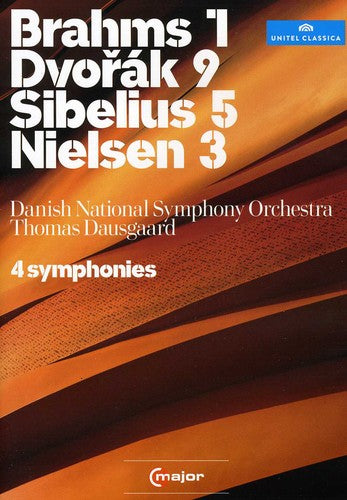
    C Major Entertainment

    4 Symphonies - Brahms, Dvorak, Sibelius, Nielsen / Dausgaard, Danish National Symphony Orchestra

    DVD · 2 discs

    $16.49 $32.99 Save 50%
    Composer
    BRAHMS DVORAK SIBELIUS NIEL
    Artist
    Dausgaard
    Released
    Jun 26, 2012


    4 SYMPHONIES • Thomas Dausgaard, cond; Danish Natl SO • C MAJOR 710508 (DVD: 168:00) Live: Copenhagen 2009

    BRAHMS Symphony No. 1. DVO?ÁK Symphony No. 9. SIBELIUS Symphony No. 5. NIELSEN Symphony No. 3

    If, as I did, you were to begin your examination of this release with disc 1, track 1 (the Brahms symphony), you might well conclude that there was little need to continue. There is something rather too cool and casual about Dausgaard’s interpretation of this powerful music. It lacks inner tension. There is not enough contrast between ideas. Accents are in the wrong places. Short notes are cheated of their value. And that’s not all. The second movement just plods on, the third is charmless, the fourth frantic and lurches from one tempo change to the next. Listening to the complete symphony several times could not induce me to alter my initial unfavorable observations. Adding visual insult to aural injury, sight and sound are not synchronized, and the difference between the two is disturbing, to put it mildly.

    But then came the Nielsen symphony. What a difference! Right from the opening moments it had all the vigor and élan and determination lacking in the Brahms. Rhythms were tight and crisp. The music bristled with enthusiasm and commitment. The finale positively beamed with Elgarian nobility and breadth, rising to an absolutely thrilling climax. What a joy! Nielsen’s Third had hitherto never been one of my favorite symphonies, but Dausgaard nearly made it so in this performance.

    Does Dausgaard work his magic on the two remaining works as well? The answer, I’m glad to say, is yes. Furthermore, the synchronization problem that affected the Brahms symphony is only minimal in the Nielsen and nonexistent in Dvo?ák and Sibelius. The “New World” Symphony receives one of the finest performances I have heard. Dausgaard’s approach is no romantic wallow but rather a clean, purposeful traversal filled with taut rhythms, precise attacks and releases, glowing sound, and architectural strength. Dausgaard likewise makes a strong case for the Sibelius Fifth, never allowing momentum to sag, carefully propelling the music forward with masterly control. I am particularly impressed with the ease in which he handles the tempo change for the second part of the first movement. By the time the grand climax of the finale arrives, one feels a great journey has been completed.

    All four performances were recorded live in Copenhagen’s Koncerthuset in 2009. The personnel changes from symphony to symphony, but both principal horns, both principal trumpets, and both timpanists are star players. Generally the woodwinds are excellent, but violins seem a bit thin for an orchestra that is otherwise so assured and well balanced. However, the basses make up for this deficiency with their huge, rich sound, heard at its best at the quiet endings of three of the Brahms movements and in some of the more powerful moments of the Dvo?ák symphony. Aside from the basses, the orchestra plays with a bright sound, textures are clear and clean, balances are well controlled.

    The camerawork is devoted about 20 percent of the time to Dausgaard and his facial contortions, 10 percent to views of the full orchestra from afar, and 70 percent to the business of jerking the viewer’s eyes from one instrumental close-up to another—two seconds of a horn player’s embouchure, a second of flute keys, two notes from the timpani, etc. Who determined that this is what we want to see? I find it annoying to the point where I simply can’t bear to watch.

    On ArkivMusic the price for these four symphonies is $27 ($40 for the Blu-ray version)—just under $7 a symphony, a good buy even without the inferior Brahms symphony, especially for performances as fine as the other three.

    FANFARE: Robert Markow
    View full page
  • SYMPHONY NO.3 IN B FLAT MAJOR,

    SYMPHONY NO.3 IN B FLAT MAJOR,

    Sterling Records Aug 2013
    1 disc
    CD
    $20.99
  • Brahms: Symphony No 3, Haydn Variations / Alsop, London PO
    Naxos

    Brahms: Symphony No 3, Haydn Variations / Alsop, London PO

    CD · 1 disc

    $19.99
    Composer
    BRAHMS
    Artist
    Alsop, London Po
    Released
    Jan 30, 2007

    Marin Alsop's recordings of Brahms' first two symphonies were good, at times very good, but not great. In particular, for all her basic musicality, the performances lacked a certain element of excitement, never mind actual risk-taking. So my expectations for this Third, the toughest of them all to conduct, were not that high. After all, some really great Brahmsians, including Toscanini and Furtwängler, have really screwed up this symphony. The latter's performances especially constitute some of the most hideously embarrassing documents ever left by a theoretically great artist. Indeed, in the entire history of the work on disc, there have been perhaps seven or eight truly great performances: Walter (Sony, stereo), Levine (RCA), Wand (his first one with NDR, on RCA), Klemperer (EMI), Jochum (EMI, with this orchestra), Dohnanyi (Warner/Teldec), and perhaps most surprisingly, Solti (Decca).


    To this select list, add Alsop. This is not a judgment made lightly, but this is one hell of a fine performance of this most elusive symphony, perhaps closest in character to Dohnanyi's Cleveland version. It's interesting to note the dearth of German or central European orchestras in the above list, and this fact holds a clue to Alsop's success: her ability to keep the textures from becoming too heavy, and to keep Brahms' bass lines moving. Ordinarily, and particularly in the First and Fourth Symphonies, the typically dark, rich German bass is just the ticket, but not here. This symphony, with its obvious homage to Dvorák's Fifth in the same key, and its frequent recourse to syncopated rhythms in the middle registers of the orchestra, needs as much space around the notes as is consistent with lively tempos and well-sprung rhythms.


    Part of the problem is of Brahms' own making. While the last three movements offer some of his finest orchestral writing, especially for the woodwinds, the first movement often comes across as a clogged-up mess. Conductors overcompensate for the lack of audible detail by playing the music too slowly. Alsop keeps the music moving, but also clarifies the underlying rhythm quite splendidly. As an example, consider the transition from the first to the second subject, and later on, the triplet accompaniments to the finale's heroic second subject. This is very good Brahms conducting: the tension never sags, no important details go unobserved (note the nicely touched-in contrabassoon just before the recapitulation), and nothing detracts from the evolving symphonic argument.


    The Andante features beautifully blended wind playing in its serene outer sections and just the right touch of mystery in the central chorale. Alsop takes great care to observe the written dynamics, a big plus in the ensuing Poco Allegretto, which sounds so much better minus the usual excess of espressivo. Best of all, the finale is spectacular: swiftly exciting, with very present timpani and a tremendously explosive (but remarkably transparent) central climax. The coda captures that special, autumnal glow that Brahms builds into the scoring, but without sacrificing sufficient momentum to bring the work to a fulfilling (as opposed to a merely exhausted) conclusion.


    The Haydn Variations makes an excellent coupling, and is equally well done. Alsop's excellent command of rhythm once again is very much in evidence, particularly in the Vivace fifth variation, and even without those darker, heavier bass lines the final passacaglia builds quite effortlessly to a joyous conclusion. Vividly detailed sonics seal the deal. The truth is that very few conductors manage to do all of the Brahms symphonies equally well, which is why the modern tendency to do them in fours is such a pity. This effort bodes well for the conclusion of Alsop's cycle, but at the same time it will be a tough act to follow. I hope she can do it; in the meantime, I'm more than happy to recommend this superb new recording as strongly as possible. [1/22/2007]
    --David Hurwitz, ClassicsToday.com
    View full page
  • Bruckner: Symphony No. 3 (1877); Adagio (1876)
    Capriccio

    Bruckner: Symphony No. 3 (1877); Adagio (1876)

    CD · 1 disc

    $21.99
    Composer
    Anton Bruckner
    Artist
    Bruckner Orchester Linz
    Released
    Jun 07, 2024
    Anton Bruckner began the revision of his Third Symphony after completing the Fifth on 16 May 1876 and continued working on it sporadically until 28 April 1877. Then, after the Vienna Philharmonic rejected the Symphony for a third time, Bruckner's friend, Hofkapellmeister Johann Herbeck, took matters into his own hands. He arranged to conduct the work himself on the concert series of the Society for the Friends of Music [Gesellschaftskonzerte] on 16 December 1877. After Herbeck passed away unexpectedly, Bruckner was forced to conduct the symphony himself. The performance proved to be one of the worst debacles of his career. The players were rude and unreceptive, and the audience left the concert hall in droves. Despite the public fiasco, Theodor Rattig, one of the few people who stayed, offered to publish the symphony. Two other people who were there at the end, Gustav Mahler and Rudolf Krzyzanowski, prepared a piano four-hand reduction for Rattig's publication which appeared at the end of 1879. It was the first publication of a Bruckner Symphony.
    View full page
  • Bruckner: Symphony No. 3 (1877); Adagio (1876)

    Bruckner: Symphony No. 3 (1877); Adagio (1876)

    Capriccio Jun 2024
    1 disc
    CD
    $21.99