Copland: Rodeo, Dance Panels... / Slatkin, Detroit Symphony
Naxos
CD · 1 disc
$19.99Jun 25, 2013
In the late 1980s, Naxos released a perfectly decent bargain version of Rodeo, recorded in Bratislava under the direction of Stephen Gunzenhauser. Listening to it again it’s still very enjoyable. However, the label has steadily progressed over the years and in this latest offering Rodeo isn’t just a good bargain version. It’s a very good version at any price and should be snapped up by anyone remotely interested in the music of Aaron Copland.
In Rodeo Leonard Slatkin doesn’t match the snappy, hard driven virtuosity of Bernstein on CBS - nobody does - but many find that disc lacking in relaxation and quite wearing. The general approach in Detroit is somewhat more laid-back - refined, even - but that doesn’t imply that the execution isn’t rhythmically tight. This is playing of the highest calibre and time and again Slatkin reveals details that can be hidden or glossed over in other recordings. The timings for the opening Buckaroo Holiday are 7:00 (Bernstein) and 7:55 (Slatkin). In listening to both, putting the hair-raising Bernstein virtuosity to one side for a moment, I find the Slatkin to be more engaging and involving. It doesn’t just pass you by; it draws you in. From the opening bars you hear a deep sonorous bottom end, full-toned brass, clean string sound and biting transients. Later on the throatily realistic double bass section introduces some trombone playing that just about stays this side of becoming tasteless. The glissandi are pretty outrageous but it’s a piece that’s full of fun at the end of the day. The extended version of Saturday Night Waltz includes an entertaining honky-tonk piano solo. Corral Nocturne is suitably sensuous and the concluding Hoe-Down clocks in at 4:47 compared to 3:06 (Bernstein), 3:16 (Gunzenhauser) and 3:18 (Johanos/Dallas, a fine disc on Vox). These timings are somewhat misleading. Admittedly, Slatkin does take the music at a slightly slower tempo than usual but he also includes a substantial section of music that isn’t to be heard in the other recordings. It brings Rodeo to a very satisfying conclusion.
I have never heard Dance Panels before and quite frankly I’m amazed that such a great piece has been so overlooked. The music is closer to the sound-worlds of Quiet City and Appalachian Spring and makes a welcome contrast to the preceding Rodeo. The music is gentle, ruminative and sophisticated in nature. Even in the more invigorating passages such as the Scherzando of the third movement and the mercurial Con brio of the fifth section (a percussion showcase) the orchestration remains controlled and the very opposite of brash. The woodwind excel throughout and there are some gorgeous sonorities and beautiful tunes. This is Copland at his finest and it’s quite a find. I challenge anyone not to fall for this music.
The two fillers are despatched with aplomb. El Salón México is superb, opening as it does with its sleazy trumpet solo and cheeky bassoons. Slatkin yet again demonstrates that music such as this doesn’t have to be fast and furious to make its mark. The slow sections conjure up scenes of lazy days in the sun and that’s what Mexico, as pictured by the composer, should be all about isn’t it? The playing is never over the top. It’s done with great taste and refinement but there’s not one boring bar to be heard. All the orchestral soloists have a field day. The closing bars are as thrilling as you could wish for. The concluding Danzón Cubano, one of Copland’s real pot-boilers, brings the disc to a rousing end.
In summary, this is a great CD featuring top recommendations for Rodeo and El Salón México and a wonderful rarity in the shape of Dance Panels that I urge everyone to hear. The Detroit Orchestra, in superb form for their inspirational conductor, are captured in spectacular and beautiful sound.
Following successes with the Firebird (Naxos 8571221) and Petrushka (Naxos 8571222) Stravinsky's ballet the Rite of Spring was the most ambitious and controversial result of his collaboration with Sergey Dyagilev's Ballet ruses the premiere performance in 1913 leading to a riot in the theatre. The Rite of Spring portrays atmospheric and dramatic pagan rituals which culminate in a sacrificial dance during which the Chosen One dances herself to death. The Dumbarton Oaks concerto represents Stravinsky's later neoclassical style referring to Bach in it's compact scale and transparency of language.
From Academy Award-nominated and Grammy Award-winning composer Thomas Newman (The Shawshank Redemption, American Beauty, Skyfall) comes his first-ever original ballet score, inspired by the classic John Steinbeck novel Of Mice and Men and composed for The Joffrey Ballet's critically acclaimed 2022 production choreographed by Cathy Marston. Newman's music evokes themes of loneliness and the aspiration for a new life, even in the face of incredible hardship.
No artist has penetrated the human soul more deeply than Rembrandt van Rijn (1606-1669). Renowned as a young man for his portrayal of individual character and expression, as he withdrew more from the world he made his art a revelation of the inner life of his subjects. On this CD, the world of Rembrandt is given a musical perspective with a carefully chosen selection of pieces by the finest composers of his time. Inside, Hugh Griffith provides explanatory notes on his life and musical environment. 1 CD with full color, illustrated, explanatory booklet.
Orfa was Adolphe Adam’s penultimate ballet, with an intriguing scenario based on Nordic mythology. It shares analogies with Hesiod’s Theogony and Wagner’s Ring cycle in depicting the struggle between the older gods (Loki) and younger gods (Odin). Full of archetypal Romantic elements, Orfa was mounted with the lavish stage spectacle for which the Paris Opéra was famous, and featured Fanny Cerrito in the title role. Adam’s writing shows increasingly vivid orchestral imagination, drama and tonal colour, with roles for several instrumental soloists. This world premiere recording uses a new edition copied from Adam’s original manuscript score held at the Bibliothèque nationale de France.
The complete symphonic version of Theodorakis' best-known work including English, French and German libretto.
In the "Zorba" ballet suite, Mikis Theodorakis uses almost exclusively well-known popular songs which he composed mainly in the 1960s. Some of them have been incorporated in the work as melodies, some of them as vocal pieces. It took twenty years before the composer became his normal self again; he first had to experience the disillusionment at the end of the 1970s concerning the social progress in Greece in order to be finally able to pick up the musical material, continue the compositional impetus of the 1950s and develop an appreciation for the genre of the opera in the mid-eighties which suits his composer's mentality – both as a melodist and as a symphonic composer – very well. When looking at the last and probably most productive period of his life, Theodorakis' return to symphonic music in 1980 must be seen as an act of liberation, as a return to his self. Since then, he has written several symphonies and oratorio-like works. In 1987, at last, the Zorba ballet marks the beginning of a new aesthetic practice.
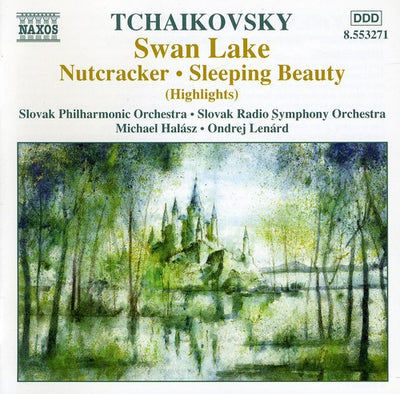
Tchaikovsky: Nutcracker, Swan Lake, Sleeping Beauty Excerpts
Naxos
CD · 1 disc
$9.99$19.99Save 50%Oct 24, 1995
1987 release with highlights from his famous ballets. Tchaikovsky (1840-1893) performed by the Slovak Philharmonic Orchestra recorded at Concert Hall of the Slovak Philahrmonic June 20-25, 1987 & Czecho-Slovak Radio Symphony Orchestra recorded at Concert Hall of the Czecho-Slovak Radio in Bratislava October 13-20, 1987 conducted by Michael Halasz & Ondrej Lenard. The music of Tchaikovsky, in spite of the reservations of contemporaries at home and abroad, must seem to US both essentially Russian and firmly in the West European tradition. In Vienna the critic Eduard Hanslick was able to complain of the "trivial Cossack cheer" of the finale of the Violin Concerto, but in Russia Tchaikovsky never went far enough to please the self-appointed leader of musical nationalists, Balakirev. While by no means a miniaturist, he nevertheless excelled in his mastery of the smaller forms necessary in ballet, writing music that displayed his remarkable gifts of melody and skill in orchestration.
Classic Library - Prokofiev: Romeo & Juliet / Tilson Thomas
Sony Masterworks
CD · 1 disc
$11.98Apr 20, 2004
Much heralded as the auspicious beginning of a new--and now defunct--recording contract with RCA, Michael Tilson Thomas and the San Francisco Symphony's Romeo & Juliet remains a stunningly good Prokofiev disc. This particular arrangement (compiled by the conductor) follows the sequence of the ballet, providing more narrative continuity than Prokofiev's three suites. Thomas' vibrant and insightful conducting, employing some highly effective and idiosyncratic rubato in many passages, powerfully enhances the drama's ebb and flow. The Balcony scene fairly flows with passion, while light and breezy pacing enlivens the Folk Dance and the Young Juliet. The intense drive of Romeo's Revenge (augmented by bass drum and tambourine at the climax) also rivets the attention.
Underlying all of this is the exceptionally high-caliber playing of the San Francisco Symphony, with its bracing energy, virtuosity, and rhythmic vitality. RCA's warmly spacious, wide-dynamic recording makes a powerful impression (even if it cannot match Telarc's recent SACD version for spatial realism). Considering that Thomas' arrangement contains virtually all the main thematic material from the ballet (minus Prokofiev's many repetitions), for many listeners this hugely enjoyable (and now mid-price) disc will be the one Romeo & Juliet to have and hold. [6/10/2004] --Victor Carr Jr, ClassicsToday.com
The Firebird is a ballet and orchestral concert work by the Russian composer Igor Stravinsky. It was written for the 1910 Paris season of Sergei Diaghilev's Ballets Russes company based on the Russian fairy tales of the Firebird and the blessing and curse it possesses for it's owner. The Firebird's mortal and supernatural elements are distinguished with a system of leitmotifs placed in the harmony dubbed "leit-harmony". Stravinsky intentionally used many specialist techniques in the orchestra, including ponticello, col legno, flautando, glissando, and flutter-tonguing. Set in the evil immortal Koschei's castle, the ballet follows Prince Ivan, who battles Koschei with the help of the magical Firebird. Recorded in 1961 by The Columbia Symphony Orchestra. This version in limited pressed on Solid Orange vinyl.
MTT - Michael Tilson Thomas - Prokofiev: Romeo & Juliet
RCA
CD · 1 disc
$17.99Dec 17, 2009
Much heralded as the auspicious beginning of a new--and now defunct--recording contract with RCA, Michael Tilson Thomas and the San Francisco Symphony's Romeo & Juliet remains a stunningly good Prokofiev disc. This particular arrangement (compiled by the conductor) follows the sequence of the ballet, providing more narrative continuity than Prokofiev's three suites. Thomas' vibrant and insightful conducting, employing some highly effective and idiosyncratic rubato in many passages, powerfully enhances the drama's ebb and flow. The Balcony scene fairly flows with passion, while light and breezy pacing enlivens the Folk Dance and the Young Juliet. The intense drive of Romeo's Revenge (augmented by bass drum and tambourine at the climax) also rivets the attention.
Underlying all of this is the exceptionally high-caliber playing of the San Francisco Symphony, with its bracing energy, virtuosity, and rhythmic vitality. RCA's warmly spacious, wide-dynamic recording makes a powerful impression (even if it cannot match Telarc's recent SACD version for spatial realism). Considering that Thomas' arrangement contains virtually all the main thematic material from the ballet (minus Prokofiev's many repetitions), for many listeners this hugely enjoyable disc will be the one Romeo & Juliet to have and hold. [6/10/2004]