Ruiz: Behold the Stars / Kerenza Peacock, Huw Watkins, Laura van der Heijden
Signum Classics
CD
$9.99$19.99Save 50%Mar 19, 2021
Signum’s first album with Mexican composer Rodrigo Ruiz combines the composer’s musical and literary passions in performances by world-class soloists Kerenza Peacock, Huw Watkins and Laura van der Heijden. Born in Tijuana, Mexico, Ruiz has attracted commissions from a number of artists, with both the opening Violin Sonata and ‘A riveder le stelle’ commissioned by Kerenza Peacock for this recording. The second work is a duo for violin and piano that is accompanied by poetic quotations from Canto XXXIV of Dante’s Inferno. The booklet notes include an interview with the composer by Jessica Duchen, who describes how the programme “clearly shows Rodrigo´s roots in the traditions of Beethoven and Brahms, but with individual twists that clearly indicate we are in fact on new territory”.
Epicycle II - Music for Cellist/Vocalist / Gyða Valtysdottir
Sono Luminus
CD
$9.49$18.99Save 50%Sep 11, 2020
Icelandic cellist, singer, and composer Gyða Valtysdóttir, a founder of the band múm and 2019 winner of the prestigious Nordic Council Music Prize, releases Epicycle II. Gyða Valtýsdóttir came to prominence with electronic experimentalists múm, the lauded Icelandic group leading the charge in the country’s fertile underground scene in the early 00s, rightfully gaining international recognition. She left the band to pursue her studies as a cellist; gaining a twofold Master’s degree from Musik Akademie, Basel, both as a classical player and a free-improvisational one. Since then she has journeyed with a colorful palette of collaborators, including The Kronos Quartet, Josephine Foster, Damien Rice, Colin Stetson, Jónsi (of Sigur Ros fame), Skúli Sverrisson, Ólöf Arnalds, Ben Frost, Aaron & Bryce Dessner (from The National) and visual-artist Ragnar Kjartansson. To name but a few.
REVIEWS:
Some of the musicians, like her fellow art-pop renegades Ólöf Arnalds and Jónsi, emphasize her crystalline, eldritch voice. Others, including Anna Thorvaldsdottir and Daníel Bjarnason, deploy her cello in yearning lines and voluptuous waves. Altogether, the album offers otherworldly transport.
-- The New Yorker
Epicycle II is a wonderful experience and a tantalizing look into the future of experimental music collaboration.
-- San Francisco Classical Voice
Epicycle II is her crowning achievement to date.
-- A Closer Listen
From atmospheric micro-polyphony to heart-rending moments of electronic intimacy, the music is interesting and powerfully drawn.
-- Music City Review
A deeply cinematic score at times, this album is often transporting with great lift, giving the listener long opportunities to soar, bird-like, over the Icelandic landscape and beyond, for the most part leaving us safely and gently deposited on the earthly shore.
A 2021 GRAMMY Nominee for Best Classical Vocal Solo Album!
Star mezzo-soprano Jamie Barton presents a recital of songs by American composer Jake Heggie, with the composer at the piano. UNEXPECTED SHADOWS is a celebration in words and music of powerful, exceptional women. The program contains four song cycles, a single song, and an opera aria. The Work at Hand, set to poetry of the late Laura Morefield, contemplates on the brave fight against cancer that she, and millions with her, went through. Matt Haimovitz’ cello playing adds an extra layer to this profoundly moving song cycle. Iconic Legacies, on texts by Gene Scheer, offers four portraits of remarkable First Ladies. Scheer also wrote texts for Statuesque, inspired by five iconic sculptures of women and the deeply human stories within them. Of Gods & Cats, based on poetry by Gavin Dillard, offers playful parodies on religious allegories. Music, on a text by Sister Helen Prejean, addresses the transformative, healing, and humanizing power of music, while the so-called Ice Cube Aria from Heggie’s opera If I Were You, on a libretto by Gene Scheer, shows the female demon Brittomara reflecting on the delicious predictability of human nature. Multi-award-winning mezzo-soprano Jamie Barton makes her PENTATONE debut. Jake Heggie has a vast discography with the label, including the opera It’s a Wonderful Life (2017) and song recital albums by Melody Moore, Lisa Delan and Joyce DiDonato. The same applies to Matt Haimovitz, who has released several albums on PENTATONE, from contemporary classical and jazz and rock covers to Bach’s complete cello suites.
-----
REVIEWS:
Everyone is in peak form on this recording. Barton purrs, croons, divas, and screams her way through four complete song collections along with the song “Music” from The Breaking Waves collection to texts by Sister Helen Prejean (Dead Man Walking), and the short “Ice Cube Aria” from Heggie and Gene Scheer’s recent opera, If I Were You. Her huge range and power allies with a larger-than-life personality. Heggie, who was clearly encouraging Barton to perform at her best, holds his own with stellar pianism whose ferocious vitality must have kept Skywalker Studio’s piano tuner very busy. Unexpected Shadows makes the best possible case for the necessity and relevance of modern American classical song.
– San Francisco Classical Voice (sfcv.org)
Barton’s solo album is devoted to Heggie’s art songs and it’s a tribute to his output that he sustains the interest for over an hour with a variety that stands comparison with, say, Poulenc in the 20th century, lavishing sumptuous tone on the cycle written for Barton, The Work at Hand.
One of the 20th century’s great conductors, Leopold Stokowski was also a prolific transcriber of music for the symphony orchestra, creating a unique repertoire by bringing masterpieces to the concert hall that were often unfamiliar to audiences of the time. José Serebrier was Stokowski’s associate conductor in New York, and drawing on memories of his special quality of orchestral sound has revived and revised the best of these sumptuous arrangements. These include a GRAMMY nominated Mussorgsky recording and Stokowski’s signature piece, Bach’s Toccata and Fugue in D Minor, immortalized as part of the soundtrack to Walt Disney’s film Fantasia.
-----
REVIEW:
Anyone who doubts the sustained power of Stokowski’s most famous transcription, Bach’s mighty Toccata and Fugue in D Minor, should experience Serebrier’s enthralling performance.
The Singing Guitar / Craig Hella Johnson, Conspirare
Delos
CD
$18.99Sep 18, 2020
A 2021 GRAMMY Nominee for Best Choral Performance!
The wonderful Conspirare chamber choir, known for its interpretive depth and other-worldly sonic lushness, offers another of its captivating programs — this time joined by three superb guitar quartets — in a program remarkably relevant for our time. The choir is joined by the Los Angeles Guitar Quartet, the Texas Guitar Quartet, the Austin Guitar Quartet, and cellist Douglas Harvey for this release featuring compositions by Reena Esmail, Craig Hella Johnson, Nico Muhly, and Kile Smith. Conspirare is a virtuoso choir. The Grammy-winning ensemble comprises distinctive solo artists who are also committed to the highest level of ensemble performance. These professional singers travel to Austin from around the country to perform together, providing their audiences with a rare level of choral music making.
REVIEW:
Conspirare’s new recording featuring the Austin-based choral group and three guitar quartets bookends impressive large-scale works by Nico Muhly and Kile Smith with small jewels by Reena Esmail and founding conductor Craig Hella Johnson.
Smith’s The Dawn’s Early Light features only one guitar quartet but the most beautiful texts, from Sarah Winnemucca Hopkins’s 1883 autobiography, one of the earliest books by a Native American woman.
The participation of three guitar quartets from LA and Texas adds texture and warmth to Muhly’s How Little You Are, a thoughtful 40-minute meditation on the words of American pioneer women in the 19th century, its lovely solos sung by Estelí Gomez.
Esmail’s When the Guitar—inspired by a 14th-century Persian lyric, ‘When the guitar can forgive the past, it starts singing’—uses the intriguing sounds of the Los Angeles Guitar Quartet as one of the layers of a fabulous wrap for the chorus. Johnson’s serene The Song That I Came to Sing, which sets a Rabindranath Tagore poem for cello and treble voices, was composed as a framing piece for the program ‘which would reflect aspects of unfulfilled purpose and a longing for intimacy with the Divine’.
-- Gramophone
The Conspirare chamber choir, known for its interpretive depth and otherworldly sonic lushness, offers another of its captivating programs—this time joined by three superb guitar quartets—in a program remarkably relevant for our time. Conspirare’s debut album on Delos, The Hope of Loving, was nominated for a Grammy Award for Best Choral Performance in 2020. Here, the combination of guitar quartet and chorus is so successful that one wonders why more composers have not written for it. The works on this album were written by four of America’s greatest living composers: Nico Muhly, Reena Esmail, Kile Smith, and Craig Hella Johnson.
Described as ‘one of the most innovative and influential among progressive figures of his time’, György Ligeti (1923 – 2006) was able to constantly reinvent himself. In his earliest works, written in Communist Hungary, the musical language is often an extension of that of Bartók’s and he kept his most daring compositions to himself. Escaping Hungary in 1956 he was able to revel in the freedom to experiment – with electronic techniques as well as elaborate serialism – but he was forever sceptical of schools and steered his own course throughout life. The 1960s and early 70s were a highly productive period, which saw works such as Lux Aeterna and Lontano, as well as three of the works on the present disc. In the Cello Concerto and the Chamber Concerto, Ligeti in different ways explores the idea of the concerto as something collective, rather than polarised between the one and the many. The Cello Concerto is striking, and even provocative, in that the soloist often seems to aspire to silence and even absence rather than virtuosic display. The Chamber Concerto, on the other hand, dazzles because here all 13 players are unmistakably present, all essential to the design and character of the whole. Like the Cello Concerto – and the Piano Concerto – Melodien can be performed by large orchestra, but also, as on the present recording, with a single string player per part, becoming a natural pendant to the Chamber Concerto. The disc closes with the Piano Concerto from 1988, which Ligeti had begun sketching eight years earlier but was only able to proceed with after having composed his first set of studies for piano solo. Ligeti himself described the five-movement work as a statement of his ‘aesthetic credo’. Performing these complex scores is the Norwegian specialist ensemble BIT 20 under the Swiss conductor Baldur Brönnimann, with soloists Christian Poltéra and Joonas Ahonen, making his first appearance on the BIS label.
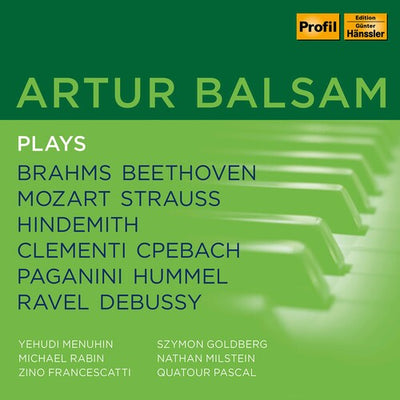
Artur Balsam plays Brahms, Beethoven, Mozart, Strauss, Hindemith, Clementi, CPe Bach, Paganini, Hummel, Ravel, Debussy
Profil
CD
$44.99Apr 02, 2021
Pianist and music teacher Artur Balsam was born in Warsaw on February 8, 1906. He attended the Helena Kijenska-Dobkiewiczowa Conservatory (now Academy) of Music established at the beginning of the 20th century in the Polish city of Lodz. After that he went to the Hochschule für Musik in Berlin, where he continued his studies with Artur Schnabel. A mere 12 years elapsed between his concert debut in 1918 and his success at the 1930 Berlin International Piano Competition; shortly after winning that competition, he was awarded the Mendelssohn Prize for chamber music in 1931 in Munich. Balsam matured into a sought-after partner at the piano: having won the Mendelssohn Prize together with the violinist Roman Totenberg, he toured the USA the following year with the brilliant young Yehudi Menuhin. After the rise to absolute power in Germany of Adolf Hitler at the head of his Nazi party, Balsam emigrated to the United States. He settled in New York in 1940, made a name for himself on the American chamber music scene and was the favorite accompanist of many famous soloists, especially in the years from 1940 to the early Seventies of the last century. He frequently partnered the great violinists Nathan Milstein and David Oistrakh, also playing for Joseph (violin) and Lillian (viola) Fuchs, Leonid Kogan (violin), Zino Francescatti (violin), Pierre Fournier (cello) and Mstislav Rostropovich (cello). Balsam was the pianist of the NBC Symphony Orchestra under Arturo Toscanini for five years. He was also a piano soloist for other leading orchestras.
Hélène Boschi’s repertoire was broad-based, ranging from the Baroque (François Couperin, Jean Philippe Rameau, Johann Sebastian Bach) to contemporary music. Her favorite composers of the Viennese Classical era were undoubtedly Joseph Haydn, Wolfgang Amadeus Mozart and Franz Schubert; strangely, it seems she left behind no Beethoven recordings. One notable fact about Boschi is that she was the first female pianist to record the works of Padre Antonio Soler (1729-1783), receiving the 1952 Grand Prix du Disque in honor of her achievement. As for the nineteenth century, her passionate readings of Schumann are of the utmost importance; but Carl Maria von Weber and Muzio Clementi also captured her attention, as did Frédéric Chopin and Emmanuel Chabrier and the Impressionists Claude Debussy and Maurice Ravel. Modern classics were also integral to her repertoire – as were the works of her immediate contemporaries. Luigi Dallapiccola dedicated his 1952 piano composition Quaderno di Annalibera to Hélène Boschi, Claude Ballif paid her that honor with his Fourth Sonata op. 31
Christopher Gunning returns with recordings of his Violin Concerto, Cello Concerto and Birdflight. Not composed until 2011, Gunning’s Violin Concerto was composed after inspiration whilst the composer was out hiking in Wales. The violin is supposed to represent ducking and weaving, rather like the insects and animals found in the Welsh hills and valleys. However, despite this positive venture for the composer, the emotions of sadness and melancholy are never far from this music – feelings which never seem far from Gunning’s music. The Cello Concerto is quite different. Although composed hard on the heels of the Violin Concerto, it is generally darker though equally expressive. The third piece, Birdflight, is for the orchestra alone; a kind of tone poem. At the opening and close there is some quiet night music with spacious strings. The birds take flight but encounter a problem; a hawk is on their tail. The birds manage to hide and there is a pause. Then, when danger has passed, they take off and once again enjoy the sheer pleasure of flying.
MYSTERY VARIATIONS ON GIUSEPPE COLOMBI’S CHIACONA • Anssi Karttunen (vc) • TOCCATA 0171 (79:57)
COLOMBI Chiacona. KAIPAINEN Anything Goes. MATALON Polvo. REYNOLDS Colombi Daydream. COHEN Chaconne. TIENSUU Bleuelein. STUCKY Partite Sopra un Basso. SALONEN Sarabande per un Coyote. CAMPION Something to Go On. WALLIN Ciacconetta. ORTIZ Paloma. HEININEN Triple Antienne. HILLBORG Still and Flow. LERDAHL There and Back Again. PUUMALA Se Sillan. DUSAPIN 50 Notes in 3 Variations. HAKOLA Colombi Variation. DUN Chiacona After Colombi. NEIKRUG Tiny Colombi. YUASA Locus on Colombi’s Chiacona. WIGGLESWORTH Arietta. MATTHEWS Drammatico. SAARIAHO Dreaming Chaconne. FEDELE Preludio and Ciaccona. GLOBOKAR Idée Fixe. DAZZI Variation Sombre et Libre d’après Chiacona. TUOMELA Idulla. JOLAS A Fancy for Anssi. SRNKA A Variation. FRANCESCONI Anssimetry. LINDBERG Duello
Mystery Variations contains 30 different short works based on Giuseppe Colombi’s Chiacona. Colombi who lived from 1635 to 1694 replaced Giovanni Bononcini as maestro di cappella of the Modena Cathedral in Italy in 1678. The Chiacona is only one of an enormous number of pieces he wrote for various instruments, chamber groups, and orchestras. It is, however, said to be the oldest piece written for the cello. The music is part of a collection from the court of Francesco II of Este at the Biblioteca Estense in Modena. The idea for the Mystery Variations came from composer Kaija Saariaho and Muriel von Braun, the wife of cellist Anssi Karttunen, as a means of celebrating the cellist’s 50th birthday. They asked each of 30 composers to write a variation on the Chiacona. None of the composers knew who else had been asked and Karttunen promised to premiere music that he had not yet heard. Most of the variations range from just under two to just over three minutes long, so all of them fit on one disc. Few of these variations are truly melodic, most depend on texture, drama, percussion, and tonal color to excite the senses of the listener. Only one of the composers, Colin Matthews, uses electronics. Mark Neikrug and Magnus Lindberg use the letters of the cellist’s name as part of their variations. Some composers, such as Tan Dun, who was born in China and Pablo Ortiz from Argentina, make use of their native cultures while others, like Argentinian Martin Matalon and Texan Edmund Campion turn elsewhere. Matalon creates novel textures and far off sounds with a mute while Campion includes some aspects of Happy Birthday in his variation. Roger Reynolds’s Colombi Daydream, evokes an element of foreboding, while Jukka Tiensuu’s Bleuelein and Paavo Heininen’s Triple Antienne have plaintive, pleading qualities.
Composers like Steven Stucky, Kimmo Hakola, Joji Yuasa, Ivan Fedele, and Magnus Lindberg are fully aware of Karttunen’s virtuosity and have written works that show off some of his skills. Esa-Pekka Salonen’s Sarabande for a Coyote starts with the cello sounding a bit like a harp, before introducing some charming harmonies that expand the usual cello range. Rolf Wallin’s Ciacconetta has sliding arpeggios that resolve into an impressive dance. Lerdahl’s There and Back Again uses the dance to guide us from Colombi’s time forward to our own and back again. Anders Hillborg’s Still and Flow treats us to his seriously studied version of Bach. The in-your-face style of Veli-Mali Puumala’s…Se Sillan…is rather unique and it added a bit of spice to the mixture on this disc. Kartunnen follows it with Dusapin’s 50 Notes in 3 Variations, an inventive and intuitive work that resolves into a tone color-filled meditation. Also in the meditative mood, Ryan Wigglesworth’s Arietta offers more respite from the dramatic. Kaija Saariaho’s Dreaming Chaconne portrays a pastoral scene with her full-blooded sound vocabulary. In Idée Fixe, Vinko Globokar asks the cellist to sing and I found it a distraction. Gualtiero Dazzi’s Variation Sombre et Libre d’après Chiacona brings us a sweet and smooth melody played in the cello’s lowest notes. Idulla means germinating and Tapio Tuomela brings us a fantasy that includes tonal color and percussion. Betsy Jolas’s A Fancy for Anssi creates rivers of sound that broaden out to reflect fragments of Colombi’s theme. Miroslav Srnka, on the other hand, uses slides and double-stops to make us hunt for the theme while Luca Francesconi makes use of it openly but varies it in unexpected ways. The finale is Magnus Lindberg’s Duello, a dialogue between the Chiacona and music based on the cellist’s full name. It ends with a pleasing melody that leaves the listener feeling that the music was worthwhile hearing. The sound on this disc is excellent and I think many of our readers will find it interesting.
Grammy Award-nominated cellist Antonio Meneses’ dazzling virtuosity in on display in the Suite for Solo Cello by Gaspar Cassadó, and two works by Zoltán Kodály - the Duo for Violin and Cello with violinist Claudio Cruz, and the Sonata for Solo Cello that was written in 1915. It is released in celebration of the 100th anniversary of the work.
Following the success of Capriccioso, a solo spectacular of works written by cellists for cellists, Antonio Meneses' brilliance is demonstrated again, with the rarely recorded Suite for Solo Cello by the Spanish cellist-composer Gaspar Cassadó. Alongside two early works by his Hungarian contemporary Zoltán Kodály - the Duo for Violin and Cello, with violinist Claudio Cruz, who was the conductor on Antonio's Grammy-nominated recording of the Concertos by Elgar and Gál; and the Sonata for Solo Cello, which was written in 1915 and is released in celebration of the 100th anniversary of the work.
----- REVIEWS:
In Cassado's dark, sensuous Suite, inspired by Kodaly but infused with Spanish undertones, he exudes a mesmerising, Zen-like calm: tenderly shaped curlicues, ornate arabesques, and complex harmonic accompanying figurations never disturb his long, arching lines or the sense of easy, improvisational charm. You can almost forget you're listening to a virtuoso display; in his refreshingly self-effacing, idiomatic approach musical substance is always to the fore.
– BBC Music Magazine
Meneses gives a performance that has been crafted down to the tiniest detail, the swirling finale in particular confident and polished, with every technical trick in the cellist's book pulled off with panache.
Born July 10, 1923, in Tiflis (later named Tbilisi), Georgia, Rudolf Kerer (also spelled Kehrer) was descended from Swabian immigrants and grew up within the Pietist community in Georgia. He began piano studies at six, and by twelve qualified for the gifted class at the Tbilisi Conservatory. In 1938, he performed in public Tchaikovsky's first Piano Concerto. In October 1941, Kerer and his surviving family were deported as enemy aliens to Kazakhstan. Without a piano, he devised a “table piano,” a table on which he painted a keyboard, so he could “practice.” By 1949-at 26-he had given up his dream of a musical career but in 1954, in Uzbekistan, he was accepted at the state conservatory as a student in the class of Zelma Slonim-Tamarkina. Three years later, Kerer graduated, and began teaching piano in Tashkent. Four years later, in 1961, he competed in the second All-Union Competition in Moscow and won the first prize. Following this winning, Kerer became a professor at the Moscow Tchaikovsky Conservatory. He performed throughout the Soviet Union but was not allowed to concertize abroad. In 1988, at 65, he was allowed to serve on the jury of the Beethoven competition in Vienna. He remained there to teach at the Musikhochschule for eight years. Later, he moved to live in Zurich, where he died on October 29, 2013. This release hears him performing some of music’s most beautiful piano concertos and sonatas.
Sveinsson: Der Klang der Offenbarung des Gottlichen
Sono Luminus
CD
$19.99Oct 09, 2020
Sono Luminus presents Der Klang der Offenbarung des Gottlichen, an opera in four acts by Kjartan Sveinsson. This marks the first collaboration between Sono Luminus and Kjartan, who is a founding member of the legendary band Sigur Ros. An opera of severe and supreme beauty, critics have raved about the work. “Der Klang boasts all the qualities we tend to associate with sweeping modern neo-classical—it's beautiful, reflective, sad...Sveinsson has a light touch, but his work hits a deeper and more visceral level, permeating and lingering long after it’s subsided...Whatever he does, he has already quietly announced himself as a major talent.” (Pitchfork) “Sveinsson, in conjunction with co-author Ragnar Kjartansson, has created an opera for the ages...it finds grace in unexpected places, arriving far after the prayers have ended.” (acloserlisten.com) "There is such a longing [for beauty] indeed in Sveinsson’s searching score, a meditative sonic canvas for Kjartansson’s exquisite images. Even absent the visual component, Sveinsson’s music summons a hushed awe that makes for a mesmerizing listen on its own.” (WQXR)
American Classics - MacDowell: Piano Concertos / Prutsman
Naxos
CD
$19.99Jan 01, 2001
Edward MacDowell (1860-1908), an exact contemporary of Gustav Mahler, was widely considered the most important American composer of his day-a time when American music was based primarily on European models. Antonin Dvorák called on American composers to turn to indigenous sources, such as Negro spirituals and Indian tribal music, for inspiration. MacDowell flatly rejected this, commenting, What Negro melodies have to do with Americanism remains a mystery to me." Thus, in the Piano Concerto No. 1 we hear the comfortable old echoes of the Grieg A minor and, in the finale, Dvorák's own concerto. MacDowell's second concerto displays a noticeably higher degree of originality, though here too the European influence is clear, in this case Saint-Saëns. The dark and portentous opening creates a mood of anticipation before the piano enters to launch the drama of the first movement. The finale is brisk and exciting, with some wonderfully bravura piano writing, with which soloist Stephen Prutsman unreservedly flaunts his brilliant technique. He's just as fine in the brief Witches' Dance, which is rather tame and far less spooky than we have come to expect after the likes of Berlioz. The soothing sounds of MacDowell's gentle Romance for Cello and Orchestra close this interesting program. As on many other Naxos recordings, the National Symphony Orchestra of Ireland (led here by Arthur Fagen) delivers performances of international caliber. Fine sound, too." - ClassicsToday.com (Victor Carr, Jr.), January 15, 2001
Although not blessed with a wide literature, numerous composers have written duets for violin and violoncello. The present collection of works by Hungarian composers not only provides both a wide overview, but above all else, many musical pleasures! Here two full blood-musicians Friedemann Eichhorn and Alexander Hulshoff have a knack for these musical partnerships.
Britten, Prokofiev & Shostakovich: The Cello Sonatas
Orfeo
CD
$20.99Apr 14, 2015
This new CD by Daniel Müller-Schott and Francesco Piemontesi offers three sonatas for cello and piano, works that sum up several chapters of 20th c. history that go far beyond the merely musical. Sergei Prokofiev displays a masterly serenity in his songlike Sonata in C, op. 119, composed in 1949. It makes evident his adjustment to the cultural politics of the Soviet Union – to which this world-famous composer had returned just twelve years before – but is also tailor-made for an exceptional cello-piano duo. Dmitri Shostakovich’s Sonata in d minor, op. 40 is no less marked by fate. It was on the program of a concert tour given by the composer and his cello partner Viktor Kubatsky in 1936 when Shostakovich was put on the Stalinist index of undesirables, on orders from the very top. Finally, Benjamin Britten’s Sonata in C, op. 65 marked the beginning of a productive, creative friendship with Rostropovich that was established, despite many a problem posed by the Cold War, in Aldeburgh in 1961 when performed by the composer and Rostropovich.
Messiaen: Quatuor Pour La Fin Du Temps / Widmann, Altstaedt, Lonquich
Orfeo
CD
$16.99Jan 29, 2013
In 2008, Carolin Widmann, Jörg Widmann, Nicolas Altstaedt and Alexander Lonquich performed Olivier Messiaen's Quartet for the end of time for violin, clarinet, cello and piano with the seriousness of spirit and subtle understatement that the work requires. Composed in 1940 in a German prisoner-of-war camp, Messiaen here reached a pinnacle of his composing career at the age of just 31. In this work he conveys to his listeners his spiritual interpretation of (musical) time and plays of colour. With these four exceptional chamber musicians, all masters of their art, the Salzburg Festival was treated to an exemplary performance of this work.
Made between December 1948 and June 1950, these recordings enjoy an unusual history which is bound up with the burgeoning industry of classical music retail in the postwar era. Among the best stocked record stores in New York at that time was The Gramophone Shop on 42nd East Street, co-owned by William H. (Bill) Tyler and Joseph F. (Joe) Brogan, an Irish-American collector and dealer. Trying to rival or surpass the mail-order business of H. Royer Smith in Philadelphia, the shop issued (in 1929 and 1931) two fat paperback catalogues, The Gramophone Shop Encyclopedia of Recorded Music. Three further editions, from 1936, 1942, and 1948, remain standard reference works. The store also ran it's own mail-order business with the reputation as a specialist in rare and high-quality recordings from Europe. From that arm of the business naturally developed the store's own label, marketed as the Gramophone Shop Celebrities (GSC) series. This is the first time these recordings have been available on modern media.
The music of William Wordsworth (1908–88) – a great-great-grandson of the poet’s brother Christopher – lies downstream from that of Vaughan Williams and Sibelius; like that of his contemporary Edmund Rubbra, Wordsworth’s music unfolds spontaneously, as a natural process. This third volume of his orchestral works brings two major scores in their first studio recordings. Wordsworth’s Cello Concerto is a work of symphonic proportions, blending angular rough-and-tumble with a sober lyricism in a style that sits somewhere between Shostakovich and Bloch. The Fifth Symphony has an even grander sense of scale, its radiant first movement and the introduction to the confident finale unfolding as calmly and unhurriedly as a change of season; the martial tone of the gruff scherzo, by contrast, is laced through by an impish sense of humour. John Gibbons has conducted most of the major British orchestras. He has been Principal Conductor of Worthing Symphony Orchestra – the professional orchestra of West Sussex – with which he has given many world premieres of neglected works. He studied music at Queens’ College, Cambridge, the Royal Academy of Music and the Royal College of Music, winning numerous awards as conductor, pianist and accompanist. He is also a Fellow of the Royal Society of Arts, vice chairman of the British Music Society, and choral director at Clifton Cathedral. His own music has been performed in various abbeys and cathedrals as well as on the South Bank, London.
Timelapse creates a space where sounds of the past and present collide to form a unique musical landscape. Although the pieces were written, in some cases, centuries apart and in culturally disparate eras, it is striking how much these contrasting works inhabit such similar emotional territory. Intriguing pairings of works by Rameau and Radiohead, Schubert and The Smiths, Adés and Grieg, Satie and Reich, compliment each other beautifully in the context of Timelapse. This recording by Orchestra of the Swan provides a place where notions of time and style have become irrelevant.