Italian guitarist Francesco Molmenti plays the historic Antonio de Torres 1884 guitar from the 'Carlo Carutti Collection, ' located at the Ala Ponzone Civic Museum in Cremona. Antonio de Torres Jurado (Almeria, 13 giugno 1817 - 19 novembre 1892) stands as a central figure in the history of guitar making. His contribution was crucial in defining the dimensions, shape, design, and construction technique of the modern classical guitar. Thanks to his work, the instrument acquired the features that still distinguish it today. Torres' training most likely took place in Granada. This formative period coincided with what is known as the first era of his activity, which ended in 1869. During these years, the technical and artistic level achieved by the Spanish luthier was particularly high, confirming him as one of the greatest makers of his time. After a break of several years, Torres began in 1875 what is defined as the second era of his production. This phase, which continued until his death in 1892, was characterised by a perfect balance between shape, proportions, weight, and dimensions, elements that made his guitars models of reference for generations of luthiers. The more than one hundred known guitars built by Torres were admired and often imitated: over the years, many instruments were attributed to him, even if they were fakes, sometimes made by renowned and skilled luthiers. A representative example of Torres' work is the guitar preserved in the Carlo Alberto Carutti collection. Built in Almeria, the instrument features a label with the date 1884 and progressive number 59, placing it in the 'second period' of the luthier's creative activity. This era was characterised by the use of more economical woods such as cypress and mahogany, which Torres alternated with finer materials such as maple and Brazilian rosewood intended for top-end instruments. Different options that did not affect the sound quality of the guitars made by the Almeria luthier. Two elements give coherence and unity to the programme of this recording. First, all the selected pieces share the presence of a female name in their title; moreover, almost all the composers are of Spanish origin (with the exception of Claude Debussy) and lived during the period in which Antonio de Torres (Almeria, 1817-1892) built his guitars. It is known that Julian Arcas, Francisco Tarrega, Miguel Llobet, and Antonio Jimenez Manjon played instruments crafted by Torres. Of the other composers, fewer biographical details are known, but the aesthetics of their works perfectly match the timbre and sensitivity of the nineteenth-century guitar. The programme also includes two compositions by non-guitarist composers: La maja de Goya by Enrique Granados and La fille aux cheveux de lin by Claude Debussy. The former, in Miguel Llobet's transcription, is ideally connected to the selection of Catalan songs; the latter, conceived as a 'bonus track, ' is a poetic homage to the French composer and to his ideal dialogue with Spain - a country he never visited, yet deeply evoked, as in La soiree dans Grenade.
The Voice of Stradivari - Giovanni Gnocchi (cello), Alessand
MV Cremona
CD
$24.99Aug 07, 2026
Antonio Stradivari's 1700 'ex Cristiani-Stauffer' cello, considered to be one of the master's finest works, was purchased by the Walter Stauffer Musicology Center in Cremona. It is now on display at the Violin Museum in Cremona. The history of this cello, though at times uncertain, suddenly becomes clear when it comes to Lisa Cristiani, a Parisian cellist who acquired the instrument, definitively linking her name to Stradivari and the cello. Lisa died very young in 1853 at just 26 years old, a fleeting star on the musical scene of her time: in just a few years, she enchanted audiences with her extraordinary cello. Felix Mendelssohn Bartholdy dedicated his Song Without Words, Op. 109, to her. But today, you can hear 'The Voice of Stradivari,' the voice of this precious cello, on this CD released by the Italian label MVcremona. The excellent performers are the cellist Giovanni Gnocchi, born in Cremona like Stradivari's cello, and the pianist Alessandro Stella. According to the renowned Italian critic Angelo Foletto, on this CD, 'Gnocchi exploits with loving interpretative skill and virtuosic ease every quality of the 18th-century 'Stauffer ex Cristiani' Stradivari cello, constructing a listening adventure of intriguing poetic subtlety and an intelligent assortment of accents.' SUONARE news, dicembre 2025 This cd includes some pieces written by cellist-composers themselves (Popper and Klengel). Other pieces were transcribed by famous concert performers and cello virtuosos of modern and contemporary times (Piatigorsky, Schiff, Isserlis). Others were dedicated by composers to their cellist friends, as in the case of Dvorak and Hanus Wihan, Liszt and Bernhard Cossmann, the living composer Ducros and Jerome Pernoo and Mendelssohn, who dedicated his Romances sans paroles op. 109 to Lisa Cristiani, then owner of this beautiful Stradivari. The final piece is an Italian masterpiece composed by Gioacchino Rossini: 'Une larme, theme et variations'. The combination of elegiac cantabile and explosive virtuosity encapsulates the characteristics that have inspired the musical choices in this CD. Rediscovered only in recent decades, it belongs to the Peches de vieillesse, the 'sins of old age' as Rossini called the many compositions he wrote in his later years and never published because, as he said, 'I do not publish anything; I only write because I cannot do anything else'. Composed in 1858, it offers the musician all the most typical elements of Rossini's genial style.
The musical 1600's represent a period of particular ferment: the birth of opera in music, the practice of continuo playing, solo singing with instrumental accompaniment. Musical settings change as well, they are no longer small chambers for ''musica reservata'' but great rooms and theaters calling for powerful voices capable of filling them. The harp and the chitarrone are two striking examples of how ancient instruments, still nearly renaissance models, become modernized if not designed ex novo to adapt the power of their sound to these large speces.
Merula: Canzoni overo sonate concertate per chiesa e camera, libro terzo / Ensemble L'Aura Soave
MV Cremona
CD
$19.99Oct 06, 2017
Tarquinio Merula, born in 1595, moved to Cremona at a very early age where he spent the better part of his life. His fame as organist and composer brought him to work in other important Italian cities (he was organist in Bergamo and Lodi and active in Venice and Warsaw), but always with appointments lasting only a few years: evidently the musical climate in Cremona had nothing to envy far more important cultural centers. A highly respected musician, he was a prolific writer of collections of madrigals, organ pieces and instrumental music. The wonderful sonatas of op. XII, some recorded for the first time on this release, are played by Ensemble L’Aura Soave on original instruments.
Cervetto: 6 Sonatas for 3 Violoncellos / Zeller, Frezzato
MV Cremona
CD
$19.99Jun 02, 2017
Six Sonatas or Trios for three Violoncellos or two Violins and a Bass, is the title of op. 1, published in London by Giacobo Basevi Cervetto between 1741 and 1745 circa. To the modern ear, it is curious to hear the terms sonata and trio referred to as synonyms: in fact, the genre – which in effect did experience a certain confusion regarding the terminology – is known today as the sonata a tre. As Cervetto was a cello concert musician, it is not surprising that his sonatas were composed for three violoncellos (two cellos and bass); the alternative of playing them with two violins was probably dictated by commercial reasons in order to interest a vaster public. We maintain that it is important to rediscover these sonatas who are little known to the public of today. These wonderful and unusual Sonatas are played on original instruments by Martin Zeller & Marco Frezzato.
Zani: Sonate a Violino e Basso / Rognoni, Ensemble L'Aura Soave
MV Cremona
CD
$19.99Oct 06, 2017
The ‘Sonate 12 a Violino e Basso intitolate "Pensieri armonici" Opus. 5’ clearly belongs to Andrea Zani's second post-Vivaldian style. Without a dedication, these sonatas are still stylistically tied to the baroque style, but there are hints of the gallant style in them, above all because of the frequent use of appoggiaturas and in the cantabile themes and their development. Each of them having three movements, in the initial and final Allegros the violin, the indisputable protagonist, giving vent, shows off with captivating virtuosity, supported by a precise and well constructed bass. The Adagios are superb, placed as a contrast between the two extreme quick movements where the cantabile nature of the writing for the violin is full of "melos" making these pages quite enjoyable. The quality of the composition of these sonatas makes one consider the unjust oblivion into which the musical work of Zani has fallen. It was previously so respected and is now practically unknown. Violinist Andrea Rognoni and the ensemble L’Aura Soave breathe new life into this forgotten work.
Johann Sebastian Bach was known by the contemporaries as a great expert in the art of organ building, and above all, as an incomparable virtuoso to the instrument. There are testimonies of his mastery and precision, his improvisational capacity, and there are also some acts of tests he performed. His concerts alternated various types of compositions and, knowing the vastness of musical culture of the Supreme Master, it is easy to imagine how he could use it to improvise in all styles of the time. Having at our disposal for this release an organ the embraces a geographical tradition-in particular those Italian and German-organist Davide Pozzi wanted to recreate a hypothetical concert performed by Bach in the Italian style. The Italian harpsichordist, fortepianist, organist and conductor, Davide Pozzi, got the diploma with full marks of harpsichord, fortepiano and clavichord, and organ and organ composition at the Conservatorio G. Verdi in Milan. At the same conservatoire he got a first-class degree in organ. Davide Pozzi held the organ post at the ancient Basilica di S. Vittore al Corpo in Milan for 13 years. Already a harpsichord teacher at the Cesena Conservatory, he is currently Professor of Theory, Rhythmic and musical perception, Basso continuo and harpsichord practice at the Conservatorio G. Verdi di Como.
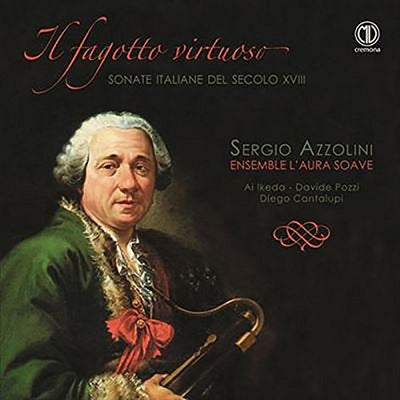
This release of soloistic sonatas for bassoon represents only a small part of the Italian pre-Classical repertoire. It is music that many performers today are still quite unfamiliar with and much has yet to be discovered from both a musicological as well as performing standpoint. With this collection, MVC hopes to have contributeed to bringing to light a production that is by no means secondary from a qualitative point of view and which is of fundamental importance for it's role in connecting to the late Baroque with the mature Classical style.
The Amatis were Cremonese violin makers universally recognized as those who perfected the morphology of the violin by defining the form considered “classic” today. They worked in Cremona for 300 years from the first half of the 16th Century until the end of the 17th Century. In particular the head of the family, Andrea Amati, and his sons Antonio and Girolamo, brought about an actual revolution in construction and form that contributed in a predominant way to attributing the violin a real soloistic role. But what music were these instruments built for? Which composers? What use of violins considering that the orchestra as we know it today was a long time in coming? With this release, the ensemble hope to contribute to bringing to light many still obscure aspects tied to violin repertory of Lombardy during the 1500’s and 1600’s. They believe that only through meticulous research of the repertory and its execution with historically informed performance practice will it be possible to correctly frame Andrea Amati and his sons, rediscovering, in addition to their renowned exceptional qualities as craftsmen, their influence and their innovative contribution to music history and to the emancipation of the soloistic instrument.
Musica strumentale a Cremona al tempo di Stradivari / Rognoni, Elsemble L'Aura Soave
MV Cremona
CD
$19.99Nov 18, 2016
Antonio Stradivarius is universally acknowledged as being the greatest violin maker of all time. About 600 of his instruments have survived until the present day, among them violins, violas, and cellos, most of which are still played, studied, and regarded by the most famous and renowned soloists, collectors, art galleries, and museums as the “non plus ultra.” The long life of Stradivarius covers a truly crucial period in the history of music: it stretches from the second half of the seventeenth century, a moment of the definitive triumph of the violin as principal instrument of Baroque instrumental music, to the first part of the eighteenth century, a period of transition toward musical classicism. We maintain that it is important, therefore, to rediscover these musicians who are little known to the public of today, but who were quite well known and respected in the Cremona of their day. They were perhaps great exchangers of concrete ideas and advice with the great violin makers of the time. As it happens today in modern violin making workshops, the exchange of ideas and advice between musicians and instrument makers is the basis for the professional growth of both.
Rameau, Mozart & Bach: Agli organi di Giuseppe Serassi
MV Cremona
CD
$32.99May 04, 2018
There would be much to say on the importance and reasons of the practice of tablature transposition and transcription in the evolution of music for keyboard instruments. What we can point out, however, is that, in the case of some great composer who did not leave an original repertoire, there is an increasing tendency to adapt pieces that had a different destination for the organ. So it is customary to hear, played on the organ, the pieces Schumann composed for pedal piano or the music for mechanical clocks composed, among others, by Händel, Haydn, Beethoven and Mozart. That is the intention of this album by Stefano Innocenti- he performs works by Bach, Mozart, and Rameau which weren't originally intended for his instrument on his instrument- the organ. This album recorded by Stefano Innocenti on the eighteenth-century organs of the Ducal Chapel of San Liborio at Colomo and the Duomo of Guastalla is part of the cultural activities promoted by the Associazione culturale "Giuseppe Serassi."
This outstanding album of Italian Renaissance songs is beautifully performed with expert performance practice by soprano Jessica Gould and lute and chitarrone player Diego Cantalupi. Works by Benedetto Ferrari, Tanquinio Merula, Giovanni Felice Sances, and others are featured. Jessica Gould has wowed audiences and critics across the globe with her impressive interpretations of early music. “A dramatic intensity that honored the texts.” (The New York Times) “Dazzling… expansive range, coloratura facility, and multi-hued, powerful sound” (Seen and Heard International) “Astonishing passage and ornaments, executed to perfection” (Lute News, UK) Diego Cantalupi was born in Milano and studied at the Civica Scuola di Musica di Milano, and the Conservatorio di Parma. He holds a degree in lute performance.
Giovanni Battista Serini is a composer all but forgotten today, known exclusively by harpsichordists and pianists thanks only to the three sonatas presented in this recording. In actuality, these works already enjoyed considerable renown at the time of their first publication and were then revised and adapted for the piano and, successively, various new modern editions. Nevertheless, the thorough study of Serini in recent years has revealed him to be quite a unique musical figure of remarkable grandeur. His biography still contains many unknown aspects but thanks to recent discoveries it is being enriched with new elements little by little. These three sonatas were composed by Serini during his Bückeburg period and, like all of his musical output, are in the galant style. They are three authentic masterworks that in some way give us the scope of his compositional talent with the elegance of their writing and the remarkable originality of the themes and their relative development, with solutions, often ingenious and not to be taken for granted.
The organ and other keyboard instruments were always considered harmonic support in the Baroque period. They constituted a constant presence in the accompaniment of the voice or other soloistic instruments and a fundamental part of larger groups as well. Nevertheless, the keyboard instrument was able to raise itself to a soloistic role thanks to the practice of transcription and, in certain cases, take over all of the orchestral parts. There were numerous keyboardists who transcribed orchestral music with great ability, sometimes creating real masterpieces for their instrument. This permitted them to perform well-known pieces without having to turn to other instrumentalists. Bach, for example, transcribed numerous concertos using, naturally, a large instrument equipped with pedal keyboard.+ The examples on this release are no less brilliant, though they don’t call for a pedal part. This characteristic makes them suitable for harpsichord performance, which is analogously what happens with concertos transcribed by the Englishwoman Anne Dawson. Of strong musicological interest on this release is the juxtaposition of two transcriptions of the same piece, thus allowing for a full appreciation of notable stylistic differences.
Italian organist and composer Marco Enrico Bossi (1861-1925) was born into a family of musicians. His father was organist at Salo Cathedral. He studied at the Liceo Musicale in Bologna and the Milan Conservatory before becoming director of music and organist at Como Cathedral. Later, he became the professor of organ and harmony at Naples Conservatory. He wrote more than 150 works for various genres, most of which remain largely unknown, except for his organ works. Organist Marco Ruggeri performs the works on the present release on an illustrious Lingiardi organ which resides in the Reggio Emilia province.
The MVcremona label, which has always been committed to enhancing the musical heritage of the city of Cremona, presents this CD dedicated to the precious Maineri-Acerbi organ of the church of San Sigismondo, a wonderful church located just outside the city. The first documented news of the construction of this monumental organ dates back to 1567 but the organ only began service in 1572. After an eighteenth-century intervention which partially modified it's phonic structure, a restoration which took place in 1860 by the organ builder Luigi Vincenzo Acerbis, he configured the current phonic structure, where all the original sixteenth-century pipes both in metal and wood are still present. This makes the instrument very versatile and suitable for performing a wide musical repertoire. The Cremonese organist Paolo Bottini, already a protagonist in the valorization of other historical organs of Cremona through numerous recordings for various record labels, presents in this CD a series of pieces by composers who worked in the Cremona area, starting from himself and going to back in time to Claudio Monteverdi, born in Cremona in 1567, the year in which construction of the organ began. The church and monastery of San Sigismondo in Cremona are governed by an order of cloistered nuns and therefore the Maineri-Acerbi organ is used only for liturgical purposes: this makes this CD even more precious because it allows you to listen to the voice of this historic organ in a repertoire of exceptional stylistic variety.
Bei Bach zu Hause - Sylvius Leopold Weiss in Leipzig / Cantalupi, Pozzi
MV Cremona
CD
$19.99Feb 09, 2024
Born in Grottkau, a town close to Wroclaw in Lower Silesia (modern day Poland), Sylvius Leopold Weiss (1687-1750) is for the lute what Johann Sebastian Bach represents for harpsichord and organ. Since 1706, in his hometown, he served Count of Palatinate Charles Philippe, brother of Prince Johann Wilhelm, Elector Palatine, patron of the arts and dedicatee of Arcangelo Corelli’s Concerti Grossi, Op VI.
Starting in 1718, he settled permanently in Dresden, refusing the salary offered by the Viennese Court –which was almost twice as much as he was earning in Dresden – and dedicated his efforts to composing more than 600 lute pieces, either solo or with other instruments. In Dresden, he took part in the musical life in court and met numerous musicians; he was particularly friendly with Wilhelm Friedemann Bach, Johann Sebastian’s son and organist at Saint Sophia’s Church. In 1739, the two friends travelled to Leipzig where they were hosted by Johann Sebastian for four weeks. We don’t know for sure for the music played by Bach and Weiss during their meeting, but it seems legitimate to think that they played their music on their instruments composing, arringing or improvising together. This programme is meant to witness this precise type of practise, and in some manner aims at recreating the musical atmosphere of these two musicians’ meeting, during which, as reported by Johann Friedrich Reichardt in the Berlinische Musikalische Zeitung,"being aware of the difficulty in performing controlled and elegant phrases on the lute, eyewitnesses ensure that the great lutenist from Dresden, together with the great organist and harpsichordist Bach improvised many fugues and fantasies together".
Mendelssohn: Concerto per violino e orchestra in mi minore,
MV Cremona
CD
$17.99Aug 16, 2024
This CD offers a beautiful live performance of the Concerto for violin and orchestra op. 64 from Felix Mendelssohn Bartholdy with the Italian violinist Christian Joseph Saccon and the prestigious Orchestra of Padua and Veneto conducted by Maffeo Scarpis. Saccon trained at the great Venetian school of Luigi Ferro, then continued his studies by attending masterclasses with the most important European masters: Tibor Varga, Corrado Romano, Franco Gulli, Uto Ughi and Giuliano Carmignola. He plays a Marino Capicchioni violin from 1942 that belonged to Maestro Salvatore Accardo. It was the famous violinist Ferdinand David who commissioned the Concerto for violin and orchestra op. 64 from Felix Mendelssohn Bartholdy. The first performance took place at the Gewandhaus in Leipzig on 13 March 1845 with David as soloist. The performance was conducted by the Danish composer Niels Gade as Mendelssohn was in poor health at the time. The concerto, performed again in October of that year, with David as soloist under the baton of Mendelssohn himself, was a resounding success. Since then, the concerto has become a staple in concert programmes. In June 1846, the concerto was performed at the Philharmonic Society in London. Mendelssohn personally selected the Genoese violinist Camillo Sivori, a pupil of Paganini, as soloist. On 3 October 1847, it was performed by a young protege of Mendelssohn, the young Hungarian violinist Joseph Joachim, who would go on to become a favourite collaborator of Brahms. The concerto is an elegant and skilfully crafted composition, where brilliance and buoyancy conceal the work's constructive genius. The Orchestra of Padua and Veneto conducted by Maffeo Scarpis interprets also the Symphony n.4 "Italiana" op.90 by Mendelssohn with fresh vigor in a brilliant live performance. It is surely one of the most celebrated compositions by Mendelssohn. The CD is completed by a precious bonus track with the pieces played by Saccon as an encore of the live concert: Capricci n.11 and n.24 by Niccolo Paganini, in which Saccon show all his virtuoso skills.
The Italian organist Marco Ruggeri offers in this CD a compilation of pieces by various author, chosen to enhance the acoustic qualities of the wonderful historical organ of the church of SS. Faustino and Giovita in Bienno. It dates back to around 1630. At that period Graziadio IV Antegnati (1608-1657) creates a 16-foot organ with an enharmonic keyboard with certainly 4 and possibly 5 broken keys for the Benedictine monks running the parish. In 1750 the instrument is restored, moreover, the organ choirs are replaced with others of a typically Baroque style while the organ case is preserved. Antegnati's organ still exists in 1822 when the scholarly Giacomo Simoni sends one of the Serassi brothers to Bienno recommending that all recoverable Antegnati material must be preserved, yet no agreement is reached. A few years later, an unknown organ builder adds typically 19th-century stops. Finally in 1891, according to the 1881 project, the organ builder Giovanni Manzoni of Bergamo, who had previously worked with Bossi and for a short time with Perolini brothers, restores and expands the organ. He initially works out a two-manual project, later he reduces the instrument to a single keyboard with 47 stops and 1823 pipes. The new structure includes also the 155 Antegnati pipes scattered in different stops, as well as 18 Principale pipes in an almost perfect succession and they confirm the original division. The latter group is moved to the 'organetti morti' (pipes placed in the upper part of the facade). The seventeenth-century case is totally preserved. In 1943 Armando Maccarinelli from Brescia carries out an extraordinary maintenance and remixes some stops. In 1961 Emilio Piccinelli of Ponteranica - without knowing Manzoni's project, found in the parish archive only years later - makes a radical restoration yet very respectful of the 1891 physiognomy. In 2017/2018 the Piccinelli family carries out a philological restoration bringing back the instrument to the exact conditions of 1891, on the precise indications from the Milan 'Servizio Tutela Organi'. The intervention is completed for the larger part by rearranging the pipes, recovering the material set aside and only with the reconstruction of 12 pipes of Cello.
Nicolò Paganini (Genoa, 1782 - Nice, 1840) is universally renowned as the greatest violin virtuoso of all times and as a huge innovator of violin technique. But the sources reveal that Paganini, besides being an extraordinary and eccentric virtuoso violinist, able to thrill the first half of the 19th century public in Italy and in the rest of Europe, was also a very skilled guitarist, even though his performances with this instrument happened only in private occasions; in fact, we don’t have any testimony of public guitar executions.
Paganini himself, in his autobiography tells about his relationship with plucked instruments, a relationship that started at a very young age. We are around the year 1795-1796 when Paganini started being interested in the guitar, so from that moment on, until the year 1804, we would compose the main corpus of his guitar works, consisting in 37 sonatas for guitars (M.S. 84) and the 5 sonatinas (M.S. 85) that are the object of the present recording in which the Italian guitarist Massimiliano Filippini plays a wonderful guitar made by Gaetano Guadagnini in Turin in 1823.
Paganini wrote these words to his friend Luigi Guglielmo Germi, on January 7th, 1824: “I’m writing to you because a lady is looking for a beautiful, but most importantly, fine guitar. If she finds it here, let me know, otherwise, ask my brother, meaning to demand him to inquire from my copyist where or in which village of Piemonte lives that fellow whose name I don’t recall, but who is an excellent artist for guitars, and commission him a good instrument, well refined and well-sounding. Please take care of this.” Therefore, Paganini knew about a great Piedmontese artisan, an “excellent artist for the guitar”; he perhaps heard about the fantastic acoustic results of the new model of guitar made by the young Gaetano Guadagnini? We don’t know, but this is a suggestive hypothesis that makes even more coherent his choice of using a Guadagnini guitar of the year 1823 to record the Paganini Sonatas for guitar.