A journey through time to castles, chambers and amorous settings around 1800. The irresistible soprano Shira Patchornik is a rising star on opera and concert stages. Many people are still familiar with Mozart's "Figaro". 'Al Desio di chi t'adora'. It is a song full of erotic tension addressed to her lover. And perhaps some are still familiar with Haydn's 'La vera Constanza'. The rest of this stimulating programme consists of discoveries and treasures from Italian opera of the same period, but largely forgotten. But what is it about? No opera can do without them: the maid, the lover, the chambermaid, the jealous wife, the daughter. Operas around 1800 are mostly intricate tales of intrigue and love. Sometimes dramatic, sometimes humorous, these stories inspired composers to the highest form of their art. Bella Ragazze, they become witnesses to amorous adventures, they are the projection screen for powerful men, or they themselves become energetic and vengeful protagonists. Shira Patchornik is a shooting star on the big stages and brings us key moments from opera treasures with a stupendous stage presence. She embodies characters in her own unique way and does justice to even the most breakneck coloratura. As if made for it, Mozart's rarely heard Divertimento joins the entertaining opera action: written as music for entertaining festive gatherings, it displays Mozart's characteristic humour in almost every moment.
World Orchestra For Peace - Valery Gergiev At The Abu Dhabi Festival
C Major Entertainment
DVD
$26.99Aug 30, 2011
TCHAIKOVSKY Symphony No. 5. ROSSINI William Tell: Overture. PROKOFIEV Symphony No. 1, “Classical” • Valery Gergiev, cond; World O for Peace • C MAJOR 707008 (DVD: 104:00) Live: Abu Dhabi 1/4/2011
& SOLTI’S VISION—THE WORLD ORCHESTRA FOR PEACE: THE FIRST 15 YEARS 1995–2010
The World Orchestra for Peace was founded by Sir Georg Solti in 1995, incorporating players from around the globe. Solti’s successor as its conductor is Valery Gergiev, who leads the present concert at the Abu Dhabi Festival, the orchestra’s first appearance in the Arab world. The DVD contains a pleasant bonus feature about the history of the orchestra and its workings. One thing that this documentary makes clear is the affection between Gergiev and his players. With what essentially is a pick-up orchestra, Gergiev hones an ensemble of beauty and refinement, with a powerful sonority. I concur with the audience in Abu Dhabi; this concert is a resounding success.
The William Tell Overture receives beautiful playing from the solo cello, flute, and English horn, plus an incisive response by the trombone choir. The interpretation is unhackneyed—one hears Gergiev’s skill as an opera conductor in setting an atmosphere. His hands flutter to create tension. The Lone Ranger music possesses a fine edge and is very exciting; I couldn’t help but conduct along with it. Gergiev takes the first three movements of the “Classical” Symphony at a leisurely pace. He begins the first movement by making circles with his right hand, suggesting the long line of the music. Gergiev’s gestures remind me of a remark Leonard Bernstein made to Glenn Dicterow: “I’m not a time beater. I’m an inspirer.” The solo bassoon in this movement is suitably puckish. The second movement here reveals the strongest influence of Haydn, with exquisite playing. The Gavotte in Gergiev’s hands is like a slow, heavy-footed Russian dance. Gergiev’s tempo for the finale is quick but not breathless. In the witty exchanges between orchestral choirs, the 20th century greets the 18th.
In Tchaikovsky’s Fifth, Gergiev molds the rich sound of the orchestra with the curve of his arms. I heard Gergiev say in an interview with Gilbert Kaplan that Furtwängler is one of his idols, which helps explain the never-capricious freedom of tempo in this performance. The opening clarinet solo is dark and mellifluous. Inexorable fate dominates Gergiev’s conception of the first movement. Nothing is sugary here. Its coda has an unusually slow, slightly menacing tempo. The horn solo that opens the second movement is dusky and dreamlike. In the darkness and heaviness of this movement, the conductor provides a foretaste of Shostakovich’s slow movements. Gergiev here gets the maximum expressiveness out of his body, perhaps wishing he could do even more. He doesn’t signal an end to the slow movement, just letting it fade away. The waltz offers a nervous respite from the previous movement. The finale is not march-like or triumphal. Gergiev paints it on a huge canvas, even down to beautiful tuba playing. The final peroration seems Byronic in its suggestion of despairing heroism. In sum, this is an individual and striking Tchaikovsky Fifth, gorgeously played.
In the encore, Johann Strauss Jr.’s Tritsch-Tratsch Polka, the orchestra creates a completely different atmosphere, echt Viennese. The violin playing is especially lithe and sparkling. The sound engineering in stereo is very good, with just a hint of congestion in climaxes. I was unable to try out the surround-sound option. The director does a fine job, alternating not overbearing views of Gergiev with sensitively judged close-ups of the orchestra’s players. I enjoyed just listening to the DVD’s sound while lying down as much as I did viewing its picture. If you are looking for CDs of the primary works, I would recommend Sir Colin Davis for the Rossini, Masur and the London Philharmonic or Rostropovich in the Prokofiev, and in the Tchaikovsky Antal Doráti and the London Symphony or Leonard Bernstein on Deutsche Grammophon. Gergiev really presents a seminar on the conductor’s art on this DVD. I would recommend it to anyone who wants to see how a major artist achieves his results.
FANFARE: Dave Saemann
------
Gioacchino Rossini: Guillaume Tell: Overture Sergei Prokofiev: Symphony No. 1 in D major, Op. 25, “Classical” Pyotr Il’yich Tchaikovsky: Symphony No. 5 in E minor, Op. 64 Johann Strauss II: Tritsch-Tratsch Polka, Op. 214
World Orchestra for Peace Valery Gergiev, conductor
Recorded live from the Abu Dhabi Festival, 2011.
Bonus: - Solti’s Vision: The World Orchestra for Peace – The First 15 Years 1995–2010.
Picture format: NTSC 16:9 Sound format: PCM Stereo / DTS 5.1 Region code: 0 (worldwide) Subtitles: German Running time: 83 mins (concert) + 21 mins (bonus) No. of DVDs: 1 (DVD 9)
A Musical Journey - Bruckner: Symphony No 4 With Scenery Of Austria
Naxos AudioVisual
DVD
$13.99Jul 30, 2013
The Places • The journey is concerned largely with places of importance in the life of Anton Bruckner, his birth-place, the monastery of St Florian where he was trained and worked, and Vienna, where he spent his final years.
The Music • A man of modest origins, the composer Anton Bruckner continued and developed the symphonic tradition of Vienna in a series of imposing works that also drew inspiration from Wagner.
Picture format: NTSC 4:3 Sound format: PCM Stereo 2.0 Region code: 0 (worldwide) Running time: 68 mins No. of DVDs: 1
The flourishing genre of the comic opera had its roots in eighteenth-century Italian opera buffa, whose irrepressible brio was soon taken up outside the country’s borders. In France it produced opéra comique and operetta, and in German-speaking countries Spieloper and Viennese operetta. Some of the world’s most popular comic opera overtures, filled with gorgeous tunes, brilliant orchestration and race-to-the-finish endings, are presented here. They include staples of the concert repertoire such as Hérold’s dramatic Zampa, the textual delicacy of Wolf-Ferrari’s Il segreto di Susanna and the vivid colour of Lortzing’s Zar und Zimmermann.
Naxos Musical Journey - Russia - St. Petersburg & Sebastopol
Naxos AudioVisual
DVD
$13.99Aug 26, 2008
This series of DVDs features travel scenes accompanied by classical music.
The Places Our tour of Russia starts in St. Petersburg, including churches and palaces, and, above all, the River Neva, on the banks of which Peter the Great's city stands. We visit Tchaikovsky's house at Klin, near Moscow, and travel south to Ukraine to see Sebastopol in the Crimea and Odessa. Finally we return to St. Petersburg, seeing the surrounding countryside, the city by night, the bridges and the people.
The Music Pyotr Il'yich Tchaikovsky succeeded in uniting strands of Russian musical nationalism with music in the cosmopolitan forms of his training. He spent his childhood and adolescence in St. Petersburg, later moving to Moscow and finally finding some refuge in the country at Klin, where his house is preserved. The music accompanying our tour is Tchaikovsky's Violin Concerto and his Serenade for Strings.
Picture format: NTSC 4:3 Sound format: Dolby Digital / DTS Surround Region code: 0 (worldwide) Running time: 70 mins No. of DVDs: 1
Mozart: Le Nozze Di Figaro / Barenboim, Tomlinson, Rodgers, Composer: Wolfgang Amadeus Mozart, Performer: John Tomlinson, Phyllis Pancella, Joan Rodgers, Richard Brünner, Conductor: Daniel Barenboim, Orchestra/Ensemble: Berlin Philharmonic Orchestra, Berlin RIAS Chamber Chorus, "Barenboim continues to favors a forceful, big-scale reading with often deliberate speeds for the slower numbers, a musically accomplished, thought-through account of the crucial finales to Acts 2 and 4, lively treatment of the recitative, finely-honed playing of the wind, alert rhythms and an avoidance for the most part of appoggiaturas... John Tomlinson is much better suited by Figaro than he was by Alfonso, but still wants in tonal focus... but he does at all times create a lively personality, a force to be reckoned with... Sir Geraint Evans is even more individual in his characterization - listen to the recitative before his Act 4 aria - and has the more agile voice, helped by the fact that it tends more towards the baritonal." - Gramophone
The tour visits historic sites in the Czech Republic, Austria, Germany, Switzerland and Belgium. These include the castles of Litomyšl and Konopišt? in Bohemia, and the historic town of M?lnik, the Horological Museum at Le Locle in Switzerland, relics of war from the Bavarian Army Museum in Ingolstadt, and a glimpse of the Belgian Château of Gaasbeek.
The Music:
The tour brings two of Joseph Haydn’s most famous symphonies, written for a London concert season in 1794, Symphony No. 100, the so-called Military Symphony, and Symphony No. 101, nicknamed The Clock.
A Musical Journey - Austria / Belgium: A Musical Visit to Sa
Naxos AudioVisual
DVD
$13.99Aug 28, 2012
The Places: The tour relates to the life of Mozart, from his native Salzburg to his final precarious independence in Vienna. There are glimpse of the Salzburg Church of St Peter and of the Cathedral, with which Mozart and his father, members of the musical establishment of the ruling Prince-Archbishops of Salzburg, were closely concerned. Memorials of Mozart and other composers are seen in Vienna, while a brief detour to Belgium to the idiosyncratic Musée Wiertz and to the Tournai Musée des Beaux Arts, brings another aspect to the journey. The Music: Mozart's Requiem Mass was commissioned anonymously in July 1791 by Count Franz Walsegg zu Stuppach, who sought to commemorate the recent death of his wife by the performance of a work of this kind that he might, at least by implication, claim as his own. An initial fee of sixty ducats was paid, with promise of a further sum when the Requiem was completed. But in November Mozart was taken ill and within a fortnight he was dead. His widow, Constanze, who needed the rest of the fee for the work, asked Joseph Eybler, who had assisted Mozart in rehearsals for Cose fan tutte, to finish the composition and the scoring. He later gave up the task and the unfinished score finally came into the hands of Franz Xaver Süssmayr, so that the best known form of the Requiem is that started by Mozart, continued briefly by Eybler and completed by Süssmayr.
MUSICAL JOURNEY (A) - ITALY: A Musical Tour of South Tyrol (NTSC)
ITALY
The Places South Tyrol, in Northern Italy, has had a varied history, for many years as part of Austrian territory. The region remains largely German-speaking, although both German and Italian are used. Looming over the territory are the mountains, the Dolomites, with their strange shapes, and the Alps, while the valleys provide fertile ground for the production of wine.
The Music Music for the tour is taken from four Concerti grossi by Handel. Born in Halle in 1685, Handel had his first musical employment there and then in Hamburg, before moving in 1706 to Italy, where he remained until 1710, when he was appointed Kapellmeister to the Elector of Hanover. He travelled almost at once to London, where he had been engaged to compose an Italian opera, and from 1712 until his death in 1759 settled in England, winning fame first as a composer of Italian opera and then as the creator of English oratorio.
Picture format: NTSC 4:3 Sound format: PCM Stereo 2.0 / Dolby Digital 5.1 / DTS 5.1 Region code: 0 (worldwide) Running time: 56 mins No. of DVDs: 1
American Classics - Daugherty: Philadelphia Stories, Ufo / Glennie, Alsop, Et Al
Naxos
CD
$9.99$19.99Save 50%Oct 19, 2004
This is the third major-label monograph of diverse music of Michael Daugherty (b. 1954), the University of Michigan faculty member known for his engagement with pop-culture subject matter. The first, of his Superman-inspired Metropolis Symphony and other works, made a splash. Another brought us a series of sound-gags, including the bassoon concerto Dead Elvis. There’s also a release of his opera Jackie O and scattered works on numerous compilations, as well as a symphonic band version of UFO and other works on the Klavier label. This is his first Naxos release, part of the terrific “American Classics” series.
Philadelphia Stories, considered by the composer his Third Symphony, was commissioned by the Philadelphia Orchestra, which premiered it under David Zinman in 2001. The work is in three movements, as much a triptych of tone poems as an abstract symphony—an urban La mer. The titles of the movements indicate the gist: “Sundown on South Street,” “Tell-Tale Harp,” “Bells for Stokowski.” The piece is just under half-an-hour long, each of the first two movements being about seven-and-a-half minutes and the third about 14.
If you know anything of Daugherty’s music, much of what’s here won’t surprise you for the most part. Daugherty frequently draws on pop and kitsch music archetypes in building up evocative larger forms. I can’t pin down any specific paraphrases in the first movement, but the several different kinds of orchestral pop, jazz, and Latin jazz conjure the atmosphere of Philly’s South Street, a byway of the musical night life where Daugherty himself had performed jazz and experimental music. The movement is a fantasia for two solo harps and orchestra, the title referring to The Tell-Tale Heart, which Edgar Allan Poe wrote in Philadelphia. Daugherty likens the somewhat gas-lit mood of the movement to Poe’s lyric poetry. The big shadow to go along with Stokowski’s in the last movement is Bach’s, alluding of course to the conductor’s famous orchestral transcriptions of Bach’s music. Daugherty begins the movement with a solo violin theme (arguably in the style of Bach), which serves as a basis for wide-ranging variations, Daugherty writes, “in my own musical language.”
The second work, UFO (1999), is a five-movement concerto for percussion and orchestra, written for soloist Evelyn Glennie and the National Symphony and conducted at its premiere by Leonard Slatkin. The five movement titles are as evocative as those in Philadelphia Stories: “Traveling Music,” “Unidentified,” “Flying,” “???,” and “Objects”; each concentrates on different percussion instruments. There are a few neat moments, but from the subject matter one expects a more imaginative (Lachenmann-like? Messiaen-ish?) orchestral experience than one gets. Deft, but largely predictable—as in Philadelphia Stories. The latter, though, is a far more satisfying work; it suffers less from a desperation solely to entertain. (The symphonic-band instrumentation of this piece was created in 2000; it was commissioned by a consortium of university bands and recorded by Glennie and the University of North Texas Wind Symphony, Eugene Migliaro Corporon conducting.)
Daugherty is a good composer from the standpoint of his ability to get what he wants out of his materials, but it’s hard to put one’s finger on what his true voice (that “my own musical language” of the above quote) might be beneath the busy surface of style-dropping. It could be argued that style isn’t something that can be heard from moment to moment, necessarily—that the whole of the work, the choices the composer makes in his gleanings from others, his extramusical impetus, are the style. Daugherty definitely has a taste for particular kinds of borrowings.
The performances are excellent. Marin Alsop obviously knows the Colorado Orchestra well and leads them with confidence through this often tricky music; they seem like they’re having fun. Glennie is outstanding as usual as a performer, but once again, she’s playing a commissioned piece that remains a little flat. Still, this disc is all in all a good and inexpensive introduction to Daugherty’s work. This Naxos series is invaluable.
3 Poems by Walt Whitman / Capriccio /
Violin Concerto No. 2
Naxos
CD
$19.99Dec 15, 2009
This recording, the first devoted entirely to the music of Paul Fetler, features Ann Arbor poet and attorney Thomas H. Blaske as narrator in the evocative Three Poems by Walt Whitman, written to commemorate the American Bicentennial in 1976.
American Classics - Daugherty: Fire & Blood, Raise The Roof / Kavafian, N. Jarvi, Detroit SO
Naxos
CD
$19.99Aug 25, 2009
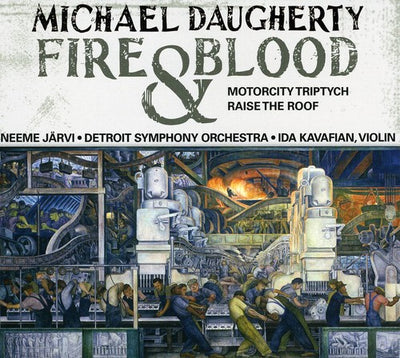
Michael Daugherty is a wonderful composer, and these three pieces make splendid listening. Fire and Blood is a violin concerto, and a damn fine one. Violin concertos are exceptionally difficult to write, especially in balancing the soloist against a large modern orchestra. Daugherty handles the challenge with aplomb. In the first movement, for example, he keeps the accompaniment light but colorful. Sounds that come across as hackneyed in the hands of other composers, such as harp glissandos or little glockenspiel accents, here sound freshly imagined, while the solo writing offers much that is genuinely lyrical and beautiful. Ida Kavafian puts plenty of heart into her playing, really digging into the tunes while making light of the technical difficulties.
Raise the Roof, for timpani and orchestra, does exactly what the title promises, but once again the music never sounds gimmicky. MotorCity Triptych features the orchestra's fine brass section: trumpet in the second movement and three trombones in the third. Daugherty's style mixes popular music idioms with traditional classical forms with complete naturalness. You never feel that he's trying too hard, or merely being trendy. Neeme Järvi and the band make exactly the bold, glittering sounds that the music requires, and I can only wonder why a disc that was recorded between 2001 and 2003 is only being issued now. Great sonics too.
American Classics - Anderson: Orchestral Music Vol 2 / Slatkin, BBC
Naxos
CD
$19.99Apr 29, 2008
If you enjoyed Vol. 1 in this ongoing series of Leroy Anderson's warm and beautifully crafted orchestral works, then you'll surely want this release as well (and probably the next one too). The performances are just as fine, and once again we get several important premieres, most notably A Harvard Festival (a sort of Academic Festival Overture, complete with organ to add extra weight to the climaxes) and Lullaby of the Drums. Only a few of Anderson's better-known works are here, most particularly The Waltzing Cat and Jazz Pizzicato, and once again there is one (relatively) large piece, the Suite of Carols, though this doesn't compare in importance to the marvelous Piano Concerto featured in Volume 1. Still, Anderson's brand of melodious charm is timeless, and you'll doubtless find many very enjoyable discoveries on this well played, well engineered disc. Kudos also go to Slatkin for lavishing such care and enthusiasm on "pops" repertoire. Easily recommendable.
-- David Hurwitz, ClassicsToday.com
Also available - Leroy Anderson: Orchestral Music Vol 1 Jeffrey Biegel's rendition of the terrific Piano Concerto is the best yet. Among the smaller pieces you'll find familiar favorites, but also some lesser-known but no less delicious surprises. Under Slatkin's baton the melodies flow effortlessly. -- ClassicsToday.com
Also available - Leroy Anderson: Orchestral Music Vol 3 Naxos continues its celebration of Leroy Anderson's 100th anniversary year with this third volume of his works, including popular favorites "The Typewriter," "Sandpaper Ballet," and "The Syncopated Clock."
The Places Starting in St Petersburg, once the capital of Russia under Peter the Great, our tour takes us to Ukraine and to Uzbekistan before returning first to Moscow and then to St Petersburg and the famous Marïinsky Theatre, where Tchaikovsky's The Sleeping Beauty and Nutcracker were first performed.
The Music The Russian composer Tchaikovsky had a mastery of the smaller forms demanded by ballet, with its series of relatively short scenes. Excerpts from his three famous ballet scores, The Sleeping Beauty, Swan Lake and Nutcracker, provide the music to accompany a tour of Russia, Ukraine and Uzbekistan.
Picture format: NTSC 4:3 Sound format: Dolby Digital / DTS Surround Region code: 0 (worldwide) Running time: 59 mins No. of DVDs: 1
Musical Journey: Germany - Bavarian Lakes And Schloss Herrenchiemsee
Naxos AudioVisual
DVD
$13.99Mar 30, 2010
GERMANY
The Places
Bavaria has a place of its own in Germany, both geographically and culturally. The tour stars with the Alpine lake known as Königssee and explores the surrounding landscape, including the Berchtesgaden National Park and the gardens of Ludwig II's answer to Versailles, his grandiose Schloss Herrenchiemsee. The tour ends with the Chiemsee, its islands and its tranquil waters.
The Music
The music for the tour is by Johannes Brahms and his colleague and collaborator, the violinist Joseph Joachim. Brahms' Second Symphony, which accompanies the earlier parts of the tour, was described by some contemporaries as Brahms' Pastoral Symphony and provides, in its generally cheerful serenity, an apt accompaniment to views of the Bavarian countryside. Joachim's Overture In memoriam Heinrich von Kleist, written probably in the same year as Brahms' symphony, 1877, commemorates the centenary of the birth of the great German writer.
Picture format: NTSC 4:3 Sound format: Dolby Digital / DTS Surround Region code: 0 (worldwide) Running time: 50 mins No. of DVDs: 1