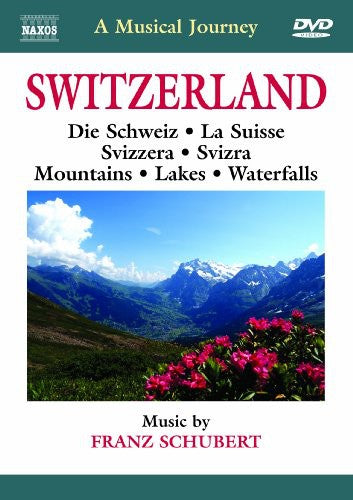
A Musical Journey: Switzerland - Music By Schubert
Naxos AudioVisual
DVD
$13.99Feb 23, 2010
The places visited in this film range from the icy slopes of the Jungfraujoch, approached by the highest railway in Europe, to the tranquility of Lake Thun, the imposing waterfalls of Trummelbach and the distinctive French, German, Italian and Romansch regions of the country. The music for this tour of Switzerland is by Franz Schubert, a composer who spent his life largely in his native Vienna. His famous 'Unfinished Symphony', the two movements of which were written in 1822, were not performed until 37 years after Schubert's death, when the manuscripts were discovered at the home of Schubert's friend Anselm Huttenbrenner. The music continues with Schubert's 'Fifth Symphony', written in the space of a few weeks in 1816, when the composer was nineteen.
This fourth volume in Marin Alsop’s acclaimed Prokofiev symphonic cycle features two of his most viscerally exciting works. Using material salvaged from his opera The Fiery Angel, the Third Symphony was hailed by Serge Koussevitzky at its 1929 première as ‘the best symphony since Tchaikovsky’s Sixth’. Originally commissioned as a ballet by Sergey Dyagilev but rejected as un-danceable, the Scythian Suite has become a popular orchestral showpiece, while Prokofiev retained a lifelong fondness for his dark-hued early symphonic sketch Autumn.
The Places The city of Nuremberg owes its importance partly to its geographical position, which made it a significant centre for trade. In spite of considerable damage, its old medieval city, now restored, remains as a monument to its importance in the late Middle Ages. By the 16th-century Nuremberg had become a centre of trade and of artistic activity. In art it could boast the presence of Albrecht Dürer and in poetry Hans Sachs and the Guild of Mastersingers, later to be celebrated by Wagner. The Music The son of Leopold Mozart, the Deputy Kapellmeister at the court of the Prince-Archbishop of Salzburg, Wolfgang Amadeus Mozart had grown up at the archiepiscopal court, to be employed there, like his father, in a childhood and early adolescence interrupted by long concert tours as an infant prodigy. He excelled as a pianist, but was also a proficient violinist, and two of the three Violin Sonatas included here date from years in which he tried briefly to escape from Salzburg and find employment elsewhere, with the third written in 1781, when he was first establishing himself in independence in Vienna, where he was to die ten years later.
Picture format: NTSC 4:3 Sound format: PCM Stereo 2.0 / Dolby Digital 5.1 / DTS 5.1 Region code: 0 (worldwide) Running time: 53 mins No. of DVDs: 1
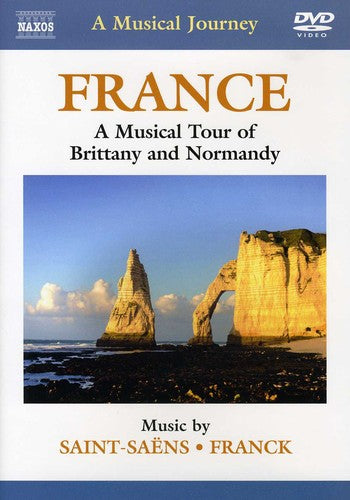
A Musical Journey - France: A Musical Tour of Brittany and N
Naxos AudioVisual
DVD
$13.99Jun 26, 2012
The Places: Brittany and Normandy, in Northern France, have a character all their own, preserving, as they do, ancient Celtic traditions in a countryside bounded on one side by a rocky coast-line. The great Abbey of Mont St-Michel remains a centre of pilgrimage and secular interest, and in Normandy we catch glimpses of the Bayeux Tapestry, with it's near contemporary record of William of Normandy's successful expedition in 1066 to conquer England. The Music: The music chosen for this tour of Northern France is the Organ Symphony of Camille Saint-Saens, a work written in memory of Franz Liszt that takes it's name from the use of the organ in it's grandiose final movement. The other music to be heard is an orchestral version of the Belgian-born composer Cesar Franck's Prelude and Chorale, written two years earlier, in 1884, and the Romance in C major, Op. 48, of Saint-Saens.
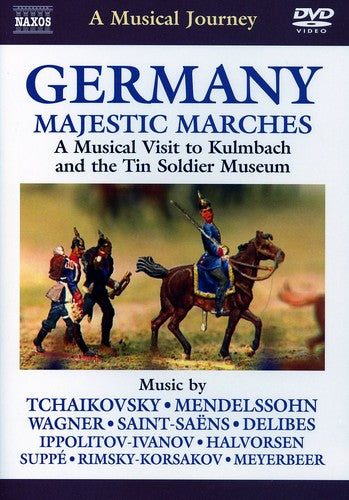
A Musical Visit to Kulmbach and the Tin Soldier Museum
The Places: On a hill above the ancient town of Kulmbach stands the imposing 12th century Hohenzollern fortress of Plassenburg. Among various collections on display is the remarkable Tin Soldier Museum, with various figures and dioramas that recreate battles and mirror the great castle itself, with a variety of scenes from all periods of human history.
The Music: The March has an inevitable part to play in human history. Marco Polo remarked on the use of music by the armies of China to terrify the enemy before a battle. Military music, however, has a more precise purpose, whatever alarm it may strike into the hearts of those who hear it. Drums and trumpets may serve as useful signals, to advance or retreat, to eat or to sleep. The same instruments and their near relations may serve to keep an army moving together, and may serve to inspire feelings of bravery and patriotism. At the same time a march can provide a suitable accompaniment to an occasion of solemnity, a wedding, a funeral or a state ceremony. The music chosen for this tour offers a series of Marches by different composers, culminating in Mendelssohn’s Wedding March.
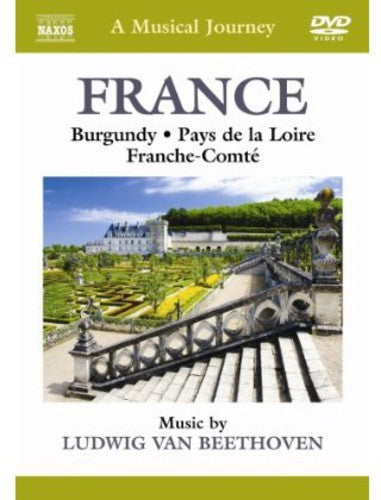
A Musical Journey - France: Burgundy / Pays de la Loire / Fr
Naxos AudioVisual
DVD
$13.99Nov 13, 2012
The Places ò the tour of France takes US to Burgundy to the Pays de la Loire to Franche-Comté and elsewhere and includes glimpses of the 17th century Château de Cheverny with it's hunting museum and souvenirs of the chase and the Château d'Arlay with it's site for falconry. The Château de Bussy-Rabutain was rebuilt in the middle of the 17th century by Count Roger of Bussy-Rabutain exiled from the French court after his scandalous Histoire amoureuse des Gaules a literary preoccupation reflected in his collection of pictures. The restored gardens of the Château de Villandry are seen in their formal lay-out. The Music ò the music chosen to accompany the tour of the fertile and varied landscapes of France is by Beethoven and consists principally of his Pastoral Symphony a work that reflects his feelings as he recollects a visit to the countryside.
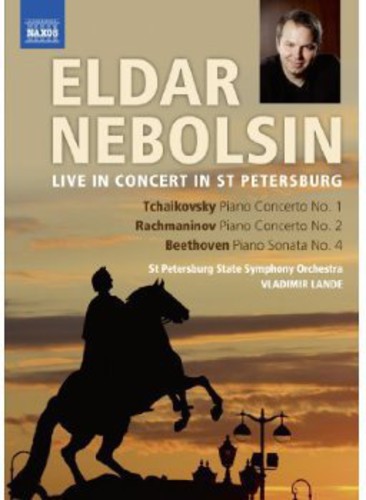
• Against the backdrop of St Petersburg’s beautiful Court Capella, Eldar Nebolsin performs the piano concertos of Tchaikovsky and Rachmaninov with a passion and sincerity as palpable onscreen as live in the hall. With such evident pleasure and seemingly with ease, he transformsthe familiar into something fresh and wonderful. He is seen live with Vladimir Lande and theSt Petersburg State Symphony Orchestra. Bonus material shows Nebolsin as soloist in anintimate and equally engaging performance of Beethoven’s Fourth Piano Sonata.In 2005, Eldar Nebolsin was unanimously awarded the Sviatoslav Richter Prize in the FirstInternational Piano Competition in Moscow, where he was also honoured with the specialaward for The Best Classical Concerto Performance. He enjoys a busy international careeras a soloist, recitalist and chamber-music player, appearing with conductors, orchestras andcolleagues of international distinction.
Schuman: Symphony No 8, Night Journey / Schwarz, Seattle Symphony
Naxos
CD
$19.99Feb 23, 2010
For enthusiasts of the orchestral Schuman and the American 20th century symphony this brings the Naxos Schuman project to a close in style.
Rejoice! With this disc Naxos complete their survey of the numbered Schuman symphonies. You will look in vain for symphonies 1 and 2: they were disclaimed by the composer. That’s a pity as it would be fascinating to hear these works of the 1930s. I have not given up hope.
Schwarz here has the conqueror-advocate’s measure of the bell-haunted Eighth Symphony. It was premiered in the Lincoln Center in 1962 with Bernstein conducting and was recorded by Bernstein the same year. That recording is easily and inexpensively accessible on a 1998 Sony CD alongside symphonies 3 and 5 via Amazon. While I still recommend that CD for an unassailably vital and kinetic Third Symphony Schwarz is to be preferred in the often more tensely reflective Eighth Symphony. He takes a minute and a half more than the comparatively opaque Bernstein but the Seattle results positively glow. This is a work that can be difficult to approach but I find it completely accessible in this Schwarz-Naxos version. Schwarz’s reading is as much of a revelation as Walter’s Brahms 3, Oramo’s Sibelius 6 and Ormandy’s Nielsen 6. The lucid and directly engaging recording is a co-conspirator in the results. The prestissimo finale showcases the audio engineering which accommodates solo strands and florid climactic material with a natural ease and without any sense of perspective zooming. Even Schwarz cannot completely transform the rather hollow gestures of the last page or two of this score but overall the Symphony emerges wonderfully well – better than ever.
Night Journey was one of four ballets on which Schuman collaborated with Martha Graham. Its spareness of utterance and angularity is only partly accounted for by the score which specifes fifteen instruments. A diminutive orchestra was not an unusual restriction for Graham ballets of that era – no doubt sensitive to cost and touring practicalities. The music has a Bergian astringency whether pensive, charged with nocturnal foreboding or fitfully frenetic. That inward quality echoes Barber’s tense dark chocolate romanticism but presents in more transparent textures. Night Journey has been issued on CD before by CRI but is not currently available. The Ives/Schuman Variations on ‘ America’ is a brilliant showcase built around a song that most Brits will recognise as God Save the Queen. The familiar tune is put through some wheezingly irreverent transformations. This is in no sense a representative Schuman work but is full of left-field fun.
It’s too easy to forget the sponsors without whose sense of judgement and even courage we would not hear the music. It’s much to the credit of the National Endowment for the Arts that they have financial sponsored this disc.
The more than capable notes are by Schuman biographer Joseph W Polisi.
For enthusiasts of the orchestral Schuman and the American 20 th century symphony this disc brings the Naxos Schuman project to a close in style.
Claude Baker: Glass Bead Game / Slatkin, Vonk, St. Louis Symphony
Naxos
CD
$9.99$19.99Save 50%Sep 25, 2012
BAKER The Glass Bead Game.1 Awaking the Winds.2 Shadows: Four Dirge-Nocturnes.3 The Mystic Trumpeter4 • Leonard Slatkin, cond; 4Hans Vonk, cond; Saint Louis SO • NAXOS 8.559642 (66:36) Live: St. Louis 11/21–24/1991; 25/14–16/1993; 35/18–20/1990; 44/16–18/1999
From 1991 to 1999 Claude Baker was the composer-in-residence to the Saint Louis Symphony, the fourth and last in a program in which he was preceded by Joseph Schwantner (1982–85), Joan Tower (1985–88), and Donald Erb (1988–91). Recorded souvenirs of the residencies of the first three were issued by Nonesuch and New World; neither Schwantner release made it to CD, but the Tower and Erb did and can still be purchased. Though arguably the most compelling artist of this distinguished quartet—please don’t send nasty notes—and certainly the one longest in residence, Baker was not so honored. A 1993 live recording of Shadows: Four Dirge-Nocturnes was included in the limited edition commemorative set, The Slatkin Years, but that is long out of print. (The Naxos disc opts for the 1990 premiere.) So this Naxos release of live recordings originally made for broadcast between 1990 and 1999, funded by Indiana University in Bloomington where Baker holds an endowed professorship, is a most welcome redress of an unfortunate oversight.
The Glass Bead Game (1982/83)—inspired, as is almost all of his music, by a literary work and quoting from the compositions of others as annotation—is quintessential Claude Baker and therefore a perfect work to open the program. Baker, inspired by Hermann Hesse’s novel of the same name, takes his thesis from the intellectual narcissism of Hesse’s Castalian scholars. Their obsession with analyzing the past, their fascination with games, trivial detail, cleverness, and systemic complexity, and their eventual stagnation and decline through failure to create anything new are all reflected in the musical program. Baker uses Hesse and the music to shine a light on 20th-century musical obsessions, using a brilliantly executed numerologically complex serial canon; a dream-like, period-correct performance of a Johann Schein courtly dance commented upon by modern atonality; and an amazing collage of six works by Dallapiccola, Schoenberg, Vaughan Williams, Shostakovich, Penderecki, and Liszt, given unity by their incorporation of the famous B-A-C-H motive. These six pieces are assimilated Castalian-syle into a final movement, which is both amazing in its virtuosity and sobering in its ultimate emptiness.
Shadows: Four Dirge-Nocturnes (1990) and The Mystic Trumpeter (1999) are grounded as well in literary sources. In Shadows, Baker explores four haiku, using characteristics of the form—syllable counts, binary construction, and motivic concision—as compositional elements. The verses and the music are dark, evoking death, the graveyard, and mourning in each of the seasons from spring through winter. Woven into the nocturnal work are gestures, fragments, and quotes from works by Mahler, Britten, and Stravinsky, ending touchingly with a quote from “In diesem Wetter” from Kindertotenlieder. The Mystic Trumpeter concerns itself with Walt Whitman, finding both literal and symbolic connection between the verse—the title poem and “The Dalliance of the Eagles”—and Ives’s The Unanswered Question, and works by Messiaen, George Rochberg, and medieval troubadour Guiraut de Bornelh. Awaking the Winds (1993) is the anomaly. It has no literary precursor, contains no borrowed music, and is “freely chromatic” rather than Baker’s usual combination of tonality and atonality. Unlike the other works that are heavily driven by the percussion section, this one eschews even timpani. It essentially is a pastorale, though the composer disavows any programmatic intent, with suggestions of wind and sounds of nature, a storm, and a quiet dénouement.
During the decade of these performances, Leonard Slatkin and the SLSO had a well-deserved reputation as promoters of new music, especially by native composers, and the orchestra was in superb shape, able to play anything that their composer might write for them. Vonk, who took over the podium in 1996, may not have taken to the idiom as naturally, but the orchestra still knew the way home and the Dutch maestro paces them most effectively. The execution of this bold, dramatic, and exceedingly challenging music is flawless, the moments of quiet and delicacy are sublimely poised, and even more to the advantage of the music, all is presented with absolute conviction. Recordings exist online of Indiana University ensembles playing this music—although The Mystic Trumpeter seems to have disappeared for now—but good as they are—and the fine Shadows is even conducted by Slatkin—none of the IU performances can match these in function or insight. The recordings themselves, the majority engineered by the late/lamented William Hoekstra, are demonstration class, and reveal little of the very quiet audiences. I was present for at least three of these concert series, so for me there could not be a better tribute to Claude Baker or to his years with the SLSO than the release of these recordings. They should serve admirably to introduce the work of the composer to those not so fortunate, as well.
Naxos has released a second collection of Russian tenor arias by Vladimir Grishko. Like the first volume, we have a beautiful tenor voice treating us to some rarely heard arias from operas not often performed outside of Russia. Probably the only familiar pieces to non-Russian listeners would be the brief orchestral excerpts from Glinka's A Life For Tsar and Polovtsian March from Borodin's Prince Igor so listening is a treat in and of itself.
Bernstein: Arias And Barcarolles; Barber, Diamond / Schwarz, Seattle Symphony
Naxos
CD
$19.99Apr 24, 2012
This triumvirate of composers represents an essentially lyrical impulse in American music. Leonard Bernstein’s Arias and Barcarolles was completed in 1988 but had existed in some form since 1955. The cycle of songs about love and marriage was written for voice and piano (four-hands) but orchestrated, under Bernstein’s supervision, by Bright Sheng, and premièred by Gerard Schwarz. Eclectic, exciting, jazzy, and Mahlerian, it reflects Bernstein in all his multi-faceted glory. Barber’s concert overture is a vibrant work, fizzing with energy, whilst Diamond’s Elegy offers a poignant, noble and at times violent lament for Ravel.
A Musical Journey: The Four Seasons - Austria, Germany, Italy, Switzerland, Scotland
Naxos AudioVisual
DVD
$13.99Jun 25, 2013
Our journey takes US to places in Austria, Germany, Italy, Switzerland and Scotland, largely following the order of the seasons, from the hope of spring to the snows of winter. Violinist, priest and highly prolific composer, Antonio Vivaldi was born in Venice in 1678 and spent most of his life there. The most popular of his 500 or more concertos, then and now, has been the Four Seasons, eventually published in 1725, each concerto accompanied by an explanatory sonnet.
•This sixth Naxos album, Out of Darkness, from Music of Remembrance devoted to remembering Holocaust musicians and their art through recordings and commissions of new works, is a moving musical witness to survival in the face of unimaginable adversity.
PROKOFIEV Symphony No. 4 (revised version); op. 112. The Prodigal Son, op. 46 • Marin Alsop, cond; São Paulo SO • NAXOS 0038 (Blu-ray Audio: 78:18)
Of Prokofiev’s seven symphonies, the Fourth has the most unassuming demeanor. Less sparkling than the First, less violent than the acidic Second and Third, less monumental than the Fifth and Sixth, and less magical than the nostalgic Seventh, its lack of distinctive character has kept it (especially in its baggier revised version) on the edge of the repertoire. Still, despite its relatively anodyne character, it has its fair share of charm, and its virtues are brought to the fore in this graceful performance, the second installment in Alsop’s symphony cycle.
Granted, at first, the performance seems slightly distracted. But within a minute or two, it comes into focus, and from then on, Alsop shows consistent sensitivity to the score’s harmonic flavor (the more mournful harmonies are especially well conveyed), its lyrical pull (especially in the more regretful moments—try the melancholy of the second movement), and its rhythmic stride. Alsop never tries to push the score into a grandeur it doesn’t possess—this is a fairly laid-back performance. But while it’s low in pressure, it’s never inattentive. She has a good sense of balance, so the passages with superimposed ideas (especially in the Finale) have enviable transparency. Details carry well, too (listen, for instance, to the marcato chatter on the bass lines at the beginning of the Finale). And while São Paulo is not quite a super-virtuoso ensemble, its members (especially the busy solo winds) play deftly. If the Symphony still sometimes seems to meander or sag (especially in the second movement and the Finale), the fault is really with the composer, not the performers.
Just as Prokofiev fashioned his Third from his opera The Fiery Angel, so he filched most of the musical material of the Fourth from his ballet The Prodigal Son. Putting the Symphony and its source material together on a single disc will seem either revelatory or redundant, depending on whether you are more interested getting insight into Prokofiev’s compositional methods or getting some musical variety. In any case, the original ballet is as pale as the Symphony (and formally a lot looser): You’ve rarely heard a less violent robbery scene than the seventh movement here, or, for that matter, a more anemic seductress than the one Prokofiev introduces in the third. Still, it too has its beauties (or, most of the time, the same beauties), and the interpretive grace that serves the Symphony so well has the same effect here. The sound is excellent, with plenty of timbral clarity (timpani have exceptional presence); the surround speakers on the 5.1 tracks offer an appropriate warmth to the total aural experience. Recommended.
Szymanowski: Symphonies No 1 And 2 / Wit, Warsaw Philharmonic [blu-ray Audio]
Naxos AudioVisual
Blu-Ray
$16.99May 31, 2011
This is an audio-only (i.e., with no video content) Blu-ray disc playable only on Blu-ray players.
Although Szymanowski later dubbed his Symphony No. 1 a “contrapuntal-harmonic-orchestral monster” and disavowed the influence of Wagner, Reger and Richard Strauss, it is an astonishingly powerful work by a composer only in his mid-20s and still enthralls listeners a century after its première. The unusually structured Symphony No. 2 is a work of great impact and invention, with many passionate and varied contrasts in its use of solo instruments, in particular the violin. On their CD release, these thrilling interpretations of Szymanowski’s Symphony No. 1 earned 5 STARS from BBC Music Magazine, while the Symphony No. 2 gained Gramophone Editor’s Choice and 5 STARS for these “deliriously sensual scores” from Classic FM.
"When Antoni Wit and his forces are in top form in the music of Szymanowski, they're pretty much unbeatable. Szymanowski repudiated his First Symphony on stylistic grounds (too Wagnerian), and it certainly does not represent the direction he ultimately took. But it's still great fun: a big, bold, scant 20 minutes of colorful scoring and exuberant musical ideas." -- David Hurwitz, ClassicsToday.com
"The performance of No 2 in two movements, an opening Allegro followed by an extended set of variations, is equally persuasive. [T]he first movement is passionate and thrustful and the variations bring some fascinating contrasts, ending with a powerful fugue. Antoni Wit's performance could not be more idiomatic, with players totally inside the music. An outstanding issue." -- Edward Greenfield, Gramophone
American Classics - Converse: The Mystic Trumpeter, Etc
Naxos
CD
$19.99Aug 01, 2002
Here's a trivia question for you: What musical work begins with an evocation of sunrise over Detroit? Answer: Frederick Shepherd Converse's Flivver Ten Million, a humorous answer to Honegger's Pacific 231 as portrayed through the adventures of a Ford automobile. After the dawn sequence, the factory gets to work and out comes our hero, the ten millionth Ford, and he sets out on his journeys. There's a sexy love scene (making out with a Chevy?) and a wild joy ride that culminates in a collision, and after a moment of introspection (and, we suspect, some time in the repair shop) Flivver takes off again, good as new. Along the way, Converse calls on a host of special effects: taxi horns, anvils, wind machine, ratchets. It's all over in 12 riotous minutes and JoAnn Falletta leads a clearly energized Buffalo Philharmonic in a knockout performance that alone is worth the price of the disc.
This isn't the time or place to go into the question of how "great" a composer Converse was, but there's no question that he had tremendous talent and a great gift for orchestral narrative. The Mystic Trumpeter (of Whitman fame) takes a few minutes to get going, but once it does, watch out! The battle music gives Tchaikovsky's Romeo and Juliet a good run for its money. And speaking of Tchaikovsky, check out the last few minutes of Endymion's Narrative, where Converse screws up the tension of his lyrical, principal theme in a manner that the great Russian would have been proud to call his own. Okay, so this may not be the most original or thought-provoking music in the world, but who in his right mind would sneer at a few more Tchaikovsky-style tone poems that are just about as good as the originals? And make no mistake; Converse's musical style did evolve over time. Flivver Ten Million, composed in 1927, shows significant advances in harmony, rhythm, and orchestration (albeit in a humorous vein) when compared to the other two works, both of which date from the first decade of the 20th century.
Throughout these works, Converse demonstrates an impressive command of the long melodic line, a keen dramatic sense, and a sure feeling for form. Better still, Falletta and the orchestra play marvelously, holding absolutely nothing back and taking those very fully scored climaxes from one peak of excitement to the next. And yet there's sensitivity aplenty, whether in the delicate harp-accompanied interludes in Endymion's Narrative or the gentle trumpet fanfares that open The Mystic Trumpeter. I can hardly imagine these pieces better played or conducted, and Naxos has contrived to produce a bold, vivid recording with terrific top-to-bottom transparency of texture and an aptly vast dynamic range. Certainly, this stands among the finest entries in Naxos' American music series to date, and markedly improves on the only available competition: the Louisville Orchestra's decent but less-than-spectacular versions of Endymion and Flivver. Let's hope Naxos pauses for a moment before moving on, to further mine this particularly fruitful lode. Remember, Converse also wrote five symphonies... [8/10/2002] --David Hurwitz, ClassicsToday.com