The German-Greek pianist Danae Dorken belongs to the elite of a new generation of internationally sought-after artists. The current album is a tribute to the great Greek composer Mikis Theodorakis on the 100th anniversary of his birth, which is on 29 July 2025. Theodorakis compositions blended classical, folk, and modern elements, often expressing the struggles and spirit of the Greek people. The Staatskapelle Weimar under Kornilios Michailidis are accompanying the pianist with the Suite No. 1 and the Helikon Concerto No. 2 for piano and orchestra.
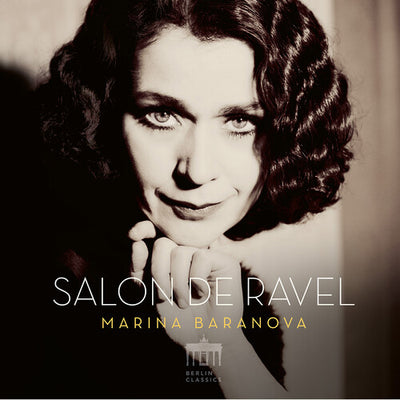
This release features Ravel's works alongside pieces from composers who inspired him, including Chabrier, Haydn, Borodine, Couperin, and more. Marina Baranova seamlessly blends classical and neoclassical elements, creating a unique musical language that is distinctly her own. Each track invites you to appreciate the dialogue between these great composers, showcasing Baranova's exceptional talent and interpretative skills.
Carmina Burana, the staged cantata by Carl Orff, is a work unique in musical history, claims conductor Paavo Jarvi: 'The convergence of medieval texts with such daringly original orchestral colours creates a soundworld that is both archaic and yet beyond time, in which chorus, orchestra and soloists vie in splendour.' The work also has an unusual history: composed shortly after the Nazi takeover of Germany, it was at first rejected because of it's Latin texts and the erotic character of some of it's songs; yet Orff and his work subsequently became highly prized by the Reich. The composer (who was secretly 'a quarter Jewish') did not support the regime, but made the best of his success... Orff was 42 by the time he experienced this breakthrough with his Carmina, which he designated as his Op. 1, disowning all his previous compositions. Departing from the Romantic style, he now wanted to create music linked to rhythm, simple repeated melodies, and non-complex forms. This work's popular success confirmed that decision.
This diverse programme of works for guitar trio is bound by the common thread of music inspired by stories from literature, stage or screen. With it's rhythmic exuberance and tragic beauty, Bernstein's West Side Story has never lost it's freshness and relevance. Ensemble member Luca Isolani's Note fuori campo is a homage to the versatile Italian composer Nino Rota, who, like Manos Hadjidakis, first shot to international fame with an Oscar-winning film score. Ravel's Ma Mere l'Oye evokes the poetry of childhood with a refined expressiveness that makes it as popular and unforgettable as Grieg's music for Peer Gynt.
Hildegard And Her Sisters, Katelyn Bouska, piano. After our first success with Women and War and Peace, Katelyn Bouska put a big smile on my face when she mentioned a second project she wanted to do with Yarlung Records. Kate can play any genre, and we discussed an album celebrating the great composer, mystic, poet, philosopher, scientist, rabble-rouser and visionary abbess Hildegard von Bingen. Hildegard is the first composer for whom we have a definite name in the European canon. She was born in 1098 and died in 1179 at 81 years of age. I was even more enthusiastic when we discussed that Kate and Yarlung would commission new music for the project in Hildegard's honor. To help place Hildegard in wider European history, she was born a mere 32 years after the Battle of Hastings, 47 years before the start of construction of Chartres Cathedral, and Henry IV was Emperor of the Holy Roman Empire after inheriting Charlemagne's throne in Aachen. Kate wanted to return to Samueli Theater at Segerstrom Center for the Arts where we made our first recording together. Aaron Egigian was able to secure dates over Easter Weekend, March 29th, 30th and 31st, 2024, when the concert hall, Kate and our team were available. My fellow recording engineer Arian Jansen and I set up for the recording before Kate arrived, and while I do not believe in frequent divine intervention for such things, we asked Hildegard to "bless the more than 50 vacuum tubes" that we would need to be working perfectly for the recording. With or without Hildegard's intercession, all vacuum tubes worked beautifully for the duration without hiss, pop or crackle. Because Hildegard is best known for her vocal music, we decided to record this album as if Kate's piano were a full choir, stretching from far left to far right in the soundstage. Thanks to the superb acoustics in Samueli Theater, you may hear ambience and extreme high and low notes on Kate's keyboard expanding outside your speakers in your listening room. Unconventional as this may be for a solo piano recording, this was intentional such that the listener can experience more of the sound Kate enjoyed sitting at the piano, as if our ears are Kate's ears while she plays.
Beyond The Years - Unpublished Songs of Florence Price
Azica Records
CD
$15.99Jul 26, 2024
With an ever-increasing awareness of the excellence that defined her career, Florence Price is finally receiving the recognition that she deserves. Price won the Wanamaker Prize in 1932, and she was the first Black woman to have a symphony premiered by a major American orchestra. Price was a gifted student, pianist, and organist. She graduated from high school in Little Rock, AR, at age 14. At age 16, she graduated from the New England Conservatory (as the only double major in her class) with degrees in organ performance and piano pedagogy. Price wrote music for everyone– across a range of styles and abilities, and for a variety of forces. Beyond the Years hones in on Florence Price the composer of songs. ONEcomposer has cataloged nearly 150 of her songs (to date), only about half of which have been published.
Beyond the Years highlights Price’s affinity for themes of faith, nature, love, and loss. Amongst Price’s treasures in the archives at the University of Arkansas, Fayetteville, is her well worn copy of Vaccai: Practical Method of Italian Singing, a symbol of her fastidious commitment to writing idiomatically for the voice.
As performed by Karen Slack and Michelle Cann, these songs are receiving new life in the hands of two of the greatest artists of our generation.
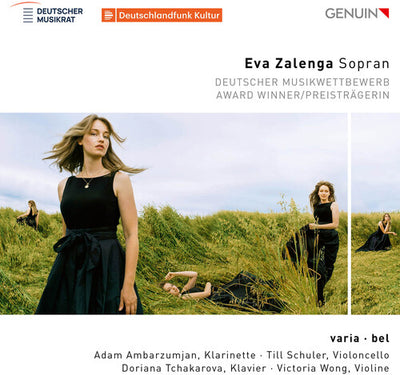
Eva Zalenga, winner of the German Music Competition, makes her GENUIN debut with an album featuring colorful and striking music for soprano and diverse instrumental ensembles. Highlights include a world premiere recording of Ignaz Lachner's work, a rare find by Darius Milhaud, and renowned repertoire such as Schubert's "Der Hirt auf dem Felsen" and songs by Rebecca Clarke and Pauline Viardot. Eva Zalenga's "fine, light, and lyrical" soprano brings fresh interpretations to these works. Another standout is the revised version of Isabelle Aboulker's "Je t'aime", developed directly with the composer.
The Czech Philharmonic and Music Director, Semyon Bychkov, continue their acclaimed Mahler cycle with the composer’s First Symphony, one of the most evocative and colourful symphonic debuts in the history of the genre. Mahler once famously said that “a symphony should be like the world, it should encompass everything.” In his First Symphony, he creates just such a world, filled with animal sounds, hunting horns, rural dances, klezmer bands and allusions to his own songs and folk song melodies such as Frère Jacques. These elements all function within a highly subjective, immersive symphonic drama, providing a blueprint for most of his symphonies to come. Semyon Bychkov and the Czech Philharmonic approach the composer’s firstling with their esteemed eye for detail and pacing, matched by their unmistakably Bohemian sound. The Czech Philharmonic is one of the world’s orchestral gems, recognised for its rich tradition with the Czech masters as well as European repertoire. Semyon Bychkov who is internationally renowned for his interpretations of the core repertoire, began his tenure with the Orchestra at the start of the 2018/19 season. Their recording of Mahler’s First Symphony follows Mahler’s Fourth and Fifth Symphonies (both 2022) and the Second Symphony (2023), part of the complete Mahler cycle to be released by Pentatone.
REVIEW:
The orchestra’s magical combination of richness, precision, and nuance is instantly in evidence, with brass and wind pinpoint and the strings characteristically shimmering and sinuous in the opening movement before making merry in Kraftig bewegt, doch nicht zu schnell. The control and perfection of Bychkov’s pacing in the third movement, and the way his forces combine in Sturmisch Bewegt with such attack one minute and astonishing fluidity the next, epitomizes a reading of beauty and depth.
Anton Bruckner: Symphony No. 9 in D Minor, WAB 109 - Live fr
Profil
CD
$20.99Apr 17, 2026
PH16063 Bruckner 9, Vol. 54 Edition Staatskapelle Dresden. Christian Thielemann, Staatskapelle Dresden, Live Aufnahme der Saison 2014/2015 aus der Semperoper »Ich mag die Neunte gar nicht anfangen, ich traue mich nicht, denn auch Beethoven machte mit der Neunten den Abschluss seines Lebens!« Anton Bruckner
Lepo Sumera (1950-2000) was one of the most important figures in Estonian music after WW2. Sumera can also be considered among the most important European symphonists of his era: between 1981 and 2000 the composer wrote an impressive series of 6 Symphonies. These dramatic and emotionally-packed works of great beauty and contrasts were greatly admired, among others, by John Adams. This new album by the Estonian National Symphony Orchestra and conductor Olari Elts is first instalment in a new fascinating symphony cycle.
'The Fifth is a cursed piece. Nobody understands it,' said Gustav Mahler in March 1905 after a performance of his Fifth Symphony in Hamburg. He had been working on his new symphony for almost three years before it premiered on 18 October 1904: in Cologne, with the Gurzenich Orchestra and Gustav Mahler at the podium. To many of his contemporaries, the work seemed too bold, too radical - perhaps also insufficiently explained, given that programmatic explanations had been added to the so-called 'Wunderhorn' Symphonies Nos. 2 to 4. Not only the number and the order of the movements seemed new, but stylistically Mahler also broke new ground with his Fifth. But now, all at once, his musical language changed, a transformation that evidently gave him some unease later. Shortly before his death, he made corrections to the instrumentation. Today the work is considered the beginning of his new creative phase, which culminated in his Ninth Symphony and it's one of his most popular symphonies. Gary Bertini was born in Bessarabia (now Moldova) in 1927. After the Second World War, he studied at the Milan Conservatory, then at the Tel Aviv Academy of Music (where he graduated in 1951), and finally at the Paris Conservatory and the ecole Normale de Musique. He founded and directed first the Rinat Choir - later named the Israel Chamber Choir - and then the Israel Chamber Ensemble with which Bertini made numerous appearances in Europe and the USA. Over the years, he has been principal conductor of the Frankfurt Opera and the Cologne Radio Symphony Orchestra, artistic director of the New Israel Opera, and music director of the Rome Opera and the Tokyo Metropolitan Symphony Orchestra. Bertini's breadth of repertoire was very impressive, reaching from the 16th century to contemporary composers.
He went on to head major orchestras in Dallas and Atlanta and to guest conduct leading ensembles all over the world. But before that, Louis Lane honed his craft while working in the shadow of one of the great masters: in 1947, legendary maestro George Szell chose the young, inexperienced Texan to assist him in Cleveland - "I think you will do" was the gruff maestro's verdict, exceptional praise indeed from that notorious perfectionist.
Between 1959 and 1972 - with the full Cleveland Orchestra, the somewhat smaller Cleveland Pops and the chamber-sized Cleveland Sinfonietta - Louis Lane made a series of critically acclaimed recordings for Columbia. They display the "exceptional breadth and impeccable taste" for which this gifted but perennially undervalued conductor was lauded in a tribute by the orchestra's executive director. Sony Classical is pleased to present them now - many for the first time on CD - in a new 14-disc set.
Reviewers were effusive in their praise when these albums were originally released on LP. Here is a sampling: Pop Concert U.S.A. (1959) - music by Copland, Gershwin, Bernstein and other American composers: "If only all the pops (or, for that matter, all the classics) were as good as this!. The orchestra plays splendidly" (Gramophone). On the Town with the Cleveland Pops (1960) - selections from On the Town, My Fair Lady, Oklahoma, The King and I and other Broadway musicals: "Scintillating. Under Lane's enthusiastic direction, the Clevelanders play these familiar musical comedy excerpts with such precision and virtuosity that they emerge with glistening freshness" (High Fidelity). Music from the Films (1961) - Henry V, Louisiana Story, Bridge on the River Kwai, Gigi, Exodus and other motion pictures: "This concert of music from the movies is so superior to most issues of it's kind that it calls for special commendation. Lane has coaxed some beautiful playing from the Cleveland orchestra, and the engineers have provided him with rich and glorious sound" (High Fidelity).
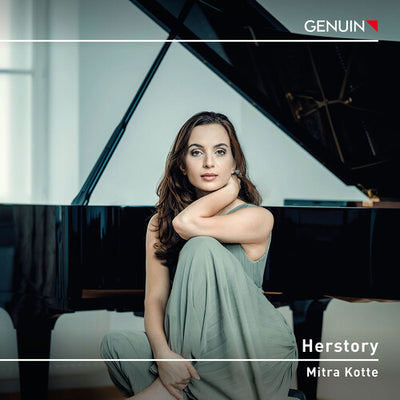
Her Story rather than "His Story": On her new GENUIN album, the remarkable Austrian pianist Mitra Kotte reexamines music history, placing women composers of the 19th and 20th centuries at the forefront. How many people truly know the works of Dora Pejacevic, Louise Farrenc, Cecile Chaminade, or Emilie Mayer as they deserve? Mitra Kotte, a prizewinner at international competitions, sheds light on a long-overlooked chapter of music. With great passion and the highest technical mastery, she introduces us to exquisite gems and profound works that leave us marveling both visually and aurally!
Anton Bruckner finally received the award of an honorary doctorate of the University of Vienna on 11 December 1891. For Bruckner, receiving the doctorate fulfilled a long-time wish. He had spent most of his life pursuing academic credentials and applied for honorary doctorates at Cambridge University in 1882 and at the Universities of Pennsylvania and Cincinnati in 1885. Two days later, Hans Richter conducted the Vienna Philharmonic in the first performance of the second or so-called “Vienna” version of the composer’s First Symphony, which he had dedicated to the university in gratitude for the degree. The changes Bruckner made in the revised version of the First Symphony are not as extensive as those he made to the Third, Fourth, and Eighth Symphonies during the late 1880s and early 1890s. His revisions to the First Symphony did not affect the overall form of any of the movements. He changed many details of orchestration, articulation, and phrase length, some of which are difficult to notice on first hearing. The 1891 autograph score is, nevertheless, the composer’s final word on how he wanted his First Symphony to be performed and understood.
Daniel Rieppel, a native of Minnesota of Austro-Hungarian descent, performs Mozart’s Fantasy and Sonata in C minor, the Piano Variations of Aaron Copland and Symphonic Etudes by Robert Schumann. Dr. Rieppel performs widely in North and South America and Europe (most recently in Iceland) and has been Professor of Music at Southwest Minnesota State University for over a quarter century. He has international recognition for his research into Schubert’s incomplete sonatas, finishing several that will be the subject of his next recording.
Bruckner’s Second Symphony is a rare enough encounter in its 1877 version, but it’s virtually unperformed in the 1872 original version. This is not owing to some deficiency of the earlier ideas compared to the later alterations. It’s mainly habit and convenience because to get new parts and re-learn something ostensibly known, that differs in a great many details, means an extra expense of effort and resources. That’s a shame, really, because it is decidedly worth discovering the original, not-yet-ironed-out rawness of Bruckner’s early masterpiece, which was something unheard of at the time – but needn’t remain unheard now.
By his own reckoning, Bruckner began his career as a professional composer when he was thirty-nine years old. With a mere exercise for a symphony under his belt – the unnumbered one in F minor – he was now ready to write his first true symphony. The world was not. First performed in 1868 in Linz – badly – the work flopped and was put aside until nine years and five symphonies later, when it was gently adjusted. A subsequent performance in 1884 was Bruckner’s “most successful Viennese performance to date”, prompting, perplexingly, a thorough revision that would be the 1891 “Vienna” version. This recording uses the unadulterated 1868 “Linz” version.
“Since Beethoven, nothing has been written that even comes close!”
The great conductor Arthur Nikisch made this remark to Bruckner’s former student, Joseph Schalk and also his fellow conductor, Hermann Levi, described the piece as “the most significant symphonic work since Beethoven’s death.”
Arthur Nikisch conducted the first performance in the Stadttheater, Leipzig, on 30 December 1884, with Bruckner in the audience. While the performance was not a total triumph, it brought the sixty-year-old composer significant international recognition for the first time. During the composer’s lifetime, the Seventh, especially its Adagio, was his most popular symphony, and it remains among his most beloved and frequently performed works.
Bruckner’s Third Symphony had always been something of a problem child among Bruckner’s symphonies, from its disastrous first reception (an enthused youthful Gustav Mahler notwithstanding) until well into the 20th century. In its original form, it is the longest, most Wagnerian of his symphonies – and often considered, rightly or not, the first truly Brucknerian symphony. While some cherish the uncompromising originality of the first version, Bruckner himself wanted the third, much tightened Edition performed, finding it “incomparably better”. It is that final version that is here recorded – and listeners can now easily decide for themselves.
Bruckner: Symphony No. 4 / Poschner, ORF Vienna Radio Symphony
Capriccio
CD
$21.99May 05, 2023
Bruckner’s frantic revisions of his symphonies Nos. 3, 4, and 8 were borne out of his disappointment with Hermann Levi rejecting the original version of the 8th symphony. Helping in this large-scale revamping effort were former Bruckner-students Franz and Joseph Schalk, Ferdinand Löwe, Max von Oberleithner, and Cyrill Hynai, which resulted in these versions’ reputation – and especially that of the last version of the 4th – being varnished as something not quite Echt-Bruckner.
It wasn’t until the discovery of photographs of the 1888 version’s manuscript score and the subsequent publication of Benjamin Korstvedt’s edition thereof that it became clear: This late edition really did reflect Bruckner’s intentions. To ears familiar with the still better-known 1881 version, the result might sound mystifying, even troubling, but it also surprises with many particularly exquisite passages!
As a winner of numerous national and international youth competitions, Robert Neumann (born 2001) was awarded with the International Classic Music Discovery Award 2017. In 2018, the Jury of the SWR (radio broadcasting corporation in Southwest Germany) chose Robert as the"SWR New Talent". For his debut CD at SWRmusic, Robert was awarded the OPUS KLASSIK Young Artist of the Year 2021. The young pianist made his orchestral debut with the Stuttgart Radio Symphony Orchestra when he was eight, and since then he has appeared with other orchestras, including the Moscow Symphony Orchestra, German State Philharmonic Ludwigshafen, Stuttgart Philharmonic, Liechtenstein Symphony Orchestra, SWR Symphonieorchestra, Praga Philharmonic Camerata and the Gewandhaus Orchestra. For his second album, Robert Neumann chose two works which can easily be placed side by side and that are both close to the pianist’s heart. Robert Schumann‘s Kreisleriana is about a character from several tales by E. T. A. Hoffmann and Modest Mussorgsky’s Pictures at an Exhibition describes walking from one work of art to the next. Both are programme music pieces with somewhat comparable ideas but, as Neumann puts it: „One idea deals with a real character, the other one doesn’t […]. And I think both show in an exemplary manner how flawlessly and also in different ways a great Romantic cycle can be structured, formed.
Leiviskä: Orchestral Works, Vol. 1 / Stasevska, Lahti Symphony
BIS
SACD
$21.99Dec 08, 2023
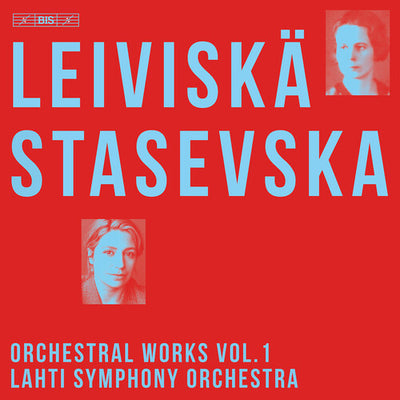
Conductor Dalia Stasevka, who received the BBC Music Magazine’s ‘Personality of the Year’ Award in 2023, and the Lahti Symphony Orchestra present three works by the Finnish composer Helvi Leiviskä, who was Finland’s first major female composer. Initially inspired by the language of late Romanticism – she mentioned Brahms as her favorite composer – Leiviskä developed an original, modern style that eschewed all schools, convinced that it was more important to tread one’s own path than to follow fashionable styles. While her output may seem small in terms of quantity, it more than makes up for it in the quality of the works, especially her symphonies, a genre she considered ‘the highest manifestation of music’.
This disc presents three works: the Sinfonia Brevis, a confidently crafted work reminiscent of Sibelius; the austere, restrained, melancholy and at times very dissonant Symphony No. 2, which could be called ‘tragic’; and the Suite for orchestra No. 2, which uses material from a powerfully descriptive score originally composed for a film. This recording bears witness to the ‘Leiviskä renaissance’ that has taken place in recent years, which has contributed to the rediscovery of a neglected but important voice in Finnish music.
To mark the 120th anniversary of Estonia's national composer Eduard Tubin, this exuberant chamber music programme, including two world premiere recordings, traces Tubin's life, which is clearly marked by the dramatic upheavals of the 20th century. Early works side by side with late compositions show deep insights into the artist's soul - we hear his inner struggles, his development and his joys in top-class interpretations by pianist Kart Ruubel and her twin sister Triin, violin, as well as Xandi van Dijk, viola and Theodor Sink, cello.
Christian Sinding might be thought of as a Grade-B composer. That’s not a dismissal, merely an assessment to adjust the expectations. He’s not the symphonic Grieg we’ve been missing, nor a Nordic Brahms that’s been overlooked. He’s an – essentially German – symphonist of the second rank who wrote very pleasing works that we will sadly not hear in the concert halls, but which can enliven our musical diet on record if we need to take a break from the usual suspects. To unfold their inherent fervour, his compositions are dependent on sensitive and enthusiastic interpretations, but that’s exactly what they get from the Norrköping Symphony Orchestra under Karl Heinz Steffens, for whom Sinding has become a composer close to his heart.
For his performance of Johannes Brahms's symphonies, Kirill Petrenko returns to their roots - and to his own: in Meiningen. Hans von Bülow was the first to perform Brahms's works there, before Fritz Steinbach succeeded him as court conductor in 1886. Thanks to Brahms's regular visits to Meiningen, Steinbach became extremely familiar with his music during his 17 years at the court - and meticulously recorded the composer's wishes as performance notes in the scores.
Rachmaninoff: Edition / Petrenko, Berlin Philharmonic
Berlin Philharmoniker
CD
$74.99Mar 01, 2024
The music of Rachmaninoff is of “enormous significance” to Kirill Petrenko. In it, he finds his “musical home”. His third edition together with the Berliner Philharmoniker is dedicated to the Russian composer, the 150th anniversary of whose birth was celebrated in 2023. It presents four key works: the Second Symphony, the Piano Concerto No. 2 and The Isle of the Dead – Rachmaninoff regularly performed them together until his emigration in 1917 – and the Symphonic Dances, which the composer wrote shortly before his death.
It was more than just breathing together in the music that made this relationship so extraordinary: Seiji Ozawa earned the respect and affection of the orchestra from the very first time he met the Berliner Philharmoniker in 1966. The young Japanese conductor knew exactly what he wanted on the podium and knew the scores down to the smallest detail. Nevertheless, the always polite and approachable conductor never imposed his views on the orchestra. The result was a partnership on an equal footing, which was not only rewarding on a personal level, but above all enabled music-making in which there was always room for freedom and spontaneity. Our edition is a tribute to this special friendship with Seiji Ozawa, who the Berliner Philharmoniker made an honorary member in 2016.
Fondamenta: Kirill Gilels, the grandson of the famous pianist Emil Gilels, made the decision to entrust us with the results of several years of research: he gave us a list of dates and places of the previously unreleased recordings of his grandfather. It was in Amsterdam where at last we succeeded in extracting five recordings of performances Gilels, one of the most important pianists of the twentieth century, had given between 1975 and 1980 at the Concertgebouw - recordings that had fallen into oblivion.
Unsuk Chin’s music is a magical realm: sometimes it unfolds labyrinths of innovative sounds and complex structures, then again moments of otherworldly beauty. Her astonishing ingenuity gives each work its own character – which makes the encounter with Chin’s music a "continuous adventure" for the Berlin Philharmonic.
For the orchestra, many highlights of this fruitful collaboration are linked to special memories: Chorós Chordón, for example, accompanied the Philharmonic on their last tour of Asia with Simon Rattle. This edition documents all the works by Unsuk Chin that have been performed by the Berlin Philharmonic to date.
In addition to the recordings on CD and Blu-ray and a bonus film, the hardcover edition features an attractively designed accompanying book with moiré effect art by Takahiro Kurashima, and introductory texts.