For the first time, this cycle is now being released as a limited vinyl edition on 17 LPs. The edition brings together Berliner Philharmoniker recordings from the last ten years. It includes the nine completed symphonies and the Adagio of the Tenth, whose performance under the direction of Claudio Abbado on the 100th anniversary of Mahler's death is one of the highlights. In addition to chief conductor Kirill Petrenko and his predecessor Sir Simon Rattle, the edition features other outstanding Mahler interpreters closely associated with the orchestra: Gustavo Dudamel, Bernard Haitink, Daniel Harding, Andris Nelsons and Yannick Nézet-Séguin.
Carl Orff Carmina Burana Orfeon Pamplones Escolania de Nuestra Senora de los Desamparados Orquesta de Valencia Alexander Liebreich Sara Blanch, soprano Joaquin Asiain, tenor Andre Baleiro, baritone They are one of the most famous and frequently performed works of classical music: Carl Orff's "Carmina Burana". The Latin title refers to a collection of songs from Benediktbeuren dating from the 11th and 12th centuries with texts written in Middle Latin, Old French and Middle High German. Orff chose 24 of these songs, their topics ranging widely from the volatility of happiness and prosperity to the fleeting nature of life, from the joy of the return of spring to the pleasures and dangers of drunkenness, gluttony, gambling, and lust. In June 2024, at the Palau de la Música in Valencia, the Orquestra de Valencia, one of the great Spanish symphony orchestras, together with the leading local boys' choir as well as one of Spain's oldest choirs, Orfeon Pamplones, performed this epic work under the musical direction of Alexander Liebreich. They were joined by soloists Sara Blanch, Joaquin Asiain, and Andre Baleiro. The live recording of this lively and captivating concert evening is now available. Recorded live at the Palau de la Música, Valencia June 2024
A wide-ranging introduction to the distinctive compositional voice of Amy Beach through her solo piano music, featuring both well-known and unfamiliar pieces. While Amy Beach is now among the best-known female composers of classical music history, her story becomes more remarkable as details of it are disseminated. The pianist Mark Viner introduces her life and music in a detailed but approachable essay to accompany this new recording of her piano music on Piano Classics. She was essentially self-taught, and a prodigy to match any previous celebrated male examples, at least in technica l terms. She translated Berlioz's treatise on orchestration in order to use it herself. She became a formidably accomplished pianist in her own right, but was then prevented from giving more than two recitals a year by her husband. Beach continued to compose, however, and steadly so through the last decade of the 19th century and well into the 20th. The earliest piece on Martina Frezzotti's recital is also one of her most familiar, the nocturne Dreaming from 1892, in which she emulates a Chopin model with piano writing that's deceptively simple on the page but uniquely haunting on the ear. The album's most substantial work is the 25-minute Variations on Balkan Themes, from 1904. The four themes in question were passed on to her by a missionary to the region, and the piece amounts to a proud cry for Serbian nationalism in the post-Lisztian style. Through it's course, Beach writes in the style of a barcarolle, a parlour waltz, a funeral march, a Hungarian dance and much more, weaving together her material with a sure hand. Beach's own skill as a pianist surely contributes to the soft tonal shades she conjures in her transcription of Richard Strauss's song Ständchen. She also explored the possibilities of making accurate musical transcriptions of birdsong decades before Olivier Messiaen did so, and her most celebrated work in this vein is the achingly beautiful Hermit-Thrush at Eve from 1922. Martina Frezzotti's album of Fanny Mendelssohn for Piano Classics (PCL10238) won enthusiastic praise from David Hurwitz on a video review for Classics Today. According to pianodao. Com (Andrew Eales), 'Frezzotti proves a brilliant advocate for these pieces in this recording, combining a poetic sensibility with the necessary weight and flair to showcase the more dazzling elements of Mendelssohn's piano writing. The recording is bright, reverberant and luminous.
Krzysztof Penderecki’s works for (string) quartet neatly encapsulate the stylistic breadth and trace the development of Poland’s most important modern composer throughout his six-decade-long career. From the avantgarde rhythmical study that is Quartet No.1, via an ode to Webern, to the neo-romantic elder Penderecki’s Schubertian Clarinet Quartet, this collection covers all his chamber music for three and four strings, even the early neo-baroque outlier of his Three Pieces adapted from his film music for the steamy 1964 movie, The Saragossa Manuscript.
REVIEW:
From wild child of the experimental avant-garde to luscious neo-Romantic, Krzysztof Penderecki had an unusually profound stylistic transformation across his career. When his string quartets neatly encapsulate that trajectory, written as they were between 1960 and 2016, it’s no mean feat to pull off the entire cycle in consistently convincing and compelling fashion. Yet, that is what the Meccore Quartet has done here.
Lovro von Matacic & Czech Philharmonic Orchestra - Beethoven
Supraphon
CD
$77.99Jun 13, 2025
The first complete edition of Supraphon recordings made by the legendary conductor Lovro von Matacic with the Czech Philharmonic Orchestra. This set contains unique historical recordings of six great symphonies of the Romantic era with the Czech Philharmonic Orchestra and the conductor Lovro von Matacic. These recordings were made between 1959 and 1980 by one of the most remarkable conductors of his generation. Matacic was born in Croatia when it was still part of Austria-Hungary. He studied in Vienna, where the great world of music revealed itself to him, and opera especially. The difficult path he had to follow led him through two world wars, but in the end he became a charismatic figure capable of inspiring and galvanising any orchestra. He repeatedly conducted the Philharmonia Orchestra, the London Symphony Orchestra, the Dresden Staatskapelle, the Munich Philharmonic, the Vienna Symphony Orchestra, and the NHK Symphony Orchestra in Japan, and he stood at the helm of the Monte-Carlo Philharmonic Orchestra. The Czech Philharmonic Orchestra and the Czech public always welcomed him as a special guest, and Supraphon enabled him to record first Beethoven's Eroica and two great symphonies by Tchaikovsky. Especially rare are the three symphonies by Anton Bruckner with the best-known Seventh, the grandiose Fifth, and the concluding Ninth representing Late Romanticism at it's zenith. This one-of-a-kind creation shows the orchestra of Ancerl's and Neumann's era in a different light. Around the world, Matacic is better known for his opera recordings, so this Supraphon set of orchestral recordings is unique.
In 2020, the Lithuanian National Symphony Orchestra and the Kaunas State Choir, under the direction of Modestas Pitrenas, came together at the National Philharmonic Hall in Vilnius for a remarkable recording of Amilcare Ponchielli's opera I Lituani. This project marks the first professional recording of this work, highlighting Ponchielli's significant contribution to 19th-century Italian opera and connecting deeply with Lithuanian heritage. Drawing inspiration from Adam Mickiewicz's poem Konrad Wallenrod, the opera tells the story of medieval Lithuania's resistance against the Teutonic Knights, exploring themes of freedom, national identity, and sacrifice. Ponchielli's rich orchestration and Ghislanzoni's powerful libretto create a dramatic musical experience that has now been captured with vibrant vocal performances and exquisite orchestration in this new recording. I Lituani, which premiered at La Scala in 1874, has long been recognized for it's beautiful melodies and emotional depth. This recording revives a significant yet often overlooked masterpiece of Italian opera, offering a fresh perspective on Ponchielli's profound musical and dramatic vision. Recorded at Lithuanian National Philharmonic Society Vilnius, September 2020
In September 2024, the music world celebrates the 200th anniversary of Anton Bruckner's birth in 1824. To coincide with the anniversary itself, and following the release of Bruckner's Ninth 4 earlier in 2024, Accentus Music will release the recording of Bruckner's Symphony No. 2 with the Bamberg Symphony, this time under the musical direction of their conductor laureate Christoph Eschenbach. Composed in a rather restless and pessimistic state of mind, Bruckner's Second oscillates between heartfelt prayers, desperate outbursts, helpless silence, and ecstatic dance scenes. A co-production with BR-Klassik
Vagn Holmboe (1909-96) stands as one of the greatest 20th-century composers of string quartets, with a monumental series of 21 quartets demonstrating his distinctive metamorphosis method. Holmboe's vibrant and organic quartet works are profoundly rooted in a Buddhist inspired perspective on life, an outlook which, though he kept it private, led him to view all manifestations of life as part of a cosmic whole. Equally essential is the influence from folk music. This third volume of the acclaimed Nightingale String Quartet series captures Holmboe at the peak of his creativity, with his musical metamorphosis practice fully flourishing.
Within a mere few years, Petr Popelka has established himself as one of the world's most exciting young conductors. Serving as principal conductor of the Prague Radio Symphony Orchestra and the Wiener Symphoniker, he has also appeared as a guest with prominent European and American orchestras, as well as at opera houses worldwide. Popelka does not view Bedrich Smetana's legacy as an obligatory Czech national classic, but rather as an object of love and vital artistic quest. "His ultimate masterpiece, My Country, should be approached a bit like an opera, as a great story... As a cycle of tone poems based on the theme of the homeland, it is absolutely unique in the history of music. Most significantly, there is not a work written with greater love." Popelka's recording is not just yet another addition to the immense number of recordings of My Country. Bringing to bear his great musicality and acute sense of detail, the conductor and the orchestra have modelled a truly exceptional form. Popelka's album features other germs too. String Quartet No. 1 in E minor, "From My Life", hailing from Smetana's mature period, when the composer was completely deaf, in George Szell's brilliant orchestration. In contrast, Smetana's early music is represented by the Triumphal Symphony, dedicated to the wedding of the 24-year-old Emperor Franz Joseph I to Princess Elisabeth of Bavaria, and three "Swedish" Liszt-inspired symphonic poems, based on dramas as immense as Shakespeare's Richard III and Schiller's Wallenstein. The extraordinary album marks the 200th anniversary of Smetana's birth. Lovers of spatial sound will certainly relish streaming My Country in the Dolby Atmos format. Petr Popelka conducts Smetana - with love, deep feeling and sense for detail
The sincerity and, at the same time, emotionality of Anton Bruckner's musical thoughts create an inimitable magnetism that makes one 'forget' time in the very best sense of the word. Anyone who wants to approach Bruckner only analytically will find their mind boggled, especially at the first encounter. His great power is a certain 'transcendental charm' that is common to all his symphonies.
In 2024, the music world celebrates the 200th anniversary of Anton Bruckner's birth on September 4, 1824. On this occasion, the Bamberg Symphony - an orchestra well-versed in the interpretation of Bruckner's symphonic cosmos - and their music director Jakub Hruša present a new recording of the composer's last and unfinished symphony, his Ninth.
On 30 November 1894, Bruckner completed the third movement of his Ninth symphony, which, like all of its predecessors, was laid out in four movements. Work on the finale began on 24 May 1895, around 16 months before his death. He composed the first 172 bars of the movement in full, after which the score is at least partially orchestrated for a further 200 bars. Although a playable version of the finale of Bruckner's Symphony No. 9 is now available, in practical life the three-movement torso has become the norm. It seems as if the non-completion paradoxically claims its place. The Austrian critic and musicologist Walter Weidringer wrote that the Ninth 'may be taken as one of those examples from music history that prove that even fragments can display a degree of completion which no longer seems capable of improvement.'
A production of Accentus Music in co-production with BR-KLASSIK.
Women were not always allowed to compose - often due to restrictions imposed by their families or for social reasons. Ursula Erhart-Schwertmann, cello, and Elisabeth Aigner-Monarth, piano, illustrate on this album by the title "lost & found" the compositional activity of women in that era, in which composing for women was increasingly recognized. Their lists of works contain mainly short chamber music pieces, less often large-scale orchestral works. This selection of works also takes this into account and offers a compilation of character pieces from the late 19th and early 20th centuries. Female composers from France, Great Britain, Denmark and north-eastern Europe like Mel Bonis, Amy Beach, Ethel Barns, Hilda Sehested or Marie Clemence de Grandval, among others, are given a voice and document the musical range of this genre.
During the first year after its publication, selected Slavonic Dances were performed in Prague, New York, Boston, London, Berlin, Dresden, Hamburg, Cologne, Bonn, Nice, Graz, Lucerne, and other cities … Dvořák’s music is deeply engraved in the DNA of the Prague Symphony Orchestra, who have performed it under conductors of such renown as Jirí Belohlávek, Charles Mackerras, Václav Neumann, Tomáš Netopil, etc.
The new recording, made with Tomáš Brauner, the orchestra’s current music director, draws upon an illustrious interpretation tradition, with its rounded and transparent sound capturing the best qualities of the exquisite Art Nouveau Smetana Hall of the Municipal House in Prague. / Slavonic Dances with the Prague Symphony Orchestra – Dvorák in good hands
The Athens State Orchestra is the oldest symphony orchestra in Greece. On the occasion of Mikis Theodorakis' 100th birthday, GENUIN evokes the spirits of his homeland and of classical antiquity in three symphonic works by Greece's most famous composer-works that played an important role toward the end of his life: from the early "Sinfonietta" in a new version, through the folk-inspired "Rhapsody for Guitar and Orchestra," to the equally moving nine-part "Rhapsody for Cello and Orchestra," Theodorakis's last orchestral work. The young, rising Kornilios Michailidis leads Greece's premier orchestra with verve, while the album's soloists contribute at the highest standard of playing to these remarkable recordings!
Hjalmar Borgstrom has been well on the way to being rediscovered since the beginning of the new millennium. Several of his most important works were performed in his native Norway until the Second World War, after which his name long disappeared from public consciousness. Until his death in 1925, he had also played an important role as a critic. With the premiere of his two operas and above all the rediscovery of his extraordinarily picturesque symphonic tone poems, a new page has turned. This contemporary of Richard Strauss who studied with Johan Severin Svendsen and Carl Reinecke among others, proves to be a legitimate descendant of Franz Liszt and Richard Wagner; it is difficult to escape the captivating boldness of his programmatic concepts and their unconventionally beautiful realisation.
The hour-long emotional tour-de-force with cellist Mark Prihodko and pianist Viktoria Korolionok evokes a soul-searching journey that spans a century of romantic repertoire following the music-making traditions of Ysaye, Gershwin, and Rachmaninov. Cerdanyenca takes its title from the eponymous sonata, written by Catalan composer Marc Migo Cortes, who dedicated this masterwork to Prihodko, his great friend. Conceived at the Juilliard School in New York, where Prihodko held the prestigious Kovner Fellowship while completing his Bachelor’s Degree in the studio of Richard Aaron, and Migo Cortes was completing his Ph.D. in the studio of John Corigliano, Sonata Cerdanyenca continues the tradition of the grandiose twentieth-century masterworks for cello and piano. Cultivating the lifetime synergy between composer and cellist, Prihodko and Migo specifically drew inspiration from the artistic collaborations between Rostropovich and Britten, and Piatigorsky and Strauss. The newly commissioned and internationally premiered Sonata has won the prestigious Pau Casals Festival International Award in 2019. In this extremely demanding monumental piece, the composer portrays the legends of his home region of La Cerdanya, from the tales of La dona d’aigua (the seducing water-woman) to the echoing Sardana Dances of Catalonia. His use of folkloric elements contextualizes hundreds of years of storytelling in an engaging acoustical play, expertly guided by Korolionok and Prihodko.
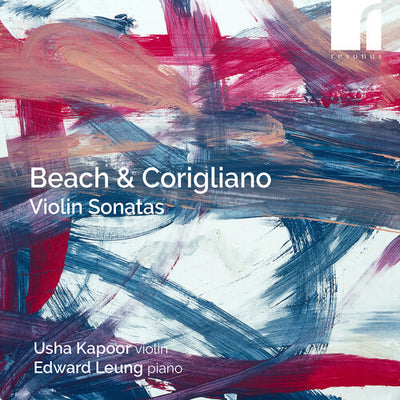
Winners of the First Prize at the inaugural Birmingham International Piano Chamber Music Competition, violinist Usha Kapoor and pianist Edward Leung present an album of violin sonatas by American composers Amy Beach and John Corigliano. The album features Beach’s large-scale chamber work of 1896, the Sonata for Violin and Piano Op. 34, and her earlier Romance for Violin and Piano, Op. 23 from 1893, together with Corigliano’s Sonata for Violin and Piano. Completed in 1963, this work was originally called ‘Duo’ and is very much intended for two equal musical partners.
Francois-Xavier Roth and the Gurzenich Orchestra Cologne explore the beginnings of Anton Bruckner's symphonic oeuvre on the way to the complete recording of the symphonies. Between Linz and Vienna, the organist from the modest provinces, "half genius and half fool", as contemporaries described him, found his symphonic language. At the age of over 40, he composed his first "real" symphony.
Bruckner‘s Third - a creative history that is unique even for the great Austrian romantic. No other of his symphonies has been revised, reshaped and reissued more often. Yet the first version from 1873, which François-Xavier Roth has chosen for this recording, bristles with boldness and the joy of experimentation. Here, the reminiscence of Beethoven‘s Ninth and the works of the dedicatee Richard Wagner is almost tangible. With this recording, François-Xavier Roth and the Gürzenich-Orchester Köln continue the highly acclaimed Bruckner Symphonies cycle and, with great attention to detail, once again present the „unvarnished“ Bruckner, groundbreaking, virtuosic and refined.
Vale - A pastoral symphony, Tristan - still, Pluen (feather)
Signum Classics
CD
$20.99Apr 24, 2026
This new album presents three major orchestral works by British composer William Mival, performed by the Philharmonia Orchestra under Martyn Brabbins. Spanning two decades, the album features the expansive new symphony Vale, the contemplative Tristan - still, and the Welsh-themed Pluen (feather). Together, they trace Mival's engagement with tradition and landscape. From the concentrated focus of Tristan - still to the folk-song variations of Pluen and the broad, five-movement design of Vale, the recording offers a clear overview of Mival's approach to writing for large forces.
Walton: Violin Concerto; Portsmouth Point; Suite from Troilu
Chandos
SACD
$21.99Apr 04, 2025
Sinfonia of London and John Wilson start a new series of recordings of works by Sir William Walton with this album featuring Charlie Lovell-Jones as soloist in the Violin Concerto. Lovell-Jones has soloed with major orchestras internationally, broadcasting on radio and television. As leader of the multi-award-winning Sinfonia of London, he has performed at the BBC Proms and recorded numerous albums, and is the winner of a number of significant international competitions. Commissioned by Jascha Heifetz, the Concerto was premiered in 1939, in America, and was enthusiastically received. Inspired by Walton's friend and lover Alice Wimborne, the work is extremely lyrical and passionate in nature, sporting a wild, virtuosic Tarantella as the second movement. Alice was also a driving force behind the inception of Walton's first grand opera, Troilus and Cressida, composed over almost a decade, largely after her untimely death. Here we hear the four-movement orchestral suite compiled in 1987 by Christopher Palmer, at the instigation of Lady Walton and his lifelong publisher OUP. Walton's overture Portsmouth Point is the earliest work on the album, premiered in 1926.
Arthur Honegger's song output falls into two distinct periods. The first spans his apprentice years from 1914 - the date of the first of the 4 Poemes H.7 - to 1924. He returned to art song on the eve of the Second World War, and Eleni-Lydia Stamellou sings two further sets of songs originally conceived as film accompaniments. In the 4 Poems there is a Debussyan turn to the harmony which mirrors the symbolist flavour of the text. More distinct from the model of Debussy is the album's title track, 'Petite Chapelle', with it's avowedly spiritual character. Honegger conceived his 3 Poemes de Paul Fort in the autumn of 1916. Here the relationship between music and text is more directly illustrative, as in the distant hunting horns to accompany the hunter lost in the forest. From February 1917, Nature morte stands alone as a musical still-life, a brief sketch of a bowl of peaches and white grapes. No less epigrammatic, but more musically adventurous as befitting the text, are Honegger's settings of the 6 Poemes d'Apollinaire which he composed between August 1915 and March 1917. But, for all Apollinaire's influence over the composers of 'Les Six' - Honegger included - Jean Cocteau was far more instrumental in determining their aesthetic aims. And though it was Apollinaire who had coined sur-realisme in response to seeing the premiere of Satie's ballet Parade in 1917, this new, mischievous spirit courses through Honegger's deft settings of Cocteau. Honegger makes a sincere tribute to one of France's most celebrated Renaissance-era poets in the Chanson de Ronsard from February 1924. From 1926, the 3 Chansons de La Petite Sirene feature whole-tone rising harmonies in the opening song, and the even briefer companions uphold a Satie-like inscrutability. At this point, Honegger continued in vocal music (operas, operettas and oratorio) but left song alone. However, in 1937, his soundtrack to Jean Choux 'talkie' remake of Louis Mercanton's 1920 silent film Miarka, la fille à l'ourse afforded an opportunity to write two brief songs. Eleni Lydia Stamellou's recital closes with another pair of songs written for the cinema, the Romances sentimentales for Un seul amour, a story by Balzac very loosely adapted for the screen by Pierre Blanchar. In a genre all their own are the settings of 3 Psaumes, which Honegger composed in occupied Paris over the winter of 1940/1. The sound of the organ underpins the Bachian flow accompanying Psalm 34 and the misty F minor chords beneath Psalm 140, even if the vocal line itself harks back to Honegger's song-writing of the 1920s. Other information: - Recorded April-December 2024 in St Petersburg, Russia - Booklet in English contains liner notes by Peter Quantrill and profiles of the musicians - Arthur Honegger (1892-1955) was a Swiss composer associated with the French musical movement Les Six. Known for his eclectic style, he blended elements of French impressionism, German romanticism, and modernist techniques. While Honegger is best known for his orchestral works, such as Pacific 231 and Jeanne d'Arc au bûcher, his vocal compositions show a more intimate and lyrical side of his artistry. - Honegger's songs reflect his deep sensitivity to poetry and text, setting works by prominent French poets like Paul Fort and Jean Cocteau. His melodies for voice and piano exhibit rich harmonic textures and expressive phrasing, demonstrating both refinement and emotional depth. Unlike his orchestral pieces, which can be complex and rhythmically driven, his songs favor clarity and directness, allowing the poetry to shine through. - Greek soprano Eleni Lydia Stamellou was Prize Winner at the Ferruccio Tagliavini Competition in Austria, with Dame Joan Sutherland as the president of the jury. She subsequently attended masterclasses given by Teresa Berganza, Edda Moser and Christa Ludwig. She sang in opera productions with MusicAeterna conducted by Teodor Currentzis. Her specialization is Renaissance/Baroque and Contemporary Music. She sang in productions of Berio and Hersant.
Just in time for the 200th birthday of Johann Strauss II on 25 October 2025, cpo is releasing the complete recording of a comedy that will itself celebrate it's 130th anniversary on 4 December. In Waldmeister, the undisputed king of the waltz once again pulls out all the stops and delivers a delightful comedy whose scandalous mix-ups ultimately dissolve in a high-proof punch. It's distinctive taste features a hero with a botanical title (Galium odoratum) and a series of evergreens - above all, the leitmotif and proverbial "Trau schau wem" ("Trust, but check"), which is enthusiastically taken up by friend and foe alike. This live recording was made during the Staatstheater am Gärtnerplatz's guest performance in Vienna and whose new production contributed to this year's Austrian Strauss celebrations.
Bliss: Music for Brass Band / Wilson, Black Dyke Band
Chandos
SACD
$21.99Aug 09, 2024
Sir Arthur Bliss contributed two staples of the brass band repertoire - Kenilworth and The Belmont Variations, whose enduring success inspired arrangers to turn to his other compositions, for example Eric Ball and Four Dances from the ballet Checkmate or Phillip Littlemore's suite from the film score for Things to Come. Three new arrangements have been made especially for this album: Robert Childs' suite from the ballet Adam Zero, and Michael Halstenson's arrangements of Music from the Royal Palaces and Welcome the Queen. Collectively this program reflects the essence of Bliss's compositional style: the inherent drama of his scores for film, ballet, and television and his flair for the ceremonial, especially in the context of his position as Master of the Queen's Music.
Black Dyke Band, tracing it's continuous history back to 1855, is the most recorded band in the world, having produced a discography of more than 350 recordings to date. It is also the most successful contesting band in the world, having won the European Championships thirteen times, the British Open thirty times and the National Championships of Great Britain twenty-four times. In 2023, they appointed conductor John Wilson as their Honorary President.
REVIEW:
The ensemble balance is superb, the internal voicing clear and detailed, the execution punchy, delicate, breezily confident and heartfelt by turn. This is a wonderful album in every way, highly recommended.
— Gramophone
The program is well put together and demonstrates the essence of Bliss’s style.
Mussorgsky: Sorochintsï Fair & Salammbô Suite / Bollon, The Lily's Project
Naxos
CD
$29.99Sep 27, 2024
Based on a story by Gogol, Modest Mussorgsky's unfinished Sorochintsi Fair is a comic opera in which amorous encounters intermingle with a devil's curse. Potentially a compelling and original drama, Salammbo was Mussorgsky's first attempt at an opera. Both works are world premiere recordings of chamber versions arranged by Fabrice Bollon, using only original material as their basis.
Few literary works exerted as strong an influence on European culture in the 19th century as Goethe's play Faust. While several important composers drew inspiration from it, Franz Liszt seems to have had a particularly close relationship with Goethe's masterpiece. He came up with the idea of a symphony 'in three characteristic pictures', each devoted to a key character in the play: Faust, Gretchen and Mephistopheles. Rather than telling the story of the play, Liszt composed a psychological exploration of these three main figures. He was also a pioneer in his use of leitmotifs, i.e. short musical ideas that underline a trait of character or evoke feelings, a process that his future son-in-law, Richard Wagner, would take even further in his operas. This recording presents the original, purely instrumental version of the Faust Symphony from 1854. This gigantic work is complemented by the first of the Mephisto Waltzes, inspired by Nikolaus Lenau's vision of the Faust myth. These two works offer two very different perspectives on Liszt's intense relationship with the character of Faust, and in particular with that of Mephistopheles, around whom many of his compositions are structured. They are key works for understanding Liszt's aesthetic project and the typical nineteenth-century tendency towards a combination of the arts.
Jascha Horenstein (1898-1973) was born in Kiev but studied in Vienna. After a move to Berlin, he became Wilhelm Furtwangler's assistant and during the 1920s he conducted both the Vienna Symphony Orchestra and the Berlin Philharmonic. At this time, he came into contact with Schoenberg, Stravinsky and Nielsen. In 1929, Horenstein became the music director of the Dusseldorf Opera but, with the outset of war, he settled in the US. He conducted some of the major orchestras there but returned to Europe in 1947, where he was much in demand including a close association with the LSO. He is best remembered for his outstanding Mahler and Bruckner performances but, being Russian, he conducted Shostakovich who he knew, and because of his early links with Nielsen, both composers were featured throughout his life.