Hildegard And Her Sisters, Katelyn Bouska, piano. After our first success with Women and War and Peace, Katelyn Bouska put a big smile on my face when she mentioned a second project she wanted to do with Yarlung Records. Kate can play any genre, and we discussed an album celebrating the great composer, mystic, poet, philosopher, scientist, rabble-rouser and visionary abbess Hildegard von Bingen. Hildegard is the first composer for whom we have a definite name in the European canon. She was born in 1098 and died in 1179 at 81 years of age. I was even more enthusiastic when we discussed that Kate and Yarlung would commission new music for the project in Hildegard's honor. To help place Hildegard in wider European history, she was born a mere 32 years after the Battle of Hastings, 47 years before the start of construction of Chartres Cathedral, and Henry IV was Emperor of the Holy Roman Empire after inheriting Charlemagne's throne in Aachen. Kate wanted to return to Samueli Theater at Segerstrom Center for the Arts where we made our first recording together. Aaron Egigian was able to secure dates over Easter Weekend, March 29th, 30th and 31st, 2024, when the concert hall, Kate and our team were available. My fellow recording engineer Arian Jansen and I set up for the recording before Kate arrived, and while I do not believe in frequent divine intervention for such things, we asked Hildegard to "bless the more than 50 vacuum tubes" that we would need to be working perfectly for the recording. With or without Hildegard's intercession, all vacuum tubes worked beautifully for the duration without hiss, pop or crackle. Because Hildegard is best known for her vocal music, we decided to record this album as if Kate's piano were a full choir, stretching from far left to far right in the soundstage. Thanks to the superb acoustics in Samueli Theater, you may hear ambience and extreme high and low notes on Kate's keyboard expanding outside your speakers in your listening room. Unconventional as this may be for a solo piano recording, this was intentional such that the listener can experience more of the sound Kate enjoyed sitting at the piano, as if our ears are Kate's ears while she plays.
J. S. Bach: Sonatas for Viola da Gamba and Harpsichord
Arcana
CD
$20.99Nov 28, 2025
Johann Sebastian Bach, though largely unaffected by the trends of his time, reimagined many older forms with striking originality, shaping the course of Western music. Among his innovations is the sonata for a melodic instrument (such as the viola da gamba) and obbligato harpsichord, where both parts engage in equal dialogue-a model later expanded by his sons and composers like Haydn, Mozart and Beethoven. Following their acclaimed first album dedicated to Corelli's Sonatas Op. 5, Teodoro Bau and Andrea Buccarella now present their second duo recording: the Sonatas for viola da gamba and harpsichord by J.S. Bach, each revealing a unique stylistic approach within a unified form.
Step into a world of musical elegance with this release featuring solo piano interpretations of the most famous compositions by J.S. Bach. This album is a celebration of Bach's genius, showcasing the intricate beauty and emotional power of his work through the expressive medium of solo piano. Performed by Tim Allhoff who has collaborated with an impressive array of musicians and ensembles, including Larry Grenadier, Jeff Ballard, Robbie Williams, Jules Buckley, Vision String Quartet, and many more, this collection promises to deliver a rich listening experience that bridges tradition and innovation. Each piece is thoughtfully crafted to highlight the depth and complexity of Bach's compositions, making them accessible and captivating for both seasoned listeners and newcomers alike.
Beyond The Years - Unpublished Songs of Florence Price
Azica Records
CD
$15.99Jul 26, 2024
With an ever-increasing awareness of the excellence that defined her career, Florence Price is finally receiving the recognition that she deserves. Price won the Wanamaker Prize in 1932, and she was the first Black woman to have a symphony premiered by a major American orchestra. Price was a gifted student, pianist, and organist. She graduated from high school in Little Rock, AR, at age 14. At age 16, she graduated from the New England Conservatory (as the only double major in her class) with degrees in organ performance and piano pedagogy. Price wrote music for everyone– across a range of styles and abilities, and for a variety of forces. Beyond the Years hones in on Florence Price the composer of songs. ONEcomposer has cataloged nearly 150 of her songs (to date), only about half of which have been published.
Beyond the Years highlights Price’s affinity for themes of faith, nature, love, and loss. Amongst Price’s treasures in the archives at the University of Arkansas, Fayetteville, is her well worn copy of Vaccai: Practical Method of Italian Singing, a symbol of her fastidious commitment to writing idiomatically for the voice.
As performed by Karen Slack and Michelle Cann, these songs are receiving new life in the hands of two of the greatest artists of our generation.
Jean-Baptiste Dupont performs transcriptions of works by Johann Sebastian Bach on the organ of Saint-Sernin. The layering of composition, transcription, instrument, and interpretation emphasizes the polyphonic depth and dynamic colouring of the pieces. Timeless masterpieces merge with the expressive potential of the Cavaille-Coll organ, itself a masterpiece of the 19th century.
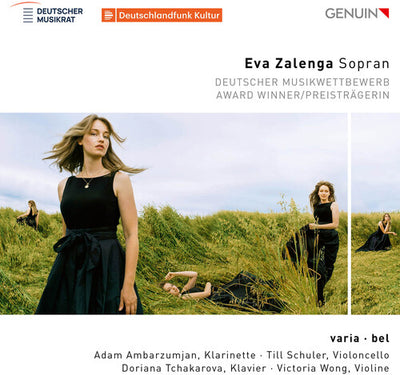
Eva Zalenga, winner of the German Music Competition, makes her GENUIN debut with an album featuring colorful and striking music for soprano and diverse instrumental ensembles. Highlights include a world premiere recording of Ignaz Lachner's work, a rare find by Darius Milhaud, and renowned repertoire such as Schubert's "Der Hirt auf dem Felsen" and songs by Rebecca Clarke and Pauline Viardot. Eva Zalenga's "fine, light, and lyrical" soprano brings fresh interpretations to these works. Another standout is the revised version of Isabelle Aboulker's "Je t'aime", developed directly with the composer.
On one side, Francesco Corti, one of the most internationally acclaimed harpsichordists and protagonist of five acclaimed albums released by the Arcana label. On the other, Ilya Gringolts, making his debut for the same label: a violinist of extraordinary versatility, committed to contemporary music but also animated by a deep passion for the Baroque repertoire and historically informed performance. Proof of this is his recording of Locatelli's Il labirinto armonico (2021), which was awarded the Diapason d'Or and selected as Editor's Choice by Gramophone. Two artistically different but complementary personalities, united for years in a successful partnership, tackle a milestone of chamber music: the first great example of concertante sonatas for keyboard and melodic instrument. Completing the programme is Tertia deficiens, a piece by contemporary composer and Baroque violinist Andrew McIntosh (Grammy nominee), commissioned specifically for this project with the aim of creating an evocative bridge between past and present.
The three Suites recorded on this CD (BWV 1007, BWV 1008 and BWV 1010) were transcribed for guitar by the performers themselves, following a practice customary for Bach and absolutely familiar to him (the Fifth Suite for cello has come down to us in two versions, one for cello and one for lute: we are not sure which came first). One should therefore recognise the full aesthetic legitimacy of the guitar transcription of these compositions, a practice, moreover, that has now been established for decades. This procedure is ultimately legitimised by the primacy, in Bach’s language, of the harmonic and contrapuntal dimension over their sonic realisation, a primacy that led Ferruccio Busoni, for whom the concept of “transcription” occupies a position of absolute centrality in his aesthetic thought, to transcribe for piano not only numerous compositions for organ by Thomaskantor, but also the Chaconne from the Second Partita in D minor for solo violin. With specific regard to the guitar, one cannot fail to mention the name of Andrés Segovia, who transcribed for his instrument and recorded in 1946 the highly famous Chaconne.
Second instalment in the ongoing complete Ferdinand Ries (1784-1838) symphony cycle by Tapiola Sinfonietta and conductor Janne Nisonen includes the composer's Symphonies Nos. 4 and 5. Often remembered in music history as Beethoven's 'right hand', these new recordings by the Tapiola Sinfonietta reveal a major symphonist. The first volume in the series has received oustanding reviews in the German music press.
Naples and Venice were two of the most important centers for music in Italy in the 17th and 18th centuries. On this new recording of baroque recorder concertos from Italy, the Bremen Baroque Orchestra and Clara Guldberg Ravn once again demonstrate their great joy of playing and the highest quality of baroque performance practice. In addition to well-known works by Antonio Vivaldi and the recorder evergreen by Giuseppe Sammartini, the young Danish recorder player has also ventured into rather unknown baroque works by the Neapolitan Nicola Fiorenza and the Swede Johan Helmich Roman.
Méditation: Keyboard Works by Bach, Couperin & Others / Andreas Staier
Alpha
CD
$15.99$20.99Save 25%Feb 16, 2024
Andreas Staier’s informed and inspired interpretations have left their mark on the discography of both the harpsichord and the fortepiano and have enabled us to see Bach, Mozart and Schubert in a completely new light. This is Staier’s first solo album of a projected series for Alpha Classics, in which he also presents his own compositions for the first time. “Two motifs connect the works in this recording: the first is a ancient cantus firmus, a melody in long notes […] the second is the interval sequence of octave, fifth, sixth, and third. […] Anklange, my six pieces for harpsichord, grew out of several conversations I had with the composer Brice Pauset about what it means to compose in our time, and in particular what it implies to compose for historical instruments. This led me to ask myself how I could express and capture my own conception of music in notes, marked as it is not only by Byrd, Bach and Schubert, but also by the music of the 20th and 21st centuries."
REVIEW:
This release is a good example of Andreas Staier’s intelligent program building, both intellectually and musically speaking. Two motifs form a thread that runs through most of the works assembled here. One is the note sequence E–F-sharp–A–G-sharp–F-sharp–E that appears in Johann Caspar Ferdinand Fischer’s E major Prelude and Fugue from Ariadne Musica, Bach’s E major Prelude and Fugue from The Well-Tempered Clavier Book II, plus Froberger’s Fantasia II and Ricercar IV (the latter transposed to begin with G). The other motif is based on a sequence of intervals: octave, fifth, sixth, and third. Other pre-Bach composers include Louis Couperin and Johann Joseph Fux
At the recital’s midpoint, Staier features his own six pieces for harpsichord composed in 2020 that comprise a suite entitled Anklänge. His style forgoes tonality for the most part, yet his boundless palette of sonorities, his dramatic registral deployment, and his instincts for when and how to leave space all generate palpable tension and release. The fourth piece, for example, makes arresting use of thick spread chords that resonate for a long time under the fingers, while No. 6 features aphoristic lines that unfold like skywriting, with plenty of air between each utterance.
Indeed, resonance and breathing room characterize Staier’s performing style, which revels in the colorful variety of stops offered on his harpsichord modeled after a 1734 Hieronymus Albrecht Hass model. You’ll notice this in how Staier times and differentiates his arpeggiations of chords throughout the Couperin Pavane, as well as in the melting impact of his masterful finger legato in the Froberger Meditation. Surprisingly, Staier takes a forthright tempo for the aforementioned Bach Fugue, where his octave couplings have a rather upholstered effect that, for my taste, works against the music’s reflective and vocally oriented nature. Still, Staier remains the masterful instrumentalist and thinking musician that has long enamored me to his extensive and wide-ranging discography.
Bach's trio sonatas, once written as teaching pieces for his eldest son Wilhelm Friedemann, show Johann Sebastian Bach at the zenith of his compositional art: three independent voices engage in a captivating dialogue, combining cantabile melodic lines with an artful yet natural-sounding counterpoint - all embedded in an experimental formal design and balanced proportions. Martin Neu makes this core repertoire his own with his lively and eloquent interpretation on the Ahrend organ in Herzogenaurach. The unusual directness and proximity to the pipework of the organ, combined with the excellent acoustic conditions, create a unique sound experience. For the first time, this is also available immersively in Dolby Atmos - a sonic innovation that allows the music to be experienced with unprecedented intensity.
J.S. Bach: Toccata, Partita & Suites for Solo Violin - Metam
Arcana
CD
$15.99$20.99Save 25%Apr 04, 2025
Though naturally closely associated with the organ and harpsichord, Bach had a special relationship with the violin, his father's instrument, throughout his life. Moreover, we know that he was a highly skilled player, performing regularly at the court of Weimar, and probably also at Kothen and Leipzig. He wrote and transcribed concertos and sonatas for violin, but above all created the unprecedented collection of Sonatas and Partitas for solo instrument. And it is precisely for this vehicle of pure virtuosity that Marco Serino's new project offers four masterpieces, only one of which - the Partita No. 2, the most ambitious work in the group - has survived in a version for violin. Both the first two Suites for cello and the Toccata and Fugue BWV 565, however, already boast an important tradition of violin transcriptions. Pervaded by the virtual polyphony so characteristic of the celebrated Sei solo, these extraordinary pieces, which are presented from a different perspective than usual, celebrate this art of transformation pursued by the artists of the Baroque as an ideal of continuous and fruitful metamorphosis.
Even their genesis seems mysterious: manuscripts of Johann Sebastian Bach's toccatas have not survived. However, it is assumed that the works were composed in the years of his Arnstadt and early Weimar period, when Bach was gradually working his way up to become a renowned organist. And it is no wonder that he chose the toccata as the playground for his development: since the days of the Roman Girolamo Frescobaldi, the toccata was a kind of musical laboratory in which one could try out anything with impunity. There are virtuosic, glittering improvisations next to strict but extremely energetic fugues, expressive arias next to lively, folksy dances. Bach has thus compiled entertaining suites and potpourris with great freedom, but always allowing them to breathe under great dramatic arcs. Jonathan Ferrucci is certain that the toccatas are among Bach's most interesting piano works. 'He is bubbling over with ideas and always creates abrupt contrasts when you least expect them. There is this wild, youthful energy with which he explores all the affects and formal possibilities of the music of the time. And when I play, I feel as if I'm composing the music together with Bach in the moment - that's because of this incredible spontaneity and his delight in invention.' Born in Florence to Italian-Australian parents, Ferrucci's childhood was already characterised by the glorious history of the Renaissance and Baroque periods and the vast Australian landscape.
Pianist Luisa Imorde, deeply inspired by Brahms, presents an album of his works, contextualizing his music with pieces that influenced him, like those by Bach and other Baroque composers. Through her sensible and virtuosic playing she engages with musical traditions, creating a dialogue between compositions and earlier works, just like Brahms had done before her.
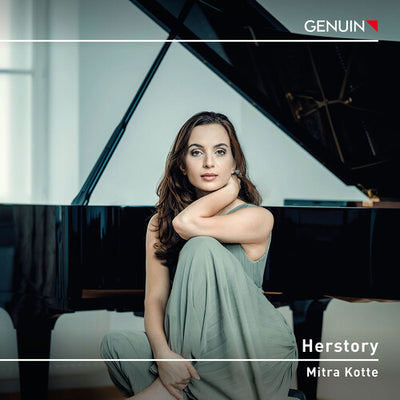
Her Story rather than "His Story": On her new GENUIN album, the remarkable Austrian pianist Mitra Kotte reexamines music history, placing women composers of the 19th and 20th centuries at the forefront. How many people truly know the works of Dora Pejacevic, Louise Farrenc, Cecile Chaminade, or Emilie Mayer as they deserve? Mitra Kotte, a prizewinner at international competitions, sheds light on a long-overlooked chapter of music. With great passion and the highest technical mastery, she introduces us to exquisite gems and profound works that leave us marveling both visually and aurally!
Concerto Copenhagen, the renowned baroque ensemble, is set to release their third album on Berlin Classics, featuring a fresh exploration of Haydn symphonies. The album highlights Haydn's Symphonies No. 47 "Palindrome," No. 44 "Trauer," and No. 43 "Merkur." Known for their innovative interpretations, Concerto Copenhagen brings a new spirit to these classical masterpieces. Haydn, who composed 140 symphonies throughout his life, played a pivotal role in shaping the classical music form and style, influencing giants like Mozart and Beethoven. This album promises to offer a captivating journey through Haydn's enduring legacy.
“[Bach] speaks to us in his work in such clear terms that we may quite well call these fugues poems. (…) These have warmth, quiet joy, love. And running through all the poems, dressed in different guises, is the main theme, creating order, binding the work as a whole together: it is a safe bond in all its diversity. Over all lies the proximity of death.” (Enzio Forsblom)
In this new recording, Bach’s final magnum opus is played by Aapo Häkkinen on a harpsichord built in 1614 by Andreas Ruckers the Elder (1579–?1652) and which belonged to the composer John Blow (1649–1708), organist of Westminster Abbey and former teacher of Henry Purcell. A tradition exists that G.F. Handel had also played this harpsichord.
BACH reconstructed - Neubrandenburg Concertos based on Bach's originals - On the trail of the wonder of Bach's music: resounding works of art such as the Brandenburg Concertos have awakened the ensemble's spirit of discovery. In order to better understand their inner architecture, their genius, ensemble member Christoph Harer has created baroque transcriptions from Bach's originals in exchange with solos and orchestra and combined them into three "Neubrandenburg Concertos". A harpsichord concerto thus becomes music for three competing string trios. Solo and chamber music are transformed into colorful concerto movements for different instrumentations. And a simple vanitas song is transformed into a dreamy string aria. In the process, la festa musicale reaches top form: solo parts are distributed across the whole orchestra, the concertos are carried by the virtuosity and imagination of many together. The creative play with the originals opens up new, unexpected perspectives on Bach's great music.
Celebrating the 50th anniversary of the internationally acclaimed German Brass ensemble, the album "Overtures" is set to release this September. This milestone collection features a captivating program of opera overtures, showcasing the ensemble's extraordinary talent and versatility. Listeners will be treated to stunning renditions of Verdi's "Nabucco," Mozart's "Le nozze di Figaro," Shostakovich's "Festive Overture," and many more timeless masterpieces. Each performance captures the grandeur and emotion of these beloved works, brought to life by the ensemble's impeccable artistry. In recognition of their outstanding contributions to classical music, German Brass was awarded the prestigious ECHO-KLASSIK in 2016. To mark their 50th anniversary, the ensemble will embark on a special anniversary tour in 2024, bringing their celebrated performances to audiences around the world.
THE CITY AND THE SEA project is a bridge connecting artists from two corners of the world - a valued American choirmaster and composer, originator of the idea of a virtual choir, Eric Whitacre, and a young Cracow composer - Klaudia Rabiega. The presented works were mostly composed to texts by well-known Anglo-Saxon poets. The compositions fit into the genre of vocal and instrumental chamber music in which the choir is equivalent to the other instruments with the piano keeping the whole together. Klaudia Rabiega knows how to compose choral music; she is perfectly at ease in the polyphonic vocal texture, and her musical language evolves in search of a balance between modern and creative style and simple language accessible to listeners. The project, which includes world premiere recordings, was implemented by excellent musicians associated with the Cracow music scene, and the whole was supervised by the charismatic conductor Andrzej Korzeniowski.
J.S. Bach, Rachmaninoff, Reger & Schubert: Sparks of Spirit
Audite Musikproduktion
CD
$20.99Apr 05, 2024
On its second CD, the piano duo Neeb presents works that illustrate the beginning of an auspicious period in the life of various composers: Full of creative energy, Max Reger threw himself into creative work after surviving years of health and mental strain. Franz Schubert fared similarly after an attack of syphilis, who, in addition to a permanent position at Esterházy Palace, was even inspired to new creative vigour by a secret love. Johann Sebastian Bach was motivated to write new concert repertoire by conducting the high-calibre Collegium Musicum, while Rachmaninov overcame his depression with the Suite op. 17, which had prevented him from composing for three years after the failure of his first symphony. The piano duo Neeb illuminate these emotional worlds in their intelligent interpretation - with creative imagination and effervescent joy of playing.
25 years of La Cetra Basel! To celebrate this anniversary, La Cetra and Arcana are releasing the "greatest musical masterpiece of all time", as the work was called in the 19th century: Bach's Mass in B minor. "It is a dream come true to have recorded this work for La Cetra's 25th jubilee - the best birthday present ever!" says maestro Andrea Marcon. Under his direction, La Cetra Basel has made a name for itself in recent years with acclaimed interpretations of J. S. Bach's most important sacred works. Featuring top-flight soloists, this recording presents Andrea Marcon's particular vision for this Mass, notable for the division of voices between "concertists" and "ripienists". The sonority and character of each movement emerge from the skilfully crafted balance between solos and tuttis, creating a three-dimensional sound reminiscent of a three-manual organ. The result is a unique tonality, full of fresh nuances and colours, and no doubt very close to what Bach had imagined.
This recording is the result of my encounter with the Stephen Paulello Opus 102. From the very first notes, I was captivated by the sound of this piano. I had the wonderful feeling that I could shape the sound, dig into it, and discover it's richness-so that, little by little, it's beauty and depth unfolded beneath my fingers. Rich, transparent, and warm all at once, the Stephen Paulello Opus 102 struck me as the ideal instrument to reveal the essence of J.S. Bach's Art of Fugue.
The latest volume in an ongoing series by an acclaimed Bach specialist on the modern piano. With recordings of the French Suites, Partitas and Goldberg Variations on Piano Classics, the Chinese pianist Yuan Sheng has placed himself among the most searching of present-day Bach pianists. As Jed Distler remarked in Gramophone, reviewing the Goldbergs, 'Yuan Sheng's disciplined, scrupulously terraced style often reflects his mentor Rosalyn Tureck.' In a new and illuminating booklet essay for this album, the musicologist and pianist Raymond Erickson remarks that the 15 two-part Inventions and the 15 three-part Sinfonias played an important role in Bach's teaching. These pieces, although today mainly associated with basic piano training, are not at all easy and in fact are sophisticated, small-scale masterpieces. 'They were not composed simply to provide technical training in keyboard playing but, perhaps more important, to teach keyboard players how to compose.' In 1720 Bach's oldest son Wilhelm Friedemann (1710-84) was already of an age appropriate for introducing him into the family trade of musician. So Bach started for him a music notebook: a Clavierbuchlein which included these Inventions and Sinfonias. Bach revised them shortly before moving to Leipzig in the spring of 1720, to take up his new post as Thomaskantor, and copied them out with a preface. In learning and playing these works, Bach affirmed, a diligent student would be taught 'a clear manner for playing not only in two voices but also in three obbligato parts and, furthermore, not only how to invent good musical ideas [inventiones] but also how to develop these well. And above all, how to achieve a cantabile manner of playing, and additionally to obtain a strong foretaste of Composition.' So it is that the Inventions and Sinfonias have given much pleasure to both performers and listeners throughout the subsequent two centuries. Brief as they are, each one of these 30 works elegantly outlines a distinct and often playful world of it's own. They reward intensive listening both on their own and in sequence. And Yuan Sheng's performances draw on all the coloristic possibilities and varieties of articulation available on the modern piano, without seeking to exceed the bounds of style which the works themselves inhabit.
Handel: Water & Fire / Sinkovsky, B'Rock Orchestra
PENTATONE
CD
$19.99Jul 14, 2023
With Water & Fire, B’Rock Orchestra and Dmitry Sinkovsky present Handel’s Water Music alongside his Music for the Royal Fireworks. Both works were written for royal open-air ceremonies, were likely substantially drowned out by the noise of fireworks and the waves of the Thames during their first performance, and were never played again during Handel’s lifetime. Since then, they have, however, become favourites of the public, and they contain some of the most appealing instrumental music of the baroque era. B’Rock performs these works with an ensemble that approaches the ca. 50 musicians that Handel originally employed, conveying the pomp and splendour while also highlighting the coloristic richness and refinement of Handel’s scores. B’Rock Orchestra is one of today’s most forward-thinking period orchestras with a desire for encounter and exchange. The ensemble returns to Pentatone after having released Schubert’s complete symphonies with conductor René Jacobs between 2018 and 2022, as well as Antwerp Requiem c. 1650 (2022). Dmitry Sinkovsky is in demand as a conductor, violinist and countertenor, and previously appeared on Pentatone with Monteverdi: Il delirio della passione (2021).
Carlo Mazzoli and Silvia Rambaldi, passionate scholars of historical instruments and performance practice of early music, were teachers for many years - respectively of Piano and Harpsichord - at the Conservatorio "G.B. Martini" in Bologna, where they realised numerous teaching and concert projects. They have had a constant point of reference in Maestro Luigi Ferdinando Tagliavini, with whom they have collaborated assiduously in the activities of the San Colombano Museum in Bologna, which has housed it's collection of historical instruments since 2010; they are both present with some performances, both solo and in duo, in the DVD Il vibrar dell'aria dedicated to the Museum. It was precisely with performances on these ancient instruments that the study of Clementi's works for duo began, leading to this first complete recording.
Johann Sebastian Bach never hesitated to adapt, rework and truly metamorphose his own music with remarkable aplomb. There is no shortage of examples. It is this model of transcription that the D!ssonanti ensemble has sought to follow in the programme on this disc. With the notable exception of the Ciaccona BWV 1004, originally written for solo violin - and already the subject of countless transcriptions throughout the ages - they have for the most part drawn on the keyboard repertoire, and in particular the great organ, an instrument that is both fascinating and sometimes a little intimidating. The Passacaglia and Thema Fugatum BWV 582, almost always written for four voices, is the culmination of this repertoire. Each of the members of the ensemble, in the course of a busy life spent in contact with Bach's music played on period instruments and with a concern for authenticity in the most prestigious ensembles (Les Arts Florissants, Pygmalion, Freiburger Barockorchester, Amsterdam Baroque Orchestra, Concerto Copenhagen...), have acquired sufficient proximity to his musical language to respect, if not the letter, at least the spirit. "Our hope is to use these adaptations to show Bach in a light that is both new and familiar. A protean Bach that we've had a lot of fun imagining - and the treasure chest we've opened is not about to close again...".
This sixth instalment of Masaaki Suzuki's critically acclaimed complete organ works by Johann Sebastian Bach presents the first eleven pieces from a manuscript since referred to as the Leipzig Chorales. Conceived around 1739, this collection is unusual in that it contains no new compositions, but rather 'reworkings' of organ chorales dating from the years 1708-17, when Bach was in Weimar. The chorale arrangements are based on established Lutheran melodies that particularly appealed to Bach. They were not intended as preludes for congregational singing, but rather as music to accompany the communion service or as concert music. Bach took great care with this project, selecting the best of his organ music from earlier in his career, and saw it as his legacy for the future. Together with the Orgel-Buchlein, the Schubler Chorales and the third book of the Clavier-ubung, the Leipzig Chorales represent the pinnacle of Bach's sacred organ music. On this recording, Masaaki Suzuki plays the Arp Schnitger organ of the Martinikerk in Groningen, the Netherlands, one of the largest and most famous baroque organs in Northern Europe. Arp Schnitger was the most famous organ builder in northern Germany in the seventeenth century, and his admirers included Buxtehude, Handel and Bach himself.