In 1955, the conductor Gary Bertini founded the Rinat Choir and thus established professional choral music in Israel. The founding of the Rinat had a significant influence on the development of the Israeli choral scene; the choir was finally named the national choir in 1972. Psalms, verses and hymns were set to music for the Rinat Choir by the country's leading composers and transformed into extensive Hebrew motets and oratorios. The founding generation of Israeli music consisted of outstanding professional musicians who were born in Europe around the turn of the century. Although these composers came predominantly from Germany, Eastern Europe and Russia, their sources of inspiration can by no means be reduced to the music of their respective countries of origin. On the contrary: what united many of these composers was their fascination with the traditional music of the Jews, especially of Sephardic, Persian and Yemenite origin, and with the music of the Arabs they encountered in Palestine. The next generation of Israeli composers were not necessarily born in Israel either, but were strongly influenced musically by this country from the very beginning. In the 1960s and 70s, this generation disseminated their inspirational sources and borrowed from contemporary styles that they had become familiar with during their studies in Europe and the USA. While some representatives of this generation carried on the tradition of the founding generation, other composers introduced current developments in the musical world into the Israeli art music of their time. The pool of influences was also expanded to include American composers such as Aaron Copland, George Gershwin, John Cage and Lukas Foss.
Bach: Sonatas for Violin and Keyboard / Kaakinen-Pilch, Hakkila
Ondine
CD
$13.49$26.99Save 50%Jan 12, 2024
The son of Johann Sebastian Bach (1685–1750), Carl Philipp Emanuel, described his father’s Sonatas BWV 1014–1019 as among the best works his father ever wrote and continued to perform them extensively after his father’s death. This is music of implication and inference, the emotions no less real for their apparent lack of specificity. There is pleasure in the paradox: even without a text, the music sings. “They still sound very good and give me much joy, although they date back more than fifty years. They contain some Adagios that could not be written in a more singable manner today”, writes C. P. E. Bach. In these new recordings, some of the greatest exponents of Baroque music in the Nordic countries, violinist Sirkka-Liisa Kaakinen-Pilch and keyboardist Tuija Hakkila join forces. Tuija Hakkila plays copy of a Gottfried Silbermann fortepiano 1747 by Andrea Restelli — J. S. Bach played one of his fortepianos in 1747 in Potsdam for Frederick the Great and his court musicians.
Originally issued on the 2LP set Nativity in 1976, this classic Vox recording is a fine example of Robert Shaw’s expertise as a choral conductor. The album features a selection of carols, choral works and orchestral Christmas favourites performed by the Atlanta Symphony Orchestra and Chorus. Produced by the legendary Elite Recordings team of Marc Aubort and Joanna Nickrenz, and newly remastered from the original analogue tapes in high-definition.
Selections from King of Kings - Organ Music of Black Compose
GIA
CD
$18.99Jun 07, 2024
This recording highlights the tremendous contribution of black composers to the repertoire of church and concert organists. Includes organ works by composers from the late nineteenth century to the present day. The masterfully arranged spirituals and dynamic original compositions can add the perfect touch to a worship service. Artist Nathaniel Gumbs has been recognized as "one of 20 outstanding organists under 30 years old for his achievement in organ performance and church music (The Diapason magazine, 2017). The Newberry Memorial Organ, in Woolsey Hall at Yale University, heard on this recording is one of the most renowned Romantic organs in the world.
As the progenitor of a style whose influence more or less came to define the instrumental music of the High Baroque, Arcangelo Corelli (1653 - 1713) occupies a position in music history as unenviable as it is to his great credit. Just what made Corelli’s style seem strikingly novel to his contemporaries is a tricky question. To be sure, his standardization and popularization of certain formal tropes – most notably the succession of movement types in Sonate da Camera and Sonate da Chiesa – was a significant part of what his followers considered the ‘Corellian’ manner.
But Corelli’s actual compositional style, his way of organizing musical thoughts into phrases and motives, is fundamentally derived from the expressive capabilities of his chosen instrument, the violin. Certain melodic patterns used to modulate and to effect sequences (e.g., chains of sevenths and fifths) basically derive from specificities of violin technique that amplify an instrument with origins primarily in dance music into one that in Corelli’s hands, could imitate the rise and fall of the sung and spoken human voice. This tension between idiomatically instrumental techniques and the evocation of the voice is the defining characteristic of Corelli’s style throughout all his surviving works and would establish the “Roman School” as the supreme measure of musical taste for generations.
For this exploration of the 18th century’s Corelli Craze, the dynamic star trio of Mahan Esfahani, Hille Perl and Michala Petri unite to trace the Roman’s influence, (sometimes in name only...) on the musical legacies of Bach, Händel and Telemann, and of course two works from the pen of the celebrated Italian Master, himself. Gramophone about the Petri/Perl/Esfahani Trio’s Bach recording: “While the tonal and expressive range of the recorder, viol and harpsichord may appear constrained in comparison to, say, flute, cello and piano, in the hands of foremost players such as these, even a relatively lightweight work such as the C major Sonata, BWV1033, comes over as the ideal demonstration of a particular facet of the composer’s style and the performers’ abilities.”
By popular demand, this Berlin Classics recording will be reissued on Vinyl. Handel's famous Suite"Watermusic" is one of the most well know and loved pieces of classical music from the baroque period. This historically informed interpretation stands out through ist clear articulation and historically accurate interpretation. This recording is a must-have for every classical music record collection.
Released on the occasion of the Swedish Radio Choir's centenary, this recording brings together works that testify to the richness and the vitality of the internationally acclaimed Swedish choral tradition. The programme features twelve extremely varied works, demonstrating the openness, versatility and flexibility of the Swedish Radio Choir and it's multi-award-winning conductor, Kaspars Putnins. It also pays tribute to the pioneering work of the choir's long-standing choirmaster Eric Ericson, whose work has influenced and inspired composers from many generations. The older works, by Ivar Wideen, Lars Johan Werle, Lars Edlund and Ingvar Lidholm, draw on ancient, secular and religious traditions, from Gregorian chant and madrigals, and combine clear melodic lines, glissandos, chants, whispers and traditional harmonies to create a language that is both modern and accessible. More modern works by Anders Hillborg, Britta Bystrom and Johannes Pollak and explore the human voice and it's possibilities in every conceivable way. Staffan Storm, Ulrika Emanuelsson and Anna-Karin Klockar pay tribute to the great Swedish Romantic Hugo Alfven in pieces composed for the 150th anniversary of his birth. Finally, Arne Lundmark and Jan Sandstrom adapt existing folk and religious pieces and 'expand' the musical content, offering a vision that is both personal and respectful of the original work. The Swedish Radio Choir and Kaspars Putnins invite you to celebrate a century of Swedish musical history.
Sometimes, dreams come true. For Francesco Tristano, the dream was twofold: first a desire to project his art in the future by devoting himself to one of the most incontestably timeless figures in the history of music, Johann Sebastian Bach. This profound desire fuelled the creation of intothefuture, Francesco Tristano's very personal line of recordings, where sounds morph into an abstract and subtly poetic photographic imagery, which is found in the booklets. This first of these recordings, dedicated to the six Partitas (BWV 825 to BWV 830) is a perfect illustration of this concept. For this pianist from Luxembourg, this collection constituted the starting point of his patient exploration of Bach's work. In fact, it also represents the composer's supreme achievement in the genre of the keyboard dance suite. Also known as the "German suites", to differentiate them from the two collections of "English" (BWV 806 to BWV 811) and "French" (BWV 812 to BWV 817) suites, the 6 Partitas belong to the rare compositions that Bach had published during his lifetime, as the first part of the Clavier-ubung - from 1726 to 1730, then all six in 1731. Composed separately, probably one after the other, these six suites, an infinite kaleidoscope of moods, were to embody his plural and abundant art, in a supreme synthesis of the tastes of the time. With their lively tempos (Partita III, Fantasia; Partita I, Allemande; Partita V, Tempo di Minuetto; Partita VI, Corrente), their very lively phrasing (Partita I, Gigue; Partita II, Capriccio; Partita VI, Toccata; Partita II, Courante), the six Partitas according to Francesco Tristano, a musician with an inexhaustible vivacity of mind, celebrate life everywhere. This impression of a whirlwind, this sense of movement are irresistible! Once again, Francesco Tristano is here in a class of his own. 24 SEPTEMBRE 2024
Chopin is said to have played in time (the metronome was always on the instrument), his left hand relentlessly keeping the tempo. Students also reported that he never played a piece in the same way, and that each performance produced a different result. And yet the composer's rubato playing was by no means as free as it is today. There are no reports of Chopin's playing of Bach in particular, but his admiration for the composer is certain. We therefore put the legend that he himself—according to his own statement—played only Bach for fourteen days before a concert into perspective and simply imagine that he worked intensively on "Bach" before his already rare performances. We can assume that the preludes and fugues of the "Well-Tempered Clavier," some of which are also heard in this project, were the focus of his interest.
A closer look at Chopin’s works, especially those of a smaller dimension, repeatedly catches the eye of modules that we think we already know from Bach. Individual bars of the Préludes op. 28 (1836-1839) and Études (op. 10 no. 4) (1833/1837) could be retransformed into a nucleus in Bach’s character with just a few “hand movements.” Chopin’s veneration of Bach preserved these highly condensed musical tools of the Baroque composer well into the Romantic century. He still used them in his late works, such as his last Nocturne in E major, which in a sense takes stock of “Bach.”
This recording, which feels entirely experimental, aims to create a unique musical experience through the direct connection of tonal, for example key, variations. The sound of some structurally related works clearly shows how much Chopin was influenced by Bach's work, whose formal stability with its geometric structures often prevented him from sowing too much "tinsel, trinkets, and pearls," something Robert Schumann once had the courage to accuse his rival of. The aim of this project tempted us to play "Chopin like Bach" here and there and to achieve the greatest possible transparency with extremely economical use of the pedal. Above all, to breathe Chopin's breath into Bach's melodic beauties with a "romantic" touch. The approximately 40-year-old Steinway B grand piano was chosen because of its slim bass section.
Luminous, sublime, joyful. The soundscapes and emotions captured in the latest disc from Somerville College Choir abound with light. In this curated selection of music from the Indian subcontinent, you will find a vibrant expression of what might be called the living Indian Choral tradition. As plural and changing as light within a prism, the album moves from the fluid harmonies of a Konkani wedding song to deep somatic meditations inspired by the poetry of Rabindranath Tagore, from Hindi secular poetry associated with the changing seasons to a whole-choir explosion of joyful rhythmic syllables in Reena Esmail's virtuosic raga exposition. In this humble tribute to the monumental tapestry of Indian classical music, the Somerville College Choir gives the oldest expression yet of it's aspiration to embrace musical styles far beyond the liturgical canon.
Fortune Infortune - A Portrait of Margaret of Austria / Elgersma, Seldom Sene
Brilliant Classics
CD
$6.99$13.99Save 50%Oct 27, 2023
The Amsterdam-based recorder quintet has done it again: an original concept, featuring several first recordings, and superb performances which confirm them among the top-tier of today’s early-music chamber ensembles. The present album arises from a concert devised in 2018 for a festival in Bruges celebrating notable female figures from history.
Seldom Sene chose to focus on Margaret of Austria (1480–1530), who was governor of the Habsburg Netherlands for almost 20 years. Margaret had grown up with the benefits of a first-class education afforded to very few of her female peers: she was adept in all the humanities, and her library of books was reckoned one of the most extensive and learned at the time, a fit place to welcome distinguished guests such as Albrecht Dürer. From around 1515, one of the volumes in Margaret’s library was her newly commissioned personal songbook: a collection of 55 chansons and motets, richly decorated with high-quality miniatures and initials.
Many of the song texts speak of loss, sorrow and loneliness, perhaps reflecting her status at the time as a noble widow, following the death of her second husband, Philibert II of Savoy, in 1504. Margaret herself seems to have written several of them, and may also have been involved in their musical setting. Marian devotion is another theme of the songbook reflected in this selection made and transcribed and recorded by Seldom Sene. Sacred hymns are balanced out by secular laments, but also lighter and more cheerful numbers such as ‘Brunette m’amiette‘ and ‘La jonne dame’. Many of the composers are now lost to us and effectively anonymous, but the names that survive are worthy of Margaret’s elevated status, including Josquin and Pierre de la Rue.
‘Like Margaret,’ concludes María Martínez Ayerza in her booklet note, ‘like her courtiers and visitors, we see and hear the music and texts in this songbook and we are moved, stirred. These artworks make us change, as we relate the texts, even the titles, and the rather abstract beauty of the music to ourselves.’ Ayerza and her colleagues in Seldom Sene bring this music and Margaret’s world back to life with intense sympathy. The album is sure to receive the glowing reviews accorded to the group’s discography on Brilliant Classics. ‘Commitment, technical versatility, unanimity of ensemble and near-immaculate tuning on display.’ (Gramophone) ‘An excellent release from an ensemble I hope we’ll hear a lot more from in the future.’ (Fanfare)
With a sure instinct for the extraordinary the Baroque orchestra caterva musica, formed by renowned soloists, release the final installment of their "L'arte del virtuoso" series in time for the ensemble's 25th anniversary. Once more they showcase their virtuosic artistry with distinctive solo concertos by J. C. Bach, Pergolesi, Vivaldi, Telemann and Walther, inspiring 18th century masterpieces that still connect with today's audiences emotionally with their cheerfulness, solemnity or sensuality.
Jerrick Cavagnaro, the First Prize Winner in the 2024 American Guild of Organists' (AGO) National Competition in Organ Improvisation (NCOI), releases his debut solo album with Pro Organo, performing upon the historic, renovated pipe organ of Trinity Church, Copley Square, Boston. The program contains both repertoire selections and several of Mr. Cavagnaro's organ improvisations in a variety of musical styles.
Discover songs to connect, heal, and inspire on the U.S. Navy Band Sea Canter Chorus’ recording “Safe Harbor”. These musicians have played a vital role in comforting America in times of mourning, and this recording follows in those footsteps
"Johann Sebastian Bach used the recorder in two Brandenburg concertos and some twenty cantatas and oratorios, but alas, he left us no sonata with harpsichord," say Julien Martin and Olivier Fortin. Arranging chamber music for a variety of instrumental ensembles was a widespread practice in the eighteenth century. Bach himself seems to have created a number of works that did not necessarily require the use of a specific instrument. Here Julien Martin and Olivier Fortin, musical partners for many years, present the Sonata in F major, originally written for transverse flute and continuo, transcriptions of the Trio Sonata for organ No. 3 in E minor, the Partita for violin No. 2 in G minor, and the Chorale 'Nun komm, der Heiden Heiland', whose extensive ornamental flourishes elongate and transform the chorale melody to the point of rendering it unrecognisable.
Spain's Siglo de Oro, the Age of Gold, gave rise to some of the greatest sacred choral music of the Renaissance. Lead, Kindly Light is devoted to the music of two outstanding Spanish composers, exploring majestic works by Cristóbal de Morales, famed throughout Europe and in the New World, and the exquisite polyphony of Sebastián de Vivanco, whose intricately crafted counterpoint adorned services at the cathedrals of Ávila and Salamanca during the late 1500s. Contrasting and complementing these 16th-century masterpieces are spellbinding settings of words by Saint John Henry Newman: Sir James MacMillan's Nothing in Vain for soloists and double choir, and the world premiere of Kerensa Briggs' Lead, kindly light, specially commissioned for this album.
The Wise Men and the Star - A Christmas Collection
Coro
CD
$18.99Oct 03, 2025
Christmas simply wouldn't be Christmas without the iconic voices of The Sixteen providing a soundtrack to the season. Celebrated for collections that provide an alternative to the customary festive offerings, this new album from the world-renown choir is no exception. No other festival in the Christian year has inspired so many composers and such a variety of musical styles as Christmas. The Wise Men and the Star features a veritable cornucopia of yuletide music from the premieres of three new works to traditional carols including Away in a manger and In the bleak midwinter, and modern classics such as Eric Whitacre's Lux aurumque and Mykola Leontovich's Carol of the bells. This new album promises something for everyone.
Featuring timeless melodies from Guide me, O thou great redeemer (known to millions as 'Bread of heaven') to Abide with me, this stunning collection of some of the best-loved hymns of all time from The Choir of Magdalen College, Oxford, accompanied by the College's magnificent Eule organ, offers a glimpse into the daily musical life of this celebrated choir.
Handel's Messiah needs no introduction. This mighty yet majestic masterpiece is the most popular oratorio ever written and includes, arguably, the most famous chorus of all time-the iconic Hallelujah! Handel was a master chorus writer and for Messiah he certainly pulled out all the stops, placing the choir front and centre throughout. Although it has become synonymous with Christmas, Messiah was originally written as an Easter offering, bursting onto the stage of the Musick Hall in Dublin in April 1742. Taken from it's Award-winning 2008 complete recording of Messiah (COR16062), this collection from The Sixteen celebrates the wonderful choruses that have given so many singers, both amateur and professional, such joy and inspired an enduring love for this epic work.
Voices of Thunder - Music for Choir & Organ / Williams, The Choir of Magdalen College at Oxford
Coro
CD
$18.99Nov 15, 2024
Voices of Thunder features a range of spectacular choral pieces that showcase Magdalen College Chapel’s new Eule organ. Following on from Peace I Leave with You, this new album combines the sublime voices of The Choir of Magdalen College, Oxford, with the new and exciting sonorities of the Eule organ. The recording includes music from Joseph Haydn to Judith Weir, as well as Arvo Pärt’s atmospheric Beatitudes, Libby Larsen’s playful I Will Sing and Raise a Psalm, and Hubert Parry’s thunderous Blest Pair of Sirens. The Eule organ was built by Herman Eule Orgelbau of Bautzen in Germany and is the first Eule organ of its kind to have been built in the UK for almost 100 years.
REVIEW:
The installation of a new pipe organ, like any long-awaited new arrival, is always best marked with some kind of celebratory fanfare such as this splendid, generously filled disc. This disc is a triumph for the Magdalen musicians and an equally enjoyable experience from both choral and organ points of view.
The harpsichord concertos of J.S. Bach form the origins of the keyboard concerto genre that was to continue to flourish through the music of his sons, C.P.E. Bach and J.C. Bach, and onwards. Here, celebrated keyboardist Steven Devine is joined by members of the Orchestra of the Age of Enlightenment in this recording that features the Concerto in D minor, BWV 1052, Concerto in A major BWV 1055, and the Concerto in D major BWV1054, together with a new reconstruction by Steven Devine of the Concerto in D minor BWV 1059.
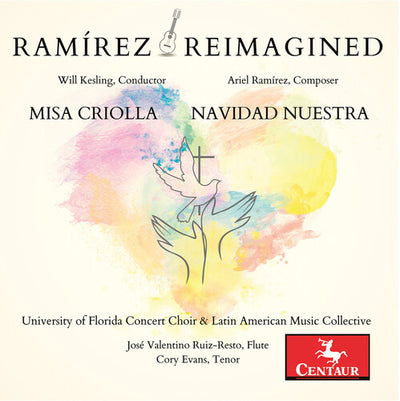
Missa Criolla, by Argentine composer Ariel Ramirez (1921-2010) is a Spanish vernacular setting of Roman mass liturgy. Navidad Nuestra, composed in 1964, is subtitled"A folk drama of the nativity based on rhythms and traditions of Hispanic America"
Josquin des Prez: the name evokes beautiful, brilliant, even magical music—but more than five centuries since he composed his last note, we are still discovering how to hear him. In this album, originally conceived to mark the composer’s quincentenary in 2021, Cut Circle strives to treat Josquin not as a sleepy relic of the distant past but as a stylish, sensitive, playful, ecstatic composer. We foreground his revolutionary precision and drive while embracing reactions to the music that are visceral and emotional.
A Thousand Charms invites listeners into two centuries of English song, from Campion's intimate ayres to Purcell's theatrical masterpieces and Handel's deeply expressive arias. The programme traces how solo song evolved from lute-inspired simplicity to richly ornamented drama, blending poetry with music of striking clarity and depth. Grace Davidson's pure, agile voice and Julian Perkins's sensitive harpsichord accompaniment bring freshness and immediacy to this repertoire, emphasising it's refinement, inventiveness and humanity. For anyone drawn to the beauty of early music, this recording offers an engaging journey through some of it's most timeless works.
A veteran Bach specialist continues his Bach odyssey on Brilliant Classics with a new recording of the English Suites. Previous volumes in this series have met with wide critical acclaim. Of the French Suites, Jed Distler wrote in Classics Today: 'a splendid new recording... these lovely performances memorably showcase Rubsam's sensitive and poetic side.' While Rubsam has been playing and recording Bach's music for over half a century, he brings a fresh perspective, both to the works themselves and his approach to them, by performing on a lute-harpsichord, known in German as a lautenwerk. Of the complete Well-Tempered Clavier, the Gramophone reviewer remarked: 'Like his other Bach recordings using the Lautenwerk, including the French Suites, the so-called Lute Suites and beautiful arrangements of the Cello Suites and Violin Sonatas and Partitas, these are revelatory... one thing's for certain: you'll never listen to any of Bach's music in the same way again.' Bach himself owned a pair of Lautenwerk, and so Rubsam is returning this music to the scale on which it was conceived: more intimate than nearly all the competition on record, perfectly suited to close studio recording and domestic listening. The Suites themselves are hardly English in character (Bach probably wrote them for an English patron) but rather French, more developed in scale and expression than the earlier French Suites, especially in the Third and Sixth of the set. Movements such as the Overture to No.2 and the Sarabande of No.3 have inspired some of the greatest keyboard musicians - on various instruments - to sound the depths of their artistry. Wolfgang Rubsam does so here, yet with a humility that draws the ear back to Bach himself, to the wondrous intricacy of his polyphony, and his particular genius for embodying the character of a dance through the natural shape of his melodies. - The complete 6 English Suites by Johann Sebastian Bach (1685-1750), played on the lute-harpsichord by Wolfgang Rubsam. - There is little "English" about these suites. Their name might have been given as a tribute to Charles Diepart, whose 6 English Suites were very popular at the time. Bach's English Suites follow the traditional sequence of dance movements of the Suite. The writing is mature and technically demanding. The English Suites, along with the French Suites and Partitas, are part of the standard keyboard repertoire. - Wolfgang Rubsam is internationally known as an authoritative Bach interpreter, from recordings of the organ and harpsichord on several different labels. This new recording is played on a lute-harpsichord, an instrument that Bach would have had at home for both music-making in the family and for teaching. The touch required and the sonority produced is delicate, subtly shaded and closely related in it's effect to the music of Bach's French contemporaries, whose music he knew well, such as Francois Couperin, Jean-Philippe Rameau and Louis Marchand. The sound is warmer, as it has gut strings and no dampers.
Five of the best brass players in the world united in a chamber music ensemble: The Reinhold Friedrich Brass Quintett was founded in 2022 and presents here its first CD, UNITY.
For this brass quintet's lifelong dream, world-renowned trumpeter Reinhold Friedrich has brought together the best players in their respective fields, musicians who not only get along extremely well with one another in a musical sense but also on a personal level. In their playing, one can feel their mutual appreciation and their joy in making music together, and, coupled with their unique technical and musical skills, as well as their chamber music experience, this enables the musicians to merge into a single unit.
The players that form this top-class quintet come together from a variety of European countries: Jeroen Berwaerts hails from Belgium and as a former principal trumpeter of the NDR Symphony Orchestra is a much-sought-after soloist who now teaches at the Hanover University of Music, Drama and Media. The Dane, Lasse Mauritzen, who was knighted to the Order of Dannebrog by Queen Margarethe II, is first principal horn of the Copenhagen-based Danish Radio Symphony Orchestra (DRSO). Although Ian Bousfield is British, he now lives in Switzerland and is accustomed to performing around the world as a former principal trombonist with the Vienna Philharmonic Orchestra, as well as being a soloist and a conductor. Fundamental to the quintet is the Norwegian Thomas Røisland, who now lives in Sweden and is principal tuba in the DRSO, as well as playing in other renowned European orchestras.These five musicians are united by their desire to set new standards in brass chamber music for their audiences and to present premiere recordings and commission arrangements of classics that have not yet been recorded at a world-class level.
For his 80th birthday, Ton Koopman has chosen some of his favourite tracks from the many recordings he has made for Challenge Classics / Antoine Marchand since 2002. This is a celebratory collection in four parts: music for organ, for harpsichord, chamber music and recordings with the Amsterdam Baroque Orchestra & Choir. Ton Koopman: "It was, of course, an almost impossible task to draw up a selection from all of the CDs I have recorded for Challenge Records, but I have tried to choose works that are very close to my heart."