Manuel de Falla
41 products
Falla, Tarrega et al: Guitar Intersections / Petricevic
This recording contains guitar music by five Spanish composers of the 19th & 20th centuries, as well as one important Venezuelan master of today. The starting point for our attention here is the work of the Spanish composer, guitarist and guitar teacher Francisco Tárrega (1852-1909), whose "school" influenced numerous Spanish composers who, like Tárrega himself, saw the guitar as Spain's national instrument.
The 19th century was a time when large concert halls were being constructed, something which, as the guitar began to enjoy increasing popularity, became rather problematic for guitarists, particularly as far as the acoustics were concerned. It was the Spanish guitar maker Antonio Torres (1817-1892) who, basing his designs on those of previous guitar makers, combined with the most up-to-date research into acoustics, developed larger instruments, something which Tárrega found vitally interesting, so much so that he developed a new playing technique. Through the evolution of his style of legato fretting and his own particular perception of the diverse timbral possibilities of the guitar, Tárrega created sounds that virtually made the instrument sing.
Passion on 10 Strings - Spanish Music & Tango for Guitar & Viola / Corti, Jonkers
The Spanish pieces on this CD became famous mainly as solo guitar compositions by the three Catalan master pianists Isaac Albéniz, Joaquín Malats and Enrique Granados. I have often played them that way in concerts as well. In 2019, Nicolas and I had the idea to transcribe these works combined with works by Astor Piazzolla for viola and guitar. Since then, we have enjoyed playing this music in numerous concerts. The viola-guitar combination gives these compositions a whole new dimension. Compared to the solo guitar versions, the works appear in a completely new light, allowing the compositions to emit transparency and a variety of tonal colors.
The Spanish music of the CD program alternates with music by one of the most frequently performed works of Manuel de Falla (1876–1946), and the Argentine composer Astor Piazzolla (1921–1992). Piazzolla is considered the great innovator of the Tango, the “Tango Nuevo”. He originally composed the “Histoire du Tango” for flute and guitar. The other compositions are short character pieces, all of which we have arranged for viola and guitar. The two movements “Bordel-1900” and “Café-1930” evoke the history of Tango in their respective eras. “Bordel-1900” goes back to the beginnings of the Tango. The new dance form was played in the brothels of Buenos Aires around this time. As “1930” marked a new era, the Tango was no longer danced as it was around 1900, and people limited themselves to listening to it. The Tango becomes more musical and romantic, the movements become slower, new harmonies are added. The music takes on a strong melancholic streak.
Spanish Classics - Falla: Piano Music Vol 2 / Daniel Ligorio
Includes work(s) for piano by Manuel de Falla. Soloist: Daniel Ligorio.
Spanish Classics - Falla: Piano Music Vol 1/ Daniel Ligorio
Includes work(s) for piano by Manuel de Falla. Soloist: Daniel Ligorio.
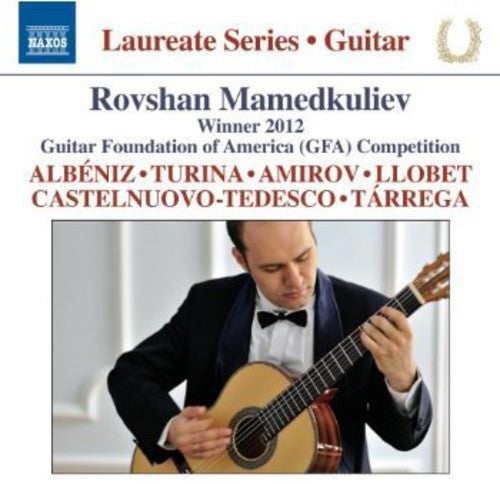
Laureate Series, Guitar: Rovshan Mamedkuliev
Rovshan Mamedkuliev was first prize-winner at the prestigious Guitar Foundation of America Competition in 2012, and now stands as one of the world’s most exciting young instrumentalists. He has constructed a programme with several themes. Iberian music is represented by Falla, Albéniz and Turina, and by two of the titans of guitar playing, Miguel Llobet and Francisco Tárrega. He also includes music by his Azerbaijani compatriot, Fikret Amirov, whose folkloricinfluenced music is another thematic link. The kaleidoscopic Just How Funky Are You by Andrew York and Leo Brouwer’s An Idea explore the guitar’s contemporary vitality.
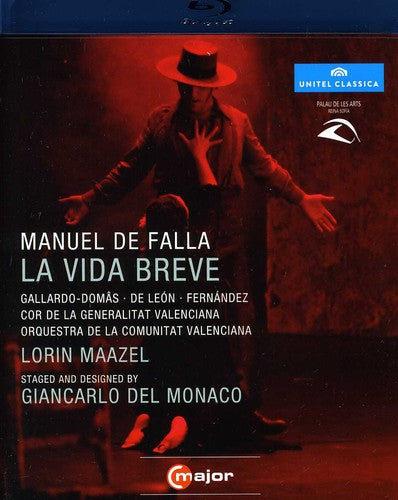
Falla: La Vida Breve / Maazel, De Leon, Gallardo-Domas, Corbacho
FALLA La vida breve • Lorin Maazel, cond; Cristina Gallardo-Domâs (Salud); Jorge de León (Paco); María Luisa Corbacho (Grandmother); Felipe Bou (Uncle Sarvaor); Sandra Ferrández (Flamenco Singer); Ode la Generalitat Valenciana • C MAJOR 710708 (DVD: 81:00) Live: Valencia Palau de les Arts Reina Sofia 4/17/2010
La vida breve is a gift to stage directors and design teams. Its deliberate ambiguities—where is the action taking place; is it all meant to be considered as occurring in reality; what do you do when so much of the music is orchestral only, even in sections that feature short vocal moments?—allow considerable leeway to interpretation, more so than in most operas. And stage directors typically enjoy having that kind of control over a production. In this 2010 production, everything is tied to the young Gypsy girl, Salud. The men working the forge and the girl selling baskets are never seen, but Salud hears them, walking around a nearly empty stage with a starkly towering, mottled red backdrop. It is in effect Salud’s head, and heart. It is only when the characters directly interact with her that we know we have moved back into something resembling a realistic frame.
Stage director and set designer Giancarlo del Monaco (and yes, in case you were wondering, it is Mario’s son) is consistently clever in integrating Salud everywhere in the opera. The interlude between acts is presented as a duet danced before Salud between two figures in wealthy wedding finery: Our heroine’s intuition, or fears, at work, as she believes Paco is being unfaithful. The chorus then enters while she watches, followed by Paco and his fiancée, all of it done slowly as in a dream; a fire blazes behind a life-sized cross, in front of which a woman stands, arms extended as though crucified. She moves away from the cross, turning into a singer who in folk tradition praises the soon-to-be married couple. All of this is ambiguous, and more is to follow. The singer has a gritty, guttural voice, unattractive but compelling: Perhaps to celebrate passion at its most dangerous and impersonal—or is her voice just being perceived this way by Salud, still viewing events as though in a vision?
With so much emphasis on Salud’s internal dialog, I suspect something more final than the written ending conclusion to La vida breve—willing herself to death as a supreme insult to her former lover who has publicly denied any affair—was felt necessary at the opera’s conclusion. In del Monaco’s staging she feigns severe hurt, and as Paco approaches, reaches out her hand to grasp his, forcing her concealed dagger into it. She then thrusts herself upon the weapon, and dies. This production foregoes props, aside from chairs. The costumes are period-effective without attracting undo attention, mainly underscoring the class and wealth differences that drive Paco away from Salud with white lace against black linen.
It would take a fine singer and actress to make this conception of La vida breve work, one who was expected to be on stage the entire time, moving and reacting when she wasn’t the center of attention. Cristina Gallardo-Domâs is fortunately up to the task. The Chilean soprano’s dark chest register and soaring, lyrical top encompass the vocal requirements, and she is a strong enough actor to remain expressively in character the rest of the time for this emotionally draining role. Jorge de León acts well, too, but his bright lyric tenor is tight with pressure, and he has a regular wobble when singing above piano. María Luisa Corbacho also shows a loosening of vibrato, but that’s not unexpected as the grandmother, while Felipe Bou brings firmness of tone to his small part. Lorin Maazel plays to the score’s color, rhythmic bite, and acute dissonances. His firm tempos and solid grasp of the drama are welcome.
The camerawork is first-rate, both varying distances, and holding shots for as long as they’re important. There are no DVD extras, unless you consider trailers for other operatic DVDs (including a very strange-looking Theodora) as useful content. Subtitles are in Spanish, English, French, and German, with PCM stereo and DTS 5.1 as the sound options. The video format is 16:9. The booklet contains good cut listings and some brief, useful history on the opera, but reproduces a short synopsis that doesn’t reflect the changes (such as the ending) in the current production. This would still be a viable recommendation had the production been less considered, and the performers less able. After all, where else are you going to turn? But as good as this is, I have no hesitation in recommending it heartily.
FANFARE: Barry Brenesal
Falla: El Amor Brujo, El Retablo De Maese Pedro
Falla: Three-Cornered Hat; Nights in the Garden of Spain / Prieto, Orchestra of the Americas
Falla: La vida breve / Mena, BBC Philharmonic Orchestra
REVIEW:
Mena prises open textures and sonorities with great subtlety and attention to detail, so that we’re fully able to appreciate the shifting colors of Falla’s writing. The playing immaculately blends clarity with sensuousness, while the Coro de la Radio e Television Espanola sing with admirable warmth of tone. Nancy Fabiola Herrera sounds sumptuous as Salud with her warm tone and full upper registers.
– Gramophone
Falla: Obras Para Piano, Concierto Para Clave / Joaquin Achucarro, Eduardo Mata
Falla's Piezas were first heard in 1908 and are dedicated to AlbCniz, whom he had met in Paris through Dukas. They are more sparselynoted than the older composer's work, sharper in outline: "Aragonesa" is an animated jota, "Cubana" a sensuous habanera-styled piece reminiscent of Cadiz where Falla was born, "Montanesa" is a bell-haunted Catalonian landscape, and "Andaluza" is harsh, percussive, carrying hints of the Fantasia Baetica. Achucarro's performances have winning grace and clarity... Fantasia Baetica [is] Falla's major keyboard piece, and in my view the finest piano work to come out of Spain. It was written during 1919 and marks his last involvement with regional music ("Baetica" was the Roman name for Andalusia); after this came the emancipation from local concerns demonstrated in El Retablo de Maese Pedro and in the Harpsichord Concerto. In the Fantasia vocal phrases and guitar figures from canle hondo are marvellously translated into pianistic terms; this is a harsh, inward-looking, sometimes bitter piece, and the distillation of a long creative process.
[Alicia] de Larrocha's performance [on Decca] is superbly alive with colour and the feeling of physical movement, and though Achucarro's tempos are very close to hers (he takes 13' as against her 12' 57), his reading is quieter, more intimate. They take complementary views, in fact, and it is good to have both. Falla devotees will already have the Decca LP but will no doubt want to add this new one for the sake of the beautiful Homenaje and the three items (all dated 1890) from the composer's youth. The Nocturno reveals Chopin's beneficial, and not excessive influence, while Serenata Andaluza, though just as charming as the Vals, is slightly more personal.
-- Gramophone [12/1976]
reviewing these recordings on LP
Falla: El Amor Brujo (1915 Version) / Gil-Ordonez, Perspectives Ensemble
The original version really is a different work: longer, with a slightly different plot that need not concern us, and despite using much of the same music often quite different in sound and texture. You can compare the two in the sound clips below. The revised version for full orchestra sounds more mysterious, more “impressionistic” if you will, while the original is leaner in outline but also definitely more rhythmically persistent and sinister. The only disadvantage to the original, in my opinion, is the generous amount of spoken dialog, which must be irritating even to native speakers when the music is so beautiful. You wish Fernández would offer less talk and more music.
Speaking of talk, Master Peter’s Puppet Show has a plot straight from Cervantes’ Don Quixote, and consists of wonderful musical bits connected by long stretches of recitative narration. The scoring is extremely imaginative, with the chamber ensemble featuring a harpsichord (played by Wanda Landowska at the premiere), and colorful parts for brass and percussion. What singing there is comes off quite well, with Jennifer Zetlan doing her best with the ungrateful part of the narrator. The plot, in case you don’t already know the original, is simplicity itself. At a roadside inn Master Peter puts on a puppet show set in the time of Charlemagne about the rescue of a damsel in distress. Don Quixote becomes thoroughly confused and takes the whole thing rather too seriously. Chaos ensues. That’s it.
Once again the performance is excellent from all concerned, and both pieces are very well recorded. Provided you have time to sit down and follow both not-terribly-long works booklet in hand, in this case thoughtfully containing texts and English translations, this release earns an easy and well-deserved recommendation.
– ClassicsToday.com (David Hurwitz)
Dukas: La Péri; Falla: Three-cornered Hat / Pierre Boulez
Manuel de Falla Collection
As the central figure of Spanish music in the first half of the last century, de Falla (1876-1946) came to define the sound of Spain for listeners beyond its borders. Folk music, romanticism, neoclassicism, modernism: all the prevalent styles of his time were assimilated and absorbed within a personal idiom that advanced the work of notable predecessors such as Albeniz and Granados in establishing a distinctively Spanish idiom for art music, making him a worthy contemporary of other composers outside the central European mainstream from Vaughan Williams in England to Bartók in Hungary and Sibelius in Finland. Falla’s cycle of Seven Popular Spanish Songs is a perfect synthesis of artsong and folksong, performed here in Luciano Berio’s orchestration by Marta Senn and the Simon Bolivar Orchestra of Venezuela under the baton of Eduardo Mata, the Mexican conductor renowned for his dynamic interpretations of Hispanic repertoire. The songs return in their instrumental guise as the Suite populaire espagnole, with the cellist Timora Rosler accompanied by Klára Würtz. Rafael Puyana is a uniquely sympathetic soloist in the Harpsichord Concerto which gave the instrument new life beyond its Baroque associations. Benita Meshulam is widely recognized as the inheritor of Alicia de Larrocha’s mantle with her superbly atmospheric recordings of Spanish piano music.
REVIEW:
Manuel de Falla Collection is an honest title, since the five CDs present only a selection of his works, including well-known ones such as Nights in Spanish Gardens, El Amor Brujo, and The Three-Cornered Hat. The recordings with the Simon Bolivar Symphony Orchestra from 1981 convey particularly well the intensity of Spanish emotional worlds that Central Europeans like to assume. The round is opened with El Amor Brujo in a striking and lively performance. The interpretation of the Seven popular Spanish Songs, as well as Homenajas let the listener dive into Spanish worlds. The three dances from The Three-Cornered Hat in the version for orchestra will be joined by others in the piano version on a later CD.
For the recordings made in Venezuela, the conductor Eduardo Mata certainly holds the orchestra together and inspires it to effective performances. One could well imagine more sensitivity here, the nocturnal sultriness of the tango instead of the midday heat, so to speak, but there is little more to offer in the way of fire and color. More delicacy without sacrificing the technical quality of the recording is offered by the oldest recording.
In Nights in Spanish Gardens, the Berlin Symphony Orchestra performs under the judicious direction of Günther Herbig. The singers go along with the emotional South American approach, not without delicately savoring the music.
The two pianists offer mature quality. Benita Mehuslam, who has also recorded the complete works for piano by De Falla on the label, is featured here with excerpts, Dances from the The-Cornered Hat and Spanish pieces. In the only chamber work, besides the piano music, Klara Würtz accompanies cellist Timora Rosler on the piano in the Suite Populaire Espagnole. The two artists, who have also won awards as a duo, give the top dance of sensitivity and European noblesse, so to speak, with their interpretation that concludes the collection. Harpsichordist Rafael Puyana from Colombia can show all the registers of his skills in the harpsichord concerto. Here and also in El Retablode Maese Pedro as well as in Psyche the Solistas de Mexico play, again conducted by Eduardo Mata. Those who want to experience this composer intensively will find in this compilation a good opportunity to be infected by the joie de vivre of the music.
-- Pizzicato