Giovanni Battista Gervasio was a significant personality in the musical scene of 'stile galante' of the second half of 18th century; composer, virtuoso and teacher, he studied and improved the four courses mandolin, which was first built in Naples in that period. Thanks to him this instrument became popular and technically refined as it is nowadays. The aim of this recording is to reproduce the tinkling sonorities of these compositions. In order to obtain thoroughly this particular natural sonority, we have decided to "capture" the natural reverberations of the environment without ignoring the sound of each single instrument, so that the phrasing is intelligible. We have played an original mandolin built in 1764 and an harpsichord copy of an Italian harpsichord of 18th century. We have chosen to play continuo only with harpsichord considering that these two instruments have a similar way to produce sound. This is the first complete recording of all the sonatas for mandolin by Giovanni Battista Gervasio and the first absolute world recording.
Sisto Reina is one of the many musicians from the Order of the Friars Minor Conventual who have greatly enriched the history of music. The diffusion of his music greatly exceeded the boundaries of the regions in which he was active: works of his are present in the archives of several Italian cities, and in Austria, Germany, Poland, Switzerland and England. The Armonia ecclesiastica, by Sisto Reina, published by Carlo Camagno in Milan in 1653 and dedicated to princess Angelica Luigia Mariana Gonzaga, nun in the convent of S. Paolo in Milan, is exemplary as regards the variety of forms, styles and languages that were typical of Italian seventeenth-century music, particularly in Lombardy. Michelangelo Gabrielli, Renaissance and Baroque repertoire specialist, directs the Concentus Vocum ensemble (from the Como Conservatory of Music) bringing this work to light in a world premiere recording.
On this sixth volume of Alessandro Scarlatti's opera omnia for keyboard, once again the star is the eighteenth century Italian Anonymous Ferrarese harpsichord owned by Francesco Tasini. Toccatas, Arpeggi, Introduzioni, and even the famous "Folly of Spain," are contained in this volume featuring the brilliant and rich harmonics of the precious historical instrument. Extremely interesting is the interpretation by Francesco Tasini, that - absolute master of the period performance practice - succeeds in giving us a perfect understanding of the correct approach to the compositions by Alessandro Scarlatti, true founder of the Neapolitan keyboard School. Francesco Tasini studied at the Conservatories of Bologna and Milan, graduating cum laude in Organ and Organ Composition, and Harpsichord and Composition. He is a member of the Accademia Filarmonica di Bologna, and of the Diocesan Commissions of Sacred Music of the Archdiocese of Bologna and of the Diocese of Ferrara.
The key to Buxtehude's trio sonatas, both for performers and for listeners, is an awareness of the stylus fantasticus which German composers of the late 17th and early 18th centuries developed in response to the new freely inventive style of Italian composers such as Claudio Merulo and Girolamo Frescobaldi. 'It is the most free and unrestrained method of composing,' wrote one contemporary theorist. 'It is bound to nothing, neither to any words nor to a melodic subject, instituted to display genius and to teach the hidden design of harmony and the ingenious composition of harmonic phrases and fugues.' The seven sonatas in each of these collections, published in Hamburg in 1696, offer a continuous succession of short movements, up to eight per sonata, which alternate between slow and fast tempi, and improvisatory and contrapuntal textures, dominated by a dazzling array of ostinato variations which embed the melodies in the listener's consciousness. We encounter witty solos, dialogues and conversations, sublime suspensions, jaunty syncopations and occasional excursions into strange and modal harmony. The expressive range is accordingly wide, venturing in Op.1 No.6 into a D minor realm of darkness and desperation. The musicians on this new recording of Buxtehude's trio sonatas are experienced and skilful practitioners of Baroque style, with an impressive catalogue of albums on Brilliant Classics to their credit. Valerio Losito has recorded the violin sonatas of Scarlatti, Telemann and Tessarini, among others, while Simone Stella has made complete surveys of the organ and harpsichord output by Froberger and Pachelbel - 'performed with natural flair, especially with respect to clarifying counterpoint' (Gramophone). Simone Stella introduces these fascinating works, milestones in the history of German-Baroque chamber music, with an extensive booklet essay. This is 'music full of lyrically delicate, sorrowful, and dramatic emotions,' he says, 'as well as melodious, harmonically gratifying, and full of vitality, a world of sound that consecrates him as a unique genius in the Pantheon of Music.' - Dietrich Buxtehude (c. 1637-1707) was a prominent German-Danish composer and organist of the Baroque period, renowned for his influence on later composers such as J.S. Bach and Handel. Best known for his sacred vocal music and virtuosic organ works, Buxtehude also wrote a substantial body of chamber music. - Published in 1694 and 1696 respectively, Buxtehude's Trio Sonatas comprise two sets of seven sonatas each. On this recording they are played with one violin, viola da gamba and harpsichord. These works represent a blend of German counterpoint and Italianate style. The sonatas are notable for their variety of forms, including fugal sections, dance movements, and expressive slow passages, the inventive use of harmony and rhythmic vitality reflecting the lively spirit of the early Baroque. The Op.1 and 2 sonatas are among the earliest significant instrumental works in Northern Germany, and they contributed to the development of the sonata genre. - Played by three foremost representatives of the Italian Historically Informed Performance Practice: Valerio Losito, Bettina Hoffmann (viola da gamba) and Simone Stella. Valerio Losito successfully recorded for Brilliant Classics works by Tessarini, Veracini, Dal Barba, Telemann and Alessandro Scarlatti.
Storace: Selva di varie composizioni d'intavolatura per cimb
Tactus
CD
$29.99Oct 06, 2017
The figure and work of Bernardo Storace are particularly fascinating because of the aura of mystery which surrounding both. The only information we have on this remarkable composer for keyboard instruments is printed on the frontispiece of his one known work, the “Selva di varie compositioni d’intavolatura per cimbalo ed organo by Bernardo Storace vice Chapel Master of the Illustrious Senate of the Noble and Exemplary City of Messina”. The continuous earthquakes that afflicted Messina right up to the beginning of the twentieth century destroyed any existing evidence of Storace and his works. The one example of the Selva, which has fortunately survived, was printed in 1664 in Venice, then a very important printing centre, but is without the editor’s name or a dedication. This vast florilegium is made up of a wide range of variations based on nearly all the popular themes of that time, as well as two courantes, two toccatas and canzonas, two ricercari and a pastorale. Francesco Cera, renowned early music specialist, here uses three different historical instruments: organ, harpsichord and spinetta, for a refined and competent performance, supported by Fabio Tricomi at the percussions.
de Falla, Poulenc, Bacarisse: Harpsichord Concertos / Marquez
IBS Classical
CD
$17.99May 28, 2021
The composer of the Stabat Mater presented in this sound recording was musically educated in Malaga Cathedral at the end of the first third of the 19th century. The musical chapel of the citys first tempo had already suffered the onslaught of the yellow fever of 1803 and the French invasion during the Napoleonic invasion (1808\-1814), and had yet to receive the lethal blows of the successive disentailment measures of Mendizábal (1836), Espartero (1841) and Madoz (1854). However, what seemed to put an end to the stable ensemble to solemnise cathedral liturgies was paradoxically giving way to a paradigm shift. The everyday music of the cathedrals would be reduced to a minimum thanks to the resources established in the Concordat of 1851 signed between Pope Pius IX and Queen Elizabeth II. Hence, the drastic mutilation of the stable staffs in the cathedrals favoured what would quickly become a common and frequent practice, i.e. the ex profeso hiring of instrumental and vocal troops for certain solemnities and festivities, among which those related to Holy Week and its natural period of spiritual preparation, namely Lent, were particularly noteworthy.
Strozzi: Sacri musicali affetti / Aurata Fonte Ensemble
Tactus
CD
$29.99Jul 02, 2021
The present release is a world premiere recording of the complete edition of the Sacri Musicali Affetti by Barbara Strozzi, a figure of great importance among the various women musicians of the seventeenth century. Her works went on printed editions for her to be recognized and appreciated as a composer, and not just as an instrumentalist or singer. She was on the Venetian intellectual scene thanks to her connection with the poet and playwright Giulio Strozzi (of whom Barbara is most likely an illegitimate daughter), a fundamental figure in the institution of the Venetian musical theater, and soon appreciated by musicians and writers of cultural circles from Venice. The Aurata Fonte ensemble, specializing in the Renaissance and Baroque repertoire, accompanies the sopranos Anna Simboli and Miho Kamiya with period instruments in the performance of this collection of sacred motets for solo voice where the composer's mastery and refinement is revealed by alternating theatrical and dramatic effects in the name of a marked vocal virtuosity. To be noted at one point the explicit mentioning of the great Claudio Monteverdi, placing by right her work in his musical wake.
Music for Archlute, Guitar & Harpsichord / Rigano, Guarino
Tactus
CD
$21.99Aug 05, 2022
Among the motivations of this disc, the most important one is the wish to present the various styles and periods in a clear, simple way, endeavoring to avoid superabundance and the accumulation of crossover deposits that are often heard where it seems that the music of the past cannot be self-sufficient and needs an extra chromatic and rhythmic shove in order to catch the listeners’ attention, inducing them to compare it with the commercial, repetitive entertainment repertoire. In this musical journey between Italy and Spain of the Baroque era, Paolo Rigano on the archlute and baroque guitar and Cinzia Guarino on the harpsichord are interpreting a singular anthology of pieces enriching the playing through the practice of the basso continuo that marked the entire musical period from the Renaissance to the late Baroque.
Mancini: XII Solos, London 1724 / Armonia Delle Sfere [2 CDs]
Tactus
CD
$29.99Oct 02, 2020
The flutist and researcher Daniele Salvatore, leader of the Armonia delle Sfere ensemble, in this double album presents the most ambitious instrumental work by Francesco Mancini, renowned composer of operas and oratories, typical representative of the Neapolitan tradition. Mancini is also a perfect example of the close cultural and musical connection between ‘Italy’ (a land united solely from a territorial aspect at that time, otherwise made up of several smaller kingdoms with different rulers, laws and economy, and significantly different culture, music and language),and London in that era: he claimed recognition with the opera Idaspe Fedele, played for the first time at the Haymarket Theatre of London on March 23rd in 1710,an opera which, together with Almahide (by anonymous author, debuting in January of the same year) was among the first ones in London to be sung entirely in Italian language. Mancini’s contribution to opera and sacred music is considerable, and his music is easily found all over Europe's many libraries, proving their author's popularity, however, the same can not be said about instrumental pieces of music written by him, of which we know just a few, such as the two toccatas for harpsichord featured on this recording, probably composed to be used for didactic purposes.
The composers featured on this new release are rarely performed, and much of their music has been lost. All of the pieces featured on this release were found in Johann George Pisendel’s private library collection, and date from 18th century Dresden. Marcin Swiatkiewicz is one of today’s foremost Polish harpsichordists. He specializes in period keyboard instruments, as well as improvisation in both the modern and old styles. Martyna Pastuszka has been the concert master and artistic director of {oh!} Orkiestra Historyczna since 2012. She is an active teacher, and is frequently asked to collaborate with other ensembles.
Live from Prague Spring Festival - Prague Spring Internation
ArcoDiva
CD
$18.99Jul 01, 2022
ArcoDiva's newest release presents works for oboe performed by Martin Danek, a graduate of the prestigious Hanns Eisler University of Music in Berlin and winner of the 2019 Prague Spring International Competition. He says: "I've been living abroad for a long time, and playing in my own country is always something special", says Mr. Danek. "This is especially true in the case of Prague Spring, with it's festive atmosphere, which I remember from my childhood. The combinations of instruments and works on this program will be unusual, so it will be a unique experience for both the audience and the performers."
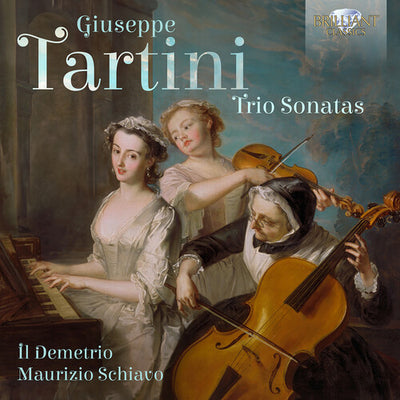
With 37 confirmed trio sonatas to his credit, Giuseppe Tartini is the most important Italian composer of his generation for this type of repertoire. It may seem odd therefore that these works have been so sorely neglected; indeed, as of 2022 only around 20 per cent of the repertoire had been recorded and a critical edition had yet to be published. This state of affairs was largely due to confusion regarding sources, with many divergent interpretations and uncertainties regarding the dates of the handwritten scores. Some order has been brought to this originally chaotic situation by the research carried out by Juan Mariano Porta from 2018 to 2022 as part of his doctoral studies, the result of which was the inclusion of the trio sonatas in the upcoming publications of the Edizione Nazionale delle Opere di Giuseppe Tartini, with advance materials made available to the Il Demetrio ensemble for recording. Giuseppe Tartini dedicated almost all his energy to his chosen instrument, the violin. His established corpus of works currently numbers 200 sonatas for violin and bass, 150 violin concertos, 37 trio sonatas, a handful of concertos for other instruments, and a small number of quartet sonatas and vocal compositions. Production of the trio sonatas began in the composer's late-mature years, and their style would seem to correspond to Tartini's final compositional period, described as a Drang nach absoluter Musik [urge for absolute music], which began around 1750 without a clear line of demarcation from what came before and continued until the composer's death. The trend was towards simplicity, partly deriving from Tartini's desire to put his theoretical speculations into practice. The trio sonatas no longer feature the virtuoso passages of earlier works. They present a binary form with regular phrasing. Their harmonic rhythm is slow, with the violins mainly proceeding in parallel triplets. The function of the bass is relegated one of harmonic support. This recording contains the sonatas G1, D1, d1 A1, A2, A3, A6, and a1, which date to Tartini's final compositional sub-period. They are little-known pieces, most of them hitherto unpublished.
Wranitzky: Works for Oboe / Veverka, Schelingerová, Štilec, Wranitzky Kapelle
ArcoDiva
CD
$18.99Mar 04, 2022
ArcoDiva’s new release presents oboe music of "a Moravian in Vienna" - Paul Wranitzky (1756-1808). In his day, Paul Wranitzky was one of the most highly regarded musicians in Europe. Moravian by birth, the composer moved to Vienna as many aspiring musicians did, and quickly achieved status as a remarkable and versatile composer of operas, chamber music, and symphonies. You can enjoy the world premieres of Wranitzky's Works for Oboe, delightfully interpreted by Wranitzky Kapelle (Marek Štilec - conductor). The oboe parts are played by eminent oboist Vilém Veverka.
Jean-Marie Leclair’s violin sonatas embody a stylistic fusion known as les goûts réunis in which the lyricism and the virtuosity of the Italian school are integrated with the dance idioms of French Baroque music. In this volume, the music reaches new heights of technical complexity in its filigree ornamentation and continuous multiple stopping while still incorporating much wistful beauty. In the Sonata in D major, however, Leclair’s ambition expands yet further, as he combines innate lyricism and rustic drones in a prototype concerto form.
In Handel's Shadow - Vocal Music by His Rivals in Eighteenth-Century London
Toccata
CD
$10.49$20.99Save 50%Sep 15, 2023
The figure of George Frideric Handel cast a long shadow over musical London in the first half of the eighteenth century; casting many of his contemporaries – fine composers themselves – into centuries of obscurity. This recording throws light into forgotten corners and discovers some glittering gems; some of them demanding dazzling vocal fireworks from their performers. Several of these composers set scenes from Classical mythology or Old Testament narratives – but they also explore the underside of the Baroque psyche in one of David’s darkest psalms and in a representation of Arcadian madness.
Antico: Frottole intabulate da sonare organi, libro primo (R
Tactus
CD
$21.99Jul 21, 2017
Organist and harpsichordist Maria Luisa Baldassari leads us to discover the singular figure of Andrea Antico da Montona, a musician and printer of the early Renaissance. His great ability as an engraver allowed him to compete with no one but Ottaviano Petrucci - the undisputed prince of musical printers - and his soul as a ‘cultural entrepreneur’ led him to the courageous and pioneering operation of proposing the intavolatura (the reduction of Vocal or instrumental polyphonic compositions) for the keyboard, instead of the lute as it was in vogue at the time. For the recording of the “Frottole Intabulate” (the frottola is the most popular Italian folk song in use between the fifteenth and sixteenth centuries), Maria Luisa Baldassari takes advantage of performing original period instruments: the spinetta, the spinetta Harpsichord, clavichord, the rare and archaic “clavisimbalum”, and the magnificent 1533 Vincenzo Colombi organ of the Chiesa del SS. Corpo di Cristo in Valvasone (Udine - Italy).
Vitali: Varie Sonate alla Francese e all'Itagliana a Sei Str
Tactus
CD
$21.99Jun 05, 2020
The city of Modena, under the rule of the Este family, was the capital of the Dukedom of Modena e Reggio. Thanks to Duke Francesco II's fondness for the violin, music became an essential element in the most important events at the Este court, such as receptions, weddings and official visits of foreign sovereigns. These were the occasions in which the Duke displayed all his magnificence. Modena stands out for the abundance of it's collection of musical documents in the Biblioteca Estense: the library is a real mine, largely unexplored so far. This consideration gave rise to the idea of making this beautiful, extraordinarily modern music available to those who are "pursuing" culture and art. So our goal is to promote a rediscovery of the enormous heritage preserved in the Biblioteca Estense, by carrying out a meticulous study of the sources of the works of the composers who were active at the Este Court in Modena, transcribing them into modern notation and critical editions, and producing monographic recordings of them. The first step consisted in the study and recording of the instrumental works of Giovanni Battista Vitali. In this fifth of 6 releases dedicated to his music preserved at the Estense Library of Modena, the baroque ensemble Italico Splendore performs the Sonatas for six instruments Op. 11, published in Modena in 1684. These are dance movements grouped by tone in the typical manner of a suite, in a sophisticated blend of Italian and French styles.
The recording of the two harpsichord sonatas by Bernardo Pasquini, master of the Italian style of the organ and harpsichord in the period between the end of the seventeenth and beginning of the eighteenth century, is a particularly interesting cameo in the panorama of the music dedicated to the genre of the partimento, advanced practice of the basso continuo that in Italy formed the basis of compositional and keyboard teaching in the 18th century Neapolitan school. In fact the sonatas consist of only the bass lines on which the two performers must create the entire composition thanks to the technical and expressive expertise obtained from a consummate knowledge and experience of the performance practice of the time. Marina Scaioli and Francesco Tasini face this instrumental 'challenge' on two Italian historical harpsichords copies: a 1725 Giovanni Ferrini and a 1778 Roberto and Federigo Cresci.
Bembo: Produzioni Armoniche, 1701 / Armonia Delle Sfere
Tactus
CD
$37.99Nov 15, 2019
Within this new album the Armonia delle Sfere ensemble is delivering to us the complete Produzioni Armoniche work by Antonia Bembo, a collection of 41 motets dedicated in 1701 to Louis XIV, in whose court she landed after a series of vicissitudes occurred in Venice, her hometown, including the failure of a marriage and important family disputes, for which she was deprived of her paternal inheritance. After being trained under the musical guidance of Francesco Cavalli (1602-1676), organist of the ducal chapel of San Marco, Antonia secretly married Lorenzo Bembo, a Venetian nobleman, from whom she had two children, and from whom in 1672 she herself asked divorce, due to the continuing absence of her husband, whom she also accused of continuing abuse and betrayal. She then moved to Paris, perhaps following the guitarist Francesco Corbetta, where she concentrated on music and composition, and where she had the opportunity to perform in the presence of Louis xiv, at the court of which she would find acceptance and protection until the end of her life. It is the fascinating story of a strong personality that sought and found its way overcoming the difficult condition of a seventeenth century woman artist.
Jean-Marie Leclair was a master of fusing Italian and French idioms, conjoining the lyricism of the former with the dance momentum of the latter. Nowhere is this better exemplified than in his third book of violin sonatas. The sonatas in this album embody rich melodic beauty, drone and rustic elements – most vividly in the Tambourin of the C major sonata in which a hurdy-gurdy is employed– and demand tour de force virtuosity such as in the joyous Ciaccona of the G major sonata. De-scribed by Gramophone as ‘technically and musically a marvel’ (Naxos 8.572866), Adrian Butterfield completes his acclaimed traversal of Leclair’s Violin Sonatas Books Nos.1–3.
Coelho: Flores de Musica pera o Instrumento de Tecla & Harpa
Inventa Records
CD
$16.99Jul 26, 2024
Flores de Musica pera o instrumento de tecla & harpa is the only known work of Portugese composer Manuel Rodrigues Coelho. Printed in Lisbon in 1620 and boasting more than five hundred pages, Coelho's Flores de Musica is one of the largest music works printed in the seventeenth century. Celebrating the 400th anniversary of it's original publication, a new edition in three volumes has been published with the research being used to inform this major new recording series. Harpsichordist Ana Mafalda Castro presents seven tentos and a piece based on Susanne un jour by Orlando di Lasso recorded on a two-manual copy of a Ruckers instrument, built by Henk Van Schevikhoven in 1984.
Pegolotti: Trattenimenti armonici da camera / Opera Quinta
Tactus
CD
$21.99Nov 04, 2022
This album is dedicated to Tomaso Pegolotti, a character who held the double role of notary public and musician in the land of the Estense dukedom between Modena and Reggio Emilia. In fact, his father Livio initiated him into both the study of music and law, and thanks to his commitment and his talent, Tomaso had a brilliant career in both professions. The collection of the "Trattenimenti armonici da camera [...] opera prima", dedicated to Prince Foresto d'Este in 1698, includes his entire instrumental production, as the planned second work was finally never terminated due to Pegolotti's involvement in some unexpected political clash also connected to one of his judicial publications.
The collection consists of twelve sonatas from which can be deduced that the author possessed considerable technical skills on the violin. The Opera Quinta ensemble led by Fabrizio Longo (former protagonist of other important productions by Tactus: tc.630201, tc.670290 and tc.621602) is a solid reference in the musical practice of early and Baroque music.
Purcell: Suites for Harpsichord / Rzetecka-Niewiadomska
DUX
CD
$21.99Apr 20, 2018
The music of the English Virginalists (virginal is a smaller variety of harpsichord) dating back to the turn of the 16th and 17th centuries served as an inspiration for the French harpsichord style, which, after several years, returned to Great Britain. It was adopted in such a mature form by the most outstanding composer born in England. Henry Purcell, conscious of the music's sources, enriched it with subsequent references to native musical traditions and with his own original compositional technique. The extremely meticulous interpretations of eight harpsichord suites by Purcell, performed by Ewa Rzetecka-Niewiadomska, convincingly confirm the artistry and aesthetic value of these compositions, with plenty of charm and stylistic treats, which, due to extra-musical reasons, are on the margin of the mainstream of the history of music.
Christophe Moyreau (1700-1774) was born and spent most of his life in Orléans. He became organist at Orléans Collégiale Saint-Aignan in February 1719 and at Orléans Cathedral in January 1738 and occupied this position until around 1772. In French music of his era (secular and also religious), an important place was reserved for the rhythms and structures of the dance. In 1753 Moyreau published his “Pièces de clavecin”, 124 pieces grouped in 6 books. The dances Allemande, Courante, Sarabande, Gigue, Rigaudon, Menuet are part of Suites, while these books also include concertos and sonatas. Some of the pieces bear titles (in the style of Couperin and Rameau) like La Flotante, Le Baccante, Le Jaloux, La Coquette, Le Preludant, L'Euridice, La Comique, L'Orphée and Le Caprice. Book 6, uniquely for French harpsichord music, consists of several three-movement keyboard simphonies written in Italian style.
Played by Fernando De Luca, one of Italy’s foremost harpsichord players, who recorded to great critical acclaim the complete keyboard works by Graupner, published by Brilliant Classics. The first-ever survey on record of the complete surviving output by a significant contemporary of Rameau: a missing piece in the jigsaw of the French Baroque.
The 12 Sonatas for mandolino and continuo by Francesco Weber represent one of the most interesting collections of compositions for the baroque mandolino that have come down to us. Despite his German surname clearly suggesting German ancestry, Francesco Weber, was an Italian lutenist / theorbist / mandolinist and composer, whose career was mainly in England. My research started from his will - drawn up in London under the name of John Francis Weber on April 13, 1745 - and proved several months after his death on June 5, 1751, in which the 'Republic of Genova' is often mentioned concerning assets and family properties. The 5-course mandolin used for this recording was built in Genoa in 1717 by Andrea Weber (1658-1740). It is the only surviving example by this maker, and one of the very few surviving Genoese baroque 'mandolinos.' It is an instrument recently discovered in a private collection, therefore completely unknown even to early mandolin experts, before this recording. An even more extraordinary aspect that distinguishes this disc is the fact that it represents a truly exceptional case - perhaps unprecedented at least in the field of early plucked string instruments - in which the music of a composer is recorded using an instrument built by his father.