One-Day Sale | October 14th, 2026
It's here! Our One-Day Sale this month is on October 14th, 2026.
For 24 hours only, save 50% on over 700 titles from Naxos!
Explore an incredible selection of box sets, CDs, DVDs, and more, featuring best-selling recordings of music by Dvořák, Strauss, Janáček, Vivaldi, and many more.
Whether you're filling gaps in your collection or discovering something new, this is your chance to shop hundreds of Naxos favorites at half price!
Over 700 titles. 50% off. 24 hours only. Don't miss out!
Shop now through Thursday, October 15th, 2026 at 9:00AM CT!
738 products
-
-
-
-
-
-
-
-
-
-
-
SaleMozart: Violin Concertos Nos 3, 4 & 5 / Kraggerud, Norwegian Chamber Orchestra
Naxos · Jun 2016CD$19.99$9.99 -
-
-
SaleDominguez: The Legend of Joaquin Murieta / Dominguez, Santiago Philharmonic
Naxos · Jun 2016CD$29.99$14.99 -
SaleTchaikovsky: Piano Concerto No. 2 & Concert Fantasia / Nebolsin, Stern, New Zealand Symphony
Naxos · Sep 2016CD$19.99$9.99 -
-
-
-
-
-
-
SaleRavel: Orchestral Works, Vol. 4 - Daphnis et Chloe / Slatkin, Spirito, Lyon National Orchestra
Naxos · Jan 2017CD$19.99$9.99 -
-
-
SaleThe Guerra Manuscript, Vol. 4: 17th Century Secular Spanish Vocal Musc / Vilas, Ars Atlantica
Naxos · Jan 2017CD$19.99$9.99 -
-
-
SaleDevienne: Flute Concertos Nos. 5-8 / Gallois, Swedish Chamber Orchestra
Naxos · Feb 2017CD$19.99$9.99 -
-
-
-
-
-
-
-
-
SaleIn the Moment: Short Pieces for String Quartet / Arabella String Quartet
Naxos · May 2017CD$19.99$9.99 -
-
-
SaleTsontakis: Anasa, True Colors & Unforgettable / Miller, Albany Symphony Orchestra
Naxos · Aug 2017CD$19.99$9.99 -
-
-
-
-
-
-
SaleRiley: Palmian Chord Ryddle, Royal Majestic / Guerrero, Nashville Symphony
Naxos · Nov 2017CD$19.99$9.99 -
-
-
SaleNarbutaite: No Yesterday, No Tomorrow / Lyndon-Gee, Lithuanian National Symphony
Naxos · Dec 2017CD$19.99$9.99 -
-
-
-
-
-
-
SaleSaint-Saens: Piano Concertos 4 & 5 / Descharmes, Soustrot, Malmo Symphony
Naxos · Apr 2018CD$19.99$9.99
Bernstein: Symphony No. 3 "Kaddish" / Alsop, Baltimore Symphony
Three examples of Leonard Bernstein’s vocal art can be heard in this recording. His Symphony No. 3 ‘Kaddish’ shuns traditional symphonic ideas in favor of an eclectic theatrical and oratorio-like form with a prominent rôle for speaker. For this recording, Marin Alsop has returned to the work’s original narrative text, heard before the 1977 revision. The Lark – heard in a concert version with added narration – derives from Lillian Hellman’s adaptation of L’Alouette on the life of Joan of Arc, and it was this music that Bernstein reworked into his Missa Brevis many years later. Music Director of the Baltimore Symphony since 2007 and Principal Conductor the São Paulo Symphony since 2013, the NYC-born Marin Alsop is recognized across the world for her innovative programming as well as her bold, audience-expanding community and education outreach initiatives.
REVIEWS:
Under Alsop's baton, the Baltimore Symphony realizes Bernstein’s extraordinary orchestral effects in ways that will both scarify you and tug at your heartstrings; and while the text is still the embarrassment it always was, narrator Claire Bloom delivers it as if it were Shakespearian prose. She believes in the part and gives it a powerful reading. Soprano Kelley Nassief will melt your heart in her “Kaddish 2” movement solo, and both the boy and adult choirs are superb. I’m really glad to have this performance, especially since my Columbia LP has disappeared and this is now the only recording I have of the original 1963 work. It’s a fantastic performance and a spectacular recording.
– Fanfare
Kaddish is recorded here in a performance of great conviction from Marin Alsop, with the wonderful Claire Bloom achieving a happy medium between the declamatory and the confidential. There are instances of pure gold - a consoling lullaby at the heart of the piece (featuring limpid soprano Kelley Nassief) which Bernstein called his 'Pietà'.
- Gramophone Magazine
British Music for Harpsichord / Lewis
Network / Ohio State University Wind Symphony, Mikkelson
Stokowski Transcriptions / Serebrier, Bournemouth Symphony
-----
REVIEW:
Anyone who doubts the sustained power of Stokowski’s most famous transcription, Bach’s mighty Toccata and Fugue in D Minor, should experience Serebrier’s enthralling performance.
– Fanfare
Mozart: Violin Concertos Nos 3, 4 & 5 / Kraggerud, Norwegian Chamber Orchestra
Mozart wrote his Violin Concertos in 1775 while still living in his home town of Salzburg and in service to Prince-Archbishop Hieronymus Colloredo. Mozart had already toured internationally and found his parochial environment restricting, but as ever he rose above circumstances to create sublime and thrillingly unconventional masterpieces filled with wit and elegant charm. The finely sustained melodic expression of each concerto’s slow center provides the perfect foil for inventive sparkle in outer movements that include a cheeky reference to the opera Il re pastore in K.216 to an exotic ‘Turkish’ moment in the finale of K. 219.
Reviews:
In the Fourth Concerto, there’s a lovely singing character to the central Andante, Kraggerud producing a variety of tone which matches the changing intensity of the line. Here, as in all the concertos, he plays his own cadenzas, which are stylish in the best sense, and show off his technique.
– BBC Music Magazine
The Norwegian Chamber Orchestra has something of a reputation for working harmoniously with guest soloist-directors, not least among them Leif Ove Andsnes in concertos by Mozart and Haydn. Their strength lies in the collaborative approach dictated by their modest dimensions and conductorless set-up. Those discs with Andsnes were conspicuously successful, both artistically and critically, and this new project with Henning Kraggerud is no less winning. While these are brisk, no-nonsense performances after the contemporary fashion, the thinking that underpins their shaping right from the very beginning makes these readings of the Third, Fourth and Fifth concertos worth returning to.
– Gramophone
Dominguez: The Legend of Joaquin Murieta / Dominguez, Santiago Philharmonic
Great fun! A new full-length ballet, especially one as tuneful as this, with an exciting story, is always a welcome addition to both the ballet repertoire and to recorded music.
José Luis Domínguez, who also conducts on this set, is a significant figure in Chilean music as a conductor. This ballet is his first large-scale symphonic work. It is little surprise that, like many conductor-composers, he has such a sure sense of orchestral balance and capability, something evident throughout this work.
The ballet tells a simple story – with plenty of action, set in California – of Joaquín Murieta, a nineteenth century brigand, perhaps the inspiration for Zorro. His origins are obscure, but he has been adopted as something of a folk hero in Chile from where he might have originated. Pablo Neruda wrote a play about him, later turned into an opera by Sergio Ortega. Those works end with a gruesome finale as Murieta is shot and beheaded.
Domínguez ignores that, instead creating a tale set during the Gold Rush, in which Murieta and his men come to the rescue of a town under threat from the villainous Galgos. There is no decapitation but rather the happy outcome of reunion with the beloved Teresa. Think of this as a blend between Robin Hood and The Magnificent Seven.
The comparison is apposite, as Domínguez is quite specific that his music is inspired by symphonic soundtracks of composers such as Korngold, Herrmann and Williams. That is a clue not only to its style, but also to his idea that it should work as a stand-alone piece. This recording is a must for anyone who enjoys the great film-scores: all the virtues of sweeping themes, varied instrumentation and memorable tunes are here.
Performances are committed and in the best Hollywood tradition, with good recorded quality.
If a great ballet company such as the Royal Ballet were to take this into their repertory, one could imagine it quickly becoming a popular hit, rather in the manner of Khachaturian’s Spartacus. A fine ballet conductor, like Barry Wordsworth, would relish this score.
– MusicWeb International (Michael Wilkinson)
Track Listing
Act I
Prologue [4.26]
The town’s people [3.53]
Teresa [7.12]
The Galgos’ Entrance (The imprisonment of the innocent) [3.17]
Joaquín Murieta’s entrance [3.20]
Teresa and Joaquín (pas de deux) [4.48]
Tresdedos [1.50]
Exit of the town’s people [1.30]
El Caballero Tramposo (The drunk variation) [2.04]
Murieta’s entrance (The freeing of the prisoners – The battle) [6.27]
Murieta and Tresdedos [3.25]
The leader of the Galgos interrogates the disguised Murieta [2.37]
The bustling town [2.04]
The women’s entrance (Variation) [4.40]
The leader of the Galgos flirts with one of the wives [6.07]
Interlude (Teresa’s Song) [3.48]
The town’s festivities and the Nobleman’s Spanish Dance [5.07]
The toast and the people’s dance [4.26]
The disguised Murieta’s intrusion [4.36]
Entrance of Murieta’s men and battle [6.15]
Teresa and Joaquín’s reunion (Pas de deux) [11.17]
Epilogue [2.31]
Mathias: Choral Music / Winpenny, St. Albans Abbey Girls Choir
William Mathias was one of the foremost British composers of the 20th century and one of the very few of his generation from Wales who established an international reputation. The lively Christmas sequences Ave Rex and Salvator Mundi contrast with the splendor and tenderness of the rarely-performed anthem An Admonition to Rulers. Also included are the joyful Wassail Carol, the popular organ solo Toccata Giocosa, and premiere recordings of All Thy Works Shall Praise Thee and The Lord's Prayer - respectively the composer's first and last choral works.
Tchaikovsky: Piano Concerto No. 2 & Concert Fantasia / Nebolsin, Stern, New Zealand Symphony
-----
REVIEWS:
Nebolsin opts for a reading that is refreshingly mellow, almost intimate and, above all, profoundly lyrical. His focus is on the shape of the phrase, inflected with the most delicate rubato. Stern and the New Zealanders mirror this rhetorical flexibility with great skill and subtlety. The finale has a fleet lightness, heightening the overall golden bravura of the concerto.
– Gramophone
Nebolsin hardly puts a foot wrong, and Michael Stern secures rhythmically vibrant playing from the New Zealand Symphony Orchestra.
– BBC Music Magazine
Christmas with Septura
With this recording Septura answers the question, “what if the greatest Christmas music had been written for brass?” In arrangements that go far beyond Yultide clichés, Septura has carefully crafted a programme that explores virtuosity and festive celebration in pieces such as the Christmas Suite with music by J.S. Bach, rapturous serenity from the likes of Robert Parson´s beautiful Ave Maria, and nostalgic favourites such as the ravishingly polyphonic The Three Kings by Peter Cornelius. Septura pushes its colours and combinations to the limit in re-imagining this varied selection of sublime Christmas music from the past 450 years.
REVIEW:
The English brass septet Septura's ensemble work is unimpeachable, but where they break new ground is in their arrangements, which both draw on a slightly wider range of sources than usual and have a more varied selection of textures. The program starts off normally enough with Schütz, Bach, and Praetorius, but brings some delightful surprises in the middle parts, such as arrangements of two sections from Rachmaninoff’s Vespers. There’s nothing to make this collection unsuitable for festive holiday listening, and indeed it will fill the bill elegantly in that regard.
-- AllMusic.com (James Manheim)
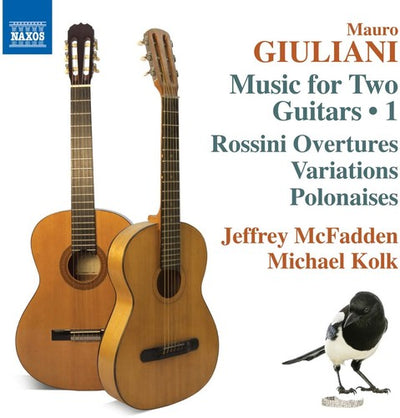
Giuliani: Music for Two Guitars, Vol. 1 / McFadden, Kolk
Mauro Giuliani was regarded in his day as "perhaps the greatest guitarist who has ever lived", making his name in Vienna and mixing with the likes of Beethoven. On his return to Italy in 1820, he consorted with Paganini and Rossini which resulted in his arranging four of the latter's overtures for two guitars. These versions abound in lyrical melodic lines, fast arpeggios, subtle colors and technical virtuosity also to be heard in the Gran variazioni concertanti. The Tre Polonesi concertanti are also full of joie de vivre, lively dance rhythms and elegant melodies.
Ravel: Orchestral Works, Vol. 4 - Daphnis et Chloe / Slatkin, Spirito, Lyon National Orchestra
Composed for Sergey Diaghilev’s Ballets Russes, Ravel’s ‘symphonie chorégraphique’ Daphnis et Chloé is based on a classical Greco-Roman love story set on the island of Lesbos. He described the work as ‘a vast musical fresco’, and with its extraordinarily passionate music, lush harmonies and orchestration, is considered both his masterpiece and the epitome of Impressionism in music. Orchestrated from the third of his Miroirs for piano, Ravel’s Une barque sur l’océan is an evocative portrayal of the ever-changing moods of the sea.
-----
REVIEWS:
This performance and recording comes close to fulfilling all of Ravel’s requirements. Slatkin paces the score admirably, even when he sets a spanking pace for the opening of the pirates’ dance. The orchestra find no difficulties in coping with the articulation of the notes here or in the final dance. I would put this Daphnis high on the list of currently available recordings.
– MusicWeb International
The shimmering orchestration and lush harmonies that epitomize impressionism are lovingly rendered by Slatkin and the French orchestra. While Daphnis et Chloé is most often presented as two suites for orchestra, this performance also includes the atmospheric choral parts, sung by Spirito, a body consisting of the Choruses and Soloists of Lyon and the Britten Chorus. Naxos provides remarkably clear and deep sound, so the finer points of Ravel’s scores are easily heard.
– All Music Guide
The Guerra Manuscript, Vol. 4: 17th Century Secular Spanish Vocal Musc / Vilas, Ars Atlantica
The Guerra Manuscript, named after its copyist José Miguel de Guerra y Villegas, is a repository of one hundred of the greatest secular songs (tonos humanos) circulating in the Madrid court of seventeenth-century Spain. The songs were composed by the leading figures of the Spanish Baroque and include many by the most prestigious of all, José Marín and Juan Hidalgo. Ideally accompanied by one of the principal Spanish baroque instruments, the arpa de dos órdenes (double harp), they explore ideas of love, praise, and beauty. This volume includes perhaps the best-known song of all, Corazón que en prisión.
Devienne: Flute Concertos Nos. 5-8 / Gallois, Swedish Chamber Orchestra
French composer Francois Devienne enjoyed great esteem with his successful operas in the Revolutionary years of 1792-97, but it was as a composer for wind instruments that he has won his place in musical history. The four Flute Concertos in volume 2 of the complete set show a combination of melodic elegance and graceful virtuosity that characterizes much of his work. Especially notable in this respect is No. 6 in D major, a compositional tour de force, rich in thematic material and panache, and one of the finest wind concertos of its epoch.
Tchaikovsky: Piano Music / Shikimori
Tchaikovsky wrote music for the piano throughout his life, many of these pieces being dedicated to family members or close friends and musical associates. Rich in variety, the Douze morceaux range from playful dances to a substantial Marche funebre, as well as lyrical jewels such as the Chanson triste and a Danse russe that found its way into the ballet Swan Lake. A background of romantic entanglements permeates the Souvenir de Hapsal which concludes with the well-known Chant sans paroles, while charm and virtuosity reside side-by-side in the Valse-scherzo and Capriccio.
Puccini: Complete Songs for Soprano & Piano / Stoyanova, Prinz
Through Puccini represents the late-Romantic apex of the Italian operatic tradition, his songs are much less well known and, in their pared simplicity and emotional restraint, could hardly be more different from his stage works. The nineteen complete songs for soprano (two in duet with a mezzo) and piano cover themes typical of lyric poetry including life, death, personal resolution, love, nature, home and religious faith. There are also rare salon pieces and examples of Puccini's secular juvenilia, written between 1875 and 1880.
Saint-Saens: Piano Concertos / Descharmes, Soustrot, Malmo Symphony
Soustrot’s Saint-Saëns symphony cycle was quite good, and this new project looks to be similarly successful. For my money, the five piano concertos remain one of the most underrated groups of major works in the entire romantic repertoire. Yes, Nos. 2 and 4 get played more often than the rest, but there isn’t a dud in the bunch. It’s really only prejudice against the French aesthetic–the formal freedom, love of color, flash, and the dance–that prevents the music from getting the recognition that it deserves. That, and perhaps the fact that the melodious ease that informs all of Saint-Saëns’ writing makes a mockery of German pretensions to ownership of instrumental music in large forms.
These performances demonstrate a thoroughly “French” sensibility. Romain Descharmes savors the music’s charm and brilliance without indulging in excessive sentimentality. The First Concerto, with its surprising wiring for horns, has a breezy freshness that completely disarming. It’s played with joyful directness and a complete lack of affectation. I enjoy fast and dazzling versions of the Second Symphony, with its whirlwind finale, but Descharmes treats the piece with almost epicurean relish, nowhere more so than in this sassy, witty account of the central scherzo. There’s no lack of virtuosity, but also time to savor the music’s many harmonic delights.
Through it all, Soustrot accompanies with total confidence, and the sonics are terrific. A disc to savor.
– ClassicsToday (David Hurwitz)
In the Moment: Short Pieces for String Quartet / Arabella String Quartet
Time, place and mood are explored in this unusual programme that reveals the inventive curiosity of the Arabella Quartet, lauded by the Boston Musical Intelligencer for its "freedom, drive, and risk-taking". The geographical span is wide, from Spain to Russia, and traditional staples by Schubert sit alongside meditative statements on human themes by Puccini, Turina, Webern and Nielsen. Shostakovich's Two Pieces for String Quartet were rediscovered in the 1980s and broaden the expressive range of this fascinating disc.
Tsontakis: Anasa, True Colors & Unforgettable / Miller, Albany Symphony Orchestra
Over the last few years American composer George Tsontakis, winner of the Grawemeyer Award for Music Composition, has crafted three distinctive and exciting additions to the contemporary concerto repertoire. Anasa, for clarinet and orchestra, combines elements of the Klezmer tradition with dance themes inspired by the lyra and lauto, traditional Cretan instruments. In True Colors the trumpet journeys in harmonically vivid, jazz-tinged directions, while Unforgettable balances the meditative with the playful, moving from ballad to phantasmagoria in a double concerto of drama and drive.
Busoni: Piano Music, Vol. 9 / Harden
All the works on this recording were composed when Busoni was between the ages of eleven and fifteen. Full of charm and wit, they reveal his precocious absorption of earlier models- principally Bach, Mozart, Weber and Schumann- as well as exceptional technical finesse. Una festa di villagigio charts the day’s events of a village festival whilst Suite campestre, one of his most distinctive early compositions, possesses moments of inwardness that presage the mature works to come. Wolf Harden, who was born in Hamburg in 1962, is one of the most versatile pianists of his generation. He has enjoyed great success in the Trio Fontenay, an ensemble that he founded in 1980 and with which he has toured to all the world’s major music centres. Harden devotes himself not only to chamber music but, with the same success, to the solo piano repertoire. His concert tours have taken him to South America and India as well as to countries throughout Europe, and his special affinity with unusual repertoire is attested by numerous recordings. He was the first to record a complete version of Hans Pfitzner’s Piano Concerto and has recorded piano music by Erno Dohnanyi, Franz Lehar and Ferruccio Busoni.
Romantic Music for Harp / Haas
John Thomas was official harpist to Queen Victoria and was known as the Chief of the Welsh Minstrels. His doleful The Minstrel’s Adieu to His Native Land illustrates the traditional folk heritage associations with the instrument.
The Smetana Die Moldau transcription is much more impressive and one of the most successful pieces in this collection. The harp brilliantly evokes the fresh tinkling, sparkling thrills of running water through the gushing springs of the upper Moldau, its progress through rapids, and forests and plains and onto Prague. The music growing from light-hearted youth in character through to proud mature grandeur as it approaches the Capital.
The lyrical beauty of Tchaikovsky’s two pieces from The Seasons are beguilingly caught by the harp, especially so of the June Barcarolle.
Virtuoso harpist Albert Zabel, was solo harpist for the Imperial Ballet in St. Petersburg. His Fantasy on themes from Faust by Charles Gounod is the most substantial piece in the programme and it allows the instrument to show off its virtuoso and dramatic/melodramatic capabilities. The Faust themes he chose seem less familiar and it would have been helpful if Pauline Haas could have elaborated her otherwise splendid, if rather colourfully effusive album notes. Ms Haas suggests that this Fantasy ‘follows the tradition of pieces written for virtuoso performance and is inspired by fashionable tunes of the period’? Whatever, here the harp sings romantically and dramatically enough and the virtuoso challenges are eagerly surmounted.
Mendelssohn’s Prelude and Fugue in E minor is a formidable work half in the Romantic tradition but also definitely in homage to the influence of Bach. The Prelude, beautifully evocatively played, ‘is often compared to a river of tears’ and the Fugue transcends tension and anger to a beatific acceptance of death. An extraordinary piece nicely, sensitively transcribed by Pauline Haas.
Finally, there is a formidable challenge for Haas; her arrangement for harp from Liszt’s piano transcription of Wagner’s Liebestodt. She successfully creates an atmosphere of calm at the beginning and serenity at the close. The emotionally intense climb to the peak of passion, is fine to start with, with plenty of sound perspective and power but, to me, it loses momentum on the way up when there is a mood-breaking sag and pause. Nevertheless this is a brave and worthy attempt.
A small moan, occasionally there is some distracting and disconcerting background noise –the soloist breathing I understand. Nevertheless this is a most interesting and enterprising collection demonstrating the undervalued capabilities of the most romantic of instruments.
– MusicWeb International (Ian Lace)
Baker: Piano Concerto "From Noon to Starry Night" / Hamelin
Award-winning and much decorated composer Claude Baker here entwines his evocative soundworld with the powerful imagery of two great poets. Recorded in its premiere performance with Marc-Andre Hamelin as soloist, the Piano Concerto ‘From Noon to Starry Night’ draws on and amplifies the structures and meanings of five poems by Walt Whitman, expressing the heroism and darkness of war, exuberant celebrations of nature and a wistful ‘remembrance of things past.’ Aus Schwanengesang is a memorial piece that expands and ‘re-composes’ the poignant Heine Lieder from Schubert’s song cycle with oblique and multi-layered references.
Cavazzoni: Complete Works
Riley: Palmian Chord Ryddle, Royal Majestic / Guerrero, Nashville Symphony
Terry Riley’s name will always be associated with his breakthrough work In C, but his influence on modern music has stretched far beyond minimalism. Both of the works on this recording reveal Riley’s spirit of exploration and his close collaboration with remarkable musicians. Commissioned by the Nashville Symphony, The Palmian Chord Ryddle is a kind of musical autobiography in which electric violin pioneer Tracy Silverman’s “one-man string quartet” sets the pace for the sparse, translucent orchestration. At The Royal Majestic is another recent example of Riley’s work with a symphony orchestra and a virtuosic soloist, in this case organist Todd Wilson. Its title refers to “the mighty Wurlitzer housed in grand movie palaces,” and the music draws on a wide variety of genres including gospel, ragtime, Baroque chorales, and boogie.
REVIEW:
The late career of Terry Riley has received less attention than that of Philip Glass or even Steve Reich. The resurgent Nashville Symphony under Giancarlo Guerrero makes a good case here that such neglect is misguided. The Palmian Chord Ryddle (2011) is an eclectic, playful eight-movement work for electric violin and orchestra, but steering mostly clear of highly extended techniques. Even stronger is At The Royal Majestic, an homage to the golden age of the theater organ. Engineering kudos for clarity in an extremely diverse set of materials. Highly recommended.
– All Music Guide (James Manheim)
Hamilton: Requiem / Cantoribus, Rosenau Sinfonia
Commissioned in 2012 to commemorate the centenary of the outbreak of the First World War, Timothy Hamilton’s Requiem draws its inspiration from the Roman liturgy. In twelve movements, it conjures up a vivid sequence of images depicting both the horror of war and the calmness and eeriness of the aftermath of battle, interspersed with moments of somber and contemplative reflection most notably in the plangent setting of Isaac Watts’ ‘Give us the wings of faith’ and the orchestral interlude ‘Lest We Forget.’ The work builds to a powerful and moving conclusion with soprano and then chorus welcoming the souls of the fallen into paradise.
Narbutaite: No Yesterday, No Tomorrow / Lyndon-Gee, Lithuanian National Symphony
Emerging from a cultural environment of silent resistance behind the Iron Curtain, Lithuanian composer Onute Narbutaite has become one of the outstanding Baltic artists of recent decades. Her output has developed from distinctive chamber music into the concerto-like symphonic style heard in the works on this recording. Described by conductor Christopher Lyndon-Gee as music that ‘transcends time and place… [and] resists any attempt at stylistic categorization of pigeonholing,’ these works convey powerful forces that flow between symbols and associations while probing direct emotional connections. Narbutaite’s imposing ‘Tres Dei Matris Symphoniae’ can be heard on Naxos as well: “a mind-blowing listening experience.” (American Record Guide).
Bolcom: Piano Music / Finehouse, Olevsky, Oppens, Taylor
William Bolcom was awarded the 1988 Pulitzer Prize in Music for his 12 New Etudes for piano, and his music has always revolved around works for the instrument on which he still performs as a soloist and accompanist. This collection of mostly premiere recordings reveals student pieces that negotiate twentieth century musical battles between the avant-garde influences of Boulez and Messiaen and Bolcom’s love of Schumann, as well as later work that embraces the 1960s ragtime revival and draws inspiration from friends and colleagues in every phase of his distinguished six-decade career. Elegantly performed by friends of the composer, this wide-ranging program is summed up by Bolcom as ‘cleaning house’ in the Charles Ives tradition.
REVIEW:
Anyone suitably provoked should accordingly investigate this set, each of whose discs is well planned as a standalone sequence. Piano tone is clear but never clinical and Bolcom’s own notes, informative and laconic, complement his music unerringly.
-- Gramophone
This extremely useful set gathers together all of Bolcom’s piano music that you don’t already have in your collection. There are many delights here, and some fascinating revelations about the development of this most versatile pianist-composer who has always resolutely refused to respect musical genre boundaries. …There are two delicious rags, separated by almost forty years, student pieces that show the composer coming to terms with the avant-garde polemics of the 1950s and 60s, and a concert paraphrase of an operatic aria in the popular ‘Neapolitan Song’ style.
-- Records International
What was originally mooted, by Klaus Heymann of Naxos, as a complete retrospective of the piano music of William Bolcom, eventually materialized as this 3-CD collection of works not easily available elsewhere. The compositions span 1956-2012, with music from his teen years to the present day, so you get a good overview of works from all periods of his career. Four pianists were engaged for the task, all with connections to the composer. Most of the recordings were set down in New York in 2014.
The music has been beautifully recorded with an attractively clear piano sound in each case. The excellent accompanying liner notes provide personal reflections and background to the pieces played, by the composer himself. On my first encounter with Bolcom’s music, I would offer a warm recommendation for this most enjoyable release.
-- MusicWeb International
Alchemize / Rand, University of Southern Mississippi Wind Ensemble
Contemporary American music for wind band is among the most varied, colorful and brilliant to be heard anywhere, not least when performed by one of the genre’s leading young ensembles. Pulitzer Prize winner Joseph Schwantner is represented by his evocative concerto “Luminosity.” David Maslanka has helped to reshape the wind band sound and “Hosannas,” some of which are based on chorale melodies, are full of moments of self-reflection. These qualities of quiet and timelessness are shared by the first movement of Steven Bryant’s “Alchemy in Silent Spaces.”
Martinu: Saltimbanques – Songs, Vol. 5
Chopin's Ghosts – Cello and Piano Works
Saint-Saens: Piano Concertos 4 & 5 / Descharmes, Soustrot, Malmo Symphony
Descharmes and conductor Marc Soustrot understand the music well. The opening variations are nicely contrasted, the ensuing Andante attractive in its flow. The long finale effectively integrates the ongoing return of the main themes, with Descharmes weaving into and out of the instrumental textures smartly and sensitively. It’s an interpretation that consistently holds your attention, and rewards your patience.
The “Egyptian” Concerto isn’t quite as good. The outer movements are fine, especially the rollicking finale, but the long central movement could be more effectively shaped, its “orientalisms” indulged just that more characterfully. Still, as in the Fourth, the performance reveals a lot of meaningful detail, especially in the finale, and Descharmes isn’t afraid to take a step back and let other instrumental colors take center stage once in a while. Ultimately this complete set of the five piano concertos stands among the best out there, even if everyone will have favorite individual performances. This is an achievement of which everyone can be proud.
– ClassicsToday (David Hurwitz)