One-Day Sale | October 14th, 2026
It's here! Our One-Day Sale this month is on October 14th, 2026.
For 24 hours only, save 50% on over 700 titles from Naxos!
Explore an incredible selection of box sets, CDs, DVDs, and more, featuring best-selling recordings of music by Dvořák, Strauss, Janáček, Vivaldi, and many more.
Whether you're filling gaps in your collection or discovering something new, this is your chance to shop hundreds of Naxos favorites at half price!
Over 700 titles. 50% off. 24 hours only. Don't miss out!
Shop now through Thursday, October 15th, 2026 at 9:00AM CT!
738 products
-
-
-
SaleMendelssohn: Violin Concertos / Tianwa Yang, Gallois, Sinfonia Finlandia
Naxos · Feb 2013CD$19.99$9.99 -
-
-
-
-
-
-
-
-
-
-
SaleDanielpour: Darkness in the Ancient Valley / Guerrero, Nashville Symphony
Naxos · Sep 2013CD$19.99$9.99 -
-
-
-
-
-
-
-
-
-
-
Saled'Albert: Cinderella Suite, Little Mermaid, Overtures / Markl, Leipzig Radio
Naxos · Apr 2014CD$19.99$9.99 -
-
-
-
-
SaleHosokawa: Orchestral Works Vol 2 / Markl, Royal Scottish National Orchestra
Naxos · Sep 2014CD$19.99$9.99 -
-
-
-
-
SaleProkofiev: Symphonies Nos. 1 'classical' & 2; Dreams
Naxos AudioVisual · Oct 2014Blu-Ray$16.99$8.49 -
-
-
-
-
-
-
-
-
SaleStandford: Symphony No. 1, Cello Concerto & Prelude to a Fantasy / Wallfisch, Lloyd-Jones, RSNO
Naxos · Feb 2015CD$19.99$9.99 -
-
-
-
-
-
-
-
-
-
-
-
-
-
-
-
Mendelssohn: Violin Concertos / Tianwa Yang, Gallois, Sinfonia Finlandia
Violinist Tianwa Yang turns her attention to one of the great 19th century violin concertos, coupled with two of Mendelssohn's youthful yet astonishingly mature works.
REVIEW:
Young violinist Tianwa Yang has exceptional technique, and her vision in the great E minor concerto is unfailingly intelligent. The first movement is taken a touch on the slow side, giving the music added weight and seriousness. In the finale, too, Yang refuses to rush or indulge in empty showmanship, while the Andante’s singing melodies do just that. If there is any down side to her interpretation, it is this: older, wiser violinists such as Nathan Milstein shape the many moments of passagework to more purposeful effect, just as a masterful singer understands that coloratura expresses virtuosity but also can be phrased and articulated so as to heighten the emotion and intensity of the phrase. Yang isn’t quite in that league yet, but there is absolutely nothing wrong with the playing as such. The accompaniments, similarly, won’t compare to the best versions featuring major orchestras, but they offer distinguished contributions nonetheless.
What makes this disc such a smart one, though, is the inclusion of the youthful D minor concerto and the F minor violin sonata. Most Mendelssohn discs couple another major violin concerto (usually Bruch’s or Tchaikovsky’s), and God knows we don’t need another recording of those works any more than we need another Mendelssohn E minor concerto. Both youthful works are vintage early Mendelssohn, and he was not a composer who invariably got better with age. Yang plays them very well indeed, and there’s far less competition here than in the more famous companion pieces. Pianist Romain Descharmes accompanies very sympathetically, and both in the concertos and the sonata the engineering is very clean and well-balanced. In sum, the couplings make this disc worth acquiring even if you’d never think of buying another version of the E minor concerto. As for Yang, she remains an artist to watch.
-- David Hurwitz, ClassicsToday.com
D'Albert: Symphony in F / Markl, MDR SO
D’ALBERT Tiefland: Symphonic Prologue. Symphony in F, Op. 4 • Jun Märkl, cond; MDR Leipzig RSO • NAXOS 8.572805 (62:40)
A recording of Eugen d’Albert’s early Symphony in F Major appeared on CPO three years ago and was reviewed by James A. Altena in 33:6. That version was conducted by Herman Bäumer leading the Osnabrücker Symphony Orchestra. D’Albert’s life story is reasonably well known, so it needn’t be recapped at length. In short, he was born in Glasgow, studied in London, and at 17 won a scholarship to study in Austria. There he was so taken with Austro-German music and culture that he repudiated his English training as worthless and from that day forward considered himself a right and proper German. He studied with Liszt, met Brahms, and built a career as one of the foremost piano virtuosos of his day. Between 1904 and 1905, d’Albert toured the U.S., and in 1907 succeeded Joseph Joachim as director of Berlin’s Hochschulefür Musik. D’Albert counted among his circle of associates and friends, Richard Strauss, who dedicated his Burleske to him, Hans Pfitzner, Engelbert Humperdinck, and Ignatz Waghalter (see the interview with Irmina Trynkos in 36:3). D’Albert’s personal life was a bit of a mess. Like Henry VIII, he married and divorced six times, though as far as we know, all of d’Albert’s wives kept their heads. When connubial contentment eluded him, he comforted himself in the arms of a mistress. His love of Germany and all things German must have soured when the First World War broke out, for in 1914, he moved to Zurich and became a Swiss citizen. He died, however, in Riga, Latvia, where he’d traveled to secure a divorce from his sixth wife.
Little by little d’Albert’s interest in composing began to overtake his career as a pianist. His output is not insignificant. It includes 21 operas, of which the seventh, Tiefland , first staged in 1903, was a major success, playing in houses around the world. It still holds the boards today, though mainly in Austria and Germany. Other works include a Cello Concerto, two piano concertos (available on Volume 9 of Hyperion’s “Romantic Piano Concerto” series), a couple of string quartets, an overture to Grillparzer’s Esther , a Piano Sonata, a handful of solo piano pieces, and lots and lots of songs.
Note: d’Albert composed the overture to Gilbert and Sullivan’s Patience in 1881, just prior to his departure for Austria. Except for the cello concerto, the two piano concertos, the symphony on this disc, and his opera, Tiefland , plus several recordings of excerpts therefrom, not a lot else by d’Albert has found its way onto disc.
Another note: if you’re searching ArkivMusic for d’Albert, you’ll find him listed under the letter “A,” as Albert, Eugène d’—odd, since the site lists D’Indy as D’Indy, Vincent. Maybe it has something to do with the lowercase “d” vs. the uppercase “D.” Amazon and the Fanfare Archive put d’Albert under “D,” but the Archive purges the apostrophe, giving his name as dAlbert. How many ways can you spell “dog?” How about “dawg?”
I concur in the opinion of others that d’Albert’s compositional strength lies mainly in his mastery of the craft; his thematic ideas lend themselves well to development and he knows his way around the orchestra. I find it a bit more difficult, however, to concur with colleague Altena that Brahms and Schumann are ever-present in d’Albert’s 1886 symphony. If you’ve not heard the piece before, my guess is you would find its soundscape rather generic, as if fashioned from some factory-made, synthetic, wash-and-wear fabric. The garment fits the style of the day, but the pants are somehow baggy and nondescript. Granted, d’Albert was only 22 when he composed his one and only symphony, but attractive as it is in the moment, it’s not the sort of work whose melodies or other features linger.
If the opening strains of the Symphonic Prologue to Tiefland recall the opening of the Scène aux champs movement from Berlioz’s Symphonie fantastique , it’s with good reason. D’Albert is painting a similar pastoral scene in which two shepherds are heard calling to each other on their pipes. Following that, the music seems to meander along a path on which it first meets, greets, and passes Wagner, only to encounter Debussy around the next bend walking his poodles, Pelléas et Mélisande . I confess to never having heard d’Albert’s opera, Tiefland , but if the rest of it is anything like the Prologue, I can understand the work’s success; it’s actually quite alluring, more so I would say than the symphony. But then the symphony is one of the composer’s earliest orchestral efforts—only the Piano Concerto No. 1 of 1884 predates it—whereas Tiefland came after d’Albert’s self-styled conversion to German-hood, and is a mature work by a composer already seasoned in writing for the stage by six previous operas.
I’m unfortunately not familiar with the CPO recording Altena reviewed, but this current release by Jun Märkl and the MDR Leipzig Radio Symphony Orchestra strikes me as eminently satisfactory. Playing and recording are both topnotch, and if you’re not acquainted with d’Albert’s music, this disc, at Naxos’s budget price, is an excellent way to gain some familiarity with it—enough, at least, to know whether you might care to explore further. On those grounds, recommended.
FANFARE: Jerry Dubins
Fairouz: Native Informant / Pine, Imani Winds
FAIROUZ Tahwidah. 4 Chorale Fantasy. 2 Native Informant: Sonata for Solo Violin 3. Posh. 4 For Victims. 2,5 Jebel Lebnan 6 • 1 Mellissa Hughes (sop); 1 David Krakauer (cl); 2 Borromeo Str Qrt; 3 Rachel Barton Pine (vn); 4 Christopher Thompson (baritenor); 4 Steven Spooner (pn); 5 David Kravitz (bar); 6 Imani Winds • NAXOS 8.559744 (78:22 Text and Translation)
This exceptionally varied and complex album features five first recordings of works by young American-Arabic composer Mohammed Fairouz (b. 1985), whose Piano Sonata impressed me when I reviewed the DVD by pianist Steven Spooner. I bristled, as I always do, to read the dreaded and hackneyed words on the CD insert that Fairouz “is one of the most frequently performed, commissioned, and recorded composers of his generation ” (italics mine). Well, what the heck generation could he possibly be part of but his own? Did you expect him to be the most frequently performed and recorded composers of his father’s generation?
But promotional semantics aside, Fairouz is a remarkably talented and highly original composer—no more so than some others nowadays who, living in America, combine the music of their ethnic cultures with European and/or American classical structures, but certainly one of the most interesting and communicative of such composers, which I suppose is what moves him to the top of his profession. Certainly, any CD that displays the combined talents of such well-known and/or outstanding talents as the Borromeo Quartet, Rachel Barton Pine, Steven Spooner, and the Imani Winds—all of whom, incidentally, are on my short list of favorite performers whose recordings I try to seek out for review—is testimony enough to the high quality of Fairouz’s music.
We begin this journey with Tahwidah, the setting of a poem by Mahmoud Darwish for soprano and clarinet. The text—which, surprisingly, is actually included in the booklet (along with all the other sung texts on this disc)—concerns the lullaby of a mother to her son, only to discover at the end that she is singing this at his funeral. The music is thus lyrical but strangely dissonant, beginning with exotic and difficult runs and trills on the clarinet, into which the soprano voice intermixes in a surprising and interesting fashion. Thank heavens, Mellissa Hughes has a pure, radiant voice, devoid of unsteadiness or wobble, and her singing is extraordinarily well phrased and emotionally moving. As in the case of so many modern-day sopranos, however, her English diction is exceedingly poor. Without the text to follow, you won’t be able to make out a single word. A small but important criticism, not meant in a mean-spirited way, but Mellissa, please work on your diction!
This is followed by Chorale Fantasy, which the composer describes as a song that combines the Arabic mode maqam “with gentle counterpoint,” leading from a songlike melody to a whirling dance. It was commissioned by the Borromeo Quartet, which plays it here. Perhaps not so curiously, the Solo Violin Sonata—commissioned by and played by Rachel Barton Pine—almost sounds, in its first movement, like an extension of the quartet, so lyrical and songlike is its melodic structure.
I was stunned here by the extraordinary range of colors that Pine extracts from her instrument, ranging from bright, sharply pointed passages reminiscent of Heifetz to warm, rich playing in the mid and lower ranges that sounded like Oistrakh. The second movement, “Rounds,” is a vigorous Arabic round dance (as per the composer’s notes), played with tremendous passion and energy, following which is a lament for the civilian victims of the Egyptian Revolution. This movement, which begins and ends very high up in the violin’s range, moves down to mid-range chordal passages which later incorporate microtonal slides (probably Arabic influenced) and, as in so much of Fairouz’s music, an exceptional singing quality that I feel is related to the song tradition of such composers as Ned Rorem. The composer describes the fourth movement as “just plain fun,” based on “the retro spirit of New York’s cabaret music,” supposedly emulating Gershwin and Porter, but I heard this music as oddly related to Eastern European folk-dance music and Eastern European-American forms, yet with an Arabic accent. At one point, Pine is required to play pizzicato counterpoint to her own top line on the violin. The final movement, which combines the feeling of both a lullaby and a lament, is titled “Lullaby of the ex-Soldat.” Fairouz says that he also conceived this movement as a tribute to Pine’s baby daughter Sylvia Michelle as a “celebration of birth and renewal.” With the possible exception of the first movement, I’d say that Fairouz has accomplished a Herculean task here, writing a sonata for unaccompanied violin that doesn’t owe much to the solo violin sonatas and partitas of Bach. I can only hope that it becomes a staple of the violin repertoire. This is, by the way, also the longest work on this disc.
Following this is Posh, a short song cycle (three pieces totaling 8:22) based on poems by Wayne Koestenbaum. These poems are not intended to “tell a story,” but merely to give an indication of a life: one song (poem) of a baby and his inability to cope with life without help, of “deadbeat dads” and dreams of the future; the second of a hapless adolescent searching for Ned Rorem songs; and third of an adult whose father “brings to mind the self-slaughtered Walter Benjamin.” This cycle is sung by “baritenor” Christopher Thompson, who has an unusual velvety timbre and, yes, qualities of both baritone and tenor. His diction is also superb, in sharp contrast to Hughes, and in the second song he makes one smile with his unusual way of bringing humor out when he sings. As usual, Spooner’s playing is also excellent, albeit subdued in this particular role as accompanist. Fairouz’s scoring for the piano here is primarily that of gently rocking notes and/or soft chime chords.
For Victims is described as “a dramatic scene for baritone and string quartet” based on two poems of David Shapiro, but although there are two movements only the second includes the sung poems. Here the Borromeo Quartet plays with a sense of sadness combined with drama, the music in the first movement vacillating between Eastern and Western modes, occasionally juxtaposing themes rather than engaging in actual development. As it turns out Shapiro’s poems, like many similar works, are about the Holocaust, the first a memorial to its victims and the second a personal memory of his grandfather emerging “in a synagogue” with his “sweet tenor coloratura” while he wonders if the dead are “permitted to sing.” Here the quartet’s role is more subdued and subservient to the vocal line. Baritone David Kravitz, unfortunately, has a woofy and tremulous voice, and his diction is only occasionally clear, which is very unfortunate as the music is exceptionally interesting and well written.
The last work, Jebel Lebnan, translates as Mount Lebanon, and is a lament for the lives lost at the massacres at the Sabra and Shatilla Refugee Camps caused by Phalange Party chief Bashir Gemayel. An interlude for flute is followed by a funeral march entitled “Ariel’s Song,” then a “reawakening” musically described by a celebratory dance to the resilience of the Lebanese people. The final movement, “Mar Charbel’s Dabkeh,” is yet another Arabic round dance. Since I am a huge fan of the Imani Winds, perhaps I am prejudiced in favor of nearly all their performances, which I always find to be rhythmically incisive, colorful in their manipulation of timbre and accent, and emotionally involved in every respect, thus I was immediately rapt by their extraordinary treatment of the opening passage, described by the composer as “a wild scream” for clarinet and piccolo. The music here, punctuated by interjections from the horn and clarinet, is continually underscored by a staccato ostinato figure played by the bassoon. The solo flute interlude is lyrical, yet with telling pauses in the musical line possibly indicating thought or meditation on the part of the flutist. It has a particularly forlorn sound that, to me, indicates such emotions. Interestingly, the solo bassoon line which opens “Ariel’s Song” sounds like a continuation of the flute lament. The other instruments of the quintet enter and exit, either singly or in pairs, but the bassoon generally dominates this lament. (I would also like to point out, for the benefit of those who don’t know, that the Imani Winds are four-fifths women musicians, which I believe is somewhat unique in the classical world.) The dance movement, surprisingly, also starts out slowly, only gradually increasing the tempo within the first dozen or so bars. It’s a cheerful little piece but not terribly uptempo—more of a relaxed dance than a frenetic one. After a short pause in the middle, Fairouz switches gears to his “little song,” which is more meditative and reflective than celebratory. This, in turn, leads into the “Dabkeh” or round dance, which begins with meditative passages played by the flute but then moves into a very sprightly dance rhythm. An Arabic round dance this may indeed be, but to my ears it has a great similarity to a horah!
Despite my small reservations on the diction of two of the singers and the singing voice of a third, I consider this one of the most interesting, varied, and engaging classical albums of the year so far, and one I shall undoubtedly be putting on my Want List.
FANFARE: Lynn René Bayley
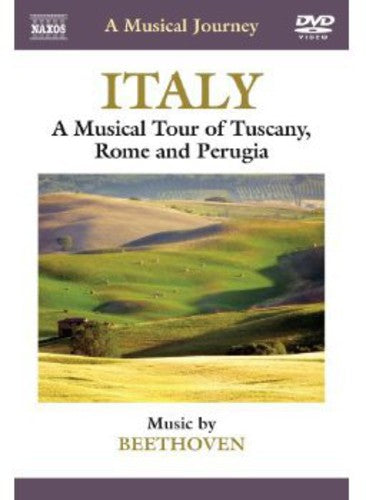
A Musical Journey: Italy - Tuscany, Rome, Perugia
The Places
The journey starts in the countryside near Arezzo, and passes from there to other districts of Tuscany, to the wine-producing fields near Montalcino, and thence to Rome and to the volcanic Lake Bracciano. The tour ends in the ancient town of Perugia, for long an artistic centre.
The Music
The music of the tour consists of Beethoven’s Symphony No. 7 of 1812 and two overtures, Coriolanus and The Consecration of the House. The Coriolanus overture was written for a play by Heinrich von Collin on the plot familiar from Shakespeare, and the second overture for the opening of a new theatre in Vienna in 1822.
Picture format: NTSC 4:3
Sound format: PCM Stereo 2.0
Region code: 0 (worldwide)
Running time: 54 mins
No. of DVDs: 1
Rodrigo: Guitar Music Vol 2 / Jeremy Jouve
Rodrigo’s music for solo guitar is not extensive but represents an important pillar of the repertoire, ranging from vignettes to sonatas over a six-decade period. The 1933 Toccata was rediscovered in 2005 and has since provided an ambitiously virtuosic vehicle for today’s guitarists. Rodrigo flecked his works with elements of fantasy, flamenco and bird song while Un tiempo fue Itálica famosa, one of his very greatest works in the genre, is superbly impassioned. The tender Pastoral, originally for piano, is here transcribed for guitar by Jérémy Jouve whose first volume in this series (8.570286) received a three-star review (“The young French guitarist plays brilliantly”) in the Penguin Guide.
Danielpour: Darkness in the Ancient Valley / Guerrero, Nashville Symphony
-----
REVIEW:
The program closes with A Woman’s Life (2007), based on a cycle of poems on that topic by Maya Angelou, who read the cycle, apparently unforgettably, to Danielpour and his wife in 2006. These songs are pitch perfect and memorably touching. I was enthralled from the start—a childhood poem of devastating innocence cloaked with an aura usually reserved for the likes of Barber—and if you love his music and American song repertoire in general you must hear this cycle. The finale is unspeakably beautiful. Ms Brown sings with loving understanding. The Nashville players sound great, as is usual these days.
–American Record Guide
Martinu: Songs, Vol. 2 - The Months
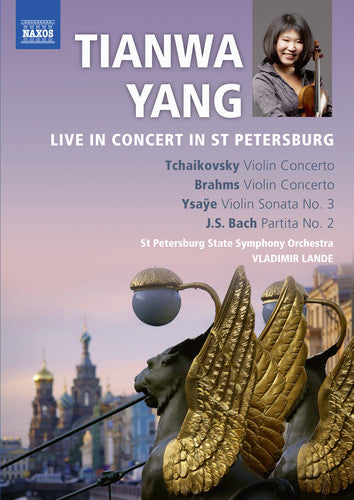
Tianwa Yang Live in Concert in St. Petersburg
Danielpour: Toward a Season of Peace / St. Clair
-- All Music Guide
Brahms: Ein Deutsches Requiem / Wit, Warsaw
"The Warsaw Philharmonic Choir, a highly capable of the most subtle gradations of tone, is always here the centre of creativity, creating the music’s existential continuum and arising to sombre unexpected splendour at ‘Die Erlöseten des Herrn’ and ‘Der Gerechten Seelen sind in Gottes Hand'...There is some beautiful orchestral playing."
-- BBC Music Magazine [5/2014]
"The Warsaw Philharmonic Choir sings beautifully throughout…Of the soloists, Christiane Libor and Thomas E. Bauer are excellent singers and the orchestra is also first-class...Wit conducts with considerable insight and interpretative command and the recording quality is equally first-rate."
-- International Record Review [5/2014]
"The Warsaw Philharmonic Orchestra and Choir outdo themselves, with some especially fabulous singing that is worth the price of the disc alone. As for the orchestral contributions, Wit uncovers all sorts of wonderful details in the low strings and winds, his expansive vision allowing for a huge emotional expressive range. Attention to dynamics, especially in the singing, is simply tremendous. This is really moving."
-- Brian Wigman, Classical Net [6/2014]
d'Albert: Cinderella Suite, Little Mermaid, Overtures / Markl, Leipzig Radio
The extravagantly gifted pianist and composer Eugen d’Albert had one of those improbably full, cosmopolitan lives spanning the 19th and 20th centuries. Born to a family of French and Italian origin in 1864, the same year as Richard Strauss, he grew up in Scotland. Taking on German nationality as a young adult, d’Albert studied with Liszt, who called him “Albertus Magnus,” and had a significant association with Brahms. A leading pianist of his time, he later turned to composition and was a prominent figure in Berlin’s extraordinary musical flowering in the 1920s.
D’Albert’s style isn’t easily pinned down, since he adopted differing stylistic approaches in different works. All of his music that I have heard is very well crafted, and some of it is inspired. It tends to be lively, affirmative, and light, at times, more like Humperdinck (traditional) than Busoni (progressive), to mention two of his contemporaries. Harmonically, it’s usually less adventurous than that of Liszt or Strauss. One of d’Albert’s teaches was Arthur Sullivan, for whom he composed the Overture to Patience . The writing for female chorus in Tiefland reveals this unusual influence.
D’Albert composed 19 operas in all manner of genres, changing his style from work to work, as Mascagni also did, in the quest for popular success. He found it with Tiefland , which is sometimes called a German verismo work, and is still occasionally performed. (Recordings of the Jewish-themed Der Golem , and the brief domestic comedy Die Abreise , have been issued in recent years.) Musically, Tiefland is compelling, and in it, one hears that d’Albert’s text setting and writing for the voice are as confident as his orchestration. It’s a very satisfying work to listen to, and I can recommend the Janowski recording with Marton, Kollo, Weikl, and Moll.
There’s a lot of music in this collection, all of it unfamiliar, and some of it very impressive. D’Albert’s colorful, sumptuously orchestrated preludes and overtures aren’t brief, and not all of them make a strong individual impression, but two stand out. The overture to Grillparzer’s play Esther from 1888 resembles a fully developed symphonic movement, majestic, with contrastingly playful sections, and perhaps modeled on Brahms. The prelude and introduction to Die toten Augen (1916), a biblical tale, sounds completely different, an atmospheric combination of a Korngold movie score mixed together with La mer.
Das Seejungfräulein (The Mermaid), an extended scene for soprano and orchestra, after Hans Christian Andersen, was composed in 1897 for one of d’Albert’s six wives, the soprano Hermine Finck. (Another was the pianist Teresa Carreño.) This intensely chromatic, surging music certainly shows the influence of Wagner, but manages not to sound derivative. Though it maintains more traditional harmony, it reminds me a little of the soprano “songs” in Schoenberg’s Gurrelieder, and it’s the most impressive composition on the CD. In the strenuous vocal part that requires the power and range of an Isolde or Brünnhilde, the Lithuanian soprano Viktorija Kaminskaite has a warm, attractive voice, and a committed delivery, but she strains and loses tonal support on some sustained high notes.
Finally, the disc’s featured work, the 1924 Aschenputtel (Cinderella) Suite , after the Brothers Grimm, is a deftly scored set of five brief, programmatic dances. Keith Anderson’s notes don’t identify the suite as a ballet, but it would certainly lend itself to choreography. This tuneful, entrancing score is a masterpiece of its kind, and like Ravel in Ma mère l’oye —there’s a French feel to Aschenputtel —d’Albert had the gift of creating captivating, childlike music.
Jun Märkl leads lively, flexible performances, and the Leipzig Radio Symphony plays well, particularly in the Aschenputtel Suite , with its many solos. I highly recommend this disc for the chance to make the acquaintance of Die Seejungfräulein , although I hope that there will be future recordings of it with more technically assured singing, and especially Aschenputtel , a delightful find.
FANFARE: Paul Orgel
-----
Eugen D’Albert was a tremendously gifted musician, and even had he not been we would owe him respect for being married six times and inspiring his second wife, the also multiply married Venezuelan pianist Teresa Careño, to utter that immortal line, “Darling, your children and my children are quarreling with our children again!” Aside from multiple marriages, D’Albert composed multiple operas, nineteen at least, and the overtures and preludes contained on this disc are very enjoyable. They range from the moody prelude to Die toten Augen, to the the luscious The Ruby (his first opera), to the jolly comedy The Departure.
The Overture to Grillparzer’s Esther is actually a robust, early concert work, while the delightful Cinderella Suite has plenty of the requisite fairytale atmosphere. The Little Mermaid is a brilliant, post-Wagnerian scena for soprano and orchestra, and it’s quite beautifully sung by soprano Viktorija Kaminskaite. Her voice rides the orchestra effortlessly, while her tone remains consistently smooth and lovely throughout its range. Jun Märkl leads the MDR Leipzig Radio Symphony with plenty of verve and a conviction often missing from his prior recordings of Debussy.
D’Albert’s style lacks the ultimate in individuality, but it’s unflaggingly attractive, and he clearly evolved from his Wagner/Liszt origins to something more contemporary, if not more personal. Anyway, the only way to find out is to listen, so let’s get to it.
– David Hurwitz, ClassicsToday.com
Respighi: The Birds; Three Botticelli Pictures; Suite In G Major / Di Vittorio, Chamber Orchestra Of New York
One of Respighi’s masterpieces, Gli uccelli (The Birds) includes transcriptions of birdsong and music of the seventeenth and eighteenth centuries in writing of evocative, captivating lyricism. Trittico botticelliano, an illustration of three paintings by Botticelli, employs dance rhythms, modal melodies and a variant of the medieval hymn Veni, Veni Emmanuel in deft, often sublime fashion. The Suite in G major, cast for strings and organ in the form of a Concerto grosso, is heard on this première recording in its original edition.
Heggie: Connection - Three Song Cycles
Famed for his operatic music, Jake Heggie has always been a devoted and prolific songwriter. Three early song cycles for soprano and piano feature in this release, each cycle exploring the many varied facets of the three women depicted, who include Ophelia and Eve. Each was written for a specific singer and they all reflect Heggie’s very personal and exciting lexicon of musical influences, which range from folk and jazz to art song and music theatre.
Hosokawa: Orchestral Works Vol 2 / Markl, Royal Scottish National Orchestra
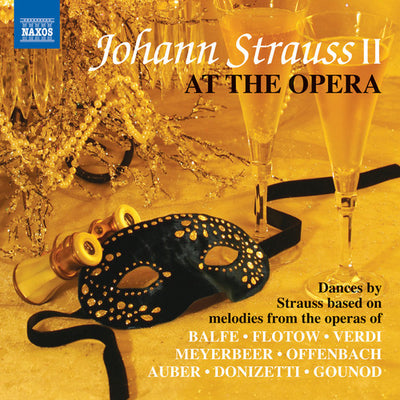
Johann Strauss II at the Opera
Prokofiev: Symphonies Nos. 1 'classical' & 2; Dreams
Soler: Keyboard Sonatas Nos. 42-56 / Mateusz Borowiak

The fourth installment in Naxos’ Soler keyboard sonata cycle introduces 25-year-old pianist Mateusz Borowiak, who has begun to make a name for himself on the competition and European festival circuit. While his playing is sensitive and stylish with regard to ornaments and phrasing, Borowiak is not afraid to exploit the modern concert grand’s dynamic range and potential for tone color. Listen, for example, to the effective crescendos and sudden contrasts in the C minor No. 48’s introductory measures, to the cross-rhythmic accents that punctuate the G major No. 45’s broken octaves, or to the shaded precision of the C major No. 50’s two-handed unison passages. Sample the A major No. 53’s differentiated detached and sustained articulation, not to mention those impressively calibrated trills. The intimate yet full bodied sonics are remarkably lifelike, as if Borowiak is working his magic just a few feet away from you. In short, this disc, along with numerous live performances posted on YouTube, clearly positions Borowiak as a piano talent to keep on your radar.
-- Jed Distler, ClassicsToday.com
The Wonder of Christmas / Elora Festival Singers
The Elora Festival Singers, conducted by internationally acclaimed director Noel Edison, is one of the most exciting of contemporary choirs. Their disc of Eric Whitacre’s choral music was nominated for a GRAMMY® in 2010. Now they turn to the art of the Christmas carol, a genre covering a variety of styles, both popular and refined, each piece expressing religious sentiments and beliefs. The music ranges from much-loved settings to new works, from polyphony to more straightforward melodies, in a recital stretching from the Middle Ages to the music of today.
Messiaen: La Nativite Du Seigneur / Tom Winpenny
Before he was thirty, Olivier Messiaen had written the work that established his worldwide reputation asa visionary composer for the organ, La Nativité du Seigneur (The Birth of the Saviour). A synthesis of hisinnovatory compositional style, it is rich in colourful harmonies and precisely noted but flexible rhythms,many derived from Hindu tâlas and from the metre of Gregorian chant. This musical commentary on theChristmas story is divided into nine movements evoking timeless grace, beauty, radiance, exhilaration,and majesty. Tom Winpenny is Assistant Master of the Music at St Albans Cathedral, the oldest site ofcontinuous Christian worship in Britain.
Standford: Symphony No. 1, Cello Concerto & Prelude to a Fantasy / Wallfisch, Lloyd-Jones, RSNO
Ries: 3 Violin Sonatas / Grossman, Kagan
Ferdinand Ries was Beethoven’s student, close friend and biographer, but until quite recently was very much one of those composers living in the shadow of his Bonn master, rather than as the gifted and prolific composer he in fact was.
American pianist, author and educator Susan Kagan has explored the music of those composers associated with Beethoven and his musical scene. In fact she has researched the music of Archduke Rudolph – Beethoven’s composition student for more than twenty years – for her Ph.D. This was subsequently published by Pendragon Press back in 1988. More recently she has almost single-handedly championed the cause of Ries’s piano music, with five CDs of his Sonatas and Sonatinas on the Naxos label.
Kagan explains: ‘Ries studied piano with Beethoven (both were natives of Bonn, Germany) and was entrusted by him with such work as making transcriptions and piano arrangements, and copying orchestral parts of Beethoven’s new works. Ries moved to England in 1813, married an Englishwoman, and had a successful career touring as a virtuoso concert pianist. At the same time he was composing prodigiously and virtually everything he wrote was published. His thorough knowledge of Beethoven’s music undoubtedly helped shape Ries’s style, but his piano sonatas, from 1809 on, show an adventurous turn toward an expressive keyboard style anticipating that of the first generation of Romantic piano composers – Mendelssohn, Chopin, and Schumann. His gift for melody is like Schubert’s, and he is ever inventive in creating and developing beautiful themes. While his symphonies and concertos are ‘public’ works, intended for large audiences and concert halls, the piano sonatas are his most personally-expressive works, revealing an individual outlook on a genre of music cultivated by that great triumvirate of the Classical period – Haydn, Mozart, and Beethoven.’
Ries also composed eighteen violin sonatas, which were brought out by Bonn music-publisher, Simrock, who also published much of Beethoven’s music. On this latest release from Naxos, Kagan is joined by violinist and fellow-American Eric Grossman, in an exploration of three of Ries’s violin sonatas, two from his op. 8 set, and his op. 19, all world-première recordings. However, unlike the piano sonatas, which have been released as part of a series of volumes, by starting here with a well-chosen selection from the eighteen extant examples, it gives the record company the option of releasing further violin sonatas in the future, or just letting this present single CD speak on behalf of the other fifteen.
It is interesting that the opening movements of the Sonata in F, Op. 8 No. 1, recorded first, and the Sonata in C minor, Op. 8 No. 2 that follows, have more than just a passing acquaintance with movements by Beethoven himself. While the latter first movement is very reminiscent of the corresponding movement from Beethoven’s Piano Sonata in the same key, Op. 10 No. 3, the F major Sonata opens in a pastoral vein, with a main theme which immediately hints at Beethoven’s ‘Spring’ Sonata for violin and piano in the same key. Rather than reinforcing the idea that Ries is merely mimicking his teacher – what follows, in both of Ries’s sonatas, after the initial ‘homage to Ludwig’, really does confirm that the younger composer has an individual voice, and subsequently embarks on quite a different musical journey from his master.
Of the violin sonatas as a whole, Kagan continues: ‘(They) are models of the Viennese Classical sonata style established by Mozart: most are in three movements, with first movements in sonata-allegro form, lyrical slow movements in ternary (ABA) form, and rondo finales. Like Mozart, Ries divides the material to provide equal interest for both instruments.’ The Sonata in F largely adheres to this pattern, though is, in fact, a four-movement work, with a sprightly Scherzo and Trio in the tonic minor (F minor) following the opening ‘Allegro ma non troppo’, before a conventional, though short slow movement, leads to the finale, with its essentially rustic theme. However, this soon contrasts with the central episode, where staccato triplets evolve into a vigorous fugato section (like a fugue, but not fully played-out), and something which, according to Kagan in her compact, yet succinct and informative sleeve-notes, is an unusual event in Ries’s music, where polyphonic writing is ‘generally avoided’.
The characteristic dotted rhythms and robust dynamics of the ‘Allegro con spirito’ that open the Sonata in C minor, imbue it initially with an almost martial character, but this soon turns lyrical, in which vein the ensuing ‘Adagio cantabile’ slow movement continues, and which also then acts as the perfect aperitif to the lightness of the closing rondo, with its staccato texture and preponderance of rapid repeated notes.
The so-named Grande Sonata in F minor, while the shortest of the three works on the CD, is nevertheless conceived in large scale, both with regards structure and content, and with its key, and the dramatic insistence of the opening movement’s main theme, link it in character to Beethoven’s ‘Appassionata’ piano sonata, written some five years earlier. Unlike Beethoven’s work, Ries’s sonata begins with a short and poignant ‘Largo espressivo’ introduction – not unlike the opening of Beethoven’s earlier ‘Pathétique’ sonata, but providing nowhere near as dramatic a lead-in. Ries maintains the feverish mood of the ‘Allegro agitato’ throughout, despite the occasional sections away from the over-arching minor tonality, and the movement’s calmly-understated close. The following slow movement, in a gentle triple measure, and in the relative major key (A flat major), has a simple charm and eloquence that makes it extremely endearing and pleasing on the ear, but with sufficient contrast within, to hold the listener’s attention throughout. The overall playful mood of the final rondo also has more than enough variety, both rhythmically and melodically in its main theme and episodes, to sustain it, with some real fireworks in the central episode. The music has a decidedly Schubertian feel, both thematically, and in Ries’s use of tonality, where more remote keys figure, and there is often a characteristic shift from major to minor and back. Yet again Ries chooses to finish like a lamb, rather than a lion – something Beethoven does in the opening movement of his ‘Appassionata’, but not in the work’s tumultuous and clattering coda to the finale.
Whichever way you look at this latest Ries CD from Naxos, you will surely not be disappointed. The playing, positioning and recording are first-rate, and the three pieces recorded are charming, entertaining and with a good feel for motivic development. Whether they form part of a more extended investigation into the composer’s repertoire for violin and piano, or remain just a one-off sampler, at the bargain price offered, they are simply too good to miss.
– Philip R Buttall, MusicWeb International
3 Flavors / 2 Movements (with Bells) / Superstar Etude No. 3
The Thurston Connection: English Music for Clarinet & Piano
Webern: Vocal & Chamber Works
Brian: Symphonies No 6, 28, 29 & 31 / Walker
Symphonies Nos. 28 and 29 both date from 1967, and both have four movements that play without pause, more or less. No. 28 is only fourteen minutes long in total. Late Brian is an acquired taste, largely because of the music’s relentlessly contrapuntal textures, heavy orchestration with lots of low brass and percussion, and lack of simple repetition to permit listeners to get their bearings. Indeed, these pieces, and the brief, single-movement No. 31 for that matter, sound as though Brian simply chopped off hunks of music from some larger overall blob of material. And yet, the opening of No. 28 has an innocent simplicity of tone and texture that the composer never lost, and all of this music sounds like no one else. That is why it retains its peculiar fascination. It may not be “easy” or “friendly,” but it is distinctive, and the work of a strong musical personality with a definite message.
As with No. 6, the performances under Alexander Walker sound remarkably assured given the unfamiliarity of the material, and they are very well recorded. The Havergal Brian Society and Mr. Godfrey Berry underwrote this production, and they definitely got their money’s worth.
– David Hurwitz, ClassicsToday.com
Martinu: Songs, Vol. 3 - The Rose
This recording focuses on three of Martinu’s song-cycles, and a selection of individual songs from an early period in his life that sheds fascinating light on his enthusiasm for song composition. Songs On One Page and Songs On Two Pages were written during his American exile, both utilising traditional and folk texts in compact but expressive ways. Set to Japanese lyric poetry, Niponari is one of his most important early compositions, revealing a transition from late-Romanticism to impressionism. Of Volume 2 in this series (8.572310) BBC Music Magazine wrote: ‘Some excellent songs here, in radiant performances’.
The Berlin Gamba Book
Bacewicz: Complete String Quartets Vol 1 / Lutoslawski Quartet
Musicologist Adrian Thomas considered Grazyna Bacewicz’s string quartets “unrivalled in 20th-century Polish music and… one of the century’s most significant contributions to the genre”. Her folk-music infused First Quartet dates from student days at the Paris Conservatoire, while exceptional polyphonic skill, intense emotion and playful, high spirits characterize the Third Quartet. Both the Sixth and Seventh Quartets unite tradition with a strikingly effective and highly personal exploration of progressive contemporary techniques. As Lutoslawski observed, in the “rapidly changing artistic currents” of the times, “it was [Bacewicz’s] music which helped create that atmosphere.”
Rouse: Seeing; Kabir Padavali
-----
Review:
Trevigne is nothing less than sensational. She is assured in her presentation, and possesses a warm and, yes, voluptuous soprano that is perfectly matched to this material. Her performance shows a level of commitment to the composer’s intentions that only the best singers of contemporary music can command.
– Fanfare
Vieuxtemps: Works For Solo Violin / Reto Kuppel
Henry Vieuxtemps was a violin prodigy who became a towering figure in a line of violinist-composers that stretches from Viotti to Ysaÿe, and whose playing led to Schumann’s statement that he “holds us in a kind of magic circle”. Influenced in part by Paganini, Vieuxtemps’s solo works demand the full arsenal of virtuoso techniques from lightning speed to the purest singing tone. The Etudes, Op. 48 include a piece subtitled ‘Torment’, while the Six Morceaux represent the composer’s homage to Bach in their polyphonic style.