One-Day Sale | October 14th, 2026
It's here! Our One-Day Sale this month is on October 14th, 2026.
For 24 hours only, save 50% on over 700 titles from Naxos!
Explore an incredible selection of box sets, CDs, DVDs, and more, featuring best-selling recordings of music by Dvořák, Strauss, Janáček, Vivaldi, and many more.
Whether you're filling gaps in your collection or discovering something new, this is your chance to shop hundreds of Naxos favorites at half price!
Over 700 titles. 50% off. 24 hours only. Don't miss out!
Shop now through Thursday, October 15th, 2026 at 9:00AM CT!
738 products
-
-
-
SaleAmerican Classics - Corigliano: Music For Violin And Piano / Bieler, Tichman
Naxos · Dec 2008CD$19.99$9.99 -
-
-
SaleTicheli: Wild Nights!; Dzubay, Bryant, Etezady, Mackey / Weiss, Gnojek, U Of Kansas Wind Ensemble
Naxos · Apr 2009CD$19.99$9.99 -
-
-
SaleAmerican Classics - Sierra: Missa Latina "Pro Pace" / Murphy, Webster, Delfs, Milwaukee SO
Naxos · May 2009CD$19.99$9.99 -
-
-
-
-
SaleCharles-Auguste De Beriot: Solo Violin Music, Vol. 1 / Bella Hristova
Naxos · Aug 2009CD$19.99$9.99 -
-
-
-
-
-
-
-
-
SaleA Chinese Musical Journey - Xinjiang: A Cultural Tour with T
Naxos AudioVisual · Mar 2011DVD$13.99$6.99 -
-
-
-
-
-
-
-
-
-
-
SaleCzech Republic - Castles And Towns In Bohemia And Moravia
Naxos AudioVisual · Jan 2012DVD$13.99$6.99 -
-
-
SaleGershwin: Concerto In F, Rhapsody No 2, I Got Rhythm Variations / Orion Weiss [blu-ray Audio]
Naxos AudioVisual · Feb 2012Blu-Ray$16.99$8.49 -
-
-
-
-
SaleA Musical Journey - Germany: A Musical Visit to the Benedict
Naxos AudioVisual · Jul 2012DVD$13.99$6.99 -
-
-
-
-
-
-
-
-
SaleDelius: Appalachia, Sea Drift / Sanderling, Williams, Tampa Bay Master Chorale
Naxos · Sep 2012CD$19.99$9.99 -
-
-
-
-
-
-
SalePater Noster - A Choral Reflection on The Lord's Prayer / King’s Singers
Naxos · Oct 2012CD$19.99$9.99 -
-
-
SaleCasella: La Donna Serpente; Introduzione, Aria E Toccata; Partita / La Vecchia, Rome SO
Naxos · Nov 2012CD$19.99$9.99 -
-
American Classics - Corigliano: Music For Violin And Piano / Bieler, Tichman
Ticheli: Wild Nights!; Dzubay, Bryant, Etezady, Mackey / Weiss, Gnojek, U Of Kansas Wind Ensemble
WILD NIGHTS! • Scott Weiss, cond; Vince Gnojek (s sax); Univ of Kansas Wind Ens • NAXOS 8.572129 (60:23)
TICHELI Wild Nights! DZUBAY Shadow Dance. Bryant Dusk. ETEZADY Anahita. MACKEY Soprano Saxophone Concerto
A wild night, indeed! This isn’t exactly warm-breezy-night-on-the-square band fare, though it would certainly make an exciting concert if the municipal ensemble were up to the considerable virtuosic demands. As we know from their earlier Naxos release, “Redline Tango” (8.570074), the University of Kansas Wind Ensemble has virtuosity to burn. As in that inaugural release of the Naxos Winds Band Classics series, they produce a superb blend and sonority; brilliant and thrillingly massive in full flight and—thanks in large part to a collection of outstanding section soloists—beautifully refined in quieter passages. “Redline Tango” was conducted by long-time Director of Bands John Lynch, who left a fine legacy of technical excellence, musical sensitivity, and dedication to new music. Scott Weiss, holder of the director’s position since Lynch’s retirement in 2007, has plainly maintained the high standards.
The title work of the album starts the proceedings with a swagger. With high energy and high spirited, it lies stylistically somewhere between Copland’s An Outdoor Overture and Bernstein’s more manic moments. Inspired by the Emily Dickenson poem of the same name, it is more about the joy and ecstasy in that work than anything of the poet’s repressed sexual desires. In any case, jazzy and full of surprises, it is the perfect program opener.
Equally effective are David Dzubay’s magical Shadow Dance , a revisitation of Pérotin’s Viderunt omnes and John Mackey’s hyperactive Concerto for Soprano Sax and Wind Ensemble. Dzubay takes the concept of organum to remarkable extremes, creating a frenzied, irreverent modern equivalent of the 13th-century composer’s primitive polyphony. It has little to do with the medieval—excepting, of course, the concluding monk-like chanting of the cantus firmus —but everything to do with joyful celebration of the past. The Mackey Concerto, homage to his teacher John Corigliano, is five movements of nonstop technical demands on the soloist. Flanked by a Prelude and Finale that in themselves would provide a challenging work, the three inner movements celebrate the three materials in the saxophone. “Felt” shows off key work, with wild note bending and alternate fingerings. “Metal” exploits the beauty of the brass, with the sax playing high and sweetly, attended by bells and chimes. “Wood” displays the instrument’s warmth in a sensuous tango. Vince Gnojek, professor of saxophone at the University of Kansas, may not have the sweetest tone—more a reedy American jazz sound than a French quality—but his technical skill is staggering and he is matched by the band members who get an amazing workout.
The other two works, Steven Bryant’s Dusk , a chorale work that shows off the band’s beautiful control and Roshanne Etezady’s three-movement Anahita , inspired by a mural of the Zoroastrian goddess of the night, are attractive, but less-distinctive works. The locally produced recording has great dynamics but not a lot of air around the ensemble, and loud climaxes become congested. It is hard to tell if it is the hall or the miking, but it is not enough to detract significantly from the overall excellent impression. Enough said: those looking for Sousa and Broadway medleys, head for the ol’ band shell. Lovers of top-drawer wind bands and high octane, listener-friendly contemporary charts should apply within. And pick up that earlier Naxos release as well. Great stuff.
FANFARE: Ronald E. Grames
American Classics - Sierra: Missa Latina "Pro Pace" / Murphy, Webster, Delfs, Milwaukee SO
- The Washington Post
Chinese Classics - Wild Grass / Beijing New Music Ensemble
ZHOU LONG Su (Tracing Back). Pianogongs. Taiping Drum. Wild Grass. Taigu Rhyme. CHEN YI Monologue (Impression on “The True Story of Ah Q”). Romance of Hsiao and Ch’in. Chinese Ancient Dances • Beijing New Music Ens • NAXOS 8.570604 (56: 04)
Elsewhere in this issue (or the next) I review another disc in Naxos’s “Chinese Classics” series—three string quartets by Ge Gan-Ru. This one is no less worthwhile, and in fact probably will be more appealing to the average listener. (I say that only because I don’t think the average listener relishes George Crumb’s Black Angels , for example, but perhaps I am mistaken.)
These two composers were born in 1953. Both currently teach at the Conservatory of the University of Missouri in Kansas City, and both studied at the Central Conservatory in Beijing and at Columbia University in New York. Both also are married—to each other! While Ge Gan-Ru usually is described as “China’s first avant-garde composer,” Zhou Long and Chen Yi seem to have less confrontational musical personalities. Their music is most assuredly not derivative, however, nor does it have that picture-postcard quality that sometimes pervades earlier classical music by Chinese composers. In fact, I’d go so far as to say that these two composers speak with more distinctive voices than Ge Gan-Ru, who seems very connected to his Western avant-garde influences.
The works on this CD were composed for a variety of instrumental combinations. Some call for traditional Chinese instruments to be paired with Western instruments. Su , for example, is for flute and the zither-like guqin, and Pianogongs is for piano and luo, the gongs traditionally used in Chinese opera. It seems to me that Zhou and Chen are doing something similar to what Chopin and Piazzolla used to do, that is, taking their country’s indigenous genres of music and transforming them into something both personal and original.
All of this music is interesting. Some of it is terrifically exciting. Taigu Rhyme , which closes this CD, is scored for clarinet, violin, cello, and three traditional drummers, and the latter build up an impressive head of steam as the music hurtles along. The clarinet imitates the sound of the guanzi, a reed instrument related to the oboe—another example of how some modern Chinese composers are synthesizing East and West, and old and new.
The very existence of the Beijing New Music Ensemble demonstrates how quickly things are changing in China. Founded in 2005, and consisting (it appears) of an international array of musicians, it has presented dozens of new works in China and elsewhere. I have little to compare them to, but the performances seem to be on the highest possible level. This digital recording was made in the studios of Beijing’s China Record Company—in itself, a marker of both change and continuity.
These works are challenging and emotionally rich, and require no special pleading. Anyone interested in the continuing evolution of Chinese culture needs to give this excellent CD a listen.
FANFARE: Raymond Tuttle
Charles-Auguste De Beriot: Solo Violin Music, Vol. 1 / Bella Hristova
BÉRIOT 12 Scènes ou Caprices, op. 109. 9 Studies. Prélude ou Improvisation, op. posth • Bella Hristova (vn) • NAXOS 8.572267 (68:02)
With the recent rash of recordings of his works, by now the music of Charles-Auguste de Bériot should have become almost as familiar to collectors as it has been to violinists, both teachers and students. Although probably few pupils work through his Méthode (1858) at the beginning of their academic careers, they encounter his concertos halfway through, and if they’ve persisted, study his 60 concert studies as a sort of gateway, beside Dont’s op. 35 and Gaviniès’s Matinées , to the transcendental technical studies of Paganini and Ernst. Unlike Dont’s more patterned études, however, Bériot’s take the form of character pieces: even the simple melodies and scales in the Méthode recall music for the salon more vividly than music for the studio.
From the outset, it’s clear that Bériot cut the Douze Scènes ou Caprices from the same cloth. The opening study, “La séparation,” begins almost as bleakly and hauntingly as does Sibelius’s Violin Concerto and includes a buzzing middle section in double-stops that draws upon the violin’s less familiar timbral regions as effectively as do some of Bartók’s duos. At least Bella Hristova plays the study that way, taking maximum advantage of the rich and dramatic possibilities for characterization it offers. If No. 2, “La polka,” doesn’t attain the same level of portraiture, it exceeds the First Study in brilliance and complexity, and Hristova proves herself more than equal to its demands. No. 3, “Le lézard,” brings snaky (lizard-like) chromatic lines, while No. 4 (“Le départ”) frames passagework with a lament. No. 5, “La fougue,” contains a mix of scalar and arpeggiated lines that climb chromatically in the middle section, punctuated by explosions of double-stops. No. 10, “Marche russe,” may not sound particularly Slavic, but it relies on the usual stock characters to carry its drama forward.
The Nine Studies, while not bearing titles (except for the last, written “in imitation of the old masters”), also express severally a range of moods that should qualify them for parlor performance, even if the first four remain as intensely patterned as the 60 Concert Studies (the Fifth, Melody, the Sixth, “Gulnare,” and the Seventh, March, offer more developed character studies). The posthumous Prélude ou Improvisation , written, as the notes state, largely without bar lines, might, except for its length (nine minutes and then some), be welcome in an occasional appearance on the concert stage in place of, say, Kreisler’s Recitativo e Scherzo.
Bruce R. Schueneman’s insert notes point out the similarity of Bériot’s arsenal to Paganini’s; and a cursory examination of the scores may perhaps make them seem more similar than they appear upon closer examination: in Bériot’s studies, the difficulties have all been wrought in conformity with positions achievable by a normal hand, while Paganini’s notoriously require the skill of a contortionist. Nevertheless, Bériot tailors these difficulties to his intended performers, and both the easiest and the most difficult of his works (and some, especially the studies, reach a very high level of difficulty) make a brilliant, thoroughly violinistic effect. Marc Pincherle likened Vivaldi to Kreisler in writing music that achieved a maximum of brilliance with a minimum of effort; he might have included Bériot.
Bella Hristova’s consistently elegant and richly characterized performances camouflage the difficulty of these studies, though they seem to reach at least the level of the 60 Concert Studies. The engineers captured the tonal splendor of her 1655 Nicolò Amati in St. John Chrysostom Church in Newmarket, Ontario, Canada, on February 12–15, 2009. Collectors of all kinds should find this compilation uncommonly interesting; but to violinists, it should be irresistible. It would be sad to learn that Hristova didn’t choose to record this repertoire only because a contract to do so had been offered and didn’t feel as sympathetic to the composer as she seems. In any case, strongly recommended.
FANFARE: Robert Maxham
Easy-Listening Piano Classics: Beethoven
Anton Rubinstein: Piano Music, Vol. 2 / Joseph Banowetz
A. RUBINSTEIN Sérénade russe. 2 Melodies, op. 2. Souvenir de Dresde, op. 118. Romance and Impromptu, op. 26. Akrostikon No. 1, op. 37 • Joseph Banowetz (pn) • NAXOS 8.570942 (75:21)
Recently, I reviewed Joseph Banowetz’s first volume of music by Anton Rubinstein, declaring myself ripe for more at the end of it. Well, here is Volume 2, a mix of the new (five of the six movements of Souvenir de Dresde are world premiere recordings—No. 6 was recorded by Leo Sirota and is available on the Arbiter label—as are the Romance and Impromptu , the Sérénade russe, and the Akrostichon No. 1). Volume 1 contained music from 1871–90; this presents works written 1852–94. I also mentioned in my earlier review that only the Melody in F has gained the favor of the catalog, and here in fact it is, played with unaffected simplicity by Banowetz and bringing in tow its lesser-known companion, a Melody in B, a work of supreme delicacy. Rubinstein uses single-line melody to great effect, and Banowetz plays with supreme dignity and maturity.
The disc begins with a work minus opus number. The Sérénade russe was written around 1852, and was composed for a publication named L’Album Bellini . The melancholy feel of the work seems entirely Russian. Banowetz ensures that the lightenings of texture and mood register to maximum effect, and that the Lisztian arabesques contain hints of improvisation.
The sublime sweetness of the first movement of Souvenir de Dresde (1894) draws one into the work. This movement’s title is, in fact, “Simplicitus.” The music opens out into sequences of roulades (dispatched with remarkable ease by Banowetz). In contrast, the second movement, marked “Appassionata,” uses Brahmsian sonorities to bring a contrastive disquiet. Annotator Joshua Creek suggests that the opening of the third movement, “Novelette,” is pastiche Rameau, and it is easy to hear what he means. The movement is a delight. A light, almost Mendelssohnian Caprice leads to an extended Nocturne where the shadow of Chopin can be clearly felt. Drama is the characteristic of the final Polonaise. Banowitz does not quite project the full sweep of the piece, perhaps.
Dripping, slow descending lines that one might expect to encounter in late Brahms begin the Romance from op. 26. Rubinstein’s offering turns out to be a simple but expressive song without words, its melody exquisitely shaped by Banowetz. The Impromptu makes for effective contrast in its playful, busy nature. Finally, Akrostikon No. 1 (written around 1856). Each movement is headed by a letter, which when put together spell “LAURA” (Laura Shveykovskaya, a young lady evidently admired by the composer). All five movements are remarkably stress-free, liquid outpourings. Any hints of disquiet in the fifth movement (Con moto) are dismissed in the quasi-improvised final movement, a clear Lied ohne Worte.
Once again, Banowetz has succeeded in alerting the record buying public of the importance of Anton Rubsinstein’s music while simultaneously providing playing of the utmost clarity and beauty.
FANFARE: Colin Clarke
Schmidt: Symphony No. 3, Chaconne / Sinaisky, Malmo Symphony
Franz Schmidt’s Third Symphony was composed in 1927–28, dedicated to and premièred by the Vienna Philharmonic Orchestra, winning a first prize from the Columbia Graphophone Company of New York for the best symphony in the spirit of Schubert’s ‘Unfinished’ Symphony as part of the centenary commemorations of Schubert’s birth. Schmidt’s symphony is lyrical, includes a set of variations, a Ländler-like Scherzo and finale rich in thematic invention. In 1931 Schmidt added wind and percussion instruments and a large body of strings to his monumental Chaconne for organ, in which form it too was premièred by the Vienna Philharmonic.
A Musical Journey: Italy & Austria - Brixen, Innsbruck
The Places
The tour starts at the great Augustinian foundation, Kloster Neustift (Novacella), at Brixen (Bressanone) in Southern Tyrol, with its rococo church interior and collection of late medieval paintings. This is followed by a visit to Innsbruck, the capital of the Tyrol, with its famous Goldenes Dachl (Golden Roof) and rococo Wilten Basilica and Collegiate Church.
The Music
The music chosen for this tour of Brixen and Innsbruck is by Mozart and includes two symphonies, with other works. Symphony No. 40 is the second of the group of three final symphonies, written in Vienna in 1787, and Symphony No. 28 was written in Salzburg in 1773 or 1774. Other works included are overtures to the early opera Il rè pastore, to The Abduction from the Seraglio, Mozart’s first operatic success in Vienna, and the overture to La clemenza di Tito, written in 1791, a few months before his death.
Picture format: NTSC 4:3
Sound format: PCM Stereo / Dolby Digital 5.1 / DTS 5.1
Region code: 0 (worldwide)
Running time: 58 mins
No. of DVDs: 1
R E V I E W:
I guess these Musical Journeys serve several purposes. A far as Naxos is concerned they recycle sound recordings for those who prefer a visual image to make a change from the wallpaper. The images are often quite stunning, whilst the music, never less than appealing, can be appropriate to the image or otherwise; a fact I touch on in this review. Other functions can be to remind the inveterate tourist of places visited, or of places to go as part of a future itinerary.
A word first about the Tyrol. In the days of Mozart, whose music is the backing to these scenes, it was part of the Hapsburg Empire of which the composer was a citizen. Italy was not even a nation, rather a collection of states, some with rulers with a connection with the Hapsburgs whilst others were influenced by, or later under, French control. In that generic sense Italy was a country Mozart visited in his childhood as his father hawked his genius round Europe. I detail this in my survey of The Complete Operas of Mozart. It can be considered, therefore, wholly appropriate that his music is the backing to this collection of views of the Tyrol the southern part of which became ceded to Italy in the treaties of 1919 in the aftermath of the First World War, Italy having joined in on the allies side, albeit a little late in the day.
Brixen lies in that ceded part of the Tyrol and contains the magnificent Neustift Monastery - the focus of the first part of this collection (Chs. 1-4). The external beauty includes the ornamental ceilings of the Cloisters, the Romanesque Bell Tower dating from the twelfth century whilst other parts are Gothic (Ch.1). The Molto allegro movement of Mozart’s 40 th symphony, one of a group of three composed in Vienna as he sought work, is an appropriate accompaniment. However, it is the magnificent interior of the Neustift Monastery that is the highlight of this Musical Journey where an equally appropriate accompaniment is the Molto allegro of the same symphony. The camera wanders around the magnificently painted and ornamented ceilings. These scenes are quite fantastic and overwhelmingly lovely. If one has never visited them I suspect this will stimulate thoughts of rectifying that state of affairs. Meanwhile the camera and Mozart’s music allow the observer to luxuriate in such beauty (Ch.2). The camera moves on (Ch.3 ) to show a different perspective with late medieval paintings of the life and death of St. Catherine of Alexandria and St. Barbara. These include a vivid representation of the Passion of Christ. Thus vivid scenes contrast with the interior as does the Minuetto of the symphony. The final part of the visit takes in the library and its Rococo ornamentation. The fastish Allegro is less appropriate as the camera has to eke out time for the music to finish with some repetitive scenes as the camera runs somewhat out of content.
The second part of this Musical Journey focuses on the Austrian town of Innsbruck, capital of the Tyrol. The views of the town and its hilly setting is impressive with the river Inn running through it. It was the Hapsburg seat and was rebuilt by the formidable Empress Maria Theresa in the eighteenth century. She had a less than benign view of Mozart; even so the allegro spiritoso of Wolfgang’s earlier 28 th symphony provides an apt background (Ch.5). In the town of Innsbruck the photographs of Helbling House, dated 1560, which is dominated by elaborate and extensive Rococo ornaments added around 1730 were rather too fancy for my taste (Ch.6). The visit to the rooftops of Innsbruck with the copper roof of the church, turned green, is less than interesting whilst the façade of the Golden Dachl originally built by Duke Friedrich in about 1420 as his own residence is more impressive (Ch.7).
The remaining views of Innsbruck are less than captivating and stretch time with a visit to the Innsbruck Alpine Zoo (Ch.9) with the music now finding vitality in Mozart’s overture to his early opera seria Il re pastore composed for a visit to Salzburg by the Archduke Maximilian, youngest son of the Empress Maria Theresa. The story of love and duty, with overtones of avuncular behaviour by royalty being considered entirely appropriate for the occasion albeit the family never did Mozart any favours. However the music finds an appropriate venue among some captivating water animals.
The concluding visits are to Wilten Collegiate Church (Ch.10) and Wilten Basilica (Ch.11); both stretched by the timings of the overtures to the singspiel The Abduction from the Seraglio and Mozart’s final opera La Clemenza di Tito respectively. By this time I was tiring of churches and their exterior decorations and would have much preferred a closer look at the impressive mountains that surround Innsbruck.
The included leaflet is adequately informative whilst Mozart’s music and the playing of the Capella Istropolitana under Barry Wordsworth was a consistent delight.
-- Robert J Farr, MusicWeb International
Schwantner: Chasing Light / Guerrero, Nashville Symphony Orchestra
SCHWANTNER Percussion Concerto 1. Morning’s Embrace. Chasing Light • Giancarlo Guerrero, cond; 1 Christopher Lamb, perc; Nashville SO • NAXOS 8.559678 (68:00)
Bottom line first: If you know and love the music of American composer Joseph Schwantner, you will find this brilliantly performed and vividly recorded disc irresistible. You need read no further. Those who are unfamiliar with the music of this magnificently gifted composer are urged to read on.
Schwantner long ago established himself as one of the preeminent composers of our time. Born in Chicago in 1943 and educated at Northwestern University, Schwantner has been the recipient of numerous awards including the 1970 Charles Ives Scholarship and the 1979 Pulitzer Prize, as well as commissions from the New York Philharmonic, the Boston Symphony, the Saint Louis Symphony, the National Symphony, and many other world-class ensembles and artists. His style is immediately accessible and very eclectic, incorporating elements of French Impressionism, jazz-influenced harmonies, African drumming, and Minimalism. Schwantner often finds inspiration in poetry, the verbal imagery of which frequently becomes the basis for his titles—… and the mountains rising nowhere, Aftertones of Infinity, Chasing Light (included on this disc), etc. Early on he developed his own unique sound, distinguished by mildly dissonant harmonies scored in an open manner, often presented in glittering pyramid and cascade effects. He is also a master orchestral colorist. Schwantner’s early works were somewhat episodic and fragmented, relying almost entirely on successions of independent and seemingly unrelated sonic tapestries, held together by a recurring, structurally binding chord. More recently, his works have been more forward-moving and thematically based (though I would hesitate to describe them as melodic in the traditional sense), while still retaining the composer’s unique sound and compositional fingerprints.
My friend and Fanfare colleague Walter Simmons very accurately described Schwantner’s 1994 Percussion Concerto as “a tremendously exciting showpiece, involving the featured instruments in lots of activity, well organized into a coherent statement” ( Fanfare 21:6). The emotional and musical heart of the work is the second movement, “In Memoriam,” a moving elegy to American composer Stephen Albert, a close friend of Schwantner, whose life was cut short in a car accident at age 51. The binding element of the movement is the bass drum, which plays a repeated rhythm representing the beating of a human heart. The emotional effect is overwhelming as the heartbeat fades and slows to silence. The two outer movements are more overtly flashy, though no less musically substantial, displaying the virtuoso potential of a virtual arsenal of percussion instruments. The work was commissioned by the New York Philharmonic for its principal percussionist, Christopher Lamb, who performs it on this disc and whose insightful, texturally clear, and colorful interpretation makes a wonderful companion to the more overtly virtuosic premiere recording by Evelyn Glennie and the National Symphony Orchestra, conducted by Leonard Slatkin (RCA 68692). I would not want to be without either recording.
Two recent works, both of which were inspired by the sunrise at Schwantner’s home in rural New Hampshire, complete the disc. The composer’s own wonderfully informative program notes, upon which I could not improve, provide eloquent and accurate descriptions of these works. Schwantner tells us that his Morning’s Embrace , composed in 2005, “draws its spirit and energy from the intensely vibrant early-morning sunrises I experience living in rural New Hampshire. The powerful kaleidoscope of hue and color piercing the morning mist and trees provided potent imagery for my musical imagination.” The work is a dazzling procession of orchestral color from dark to light, the effect of which is quite breathtaking.
Chasing Light from 2008, a similarly inspired work, concludes the disc. Again in the composer’s words, “One of the special pleasures of living in rural New Hampshire is experiencing the often brilliant and intense early-morning sunrises, reminding one of Thoreau’s words, ‘Morning is when I am awake and there is a dawn in me.’” He further states, “ Chasing Light , like my earlier work Morning’s Embrace , also draws inspiration from the celebration of vibrant colors and light that penetrate the morning mist as it wafts through the trees in the high New England hills.” Like its companion piece, this four-movement orchestral tour de force is a feast for the ears.
The Nashville Symphony, conducted by its music director, Giancarlo Guerreo, plays the music as if it owns it, stepping up to give performances befitting the greatest orchestras in the world. The recording is rich and lucidly detailed, though I would have preferred a bit more orchestral presence in the concerto. Highly recommended and a Want List no-brainer.
FANFARE: Merlin Patterson
Italy: Musical Tour Of Southern Tyrol
The Places
The Southern Tyrol was in earlier times part of the Habsburg Empire, governed from Vienna, and ceded to Italy in 1919. The region remains largely German-speaking and enjoys a considerable degree of autonomy. Of particular interest are the rock-formations of the Dolomites and the many castles and fortified houses of the province. The tour shows two historic buildings, Scholss Velthurns and Schloss Runkelstein.
The Music Music for thebr> tour is by Mozart, born in Salzburg in 1756. With his father, Leopold Mozart, Vice-Kapellmeister in Salzburg, he made three notable visits to Italy, and on various occasions broke his journey at Bozen (Bolzano) and visited Brixen (Bressanone). The music heard here is the Posthorn Serenade, written in Salzburg in 1779, and the Notturno, another serenade, written there in the winter of 1776–77.
Picture format: NTSC 4:3
Sound format: PCM Stereo 2.0 / Dolby Digital 5.1 / DTS 5.1
Region code: 0 (worldwide)
Running time: 59 mins
No. of DVDs: 1
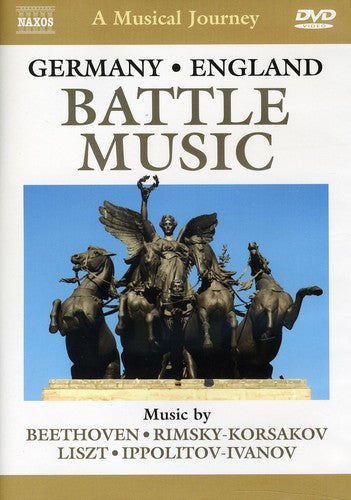
A Musical Journey - Battle Music: Germany / England
France - A Musical Tour Of The South Of France
The Places
The tour opens with views of the Camargue, the marshy region near Arles with its wild life. Views of the Côte d’Azur are intercut with glimpses of the Munich Glyptothek with its collections of Roman and Greek statuary. Near Arles is the ancient Abbey of Montmajour and the fortified monastery and Abbey on Saint-Honorat, one of the Iles de Lérins. In Arles we see the Roman theatre and necropolis and, at Saint-Rémy-de-Provence, the remains of the ancient Gallo-Greek town of Glanum.
The Music
Music for the tour includes Debussy’s evocative Prélude à l’après-midi d’un faune, two Gymnopédies by Erik Satie and Ravel’s two suites from his ballet Daphnis et Chloé, followed by his Introduction and Allegro for Harp, Flute, Clarinet and String Quartet.
Picture format: NTSC 4:3
Sound format: PCM Stereo / Dolby Digital 5.1 / DTS 5.1
Region code: 0 (worldwide)
Running time: 57 mins
No. of DVDs: 1
Czech Republic - Castles And Towns In Bohemia And Moravia
The visit to the Czech Republic starts with Hluboká Castle, a massive building that for over three hundred years belonged to the Schwarzenberg family. The present building is modelled in part on England's Windsor Castle. Other sites visited include Konopiště Castle, the picturesque town of Telč, and Vranov Castle.
The Music
Music for the visit is by Mozart and consists of his four Horn Concertos, written during the last decade of his life, when he was in Vienna. They were intended for his old Salzburg friend Ignaz Leutgeb, who had also settled in Vienna, prudently married there, and, in tandem with his musical activities, had become the owner of a small cheese-shop. The concertos, one of them unfinished at the time of Mozart's death, represent his work at its height.
Picture format: NTSC 4:3
Sound format: PCM Stereo / Dolby Digital 5.1 / DTS 5.1
Region code: 0 (worldwide)
Running time: 53 mins
No. of DVDs: 1
Gershwin: Concerto In F, Rhapsody No 2, I Got Rhythm Variations / Orion Weiss [blu-ray Audio]
Also available on standard CD
George Gershwin’s Concerto in F was a response to demands for a ‘proper concerto’ after the success of Rhapsody in Blue, avoiding programmatic content while providing a feast of tunes both uplifting and nostalgic. Originally intended as music for a film, his up-beat Rhapsody No 2 describes the bustling Manhattan cityscape while under construction. Sourced from his hit musical Girl Crazy, I Got Rhythm Variations was Gershwin’s last full score. Pianist Orion Weiss is one of the most sought-after soloists and collaborators of his generation of young American musicians.
Janáček: Taras Bulba, Lachian Dances / Wit, Warsaw Philharmonic
Leoš Janáček was an authority on his native folk-music, and the Lachian and Moravian Dances preserve and celebrate culture and traditions which were vanishing even in his own lifetime. Based on Gogol’s historical novel, Janáček’s inspired orchestral rhapsody on Taras Bulba depicts three moving and dramatic episodes in the violent life of the Cossack leader, climaxing in his stirring and triumphant prophecy of liberation. This release follows Antoni Wit’s acclaimed Warsaw recording of Janáček’s Glagolitic Mass and Sinfonietta (8.572639). Antoni Wit, one of the most highly regarded Polish conductors, studied conducting with Henryk Czyz and composition with Krzysztof Penderecki at the Academy of Music in Kraków, subsequently continuing his studies with Nadia Boulanger in Paris. In 2002 he became managing and artistic director of the Warsaw Philharmonic Orchestra.
REVIEWS:
Everything about this disc is fabulous: the performances, the coupling, and the sonics. Antoni Wit’s Taras Bulba sounds like no other. It’s full of details that you won’t have heard before, particularly in the layering of textures and shades of woodwind color. This is particularly obvious in the second movement, “The Death of Ostap”, but these personal touches never get in the way of an idiomatic, indeed visceral response to the music’s high drama. Wit builds the tension in the first movement’s successive episodes as well as anyone ever has, and releases it in a truly menacing battle sequence, with vicious contributions from the low brass. In the finale the Naxos engineers balance the organ and orchestra uncannily in the concluding apotheosis, which Wit conducts with a wholly individual combination of grandeur and serenity. It’s just plain wonderful.
Wit’s first Janácek disc contained the Glagolitic Mass and the Sinfonietta, and finding appropriate couplings for the composer’s scant orchestral output is never easy. There are the two other symphonic poems (The Ballad of Blaník and The Fiddler’s Child), some assorted overtures, the Schluck und Jau incidental music, the early works for string orchestra, and very little else. Wit’s choice of the two dance suites turns out to be an inspired decision, since they offer music that marries very well with Taras Bulba. The Lachian Dances are somewhat well known from recordings, though still a rarity in concert, but the Moravian Dances of 1891, a five-movement suite lasting about nine minutes, remains the preserve of Janácek specialists. They are delightful, and I offer a sample of No. 2 (“Kalamajka”). For the record, Wit omits the optional organ part in the Lachian Dances (the score refers to it as “inobligato”), a smart idea as the orchestration is already somewhat thick. Strongest recommendation.
– David Hurwitz, ClassicsToday.com
A Musical Journey - Germany: A Musical Visit to the Benedict
Prokofiev: Romeo and Juliet Suites Nos. 1 and 2 - Pushkin Wa
Strauss: Also sprach Zarathustra - Four Symphonic Interludes
Mahler: Symphony No. 1 / Alsop, Baltimore Symphony
This remarkably original work, with its recurring quotations from the composer’s own songs, notably Lieder eines fahrenden Gesellen (Songs of a Wayfarer) and Des Knaben Wunderhorn (The Boy’s Magic Horn), is the perfect expression of one of Mahler’s most quoted sayings, “The symphony is a world; it must contain everything”. The opening movement, filled with sounds that Mahler remembered from his childhood, depicts “Nature’s awakening from the long sleep of winter”, and is followed by an exuberant scherzo and trio based on a Ländler. The disturbing slow movement funeral march, based on the children’s song Frère Jacques, is unlike anything that had been heard before, and the symphony concludes with music of thrilling dramatic intensity.
REVIEWS:
In the finale the brass section is given its opportunity to step forward and they really deliver the goods. The trumpets, tuba, braying horns and tam-tam are thrilling in their impact. There is no distracting applause at the end of the symphony, thank goodness, and this allows for a few seconds thought before realising what a cracking performance has just taken place.
–MusicWeb International
This is a thoughtful performance, very reined-in for the most part, though when Alsop finally lets her Baltimore forces off the leash in the closing peroration the effect is so starling that it blows you away. Earlier on, there are moments when you feel she’s held too much back, particularly in the scherzo, which is overly deliberate. But the sense of wonder of the first movement, together with the ironies of the later funeral march, are breathtakingly done, and all that hard to balance counter-point is beautifully clear.
– Guardian (UK)
Delius: Appalachia, Sea Drift / Sanderling, Williams, Tampa Bay Master Chorale
It is a delight to welcome performances of two of Delius’s American-inspired works by forces from Florida, where Delius lived from 1892 to 1895. Although Sea Drift, a setting of a poem by Whitman, is overtly about an American subject, the music is more universal than specifically American. While the initial drafts of Appalachia were made in Paris the year after Delius left Florida - Marco Polo, Naxos’s sister label, once had a recording (8.220452) of this earlier version in their catalogues under the title of American Rhapsody - the work was very substantially expanded to the form we have it here some eight years later, long after Delius had returned to Europe.
I first heard Sea Drift in the original Beecham recording issued on a limited edition Delius Society release of four 78s (now on Naxos) - I still have them. Beecham’s account of the score remains a marvel of sympathetic identification with the spirits of both Whitman and Delius. Unfortunately all of his recordings - and there are a good many of them, from studio and live broadcasts, not all currently available - are in mono. This is a score which absolutely demands the atmosphere of stereophonic sound. Similarly Beecham never recorded Appalachia in stereo, and his last (mono) LP (reissued by Sony) suffered from a baritone who had seemingly been chosen for his ability to sing Danish for the coupled recording of the Arabesque rather than any ability to sing sympathetically in English for the closing ‘negro spiritual’ section of Appalachia. One cannot possibly accuse Leon Williams of sounding un-American, but the tone of his voice is nevertheless rather English and rather too polite. He is not helped by the rather close proximity of the microphone, which brings him closer than the rest of the performers rather than blending him into the whole. Bryn Terfel, in his Chandos recording of Sea Drift with Richard Hickox (coupled with the Songs of Sunset and Songs of Farewell), digs far more deeply into the meaning of the words than Williams does here. The emotion of the latter is too generalised, and his voice lacks the light and shade of Terfel or John Shirley-Quirk on Hickox’s earlier Decca recording.
Appalachia fares rather better in this reading. The orchestra relishes the contrasts in Delius’s set of variations, with a nicely winsome touch in passages such as the waltz variation at 19.57; Beecham allowed a very gusty breath of the ballroom to intrude here. Earlier they are beautifully atmospheric in the passage from 17.01 which recalls Delius’s Florida opera The magic fountain. The chorus is nicely distanced in their brief interjections in the earlier variations, and come into their own with the own variation at 27.50, when they appear to move closer. Unfortunately the close microphone placement given to Williams at 31.52 serves only to emphasise how precisely English is his diction, and the choir are now very far forward indeed, which brings a sense of stridency which is entirely foreign to the Delius idiom. The passage at 33.28 sounds uncomfortably like the closing titles for a Hollywood Western - not at all the area of America that Delius had in mind.
This Naxos disc duplicates exactly the contents of one of Richard Hickox’s earliest recordings of British music, issued originally on an Argo LP in 1980, with Shirley-Quirk at the peak of his form in the baritone solos, which is certainly a reading which deserves to be in any Delius collection - it remains available from Arkiv Music . The Naxos recording is more immediate in general sound than the analogue Hickox, but the latter has plenty of atmosphere and the Royal Philharmonic Orchestra - many of whose members must have played this music under Beecham - respond with affection to Hickox’s somewhat slower tempos. Indeed Sanderling could sometimes be accused of hurrying, as at the baritone entry at 2.58 where the soloist sounds a bit hustled. It is important to keep Delius’s music moving, not allowing it to stagnate, but the flow can be maintained without undue haste; Sanderling shaves nearly four minutes off Hickox’s speeds in his earlier recording, almost a fifth of the whole duration of a fairly short work. Beecham, even with the constraint of 78 sides, was slower than this, and Delius always expressed his conviction that this conductor understood his music better than anyone else.
It is always a suspicion that when one knows a particular performance well one might be allowing nostalgia to colour reactions to a performance. To test this I played the recording of Sea Drift to a friend of mine who, although he knew and loved the poem, did not previously know the music at all. He like me vastly preferred Hickox, observing that although that performance was noticeably slower, it at the same time had a sense of purposeful motion that Sanderling lacked. He also actually preferred the more integrated sound of the older recording.
Naxos’s cover photograph by Giorgio Fochesato is particularly beautiful and appropriate, and the booklet commendably includes the complete texts of both works. The orchestra and chorus both perform superbly; it is nice to hear a really big choir sing this music - 137 singers are listed - as Delius would have expected in his earlier performances. They maintain pitch even in the most exposed passages of Sea Drift.
-- Paul Corfield Godfrey, MusicWeb International
Percival's Lament / Ferrero, Capilla Antigua De Chinchilla
Rossini: Complete Overtures Vol 1 / Benda, Prague Sinfonia
Rossini wrote some of music’s most masterful and lovable operas. His gift for comic and tragic forms was matched by a relish for characterisation, qualities that are always evident in his overtures. La gazza ladra (The Thieving Magpie) is perhaps the most famous, one of the world’s most popular concert openers. But in Otello he reveals his more complex turns of phrase and in Le siège de Corinthe the writing is dramatic and colourful. The overture for Elisabetta, Regina d’Inghilterra was used again a year later by Rossini for Il barbiere di Siviglia. This is the first of four discs of the complete Rossini Overtures.
Pater Noster - A Choral Reflection on The Lord's Prayer / King’s Singers
GRAMMY®-Award winners in 2009, The King’s Singers are one of the world’s most celebrated ensembles. Their programming concept in this disc is unique: built upon the individual clauses of The Lord’s Prayer, beginning and ending in plainchant, it ranges over the centuries to explore the spiritually charged text. Chant is at the heart of the programme, and each composer’s setting illuminates the others, shedding rich interpretative light on the poetic and devotional aspects of the prayer.
Casella: La Donna Serpente; Introduzione, Aria E Toccata; Partita / La Vecchia, Rome SO

The composer that Casella most resembles in his chameleon-like musical personality is probably Martinu, and this is nowhere more true than in the Partita for piano and small orchestra. Scored for the distinctive combination of oboe, two clarinets, bass clarinet, three trumpets, timpani and strings, the work is an unalloyed delight. Listen to the end of the first movement recapitulation, and you’ll be hooked. Like Martinu’s Sinfonietta giocosa, the lightweight title in fact conceals a work of genuine substance, lasting (in this case) just over half an hour. The central Passacaglia (a form much exploited by Casella) is profoundly beautiful, and its evocative use of trills reveals that Casella learned a trick or two from the first Nachtmusik of Mahler’s Seventh, which he arranged for piano four-hands.
The Introduzione, aria e toccata again recalls (or foreshadows) Martinu–in this case the Toccata e due canzone. Like that piece, this is a substantial, at times brooding work brimming with memorable invention. The music’s stylized, neo-Baroque idiom couldn’t be farther removed from the nearly contemporary orchestral fragments from Casella’s only opera, La donna serpente (The Snake Woman), after a play by Gozzi. These “fragments” are actually pretty extensive, lasting a full half an hour, and if they pay homage to anyone I’d have to mention Rimsky-Korsakov. The Military March that ends the first suite evokes a fairytale atmosphere similar to that of The Golden Cockerel or Tsar Sultan, but there’s nothing Russian about the melodic material, which is completely personal.
This disc marks the conclusion of Naxos’ Casella series, and it has been a wonderful journey. As with the other discs, the performances are excellent. Sun Hee You does a wonderful job in the Partita, offering effortless virtuosity and an aptly light touch. There’s only one other recording available, featuring the very good Joshua Pierce, coupled to concertante works by Respighi and Rachmaninov, but conductor Franceso La Vecchia proves himself more imaginative an accompanist the Anton Nanut, and he also has the better orchestra and engineering. Casella truly was a great composer. The evidence on this disc is incontestable.
– David Hurwitz, ClassicsToday.com